UNIVERSITY OF TWENTE
Multifunctional Flood Defense
Structures
An Integrated Benefit Calculation Method
1
Table of Contents
1.0 Introduction ... 2
2.0 Research Model ... 3
3.0 Theoretical Points of Departure ... 3
4.0 Research Method ... 10
5.0 Method to calculate the benefits in MFFDs ... 12
6.0 How this method could work in reality? Illustration of the benefit calculation method in a MFFD ... 15
7.0 Conclusions & Discussion ... 25
8.0 Acknowledgement ... 28
Bibliography ... 29
APPENDIX (PROJECT’S PROFORMA) ... 32
Abbreviations
MFFDs: Multifunctional flood defense structures CBA: Cost benefit analysis
2
1.0
Introduction
The Netherlands is situated in the delta region of the Rhine, Meuse, Scheldt, and Ems rivers and has a long history of fighting the water element. Large parts have been developed alongside a river and in the most cases they lie below the sea level. As a result, the threat of a possible flood is always dominant. The economic development and population growth have increased the potential consequences of a flood event since more people and property are at risk of flooding. Moreover, the flood risk in urbanized areas is influenced by climate change. It is expected that the probability of flooding will increase due to the effects of climate change [1]. In addition, the rapid urban development, the consistent need for space and the increase in the number of people at risk in low-lying areas lead to the need for new dyke reinforcement technologies and new dyke designs. Therefore, instead of trying to enhance and enrich the already existing dykes by heightening up the walls or taking any other kind of measures; the new concept suggests the design of multifunctional flood defenses. The multifunctional dyke concept combines other functions with the primary flood protection function. In practice, incorporation of multiple functions requires over-dimensioning and may thereby help to create a robust dyke [2].
Nowadays, this design concept of multifunctional dyke has become increasingly popular among municipalities and private organizations since they want to implement solutions that will provide safety to the citizens but also be financially beneficial for them. Especially in urban areas, the opportunity of integrating housing, transport or infrastructure into a multifunctional flood defense is attractive in terms of efficient use of available space [3].
3
The focus of this research is to present the potential benefits that could be the result from the implementation of MFFDs, identify methods within the literature that could be used in order to calculate these benefits and develop an integrated method to calculate the benefits from MFFDs. In particular, the next section (section 2) presents the goal of this research and the research questions that will support the accomplishment of this goal. The next section (section 3) presents an overview of the benefits found in the existing literature and underlines the literature gap regarding the method of benefit calculation for MFFDs while section 4 explains the research method that we followed. Next, we explain how we will mitigate this gap (section 5) by presenting the integrated method for the benefit calculation in MFFDs. By implementing this method into a real project (section 6), we will check if this calculation is feasible and we conclude to some useful results but also suggestions for further steps to this direction (section 7).
2.0
Research Model
Research goal
The goal of this research is to develop an integrated method to calculate the benefits, derived from the construction of MFFDs.
To achieve the research goal, the following research questions should be answered:
What are the main potential benefits that derive from the construction of MFFDs?
Which methods could be applicable to calculate the benefits?
How these benefits can be calculated with an integrated method and consequently included in a CBA?
3.0
Theoretical Points of Departure
The literature review is the starting point of our research. First, we describe the different multifunctional design concepts and the kinds of functions that could accommodate. Then, a description of the benefits from MFFDs that have been already identified in previous studies follows. The section is concluded with methods that have been applied in other kinds of projects in order to calculate similar benefits but for different purposes.
3.1 Multifunctional Design concepts
4
a technical solution which provides the necessary flood protection and simultaneously provides space for other functions [4]. The table below presents these concepts with the possible functions that can be integrated [4]:
Multifunctional Design Possible Integrated functions
Coffer dam
- Infrastructural functions - Recreational functions - Green functions - Nautical functions
L-wall
- Infrastructural functions - Living functions
- Industrial functions - Business functions
Soil retaining wall
- Infrastructural functions - Living functions
- Industrial functions - Business functions - Recreational functions - Green functions - Nautical functions - Agricultural functions
Over sizing inner and outer slope - All the functions are possible
Step dyke
- Infrastructural functions - Recreational functions - Green functions - Nautical functions Table 1: Multifunctional designs with possible integrated functions
The exploitation of these functions could bring significant revenues. The next section describes the benefits that could derive from these functions as a part of a CBA.
3.2 Benefits of MFFDs in CBA
CBA is an economic tool that is usually used for project evaluation. CBA is the examination of a decision in terms of its consequences or costs and benefits [5]. These costs and benefits are quantified as much as possible and expressed in monetary terms. Costs and benefits occur in different years within the time horizon of the CBA. To deal with this, they are presented as so-called net present values (NPV) [6].
5
NPV<0, then normally the project should be rejected. However, in some exceptional cases, a project with a negative NPV could be accepted if there are important non-monetized benefits (e.g. for biodiversity preservation projects, cultural heritage sites, landscape) [31]. MFFDs could belong to this category since many of the benefits cannot easily be counted in monetary values. A CBA can be carried out to assess the profitability of a project by comparing the required costs for the project with the expected benefits. The basic principle of CBA requires that a project results in an increase of societal welfare, i.e. the societal benefits generated by the project should exceed the costs of it [7].
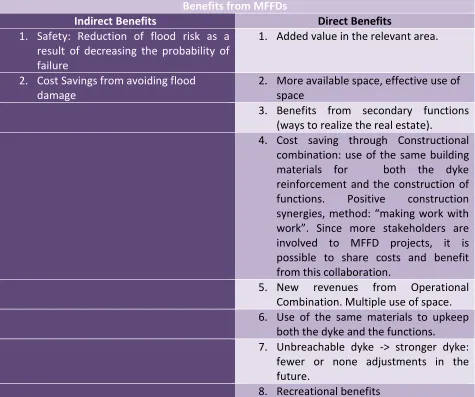
In the existing literature, there are several studies [8], [3], [4], [7], [9], [10] that point out the benefits that could be derived from the construction of MFFDs or from the multifunctionality in general. These benefits could be grouped to two main categories, the direct and the indirect benefits. The table below presents the overview of these benefits.
Benefits from MFFDs
Indirect Benefits Direct Benefits
1. Safety: Reduction of flood risk as a result of decreasing the probability of failure
1. Added value in the relevant area.
2. Cost Savings from avoiding flood damage
2. More available space, effective use of space
3. Benefits from secondary functions (ways to realize the real estate).
4. Cost saving through Constructional combination: use of the same building materials for both the dyke reinforcement and the construction of functions. Positive construction synergies, method: “making work with work”. Since more stakeholders are involved to MFFD projects, it is possible to share costs and benefit from this collaboration.
5. New revenues from Operational Combination. Multiple use of space. 6. Use of the same materials to upkeep
both the dyke and the functions. 7. Unbreachable dyke -> stronger dyke:
fewer or none adjustments in the future.
[image:6.612.71.546.306.703.2]6
The indirect benefits include the high level of safety and the costs that could be saved from damage avoidance. Multifunctional dykes are usually unbreachable and over-dimensioned. By constructing an unbreachable dyke the risk of total failure and subsequent total inundation is virtually zero and consequently the flood risk significantly reduced [10]. Therefore, an unbreachable dyke means a stronger dyke. This means that the dyke will need fewer or none adjustments in the future, which could reduce the maintenance costs [10]. In addition, by reducing the flood risk, we also avoid significant damage costs from a possible flood. There are several studies [11], [7], [12], [13] that analyze and calculate the benefits from avoiding flood since this benefit derives from any flood defense, either monofunctional or multifunctional. Therefore, in the terms of this research, we will not include these benefits in the integrated methods that we will develop.
On the contrary, we will focus on the direct benefits that could derive from the construction of MFFDs. These benefits can be considered as more commercial and financial since these benefits could affect the financial performance of a project. There are several researchers that have mentioned these benefits in previous studies [10], [2], [8]. Most of these benefits concern the extra space that becomes available which could be used effectively by accommodating various functions. In this way, the value of the area is increased while new ways to realize real estate are developed since multifunctional projects usually determine the new market price of land at the location and the change in the producer and consumer surplus as a result of the project. This happens because the multifunctional projects make extra space available for construction [9]. We estimate this effect by deriving the residual value of land in the project area from the expected value of the real estate to be constructed. This approach is also being used by municipalities in determining the rents for newly issued land.
7
of the functions, improving social cohesion [8]. In addition, the same materials could be used to upkeep both the dyke and the extra functions due to this operational combination [8].
The benefits from the exploitation of recreational functions could also be considered as direct benefits. The term ‘recreation benefits’ covers benefits arising from the enjoyment of landscape, wildlife and natural amenities as well as from the enjoyment of recreational activities. A multifunctional dyke can accommodate several recreational functions such as parks, boulevards or shopping buildings [4]. These functions will affect the value of the river or coast for recreational uses [12].
Most of these benefits are not included or fully included in CBA for potential multifunctional projects and consequently this design solution is often considered as expensive and unattractive. The economic challenges behind this opinion concern mainly the non-repetitive benefits that are delayed, dispersed, non-guaranteed and non-financial. These challenges hamper the willingness and the ability of private sector parties to invest in multifunctional projects [14]. Therefore, quite “traditional” solutions are prevalent [14].
Important to this research is to mitigate this gap by suggesting an integrated method to calculate the main benefits so that this calculation could be included in a CBA for MFFDs. We will pay special attention to the benefits that according to the literature are more frequent in MFFDs and have direct financial effect on the project. However, it is beyond the scope of this research to discuss the calculation of all the possible benefits. The benefits we consider in this research are: 1) benefits from the real estate realization, 2) benefits from the constructional combination, 3) recreational benefits and 4) benefits that derive from the added value in the relevant area. The next section presents methods for the calculation of benefits that have been identified in the literature and have been implemented in other kinds of projects.
3.3 Methods to calculate the benefits
There are several studies in different research fields that introduce methods to calculate similar benefits but in different kinds of projects (infrastructure, recreational, flood defense etc.). Therefore, these methods could also be suitable and become the basis for the calculation of the benefits from MFFDs. These methods are: the comparing rental value method, the travel cost method, the asset valuation method and the comparing alternatives method.
8
implemented this method in the infrastructure multifunctional project in the Amsterdam South Axis area to calculate the benefits from the rent of office and the sale of the dwellings that became available from the multifunctional land use.
The travel cost method (TCM) is a method that is mainly used to calculate recreational benefits. In this method, we collect data about the travel costs associated with accessing the amenity or recreational site. The travel cost method involves collecting data on the costs incurred by each individual in travelling to the recreational site or amenity. This method normally requires a survey on the field of the amenity. In particular, questionnaires are distributed to the visitors of the amenity; including questions about the price that each of them is willing to pay to visit this amenity. This ‘price’ paid by visitors is unique to each individual, and is calculated by summing the travel costs from each individuals original location to the amenity. By aggregating the observed travel costs associated with a number of individuals accessing the amenity a demand curve can be estimated, and as such a price can be obtained for the non-price amenity [15]. To calculate the value of the asset with this method, we use the following equation:
V = (T*w) + (D*v) + Ca Where,
T = travel time in hours
w = average wage rate (€/hour) D = distance (in km)
v = marginal vehicle operating costs Ca = cost of Admission to asset
There are studies [16], [17], [18], [19], [20], [21] which used this method to calculate the recreational value of a natural coastal area or the recreational beach use. In particular, Voke et al. [17] used the TCM to associate financial values with non-marketed aspects of the marine environment while Rolfe et al. [21] used this method to calculate the benefits form a visit to a beach along the coastline adjacent to the Great Barrier Reef in Australia. Also, this method has been applied in studies that aimed to calculate the recreational benefits from parks or lakes [22], [23], [24], [25]. In particular, Turpie et al. [24] calculated the benefits of a change in river quality on the tourism value of Kruger National Park in South Africa while Fleming et al. [23] used the TCM to calculate the recreational value of lake McKenzie in Australia and the method yields recreational values of the Lake ranging from $13.7 M. to $31.8 M per annum, or from $104.30 to $242.84 per-person per-visit.
9
the costs and the benefits of several alternatives for the same project in order to conclude to the most beneficial one. For example, Rik Jonker et al. [8] claim that on MFFDs, to find out which solution is more cost-effective, two alternatives should be examined: The costs and the benefits from the simultaneous construction of the dyke and the functions (constructional combination) should be compared with the ones from the separate developments. Also, Besseling et al. [9] used the same comparing method to find out the benefits from the multifunctional land use and the simultaneous construction of all functions in the Amsterdam South Axis area.
The same researchers [9] used also the asset valuation method to calculate the residual value of the land. The asset valuation method uses changes in the value of assets to estimate the benefits or costs of a project. The size of a price increase can be used to estimate the benefit of a project, and similarly the size of a price decrease can be used to measure the costs of a project or negative externality. They explained that the residential value can be derived as a balance of the net revenues of the real estate development of the land and the costs that must be made to make the land ready for building. The net revenues of the real estate development equal in their turn the balance of the revenues from exploitation of the real estate and the development/building costs and the costs of maintenance. A normal return to the capital constitutes a part of the development/ building costs.
The benefits that are calculated with these methods refer to year 0. However, the benefits should be calculated for the whole life cycle of the function. Therefore, the benefits should be calculated for all the years of the life cycle and be converted in prevent values. In order to do that, we use the discounting technique which converts all costs and benefits that occur in different time periods to present values so that they can be compared [4]. The present value of benefits is calculated as follows [15]:
PV = 𝐹
(1+𝑟)𝑛
Where, PV = present value
F = future value of cost or benefit in monetary terms r = the rate of discount
n = no. of periods under consideration (e.g. years)
For cases that the functions will last for multiple years, the formula that we use is the following:
PV =
∑
F10
In the next section, we will describe the research method that we followed in our research.
4.0
Research Method
In order to achieve the research goal, we conducted a case study. In particular, we used two different methods to collect the necessary data: 1) literature review and 2) documents from past projects. We decided to use this methodological triangulation and combine these methods of data gathering in order to ensure the validity of the research. In this way, we will check if the data of these different approaches match and we will be able to cross-check our findings [26]. The figure below presents the process that we followed.
Literature Review + Past Project
Identification of benefits in literature
and past projects
Search in literature for methods that calculate benefits in other fields and
check which benefits these methods could
calculate.
Combination of these methods to develop the integrated benefit calculation method for
MFFDs
Illustration of the method in a real MFFD
project
Figure 1: Research method
Literature review + Past projects Identification of benefits
The first step in our research was to identify the benefits from MFFDs that have been recognized in the existing literature and in past projects. The focus of our research was mainly on benefits that could be translated in monetary values and consequently could affect the financial perspective of the project. Consequently, we didn’t include benefits that are also derived from monofunctional flood defenses such as the avoided damage from a potential flood or the number of human lives that become safe due to flood defense. On the contrary, we identified several commercial benefits in the existing literature and in past projects and we wanted to check which of them were most frequent in these two sources.
Therefore, we examined four past projects from the Municipality of Rotterdam which included the implementation of multifunctional flood defense structures. We selected these cases in order to identify the benefits that were realized in these projects and add or verify the results from the literature review. The chosen past projects from the Municipality of Rotterdam were the following: the “Noordendijk Dordrecht”, the “Boompjes”, the “Stadionpark” and the “Brielse laan”. We chose these cases because they cover a significant range of possible multifunctional solutions, different kinds of integration and they explain the need to balance the costs and the benefits behind these projects.
11
the exploitation of the space that becomes available. When we gathered all the benefits from these two sources, we made a list and we compared these benefits in order to find out the most frequent that our integrated method should focus on. Also, we wanted to include benefits that could affect directly the financial perspective of the project and could contribute to the final decision during the decision making process.
Benefit calculation methods in the existing literature Develop the integrated
benefit calculation method for MFFDs
After the identification of the benefits, we searched methods in the existing literature that could calculate these benefits separately and normally in other fields but could be applicable in the case of MFFDs. We found four different methods which could calculate four of the identified benefits. These methods were (1) the comparing rental value method, (2) the travel cost method, (3) the asset valuation method and (4) the comparing alternatives method and the benefits that these methods could calculate were (1) benefits from the real estate realization, (2) recreational benefits (3) benefits that derive from the added value in the relevant area and (4) benefits from the constructional combination.
The next step was to combine these methods in order to develop the integrated benefit calculation method for MFFDs. To integrate these methods we combined the necessary data for the calculation of each benefit such as the available land, the land prices, the travel costs or the possible cost savings and we used them as a basis in order to develop the overall method that could lead to an efficient calculation of the benefits from MFFDs. Since each of the benefits is unique, it was not feasible to use only one of these methods to calculate all the benefits at once. On the contrary, all these methods together will provide a complete first impression for the benefits that we could expect from the construction of MFFDs and will enhance the decision making process in the comparison between the costs and the benefits of the project. The integration process can be divided into three steps: (1) identify the required data and formulas for the calculation of each benefit, found in existing literature, (2) calculate all the benefits for year 0 and the PV of these benefits for the whole life cycle of the project, and (3) combine all the calculations for the integrated benefit calculation method to a final proforma.
Illustration of the method in a real MFFD project
12
of them were not. However, none of these benefits have been calculated for this project in the past and therefore we suggest how we could calculate them by using the integrated benefit calculation method in order to include their calculation in a CBA.
The outcome of the research is presented in the next section where the suggested method for the calculation of the benefits from MFFDs is described while in section 6 an illustration example of this method in a case of MFFD project follows. Our results as well as their theoretical and practical implications are further discussed in section 7.
5.0
Method to calculate the benefits in MFFDs
Comparing rental value
method Available land for rent or sale
Land prices per sqm
Benefits from renting or selling the land
Asset valuation method Revenues from real estate development Costs for making the land ready for
building
Increase economic value of the relevant area Travel cost method Recreational benefits Travel information Distance form the amenity Comparing method between the alternatives Past projects
Two or more possible alternatives Benefits from Constructional combination= cost savings Calculation of benefits in
MFFDs
Final proforma of the project and calculation of NPV
IN P U T ME TH O D O U TP U T Available land (sqm) x land price (€/sqm)
Real estate benefits Vs building costs
V = (T*w) + (D*v) + Ca
Comparison of required costs among the alternatives
Calculation of the PV of all the benefits: PV = F/(1+r)n
PV of benefits
Define the life span of the project C a lc ul at io n fo r ye a r 0 C a lc ul ati o n fo r ye a r 0 C a lc ul at io n fo r ye a r 0 C a lc ul at io n fo r ye a r 0
First, we should identify the required data for the calculation of each benefit. In particular, to apply the comparing rental value method and calculate the benefits from renting or selling the land that becomes available, we should know the extra space that becomes available due to the multifunctional construction. Also, we need the rent/sale prices of this land per m2. Then we can calculate these benefits by multiplying the available land with the land prices. For the asset valuation method, we need first to calculate the revenues of the real estate development and the costs of making the land ready for building [9]. Then, we can calculate the increase in the economic value of the area as a balance between the real estate benefits and the building costs. To apply the TCM and calculate the recreational benefits from extra functions like parks or amenities on the top or next to the dyke, we should set travel zones around the amenity. Then, we should identify travel information such as fuel costs, travel time and visits per year as well as the distance between these travel zones and the amenity. The formula which calculates the recreational value of the amenity is the following:
V = (T*w) + (D*v) + Ca Where,
T = travel time in hours
w = average wage rate (€/hour) D = distance (in km)
v = marginal vehicle operating costs Ca = cost of Admission to asset
For the comparing alternatives method, we should comparedifferent alternatives based on the required costs and the expected benefits and calculate the benefits that could derive from the constructional combination. In particular, the potential benefits that we want to calculate with this method are the cost savings that we could have due to the constructional combination. Therefore, to apply this method, we need first to identify the alternatives. In the case of MFFDs we want to compare the required costs for the simultaneous construction of the dyke and the extra functions in comparison with their separate construction. Evidence from past multifunctional projects could also enhance this comparison. In this way, we will be able to identify if and how much money we can save from this constructional combination.
15 PV =
∑
F(1+𝑟)𝑛
Where, PV = present value
F = future value of cost or benefit in monetary terms r = the rate of discount
n = no. of periods under consideration (e.g. years)
The calculation of the benefits leads to the final proforma of the project. The proforma is a cash flow of the benefits for the whole life cycle of the project. This proforma gathers together all the benefits that we could expect from the project and therefore can be a part of a CBA. The final step is to calculate the NPV to check if it is positive or negative. The NPV can be calculated by using the following equation:
NPV = Total discounted benefits – Total discounted costs
In the next section, we present an illustration example of the integrated benefit calculation method in a real MFFD project.
6.0
How this method could work in reality? Illustration of the
benefit calculation method in a MFFD
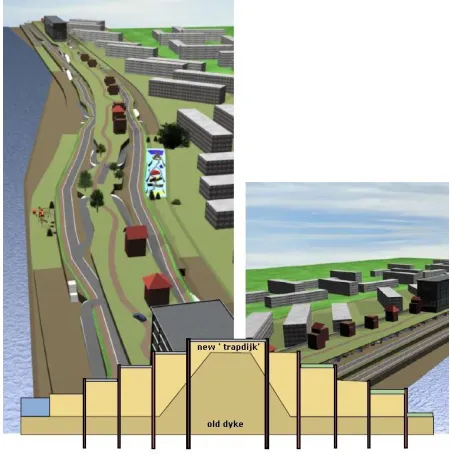
To check how the integrated benefit calculation method could be used to calculate the benefits from MFFDs, we applied it in a real MFFD project. The project ‘Waterwegcentrum (Waterway Centre) Hoek van Holland’ gave rise to the idea of the ‘step dyke’ (figure 1). Through the use of vertical walls, diaphragm walls or sheet piling, no space-demanding embankments are needed with dyke reinforcement, so the available horizontal surface can be designed efficiently for urban use [8]. In combination with the use of flood defense, there will be space for urban functions.
16
since the functions could be built on, in or under the flood defense structure, but does not directly retain water [27].
In addition, this project can also include tourism and recreational functions, housing, transport and public amenities in a coordinated way [28]. The project consists of an eastern and western planning area: The eastern planning area (“Waterwegcentrum Oost”) includes the construction of 550 new houses as well as shops, hotel and catering facilities. In the western planning area (Kaap de Goede Hoek, westelijk deel), a new dune area will be created. On both sides of the dune, 165 dwellings will be constructed and some apartment buildings [29].
Figure 3: "Step Dyke"
[image:17.612.193.418.230.461.2]17
We will calculate these benefits for this project by using the integrated benefit calculation method that is described in the previous section.
Comparing rental value method Benefits from renting or selling the available space or the functions:
The Municipality of Rotterdam offers 9 lots in the area of “Hoek van Holland Stationsweg” for building houses. These lots are presented in figure 2.
The sale prices as they are given from the Municipality of Rotterdam are presented in the table below:
Lot Area in m2 Price (€ per m2) Total purchase price(€)
A 772 475 366700
B 750 475 356250
C 745 475 353875
D 1085 450 488250
E 734 475 348650
I 711 475 337725
K 703 475 333925
L 978 480 469440
O 892 425 379100
Table 3: Prices of the available lots
18
Figure 4: Available lots from the Municipality of Rotterdam
19
dwellings. In this case of MFFDs, buildings are compared that could accommodate a hotel or restaurant.
For this situation, a rental price of €10.417/month for a hotel/restaurant in Zuid-Holland of approximately 1000 m2 is applied. Here, there is one lot of this size, so the total benefits will be €125,004. For the lots that are smaller and around 700m2-800m2, a rental price of €4,957/month is applied. Here, there are two lots of this size, so the total rent benefits are €118,968. Finally, for the lot between 800m2-950m2, a rental price of €6,500 /month is applied. Then the benefits for the total year are €78,000.
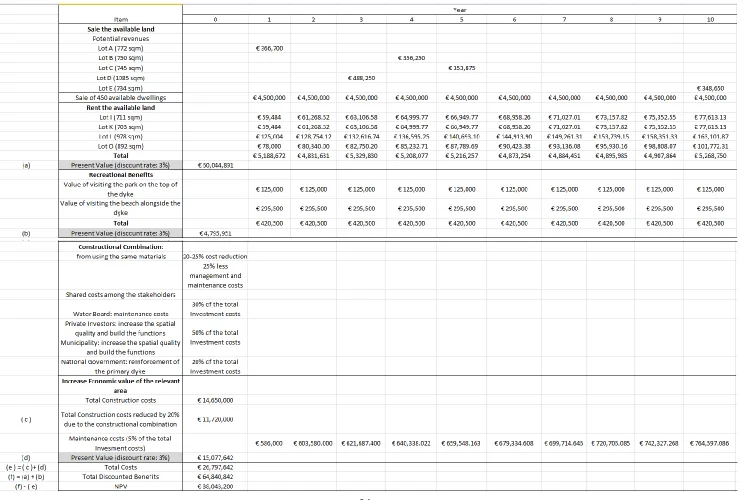
Except from these lots, as we mentioned above, there are also dwellings available for sale that can be used for residential purposes. The price range is between €130,000 respectively €1,650,000 for an apartment with the surface area of 100 respectively 500 m2 in the neighborhood of “Strand en Duin” [30]. Therefore, if we assume that all the 550 dwellings in the eastern area and the all the 165 in the western area will be sold in the average price of €500,000 then the total benefits will be €357,500,000 in year 0. However, in our case, we assume that 450 of the dwellings will be sold during the life cycle of the project gradually.
Asset Valuation method Increase Economic value of the relevant area
To apply this method we need to estimate the revenues of the real estate development and the costs of making the land ready for building [9]. This requires assumptions to be made concerning the developments at the land market. The project of “Kaap de Goede Hoek” includes the construction of 1200 dwellings in total for sale and the whole area is 12.000 m2 for both the houses, hotels and the other facilities. On the one hand, we assume that the building costs are €1000/m2. Then we have a total for the whole area of €12,000,000. Besides, we assume civil technical costs like excavation costs or preparation costs of the building site of €2,650,000 based on other multifunctional projects. Then the total costs will be €14,650,000. We assume that the maintenance costs will be 5% of the total investment costs.
On the other hand, the discounted benefits from the sale and rent of the available lots and the dwellings as they were calculated above are € 60,044,891.
20
the increased value are the location characteristics such as accessibility, availability and quality of facilities, economies of scale, and the quality of real estate.
Travel Cost Method (TCM) Recreational Benefits:
To calculate the recreational benefits from the additional functions that can be integrated in the dyke such as a park or a visit to the beach we will use the travel cost method. As we explained in section 3, this method requires the conduct of a survey in the field of the amenity (park, beach, etc.). However, in the terms of this illustration example for simplicity reasons, we will be based on assumptions regarding the data that we need to apply this method.
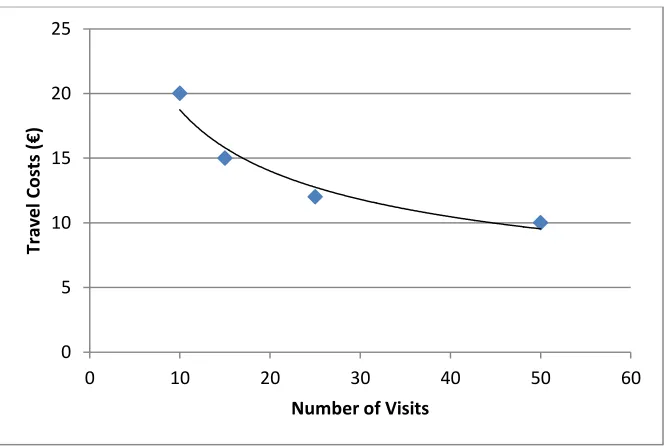
Let’s assume that we have four individuals that travel from 4 different locations. The table below presents these data:
Individual Start point Distance from the amenity(km)
Travel cost
(€) Visits/year
A Rotterdam 31.6 20 10
B Schiedam 25.8 15 15
C Delft 22.2 12 25
[image:21.612.101.513.281.394.2]D The Hague 18.6 10 50
Table 4: Data needed for TCM
By using this data, we can develop the demand curve.
Figure 5: Demand Curve
0 5 10 15 20 25
0 10 20 30 40 50 60
Tr
av
e
l Co
sts (
€
)
[image:21.612.141.474.433.656.2]21
In this curve we add data from other individuals in order to obtain the average price. The value of the asset can then been calculated if we multiply this average price with the total number of visitors.
For this project, the average price is €12.5 and the number of visitors on warm beach days is 60,000 to 70,000 for the whole beach area. If we assume that the visitors in the area which include the combination of the dyke and the functions will be 10,000, then the value of the asset is €125,000.
[image:22.612.75.542.319.601.2]To calculate the value of a visit to the park on the top of the dyke, we can apply another application of the travel cost method, used by the researchers. This is the zonal travel cost method in which the researcher can designate zones around the amenity. For example, let’s assume the park on the top of the dyke. We can set three zones around this asset. The zone A up to 10km, the zone B up to 20km and the zone C up to 30km. The picture below presents these travel zones.
Figure 6: Travel zones
22 Zone Travel Time
(hours)
Travel Distance (km)
Admission Cost (€) Visits per year
A 0.25 10 2.50 10000
B 0.55 20 2.50 8000
C 0.70 30 2.50 5000
Table 5: Data regarding the visit to the park
To calculate the value of the asset, we use the following equation: V = (T*w) + (D*v) + Ca
We assume that the average wage rate is €15/ hour. The marginal vehicle operating cost is 0.20cents/km
Therefore, the values of the asset for the zones A, B and C are presented in the table below:
Zone Value Average number of
visits Total value (value x number of visits) (€)
A 8.25 10000 82500
B 14.75 8000 118000
C 19 5000 95000
Table 6: Asset value for the zones A, B, C
The overall value of the park equal to, V = €295,500
Comparing alternatives method Constructional Combination
23
Furthermore, in other projects that included multifunctional structures other than flood defenses, the multifunctionality led to a cost reduction between 20% and 25%. Therefore, we can assume that also in this project, if everything is built at the same time, we can save around 25-30% of the total investment costs. Management and maintenance costs are reduced due to the shared responsibility. Past projects have proved that the implementation of multifunctionality leads to 25% less management and maintenance costs in comparison with the reinforcement of a traditional dyke.
Normally, in projects that include the reinforcement of traditional dykes both national government and the water boards pay 50% of the construction costs. The maintenance costs are fully covered by the water board. The national government only contributes when a dyke fails the national assessment and becomes part of the Flood Risk Protection Program. Ellen et al., (2011) have mapped different problems regarding financing multifunctional dykes. For example additional costs for maintenance and construction costs can become a problem, especially taken into account the precondition that the design of a dyke must be ‘robust, sober and effective’ [10].
In this project, the shareholders who are mainly involved are the municipality of Rotterdam, the water board and the private investors who will buy and exploit the available area. Normally, the water board is responsible for maintaining the dykes but they can also contribute to increasing the spatial quality like in the project “Hondsbossche and Pettemer Sea defense” or the project of “Streefkerk” where the water board paid the €0.1 million of the additional costs since in return they will have a 100 times extra strong dyke. However, they did not contribute to the development of the housing area [10]. Therefore, we can assume that in this project, the water board will cover the maintenance costs; the municipality in cooperation with private investors will cover the costs for increasing the spatial quality and build the functions and the national government will pay for the reinforcement of the primary dyke.
All the above benefits are calculated for the year 0. Therefore, the next step in our method is to calculate the present value of these benefits for the whole life cycle of the project. This calculation leads to the final proforma (figure 8) of the project. The proforma is a cash flow of the benefits for the life time of the functions which in this case we assumed that this life cycle will be 50 years. The calculation sheet presents the first 10 years but all the present values have been calculated for the life time of 50 years. The proforma for 50 years is presented in the appendix.
25
7.0
Conclusions & Discussion
The construction of MFFDs is a design concept that together with flood protection can provide other commercial functions which enhance the urban development and could bring revenues for all the involved parties. There are several benefits, derived from the construction of MFFDs that have been identified in the existing literature such as real estate benefits, increase in the economic value of the area or cost savings during the construction.
Until now some of these benefits were not included or fully included in a CBA for MFFDs. The reason is mainly that the calculation is considered complicated since the most of these benefits are non-financial and are lying far to the future [14]. However, in our research we introduce a method that includes the integrated calculation of some of these benefits. By using and applying the integrated benefit calculation method in a real case, we realized that the calculation of these benefits is feasible and that it could be included in a CBA in order to support the ex-ante evaluation of a project.
The suggested method includes and calculates the benefits from the real estate realization, the benefits from the constructional combination, the recreational benefits and the benefits that derive from the added value in the relevant area. However, as we described in the theoretical section, there are also more direct benefits that could derive from the construction of MFFDs, which could also be included in the method. In addition, it is important to take both the direct and the indirect possible benefits into account during the decision making process in order to conclude to the best solution. Until now, the indirect benefits such as the calculation of the avoided damage due to the flood defense were mostly included in a CBA for MFFDs. Our research suggests a way to include also the calculation of direct benefits that could derive for the exploitation of the extra space that becomes available and the implementation of extra functions in the area. Therefore, the integrated benefit calculation method could be considered a first step to that direction.
26
could be a tool for the decision makers who want to check the cost-efficiency of different alternatives within a project.
In the existing literature, there are methods to calculate these benefits separately and for different purposes. For instance, Besseling et al. implemented the comparing rental value method to calculate the rental benefits or Zhang et al. used the travel cost method to calculate the recreational benefits from a visit in a coast beach. However, up to now, there was little or none exploration of how the benefits from MFFDs can be calculated within a project and therefore it was difficult to include these benefits in a CBA during the decision making process. Oderker et al [4] and Veelen et al. [32] mention that special attention should be paid not only to the costs but also to the benefits within the construction of MFFDs in order to evaluate a MFFD. Therefore, our research suggests an integrated benefit calculation method that could be applicable in the case of MFFDs and limit this literature gap. This method uses the combination of existing methods in order to calculate the different benefits and provide an overall picture of the benefits that we should expect from the multifunctional solution. We decided to combine four different methods which we considered more suitable for the calculation of the benefits. However, it is possible that there will be more methods that could be also integrated and applied in the case of MFFDs.
The integrated benefit calculation method can not only be applied in a CBA for MFFDs, but it could also be used in general for the calculation of specific benefits. For example, recreational benefits could derive from different projects such as environmental or natural. Also, the real estate benefits and in particular the benefits from the rent or sale of the area are again benefits that we should take into account in almost all kind of projects that include the aspect of urban development. In addition, the way to calculate the increase in the value of the affected area is useful in many projects that include any kind of change even the construction of a road that would diminish the distance between a city and an amenity or in our case the construction of a multifunctional flood defense.
In addition, this method could also be used in other multifunctional projects that do not contain necessarily a flood defense but other functions such as a road and an underground parking area. Also, the method that we suggested can be applied in monofunctional projects that could generate these benefits and not only in multifunctional ones. For example, the method could be applied in infrastructure or recreational projects. Therefore, it could be applied in other countries and not only in countries that face a high risk of flood.
27
a result, further research could conduct a risk assessment and examine the risks behind these decisions. Furthermore, it would be interested for further research to examine the fluctuations in the real estate market due to the addition of extra functions.
Another limitation was that it wasn’t possible to calculate all the benefits. The main obstacle was that some of these benefits cannot easily be translated to monetary values. For example, the fact that the construction of MFFDs could lead to more effective use of space is a benefit that cannot be calculated in terms of money. In addition, the benefit of using the same materials to upkeep both the dyke and the extra functions could be calculated but this can be done only further in the life cycle of the project and not in advance. Therefore, we suggest that further research could be done in a different point during the life cycle of the project which will calculate these benefits and compare them with the solution of a traditional dyke.
Furthermore, there were also limitations regarding the different methods that we decided to combine in order to develop the integrated benefit calculation method. For example, the TCM that we used to calculate the recreational benefits requires a survey, in which questionnaires should be distributed to visitors asking them about the amount of money that they are willing to pay in order to visit an amenity. However, it may actually be quite difficult to measure the cost of accessing a site or amenity. This is because of the opportunity cost associated with the travel time. If the opportunity cost of all individuals is the same then the estimated price will be accurate. If, however, the opportunity cost of individuals accessing the site varies, which is more likely, then the measure will be inaccurate [15]. Another limitation regarding this method is that the estimation of willingness to pay used in the TCM is usually for the entire site access rather than specific features. The TCM only provides a price or value relating to the cost of accessing the amenity or recreational site and it does so for the whole site. It may, however, be the case that we wish to value a certain aspect of the site in our project appraisal [15]. For example, in the case of MFFDs we do not wish to value all the functions, but instead the park on the top of the dyke. Therefore, further research could conduct a real survey and calculate precisely the recreational benefits in a case of MFFDs.
28
Furthermore, regarding the benefit of constructional combination, we assumed a total percentage of savings due to this benefit. However, further research could focus only on the phase of construction and estimate the exact amount of money that could be saved from the less needed quantities of materials in a simultaneous construction of the dyke and functions in comparison with the separate construction of them. In addition, further research could analyze the synergetic effects due to the integration of functions.
Finally, we presented the benefit from the share of costs between the involving parties. As we have already mentioned, this benefit requires the total agreement among the stakeholders regarding who will pay for what and of course who will reap the benefits. This agreement is difficult to be achieved from the beginning of a project since the participants have different interests and criteria in making funds available and have different time horizons in their goals [3]. Therefore, further research could be conducted for these communication requirements among the involving parties and focus on ways for better distribution of the costs and benefits among the stakeholders.
8.0
Acknowledgement
First and foremost, I would like to express my gratitude to my supervisors Dr. Timo Hartmann, Ms. Julieta Matos Castano and Mr. Peter van Veelen. Without their help and guidance I couldn’t accomplish my thesis research. Their instructions through the whole process helped me not only to fulfil my thesis but also learn valuable things for my future career. Even the “hard” moments were an extra motivation which encouraged me to concentrate and achieve my goal. I would also like to thank the Municipality of Rotterdam for the support during my internship there.
29
Bibliography
[1] B. Stalenberg, Innovative Flood Defenses in Highly Urbanized Water Cities, 2012.
[2] J. v. Loon-Steensma and P. Vellinga, "Robust, multifunctional flood protection zones in the Dutch Rural Riverine area," 2013.
[3] J. M. v. Loon-Steensma, "Flood protection: planning, design and management of flood defense zones," 2012.
[4] M. Oderker and Vermeer Dura, "Design concepts of multifunctional flood defence structures," 2013.
[5] J. DREZE and N. STERN, "THE THEORY OF COST-BENEFIT ANALYSIS," 1987.
[6] P. Rietveld and B. v. Wee , "Ex ante evaluation of railway station development projects: Issues still to be solved".
[7] S. Jonkman, M. Brinkhuis-Jak and M. Kok, "Cost benefit analysis and flood damage mitigation in the Netherlands," 2004.
[8] R. Jonker , J. v. d. Heijden and M. Altamirano , "Water – its control and combination, Multifunctionality and flood defenses," 2013.
[9] P. Besseling, J. Ebregt, R. Saitua and I. Ossokina , "Multifunctional land use in the Amsterdam South Axis area: a cost- benefit analysis," 2005.
[10] M. Tettero, "A breakthrough with multifunctional unbreachable dykes," 2013. [11] E. P. A. PRACTICES, "Understanding the FEMA Benefit-Cost Analysis Process".
[12] F. a. F. Ministry of Agriculture and Flood and Coastal Defence with Emergencies Divisio, "Flood and Coastal Defense Project, Appraisal Guidance," 1999.
30
[14] A. Gleijm and E. Gerdes, "Bridging the gap in water related climate adaptation projects," 2012.
[15] "CBA Builder," [Online]. Available: http://www.cbabuilder.co.uk/.
[16] S. MARZETTI DALL’ASTE BRANDOLINI, "Investing in biodiversity:The recreational value of a natural coastal area," 2005.
[17] M. Voke, I. Fairley, M. Willis and I. Masters, "Economic Evaluation of the recrational value of the coastal environment in a marine renewables deployment area," 2013.
[18] J. Windle and J. Rolfe, "Estimating nonmarket values of Brisbane (state capital) residents for state based beach recreation," 2013.
[19] J. C. Whitehead, . T. C. Haab and J.-C. Huang, "Measuring recreation benefits of quality improvements with revealed and stated behavior data," 1999.
[20] F. Zhang, X. H. Wang, P. A. Nunes and C. Mad , "The recreational value of gold coast beaches, Australia: An application of the travel cost method".
[21] J. Rolfe and D. Gregg, "Valuing beach recreation across a regional area: The Great Barrier Reef in Australia," 2012.
[22] S. Alvarez and S. L. Larkin, "Valuing Recreational Benefits of a National Park in Andean Columbia," 2008.
[23] C. M. Fleming and A. Cook, "The Recreational Value of Lake McKenzie: An Application of the Travel Cost Method," 2007.
[24] J. Turpie and A. Joubert, "Estimating potential impacts of a change in river quality on the tourism value of Kruger National Park: An application of travel cost, contingent and conjoint valuation methods," 2001.
[25] E. B. Musamba, E. K. Boon, Y. M. Ngaga, R. A. Giliba and T. Dumulinyi, "The Recreational Value of Wetlands: Activities, Socio-economic Activities and Consumers’ Surplus around Lake Victoria in Musoma Municipality, Tanzania," 2012.
[26] L. A. Guion, "Triangulation: Establishing the Validity of Qualitative Studies," 2002.
31 FLOOD DEFENCES".
[28] E. C. I. I. IIIB, "N°233 | Waterwaycentre Hoek van Holland at Sea," [Online]. Available: http://3b.nweurope.eu/page/projetIdea.php?p=&id=233#5.
[29] Delatares, " Kaap de Goede Hoek - Waterwegcentrum Hoek van Holland," 2008. [Online]. Available: https://publicwiki.deltares.nl/display/KWI/4.3.01.+Kaap+de+Goede+Hoek+-+Waterwegcentrum+Hoek+van+Holland.
[30] "FUNDA," [Online]. Available: http://www.funda.nl/koop/hoek-van-holland/.