Matrix Representations of Intuitionistic Fuzzy Graphs
M.G.Karunambigai
⋆,O.K.Kalaivani
⋆⋆
Department of Mathematics,Sri Vasavi College,Erode-638016,
Tamilnadu,India.
([email protected],
[email protected].)
May 23, 2016
Abstract
Matrices play an important role in the broad area of science and engineering. However, the classical matrix theory sometimes fails to solve the problems involving uncertainties, occurring in an imprecise environment.Sometimes it seems to be more natural to describe imprecise and uncertain opinions not only by membership functions and also by non membership function. In this paper, it is proved that (CON Nµ(G)(vi, vj), CON Nν(G)(vi, vj)) = (i, j)th entry of A+A2+...+An−1, ∀vi ̸= vj ∈ V , where
A is the index matrix of the intuitionistic fuzzy graph G and Ak is the kth power of an intuitionistic
fuzzy matrix A and (CON Nµ(G)(vi, vj), CON Nν(G)(vi, vj)) is the strength of connectedness of vi and
vj. Also, the properties of subdivision IFG, line IFG and power of an IFG are discussed.
2010 Mathematics Subject Classification: 05C72, 03E72, 03F55.
Index Terms: incidence intuitionistic fuzzy matrix, line intuitionistic fuzzy graph, Power of an intuitionistic fuzzy graph, subdivision intuitionistic fuzzy graph.
I
Introduction
Graphs can be sometimes very complicated. So one needs to find more practical ways to represent them.
Matrices are a very useful way of studying graphs, since they turn the picture into numbers. Networks can represent all sorts of systems in the real world. As computers are more adept at manipulating numbers than at
recognizing pictures, it is standard practice to communicate the specification of a graph to a computer in matrix form. Matrices play an important role in the broad area of science and engineering. However, the classical matrix
theory sometimes fails to solve the problems involving uncertainties, occurring in an imprecise environment. Sometimes it seems to be more natural to describe imprecise and uncertain opinions not only by membership
functions and also by non membership function.So an Intuitionistic fuzzy matrix is the appropriate choice when exhibiting the membership degree and non- membership degree. In 1975, Rosenfeld [17] discussed the concept of
fuzzy graphs whose basic idea was introduced by Kauffmann [12] in 1973. The fuzzy relations between fuzzy sets were also considered by Rosenfeld and he developed the structure of fuzzy graphs, obtaining analogs of several
graph theoretical concepts. The first definition of fuzzy graph was introduced by Kaufman[12] in 1973, based on Zadeh’s fuzzy relations in 1971[20]. Atanassov[3][19] introduced the concept of intuitonistic fuzzy(IF) relations
and intuitionistic fuzzy graphs(IFGs). M.G.Karunambigai and R.Parvathi[10][14] introduced the concept of IFG elaborately and analysed its components. Atanassov introduced the index matrix reresentation of intuitionistic
fuzzy graphs and discussed its operations in [5][4][6]. Akram et al. discussed the properties of strong intuitionistic fuzzy graphs and also the properties of intuitionisic fuzzy cycle and intuitionistic fuzzy trees in [1][2]. R.Parvathi
et al.[16] discussed operations on intuitionistic fuzzy graphs using index matrices. Intuitionistic fuzzy matrix
are extensively used for decision making problems, cluster analysis, pattern recognition, medical diagnosis and network problems. Intuitionistic fuzzy matrices can be used whenever uncertainity occurs in a problem. These
application motivated us to consider intuitionistic fuzzy matrices and discuss its properties. The paper is organized as follows. In section 2, we review the basic definitions of intuitionistic fuzzy graph. Section 3 deals
with the properties of the power of an intuitionistic fuzzy graph and given the relationship between the index matrix of an intuitionistic fuzzy graph and power of an intuitionistic fuzzy graph and section 4 concludes the
paper.
II
Preliminaries
In this section, the basic definitions and Theorems which are used to prove the forthcoming results are given.
Definition 2.1 [8] A crisp graph G∗ = (V, E) is an ordered triple (V(G∗), E(G∗), ψG∗) consisting of a
non-empty V(G∗) of vertices, a set E(G∗), disjoint from V(G∗), of edges and an incidence function ψG∗ that
associates with each edge of G∗ an unordered pair of vertices of G∗.
Definition 2.2 [8]Let G∗ = (V, E) be a crisp graph. A walk is a sequence of vertices and edges, where the endpoints of each edge are the preceding and following vertices in the sequence. A path is a walk without repeated vertices. If a walk (resp. trail, path) begins at u and ends at v then it is an u−v walk. A walk is closed if it begins and ends at the same vertex.
Definition 2.3 [8] Let G∗= (V, E) be a crisp graph. The length of a path P =v1v2...vn+1 in G is n.
Definition 2.4 [8] Let G∗= (V, E) be a crisp graph. The distance between the two vertices vi and vj in G∗
is denoted by dG∗(vi, vj) and is defined as the minimum length of the path connecting the vertices vi and vj.
Definition 2.5 A matrix is a rectangular array of numbers arranged in rows and columns. The number of rows and columns that a matrix has, called its dimension or its order. That is , the dimension or order of a matrix with m rows and n columns is m×n. The individual items in a matrix are called its elements or entries.
Definition 2.6 Let A= [aij] and B = [bij] be two matrices. Then two matrices A and B are equal to each
other, if they have the same dimensions m×n and the same elements aij=bij fori= 1, ..., nandj= 1, ..., m.
It is denoted by A=B
(1) V ={v1, ..., vn} such that µi :V →[0,1] and νi :V →[0,1], denotes the degree of membership and
non-membership of an element vi∈V respectively and 0≤µi+νi≤1, for every vi∈V,
(2) E⊆V ×V where µij:V ×V →[0,1] and νij:V ×V →[0,1] are such that µij≤min(µi, µj)
νij ≤max(νi, νj),
denotes the degree of membership and non-membership of an edge eij = (vi, vj)∈E respectively, where, 0≤µij +νij ≤1, for every eij = (vi, vj)∈E. The degree of hesitance(hesitation degree) of the vertex vi∈V in G is Πi= 1−µi−νi and the degree of hesitance(hesitation degree) of an edge eij = (vi, vj)∈E
in G is Πij = 1−µij−νij.
Definition 2.8 [10] Let G= (V, E) be an intuitionistic fuzzy graph.A walk is a sequence of vertices and edges, where the endpoints of each edge are the preceding and following vertices in the sequence, such that either one of the following conditions is satisfied.
1) µij >0 & νij = 0 for some i & j. 2) µij >0 &νij >0 for some i & j. If a walk begins at vi and
ends at vj then it is an vi−vj walk. A walk is closed if it begins and ends at the same vertex.
Definition 2.9 [10] Let G= (V, E) be an intuitionistic fuzzy graph. A path P in an intuitionistic fuzzy graph
G is a sequence of distinct vertices v1, v2, ..., vn such that either one of the following conditions is satisfied.
1) µij >0 & νij = 0 for some i & j. 2) µij >0 & νij>0 for some i &j.
Definition 2.10 [10] Let G= (V, E) be an intuitionistic fuzzy graph. The length of a path P =v1v2...vn+1
(n >0) in G is n.
Definition 2.11 [10] An intuitionistic fuzzy graph G= (V, E) is connected if any two vertices are joined by a path.
Definition 2.12 [10] Let G= (V, E) be an intuitionistic fuzzy graph. The µ− strength of a path P =v1v2...vn
in an intuitionistic fuzzy graph G is denoted by Sµ(G)(P) and is defined as min{µij}, for all i, j= 1,2, ..., n
Definition 2.13 [10] Let G= (V, E) be an intuitionistic fuzzy graph. The ν− strength of a path P =v1v2...vn
in an intuitionistic fuzzy graph G is denoted by Sν(G)(P) and is defined as max{νij}, for all i, j= 1,2, ..., n
Definition 2.14 [10] If vi, vj∈V ⊆G, the µ− strength of connectedness between the vertices vi and vj in G is CON Nµ(G)(vi, vj) = max{Sµ(G)(P)} and ν− strength of connectedness between the vertices vi and vj
in G is CON Nν(G)(vi, vj) = min{Sν(G)(P)} for all possible paths between vi and vj.
Definition 2.15 [10] An intuitionistic fuzzy graph, G= (V, E) is said to be a strong intuitionistic fuzzy graph if
µij= min(µi, µj)and νij = max(νi, νj), ∀(vi, vj)∈E.
Definition 2.16 [10] An intuitionistic fuzzy graph, G= (V, E) is said to be a complete intuitionistic fuzzy graph if
Definition 2.17 [13] The order of an intuitionistic fuzzy graph G = (V, E) is defined as O(G) = (Oµ(G), Oν(G)) where
Oµ(G) =
∑
vi∈V
µi andOν(G) =
∑
vi∈V νi
Definition 2.18 [13] The size of an intuitionistic fuzzy graph is defined as S(G) = (Sµ(G), Sν(G))
Sµ(G) =
∑
eij∈E
µij andSν(G) =
∑
eij∈E νij
Definition 2.19 [13] Let G= (V, E) be an intuitionistic fuzzy graph. The neighbourhood of a vertex vi∈V
is denoted by NG(vi) and is defined as NG(vi) ={vj∈V|(vi, vj)∈E}.
Definition 2.20 The function f :X →Y is an one to one function if and only if for every element y ∈Y
there is exactly one element x∈X. In Symbol, f(x) =f(y)⇒x=y,∀x, y∈X.
Definition 2.21 The function f :X →Y is an onto function if and only if for every element y∈Y there is at least one element x∈X. In Symbol, f(x) =y,∀y∈Y .
Definition 2.22 A function f :X →Y is a bijection if the function is both one-one and onto mapping of a set X to a set Y .
Definition 2.23 [11] A homomorphism from a intuitionistic fuzzy graph G1 = (V1, E1) to a intuitionistic
fuzzy graph G2 = (V2, E2), written f : G1 →G2, is a mapping f : V1 →V2 from the vertex set of G1 to
the vertex set of G2 such that if any two vertices vi, vj ∈V1 are adjacent in G1, then f(vi), f(vj)∈V2 are
adjacent in G2 and
µ(vi)≤µ′(f(vi))andν(vi)≥ν′(f(vi)),∀vi∈V1
µ(vi, vj)≤µ′(f(vi), f(vj))andν(vi, vj)≥ν′(f(vi), f(vj)),∀vi, vj ∈V1.
Definition 2.24 [11] Two intuitionistic fuzzy graphs G1 = (V1, E1) and G2 = (V2, E2) are said to be
isomorphic if there is a bijections f : V1 → V2 such that any two vertices vi, vj ∈ V1 are adjacent in G1
if an only if f(vi), f(vj)∈V2 are adjacent in G2 and
µ(vi) =µ′(f(vi))andν(vi) =ν′(f(vi)),∀vi∈V1
µ(vi, vj) =µ′(f(vi), f(vj))andν(vi, vj) =ν′(f(vi), f(vj)),∀vi, vj ∈V1.
Definition 2.25 [11] Two intuitionistic fuzzy graphs G1= (V1, E1) and G2= (V2, E2) are said to be co-weak
isomorphic if there is a bijections f :V1→V2 such that any two vertices vi, vj∈V1 are adjacent in G1 if an
only if f(vi), f(vj)∈V2 are adjacent in G2 and
µ(vi)≤µ′(f(vi))andν(vi)≥ν′(f(vi)),∀vi∈V1
Definition 2.26 [9] Let G1= (V1, E1) and G2= (V2, E2) be two IFGs with V1∩V2̸=ϕ. Then the union of
G1 and G2 is an IFG, denoted by G1∪G2= (V1∪V2, E1∪E2) and is defined as
((µ∪µ′)(vi),(ν∪ν′)(vi)) =
(µi, νi), if vi∈V1−V2,
(µ′i, νi′), if vi∈V2−V1,
(max(µi, µ′i),min(νi, νi′)) if vi∈V1∩V2.
(µ∪µ′)(vi, vj) =
µij ifeij∈E1−E2,
µij′ ifeij∈E2−E1,
max(µij, µ′ij) ifeij∈E1∩E2,
min((µi∪µ′i),max(µj, µ′j)) if vi∈V1−V2,
vj∈V1∩V2 and
eij∈E1−E2
oreij∈E2−E1,
(0,1) otherwise.
(ν∪ν′)(vi, vj) =
νij if eij∈E1−E2,
νij′ if eij∈E2−E1,
min((νi∪νi′),(νj∪νj′)) if eij∈E1∩E2,
max((νi∪νi′),min(νj, νj′)) if vi∈V1−V2,
vj∈V1∩V2 and
eij∈E1−E2
oreij∈E2−E1,
(0,1) otherwise.
Definition 2.27 [15] An intuitionistic fuzzy matrix(IFM) is a matrix of order m×n and is defined as
and 1≤j≤n. It can also be represented in the matrix form,
A={< aµij, aνij >}m×n=
< aµ11, aν11 > < aµ12, aν12 > ... < aµ1n, aν1n>
< aµ21, aν21 > < aµ22, aν22 > ... < aµ2n, aν2n>
...
< aµm1, aνm1 > < aµm2, aνm2 > ... < aµmn, aνmn>
Definition 2.28 The number of rows and columns that IF matrix has called its dimension or its order. That is , the dimension or order of IF matrix with m rows and n columns is m×n. The individual items in an IF matrix are called its elements or entries.
Definition 2.29 [15] Let A = {< aµij, aνij >}m×n be a intuitionistic fuzzy matrix. The transpose of the
matrix A is denoted by AT and is defined as AT ={< a
µji, aνji >}n×m.
Definition 2.30 LetA = {< aµij, aνij >}m×n and B = {< bµij, bνij >}m×n be two intuitionistic fuzzy
matrices. Then two IF matrices A and B are equal to each other, if they have the same dimensions m×n
and the same elements aµij =bµij, aνij =bνij fori= 1, ..., m andj= 1, ..., n. It is denoted by A=B
Definition 2.31 Let A = {< aµij, aνij >}m×n and B = {< bµij, bνij >}m×n be two intuitionistic fuzzy
matrices, then the sum of A and B is denoted by A +max−minB, is defined as A+max−minB = {<
cµij, cνij >}m×n= [<max(aµij, bµij),min(aνij, bνij)>], 1≤i≤m,1≤j≤n.
Notation 2.1 Throughout this paper, we denote ′′+′′max−min as ′′+′′.
Theorem 2.2 [8] If a crisp graph G∗ contains a u−v walk of length l, then G∗ contains a u−v path of length l.
Theorem 2.3 [8] Let G∗ be a crisp graph. Then G∗ is connected if and only if every pair of vertices in G∗
is connected.
III
Matrix Representations of Intuitionistic Fuzzy Graphs
In this section, the properties of the power of an intuitionistic fuzzy graph and the relationship between the
index matrix of an intuitionistic fuzzy graph and power of an intuitionistic fuzzy graph have been analysed.
Definition 3.32 Let A = {< aµij, aνij >}m×n and B = {< bµij, bνij >}n×p be two intuitionistic fuzzy
matrices. Then the two types of product of A and B are defined as
1) max−min product of IF matrices : A•max−minB = {< cµij, cνij >}m×p = [< max(min(aµij, bµjk)), min(max(aνij, bνjk))>], 1≤i≤m,1≤j≤p,1≤k≤n and
Definition 3.33 Let A={< aµij, aνij >}m×n be intuitionistic fuzzy matrix and k is a positive integer. Then
the kth power of an intuitionistic fuzzy matrix is denoted by Ak and is defined as max−min product of k−
copies of an intuitionistic fuzzy matrixA.
Definition 3.34 [5] Let G = (V, E) be an intuitionistic fuzzy graph. The index matrix representation of intuitionistic fuzzy graph(IMIFG) is of the form [V, E⊂V ×V] where V = {v1, v2, ..., vn} and
E={< µij, νij>}m×n =
v1 v2 ... vn
v1 < µ11, ν11> < µ12, ν12> . . . < µ1n, ν1n >
v2 < µ21, ν21> < µ22, ν22> . . . < µ2n, ν2n >
..
. . . .
vn < µn1, νn1> < µn2, νn2> . . . < µnn, νnn>
where < µij, νij >∈ [0,1]×[0,1](1 ≤ i, j ≤ n), the edge between two vertices vi and vj is indexed by < µij, νij>.
Note 3.4 Index matrix representation of any intuitionistic fuzzy graph is an intuitionistic fuzzy matrix.
Definition 3.35 Let G = (V, E) be an intuitionistic fuzzy graph where V = {v1, v2, ..., vn}. The incidence
matrix of an intuitionistic fuzzy graph G is B ={< bµij, bνij >}n×m, where n and m represents the number
of vertices and number of edges of G respectively, whose entries of B are as follows:
B={< bµij, bνij >}n×m=
< µ(ej), ν(ej)>,if an edge ej is incident on the vertex vi
<0,1>, otherwise
It can also be represented in the matrix form,
B={< bµij, bνij >}n×m=
e1 e2 ... en
v1 < µ(e1), ν(e1)> < µ(e2), ν(e2)> . . . < µ(en), ν(en)>
v2 < µ(e1), ν(e1)> < µ(e2), ν(e2)> . . . < µ(en), ν(en)>
..
. . . .
vn < µ(e1), ν(e1)> < µ(e2), ν(e2)> . . . < µ(en), ν(en)>
where < µ(ej), ν(ej)>∈[0,1]×[0,1].
Definition 3.36 Let G = (V, E) be an intuitionistic fuzzy graph, where V = {v1, v2, ..., vn} and E = {e1, e2, ..., ek}. Then the line intuitionistic fuzzy graph is denoted by GL = (VL, EL), where the vertices of GL are in one-one correspondence with the edges of G and there exist an edge between the vertices of GL if
and if only if the corresponding edges of G are adjacent. The membership and non-membership value of VL
andEL are defined as follows:
µL(vi) =µ(ei)andνL(vi) =ν(ei),∀ei∈E.
µL(vi, vj) =
min(µL(vi), µL(vj)),if ei and ej are adjacent in G
(0,1), otherwise
νL(vi, vj) =
max(νL(vi), νL(vj)),ifei and ej are adjacent in G
(0,1), otherwise
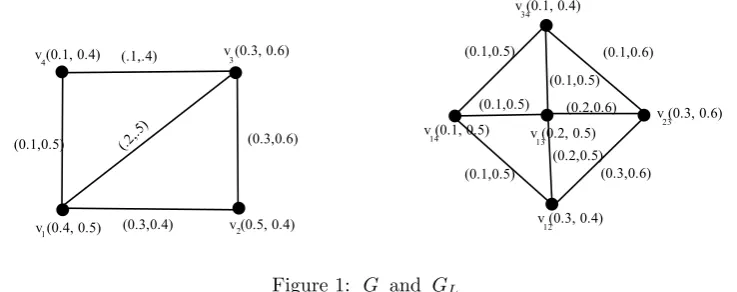
Example 3.1 Consider an intuitionistic fuzzy graph, G = (V, E), such that V = {v1, v2, v3, v4},
[image:8.595.143.512.405.551.2]E = {(v1, v2),(v1, v3),(v2, v3),(v3, v4),(v4, v1)} and VL = {v12, v23, v34, v14, v13} and EL = {(v12, v23),(v23, v34),(v34, v14),(v14, v12),(v12, v13),(v14, v13),(v13, v23),(v13, v34)}
Figure 1: G and GL
Definition 3.37 Let G= (V, E) be an intuitionistic fuzzy graph with the underlying crisp graph G∗= (V, E). Then the subdivision of an intuitionistic fuzzy graph G is denoted by Gsd= (Vsd, Esd) and is obtained by adding
a new vertex uk into every edge eij = (vi, vj)∈E of G such that the membership and the non-membership
of the vertex vk and the edges viuk and ukvj are defined as follows:
µsd(uk) =µij andνsd(uk) =νij,∀uk∈Vsd
µsd(vi, uk)≤min(µsd(vi), µsd(uk))andνsd(vi, uk)≤max(νsd(vi), νsd(uk))
Example 3.2 Consider an intuitionistic fuzzy graph, G = (V, E), such that V = {v1, v2, v3, v4, v5},
E = {(v1, v2), (v1, v5), (v2, v3),(v2, v4),(v3, v4),(v4, v5)} and Vsd = {v1, v2, v3, v4, v5, u1, u2, u3, u4, u5} and
[image:9.595.186.468.131.272.2]Esd={(v1, u1,(u1, v2),(v2, u2),(u1, v3), (v3, u3),(u3, v4),(v4, u6),(u6, v2),(v4, u4),(u4, v5),(v5, u5),(u5, v1)
Figure 2: G and Gsd
Definition 3.38 Let G= (V, E) be an intuitionistic fuzzy graph with the underlying crisp graph G∗= (V, E)
where V ={v1, v2, ..., vn}. Then the power of an intuitionistic fuzzy graph G is denoted by, Gk = (Vk, Ek),
where Vk =V and the vertices v
i and vj are adjacent in Gk if and only if dG∗(vi, vj)≤k(Refer Definition
1.4). The membership and non -membership values of the edges of Gk are defined as follows:
(µk(vi, vj), νk(vi, vj)) =
(min(µi, µj),max(νi, νj)),ifdG∗(vi, vj)≤k
(0,1), otherwise
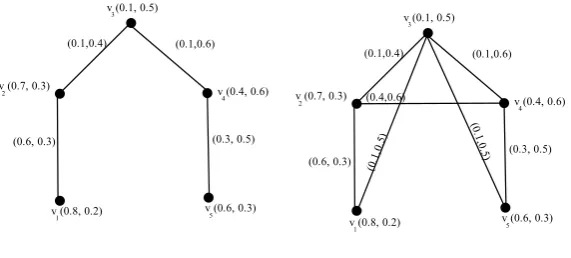
Example 3.3 Consider an intuitionistic fuzzy graph, G = (V, E), such that V = {v1, v2, v3, v4, v5},
E={(v1, v2),(v2, v3),(v3, v4),(v4, v5)}, E2={(v1, v2),(v2, v3),(v3, v4),(v4, v5),(v1, v3),(v3, v5),(v2, v4)}, E3=
{(v1, v2),(v2, v3),(v3, v4),(v4, v5),(v1, v3),(v3, v5),(v2, v4),(v1, v4),(v2, v5)} and E4 =
{(v1, v2),(v2, v3),(v3, v4),(v4, v5),(v1, v3),(v3, v5),(v2, v4),(v1, v4),(v2, v5),(v1, v5)}
[image:9.595.186.472.515.644.2]Figure 4: G3 and G4
It can also be represented in the matrix form,
(i, j)thentry of A=
v1 v2 v3 v4 v5
v1 <0,1> < .6, .3> <0,1> <0,1> <0,1>
v2 < .6, .3> <0,1> < .1, .4> <0,1> <0,1>
v3 <0,1> < .1, .4> <0,1> < .1, .6> <0,1>
v4 <0,1> <0,1> < .1, .6> <0,1> < .3,5>
v5 <0,1> <0,1> <0,1> < .3, .5> <0,1>
(i, j)thentry of A2=
v1 v2 v3 v4 v5
v1 < .6, .3> <0,1> < .1, .4> <0,1> <0,1>
v2 <0,1> < .6, .3> <0,1> < .1, .6> <0,1>
v3 < .1, .4> <0,1> < .1, .4> <0,1> < .1, .6>
v4 <0,1> < .1, .6> <0,1> < .3, .5> <0,1>
v5 <0,1> <0,1> < .1, .6> <0,1> < .3, .5>
Theorem 3.5 Let G= (V, E) be a intuitionistic fuzzy graph. If an intuitionistic fuzzy graph G contains a
u−v walk of length l, then G contains a u−v path of length l.
Proof. Proof follows from the Definition 1.8 and Theorem 2.2 .
of an intuitionistic fuzzy graph G. Then Sµ(Gsd)≤2Sµ(G) and Sν(Gsd)≤2Sν(G), where Sµ and Sν are
size of G.
Proof. Let G= (V, E) be a strong intuitionistic fuzzy graph and Gsd = (Vsd, Esd) be the subdivision of an intuitionistic fuzzy graph G. The size of G is S(G) = (Sµ(G), Sν(G)) , where Consider,
Sµ(Gsd) =
∑
eik, ekj∈Esd
(µsd(eik) +µsd(ekj)),
≤∑µsd(vk) +
∑
µsd(vk),since G is strong
≤∑µij+
∑
µij,since by Definition 1.37
≤2∑µij ≤2Sµ(G).
and
Sν(Gsd) =
∑
eik, ekj∈Esd
(νsd(eik) +νsd(ekj))
≤∑νsd(vk) +
∑
νsd(vk),since G is strong
≤∑νij+
∑
νij,since by Definition 1.37
≤2∑νij ≤2Sν(G).
Theorem 3.7 Let G1= (V1, E1) and G2= (V2, E2) be two strong IFGs. Then A(G1∪G2) =A(G1) +A(G2)
if and only if V1=V2.
Proof. Let us assume that A(G1∪G2) = A(G1) +A(G2) . Suppose that G1 and G2 are having different
vertex set and let V1={v1, v2, ..., vm} and V2={u1, u2, ..., un}, where vi̸=uj, i= 1,2, ..., m, j= 1,2, ..., n,∀i and j
Case(i):Let m ̸= n. Then V(G1 ∪G2) = {v1, v2, ..., vm, u1, u2, ..., un} and the order of the IF matrix A(G1∪G2) = m+n×m+n. But the order of the IF matrix A(G1) = m×m and the order of the IF
matrix A(G2) =n×n. Therefore A(G1) +A(G2) is not possible, since by Definition 1.31 , the order of the
matricesA(G1) and A(G2) are not equal. Hence by Definition 1.30, A(G1∪G2)̸=A(G1) +A(G2) , which is
a contradiction to our assumption that A(G1∪G2) =A(G1) +A(G2) . Hence V1=V2.
Case(ii): Let m=n. Then V(G1∪G2) =V1∪V2={v1, v2, ..., vm, u1, u2, ..., um} and the order of the matrix A(G1∪G2) = 2m×2m. But the order of the IF matrix A(G1) = m×m, A(G2) = m×m. Therefore the
order of the IF matrix A(G1) +A(G2) =m×m̸=A(G1∪G2) , which is contradiction to our assumption that
A(G1∪G2) =A(G1) +A(G2) . Hence V1=V2.
Conversely, Let us assume that V1 =V2. and let V1 ={v1, v2, ..., vm} and V2 ={v1, v2, ..., vm}. Then the order of IF matrix A(G1∪G2) =m×m=A(G1) +A(G2) . Next, in order to prove the entries of the IF matrix
A(G1∪G2) = the entries of the IF matrix A(G1) +A(G2) , we need to consider the following three subcases:
By Definition 1.26 ,
(µ∪µ′)(vi, vj) = max(µij, µ′ij)
(ν∪ν′)(vi, vj) = min((νi∪νi′),(νj∪νj′))
= min(min(νi, νi′),min(νj, νj′))
= min(min(νi, νj′),min(νi′, νj′)),SinceG1 &G2 are strong IFGs
(ν∪ν′)(vi, vj) = min(νij, νij′ )
Therefore, (i, j)th entry of
A(G1∪G2) = (max(µij, µij′ ),min(νij, νij′ )) (1)
By Definition 1.31 and 1.34 , (i, j)th entry of
A(G1) +A(G2) = (max(µij, µij′ ),min(νij, νij′ )) (2)
From Equation (1) and (2) , (i, j)th entry of A(G
1∪G2) = (i, j)th entry of A(G1) +A(G2)
Subcase(ii): Let eij ∈E1−E2. Then by Definition 1.26 , (µ∪µ′)(vi, vj) =µij and (ν∪ν′)(vi, vj) =νij. Therefore, (i, j)th entry of
A(G1∪G2) = (µij, νij) (3)
If eij ∈E1, then (µij, νij)̸= (0,1) and if eij ̸∈E2, then (µ′ij, νij′ ) = (0,1) . Therefore, (i, j)th entry of
A(G1) +A(G2) = (max(µij, µ′ij),min(νij, νij′ )) = (µij, νij) (4)
From Equation (3) and (4) , (i, j)th entry of A(G
1∪G2) = (i, j)th entry of A(G1) +A(G2) .
Subcase(iii): Let eij ∈E2−E1. Then proof follows from the Subcase(ii) by replacing E1 by E2 and E2
by E1. Hence, from the Subcases (i)−(iii) , it follows that (i, j)th entry of A(G1∪G2) = (i, j)th entry of
A(G1) +A(G2) .
Theorem 3.8 Let G = (V, E) be an IFG and let A ={< µij, νij >} be the index matrix of G. Then for
each positive integer k, the
(i, j)thentry ofAk = strength of connectedness of vi−vj walks of length k. (5)
Proof. Let G = (V, E) be an IFG and let A = {< µij, νij >} be the index matrix of G and the vertex
set V ={v1, v2, ..., vn}. Let Ak ={< bµij, bνij >} be the k
th power of the IF matrix A. Let us prove the
Equation (1) by mathematical induction method on the power of A.
Initial Step: Let k = 1 , then Ak = A. Then A = {< µij, νij >} , where µij is µ− strength of connectedness of (vi, vj) walk of length 1 and νij is ν− strength of connectedness of (vi, vj) walk of length
1 = (CON Nµ(G)(vi, vj) , CON Nν(G)(vi, vj)) , where (vi, vj) is vi−vj walk of length 1 .
Inductive Step: Assume that the result is true for k. By the inductive hypothesis, (i, j)th entry of
Ak = (CON N
µ(G)(vi, vj) , CON Nν(G)(vi, vj)) , where (vi, vj) is vi−vj walk of length k. Next we have to prove the result for k+ 1 .
of Ak •
max−min (i, j)th entry of A = (
∨n l=1(aµil
∧
bµlj),
∧n l=1(aνil
∨
bνlj) = (max(min(CON Nµ(G)(vi, vl), CON Nµ(G)(vl, vj))) , min(max(CON Nν(G)(vi, vl), CON Nν(G)(vl, vj)))) , where (vi, vl) is vi−vl walk of length k and (vl, vj) is vl−vj walk of length 1 = (CON Nµ(G)(vi, vj), CON Nν(G)(vi, vj)) , where (vi, vj) is vi−vj walks of length k+ 1 , ∀vl∈V . Hence the result is true for every k. That is, (i, j)th entry of Ak = strength
of connectedness of vi−vj walks of length k.
Theorem 3.9 Let G = (V, E) be an intuitionistic fuzzy graph, where V = {v1, v2, ..., vn} be the vertices of G. Let A={< µij, νij >} be the index matrix of G. Then
(CON Nµ(G)(vi, vj), CON Nν(G)(vi, vj)) = (i, j)th entry of A +A2 +... +An−1, ∀vi ̸= vj ∈ V and (CON Nµ(G)(vi, vi), CON Nν(G)(vi, vi)) = (i, i)th entry of A+A2+...+An, ∀vi∈V
Proof. Let G be an IFG, where V = {v1, v2, ...vn} be the vertices of G. Let A be the index matrix of G and Ak be the power of IF matrix A. By Theorem 3.8 , (i, j)th entry of Ak =
(CON Nµ(G)(vi, vj), CON Nν(G)(vi, vj)) , where (vi, vj) is vi−vj walks of length k.
Case(i): Let vi̸=vj. By Theorem 2.2 , vi−vj walk of length k contains vi−vj path of length k. Since
the vertex set V has n− vertices, the vi−vj path passes through at most n− vertices . Therefore (vi, vj) is path of length less than or equal to n−1
Hence,
(i, j)thentry ofA+A2+...+An−1= (max(CON Nµ(G)(vi, vj)),min(CON Nν(G)(vi, vj))) = (max(max(Sµ(G)(vi, vj)),min(min(Sν(G)(vi, vj))) = (CON Nµ(G)(vi, vj), CON Nν(G)(vi, vj))
where (vi, vj) is vi−vj path of length less than or equal to n−1
Therefore, (CON Nµ(G)(vi, vj), CON Nν(G)(vi, vj)) = (i, j)th entry of A+A2+...+An−1, ∀vi̸=vj∈V .
Case(ii): Let vi=vj∈V . Since the vertex set V has n− vertices, the closed vi−vi path passes through at most n− vertices. Therefore (vi, vi) is vi−vi path of length less than or equal to n.
Hence,
(i, i)thentry ofA+A2+...+An= (max(CON Nµ(G)(vi, vi)),min(CON Nν(G)(vi, vi))) = (max(max(Sµ(G)(vi, vi))),min(min((Sν)G)(vi, vi))))) = (CON Nµ(G)(vi, vi), CON Nν(G)(vi, vi))
where (vi, vi) is vi−vj paths of length less than or equal to n
(CON Nµ(G)(vi, vi), CON Nν(G)(vi, vi)) = (i, i)th entry of A+A2+...+An, ∀vi∈V .
Theorem 3.10 Let G= (V, E) be a strong intuitionistic fuzzy graph and A be the index matrix of G. Let
Ck ={< cµij, cνij>} =A+A
2+...+Ak and C
k−1 ={< c′µij, c′νij >} =A+A
2+...+Ak−1. Then G is
connected and Gk is complete if and only if
{< cµij, cνij>} ̸=<0,1>,for every iandj
{< c′µ ij, c
′
Proof. Let G= (V, E) be a strong intuitionistic fuzzy graph and A be the index matrix of G. Let Ak be the kth power of the IF matrix A. Let Gk be a complete intuitionistic fuzzy graph. Then by Theorem 3.8:
(i, j)thentry ofA= (CON Nµ(G)(vi, vj), CON Nν(G)(vi, vj)),where (vi, vj) is vi−vj walk of length 1
(i, j)thentry ofA2= (CON Nµ(G)(vi, vj), CON Nν(G)(vi, vj)),where (vi, vj) isvi−vj walk of length 2
...
(i, j)thentry ofAk−1= (CON Nµ(G)(vi, vj), CON Nν(G)(vi, vj)),where (vi, vj) isvi−vj walk of lengthk−1
(i, j)thentry ofAk = (CON Nµ(G)(vi, vj), CON Nν(G)(vi, vj)),where (vi, vj) is vi−vj walk of lengthk
Therefore,
(i, j)thentry ofA+A2+...+Ak−1= (max(CON Nµ(G)(vi, vj)),min(CON Nν(G)(vi, vj))),
(i, j)thentry ofA+A2+...+Ak−1= (CON Nµ(G)(vi, vj), CON Nν(G)(vi, vj))) (6) where (vi, vj) is vi−vj walk of length less than or equal to k−1 and
(i, j)thentry ofA+A2+...+Ak = (max(CON Nµ(G)(vi, vj)),min(CON Nν(G)(vi, vj))),
(i, j)thentry ofA+A2+...+Ak= (CON Nµ(G)(vi, vj), CON Nν(G)(vi, vj))) (7) where (vi, vj) is vi−vj walk of length ≤k.
From Equation (2) , (i, j)th entry ofA+A2+...+Ak−1 is the strength of connectedness of (v
i, vj) walk of
length 1,2, ..., k−1 except k.
Therefore, {< c′µij, c′νij >}=
(CON Nµ(G)(vi, vj), CON Nν(G)(vi, vj))̸=<0,1>,(vi, vj) is walk of length 1,2, ..., k−1
<0,1>,(vi, vj)is walk of lengthk
(8)
Since Gk is complete, the maximum shortest path of length in Gk is k. Then there exist at least one path of length k in Gk. Therefore from Equation (6),(7) and (8) ,
(i, j)thentry ofA+A2+...+Ak = (CON Nµ(G)(vi, vj), CON Nν(G)(vi, vj)))̸=<0,1>, (9)
where (vi, vj) is walk of length k , ∀i, j. Hence from Equation (8) and (9) ,
{< cµij, cνij >} ̸=<0,1>,for everyiandj
{< c′µij, c′νij >}=<0,1>,for someiandj
Conversely, suppose that Equation (10) is true, then for each distinct pair i, j we have Ck ̸= 0 . Therefore, there exist at least one walk of length less than n from vi to vj. This implies that vi is connected to vj, for
every vi, vj ∈V . Hence G is connected. Again, let us assume that Equation (10) is true, then there exists vi−vj walk of length ≤k and shortest path of length k in G. By the Definition 1.38 and Theorem 2.2 ,
µkij= min(µi, µj) andνijk = max(νi, νj),(vi, vj)̸∈EanddG∗(vi, vj)≤k (11)
Since G is strong intuitionistic fuzzy graph and from the Equation(11),
µkij= min(µi, µj) andνijk = max(νi, νj),∀vi, vj ∈V
Hence Gk is complete.
Corollary 3.11 Let G = (V, E) be an intuitionistic fuzzy graph and A be the index matrix of G. Let
Ck ={< cµij, cνij>} =A+A2+...+Ak and Ck−1 ={< c′µij, c
′
νij >} =A+A
2+...+Ak−1. Then G is
connected and (G∗)k complete if and only if
{< cµij, cνij>} ̸=<0,1>,for every iandj
{< c′µij, c′νij >}=<0,1>,for someiandj
Corollary 3.12 Let G= (V, E) be a strong directed intuitionistic fuzzy graph and A be the index matrix of
G. Let Ck ={< cµij, cνij>}=A+A2+...+Ak and Ck−1={< c′µij, c
′
νij >}=A+A
2+...+Ak−1. Then
G is connected and Gk is complete if and only if
{< cµij, cνij>} ̸=<0,1>,for every iandj
{< c′µ ij, c
′
νij >}=<0,1>,for someiandj
Theorem 3.13 Let G and H be two intuitionistic fuzzy graphs. Then G is co-weak isomorphic with H then
Gk is homomorphic with Hk.
Proof. Proof follows from the definition 1.23,1.25 and 1.38 .
Theorem 3.14 Let G = (V, E) be an intuitionistic fuzzy graph. Let A = {< µij, νij >}m×m and B = {< bµij, bνij>}m×n be the index matrix and incidence matrix of G respectively. Then the entries of B•max−minBT are
{< bµij, bνij>}m×m=
(µij, νij),if i̸=j
Proof. Let G = (V, E) be an intuitionistic fuzzy graph. Let A = {< µij, νij >} and B ={< bµij, bνij>} be the index matrix and incidence matrix of G of order m×m and m×n respectively. Let BT = {<
b′µij, b′νij>}n×m be the transpose of the matrix B. Then the order of B•max−minBT is m×m.
Case(i): Let ek∈(vi, vj), i̸=j. By the Definition 1.35 , the entries in B are as follows:
{< bµij, bνij>}=
(µij, νij),∀ek ∈(vi, vj)
(0,1),otherwise
The (i, j)th entries of B•max−minBT is given by
(B•max−minBT)ij = (∨k(bµik∧b
′
µkj),∨k(bνik∧b
′
νkj))
That is,
(B•max−minBT)ij = (µij, νij),sinceek ∈(vi, vj) (12)
Case(ii): Let (vi, vj)̸∈E of G.
Subcase(i): Let vi ∈ V is incident on ek ∈ E and vj ∈ V is not incident on ek ∈ E, then (bµik, bνik)̸= (0,1) = (µ(ek), ν(ek)) , (bµjk, bνjk) = (0,1) and (b′µkj, b
′
νkj) = (0,1) . Therefore,
(B•max−minBT)ij = (∨k(bµik∧b
′
µkj),∧k(bνik∨b
′
νkj)) = (0,1) (13)
Subcase (ii): Let vi ∈ V is not incident on ek ∈ Eand vj ∈ V is incident on ek ∈ E, then (bµik, bνik) = (0,1) and (bµjk, bνjk)̸= (0,1) =µ(ek) and (b′µkj, b
′
νkj)̸= (0,1) =µ(ek) . Therefore,
(B•max−minBT)ij = (∨k(bµik∧b′µkj),∧k(bνik∨b
′
νkj)) = (0,1) (14)
Subcase(iii): Let vi, vj ∈V is not incident on ek ∈E, then (bµik, bνik) = (0,1) and (bµjk, bνjk) = (0,1) and (b′µ
kj, b
′
νkj) = (0,1) . Therefore, (B•max−minB T)
ij = (∨k(bµik∧b′µkj),∧(bνik∨b
′
νkj)) = (0,1) Hence from the above three cases,
(B•max−minBT)ij = (∨k(bµik∧b
′
µkj),∨k(bνik∧b
′
νkj)) = (0,1),∀(vi, vj)̸∈E (15)
Case(iii): Let vi=vj∈V in G.
(B•max−minBT)ij = (∨k(bµik∧b
′
µki),∧k(bνik∨b
′
νki))
= (∨k(bµik),∧k(bνik))
= ((bµi1∨bµi2∨...∨bµin),(bνi1∧bνi2∧...∧bνin))
= (∨kµik,∧kνik),∀ek∈E is incident on vi∈V
Hence from Equation (8),(9) and (10) and Case (iii) ,
{< bµij, bνij>}m×m=
{< µij, νij >},ifi̸=j
Theorem 3.15 Let G= (V, E) be an intuitionistic fuzzy graph and GL = (VL, EL) be a line intuitionistic
fuzzy graph. Let A={< µij, νij >} and B ={< bµij, bνij>} be the index matrix and incidence matrix of G
respectively. Then the entries of BT •
max−minB are
{< bµij, bνij>}n×n
(µL(vi, vj), νL(vi, vj)>),ifi̸=j
(max(µik),min(νik)),if i=j,∀vk ∈NG(vi)
where (µL(vi, vj), νL(vi, vj)) is the membership and non membership value of an edge eij ∈EL.
Proof. Let G = (V, E) be an intuitionistic fuzzy graph. Let A = {< µij, νij >} and B ={< bµij, bνij>} be the index matrix and incidence matrix of G of order m×m and m×n respectively. Let BT = {<
b′µij, b′νij>}n×m be the transpose of the matrix B. Then the order of BT •max−minB is n×n.
Case(i): Let ei∈E, ej∈E are incident on vk ∈V . Then ((bµki, bνki)̸= (0,1) = (µ(ei), ν(ei)) = (b′µik, b
′
νik) , (bµkj, bνkj)̸= (0,1) = (µ(ej), ν(ej)) = (bµjk′ , b′νjk) . The (i, j)th entry of BT •max−minB are as follows:
(B•max−minBT)ij = (∨k(b′µik∧bµkj),∧k(b
′
νik∨bνkj))
= (∨(µ(ei)∧µ(ej)),∧((ν(ei)∨ν(ej))))
= ((µ(ei)∧µ(ej)),(ν(ei)∨ν(ej)))
= ((µL(vi)∧µL(vj)),(νL(vi)∨νL(vj))),since by Definition 1.36
= (µL(vi, vj), νL(vi, vj)),(vi, vj)∈E
Case(ii): Let ei ∈ E, ej ∈ E are not incident on vk ∈ V Then ((bµki, bνki) = (0,1) = (b′µik, b
′
νik) , ((bµkj, bνkj) = (0,1) = (b′µjk, bνjk′ ) . The (i, j)th entry of BT•max−minB are as follows:
(BT•max−minB)ij = (∨k(b′µik∧bµki),∧k(b
′
νik∨bνki))
= (0,1)
Case(iii): Let vi=vj∈V in G.
(BT •max−minB)ij = (∨k(b′µik∧bµki),∧k(b
′
νik∨bνki))
= (∨k(bµik),∧k(bνik))
= ((bµi1∨bµi2∨...∨bµin),(bνi1∧bνi2∧...∧bνin))
= (∨kµik,∧kνik),∀ek ∈E is incident with vi∈V
Hence from the Cases (i) and (ii) and by Definition 1.36 , (BT •
max−minB)ij = (µL(vi, vj), νL(vi, vj)) , if i̸=j
Hence from the Case (iii) , (BT•
max−minB)ij = (max(µik),min(νik)) , if i=j,∀vk∈NG(vi) .
IV
Conclusion
In this paper, we discussed the properties of the power of an intuitionistic fuzzy graph, subdivision intuitionistic fuzzy graph and line intuitionistic fuzzy graph. Intuitionistic fuzzy graph effectively expresses the approximate
References
[1] Akram, M. and Davvaz, B.,Strong intuitionistic fuzzy graphs, FILOMAT 26(1)(2012) 177-196.
[2] Akram, M., Al-Shehrie N. O,Intuitionistic fuzzy cycles and Intuitionistic fuzzy trees, The Scientific World Journal, Volume 2014 (2014), Article ID 305836, 11 pages.
[3] K. Atanassov,Intuitionistic Fuzzy Sets:Theory and Applications, Springer Physica-Verlag, Berlin, 1999.
[4] Atanassov K.,Index matrix representation of the intuitionistic fuzzy graphs, Fifth Scientific Session of the Mathematical Foundations of Artificial Intelligence Seminar, Sofia, Oct. 5, 1994, Preprint MRL-MFAIS-10-94, 36-41.
[5] Atanassov K,On index matrix interpretations of intuitionistic fuzzy graphs, Notes on Intuitionistic Fuzzy Sets, Vol. 8 (2002), No. 4, 73-78.
[6] K. Atanassov,Generalized index matrices, Compt. Rend. de l’Academie Bulgare des Sciences, Vol.40, 1987, No 11, 15-18.
[7] Atanassov, K.,On index matrices. Part 1. Advanced Studies in Contemporary Mathematics,20(2), (2010)291-302.
[8] Bondy,JA and Murthy, U.S.R.Graph Theory with Applications, American Elseiver Publishing Co., Newyork, 1976.
[9] Karunambigai, M.G., and Kalaivani, O.K., Self Centered and Self Median Intuitionistic Fuzzy Graphs, Advances in Fuzzy sets and systems, Volume 14, Number 2, 101-132, 2013.
[10] M.G. Karunambigai and R. Parvathi, Intuitionistic Fuzzy Graphs, Journal of Computational Intelligence, Theory and Applications, Vol. 20, 139-150, 2006.
[11] M.G.Karunambigai , R.Parvathi and O.K.Kalaivani,A Study on Atanassovs Intuitionistic Fuzzy Graphs, Proceedings of the International Conference on Fuzzy Systems,FUZZ-IEEE- 2011, Taipei, Taiwan ,(2011)157-167.
[12] A. Kaufmann,An introduction to theory of fuzzy sub sets, vol. 1, Academic Press, New York, 1975.
[13] A. Nagoor Gani and S. Shajitha Begum,Degree, Order and Size in Intuitionistic Fuzzy Graphs, International Journal of Algorithms, Computing and Mathematics, Vol 3, Number 3, 2010.
[14] Parvathi, R., Karunambigai, M.G., and Atanassov, K., Operations on Intuitionistic Fuzzy Graphs, Proceedings of IEEE International Conference on Fuzzy Systems (FUZZ-IEEE), 1396-1401, 2009.
[15] M.Pal, S.Khan and A.K.Shyamal,Intuitionistic fuzzy matrices, Notes on Intuitionistic Fuzzy Sets, 8 (2) (2002) 51-62.
[16] R.Parvathi S.Thilagavathi, M.G.Karunambigai and G.Thamizhendhi,Index Matrix representaion of Intuitionistic fuzzy graphs
, Notes on Intuitionistic Fuzzy Sets, Vol. 20, No. 2, 100108 (2014)
[17] Rosenfeld, A.,1975. Fuzzy Graphs, In Fuzzy Sets and their Applications to Cognitive and Decision Processes, Zadeh. L.A., Fu, K.S., Shimura, M., Eds ; Academic Press, New York, 77-95.
[18] M. Sarwar and Akram, M,An algorithm for computing certain metrics in intuitionistic fuzzy graphs, Journal of Intelligent and Fuzzy Systems, 2015.
[19] A. Shannon , K. Atanassov,A First Step to a Theory of the Intuitionistic Fuzzy Graphs, Proc. of the First Workshop on Fuzzy Based Expert Systems (D. akov, Ed.), Sofia, 59-61,1994.
[20] L.A.Zedeh, Fuzzy sets, Information and control 8, 1965, 338-353.
AUTHORS
First Author -M.G.Karunambigai, M.Sc,M.Phil,PGDCA, Ph.D, Department of Mathematics, Sri Vasavi
College, Erode-638016, Tamilnadu, India. ([email protected]).
Second Author- O.K.Kalaivani, M.Sc,M.Phil,PGDCA, Department of Mathematics, Sri Vasavi College,