University of Warwick institutional repository: http://go.warwick.ac.uk/wrap
A Thesis Submitted for the Degree of DClinPsy at the University of Warwick
http://go.warwick.ac.uk/wrap/49320
This thesis is made available online and is protected by original copyright. Please scroll down to view the document itself.
Escaping From Homelessness
William J Morgan
This thesis is submitted in partial fulfilment of the requirements for the degree of
Doctorate in Clinical Psychology
The Universities of Coventry and Warwick Department of Clinical Psychology
Table of Contents
List of Tables and Figures iii
List of Appendices iv
Acknowledgements v
Declaration vi
Summary vii
List of Abbreviations viii
Chapter 1: Empirical Paper 1
1.1 Abstract 2
1.2 Introduction 3
1.3 Methodology 7
1.4 Results 14
1.5 Discussion 28
1.6 References 34
Chapter 2: Literature Review 38
2.1 Abstract 39
2.2 Introduction 40
2.3 Method 46
2.4 Results 49
2.5 Discussion 62
2.6 References 65
Chapter 3: Reflective Paper 70
3.2 Homelessness research: My personal journey 71
3.3 Therapists as researchers 75
3.4 Conclusions 81
List of Tables and Figures
Table 1.1 Pen portraits of the participants 9
Figure 2.1 Summary of systematic selection process 48
List of Appendices
A Author Instructions forBritish Journal of Psychology 85
B Participant Information Sheets 87
C Semi-structured Interview 90
D Consent Form 91
E Demographic Information Sheet 92
F Debriefing Sheet 93
G Example of Initial Analysis 95
H Example of NVivo Coding 97
I Example of Table of Themes 99
J Ethical Approval Form 100
Acknowledgements
Many thanks to all those friends, family and colleagues who have supported me
throughout my clinical training and during this thesis in particular.
I would like to thank my research supervisors, Dr Adrian Neal at Coventry
University and Dr Rachel Shaw at Aston University, for all their help and
guidance during the research process.
For help with recruitment, I would like to thank Jon Smith at the Bridge Project,
Michael Middleton at Jericho and Charlotte Aldridge at Business Action on
Homelessness.
Thanks, too, to Dr Suzanne Elliott, Leicester Homeless Mental Health Service,
and Professor Panos Vostanis, University of Leicester, for their helpful
comments on drafts of the empirical paper and the literature review respectively.
I would also like to say a special thank you to Tom, Steven, Andrew, Adam and
John for sharing their escape stories with me.
I would also like to thank my current placement supervisors Dr Tom Barker and
Dr Kate Strauss, both at Worcestershire Mental Health Partnership NHS Trust,
for their help, support and understanding.
And finally a big thank you to my wife, Hazel, and children, Rebekah, Joshua
and Katie, who have put up with so much over the last nine years - thank you for
Declaration
This thesis is a record of original work carried out by me under the supervision
of Dr Adrian Neal, Coventry University, and Dr Rachel Shaw, Aston University.
The original idea for this work was my own and followed discussions with Dr
Adrian Neal. Apart from the above collaborations, all the material presented in
this thesis is my own work.
Summary
This thesis addresses the question of what helps the homeless to escape from
homelessness. It comprises an empirical paper, a systematic literature review and
a paper reflecting on the experience of conducting research with once-homeless
men.
The empirical paper details a qualitative exploration of the experience of
escaping from homelessness for five once-homeless men. Semi-structured
interviews were carried out and analysed using interpretative phenomenological
analysis. Emergent themes were:life breaking in, decision to change, bad past
andgood present, better future. Life breaking inconsidered how life events and
relationships 'broke into' cycles of homelessness and drug abuse participants
were caught in. Their combined effect seemed to be to bring participants to a
‘turning point’, where they made a cleardecision to change. Participants'
relationship with their past, present and future seemed key in maintaining their
escape. Escape from homelessness was discussed in terms of identity change,
especially the need to repair a broken identity.
The systematic literature review evaluates the evidence for the effectiveness of
therapeutic communities (TCs) for dually-diagnosed homeless. PsycINFO, Web
of Science, ASSIA and PubMed were searched using terms relating to
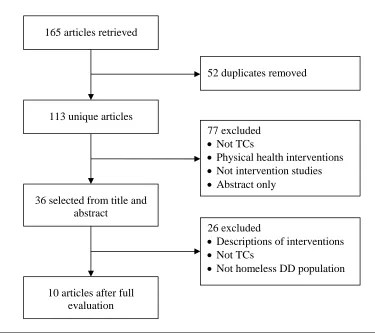
therapeutic community,homelessnessandeffectiveness. A total of 113 unique
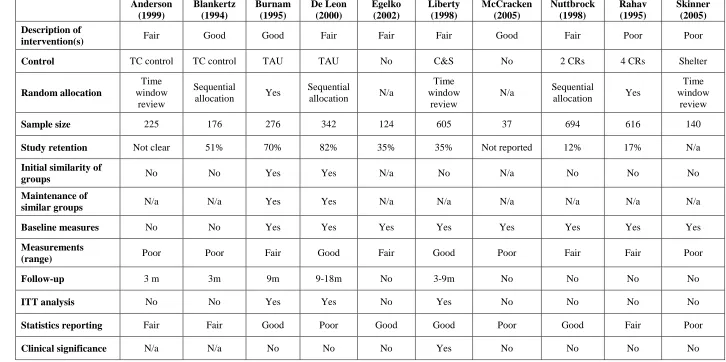
articles were retrieved and of these ten met inclusion criteria and were reviewed.
The review found that TCs with adaptations for patients with mental illness, in
addition to substance dependency, led to small improvements in substance abuse,
mental health and housing outcomes. However, these effects were short-lived
and few were still present after a year.
In the reflective paper, the experience of conducting research, as a therapist, with
once-homeless men was reflected on and the question of what therapists bring to
research was considered. While therapists may struggle with some aspects of
List of Abbreviations
C&S Clean and sober
CR Community residence
GAF Global Assessment of Functioning
HIV Human immunodeficiency virus
IAPT Improving Access to Psychological Therapies
IPA Interpretative phenomenological analysis
ITT Intention to treat
MTC Modified therapeutic community
NHS National Health Service
RCT Randomised controlled trial
TAU Treatment as usual
TC Therapeutic community
UK United Kingdom
Chapter 1: Empirical Paper
Escaping from Homelessness: An interpretative
phenomenological study
Target Journal:
British Journal of Psychology
See Appendix A for Author Instructions
1.1 Abstract
Homelessness is not a recent phenomenon, but has received little research
attention. Although something is known about its causes, 'escape' from
homelessness is less understood. This study explores the lived experiences of
five men who have escaped from homelessness.
Semi-structured interviews were carried out and analysed using interpretative
phenomenological analysis. Emergent themes were:life breaking in, decision to
change, bad pastandgood present, better future.
Participants' escape from homelessness followed a low point, resulting from a
complex mix of external and internal events, in the context of sustained and
supportive relationships. Participants' relationships with their past, present and
future seem to have been key in maintaining their escape. Whilst the past served
as a reminder of what they could return to, their current lives, and their hope for
the future, helped anchor them in their escape. Escape from homelessness was
discussed in terms of identity change, especially participants' need to repair a
broken identity.
Clinical interventions for the homeless should be available around low points and
be long-term and relational in nature. Future research needs to explore the escape
experiences of other groups, including women, children and young people, the
1.2 Introduction
Homelessness is not a new phenomenon in the UK (Timms, 1996) and, although
accurate figures are hard to come by, the homeless charity Crisis estimates that
the homeless total is around 800,000 (Crisis, 2008). Homelessness is associated
with a higher frequency of a range of physical health problems and the homeless
do not live as long as members of the general population (Flick, 2007). The
homeless also have higher rates of mental health problems (Längle, Egerter,
Albrecht, Petrasch, & Buchkremer, 2005) with substance abuse, especially of
alcohol, being particularly high (Philippot, Lecocq, Sempoux, Nachtergael, &
Galand, 2007).
1.2.1 Homelessness research
Phillippotet al.(2007) carried out a systematic review of research on
homelessness in Western Europe and found that, although little had been done,
most of it had focussed on establishing the characteristics of the homeless.
Consequently, it is now known that Europe's homeless are: predominantly men,
aged around 40 years, schooled to a low level, mostly unemployed, mostly
unmarried and homeless for many years (Firdion & Marpsat, 2007; Leonori,
Muñoz, Vázquez, Vázquez, Fe Bravo, Nuche et al., 2000; Muñoz & Vázquez,
1999). As regards the causes, research suggests that homelessness arises from
complex interactions between a range of socioeconomic and personal
vulnerability factors including: housing policy, unemployment, social welfare
policy and immigration, the breakdown of social networks, addiction and
loneliness, physical and mental illness, and traumatic life events (Philippot,et al.,
situation, there was a split between women and youth, who cited relationship
problems, and men who blamed unemployment, eviction and financial problems
(Muñoz, Vázquez, Bermejo, & Vázquez, 1999).
1.2.2 Escape from homelessness
There has been less research on what has helped homeless people to escape from
homelessness, with most studies taking the form of quantitative evaluations of
homeless services. Typical of these studies is Stergiopoulos, Dewa, Rouleau,
Yoder and Chau's (2008) review of the progress of 73 men referred to a
shelter-based mental health care team. Just two criteria were used to determine
improvement at six-month follow-up: psychiatrist’s impression of clinical
improvement and being re-housed in the community. Both clinical and
housing-status improvement were significantly associated with treatment adherence and
number of visits to the psychiatrist. Housing outcomes were also significantly
associated with a substance use disorder.
In a departure from this model, Patterson and Tweed (2009) asked 58 homeless
and 80 once-homeless individuals to rate anticipated and perceived facilitators of
escape from homelessness. The homeless group rated housing as the most
important, followed by health-related services, food, dental care and
transportation. The once-homeless group was asked to what extent each factor
would have helped them when they were homeless. Housing was again rated
highest, followed by food, social assistance funding, health-related services and
training in resisting temptation. The once-homeless were also asked to rate
another 31 factors according to how much they had actually helped them escape
bottom’, ‘realizing your potential’, ‘realizing your self-worth’ and
‘accountability for past decisions and current situations’.
Whilst less common, there were some qualitative studies which had conducted
richer explorations of the experience of moving out of homelessness. Kirkpatrick
and Byrne (2009) interviewed 12 participants with mental health diagnoses, who
had been homeless and were living in supported accommodation. Adopting a
narrative approach, they explored the experience of ‘moving on’ for
once-homeless individuals with mental illness, after they had obtained permanent
supported housing. Having stable accommodation and social support enabled
them to ‘move on’, helping them to re-establish family relationships, gain
employment and plan for the future.
In another qualitative study, looking at the routes through and out of
homelessness, McNaughton (2008) interviewed 28 people who were, or had
recently been, homeless. A key emergent theme was participants’ substance use
and its relationship with their homelessness. Although 19 were re-housed by the
study’s end, their ‘rehabilitation’ was far from complete – they reported
continuing to feel marginalized and isolated and most continued their
problematic substance use.
These last two studies give a greater sense of the experience of moving out of
homelessness, although both still operationalized it as simply having been
re-housed. Whilst acquiring stable accommodation is a necessary part of moving
out of homelessness, research has shown it is not sufficient (e.g. Crane &
Warnes, 2007; McNaughton, 2008). No studies were identified that endeavoured
to explore the escape experience of participants who were more re-integrated into
may have set the bar too low in terms of selection criteria, resulting in a limited
understanding of what is involved in escaping from homelessness.
This research sets out to explore the experience of those who are further on in
their escape from homelessness than participants in previous studies. It aims to
provide a greater understanding of what this escape involves and what helps the
homeless to make it. By focusing on those who are ‘more escaped’, this study
hopes to contribute to the limited knowledge base on what making a lasting
escape from homelessness involves. Inspired by positive psychology (Seligman
& Csikszentmihalyi, 2000), this study has focused on what works for those
escaping homelessness, rather than what has gone wrong, as this will be of more
1.3 Methodology
1.3.1 Participants
The population of interest for this study was people who had been homeless, but
who were now ‘escaped’ from homelessness. Individuals were considered to
havebeenhomeless if they had previously ‘sofa surfed’1, lived in hostels or
overnight shelters or slept rough2for a continuous period of at least four weeks.
Havingescapedfrom homelessness was operationalized as having lived in
stable/long-term accommodation for at least six months and meeting the
following conditions:
Not abusing alcohol or any illicit substance;
In paid work or further/higher education for most of the working day.
As interpretative phenomenological analysis (IPA; Smith, 1995) was chosen to
analyse the data, participants needed to form a homogenous group in terms of
their perspective on the phenomenon under consideration (Smith, Flowers &
Larkin, 2009). Age, gender and country of origin are key demographic variables
in the experience of homelessness (Philippot, et al., 2007) and were used to
define homogeneity here. As the ‘typical’ homeless person is a 40 year old man
(Firdion & Marpsat, 2007; Leonori, et al., 2000; Muñoz & Vázquez, 1999),
clinical utility and pragmatism were served by recruiting male participants, aged
25-65, who were born in the UK. Five participants were recruited (in line with
advice from Smithet al.(2009), who argue that four to ten participant interviews
allow a level of analysis appropriate for a clinical thesis) and their ‘pen portraits’
1
are given in Table 1.1. Although participants ranged on some demographic
variables, the sample was still sufficiently homogeneous, as evidenced by the
fact that it was possible to draw out common themes from their escape narratives.
1.3.1.1 Recruitment
Participants were recruited through homeless hostels they were still in contact
with, and other community organisations working with homeless people. Staff
forwarded participant information sheets (see Appendix B) to potential
participants or used them to discuss participation. Those interested were
contacted and invited for interview.
1.3.2 Design and materials
1.3.2.1 Design
This study is concerned with exploring the lived experience of men who have
‘escaped’ from homelessness and the sense they make of this experience. In view
of the exploratory and descriptive nature of the primary research question, a
qualitative approach was taken. Qualitative methodology allows both the capture
of the “richness of the themes” (Smith, 1995, p. 9) contained in individual
narratives and also preserves the essence of the individual perspective on their
experience (Bramley & Eatough, 2005).
IPA was chosen as the method of data analysis. IPA is phenomenological in the
sense that it is concerned with the individual’s subjective perception and account
of the topic under investigation (Smith, Jarmon & Osborn, 1999), in this case the
Pseudonym History of homelessness Homeless life
Tom 46
Tom became homeless aged 40, following the breakup of his marriage. He moved into his own flat, but as his drinking escalated and his depression worsened, he struggled to maintain his tenancy, and gave it up. Initially he sofa surfed, but soon tired of this and ended up sleeping rough, staying on the streets for around four years. Tom spent a further two years in hostels when he came off the streets. When interviewed Tom was 46, in full-time further education and had been living in his own place for seven months.
“I was fully committed to dying on the street, because I'd convinced myself this is, this is my life, this is the way it's going to end. And I didn't really do anything about it. I had, I had no … Well I hadn't got any self-respect, no … I just didn't care, I was numb inside. I had no feeling …”
Steven 27
Steven became homeless at 22, following a break-up with his fiancée. She left him with debts that he was unable to manage and he was evicted. Steven's mental health is likely to have played a part here -he has recently been diagnosed with bipolar disorder. Steven was homeless for a total of 1½ years, sofa surfing and moving every two to three months. Steven has never slept rough or used a hostel. When interviewed Steven was 27, had been working in his current job for three years and had just moved into his own studio flat, having lived in shared accommodation for the last three years.
“It was difficult, it was definitely difficult erm constantly having to make adjustments in your life style of that kind of size was always a challenge and there was always, obviously the fear that I'd end up with nowhere and it would have to be the street.”
Andrew 29
Andrew had been homeless before, but this period began when, aged 26, he left Scotland and moved to the West Midlands. Andrew talked about being 'frustrated' and feeling 'trapped' in Scotland, but not depressed. Initially he stayed with his girlfriend and her mother, but soon found himself in a hostel. He lived in hostels for a total of two years. Andrew had never slept rough.
At the time of the interview, Andrew was 29, had been working at his current job for six months and lived in his flat for the same length of time.
“At the end, I was really starting to run out of patience because I was thinking, “Two years of my life I’ve been homeless”. Two years is a,
depending on how you look at it, can be a very short time, or a very long time. And I was actually close to going back to Scotland, very, very close.”
Adam 33
Adam first became homeless around the age of 19, when his drug use became too chaotic for his parents to cope with. He had five or six periods of homelessness between the ages of 19 and 28, and estimates that he was homeless for a total of 3½ years, not counting time in prison. Adam had slept rough, used night shelters and hostels, sofa surfed and lived in squats.
When interviewed, Adam was 33 and had been living in his current accommodation for 1½ years. He had been working in his current job for two years. He had last been homeless 4 ½ years ago.
“I was sort of quite content with faeces and dirty condoms and needles and everything else around me whilst I got warm with dirty old blanket and newspapers and I was …. I accepted that that’s my life and that was the way I was going to be.”
John 34
John first became homeless aged 14, when his mother expelled him from the family home because of his increasing criminal activity. John then began a cycle of moving between friends' houses, the streets (where he started using heroin) and then prison. John had slept rough, sofa surfed and used hostels and night shelters.
When interviewed John was 34, had been living in his current accommodation for the last ten months and been working full-time for the last five months.
“I started getting locked up, and I come out, put into a hostel. And I was drugs, I was drug-free when I got out, I felt brilliant and then, no matter what hostel I went into, they was drugs. And I thought, ‘Is this the cycle of life that’s happened for me? Crime, drugs, hostel, prison, crime …’”
sense of their major life experiences” (Smith et al, 2009, p. 1) fits in well with
this study’s research question.
In addition, IPA’s focus on the individual case is in line with the aim of this
research: to improve understanding of how homelessindividuals(in this case
men) have escaped from homelessness. IPA is well-suited to studies such as this,
concerned with the in-depth study of small numbers of individuals, as it permits
“fine-grained and contextual analysis of the phenomenon under investigation”
(Bramley & Eatough, 2005, p. 225) and allows the researcher to get
"experience-close" (Smith et al, 2009, p. 33).
1.3.2.2 Materials
A semi-structured interview format was used (see Appendix C). This allowed
greater flexibility than a conventional structured interview, enabling the
researcher to follow up interesting emergent themes and the respondent to
address the topic in ways most meaningful to them (Smith, 1995). Questions
were designed to explore participants’ experience of homelessness, focussing on
their escape. Following the model of the narrative interview (Bauer, 1996),
questions were grouped chronologically to cover:
The route into homelessness;
The experience of becoming and being homeless;
The route out of homelessness;
Life post-homelessness.
1.3.3 Procedure
One-off in-depth interviews were carried out at participants’ place of preference.
Mean interview length was 71 minutes (range 65 - 79 minutes), suggesting that
participants engaged well with interview questions and provided detailed
accounts of their homeless experiences.
Participants were given information on the study (see Appendix B) and the
opportunity to ask questions about their participation. Participants were then
asked to sign a consent form (see Appendix D) to verify that they had understood
the voluntary nature of participation, their rights regarding anonymity and
withdrawing their data, and details of the complaints procedure. Explicit consent
to be recorded was also obtained.
Interviews were recorded on a digital audio recorder and transcribed verbatim.
Participants were given a pseudonym and all personally identifiable material was
removed to ensure anonymity. Demographic information (see Appendix E) was
collected at the end of the interview.
Participants were debriefed (see Appendix F) and given information on support
services available if they wanted to pursue anything covered in the interview.
1.3.4 Analysis
Following transcription, the data was analysed using IPA, following the steps
suggested by Smithet al.(2009). In line with the idiographic ethos of the
research, interviews were analysed individually, before integrating the analysis
across cases. The initial analysis was carried out by hand, as this allowed a more
number of times and notes of anything appearing interesting or important were
made in the right-hand margin (see Appendix G for example).
Higher-level themes were identified during subsequent readings and used to code
transcripts. These emergent themes were then clustered under appropriate
super-ordinate conceptual headings. This level of analysis was carried out using
computer software, allowing for finer data-coding and greater flexibility in
re-coding data and grouping/re-grouping themes than a ‘pen and paper’ approach
(see Appendix H for example). On completing analysis for each transcript, tables
of super-ordinate and sub-ordinate themes, along with illustrative excerpts for
each, were produced (see Appendix I for example).
This process was repeated for all the transcripts, leading to a table of
super-ordinate themes for each case. A master list of super-super-ordinate themes was then
drawn up, incorporating all the themes raised in the individual interviews.
IPA has no pretensions to objectivity, but takes quality seriously (Smith et al,
2009), and the validity of interpretations was monitored in supervision. Both
researcher and supervisor made exploratory notes and comments for sections of
the first interview and these were compared and discussed. Full coding tables for
each transcript, showing the detail of super-ordinate and sub-ordinate themes and
excerpts which illustrated them, were also discussed in supervision. Early drafts
of the results section were forwarded along with the NVivo database used to
code the interviews.
A reflexive diary was kept throughout the study and served different functions at
different stages. In the interview stage it was used to record impressions of
transcription and analysis it was used to allow further exploration of, and
reflection on, emerging themes.
1.3.5 Ethics
This study was conducted within the ethical framework provided by the codes of
ethics and conduct of both Coventry University and the British Psychological
Society.
During the proposal phase, this study was formally reviewed by staff on the
Doctorate in Clinical Psychology programme at Coventry and Warwick
universities. Feedback was also received from staff with experience in qualitative
research, research and development in the NHS and clinical work with a
homeless population.
Ethical approval for this research was sought and given from Coventry
University Applied Research Committee (Appendix J). In addition, ethical
clearance was also obtained from the various community organisations through
1.4 Results
The themes identified were:life breaking in, decision to change, bad pastand
good present, better future.The first two were associated with the escape from
homelessness and the latter two with maintaining that escape.
1.4.1 Life breaking in
1.4.1.1 Low points
The experiences of most of the participants, around the time that they made their
first steps towards escaping homelessness, can be framed in terms of them
reaching a low point in their lives. There were differences though, and the most
dramatic experiences were those of Tom and Adam who felt that they had come
to the end of their lives. For Tom, his low point occurred when his alcohol abuse
led to such a deterioration in his physical health that he was admitted to hospital
after collapsing on the street, just days from dying.
And I, my body... I remember falling actually, and I thought, “Here we go, this is
it now. It's all over”, because I was fitting anyway, I was convulsing, I'd had them
a couple of weeks prior to that …
Adam described his low point as the feeling that he had come to the end of
himself, when he had reached the stage where he did not feel that the drugs were
working for him any longer. Although his physical health at this time was poor,
he defined his low point more in terms of its emotional and cognitive aspects.
…the errm booze and the drugs stopped working. They stopped working, they
stopped taking the pain away, they stopped taking the guilt away, they stopped
taking the confusion in the mind. They stopped doing all of that, cos it was all
While Steven and Andrew do not seem to have reached these depths, there was
still evidence that the time their lives began to change was experienced as a low
point. Steven had been dismissed by the organisation he had worked with
voluntarily for over 18 months, and was left with the feeling that he had nothing
to show for his time there.
…it fell through and they errm told me I couldn’t work up there any more and
that I'd have to go back. And they said, “Right basically, you're fired, Can't do
that here any more. Go home.”
For Andrew, his low point was the state that he had reached at the end of his time
in his first hostel, and the shock of being evicted and having to find somewhere
else to stay.
And I was drinking more in the end as well, at the end of that first one. Because
I started thinking more negative which was leading me to drink more, which was
leading to think more negative. I was getting trapped in a kind of ….. a wee
negative hole somewhere.
John did not seem to experience the time before his move out of homelessness as
an especially low point in his life, although he did talk about the sudden death of
his partner, while he was in jail, and the subsequent loss of his son, who was
taken away by her parents.
So that’s a kick up the arse as well, her passing away. So young, 33.
…my son got taken away from me. Her Mum took my son to Ireland. And I ain’t
seen him since, he’s nine now.
However, these by themselves were not enough to bring about change in his life
It was not just negative events that were associated with the move out of
homelessness: Tom and John both had experiences which they described in more
positive terms. Tom was admitted to hospital following his collapse and was
unconscious for some time; during this time he heard a voice.
I kept on hearing someone telling to me, saying to me, that um, “You're not dead
Tom, just get up. It's time to get up now. You're not dead Tom, it's time to get up
now. Stop this now, it’s time to get up.” And …..ummm I don't know what it was
inside me, and everything just …. it made me get up really.
Tom returned to his experience of the voice a number of times during the course
of the interview and while he still puzzled about its source, it seems clear that it
had a major impact on his decision not to drink any more.
Yeah. Yeah but …..well …. I am trying to think, was it, was it one of the nurses
but … no. But, it, it ...and, but... the strange thing is, I knew when I left hospital, I
wasn't going to drink …
John’s significant experience was a talk that he had with his father, some time
after he had left prison. On his release from prison, John's father had invited John
to stay with him, but when he resumed his heroin use his father had told him to
leave. One day John’s father invited him round and told him that he needed to
grow up, that he was too old for this lifestyle and that he had his son to think
about. This talk had a major impact on John and he described it thus:
It just hit, he hit home. Everything he said hit home. I said I had to walk out, I
walked out cos I knew he was right. It was, I was hurt, truth hurts don’t it? And it
In a way reminiscent of the impact that the voice had on Tom, John's father’s talk
stayed with him on his return to the ‘crack house’ where he was living.
Woke me up. And I was sat, I was sat in house, I kept think, I was in my head, I
was hearing, I was hearing him saying it, over and over again.
1.4.1.2 Relationships
One of the clearest examples of others’ impact on escaping from homelessness
comes from Adam, who was helped by an organisation working with people on
their release from prison. This support began before Adam reached his low point
and has stayed with him. What seemed important for Adam was both what they
did for him and that they stayed with him through his ups and downs, when his
family felt unable to maintain contact.
…they never give up on me: always phoning me, always wanting me to keep in
touch with them. Umm it just, when it, I felt that the whole world had give up on
me, these people didn’t.
Adam had experienced people trying to help him before, but they had not been
able to stay with him through the inevitable relapses in his drug use. The fact that
this organisation did not give up on his was especially significant.
It had a massive effect. You know, “These people weren’t willing to give up on
me, so why am I giving up?” You know what I mean? “Why am I giving up?”
Tom also talked about the support that he had from one of the hostels that he
lived in after he left hospital. Previously Tom had talked about a loss of desire, a
loss of vision and a giving up on himself, but as he experienced the help and
It's just finding the … people like who do a genuine job and it's, start to give you
that belief back in yourself …. It gives you that belief back, it gives you that …
respect back … err it helps you think ahead... It helps you cope with rejection
and things, you know, a lot better.
For Andrew, his main experience of support came from the staff at the second
hostel he lived in, following his eviction from the first one. Whilst he had found
the staff at the first hostel unhelpful, overly analytic and inquisitive, he
experienced the atmosphere at the second hostel as being entirely different.
Like with the staff. Cos they would sit down and speak to you and say, “Is there
anything that you want to talk about?” and things like that. And they were kind of
open for discussion and that and they didnae treat like as any different.
Andrew felt that this friendlier attitude had a positive impact on him, and he too
talked about a return of hope.
It gave me new hope. ….. New hope, is it new hope you could call it, or better
hope? Better expectations….
Although he does not explicitly make this link, it seems likely that this renewed
hope was important in helping Andrew to pursue the housing and the job
opportunity which led to his move out of the hostel after another year there.
For John, the support of his father on his release from prison appears to have
been highly significant. It was the first time that John had felt supported by his
family on release from prison, and the fact that it was his father offering him help
seems to have been especially important.
This time I got help. This time I got help, cos when I got out I went to my Dad’s
before, never had family support.
Although John's father asked him to leave when he started using heroin again, he
maintained contact with John, letting him shower at the house and letting John’s
girlfriend stay with him. It was in this context of not shutting the door on John,
that John's father called him over to have the talk that was to prove so significant
for him.
Steven’s experience of support around this time was quite different. Whilst
homeless he had worked voluntarily and, although he had not felt especially
supported by the organisation, the opportunities that they gave him played a
significant part in his later escape from homelessness. He was given many
responsibilities and the 'opportunity to excel' and, as he did so, this affected the
way that he felt about himself:
I discovered that I was much more capable than I'd given myself allowances for.
Ermm so this time I suppose I knew that I could make a difference if I decided to
...because I was capable.
With his new confidence in his ability to affect his life, if he chose to, Steven was
in a much better place to act when the organisation said that they could no longer
allow him to work for them.
1.4.2 The decision to change
Following the experiences described above, participants seemed to have arrived
at a clear decision point, experienced for some as a cross roads moment, where
they had to choose between two very different future lives. For some, this
they were leading at the time and a positive statement of what they did want from
their future lives. All but Andrew seem to have experienced this as a sudden
process, even though the change that followed it was something that took place
over a longer time period.
Tom realized that he had come to a choice between living and dying and that if
he had carried on as he was then he would not still be alive.
... I just couldn't go any lower, that was the only way for me to get where I am
today … I'd, you know, either be dead or go the other way I think, looking back
on it.
Unlike others, who seemed to frame their decision in terms of a rejection of their
past life style, Tom did not seem to do that. His decision seemed to take the form
of a shift from the certainty that he was going to die on the streets as an alcoholic
to the certainly that he was not going to drink any more.
But then … I knew automatically then I would never drink again … And I don't
know why that was … I knew I'd turned my life around …..
Adam too described his decision point as a cross roads moment, where he could
choose between life and death and, when faced with this stark choice, chose life:
I’d had enough. I’d had enough. I’d had enough of it. Cos I knew if I’d have
carried on, I’d have been dead. And I didn’t really want to die… in the end. I’d
have been dead.
Adam then goes on to talk about his rejection of the life that he had been living
up to that point, in terms of the things that he did not want:
I didn't want to use and I didn’t want to live on the streets and I didn’t want to be
John too talked in terms of having reached a life or death time in his life,
although his situation does not seem to have been as desperate at that of Tom or
Adam. During his last prison sentence, possibly precipitated by the death of his
partner, he had started to reflect on his life:
I thought, “Do you know what? I can’t do this no more. I’ll end up killing myself
and having no life.”
John also reflected on the choice between life and death, following the talk he
had with his father, when the need for him to grow up was raised.
If I didn’t grow up, I wouldn’t be here now. I’d be in and out of jail. I’d still be
smoking smack, and the crack, committing crime. I’d probably be on the streets,
probably be dead. I don’t want that, I don’t want my life to end so young.
John's rejection of his drug-using lifestyle followed this talk and came as,
surrounded by his drug-using friends, thinking about what his father had said and
contemplating his father’s “four-bedroomed lovely warm bedroom house", he
shouted:
“What, where’s the heating, where’s the food? Nothing here! Cos it fucking, it’s a
crack house, and I don’t want it no more!”
Whilst he did not frame his decision in life or death terms, Steven came to the
realisation that he was faced with dealing with his situation or becoming
homeless:
…it was just me ermm and either I chose to deal with it or I gave in completely
Steven’s choice takes the form of a rejection of the status quo and a statement of
the things that he wants from life:
…it was a decision not to keep doing it any more, that I wanted … I wanted a
stable income I wanted a job, I'd wanted – cos I'd worked since I left school, I
didn't go to college – I wanted a job I wanted a house...
With Andrew, the decision point was less clearly stated. Although he
acknowledged using a range of unhelpful ways of coping with his feelings in the
first hostel, he did not say what changed on his move to the second hostel. The
closest he got to talking about any changes came when he talked about what he
learnt from his experience in the first hostel:
Ermmm basically I learned from my mistakes from the first one and ermm I, also
as well in the second one, like I say the staff were a lot more helpful.
1.4.3 Bad past
Adam gave the clearest illustration of the way in which being reminded of the
past was helpful for him. For him, one of the main benefits of attending 12 Step
meetings was the opportunity they provided to hear the stories of those who were
early on in their recovery from addiction. These stories served to remind Adam
where he had come from and what he could return to.
…new-comers come and they share their experience and you hear them, and it
just reminds me of what I don’t want to go back to. So it’s not only helping
people, it helps me cos I’m reminded of what it can be like.
When asked specifically about things that were important in helping him
maintain his life at the moment, he raised the theme of the past again.
Tom also talked about his relationship with the past, explaining how the memory
of it had a positive effect, reminding him of where he had come from and giving
him a focus for his current life. He was also still affected by it in a negative way,
and the memory of it was difficult for him.
I never want to go back to that … like the way I was, the way I was living … four
or five years ago it was, it was just totally alien to me … Even though it creeps
back up on me now and again – I still get depressed about it ….
Steven talked about the effect of the past in helping him keep on top of the
routine aspects of daily life, things he often struggled with.
… it's just making sure that things like that [rent], bills, Council Tax are – no
matter what other priorities I have in my life – they are the top priorities.
Because I don't want to end up there again.
Although the past was something that he clearly wished to avoid reliving, Steven
seems to have believed that he needed to live through it, in order to achieve his
current stability. In this sense, Steven seems to have viewed his homelessness,
although unpleasant and difficult at times, as ultimately beneficial.
…hard as it's been, I wouldn't change a thing. Ermm it's certainly been an
experience errm and I’ve learnt a lot about it, a lot from it, ermm that's helping
me now keep my life stable, and sort it out.
Andrew in general seemed less prepared than the other participants to reflect on
the past. However, he too used the past as a motivation, something to avoid
going back to, and as a way of helping him keep focussed on dealing with the
I’m focused on my work and my money and my flat and maintaining that. Not to
go back to where I was before.
John’s relationship with the past seemed to be somewhat different, although he
too talked about a fear of going back, during a discussion on his need to keep
busy:
…don’t want to be sitting around, a bum, on the J, Job Seekers. [unintelligible] I
don’t want to be a, I don’t want to be a [unintelligible] for the rest of my life, I
don’t want it – it could lead to something else, to back where I was.
For the most part, in terms of his relationship with the past, John seemed more
focussed on “getting back” the 15 years that he feels he had wasted when he was
using heroin and living on the streets.
I know I can’t change the past, but I want to get them back. One way or another
like I’m going good now. So them 15 years what I wasted, I can make sure I can
have a good 15 years life.
1.4.4 Good present, better future
Tom talked about being happy with the life that he had at the time. This too
seemed important – if life as it is, is not going well (even with its ups and downs)
then the struggle to maintain escape will be that much more difficult.
Life is pretty good, it still has its ups and downs , but, you know, you do, on the
whole, you tend to manage … Errm …. well it's, I think the way it's … the way I
want it to be ….
When asked about his plans to train as a counsellor, Tom talked about the way in
which they were working to keep him focused on daily life and how they gave
him something to work for.
do anything to jeopardize that, you know ….But it, really, it excites me, I'm
looking, I'm really looking forward to it
Here too is the implicit admission that he was still capable of returning to how
things were, but that his hope for the future was so strong that he would not put it
at risk by anything that he did in the present.
Steven also talked about the pull of the present and the way that life being so
good now was a major factor in preventing any return to homelessness:
…getting my own place, it's a sense of .. finally getting there, of that
accomplishment and now I just have to keep it stable, which after all the work
I've put into getting there in the first place, should be so much easier really
[laughs].
Having realized his goal of getting his own place, after a long period of living in
shared accommodation, Steven was focussed on maintaining it. There was a
tension between the present, which he wanted to hold on to, and the past which
he wanted to avoid reliving. For Steven, the fact that his present was so very
positive means that it had a more powerful hold on him, serving to anchor him
more effectively in his new way of life.
Andrew too was happy with his life at the time, although as he was not doing the
job that he would really have liked to do. There were also difficulties in his
relationships (including access to his son), and he was, understandably, more
qualified in his remarks about his life than the others.
I feel that my life’s back on track, back to normal. Umm there’s things that are,
There was almost a sense that Andrew had done what he needed to in getting the
basics of life, of job and home, into place and was now able to look at what
really motivated him. Andrew seemed to take less pleasure in the present,
although he was happy enough with it, than the others, and was more motivated
by the things that he was working towards – his other more creative interests,
with the hope that one day he would be able to work in an area which really
interested him.
I want to be working in the media or sound industry, you know what I mean?
And doing, cos I, doing what I would be really happy doing
Adam seemed more focussed on his achievements in the present, and he had
achieved a lot: a self-employed carpenter, he was engaged to be married and had
bought, and renovated, a house with his partner. It was almost as if he could not
believe how well he had done and how far he had come:
My… all… when I was in the treatment centre, my goals was to do voluntary
work and get a sponsor and work the programme. And it’s exceeded that.
When Adam talked about his present life, he focussed more on the negatives that
were missing than the positives that were present:
I’ve got nothing hanging over me, I’ve got no convictions hanging over me,
they’re all spent. I got no probation that I need to go and see. I’ve got no drug
worker I need to go and see, you know what I mean?
Adam too had goals for the future, but he did not go into detail about these and
about personal goals, and this perhaps reflected his desire to hold onto what he
had:
I’m working on, or trying to get better at, not hitting the destruct button,
self-sabotage. There’s something, something within me that thinks, “Right.
Everything’s alright now, let’s cause a bit of chaos.”
John emphasized the pull that his current life had on him and how important it
was in keeping him anchored in that life. When asked about what was important
in helping him to maintain this life, he kept returning to his quality of life and his
happiness with it.
I'm just happy. I'm just.... I've got an amazing girlfriend, I've got... and my family
are around me. I'm just happy. My job. I'm happy at it now, I'm …. I'm set for life
now.
While very happy with his present, John thought about the future too and, of all
participants, seemed to have the clearest picture of what he was looking forward
to.
You know it’s going to be good. And then when I’m an old man, when I’m an old
man, I got grand kids running round me, it’s going to be brilliant. Looking forward
1.5 Discussion
This study has explored the life-stories of five men who had experienced one or
more forms of homelessness and no longer see themselves as homeless. These
five men all had different routes into homelessness and different experiences of
it. The study focuses on their experience of escaping from homelessness and the
main themes that emerged clustered into two broad groups: those associated with
escaping from homelessness and those associated with maintaining that escape.
In what follows, the main themes will be discussed in relation to the literature
before considering clinical implications, limitations and recommendations for
future research.
1.5.1 Exploration of themes
Life breaking inlooked at how life events and relationships seemed to break into
the cycles of homelessness and drug abuse participants were caught up in. Their
combined effect seemed to be to bring participants to a ‘turning point’, after
which time their lives went through a period of positive change. Some
experienced this turning point as a low point, where physical and emotional
resources were exhausted and their health was in jeopardy, or where plans had
fallen apart and there seemed to be no way forward. Two of the participants had
highly emotionally charged experiences, not portrayed as negative, which were
significant in bringing them to a turning point: Tom heard a voice while in
hospital and John had a talk with his father. These experiences seemed to have
had the quality of epiphanies and both returned to them a number of times during
their interview. Patterson and Tweed (2009) also found that the low point played
‘hitting rock bottom’ second only to obtaining housing in facilitating their
escape. The role of life events in bringing individuals to a turning point is also
discussed in the 'recovery from addiction' literature. There the turning point is
seen as the stage beyond which the addict is not prepared to go (McIntosh &
McKeganey, 2001) and some view it as an essential step in recovery (Bess,
Janus, & Rifkin, 1972). There too, turning points are usually associated with a
range of negative experiences including sudden deterioration in health or other
significant losses (Stall & Biernacki, 1986). However, McIntosh and
McKeganey (2001), in their study of recovery from addiction, also found that
positive events such as a child’s birth or the beginning of a new relationship
could bring participants to a turning point.
In addition to being influenced by life events, participants’ escape from
homelessness was also affected by their relationships. The experience of help and
support from others was different for different participants: for some it seemed to
be especially significant before their turning point, for others it seemed to come
after it. Whilst some experienced this support as being more relational –
impacting on feelings of self-worth – elements of it were practical: building up
skills and dealing with day-to-day problems, leading to a greater sense of
self-efficacy. Granfield and Cloud (2001) highlight the importance of maintaining
relationships in their study of untreated recovery from addiction. Their
participants' relationships, although put under considerable strain, had not been
stretched to the point of breaking and played an important part in their recovery.
During their years on the streets, participants in the current study had exhausted
the good will of family and friends, or just lost contact with them. For most, the
from those who had not been close to them. Using the concept of an ‘emotional
economy’ (Clark, 1987), it is as if they had gone into overdraft in all the accounts
in their close relationships and needed to turn to others that were still available.
The decision to changelooked at participants' experience of the turning point as a
clear decision not to carry on with their lives as they had been. For some, this
was as stark as choosing between life and death, for others it was a choice
between the life they were currently living and a better one. For a number, this
decision point took the form of a rejection of their homeless life and a positive
statement of what they now wanted from life. There are similarities here with
participants in McIntosh and McKeganey's (2001) study of recovery from
addiction, one of whom describes his decision to change as being a crossroads in
his life. Participants’ rejection of their homeless life can be conceptualized in
terms of McIntosh and McKeganey's (2001) model of recovery from addiction in
which the need to repair a broken identity is seen as central. From this
perspective, the rejection of a homeless lifestyle is seen as the rejection of a
homelessidentity, which had become intolerable for the individual, and their
positive statement a vision of a new identity.
Bad pastexplored the role of the past in the lives that participants were now
living. While at times distressed by their memories of the past, participants used
these reminders of ‘what it was like’ as a way of spurring themselves on with
their current lives. In this way, the past functioned as a 'push', something to avoid
returning to at all costs. This is similar to the finding, from the substance abuse
literature, of the role played by the push from the negative consequences of a
drug-using lifestyle plays in initiating recovery (Walters, 2000). However, in the
maintain, escape from homelessness. Some also saw the past in a more positive
light, as it had brought them to the good place that they were in at present. There
are similarities here with the post-traumatic growth literature, where those who
have suffered a range of traumas go on to experience positive growth (see e.g.
Linley & Joseph, 2004 for a review).
Good present, better futurelooked at the way in which participants were, in
general, happy with the life that they had at present – all had stable
accommodation, a stable income - and had hope for the future. This happiness
with their current lives exerted a strong pull on them, serving to anchor them in
the present and preventing a return to their homeless lifestyles. Stall and
Biernacki (1986) also found that quality of the current lifestyle played an
important part in maintaining recovery from substance abuse. In their review,
they identified management of a new identity and integration into a 'non-using'
lifestyle as being the key mechanisms by which this occurred.
1.5.2 Clinical implications
This study reinforces the importance of timing when working with this
population. Following a low point, homeless men (along with other groups) are
likely to be more open to interventions especially those for substance abuse
-and these are more likely to be effective. While low points cannot be predicted
with any certainty, targeting interventions at individuals on release from prison
and on admission into hospital following health problems are two possible
strategies.
For participants in this study, relationships played a key role in their escape from
with family and friends. Therefore, these relationships will often need to be
supplied by the professionals working with the homeless. However, it is
important that these professionals are genuine and open with their homeless
'clients' remembering that, above all else, they are people. Participants in this
study told a number of stories of sub-standard help they had received, which was
no help at all.
The quality of participants' present lives and their hope for the future played a
crucial role in anchoring them in their new non-homeless lifestyle. Participants'
jobs played an important part in this and it seems likely that, as McIntosh and
McKeganey (2001) discuss, paid work has a key role in the process of 'social
rehabilitation' which many ex-homeless will have to undergo if they are to escape
homelessness. Re-entry into the job market thus needs to be a goal for those
working with the homeless and they must be well-informed about local and
national schemes available to help with this.
1.5.3 Limitations
Although this study used stricter criteria than previous research for
operationalizing escape from homelessness, it was still not possible to determine
whether participants had in fact managed this. Three of the participants had last
been homeless less than a year ago and it is possible that they were still more
escapingthanescaped. Future research could target participants who had been
homeless less recently and also consider conducting longitudinal follow-ups to
establish continued escape.
This study has explored the experience of escaping from homelessness for just
in the same West Midlands city. Research has shown that age, gender and
country of origin are key variables in the experience of homelessness (Philippot,
et al., 2007); these variables are also likely to impact on the experience of
escaping from homelessness. Further work needs to explore the experiences of
different groups including women, children and young people, the elderly and
those from other ethnic groups.
The number of participants in this study limited the extent to which the
individual’s experience of escaping from homelessness could be explored. Future
research could consider working with smaller samples or single cases.
1.5.4 Future research
This research has been exploratory and sometimes quite descriptive in nature.
Future research would benefit from looking in more detail at some of the changes
that the homeless experience during their escape, with the aim of understanding
more the underlying processes. This study did not arrive at a full understanding
of what had changed to allow this escape to take place. However, McIntosh and
McKeganey's (2001) conceptualization of the escape from addiction as an
attempt to repair a broken identity seems to hold promise for the field of
homelessness and merits further investigation.
For these men, their escape from homelessness seems to have resulted from a
complex mix of external and internal events in the context of sustained and
supportive relationships. This strong sense of relationships – and the relational
self – together with the change process over time warrants further exploration.
Conceptualizing escape from homelessness in terms of identity change may
1.6 References
Bauer, M. (1996). The Narrative Interview.LSE Methodology Institute Papers,
Qualitative Series no. 1.
Bess, B., Janus, S., & Rifkin, A. (1972). Factors in Successful Narcotics
Renunciation.American Journal of Psychiatry, 128(7), 861-865.
Bramley, N., & Eatough, V. (2005). The experience of living with Parkinson's
disease: An interpretative phenomenological analysis case study.Psychology &
Health, 20(2), 223-235.
Clark, C. (1987). Sympathy Biography and Sympathy Margin.The American
Journal of Sociology, 93(2), 290-321.
Crane, M., & Warnes, A. M. (2007). The outcomes of rehousing older homeless
people: A longitudinal study.Ageing & Society, 27(6), 891-918.
Crisis. (2008). Hidden Homelessness. Retrieved 08/09/2009 at 11:53, from
http://www.crisis.org.uk/policywatch/pages/hidden_homeless.html
Firdion, J.-M., & Marpsat, M. (2007). A research program on homelessness in
France.Journal of Social Issues, 63(3), 567-588.
Flick, U. (2007). Homelessness and health: Challenges for health psychology.
Journal of Health Psychology, 12(5), 691-695.
Granfield, R., & Cloud, W. (2001). Social context and "natural recovery": The
role of social capital in the resolution of drug-associated problems.Substance
Kirkpatrick, H., & Byrne, C. (2009). A narrative inquiry: Moving on from
homelessness for individuals with a major mental illness.Journal of Psychiatric
and Mental Health Nursing, 16(1), 68-75.
Längle, G., Egerter, B., Albrecht, F., Petrasch, M., & Buchkremer, G. (2005).
Prevalence of mental illness among homeless men in the community: Approach
to a full census in a southern German university town.Social Psychiatry and
Psychiatric Epidemiology, 40(5), 382-390.
Leonori, L., Muñoz, M., Vázquez, C., Vázquez, J. J., Fe Bravo, M., Nuche, M.,
et al. (2000). The mental health and social exclusion European network: A
research activity report on European homeless citizens.European Psychologist,
5(3), 245-251.
Linley, P. A., & Joseph, S. (2004). Positive Change Following Trauma and
Adversity: A Review.Journal of Traumatic Stress, 17(1), 11-21.
McIntosh, J., & McKeganey, N. (2001). Identity and recovery from dependent
drug use: the addict's perspective.Drugs-Education Prevention and Policy, 8(1),
47-59.
McNaughton, C. C. (2008). Transitions through homelessness, substance use,
and the effect of material marginalization and psychological trauma.Drugs:
Education, Prevention & Policy, 15(2), 177-188.
Muñoz, M., & Vázquez, C. (1999). Homelessness in Spain: Psychosocial
Muñoz, M., Vázquez, C., Bermejo, M., & Vázquez, J. J. (1999). Stressful life
events among homeless people: Quantity, types, timing, and perceived causality.
Journal of Community Psychology, 27(1), 73-87.
Patterson, A., & Tweed, R. (2009). Escaping Homelessness: Anticipated and
perceived facilitators.Journal of Community Psychology, 37(7), 846-858.
Philippot, P., Lecocq, C., Sempoux, F., Nachtergael, H., & Galand, B. (2007).
Psychological research on homelessness in Western Europe: A review from 1970
to 2001.Journal of Social Issues, 63(3), 483-504.
Seligman, M. E. P., & Csikszentmihalyi, M. (2000). Positive psychology: An
introduction.American Psychologist, 55(1), 5-14.
Smith, J. A. (1995). Semi-structured Interviewing and Qualitative Analysis. In J.
Smith, R. Harré & L. Langenhove (Eds.),Rethinking Methods in Psychology.
London: SAGE Publications Ltd.
Smith, J. A., Flowers, P., & Larkin, M. (2009).Interpretative Phenomenological
Analysis: Theory, Method and Research. London: SAGE Publications Ltd.
Smith, J. A., Jarman, M., & Osborn, M. (1999). Doing Interpretative
Phenomenological Analysis. In M. Murray & K. Chamberlain (Eds.),Qualitative
Health Psychology. London: SAGE Publications Ltd.
Stall, R., & Biernacki, P. (1986). Spontaneous Remission from the Problematic
Use of Substances - an Inductive Model Derived from a Comparative-Analysis
of the Alcohol, Opiate, Tobacco, and Food Obesity Literatures.International
Stergiopoulos, V., Dewa, C. S., Rouleau, K., Yoder, S., & Chau, N. (2008).
Collaborative mental health care for the homeless: The role of psychiatry in
positive housing and mental health outcomes.The Canadian Journal of
Psychiatry / La Revue canadienne de psychiatrie, 53(1), 61-67.
Timms, P. (1996). Homelessness and mental illness: A brief history. In D.
Bhugra (Ed.),Homelessness and mental health.Cambridge, UK: Cambridge
University Press.
Walters, G. D. (2000). Spontaneous remission from alcohol, tobacco, and other
drug abuse: Seeking quantitative answers to qualitative questions.American
2
Chapter 2: Literature Review
The Effectiveness of Therapeutic Communities for
Dually Diagnosed Homeless: A systematic review
Target Journal:
Journal of Dual Diagnosis
See Appendix K for Author Instructions
2.1 Abstract
Objective
There is little agreement on which interventions work best for the homeless. The
primary goal of this systematic review is to assess the effectiveness of
therapeutic communities (TCs) as an intervention for the homeless dually
diagnosed.
Methods
PsycINFO, Web of Science, ASSIA and PubMed were searched for all dates
until December 2010 using the following terms: therapy, therapeutic,
community, homeless, homelessness, effective(ness), efficacy, outcome,
evaluate, evaluation. Citation and reference list searches of key articles were also
carried out. 113 unique articles were retrieved and 37 underwent full review. Ten
articles met inclusion criteria (evaluation of therapeutic community intervention
for homeless dually diagnosed patients).
Results
TCs with adaptations for patients with mental illness, in addition to substance
dependency, led to small improvements in substance abuse, mental health and
housing outcomes. However, these effects were short-lived and most were not
present after a year. There was no conclusive evidence that one type of TC was
more effective than any other.
Conclusions
This review has found little conclusive evidence in support of TCs as effective in
treating a range of patients with dual diagnoses. However, the limitations of the
studies reviewed mean that any conclusions drawn from their findings must be
tentative. Homelessness in general is under-researched and more attention needs
to be given to what interventions would best serve those who find themselves in
this desperate state.
2.2 Introduction
2.2.1 Causes of homelessness
Homelessness is a complex phenomenon, arising from interactions between a
range of socioeconomic and personal vulnerability factors including: housing
policy, unemployment, social welfare policy and immigration, the breakdown of
social networks, addiction and loneliness, physical and mental illness, and
traumatic life events (Philippot, Lecocq, Sempoux, Nachtergael & Galand,
2007). Research into the prevalence of mental health problems amongst the
homeless has found very high rates, ranging from 58% to 100% (Philippot, et al.,
2007), and there is an especially high prevalence of substance abuse and
dependence, particularly of alcohol. Studies looking at whether substance abuse
has preceded or followed homelessness have found that, for most homeless
individuals, these problems were present before they became homeless (Muñoz,
Koegel, Vázquez, Sanz, & Burnam, 2002). A number of authors have also found
high levels of stressful events in the lives of homeless individuals, strongly
linked with mental health problems, often preceding the onset of their
homelessness (Muñoz, Vázquez, Bermejo & Vázquez, 1999), and high rates of
post-traumatic stress disorder (Philippot, et al., 2007; Taylor & Sharpe, 2008). In
addition, studies have found high rates of co-existing mental health and
substance misuse problems, so-called ‘dual diagnosis’, among groups of
homeless people (DoH, 2002).
2.2.2 Services for the dually diagnosed
A significant number of homeless have both mental health and substance abuse