MASTER THESIS
Methodological guideline to find
suitable design patterns to
implement adaptability
Ime Pijnenborg
FACULTY OF ELECTRICAL ENGINEERING, MATHEMATICS
AND COMPUTER SCIENCE
SOFTWARE ENGINEERING
EXAMINATION COMMITTEE Prof. dr. ir. Mehmet Akşit Dr. Maya Daneva
Abstract
We have a rather broad definition of the term adaptability: Software S1 is considered more adaptable than software S2 if for example (a) it can satisfy evolutions in requirements with lesser effort than S2, (b) if it can more easily react to the changing contextual parameters, such as the execution environment, the platform, software usage patterns etc., and (c) if it is easier to carry out corrective operations such as bug fixes than S2.
It is a well-known fact that requirements of software systems continuously evolve [2]. Furthermore, more and more software systems are designed to cope with its changing context such as changing in usage patterns without losing its functionality. Also, many software systems are designed to operate in multiple platforms. Therefore we think that making software adaptable is a legitimate goal.
This project is inspired by the problem of implementing adaptability in object-oriented programs. Currently, software engineers adopt techniques for making software adaptable in ad hoc manner. What is new in this thesis, is that we offer a framework (a tool-shell) where it is possible to define a set of heuristic rules and to enter a set of patterns descriptions.
This framework can be programmed to help the designers in searching suitable patterns for their needs. For this, the designers must enter their current design into the tool and answer a set of questions. With the help of the current design and the answers that the designer provides, the tool suggests a set of patterns to be integrated with the current design.
We call this framework the ‘Design Pattern Recognition Framework’ (DPRF). We also use the term initial model for the current actual model of the client. The client is not satisfied with this model, because he or she needs some adaptability requirements which are not
supported by the initial model.
In this case, we ask questions to the client, to detect its adaptability needs. The framework matches the adaptability needs with a set of patterns to determine which pattern is suitable for implementing the desired adaptability.
Preface
This thesis presents the results of the final assignment in order to obtain the degree Master of Science at the University of Twente. It has been a long and interesting road for me. Now I have completed my thesis, I would like to thank some people who helped me during this period.
First, I would like to thank Mehmet for being my first supervisor on behalf of the university. The numerous meetings really helped me to distinguish the main points from the side problems of this project and how to work more concrete. I have learned a lot thanks to your experience and feedback.
Second, I want to thank Maya, my second supervisor on behalf of the university for her positivity and for raising my awareness of the projects meaning and contribution.
Finally I would like to thank my family back home for their support and believe in my abilities to finish my study. Your support has helped me through the complete study at the university.
Table of contents
Abstract... 1
Preface ... 2
Table of contents ... 3
1. Introduction ... 5
1.1 Adaptability in object-oriented programs ... 5
1.2 Problem statement of adaptability ... 5
1.3 Motivation ... 5
1.4 Defining a framework that can assist the designers to find suitable patterns for his or her needs ... 6
1.5 Structure of the report ... 6
2. Background in object-oriented modeling ... 8
2.1 Adaptability and evolution ... 8
2.2 The object-oriented paradigm ... 9
2.3 Design patterns ... 12
2.4 Model Analysis and Checker (MACH) ... 12
2.4.1 Rule-based expert systems ... 15
3. A model and design patterns for adaptability ... 18
3.1 Evolution semantics ... 19
3.1.1 Non-overlapping extensions ... 19
3.1.2 Specialization ... 20
3.1.3 Overlapping extensions ... 21
3.1.4 Layered (meta) evolutions ... 22
3.2 Design patterns for adaptability ... 23
3.2.1 Decorator pattern ... 24
4. A framework to find applicable design patterns ... 26
4.1 Overview of the Design Pattern Recognition Framework ... 26
4.2 Part I - Detecting the adaptability need ... 27
4.3 Part II - Pattern matching ... 30
4.4 Part III - Merger ... 31
5. Application of Design Pattern Recognition Framework ... 32
5.1 An example application ... 32
5.2 Part I - Detecting the adaptability need ... 35
5.3 Part II - Pattern matching ... 40
5.3.1 Pattern repository: Decorator pattern ... 40
5.3.2 Pattern matching ... 45
5.4 Part III - Merger ... 47
5.4.1 Merger ... 47
5.4.2 Client’s adaptable model ... 48
6. Conclusions and future work ... 50
6.1 Contributions ... 50
6.2 Future work ... 51
6.3 Lessons learned ... 54
1. Introduction
1.1 Adaptability in object-oriented programs
We have a rather broad definition of the term adaptability: Software S1 is considered more adaptable than software S2 if for example (a) it can satisfy evolutions in requirements with lesser effort than S2, (b) if it can more easily react to the changing contextual parameters, such as the execution environment, the platform, software usage patterns etc., and (c) if it is easier to carry out corrective operations such as bug fixes than S2.
The process of enhancing adaptability in response to such changes involves finding solutions and integrating them into the system without deteriorating other relevant quality attributes. Of course the designer can also aim at anticipating the future changes.
Object-oriented languages have some features that allows the developers to implement adaptable programs [18]. For example these features are: separation of concerns,
encapsulation, message passing, polymorphism, inheritance, and modular decomposition.
1.2 Problem statement of adaptability
Frequently, designers need to create adaptable software either based on anticipated future changes and/or based on new requirements. Currently, the designers have the following possibilities in carrying out such a task:
(1) They have experience in the adaptability features of the languages they adopt and they use this experience.
(2) They adopt a design method that emphasize adaptability.
(3) They select a suitable pattern from a pattern catalogue and integrate with their current design.
Unfortunately, there are no intuitive tools that can support the designers in assisting in these tasks. This thesis aims to support the designers in the third option.
1.3 Motivation
If the required adaptability of software can be anticipated, then right from the beginning of a project, it can be defined as a non-functional requirement. Alternatively, as a form of bug fixing, the designer may need to reengineer software to make it adaptable so that software functions as desired. A third possible option is that the requirements evolve. If the evolution was anticipated and software was designed accordingly, this may not be a problem.
Otherwise re-engineering of software may be necessary.
We offer a tool-shell that can be used to program a guideline that can help the designers to find suitable patterns for his or her needs and we call this tool-shell a framework. This framework should be programmable so that more and more patterns can be defined in the framework so that a large set of adaptability needs can be satisfied.
We assume that first the designer creates a UML model for his or her initial software which is not (yet) necessarily adaptable, which we call the client’s initial model. We also assume that the designer is not satisfied with this model, because the adaptability requirements are not supported by the initial model. A framework may help designers to identify the needs.
1.4 Defining a framework that can assist the designers to find
suitable patterns for his or her needs
This project aims to develop a framework for finding suitable design patterns. This project will only elaborate on design patterns as these are all modeling solutions for accomplishing adaptability.
This framework should help the designer to find a suitable pattern and this framework can help you to define a methodological guideline. A goal of this research is to develop aproof of concept in the form of a prototype that can assist the designer by identifying his or her needs and matching these to a set of patterns.
The goal of this project is not to fully implement all possible design patterns, but to develop a proof of concept that will demonstrate the process of matching and merging a design pattern to the designer’s initial model. By describing the way to extend the framework with other patterns, this project will also offer the possibility of continuing to develop the framework.
This framework first applies a matching process between the designer’s adaptability needs and a set of design patterns. Therefore, to successfully implement the matching and merging process, it is important to specify the initial model, needs, and design patterns in a formal manner.
1.5 Structure of the report
The structure of this thesis follows the approach taken in this study. The thesis is structured as follows:
Chapter 2 provides background information about subjects important to this research, including adaptability, evolution, design patterns, MACH, and rule-based expert systems.
Chapter 4 introduces the developed framework for finding the applicable design patterns. The ‘Design Pattern Recognition Framework’ (DPRF) is explained by presenting an overview of its components. The overview is divided into three parts: Detecting the adaptability need,
Pattern matching, and Merger. These parts of this framework will be discussed in detail.
Chapter 5 presents an example application of the framework by describing how a suitable design pattern can be matched and merged with a designer’s initial model, according to the designer’s needs. The application will be divided into the same three parts of the framework as the overview in chapter 4.
2. Background in object-oriented modeling
Here we present the relevant background work. By providing background information, the research activities will become clearer. This chapter presents background information about adaptability and evolution, the object-oriented paradigm, design patterns, Model Analysis and Checker (MACH), and rule-based expert systems.
2.1 Adaptability and evolution
Adaptability and evolution represent the main problem we address in this project. This section describes evolution of software and the way to adapt to it in more detail as a
[image:9.595.75.520.285.500.2]software solution can be modified and extended over time. An example scenario is depicted in Figure 2.1 [2].
Figure 2.1: Example scenario for evolution [2]
At time t1, the software solution has two components, A1 and A2. In this report we use the term component to represent any meaningful software abstraction that represents a significant concern. For example, in object-oriented languages, it may refer to an object.
The solution evolved at a time t2. The components, A1 and A2, have evolved into A3 and A4 and the solution is extended with the components A5 and A6. At time t3, the solution has further evolved, and consists of six components (A7, A8, A9, A10, A11, and A12).
Functional requirements and third-party technologies can change in time, which means the software has to change accordingly. It must adapt to these changes to perform tasks it was designed for [14]. According to Selim Ciraci, Pim van den Broek, and Mehmet Aksit,
“Software evolution for such changes involves finding solutions for these new set of requirements and integrating them into the system without affecting the quality of the system.” [9]They emphasize that it is important to maintain the quality of the software.
can be altered or extended. To build adaptable software, it is important to build the right thing, to build the thing right, and to support the next thing. [11] Validating requirements can ensure that the right thing is built; by verifying and correcting the software, the developer can build correctly. There are several ways to support the next thing. A well-known approach is to build reusable software–blocks that can be used again in another place. A well-known example is an object in object-oriented languages.
Adaptable software can support evolution more efficiently as it anticipates changes in requirements or the environment.
2.2 The object-oriented paradigm
The goal of this project is to define a framework that can assist the designers to find suitable patterns for his or her needs with the help of object-oriented languages. Before elaborating the defined framework, we should describe the object-oriented paradigm. It is the most commonly used paradigm and it provides special constructs for adaptability.
The object-oriented programming paradigm was introduced in the late 1970s and early 1980s. This paradigm is based on the idea of ‘objects’, which are data structures that contain data (in the form of attributes) and behavior (in the form of methods) [18].
The object-oriented paradigm has become more popular as one can create a system with objects that can work independently. According to the University of Colorado, the system has become “a network of objects collaborating to fulfill the responsibilities (requirements) of the system” [4].
The objects are entities that combine data and behavior, also known as features. The data allows the object to keep track of its state, and the behavior allows it to function in the way it is supposed to function [23].
One of the characteristics of the object-oriented paradigm is that objects can act as instances of a class. It is possible to have multiple objects of the same class, each containing specific data although they have the same set of methods [18].
A powerful aspect of the object-oriented paradigm is the relationships between objects. For example, a class can have inheritance relationships. According to the University of
Colorado, behavior and data associated with a superclass are passed down to instances of a subclass [4]. The subclass can add new behaviors and new data that are specific to the subclass, but it can also modify the inherited behavior from the superclass [15].
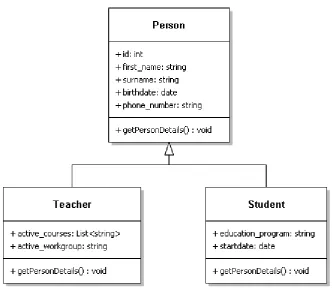
Figure 2.2: Example inheritance
The object-oriented paradigm also has the ability to hide variables of a class; this is named
[image:11.595.75.243.541.747.2]encapsulation or information hiding [15]. The goal of encapsulation is to hide the variables of a class from other classes, by keeping them private. These variables can be accessed only through methods of their current class. The class should provide public setters and getters to modify and access the values of the hidden variables.
Polymorphism is another powerful aspect of the object-oriented paradigm. Alan Shalloway explains that polymorphism is “Being able to refer to different derivations of a class in the
same way, but getting the behavior appropriate to the derived class being referred to” [19]. Polymorphism is the ability of an object to take on many forms.
Polymorphism_example.java
public class Person {
public void getPersonDetails() {
System.out.println("This is a person.");
} }
public class Student extends Person { @Override
public void getPersonDetails() {
System.out.println("This is a student.");
} }
public class ClientApplication{
public static void main(String[] args) { Person student = new Student();
student.getPersonDetails();
} }
As illustrated above, the class Student (subclass) extends the class Person (superclass). In the class ‘ClientApplication’, which represents the client-program, we instantiate a variable ‘student’ of type Person. We assign a new Student object to the variable. When the client calls the overridden method ‘getPersonDetails()’ on the superclass variable, the subclass version of the method will be executed. The system will print: “This is a student”.
Another powerful aspect of the object-oriented paradigm is abstraction. According to the University of Colorado, abstractionrefers to “The set of concepts that some entity provides you in order for you to achieve a task or solve a problem” [4]. Abstraction allows the
developer to write codes which work with abstract data structures. It is the concept of describing something in simpler terms (abstracting the details, in order to focus on what is important) [15].
We can demonstrate the concept of abstraction by using the example of Person, Student
and Teacher. Person can be an abstract class to specify the default data and behavior of an object and let its subclasses (Student and Teacher) explicitly implement that functionality.
Abstraction_example.java
abstract class Person { public int id;
public void getPersonDetails();
}
public class Student extends Person { public void getPersonDetails() {
System.out.println("This is a student.");
} }
public class ClientApplication{
public static void main(String[] args) { Person student = new Student();
student.getPersonDetails();
} }
The object-oriented paradigm offers numerous concepts and possibilities to model software. The use of objects together with the four important aspects of the paradigm (Inheritance, Encapsulation, Polymorphism, and Abstraction) gives the developer more options in the design of software architecture.
Various programming languages support the object-oriented paradigm; the most popular are Java, C++, C#, Delphi, PHP, Python, Visual Basic, and Objective C [18].These languages have their own syntax, but it is possible to program in an object-oriented style.
2.3 Design patterns
In this project, we will define a framework that can help the designers to find suitable patterns for his or her needs. Hereby, in this section we will define what a design pattern is.
Patterns capture well-proven experience in software development and help to promote good design practice. A pattern can deal with specific recurring issues in the design or
implementation of software. With the use of patterns, it is possible to construct software architecture with particular properties. [7]
Christopher Alexander explains that “Each pattern describes a problem which occurs over and over again in our environment, and then describes the core of the solution to that
problem, in such a way that you can use this solution a million times over, without ever doing it the same way twice.” [3] This definition is based on patterns in buildings and cities, but is
also applicable in software.
A design pattern has four essential elements: The context giving rise to a problem, the recurring problem, the proven resolution, and the consequences (advantages and
disadvantages). [7][12] Design patterns can be used to model adaptability into software. [2]
2.4 Model Analysis and Checker (MACH)
MACH is a tool to deploy and test advanced algorithms for analyzing UML models. [20] The tool’s implementation language and existing code base uses Prolog (specifically SWI-Prolog), and the tool has a command-line User Interface (CLI). MACH is a flexible and lightweight framework for the loose integration of independent tools, and has a set of integrated tools.
MACH was developed in the Department of Applied Mathematics and Computer Science, Technical University of Denmark, in 2013 under the lead of Professor Harald Störrle. While developing the tool, they focused on academic stakeholders, but neglected industrial users. MACH users should have some understanding of models and the underlying concept to fully understand and use the tool.
The research work focuses on advanced operations on UML models that are beyond the scope of existing modeling tools. MACH offers an advanced analysis and checking
procedures on UML models. The tool can be seen as proving ground for analysis techniques from recent research.
MACH loads models in XMI format and converts it to an internal data structure in Prolog. This internal data structure is represented as Prolog facts. When the model is converted to an internal data structure, it is possible to use commands to search for specific patterns or elements in models, and to inspect parts of models in detail.
The user can navigate through directories with a set of commands:
- pwd Print working directory
- cd [PATH] Change directory to [PATH]
- ls [OPTION] Shows contents of working directory. Possible options:
m: list only models
a: list all files
p: list all Prolog files
To access/load the existing models in MACH, the models should be stored in a XMI format. MagicDraw is a modeling tool (which will be explained in more detail later in this section) and has a custom format (MDXML), which is based on the standard XMI model interchange format. MACH assumes the models are of the MDXML format.
The user can access existing models with the following commands:
- open [FILE] Access file and interpret it as a model
- open [FILE] as $ALIAS Access file, interpret it as a model and assign the name as a shorthand for the file
- show all aliases List all currently defined aliases - show alias $ALIAS show details of the specified alias - clear all aliases Remove all alias declarations
SWI-Prolog
MACH requires SWI-Prolog, an open source implementation of Prolog. Prolog is a Logic-programming language based on formal logic [21]. It is expressed in terms of relations represented as facts and rules. A computation is initiated by running a query over these relations.
Prolog is helpful for MACH, because you can run a query to search for specific elements in models. With a query, questions are asked about the relations [6].
SWI-Prolog has a set of features, including libraries for constraint logic programming,
multithreading, unit testing, GUI, interfacing, among other technologies. The development of SWI-Prolog started in 1987 by Jan Wielemaker at the University of Amsterdam.
Prolog is highly useful as it has a built-in backward chaining inference engine which can be used to partially implement some expert-systems [10].
Structure of Prolog facts
MACH will be used in this project to load models in XMI format and convert them to Prolog facts. Hereby, the structure of the facts should be the same to compare, infer, or match with other facts. The structure is explained based on an example class, illustrated in Figure 2.7.
Figure 2.5: Example class ‘Foo’
Figure 2.5 demonstrates a class called ‘Foo’. This class has a private property called ‘bar’ of the type ‘int’. The representation of this class in Prolog looks like this:
me(class-1,[name-'Foo',ownedMember-ids([2])]).
me(property-2,[name-'bar', visibility-'private', type-'int']).
The first argument of the me-predicate is a pair of type and internal identifier (an integer). The second argument is a property list of tags for meta-attributes and their values. References to identifiers are marked with an id or ids-term. The attribute
‘ownedMember-ids([2])’ of the class ´Foo´ indicates that this class has a subfact with an internal identifier of 2. This reference shows that the ownedMember is a property of the class.
The internal identifier is an integer and identifies the predicate. The type identifier represents the type of element. Possible type identifiers are: model, comment, diagram, class,
generalization, property, operation, and parameter.
MagicDraw
MagicDraw is a visual UML, SysML, BPMN, and UPDM modeling tool. This dynamic tool facilitates analysis and design of object-oriented software and databases, publicly released in 1998 [17].
The Unified Modeling Language (UML) is the industry’s standard general purpose modeling language for software engineering. MagicDraw supports the notation and semantics
associated with the UML. The tool makes it possible for the user to create and edit UML diagrams, which are diagrams that follow the graphical notation of the UML.
MagicDraw saves UML diagrams as MDXML-files, which is required by MACH. Therefore, MagicDraw is an efficient and verified tool to accomplish the desired conversions. Other tools may work as well, but MagicDraw is verified by MACH developers.
2.4.1 Rule-based expert systems
As we use Prolog facts to represent UML models internally, we also use Prolog facts to implement the matching and merging process of the framework that we define in this project. A rule-based expert system is a technology that underlines this framework by using Prolog facts, and this section will elaborate on this.
An expert system is a system that corresponds to the decision-making capability of a domain expert. A rule-based expert system uses human expert knowledge to solve problems that occur in the real world. The system encodes expert knowledge into an automated system. These systems are the simplest form of artificial intelligence [1].
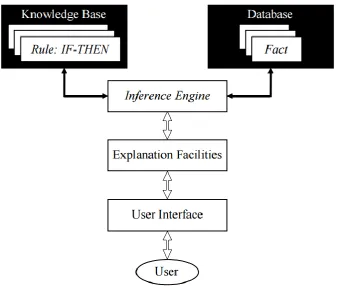
Figure 2.6: Basic structure of a rule-based expert system
The knowledge base contains the domain knowledge that is needed for problem-solving. Domain knowledge is expressed as a set of rules, also described as a ‘rule base’. This set contains all actions that should be taken depending on the set of facts. Each rule is
represented as an IF-THEN statement, and is a conditional statement that connects conditions to actions or outcomes.
The database includes a set of facts used to match against the IF-part of rules in the knowledge base.
The inference engine performs the analysis and interpretation whereby the expert system finds an applicable solution. The inference engine links the given rules in the knowledge base with facts from the database.
A rule-based expert system also contains explanation facilities to clarify its reasoning and defend its conclusion. The explanation facilities enable the developer to ask the system why a specific fact is needed, and how a particular conclusion is reached.
The user interface is the communication layer between the user and the expert system. It is the means of communication between a user searching for a solution to a particular problem and the expert system.
Forward chaining is data-driven reasoning. The reasoning starts from known data and progresses with that knowledge. Forward chaining is a technique for collecting data and inferring from it whatever is possible.
Backward chaining is goal-driven reasoning. The reasoning starts with a goal (hypothetical solution) and the inference engine attempts to find the rule(s) that might have the desired solution. Such rules must have the goal in their THEN-parts. Rules can be stacked to have subgoals that can confirm the main goal.
Decision tree
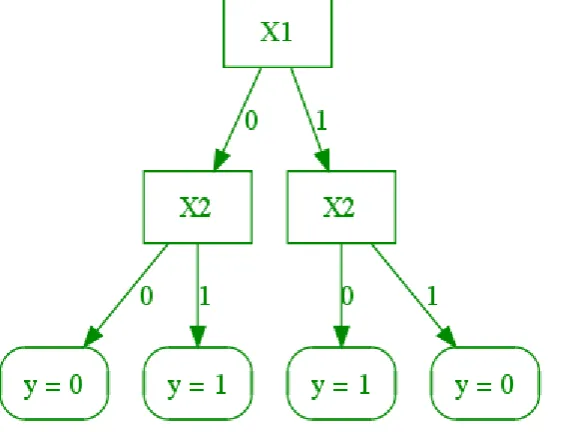
[image:18.595.76.364.253.469.2]A decision tree is a good method for the implementation of the knowledge base. A decision tree can be used to classify a situation according to a set of decisions [22].
Figure 2.7: Decision tree example
A decision tree is an intuitive structure that looks like a flowchart and consists of decision nodes. After going through the decision nodes, the decision tree will end with a suggestion. In Figure 2.7, X1 and X2 are variables that can be false (0) or true (1). The value of variable y depends on the values of X1 and X2. The decision nodes represent the IF-THEN
statements in the knowledge base according to given facts (X1 and X2), like one of the nodes in the example:
3. A model and design patterns for adaptability
Evolution can have a impact on a software solution which is why it is important to implement adaptability in the software [8]. In this chapter, we will define the formula to model
adaptability and make divisions in evolution, stated as evolution semantics. For each type of evolution, we define a set of object-oriented technologies and design patterns that can be used to implement this. We elaborate on the decorator pattern.
The formula to model adaptability into software can be defined as follows [2]:
Explanation of the formula:
This is the solution that you need
These are the solutions (or solution) you need to add
This is how you add it
This is the solution that you have
The software that has to evolve (solution S1) can be anticipated or unanticipated. This indicates if the software is prepared for changing requirements and/or future technology. Anticipated software is software that is designed in a way that can be replaced or extended in runtime. Software that is unanticipated is software that is without considering changes in the future. This means when requirements or technology changes, the existing software should adapt to these changes, which indicates that it should be recompiled.
Anticipated software can be divided into two types: Just good and Too much. Just good
indicates that the software correctly anticipates desired changes. Too much indicates that the software anticipates too many possible changes. This causes significant overheads and may result in a lack of robustness.
Possible changes in functional requirements or technologies are anticipated by determining a line between the fixed part and the adaptable part of the software. It is important to know which components should be variable and which components should remain fixed. When this is clear, the software anticipates numerous possible changes.
Evolution can be divided into four types: non-overlapping extensions, specialization,
overlapping extensions, and layered (meta) evolutions [2]. The following section, section 3.1, will describe these according to the formula for modeling adaptability. Section 3.2 will
3.1 Evolution semantics
3.1.1 Non-overlapping extensions
[image:20.595.77.518.169.319.2]Non-overlapping extensions are an extension to the existing solution. Figure 3.1 depicts an extended software system [2].
Figure 3.1: Example of non-overlapping extensions [2]
Here the most right rectangle S1 represents a system to be extended. This system has two components, A1 and A2, which are represented as two inner rectangles. The extension interfaces of these two components are represented by two ellipses on the left of these rectangles.
S2 represents a software system that is to be added to the existing system. The (+) is a composition operator, which is necessary to integrate S1 and S2. Like S1, S2 has two inner components (A3 and A4) with their own extension interface.
We define this as a non-overlapping extension because S1 and S2 do not share software components. S2 will be bound to S1. The binding of solutions S1 and S2 means that components A1 and A2 will connect with components A3 and A4. This connection can be implemented with the help of various technologies and design patterns.
To implement a non-overlapping extension, four design patterns can be used: decorator, proxy, mediator, and adapter. Other object-oriented technologies can be used to implement this type of evolution: glue code, script, and transformation. In the following we will define these patterns and other object-oriented technologies.
Decorator pattern
The decorator pattern is used to attach additional responsibilities dynamically to individual objects instead of an entire class. Decorators provide a flexible alternative to subclassing for extending functionality [12].
Proxy pattern
Mediator pattern
By using the mediator pattern, the communication complexity between multiple objects or classes will be reduced by providing a mediator class which handles all communication between them [12].
Adapter pattern
An adapter pattern is applied to use an existing class and its interface does not match the one you need. The pattern lets classes work together that otherwise could not because of incompatible interfaces [12].
Glue code
Glue code is a dedicated program that replaces and/or binds the interfaces of modules. The standard practice is to keep logic out of the glue code and leave that to the code blocks it connects to [2].
Script
Script is a dedicated interpreter-based language that installs modules and configures calls among them [2].
Transformation
Transformation transforms the solution into a new solution. This can be implemented with the help of transformation rules [2].
3.1.2 Specialization
[image:21.595.78.523.480.606.2]Specialization is the extension of the current solution which serves as a replacement. Figure 3.2 illustrates a software system which is extended [2].
Figure 3.2: Example of specialization [2]
In Figure 3.2, a software system is depicted which is extended with the use of a delegation mechanism. S1 represents a system to be extended. This system has two components, A1 and A2. S2 represents a software system that is to be added to the existing system. Like S1, S2 has two inner components (A3 and A4).
It will become possible to substitute components in S1 with components in S2, resulting in the desired solution S3. This mechanism can be implemented with the help of various technologies.
To implement the specialization, three design patterns can be used: bridge, strategy, and command. In addition, other object-oriented technologies can be used to implement this type of evolution: inheritance and true delegation. In the following we will define these patterns and other object-oriented technologies.
Bridge pattern
The bridge pattern can be used to decouple an abstraction from its implementation so that the two can vary independently by providing a bridge structure between them [12].
Strategy pattern
By using the strategy pattern, a class behavior or its algorithm can be changed at runtime. With this pattern, objects are created which represent different strategies and a context-object with different behaviors per strategy [12].
Command pattern
The command pattern is used to issue requests to objects without knowing anything about the operation that is being requested or the receiver of the request. It encapsulates a request as an object, thereby allows one to parameterize clients with different requests and support undoable operations [12].
Inheritance
You can extend behavior through inheritance with the help of super calls, which is similar to the decorator pattern, although it is through the inheritance hierarchy [2].
True delegation
This technology is about transitive reuse with support of self calls, similar to the delegation-based language self [2].
3.1.3 Overlapping extensions
Figure 3.3: Example of overlapping extensions [2]
S1 represents a system to be extended. System S1 has two components, A1 and A2. S2 represents a software system that is to be added to the existing system. System S2 has two components, A3 and A4.
We define this extension as an overlapping extension because S2 has components that overlap some functionality of the components in S1. One or multiple software components are shared between the solutions S1 and S2.
Merging the components can be quite difficult, because it contains overlapping functionality. Nevertheless, with the help of various technologies it will become possible to extend solution S1 with solution S2.
To implement the overlapping extension, two design patterns can be used: bridge and strategy. These patterns have been described in section 3.1.2. Other object-oriented technologies can be used to implement this type of evolution: programming, override, and transformation. In the following we will define object-oriented technologies.
Programming
By reprogramming and recompiling the solution that you have, it is possible to extend it with the solution to add [2].
Override
With this technology, you can replace parts of the program using inheritance to override existing methods [2].
Transformation
This technology is about transforming the software solution into a new software solution [2].
3.1.4 Layered (meta) evolutions
Figure 3.4: Example of layered (meta) evolutions [2]
The right rectangle S1 represents a system to be extended. This system has two
components, A1 and A2. S2 represents a particular (meta) layer to be added to the existing system. Like S1, S2 has two inner components (A3 and A4).
We define this type of evolution as layered (meta) evolutions, because the components in S2 interpret or adapt the existing components in S1. This means that the components in S2 describe the components in S1 on a higher (meta) level.
When the layers interact with each other, it will result in the solution S3. This layered evolution can be implemented with the help of various technologies.
To implement the layered (meta) evolutions, one design pattern can be used: the command pattern, described in section 3.1.2. Besides the command pattern, other object-oriented technologies can be used to implement this type of evolution: interpretation, compilation, reflective features, and transformation. Transformation technology is discussed in section 3.1.3. In the following we will define interpretation, compilation and reflective features.
Interpretation
Interpretation is about processing a program and/or runtime environment [2].
Compilation
Compilation states a compiling program, like application generators, language compilers, and stub-generators [2].
Reflective features
This technology includes the use of reflective features of the language to examine and modify the structure and behavior of the solution at runtime [2].
3.2 Design patterns for adaptability
patterns. The decorator pattern is a design pattern that can be used for non-overlapping extensions.
We now describe the Decorator pattern in detail, by defining the applicability, solution, advantages, and disadvantages.
3.2.1 Decorator pattern
Applicability
The decorator pattern can be used when it is important to add encapsulated responsibility to individual and existing objects transparently without affecting another object. These
responsibilities can be removed again without affecting other objects [12].
This pattern extends classes without the use of subclassing. Subclassing adds behavior at compile-time and the change affects all instances of the original class, which makes it a less suitable solution. The pattern is suitable when it is desirable to add new behavior at runtime.
Solution
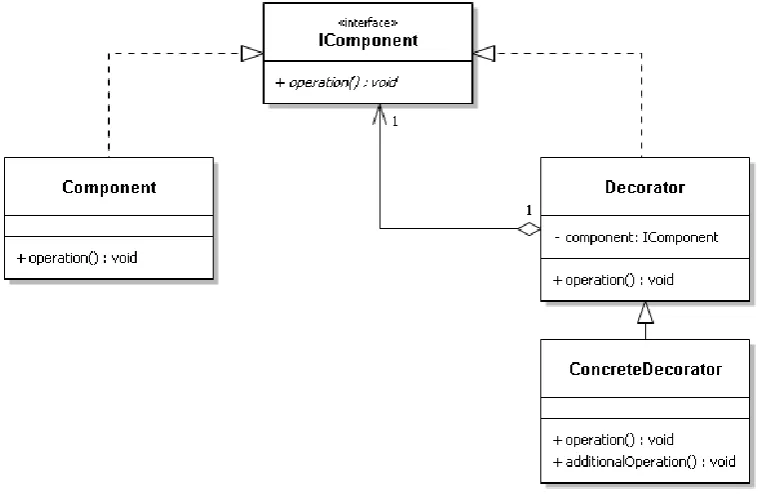
The solution of the decorator pattern can appear in various forms. The UML-diagram of the most basic form is depicted in Figure 3.5 and has four participants: ‘Component’,
[image:25.595.76.457.391.638.2]‘IComponent’, ‘Decorator’ and ‘ConcreteDecorator’.
Figure 3.5: UML-diagram of decorator pattern
Participants:
- Component
- Component is the object to which additional behavior can be added. - IComponent
- Decorator
- Maintains a reference to Component and defines an interface that is to conform to IComponent
- ConcreteDecorator
- Extends the behavior of Component by adding additional functionality
Collaboration:
Component and IComponent are classes in the existing solution where additional behavior is desired. The Decorator maintains a reference to Component and defines an interface that is the same as IComponent. By creating one or multiple ConcreteDecorators, the behavior of Component can be extended. The ConcreteDecorator calls the method operation() from Component and the additional extension additionalOperation().
Advantages and disadvantages Advantages:
- Flexibility, by extending messages and behavior at runtime. It is also possible to extend the individual object with as much additional behavior as the developer desires, by adding more ConcreteDecorators.
- Not much anticipation of software needed, because no complex customizable class is needed for additional behavior. The software only has to anticipate the Decorator-class. The behavior can be extended at runtime by incrementally adding
ConcreteDecorators.
Disadvantages:
- Decorator and ConcreteDecorators are not identical, from an object identity point of view. This means that it is not possible to rely on object identity of the decorators. - Many small objects, because the decorator has many small objects that look alike.
4. A framework to find applicable design patterns
In this chapter, we will describe the framework that we designed to find applicable patterns. We call this ‘Design Pattern Recognition Framework’ (DPRF). This framework is our
contribution to the problem statement as we described in chapter 1. With DPRF, it will become clear which design pattern can be used in the most effective way to implement adaptability into the initial model of the designer. DPRF assists the designer by finding an applicable pattern in his situation and according to his needs.
Section 4.1 defines the overview of the framework with the relevant components and techniques in a UML activity diagram. Sections 4.2, 4.3, and 4.4 specify and explain the components and techniques, divided into three parts (adaptability need, pattern matching, and merger).
4.1 Overview of the Design Pattern Recognition Framework
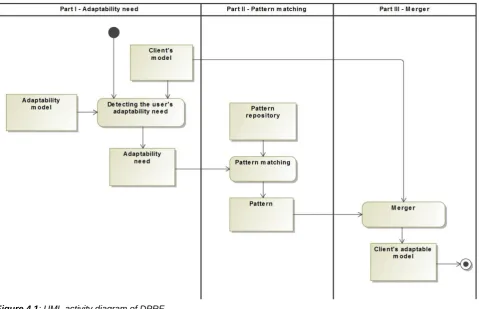
[image:27.595.76.556.372.681.2]This section will describe the overview of DPRF by introducing a UML activity diagram. This diagram is illustrated in Figure 4.1.
Figure 4.1: UML activity diagram of DPRF
Part I focuses on the detection of the user’s adaptability need by applying a matching process between the client’s model and adaptability model. The black circle at the top represents the starting point of the activity and points to the first activity (‘Detecting the user’s adaptability need’). The client’s and adaptability model serves as input to this activity. The client’s model is a set of Prolog facts and represents the user’s initial UML model
internally. The adaptability model includes generic adaptability features that can be identified by the user. With the help of a decision tree, the user can detect its adaptability need.
Part II contains a pattern repository that exists in a set of design patterns. Each pattern has a subset of adaptability features that can be implemented by the pattern. This subset is
matched with the output of the decision tree, to find a suitable pattern according to the user’s need.
Rule-based expert system, as described in section 2.4.1, is the technology that underlines the first two parts of the framework. The knowledge base is represented by the adaptability need and the pattern repository represents the database. DPRF performs the analysis and interpretation as an inference engine, to find a suitable pattern.
Part III represents the merging process between the client’s model and the derived pattern. The merger unites the pattern with the client’s model to fulfill the user’s adaptability need. This activity results in the client’s adaptable model.
4.2 Part I - Detecting the adaptability need
In this section, we describe the relevant components in part I. To detect the user's
adaptability need, the framework uses the client’s model and adaptability model as input. This process results in a subset of adaptability needs.
The client’s model serves as input for the framework. It represents the UML model of the existing application which has some adaptability problem. The client’s model must be
represented internally using Prolog facts in a particular structure as described in section 2.5.
The adaptability model includes generic adaptability features and is based on the four types of evolution described in section 3.1. These generic features describe the types of
adaptability that can be recognized by the user. The process to detect the user’s adaptability need is the identification of a set of adaptability features from the adaptability model. This set of features is the output of the process and can be represented as the user’s adaptability need.
In the following, we will define and describe the features step-by-step. Each feature is represented within a rectangle and is numbered from 0 to 6.
0 "We have a method m1()."
1 "The implementation of method m1() may change according to the context at runtime."
Feature 1 indicates that the set of statements that represents the implementation of method m1(), may change. The program should decide at runtime which set of statements is used for the implementation of the method. This decision depends on the context.
2 "The method m1() can be divided into sub-methods."
Feature 2 declares that the implementation of method m1() can be divided into multiple sets of statements.
3 "The implementation of the change means sequentially cascading a selected set of sub-methods together."
Feature 3 states that implementing the desired change means sequentially cascading one or multiple sub-methods. This set of sub-methods will give the desired implementation of the method.
4 "Each sub-method is implemented in a different object."
Feature 4 indicates that each sub-method has its own object. This means that sub-methods are separated from each other at an object level.
5 "The existing object will not be affected."
Feature 5 declares that the existing object will not be affected in any way during the
implementation of the adaptability solution. This means that the existing object in which the problem applies, does not have to be recompiled.
6 "Change is implemented by running a configuration program which sequentially cascades sub-methods."
Feature 6 states that the desired change will be implemented by running a configuration program. This configuration program sequentially cascades a selected set of sub-methods.
The decision tree starts with the black circle at the top of the figure. The arrow from this starting point indicates the direction of flow. A diamond-shaped symbol represents a decision with two possible outcomes that are represented by outgoing flows. A rounded rectangle represents an action. These actions are used by DPRF to ask for additional information from the user. The white circle with a black cross sign indicates that the flow is ended, and this occurs when the framework can’t process the decisions to a particular design pattern. The white circle with an inner black circle at the bottom of the tree represents the final node and states that the decision tree is executed successfully.
DPRF runs the decision tree and guides the user to identify his adaptability need. The framework asks the user to make a set of decisions and requests additional information.
4.3 Part II - Pattern matching
In this section, we describe the pattern matching process between the pattern repository and the adaptability need. The adaptability need is a set of adaptability features according to the user’s need as described in the previous section.
The pattern repository represents a set of design patterns. The patterns are represented internally as Prolog-facts. Each pattern is defined as a set of facts to represent its structure. Each element and relations between the elements is represented. We use the MACH tool as a means to generate the Prolog facts, based on the UML diagram of the design pattern. Internally, MACH has a library of Prolog facts which are used in the representation of diagrams.
To match the pattern with the user’s adaptability need, we define the related adaptability features. For each pattern, a subset of adaptability features from the adaptability model is designed. This subset represents the needs for adaptability that can be implemented by the pattern. This states that each pattern in the pattern repository consists of two parts: the internal representation and the related adaptability features.
The related adaptability features are represented as Prolog facts to implement the pattern matching process. The related features are stated as follows:
‘adaptability_feature’ is a Prolog predicate, where P represents the name of the pattern, F
represents the identifier of the adaptability feature, and Y represents the description of the feature. Y is not relevant to the matching process, as it does not identify the feature or pattern.
The user’s adaptability need is also represented as a set of Prolog facts. These facts are stated as follows:
‘adaptability_need’ is the second Prolog predicate, where F represents the identifier of the adaptability feature and Y represents the description of the feature. Y is irrelevant, as it does not identify the adaptability feature.
DPRF will find the pattern that has the same adaptability features as defined in the adaptability need. Referring to the stated Prolog facts, DPRF matches F between both predicates. There is a match when all the adaptability needs are stated as adaptability features (same F) and are related to the same pattern, P.
If there is a match, the related pattern P serves as an output of the matching process and is identified as a suitable design pattern to implement the desired adaptability need.
4.4 Part III - Merger
In this section, we describe the merging process between the client’s model and a suitable design pattern. The client’s model is already recognized and represented internally in the first part of DPRF. By executing the decision tree, the framework knows to which element the adaptability problem applies.
DPRF merges the pattern with the client’s model by transforming the client’s model into an adaptable model. This transformation applies transformation rules to produce the adaptable model, which represents the solution to the user’s adaptability problem.
The framework consolidates the internal representation of the pattern with the internal representation of the client’s model, by finding the object(s) in the pattern model to be replaced by object(s) in the client’s model. DPRF transforms generic objects of the pattern into instantiated objects according to the client’s model and adaptability need.
The decision tree as described in section 4.2, asks the user to identify the object(s) or methods of the client’s model to merge with the pattern in preparation of the merging process.
The transformation rules that are applied on the client’s model are dependent on the pattern structure, which states that every pattern has its own set of transformation rules.
5. Application of Design Pattern Recognition
Framework
In this section, with the help of DPRF, we will describe how an appropriate pattern can be identified and applied to address a specific adaptability problem that may appear in applications.
In section 5.1, we will describe an application by defining the requirements and UML model. In section 5.2, we will describe the detection of the user’s adaptability need by defining the evolution scenario and adaptability facts related to these needs. In section 5.3, we will describe the matching of a pattern in the pattern repository with the user’s adaptability needs. In this section we will represent the decorator pattern internally and define
adaptability features that can be implemented by the pattern. In section 5.4, we will describe the merging process between the client’s model and the derived pattern by using
transformation rules.
5.1 An example application
We elaborate the application of DPRF with an example of an application for an airline to administer flight seats. The requirements of this application are defined in Listing 5.1.
Requirement 1 - “Maintain a list of all flight seats.” Requirement 2 - “Get the details of a flight seat.” Requirement 3 - “Print the details of a flight seat.” Requirement 4 - “Get the price of a flight seat.”
Listing 5.1: Requirements example application
[image:33.595.79.321.522.707.2]The architecture of the application is designed on the basis of requirements as a UML model, illustrated in Figure 5.1.
The example application has two classes: FlightSeat and IFlightSeat. IFlightSeat is the interface of FlightSeat with two methods: ‘getDetails()’ and ‘getPrice()’. The method
‘getDetails()’ prints the details and the method ‘getPrice()’ returns the price of the flight seat.
The UML model represents the client’s model of DPRF. The client’s model is the internal representation of the designer’s initial UML model. MACH loads the diagram and converts it to a set of Prolog facts.
In the following, step-by-step, we will describe how the diagram in Figure 5.1 is represented as Prolog facts. Each fact is represented within a rectangle and is numbered from 0 to 13. The fact number is outside the rectangle on the left hand side.
0 client_model(model-0,[annotation-id(1),ownedMember-ids([1,2,3,9]),name-'Clients-model']).
‘client_model’ is provided to the MACH tool and states that this fact refers to the client’s model. Every time MACH generates a Prolog representation of a UML diagram, it generates the fact ‘model’ with an index starting from 0.
Each time a new fact is generated, the index number is incremented. The expression between the brackets ‘[’ and ‘]’ defines the properties of the fact. Here, the keyword ‘annotation’ represents the facts that are attached to this model as metadata. The value ‘id(1)’ of this property refers to the fact with an index of 1.
The keyword ‘ownedMember’ refers to sub-facts, which are represented as ‘1, 2, 3, 9’ between the brackets ‘[’ and ‘]’. The keyword ‘name’ is generated by the tool and indicates that this is the client’s model.
1 client_model(comment-1,[body-'Author:IPIJNENB',annotatedElement-id(0)]).
The fact ‘comment’ is used to indicate the author of the model as a comment. The keywords ‘body’ and ‘annotatedElement’ refer to the content of the comment and the corresponding model ID, respectively.
2 client_model(diagram-2,[name-'UML-diagram',visibility- (public),ownerOfDiagram-eee_1]).
The fact ‘diagram’ indicates that the name of the diagram is ‘UML-diagram’ and the visibility of the diagram ‘(public)’ and the owner of the diagram is ‘eee_1’.
3 client_model(class-3,[ownedMember-ids([4,5,7]),name-'FlightSeat']).
The fact ‘class’ states that the facts that are referred to by ‘4, 5, 7’ are related facts and the name of the class is ‘FlightSeat’.
The fact ‘generalization’ indicates that there is a generalization relation between the class that refers to this fact and the class that is referred to by the identifier ‘9’. Since this fact was referred to by the previous fact, the generalization relation is defined between class
FlightSeat (declared by fact 3) and the class referred to by the identifier 9.
5 client_model(operation-5,[ownedMember-ids([6]),name-getDetails,visibility- (public)]).
The fact ‘operation’ declares the ‘public’ operation of class FlightSeat and states that the fact that it is referred to by the number ‘6’ is a related fact. The fact also declares that the name of this operation is ‘getDetails’.
6 client_model(parameter-6,[visibility- (public),direction-return]).
The fact ‘parameter’ was referred to by the previous fact and states that the operation returns no value (type void).
7 client_model(operation-7,[ownedMember-ids([8]),name-getPrice,visibility- (public)]).
The fact ‘operation’ declares the ‘public’ operation of class FlightSeat and the name of this operation is ‘getPrice’.
8 client_model(parameter-8,[visibility- (public),direction-return,type-int]).
The fact ‘parameter’ was referred to by fact 7 and states that the operation returns a value of type ‘int’.
9 client_model(class-9,[ownedMember-ids([10,12]),name-'IFlightSeat']).
The fact ‘class’ states that the name of the class is ‘IFlightSeat’ and the facts that are referred to by the numbers ‘10’ and ‘12’ are related facts.
10 client_model(operation-10,[ownedMember-ids([11]),name-getDetails,visibility- (public)]).
The fact ‘operation’ declares the ‘public’ operation of class IFlightSeat and the name of this operation is ‘getDetails’.
11 client_model(parameter-11,[visibility- (public),direction-return]).
The fact ‘parameter’ was referred to by the previous fact and states that the operation returns no value (type void).
The fact ‘operation’ declares the ‘public’ operation of class IFlightSeat and the name of this operation is ‘getPrice’.
13 client_model(parameter-13,[visibility- (public),direction-return,type-int]).
The fact ‘parameter’ was referred to by fact 12 and states that the operation returns a value of type ‘int’.
Listing 5.2 provides an overview of all Prolog facts together as a Prolog program that represents the UML diagram of the example application.
0 1 2 3 4 5 6 7 8 9 10 11 12 13
client_model(model-0,[annotation-id(1),ownedMember-ids([1,2,3,9]),name-'Clients-model']).
client_model(comment-1,[body-'Author:IPIJNENB',annotatedElement-id(0)]).
client_model(diagram-2,[name-'UML-diagram',visibility- (public),ownerOfDiagram-eee_1]).
client_model(class-3,[ownedMember-ids([4,5,7]),name-'FlightSeat']).
client_model(generalization-4,[general-'9']).
client_model(operation-5,[ownedMember-ids([6]),name-getDetails,visibility- (public)]).
client_model(parameter-6,[visibility- (public),direction-return,type-int]).
client_model(operation-7,[ownedMember-ids([8]),name-getPrice,visibility- (public)]).
client_model(parameter-8,[visibility- (public),direction-return]).
client_model(class-9,[ownedMember-ids([10,12]),name-'IFlightSeat']).
client_model(operation-10,[ownedMember-ids([11]),name-getDetails,visibility- (public)]).
client_model(parameter-11,[visibility- (public),direction-return]).
client_model(operation-12,[ownedMember-ids([13]),name-getPrice,visibility- (public)]).
client_model(parameter-13,[visibility- (public),direction-return,type-int]).
Listing 5.2: Client’s model in example solution
5.2 Part I - Detecting the adaptability need
This section elaborates the detection of the user’s adaptability need. In section 5.2.1, we define the evolution scenario by defining new requirements. In section 5.2.2, we identify adaptability facts that are related to the needs of the user.
5.2.1 Evolution scenario
Assume that the requirements of the example application have changed so that flight seats now include additional features, like WiFi or DVD. The set of new requirements is defined in Listing 5.3.
Requirement 5 - “Ability to add additional features to the flight seats.”
Requirement 6 - “Ability to depend the details of the flight seat on the number of additional features.”
Listing 5.3: New requirements example application
Requirement 5 states that it should be possible to include additional features to flight seats, like WiFi or DVD, depending on the context. Requirement 6 states that the details of the flight seat changes, depending on the number of additional features.
5.2.2 The application of the facts related to the adaptability needs
As depicted and described in section 4.2, a Prolog-based decision tree is used to define the user’s adaptability needs. The decision tree will ask the user questions to determine the desired adaptability features. By instantiating generic features in the adaptability model, specific features that refer to the client's model are defined.
[image:37.595.71.301.218.347.2]The following figures illustrate the decision tree, with explanations of all the instantiated adaptability features and the process used to detect the user’s adaptability needs.
Figure 5.2: Decision tree: Step 1
[image:37.595.74.204.483.697.2]Figure 5.2 illustrates Step 1 of the decision tree. The decision tree starts with a decision. This decision represents the first adaptability feature “We have a method”, determining if there is a method in the client’s model that relates to the adaptability problem. The adaptability problem of the example application refers to the method getDetails(), which indicates that this adaptability feature is applicable in the user’s situation, so Yes is the answer.
Figure 5.3: Decision tree: Step 2
an action. With the first action, the pin represents the output of the question, labeled class name. The second action depicts a second question to the user, with class name as an input. When this step is completed, the name of the class and method that is referred to by the adaptability problem are defined. Using the example, the name of the corresponding class is FlightSeat and the name of the corresponding method is getDetails().
Figure 5.4: Decision tree: Step 3
[image:38.595.74.306.418.532.2]Figure 5.4 illustrates the Step 3 in the decision tree and represents the adaptability feature. The decision is whether the statement “The implementation of the method may change according to the context at runtime” is true or not.In the example, this would mean that the implementation of the method getDetails() in the class FlightSeat may change at runtime. The adaptability problem of the example indicates that this is the case, as details of a flight seat may change depending on the number of additional features. The user will therefore choose Yes for this decision.
Figure 5.5: Decision tree: step 4
Figure 5.6: Decision tree: Step 5
Figure 5.6 illustrates Step 5 in the decision tree, and lets the user choose if the
[image:39.595.74.345.336.447.2]implementation of the change means sequentially cascading a selected set of sub-methods together. In the example application, an instance of a flight seat has a set of additional features. A flight seat can have zero, one, or two additional features and the context determines the selected set. As this adaptability feature is applicable in this instance, the user will choose Yes.
Figure 5.7: Decision tree: Step 6
[image:39.595.75.309.550.671.2]Figure 5.7 depicts Step 6 of the decision tree, which identifies another adaptability feature: “Each sub-method is implemented in a different object”. For the user this is less interesting, but it is important to know if this is fine to the user. In the example application, the additional features can be implemented in a different object, which means the user will choose Yes.
Figure 5.8: Decision tree: Step 7
Figure 5.9: Decision tree: Step 8
[image:40.595.87.268.327.564.2]Figure 5.9 depicts Step 8 of the decision tree, which asks the user to assess another adaptability feature: Change is implemented by running a configuration program which sequentially cascades sub-methods. In the example application, the client-program serves as a configuration program and determines which additional features will be added to the flight seat. It also defines the order in which the features are added. As this adaptability feature is applicable for the user, he or she will choose Yes.
Figure 5.10: Decision tree: Step 9
Figure 5.10 illustrates Step 9 the decision tree, which is the final step. It asks the user for additional information that is needed for the implementation of the pattern. This step involves two actions that must take place before the flow arrives at its final state. The first action asks a question of the user: “The method can be divided into how many sub-methods?”The second action asks another question: “What are the names of these sub-methods?”
The user’s adaptability needs is a set of adaptability features that apply to the user’s needs and initial model. The adaptability needs is the output of the executed decision tree. The set of adaptability features that is identified by the user of the example application is depicted in Listing 5.4.
adaptability_need(adaptability-feature-0, "We have a method m1()").
adaptability_need(adaptability-feature-1, "The implementation of method m1() may change according to the context at runtime").
adaptability_need(adaptability-feature-2, "The method m1() can be divided into sub-methods").
adaptability_need(adaptability-feature-3, "The implementation of the change means sequentially cascading a selected set of sub-methods together").
adaptability_need(adaptability-feature-4, "Each sub-method is implemented in a different object").
adaptability_need(adaptability-feature-5, "The existing object will not be affected").
adaptability_need(adaptability-feature-6, "Change is implemented by running a configuration program which sequentially cascades sub-methods").
Listing 5.4: Adaptability need in example solution
5.3 Part II - Pattern matching
In the previous section, we defined the user’s adaptability need. In this section we define the matching process between the pattern repository and the user’s adaptability need. First, we describe the pattern repository, using the Decorator pattern. We represent each pattern in the pattern repository internally and define the adaptability features that can be identified by the patterns. Second, we will define the matching process between the pattern repository and the user’s adaptability need.
5.3.1 Pattern repository: Decorator pattern
Figure 5.11: Model of decorator pattern (variation 1)
We use the MACH tool as a means to generate pattern representations internally. As explained in section XXX, MACH uses the Prolog language to represent UML diagrams. Each UML diagram is therefore a Prolog program. Each element and relations between the elements are represented as Prolog facts.
In the following, we describe how the diagram in Figure 5.11 is represented as Prolog facts. Each fact is represented within a rectangle and is numbered from 0 to 20. The number of a fact is shown outside the rectangle on the left.
0 d_1(model-0,[annotation-id(1),ownedMember-ids([1,2,3,9,13,14,18,22]),name-'UML-model']).
‘d_1’, on the left side of the expression, is provided to the MACH tool and refers to ‘variation 1’ of the decorator pattern. In the set of properties, the keyword ‘annotation’ represents the facts that are attached to this model as metadata. This property refers to the fact with an index of 1. The keyword ‘ownedMember’ refers to sub-facts, represented as ‘1, 2, 3, 9, 13, 14, 18, 22’. The keyword ‘name’ indicates that this is a UML model.
1 d_1(comment-1,[body-'Author:IPIJNENB',annotatedElement-id(0)]).
The fact ‘comment’ is used to indicate the author of the model as a comment. The keywords ‘body’ and ‘annotatedElement’ refer to the content of the comment and the corresponding model ID, respectively.
2 d_1(diagram-2,[name-'UML-diagram',visibility- (public),ownerOfDiagram-eee_1]).
3 d_1(class-3,[ownedMember-ids([4,5,6,7]),name-'Decorator']).
The fact ‘class’ states that the facts that are referred to by ‘4, 5, 6, and 7’ are related facts and the name of the class is ‘Decorator’.
4 d_1(generalization-4,[general-'9']).
The fact ‘generalization’ indicates that there is a generalization relation between the class that refers to this fact and the class that is referred to by the identifier ‘9’. Since this fact was referred to by the previous fact, the generalization relation is defined between class
Decorator (declared by fact 3) and the class referred to by the identifier ‘9’.
5 d_1(property-5,[name-component,visibility-private,type-'9']).
The fact ‘property’ declares the ‘private’ attribute ‘component’, which has the type of the class declared by the fact ‘9’.
6 d_1(property-6,[visibility-private,type-'9',association-'_4361',aggregation-composite]).
The fact ‘property’ declares the ‘private’ composite-association between class Decorator and the class which is declared by the fact ‘9’. The identifier of this relation is defined with the identifier ‘4361’.
7 d_1(operation-7,[ownedMember-ids([8]),name-operation,visibility- (public)]).
The fact ‘operation’ declares the ‘public’ operation of class Decorator and states that the fact that is referred to by the number ‘8’ is a related fact. The fact also declares that the name of this operation is ‘operation’.
8 d_1(parameter-8,[visibility- (public),direction-return]).
The fact ‘parameter’ was referred to by the previous fact and states that the operation returns no value (type void).
9 d_1(class-9,[ownedMember-ids([10,11]),name-'Component']).
The fact ‘class’ states that the facts that are referred to by the numbers ‘10 and 11’ are related facts and the name of the class is ‘Component’.
![Figure 2.1: Example scenario for evolution [2]](https://thumb-us.123doks.com/thumbv2/123dok_us/9793928.480549/9.595.75.520.285.500/figure-example-scenario-for-evolution.webp)
![Figure 3.1: Example of non-overlapping extensions [2]](https://thumb-us.123doks.com/thumbv2/123dok_us/9793928.480549/20.595.77.518.169.319/figure-example-non-overlapping-extensions.webp)
![Figure 3.2: Example of specialization [2]](https://thumb-us.123doks.com/thumbv2/123dok_us/9793928.480549/21.595.78.523.480.606/figure-example-of-specialization.webp)
![Figure 3.3: Example of overlapping extensions [2]](https://thumb-us.123doks.com/thumbv2/123dok_us/9793928.480549/23.595.77.517.74.210/figure-example-overlapping-extensions.webp)
![Figure 3.4: Example of layered (meta) evolutions [2]](https://thumb-us.123doks.com/thumbv2/123dok_us/9793928.480549/24.595.77.522.79.251/figure-example-of-layered-meta-evolutions.webp)