Original citation:
Mawson, Kate. Harnessing technology to provide the support that trainees require to write high quality reflective statements. Science Education Teacher (75). pp. 19-28
Permanent WRAP URL:
http://wrap.warwick.ac.uk/78413
Copyright and reuse:
The Warwick Research Archive Portal (WRAP) makes this work by researchers of the University of Warwick available open access under the following conditions. Copyright © and all moral rights to the version of the paper presented here belong to the individual author(s) and/or other copyright owners. To the extent reasonable and practicable the material made available in WRAP has been checked for eligibility before being made available.
Copies of full items can be used for personal research or study, educational, or not-for-profit purposes without prior permission or charge. Provided that the authors, title and full bibliographic details are credited, a hyperlink and/or URL is given for the original metadata page and the content is not changed in any way.
A note on versions:
The version presented in WRAP is the published version or, version of record, and may be cited as it appears here.
This project was implemented during a one-year secondary Postgraduate Certificate of Education (PGCE) and School Direct (SD) training course at the University of Warwick.
Trainees work within schools spending 80% of their time away from University. The one day a week during which they are based at Warwick is full of content delivery, subject knowledge improvement and pedagogy training. The course uses ICT to support trainees, through Moodle as the VLE for online course delivery and Mahara as the e-portfolio for
assessment, where trainees display their evidence against the eight teaching standards. Trainees produce an e-portfolio where they write reflective statements to demonstrate their development over the course of the year; this evidence enables them to achieve 30 CAT points, which trainees can count towards an MA qualification.
The trainees are encouraged to regularly write reflectively after lessons, observations and any learning episodes, as well as completing a reflective writing task set early in the course to assess levels of critical reflection. Reflective learning is of
particular relevance to the education of professionals, as it encourages students to integrate theory with
practice, appreciate the world on their own behalf, and turn every experience into a new potential learning experience (Wong, Kember, Chung & Yan, 1995). The need for this project was identified in October, when staff reported particularly low levels of critical reflection in the cohort and a method of improving reflective writing was required.
A technology-based solution was selected to provide an easily accessible reflective writing resource that supported production of quality critical reflections, helped trainees to acquire new knowledge and provided support without
face-to-face delivery.
The effectiveness of the resource was judged by the following question:
Does using an online scaffold, harnessing technology to enhance learning, provide the support that trainees require to write high quality reflective statements?
Project overview and management
Successful technology integration requires that educators blend strong content knowledge with appropriate pedagogical strategy.
STE
Harnessing technology to provide the support
that trainees require to write high quality
reflective statements
‘Where it is appropriate for scaffolding to assist in the process, then the design of that scaffolding will be an important factor in determining the outcome’
(Mason, 2012, p.186).
Identifying the need for an asynchronous
ICT resource
Initial attempts at using technology to develop critical reflection started with using technology as a platform for discussions between trainees and tutors, the idea being to use the trainees’ initial reflections as a starting point, then asking tutors to provide detailed formative feedback to trainees to support them in their reflective writing. However, after a stakeholder analysis, the large workload of this model became apparent very quickly, so it was eliminated as an option. We then trialled a model
in which specific questions were provided for trainees, and those trainees had to write their reflections based on these. This was immediately seen by trainees as extra work for no extra credit and the completion rate for this activity was 0%.
Our initial findings indicated that the trainees’ reflection was basic and limited; the technology solution therefore needed to be capable of
supporting trainees through basic initial reflections towards more critical reflections, and providing new knowledge. Examples were included within the technology enhanced learning (TEL) resource to help the trainees to model good practice in reflective writing.
The scaffold created has vivid descriptions and visualisations, to try to harness the power of the findings in the work of Kim (2011), fitting with ideas from McLoughlin & Marshall (2000):
‘Scaffolding can be implemented to motivate the learner, reduce task complexity, provide structure, and reduce learner frustration. Providing feedback, examples, peer support and communication, and clarifying roles and expectations of the learners, can help scaffold student learning’.
STE
Harnessing technology to provide the support
that trainees require to write high quality
reflective statements
●
Kate Mawson
Figure 1:Project stages.
▼
▼
• RP1 poor pass rate and need identified • Initial strategies trialed
and stakeholder analysis
• Prior questionnaire • Research around TEL
options and refelction • Completion of
Mahara resource
• Post questionnaire and interviews
• Outcomes for trainees and • Evaluation and future
implications of the project
PGA TEL project Stage 1 Sep14 -Dec14
Resource made available Stage 2 Dec 14-March 15
Due to the demands and nature of the PGCE course, it was decided that the resource needed to be static and asynchronous.
The reasons that led to this conclusion arose from mapping the advantages and disadvantages of this approach alongside the time pressure perceived by staff and workload for trainees. Previous work has indicated that this is by far the largest concern in the stakeholder analysis (Hrastinski, 2008;
Obasa et al, 2013).
The asynchronous media have three crucial advantages: time to reflect, flexibility and situated learning. The disadvantage highlighted by
Vonderwell (2003) was lack of interaction but, in our context, this became of a lesser concern, as face-to-face reflection time was facilitated in Friday’s tutor-led sessions each week.
The asynchronous nature of a resource is regularly identified in the online learning literature as a reason for the success or failure of online learning. For example, Song (2004) discusses the work of Poole (2000):
‘In a study of student participation in a
discussion-oriented online course, the results indicated that students participated in online discussions at times most convenient to them... Poole also found that students mostly accessed course materials from their home computers, the place most convenient to them’
(Song, 2004).
This becomes even more of a consideration when we acknowledge the fact that many PGCE and SD trainees are fulfilling 80% of a permanent secondary school teacher’s allocation in the summer term and some undertake many other school-based responsibilities.
With nationally recognised workload issues facing the trainees at the same time as completing the course, convenience of the resource is of prime importance.
The following tools were considered and a brief summary is presented on the next page:
STE
Harnessing technology to provide the support
that trainees require to write high quality
reflective statements
No online forum option. However, there is a comment box where asynchronous comment could be made. This is not the same as
asynchronous forum. There is a lack of staffing in order to facilitate a forum so this lack of a forum feature is less of a concern at this stage in the project.
Lack of technological skills is a constraint and this also applies to many of the technologies, but the VLE is a more complex tool (Song, 2004).
Very crowded area already and trainees have already expressed concern with its structure.
STE
Harnessing technology to provide the support
that trainees require to write high quality
reflective statements
●
Kate Mawson
e-portfolio: Mahara
Virtual Learning Environment: Moodle
Tool Pros Cons
‘e-portfolio tools demonstrate the value of accommodating reflective practice and explanatory content in supporting learning’ (Mason, 2002, p.2)
Mahara offers what none of the other tools does; it is the tool for PDP assessment. McKinney writes that, in order to effectively use technology, ‘teachers need visions of the technologies’ potential, opportunities to apply them, training and just-in-time support, and time to experiment’ (1998), so using a package that they would be engaging with throughout the year provides opportunity for trainees to effectively use Mahara, which is a requirement of the course, in order to produce a quality PDP for assessment.
Variety of advantages put forward by Owen (2000).
STE
Harnessing technology to provide the support
that trainees require to write high quality
reflective statements
●
Kate Mawson
The disadvantage to this type of forum is that it requires an additional workload, as, for a forum to be effective, there must be someone in the role of forum moderator (according to Mason, 1997).
Limited ability to code in HTML and, whilst there are tools that the University buys into in order to provide structured pages, it would be a very time-consuming approach to create my own. Use of a VLE or e-portfolio could achieve the same benefits stated by Anderson (1996); however, it fails to be cost-effective if staff are required to spend hours creating it.
Time constraints although ‘some to some’, a method proposed by Smyth (2005) may be possible in the future.
Online forums
Web page
Video conferencing: Blackboard
collaborate
Tool Pros Cons
(1) Freedom from time constraints (trainees can participate when and if they choose);
(2) Time for reflection (trainees decide when and if they choose to participate); (3) Opportunities to research and back up
assertions (Anderson, 1996). Cost-effective: all a learner needs is a computer and a decent internet connection.
Immediate feedback and participate in discussion (Kock, 2001).
After research into the available tools that could support increased critical reflection within the cohort, an e-portfolio tool was used to generate the scaffold. It was primarily the work of McKinney (1998) and of Biggs (1996) on constructive
Once the resource type was established, the content then needed to be addressed. Therefore, it was important that the scaffold allowed trainees to get to the critical thinking level required rather than just giving a personal reflection, and that they were clear how it linked to their assessment model in order for it to be of value.
The resource was made available to all trainees in March and was introduced to the whole cohort
via a PechaKucha-style lecture. PechaKuchawas
designed by Klein and Dytham of Klein Dytham Architecture in 2003 as a means of presenting concise presentations. Twenty slides of 20 seconds’ duration each provide an innovative way to present a new idea. More information can be found at
www.pechakucha.org
Visits to the page were recorded automatically by the Mahara software. A link was also provided to a YouTubevideo taking a humorous look at the ‘six thinking hats’ approach.
Being an effective practitioner relies upon personal relationships, and humour helps to cement these relationships, hence the addition of the piece
created by ‘ProfesseurDestructo’ and available from
https://www.youtube.com/channel/UCUVe7r4GRB Y6mM_KBLTddbA
The use of varied types of media used was informed by knowledge of learning theory and limited by technological repertoire.
The resource, therefore, is an attempt to provide a static resource that does have the ability to
generate new knowledge and that can be used in dynamic ways by trainees. The resource includes:
❍ Technical support pages with video link. Of
2253 visits to the resource during the project, 685 were to the technical support pages. ❍ A PechaKuchapresentation with audio
explanation of the construct for reflective statements. A link to a Moodle quiz to help solidify knowledge of the construct.
❍ Developmental questions organised into
teaching standards and exemplar reflective material.
❍ Humorous video around DeBono’s theory of
six thinking hats.
STE
Harnessing technology to provide the support
that trainees require to write high quality
reflective statements
Data and outcomes of the project
The outcome for trainees was significant;
a 100% PDP pass rate was seen. Data also show that the use of the Mahara scaffold-supported reflective writing helped trainees to write high quality reflective statements.
There is strong evidence that trainees found the resource helpful and that their frequency of reflective writing increased, as can be seen in Figure 2.
When asked how helpful trainees found the
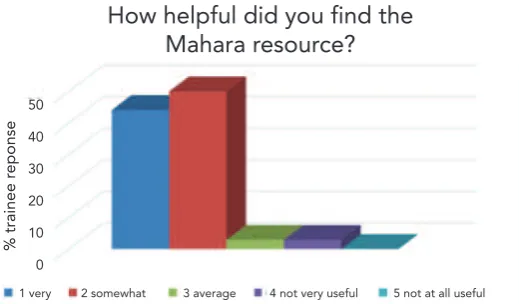
resource, Figure 3 shows a very positive response.
As with any intervention, it is possible that the overall increase in reflective writing frequency and quality could just be an outcome of the natural progression of the course. However, the resource had been accessed 2253 times by the end of the project and, with only 122 trainees on the course, this is a significant number of visits.
To establish more fully if the resource was a success, interviews with trainees were conducted to assess reasons for site visits. The post-resource interviews found that trainees believed the quality of their reflections had improved.
STE
Harnessing technology to provide the support
that trainees require to write high quality
reflective statements
●
Kate Mawson
How regularly do you Every day Twice a week Once a week Once a month Never write reflectively?
% Pre resource 2 12 20 47 18
% Post resource 9 24 29 32 6
[image:8.595.29.289.362.514.2]Figure 2.
Figure 3. 50
40
30
20
10
0
%
t
ra
in
ee
r
ep
o
ns
e
1 very 2 somewhat 3 average 4 not very useful 5 not at all useful
Outcomes for trainees also support the fact that quality of reflective writing improved as the pass rate for their first assessment was significantly low, below 40%, whereas the pass rate for the second assessment, PDP reflective writing, was 100%. Reflective writing is well established as a way to develop learning and the use of TEL can help to support this further by encouraging a more self-directed approach, which the resource does.
‘Students report an ability to recognise their strengths and their own growth more readily when they follow a self-directed approach to evaluating their learning’(Riley Doucet & Wilson, 1997).
The trainees reported the ability to recognise their own strengths and a quote from the 2015 course evaluation is testimony to this:
J.W. ‘I enjoyed completing my Professional Digital Portfolio, as it not only allowed me to reflect on my practice and how to improve, but it also showed me my full development as a teacher. It shows the range of ideas and teaching aspects which I have learnt in an accessible and easy to navigate programme’(sic)
It was found that the quality of reflective writing did improve after implementation of the resource and this work has implications for both TEL research and for teacher development. The project was a huge success, with 100% of the cohort gaining a pass in their PDP assessment. The Centre for Professional Education is moving towards
Distinction, Merit, Passassessment criteria next year and it will be of interest to look at the proportion of distinctions awarded for PDP
submissions, related to trainee use of the scaffold.
‘Together, technology and pedagogy reveal and develop our human creativity and responsiveness and allow us to learn effectively and enjoyably’
(Anderson, 2012).
Acknowledgements
Thanks go to Jim Judges from ‘My Warwick Journey’ for the Mahara support videos used in the
resource, as well as to members of the University of Warwick Centre for Professional Education (CPE) for their invaluable support during the project, and specifically to Dr. John Thornby and past trainees for the supply of exemplar material.
STE
Harnessing technology to provide the support
that trainees require to write high quality
reflective statements
References
Anderson, T. (1996) ‘The virtual conference:
Extending professional education in cyberspace’,
International Journal of Educational Telecommunications,2, (2/3), 121–135
Anderson, T. & Dron, J. (2012) ‘Learning technology through three generations of
technology-enhanced distance education pedagogy’,
Revista Mexicana de Bachillerato a Distancia.
Available from http://files.eric.ed.gov/fulltext/
EJ992485.pdf Accessed 03/09/15 Biggs, J. (1996) ‘Enhancing teaching through
constructive alignment’, Higher Education,
32, (3), 347–364
Hrastinski, S. (2008) ‘A study of asynchronous and synchronous e-learning methods discovered that
each supports different purposes’, EDUCASE
Quarterly Number 4, 51–55. Accessed via
https://net.educause.edu/ir/library/pdf/EQM08 48.pdf Accessed 03/09/15
Kim, M. & Hannafin, M. (2011) ‘Scaffolding
problem-solving in technology-enhanced learning environments (TELEs): Bridging research and
theory with practice’, Computers & Education
403–417. Available from
http://www.sciencedirect.com.pugwash.lib.warwi ck.ac.uk/science/article/pii/S0360131510002
526Accessed 03/09/15
Kock, N., Davison, R., Wazlawick, R. & Ocker, R. (2001) ‘E-collaboration: A look at past research
and future challenges’, Journal of Systems and
Information Technology, 5,(1), 1–9
Mason, R. (1997) Moderating educational
computer conferencing. Available online at: http://star.ucc.nau.edu/~mauri/papers/mason. html Accessed 03/09/15
Mason, J. (2012) ‘Scaffolding reflective enquiry – enabling why – questioning while e-learning’,
Research and Practice in Technology Enhanced Learning, 7,(3), 175-198
McKinney, M. (1998) ‘Preservice Teachers’ Electronic Portfolios: Integrating Technology,
Self Assessment and Reflection’,Teacher
Education Quarterly, 25,(1), 85-103
McLoughlin, C. & Marshall, L. (2000) Scaffolding:
a model for learner support in an online teaching environment. Available from
http://www.c3l.uni-oldenburg.de/cde/ support/readings/loughlin2.htm
Mcloughlin, C. (2002) ‘Learner support in distance and networked learning environments: Ten
dimensions for successful design’, Distance
Education, (2), 149–162
STE
Harnessing technology to provide the support
that trainees require to write high quality
reflective statements
Obasa et al(2013) ‘A comparative study of synchronous and asynchronous e-learning
resources’,International Journal of Innovative
Research in Science, Engineering and
Technology, 2, (11), 5938–5946. Available from:
http://www.ijirset.com/upload/2013/november/ 3_A-COMPARATIVE.pdf Accessed 03/09/15
Obasa et al(2013)‘Virtual classrooms through
the ages’, World J Young Researchers, 3, (1).
Available from http://rrpjournals.org/wjyr/
en_wjyr_vol_3_iss_1_pg_1_8.pdf
Accessed 03/09/15
Owen, B. (2000) ‘Implementing virtual learning environments: Looking for holistic approach’,
Educational Technology & Society, 3,(3), 39–53 Riley Doucet, C. & Wilson, S. (1997) ‘A three-step
method of self reflection using reflective journal
writing’, Journal of Advanced Nursing, (25),
964–968
Song, L. et al. (2004) ‘Improving online learning:
Student perceptions of useful and challenging
characteristics’, The Internet and Higher
Education, (7), 59 –70
Wong, F., Kember, D., Chung, L. & Yan, L. (1995) ‘Assessing the level of student reflection from
reflective journals’, Journal of Advanced
Nursing, 22,(1), 48–57
Vonderwell, S. (2003) ‘An examination of asynchronous communication experiences and perspectives of students in an online course: a case study’,
The Internet and Higher Education, (6), 77–90
Kate Mawson,University of Warwick Centre for Professional Education.
E-mail: [email protected]