Design of a Planning Tool for effective management of
software development projects
Noortje van Laarhoven
MSc Business Administration – Track Entrepreneurship, Innovation & Strategy
University of Twente
University of Twente
Dr. M. de Visser
Dr. R.P.A. Loohuis
Sigmax Public Transport
Evert Veldhuizen
2
Abstract
Sigmax Public Transport (SPT) is a relative young business unit, part of overarching organization Sigmax Group. SPT is still in its initial phase and therefore does not have a solid body of structure and formalization concerning their product portfolio and related (project) management processes. This absence of structure results in somewhat uncoordinated processes of product- and project management. In addition, SPT lacks decision-making based on rational thinking and hard metrics, in terms of project selection, prioritization and/or termination. Furthermore, a long-term focus has been driven out by short-term projects and for the most part, long-term thinking and planning are not even present within SPT. Absence of the aforementioned, reduces continuity within the SPT department and does not contribute to the overall work progress.
The goal of this research is therefore threefold and includes development of a practical Planning Tool supporting SPT in:
1a. Formulation of the SPT business and definition of the competitive position within the business environment.
1b. Development and communication of a business strategy and long-term organizational planning.
2. Decision-making related to selection, prioritization and/or termination of projects, before, during and after project implementation.
3. The application of guidelines for process-based and organized management of projects.
Based on these research goals, a research question is formulated:
‘ In what way can SPT be supported in the development of a long-term vision, decision-making related to software projects
and
in the implementation of structure within project management processes? ‘
To answer the research question, an academic method of problem solving is performed. The problem solving cycle (Van Aken, Berends, & Van der Bij, 2009) has a design-oriented focus and is used to design a practical solution for the business problem. Based on the problem context and the literature findings, a set of 3 design propositions is developed to guide the design process of the Planning Tool. Qualitative research methods are performed to allow for multiple iterations and interim moments of reflection. Various individual interviews and a focus group are part of this qualitative research.
Three prototypes are developed prior to development of the final design of the Planning Tool. This Tool is developed by means of the Business Process Model Notation technique and includes new activities, documents, organizational roles, periodic meetings, decisions and responsibilities. The Tool, consisting of a resp. a Strategic-, Tactical- and Operational level, will support SPT in the implementation of structure within management processes by the implementation of an hybrid management approach and application of important areas of project management (phasing and specializations). In addition, application of different portfolio management tools and the use of the developed Project Assessment Criteria Checklist, will support SPT in decision-making related to project selection, prioritization and/or termination. To conclude, SPT will be enabled to anticipate to the future business environment by implementation of the Scenario-based Roadmapping Tool and performance of differently themed organizational analyses. A User Manual and Document
3 Implementation plan is developed, supporting SPT in the implementation process of the Planning Tool.
Implementation of the Planning Tool does involve application of entirely new business processes. A one-year pilot is suggested to embed these new processes into the SPT business culture and assess whether, or not, the Planning Tool functions properly. Execution of áll Planning Tool elements is a necessary precondition for this, e.g. the implementation of new activities, documents, organizational team roles and periodic meetings. To guide this implementation process, it is advised to assign an organizational member responsible. Preferably, someone of the SPT management team.
4
Table of Content
Abstract ... 2
Introduction ... 6
The problem context ... 7
Description Sigmax Group and Sigmax Public Transport ... 7
Methodology ... 8
Problem solving cycle ... 8
Theoretical framework ... 9
Qualitative research method ... 9
Data collection ... 9
Data analysis ... 10
Identification Business Problem ... 11
Results initial interviews ... 12
Validation Business Problem... 13
Current situation SPT ... 13
Desired situation SPT ... 13
Research Goals ... 14
Research Question ... 14
Initial Solution Design ... 15
Requirements Planning Tool ... 16
Functional requirements ... 16
Design requirements ... 18
Theory section ... 19
Strategic planning ... 19
Tactical planning ... 24
Operational planning ... 26
Synthesis of literature models, tools and techniques... 29
Prototype 1 ... 33
What are the different variables presented in Prototype 1? ... 34
Strategic planning ... 35
Tactical planning ... 37
Operational Planning ... 39
Feedback session Prototype 1 ... 43
Feedback & Improvement points ... 45
Prototype 2 ... 54
5
Description levels Prototype 2 ... 62
Feedback session Prototype 2 ... 64
Final Design Planning Tool ... 69
Design Planning Tool and Business Process Model Notation ... 69
What are the different variables presented in the Final Design? ... 70
Digital Process Model of Final Design ... 71
Description levels and variables Final Design ... 75
User Manual Planning Tool & Document Templates ... 75
Feedback session Final Design ... 76
Feedback & Improvement points ... 78
Implementation plan ... 80
User Manual Planning Tool & Templates... 80
Conclusion ... 81
Reflection ... 82
Reflection Requirements Planning Tool ... 82
Reflection Methodology ... 85
Challenges to Implementation ... 86
School of Thoughts and Strategy as Practice ... 87
Theoretical contributions ... 88
Practical contributions ... 88
Recommendations for SPT ... 89
Limitations... 90
Future research ... 91
Managerial Implications ... 92
References ... 94
6
Introduction
Humans, as well as all organisms, go through several development phases in life. This biological maturity process is not static, it is characterized by change and uncertainty. From birth to death, several interdependent phases can be categorized, all individually contributing to the growth and development of organisms. Equal to the maturity phases in biology, organizations experience a similar process of growth and development. Decades ago, organizational researchers discovered this similarity, its relevance highly emphasized in nowadays organizational management literature. This maturity process consists of sequential stages characterized by firm growth and development, more commonly referred to as the Organizational Life Cycle (Quinn & Cameron, 1983). This life cycle describes the predictable sequential phases an organization goes through, from inception to execution. The establishment of a company is referred to as the entrepreneurial stage, followed by the collectivity stage and formalization and control stage. Decline of a company, referred to as the elaboration of structure stage, completes the life cycle.
Sigmax Public Transport (SPT), part of Sigmax Group, is a relative young business unit and formerly part of business unit Sigmax Law Enforcement (SLE). Due to the increasing demand for public transport related products and internal organizational growth, a separate business unit was a logical consequence. STP as an isolated new business unit is still in its initial phase. They however operate in the public transport industry for many years. Currently, SPT is situated in the aforementioned
collectivity stage in which informal communication and structure, as well as little planning is performed (Quinn & Cameron, 1983; Greiner, 1989). Nevertheless, formalization is required. SPT is in need for organizational stability, efficiency of work and formalization of rules and procedures (Katz & Kahn, 1978; Scott, 1971; Quinn & Cameron, 1983). Therefore, this study focusses on finding a solution that supports SPT in the application of structure within their management processes, in order to effectively manage software development projects. Furthermore, the solution has to allow SPT to anticipate to the future business environment accompanied by new innovations and
technological trends.
7
The problem context
Description Sigmax Group and Sigmax Public Transport
The company under investigation, Sigmax Group, prioritizes in the development of software and ICT solutions in order to empower professionals everywhere. In 1998, Sigmax has been established as a system management partner for medium-sized organizations. In 2002, they started to develop innovative software for handhelds, tablets and smartphones for business clients. With this
development, Sigmax tapped into a new market segment and expanded beyond national borders. Anno 2019, Sigmax still concentrates on the above mentioned, by focusing on the design and management of ICT infrastructures and delivery of effective and efficient software solutions for organizations.
Sigmax’ strategy comprises the development of best-in-class ICT and software solutions with tangible value for organizations that want to realize their ambitions and goals. By well -maintained customer relationships and enabling talented and passionate people to develop high-end software solutions, they can continuously improve on customers’ expectations and increase their competitive advantage. This enables Sigmax to become market leader and rises possibilities for further expansion into Europe.
The headquarter of Sigmax is located in Enschede, The Netherlands. The company has almost 500 clients worldwide and operates in four countries. Sigmax has over 250 employees, ranging from software developer to ICT specialist, divided into 6 business units (Figure 1). These business units each have their own field of expertise, all within the ICT and software domain. Focus within this study will be on the business unit concerning Public Transport. Sigmax Public Transport makes enforcement and supervision in public transport more effective and efficient by development of smart and innovative software. By implementation of this software, enforcers of multiple public transport operators are equipped with the right tools and procedures, supporting them in their daily working routines. The product portfolio of SPT includes OV pocket, OV Smart Ticketing and OV IoT Monitoring Solutions. Appendix 1 provides a detailed elaboration of all business units and the SPT product portfolio.
8
Methodology
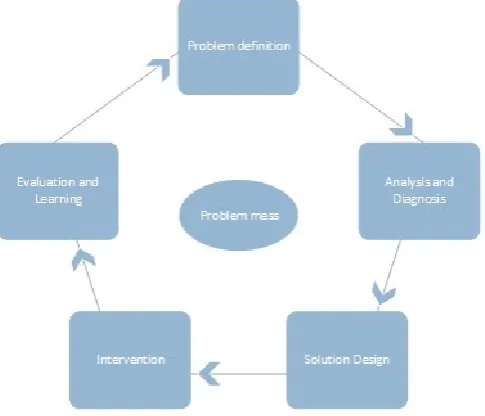
To answer the research question of this study, an academic method of problem solving will be performed. The reflective redesign will be used to develop a solution for the business problem and allows for interim moments of reflection in order to learn. This redesign will serve as a guidance throughout the whole problem solving process and is based on the business problem solving cycle as depicted in Figure 2, van Aken et al. (2009). By implementation of this method, a systematic way of coping with the business problem is ensured and a tailor-made solution for the defined SPT business problem is guaranteed.
Problem solving cycle
The problem solving cycle consists of 6 interdependent steps. In order to come up with a well-defined business problem, the problem mess consisting of multiple underlying sub problems needs to be structured. By structuring this mess, a clear and comprehensive problem definition can be formulated. Multiple perspectives towards the SPT business problem will be gathered, this to view the problem from different angles. Initial informal interviews with several internal stakeholders will be held to formulate the actual business problem and possible sub problems. When the business problem is clearly defined and validated and major causes of the problem are diagnosed and
analyzed, a theoretical framework will be developed based on a systematic literature review. Review of existing scholarly and management literature will provide deeper knowledge on relevant
theoretical concepts, enabling exploration of potential solutions. Through creative use of the existing literature and a solid qualitative research methods, a pragmatic solution can be designed. An
implementation plan will be developed in order to implement the designed solution and to allow for organizational support within SPT.
[image:8.595.178.421.212.420.2]The problem solving methodology as described by van Aken et al. (2009) is theory- informed and design oriented. Theory-informed (evidence-based) refers to the use of scholarly and management literature, supporting in the business problem solving process. By using the literature, a large amount of data can be gathered, useful as inspiration for the solution design. Design-oriented refers to the ability of creating and designing a solution for this particular business problem. Theory will not
9 be tested nor be developed. A best fitting tailor made solution will be designed. Furthermore, an implementation plan will be developed facilitating SPT in the implementation process of the solution design.
Theoretical framework
Since this study has a design-oriented focus, a design-oriented qualitative integration method will be performed. This method emphasizes on the development of design propositions by integrating outcomes of relevant literature (van Aken et al., 2009). The CIMO-logic1 will be applied since already
a desirable outcome is identified (Denyer, Tranfield & van Aken, 2008). This upfront focus allows for selection and integration of literature that is relevant in designing the desired outcome for the particular business problem within SPT. A systematic literature review will be performed, serving as a basis for the exploration of potential solutions. The literature will be searched for different interventions that may produce the desired outcome. Design propositions will be developed to relate the literature and the content of the solution design and to guide the process of solution development (Denyer et al., 2008).
Qualitative research method
In order to shape the solution design, qualitative research will be conducted. This empirical research method is a follow-up of the aforementioned qualitative integration technique. By gathering
personal views and opinions of different SPT employees and internal stakeholders, multiple perspectives towards the SPT business problem will be uncovered. In this way, the problem is viewed from different angles allowing for a more saturated solution design. Furthermore, qualitative research allows for in-depth conversations and leaves room for questioning beyond the standard predefined subjects. Moreover, less well-spoken and introvert interviewees will not be overruled by more extravert ones. In order to design a solution in line with the requirements and needs of SPT stakeholders, input obtained via personal conversations is desired. For the abovementioned reasons, qualitative research is selected as data collection method in this study.
Data collection
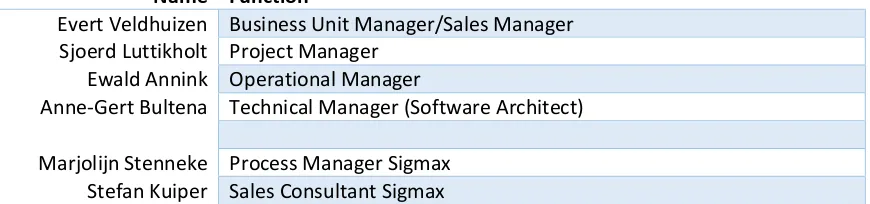
Multiple iterations are part of the design process, resulting in multiple interim moments of feedback. Interim feedback will be collect by means of three sequential stages in the design process. Table 2 presents an overview of the different types of data collection that will be applied. Differently employed internal stakeholders will be questioned during these meetings (Table 1). All involved SPT managers will be asked for feedback, as well as a Sigmax Process Manager and Sales Consultant. The individual feedback meetings (session 1 and 2) will be performed by means of a semi-structured interview approach. Specific content-oriented questions will be developed to guide the interview and structure the session. However, room for additional information will be present in order to benefit from the expertise and creativity of the interviewees (van Aken et al., 2009). In order to achieve non-biased opinions regarding the first two designs, these moments of feedback are individual scheduled meetings. The final feedback will be collected by means of a focus group. Commonly shared opinions will be gathered by performance of this method. Moreover, comments of other participants stimulate explanation and clarification of one’s own statements, allowing for more aligned solution design (van Aken et al., 2009).
10 Name Function
Evert Veldhuizen Business Unit Manager/Sales Manager Sjoerd Luttikholt Project Manager
Ewald Annink Operational Manager
Anne-Gert Bultena Technical Manager (Software Architect)
[image:10.595.90.525.81.183.2]Marjolijn Stenneke Process Manager Sigmax Stefan Kuiper Sales Consultant Sigmax Table 1 Participants feedback sessions
Feedback session Type of data collection Feedback session 1 Individual feedback meetings
4 managers + Sales Consultant Sigmax Feedback session 2 Individual feedback meeting
Process Manager Sigmax Feedback session 3 Focus group
4 managers
Table 2 Types data collection
Data analysis
After collecting the data via different feedback meetings, the data will be analyzed. In the data collection part, the feedback will be structured by the use of the three planning levels, e.g. strategic, tactical and operational level. The discussed deficiencies and redundancies in the prototypes are listed per planning level. New input and suggestions for subsequent prototypes are summarized as well. Hereafter, this data will be divided into positive feedback and constructive criticism.
Furthermore, overall feedback and additional remarks will be questioned. This data will be
structured in a similar way as the aforementioned feedback. Results of these open questions will be categorized into resp. the strategic, tactical or operational level, hereafter divided into positive feedback or constructive criticism.
Not all collected feedback will be implemented in subsequent prototypes, there will be distinguished between usable and non-usable feedback. The categorization of feedback into usable or non-usable, depends on 2 different factors. The first factor is democratic decision-making. If specific feedback or input is given by the majority of the interviewees, this feedback will categorized into usable
11
Identification Business Problem
To identify the actual business problem within SPT and possible underlying problems, initial informal interviews are conducted. Several stakeholders are interviewed, all differently employed within SPT. The stakeholders are questioned by means of a semi-structured interview approach. A set of specific content-oriented questions is developed to guide the interview (van Aken et al., 2009). This
interview guide can be found in Appendix 2. By conducting these informal interviews, different perspectives towards the business problem are gathered. Furthermore, this approach allows for validation of the business problem later on. Table 3 presents an overview of the interviewees.
Name Function
Evert Veldhuizen Business Unit Manager/Sales Manager Sjoerd Luttikholt Project Manager
Ewald Annink Operational Manager
Anne-Gert Bultena Technical Manager (Software Architect) Rob Nijhuis Software Designer
12
Results initial interviews
By conducting the small informal interviews, different perspectives towards the business problem were gathered. An overview of the most frequently mentioned problems and deficiencies is
presented below. The interview guide, format and interviews transcripts can be found in Appendix 2 and 3.
Insufficient resources
An insufficient amount of resources is available during execution of projects, e.g. insufficient personnel (competencies), financials and time. This results in shifting of deadlines and delay in projects. Nevertheless if sufficient resources are available, they are not always appropriately allocated among projects.
Absence long-term focus
SPT is overly focused on short-term goals and objectives and primarily concentrates on issues of the day. Furthermore, a long-term vision, strategy and planning are absent. Moreover, the ability to focus on long-term organizational goals and objectives is driven out by small intervening projects.
Degree of innovation
SPT develops a variety of products, all requiring a different application of operating systems, software and hardware. Some projects require implementation of an operating system or hardware solution of the outdated type, if those are explicit customer requirements. Application of these somewhat outdated resources blocks being at the forefront of competition. Furthermore, decrease in innovativeness can be a result of the aforementioned.
Selection, prioritization and evaluation projects
SPT misses guidelines for the selection of suitable SPT projects in line with their business strategy and core values. In addition, interim evaluation of projects is missing, what can result in not entirely fitting software solutions and delay in project lead-times. Moreover, interviewees mentioned the absence of a clear and transparent project ranking in terms of priority. This results in scattered and reduced project focus.
Insufficient identification of customer demands
Requirements and needs of customers are not always fully understood, what can result in not entirely fitting software solutions. Adjustments and development of a redesigning takes time, resulting in project delays. A clear and straight formulation of product requirements and
functionalities is therefore desired. Particularity at project initiation, requirements and whishes have to be clear and transparent.
Insufficient definition of project scope
13
Validation Business Problem
Current situation SPT
Sigmax Public Transport is a relative young business unit, formerly part of business unit Sigmax Law Enforcement. Due to the increasing demand for public transport related products and internal growth, a separate business unit was a logical consequence. SPT is still in its initial phase and therefore does not have a solid body of structure and formalization concerning their product portfolio and related management processes. This absence of structure and formalization results in somewhat uncoordinated processes of product- and project development. Requirements and needs of clients are not always fully understood, what can result in not entirely fitting software solutions. A clear scope at the start of a project is missing, as well as a clear project definition including its boundaries. This results in shifting of deadlines and delay in projects. SPT lacks decision-making based on rational and hard metrics, in terms of project selection, prioritization and/or termination. Furthermore, interim moments of project evaluation are missing. A long-term focus has been driven out by short-term projects and for the most part, a long-term planning and vision is not even present within SPT. Absence of the aforementioned, reduces continuity within the SPT department and does not contribute to the overall work progress. Furthermore, SPT is not able to anticipate to the future environment accompanied by new innovations and technological trends. They lack the right tools and techniques to support them in the process of long-term thinking and innovative product development.
Desired situation SPT
In order to operate in a more process-based and structured way and be able to appropriately manage the product portfolio, effective and efficient methods and tools are desired for the solution design. Practicality and simplicity are of key importance in this design, for
management as well as SPT employees. The solution design has to offer management the right tools and guidelines for process-based and organized management of software projects and has to support in evaluation and decision-making in terms of software projects. This, in order to support decision making processes related to new product innovations. The solut ion design has to clarify the process of product development projects and has to enable management to draw new projects based upon solid and valid argumentation. Requirements and wishes of clients are well determined, as well as the project scope including project boundaries, reducing the shift of
14
Research Goals
Based on the results of the initial interviews and the desired shape and content of the Planning Tool, a research goal for this study is formulated. This research goal is threefold and will support in the in the development process of the Planning Tool.
The goal of this research is development of a practical Planning Tool supporting SPT in:
1a. Formulation of the SPT business and definition of the competitive position within the business environment.
1b. Development and communication of a business strategy and long-term organizational planning.
2. Decision-making related to selection, prioritization and/or termination of projects, before, during and after project implementation.
3. The application of guidelines for process-based and organized management of projects.
Research Question
‘ In what way can SPT be supported in the development of a long-term vision, decision-making related to software projects
and
in the implementation of structure within project management processes? ‘
15
Initial
Solution Design
After development of a theoretical framework and associated design propositions, a variety of possible solutions can be developed. The design that best represents the requirements and needs of SPT and is most applicable within the SPT business culture, is selected. By using the relevant
literature in a critical and creative way, a tailor made solution can be designed that provides SPT the guidance and support they need. The solution design is categorized into 3 planning levels.
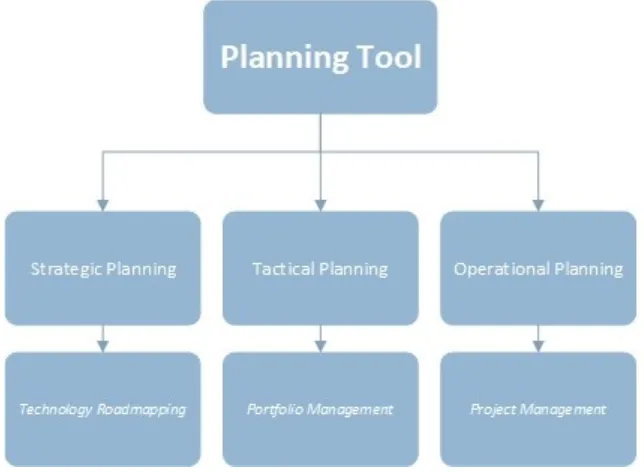
Technology Roadmapping, Portfolio Management and Project Management are selected as focus areas for resp. the strategic-, tactical- and operational level. Figure 3 presents an overview of the Planning Tool and the different interrelated levels.
Implementation Plan
The implementation plan describes how implementation of the Planning Tool will be realized in practice (van Aken et al., 2009). This plan will support SPT in the implementation of new
organizational processes, roles and routines. New tools, techniques and methods will assist SPT in effectively creating structure within management processes related to project- and product
[image:15.595.133.455.241.477.2]developments. Furthermore, this plan will support SPT in anticipating to the business environment in which they are operating.
16
Requirements Planning Tool
Based on the wishes and requirements obtained via the initial interviews with different SPT employees, a set of design requirements is developed. This concerns requirements in terms of planning tool functionalities and the design of the planning tool. The design of the tool requires a simple and transparent visual lay-out, introducing a step-by-step model of business processes. In this section, different design requirements will be presented in order to guide the development process of the planning tool. Below an overview of the subjects that will be addressed in this chapter.
Functional requirements Planning Tool o 3 planning levels
o Coherence planning levels
Design requirements Planning Tool o Process modeling techniques o Variables
Functional requirements
Each planning level has its specific goals and objectives. In order to achieve these goals, different planning tool functionalities are defined. These functionalities differ in content for resp. the
strategic-, tactical- and operational level. In the next section, the goals and associated functionalities are clarified.
Strategic planning
Which strategic direction do we take and what are the motives?
The strategic planning has to clarify the SPT business and its business model. Long term
organizational goals and objectives are visualized, accompanied with the markets, products and technologies that will be utilized to achieve the objectives. This level has to support planning of projects over the long term and requires matching of long-term goals to short-term actions. In addition, it has to prepare SPT to multiple possible futures. Future technological trends, environmental changes and uncertainty will be addressed. Furthermore, this planning level will function as a communication tool to internal and external stakeholders, providing graphical insights into the long-term organizational planning of SPT.
Tactical planning
Which projects do we select and accept and how do we make these choices?
The tactical planning has to support in decision-making related to selection, prioritization and termination of projects. It has to be directive in making go/kill decisions and support in resource allocation and risk spreading. Furthermore, it requires contribution to predefined strategic
organizational goals and objectives. In addition, the planning level has to align the SPT strategy with the right choices of projects eligible for the portfolio. Better project focus is a result of the
17 Operational planning
How do we effectively and efficiently manage the selected projects?
The operational planning has to facilitate in relevant aspects associated with the management of projects. It has to offer management the tools and techniques to support in the implementation of appropriate project management to successfully complete projects. Different perspectives towards the business problem were collected during the initial interviews with internal stakeholders. As a result of these interviews, there is decided not to focus on all elements of project management within the operational planning, but rather on the for SPT key importance areas. A set of 5 key project management elements is therefore selected. Definition of scope- and requirements will be addressed, as well as time management and associated project planning and monitoring. To
conclude, management of project costs and quality are taken into account in the operational part of the planning tool. Other elements of project management are excluded from this study.
Coherence planning levels
[image:17.595.112.477.409.671.2]As already mentioned in the previous section, all three planning levels have their own purpose and individually contribute to the achievement of structure and organized (management) processes. To develop an organized and logic planning tool, coherence between all three levels is desired. By means of this interrelation between levels, a logical flow of information, requirements and decisions is created. Figure 4 indicates the coherence between planning levels.
18
Design requirements
Process modeling techniques
In order to design a transparent and easy-to-use planning tool, different process modeling techniques and tools can be applied. Broadly defined, all modeling techniques have a common purpose; the visualization of a business process or flow of work. By mapping the processes and interrelations between different variables, the business workflow can be displayed. Different process mapping techniques are presented within the literature. Some well-known visualization techniques are mentioned below. At a later stage, the most suitable process modelling technique will be selected.
Flowchart technique
Business Process Modeling Notation (BPMN)
Unified Modeling Language diagram (UML)
Data flow diagram
Gannt chart
Variables
Differently themed variables will be part of the planning tool. By clearly defining variables as actors, activities, requirements, decisions, milestones and flows of information etc., the right activities and requirements can be assigned to appropriate actors. The application of these variables will enhance transparency of business process and ease communication between relevant stakeholders.
19
Theory section
To comply with the predefined Planning Tool requirements, a systematic literature research is conducted. By means of this literature, Design Propositions can be formulated to meet the requirements and guide the development process of the Planning Tool.
Strategic planning
Definition business model and competitive position
Which techniques and analyses can be practiced to define and formulate the business model of organizations, as well as the competitive position?
Strategy
Strategy can be defined as the competence of organizations to achieve long term business goals and objectives in order to reach customer satisfaction and competitive advantage. Porter (2008) defines strategy as a way to convey the companies unique selling point and emphasizes on a combination of skills, competencies and resources in order to create competitive advantage. Multiple strategic management methods, tools and techniques are presented within the literature, supporting companies in formulation and implementation of their business strategy (Vuorinen, Hakala,
Kohtamäki & Uusitalo, 2018). These strategy tools support in definition of the current position of the organization, its competitive position and helps to identify weaknesses and threats.
Organizational analyses - Intern and extern
Similar to the aforementioned strategy tools, organizational analyses are an appropriate tool to get an understanding of how organizations are positioned and what the characteristics are of the environment they operate in. The analyses serve as guidance throughout the exploration the business environment. Literature differentiates between internal and external organizational analyses, both emphasizing important aspects of the organizational business environment. Table 4 presents different organizational analyses and strategic management tools. These tools and analyses support organizations to gain an better understanding of the business environment and assist in the development process of business strategies.
Management tools and analyses Explanation Balanced Scorecard
(Kaplan & Norton, 1992)
A performance metric using organizational objectives, measures and initiatives to achieve strategic goals. Internal elements of the organization are highlighted and areas of improvements are identified.
SWOT analysis This analyses takes into account the internal factors (Strengths and Weaknesses), as well as the external factors (Opportunities and Threats). Areas of improvement can be identified, as well as companies’ strong suits.
Porters Five Forces analysis (Porter, 2008)
This analysis supports in the identification of
20 VRIO framework This framework contributes more to the vision and mission
formulation, instead of strategy formulation. By addressing the Value, Rarity, Imitability and Organization of the
company, both aforementioned concepts can be defined. Market analysis This analysis supports in gaining a better understanding of
the market in which the business is operating, The aim of this analysis, is clarification of the requirements and needs of consumers, identification and definition of market segments and formulation of how consumers can be approached.
PESTEL/DESTEP analysis This analysis supports in mapping the external business environment of the organization. Political, Economic, Sociocultural, Technological, Environmental and Legal factors are identified.
Value Chain analysis This analysis addresses all elements or activities within the value chain, which add value to the final product or service. The elements are analyzed in order to decrease costs and/or include new product developments to increase value. Table 4 Management tools and analyses
Mission, vision and core values
A mission, vision and organizational core values serve as guidance for an organization and support in achievement of long-term organizational goals and objectives. The correct formulation on
aforementioned concepts allows organizations to clearly define their current position within the business environment and their core activities. Mission and vision are used interchangeably in the business environment and often confused by organizations. However, they significantly differ and formulation of both concepts is therefore highly valued. The next section presents the
aforementioned concepts.
A vision describes the desired future of the company, it entails how the organization ideally would look like in for example 10 years. A vision should function as a source of inspiration for all
employees, motivating them in actively achieving organizational goals and objectives. Furthermore, a vision should be short, clear and inspiring.
A mission elaborates on the organizational goals and objectives to achieve the stated vision. It describes how the organization creates, delivers and captures values for their customers. Moreover, it appoints how the company will achieve competitive advantage and how it distinguishes itself of others within the business environment.
Organizational core values are the most important values of an organization. These values embody the incentives and motives the organization represents. Furthermore, they describe how the organization positions themselves within the business environment. Moreover, core values clarify the business culture of the organization. It is recommended to use a set of three unto six core values for definition of the organization.
Business Model Canvas
21 organization. The BMC is composed out of nine building blocks, addressing all relevant areas
involved in ‘doing-business’, e.g. value proposition, key activities, key resources, key partners, customer segments, customer relationship, channels, costs and revenues etc. The model captivates all key components important for creation of value (value proposition) and customer satisfaction (Chesbrough, 2010). Furthermore, interrelations between the components are emphasized in this visual representation of a business model.
Methods and tools to develop strategy
Which methods and tools can be practiced to develop and visualize business strategies and a long-term organizational planning?
Definition Technology roadmapping
A roadmap is a graphical representation of organizational developments over time and supports in matching short-term actions with long-term goals. It comprehensively presents possible markets to tap into, products and services to offer and technologies required for the development of these products (Phaal, Farrukh & Probert, 2004; Phaal & Muller, 2009; Groenveld, 2007). By combining these aspects, definition and formulation of a business strategy is supported. In its turn, this strategy will guide the organization in planning their products and projects over the long term, whilst
matching short-term actions with long-term goals, utilizing innovative technology. Proper implementation a roadmap will ensure good communication to both internal and external stakeholders.
Definition Scenario planning
Scenario planning is a foresight method, supporting organizations in preparing for different potential futures and situations (Siebelink, Halman and Hofman, 2016; Hussain, Tapinos and Knight, 2017; Amer, Daim & Jetter, 2013). This method supports organizations in acting more flexible and innovative, by addressing (technological) trends, environmental developments and policies. This strategic planning method supports in development of a business plan to cope with the rapidly evolving business environment and associated uncertainty. Moreover, it allows organizations to make decisions based on rationality. In order to generate the most valid scenarios, implementation of the most crucial environmental drives is required (Amer, Daim & Jetter, 2013). Furthermore, development of a set of 3 till 5 scenarios will most likely be successful, as stated in the scenario planning methodology.
Synthesis road mapping and scenario planning
To guide the activities that are part of the aforementioned techniques, several convenient checklists and practical guidelines are presented within the literature. Predefined roles and procedures and actions to take are mentioned by several scholars (Gerdsri, Assakul & Vatananan, 2010; Yu & Daim, 2017). Moreover, several scholars developed step-by-step approaches and processes, enabling organizations to cope with future technological changes accompanied with uncertainty. Scenario-based -or driven- road mapping (SBRM) is a frequently elaborated method, allowing for strategic organizational planning and matching short-term actions with long-term goals. SBRM addresses both the macro and micro level by combining scenario planning, as well as road mapping in one
22 phase. A comparable approach is taken by Siebelink, Halman and Hofman (2016), who explore organizational opportunities by the implementation of differently themed workshops within their method. Hussain, Tapinos and Knight (2017) developed a roadmap consisting of multiple phases, using both scenario planning and technology road mapping as variables for the SBRM construction. In addition, they highlight ‘flex points’ (critical developments) to link scenarios and roadmaps, contributing to strategic organizational planning. Based on the aforementioned methods and techniques, the below mentioned elements can broadly be defined within the roadmap process.
1 Preparation 2 Design
3 Implementation
Variety Roadmap purposes
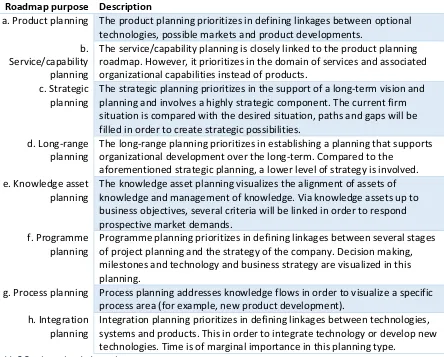
Different roadmap purposes are classified within the literature. An overview of these possibilities is displayed in Table 5.
Roadmap purpose Description
a. Product planning The product planning prioritizes in defining linkages between optional technologies, possible markets and product developments.
b. Service/capability planning
The service/capability planning is closely linked to the product planning roadmap. However, it prioritizes in the domain of services and associated organizational capabilities instead of products.
c. Strategic planning
The strategic planning prioritizes in the support of a long-term vision and planning and involves a highly strategic component. The current firm situation is compared with the desired situation, paths and gaps will be filled in order to create strategic possibilities.
d. Long-range planning
The long-range planning prioritizes in establishing a planning that supports organizational development over the long-term. Compared to the
aforementioned strategic planning, a lower level of strategy is involved. e. Knowledge asset
planning
The knowledge asset planning visualizes the alignment of assets of knowledge and management of knowledge. Via knowledge assets up to business objectives, several criteria will be linked in order to respond prospective market demands.
f. Programme planning
Programme planning prioritizes in defining linkages between several stages of project planning and the strategy of the company. Decision making, milestones and technology and business strategy are visualized in this planning.
g. Process planning Process planning addresses knowledge flows in order to visualize a specific process area (for example, new product development).
h. Integration planning
[image:22.595.77.521.308.665.2]Integration planning prioritizes in defining linkages between technologies, systems and products. This in order to integrate technology or develop new technologies. Time is of marginal importance in this planning type.
Table 5 Roadmap description and purposes
Connecting Strategy, BMC, Road mapping and Scenario planning
24
Tactical planning
To support in decision-making related to project selection, prioritization and termination, different portfolio management techniques are associated concepts are studied. Since decades, the portfolio management literature evolves mainly around three core concepts; strategic fit, portfolio balance and value maximization. Therefore, tools and methods are primarily concentrated on these concepts (Cooper, Edgett & Kleinschmidt, 1999; Cooper, Edgett & Kleinschmidt, 2001). Currently, a shift has taken place within the literature. Existing portfolio management tools and techniques are not considered as dominant as before. A shift towards evaluation of the entire portfolio management process is taking place. This process includes the aforementioned tools and techniques, however, the alignment of projects with organizational business strategies and periodic review- and monitoring sessions are addressed as well. When considered as one integrated process, portfolio management can be better understood and contribute to successful application of portfolio management.
Alignment portfolio strategy and business strategy
By means of which technique(s) can the portfolio strategy be aligned with the business strategy?
In order to align business strategies with organizational projects, several scholars addressed this relation. For example, Ansari, Shakeri & Raddadi (2014) developed a framework of five key processes which supports in the implementation of business strategies through project execution (formulation and implementation of strategy, PPM, PM and alignment of organization strategies and PM). In addition, different alignment evaluation criteria and elements are developed. This method supports in the assessment of strategic fit of projects, allowing for organizational decision-making more in line with business strategies. Similar to the aforementioned framework, Kaiser, El Arbi and Ahlemann (2015) developed an information processing model in which the emphasize on structural alignment. They highlight strategic information requirements in order to develop a link between portfolio management and the business strategy. Through centralize strategy development and project evaluation criteria derived from strategic goals and objectives, successes in strategy implementation can be achieved. Meskendahl (2010) explores the linkage between implementation of business strategy and business success, via strategic orientation and project portfolio management (strategic fit, portfolio balance, formalization etc.). By performance of a solid strategic orientation and
portfolio structuring, implementation of business strategies can be accomplished. Santiago and Soares (2018) explore a more in-depth and product-oriented approach by developing a framework that utilizes strategic buckets to align the portfolio with a business strategy. Furthermore, resource allocation and project selection are supported by performance of this approach.
Project evaluation methods & review criteria
Which methods and review criteria can be practiced to evaluate and revise projects?
A wide variety of evaluation methods and review criteria are addressed within the literature. These methods support in decision-making related to prioritization, continuation and termination of projects. Several scholars applied traditional project evaluation tools and techniques in their studies (Lerch & Spieth, 2013; Jugend & da Silva, 2014; Oh, Yang & Lee, 2012; Cooper, Edgett &
25 the organizational long-term vision and strategy. Cooper, Edgett, and Kleinschmidt (1999;2001) present several practical portfolio methods that support organizations in decision-making related to projects. An overview of these portfolio methods and tools is presented in Table 6.
Portfolio management method Description
Financial method Financial calculations used to rank and rate projects. Profitability and return metrics such as the Productivity Index, ECV, NPV and ROI are popular tools for
evaluation.
Options pricing theory This method handles each stage of a new project in the same way as if an option for new investments would be obtained.
Business strategy Strategic buckets approach
The organizational business strategy functions as a basis for assigning resources to certain projects and products. Highest ranked are those best aligned with the strategy of the company. An example of this method is the Strategic Bucket approach.
Behavioral approach This method supports managers in finding an agreement in project selection and prioritization, particularly in the initial stages.
Bubble diagram or portfolio map Projects are visualized as bubbles of different sizes and categorized into an x-y plot. Based on predefined characteristics (plotted on the x and y as), decisions can be made.
Scoring model This method ranks projects based on the outcome of specific questions, criteria or scales. A weighted fashion is applied in order to indicate differences in importance. Checklist This method evaluates projects based on the answers to
yes/no questions. If all, or enough, questions are
answered with yes, the project receives a Go. Otherwise, the project will be killed or deprioritized.
[image:25.595.95.521.136.558.2]Hybrid approach This method indicates a combination of several of the above mentioned methods. By application of a hybrid approach, best results can be achieved.
Table 6 Portfolio management methods Monitoring portfolio
How does monitoring support the tactical planning?
26
Operational planning
To apply structure within project management processes, application of a suitable project management approach and related elements is required. This Operational Planning translates strategic organizational goals and objectives into day-to-day processes, supporting in management of projects in order to successfully complete projects. The profession of project management is performed within different industries and business sectors worldwide. This results in multiple organizations concerning themselves with best practices within the field of project management. Numerous methods, approaches and templates are addressed as antecedents of successful project management. With regards to the (problem) context of SPT and need for a structured and
systematic approach in project management, focus will be on approaches and methods embodying this. Work of top project management organizations is reviewed; different hand/tool books, sourcebooks, methods and approaches are explored. An overview of the consulted organizations is presented in Table 7.
Project Management Organizations Project Management Institute (PMI) Association for Project management (APM) International Project Management Association (IPMA) AXELOS Table 7 Project Management Organizations
Definition Project Management
Project management is defined as ‘a temporary endeavor undertaken to create a unique product, service or result’ (PMI, 2013). Management of a project includes requirements such as knowledge, competences, tools and techniques for successful project completion. Multiple specialization areas and disciplines are addressed within the literature, all individually contributing to successful completion of projects (PMI, 2013; APM, 2012; IPMA 2015; 2016). Furthermore, different phases and stages within project management are emphasized within the literature (PMI, 2013; IPMA, 2015). In the following sections a comprehensive overview of the different management
specializations and phases are explained.
Project management phasing and specializations
Which project management phasing and specialization areas are addressed within the literature, supporting in process-based and organized management of projects?
The Project Management Body of Knowledge (PMBOK) is a worldwide accepted standard in the field of project management. It functions as a guidance throughout the entire project management process and focusses on several Process Groups and Knowledge Areas (PMI, 2013). Projects are divided into several sequent or concurrent phases and three types of project life cycles can be distinguished; predictive, iterative and incremental, and adaptive. Different areas of specialization (i.e. Knowledge Areas) within project management are described by PMI (2013), supporting in the successful management of projects and underpin execution of the life cycle processes.
27 accountability, enhances personal project management competencies and skills and supports in the knowledge needed for successful execution of project management (APM, 2012).
PRINCE2 is a process-based project management method and divides projects into several different stages in order to effectively manage and control projects (AXELOS, 2017). Whereas the aforementioned Body of Knowledge frameworks (PMI, 2013; APM, 2012) both approach project management specializations in a quite similar manner (e.g. Knowledge Areas and Delivery Areas), the PRINCE2 method addresses 7 principles, 7 themes and 7 processes to perform their method. All components consist of interrelated activities and support in guidance of project processes related to successful management of projects.
The International Project Management Association emphasizes on competences required for individuals and organizations, working in the field of project management (IPMA, 2015; IPMA, 2016). Several competence are addressed, split up into three areas: perspective, people and practice. Different methods, tools and techniques are described. In addition, several management elements and generic- and key competence indicators are addressed in order to support and indicate successful project management.
In contrast to the abovementioned methods and approaches, the ITIL approach is part of IT service management (ITSM) and is based on the phasing of the service lifecycle (AXELOS, 2011). By offering a best practice format with key activities, principles, organizational roles and routines, proper guidance in the development process can be assured, resulting in successful management of projects.
Table 8 on the next page presents an comprehensive overview of the different project management methods and tools as described above. Furthermore, the project management phases and
specializations are presented.
Definition project management specializations
Different project management specializations are presented within the project management literature. Based on the predefined design requirements of the Planning Tool, solely on the for SPT key important specialization areas will be focused. Therefore, definition of scope- and requirements will be addressed, as well as time management and associated project planning and monitoring. To conclude, costs and quality of projects are taken into account. The table below presents descriptions of the selected project management specializations.
Project management Specializations
Planning and scheduling Comprises management of time within the entire process of a project. Planning and scheduling of project activities, personnel, budget, resources etc. is part of this.
Scope and requirements Comprises definition and formulation of the project scope and requirements of external, as well as internal
stakeholders.
Quality Comprises managing and controlling the quality of the whole project, as well as the deliverables of the project.
Costs Comprises all tasks related to finance; managing project budget, projects costs, investments, financial resources etc. Monitoring and evaluation Comprises controlling and directing of the entire process of
28
Method Phases
Specializations
PMBOK Guide Process Groups (stages) Knowledge Areas
PM life cycle Initiating processes Project integration management Planning processes Project scope management Executing processes Project time management Monitoring and controlling processes Project quality management Closing processes
APM Body of Knowledge Delivery Areas
Scope management
Requirements management
Schedule management
Financial management
Quality management
PRINCE2 Processes Themes
PM life cycle Starting up a project Business Case Initiating a project Organization Directing a project Quality Controlling a Stage Plans Managing Product Delivery Risk Managing a Stage Boundary Change Closing a Project Progress
ITIL Phases
Service life cycle Service Strategy Service Design Service Transition Service Operation
Continual Service Improvements
Competence Baseline Series Competence elements
Project design
Requirements, objectives and
benefits
Scope
Time
Quality
Finance
[image:28.595.74.527.68.600.2]Plan and control
29
Synthesis of literature models, tools and techniques
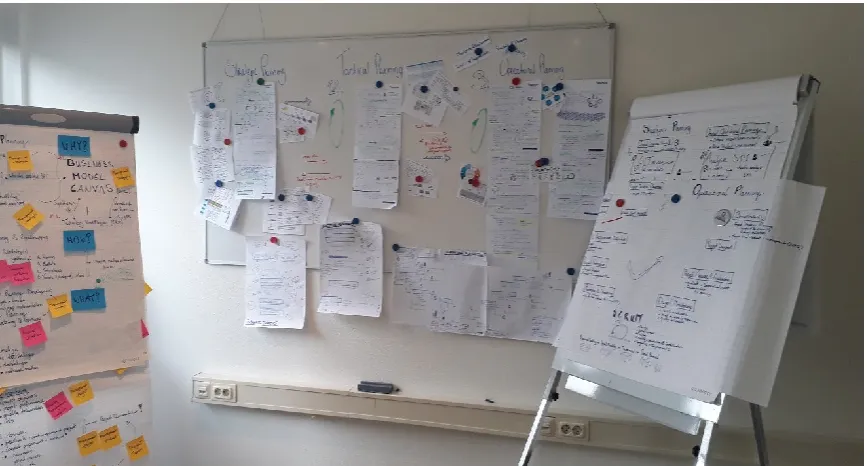
The literature study has resulted in a variety of tools and methods applicable for the planning tool. To receive an visual overview of this researched literature and categorize the different models, tools and techniques, all relevant parts are attached to the wall (Figure 5). This in order to define and select the relevant pieces of literature and support myself in the creativity and design process. Not all of the visualized methods and tools will be applied, a selection of the most appropriate ones is made in this section. A synthesis of the researched literature will result in design propositions. These design propositions are developed to find coherence between the literature and the design of the planning tool and are guided by the research goal of this study. The propositions will guide the development process of the planning tool. Below an overview of the selected tools and methods including motives and the developed design propositions.
Strategic Planning
Research goal: Formulation of the SPT business and definition of the competitive position within the business environment.
Which tools and methods are selected and why?
In order to formulate the SPT’s business, the concepts of
mission, vision and core values
are selected. Identification of the aforementioned concepts supports SPT in development of a strategy and directs in the achievement of long-term organizational goals and objectives. TheBusiness
Model Canvas
is selected as this tool supports in expressing the SPT business in a visual an graphical way. Correct formulation of both the aforementioned enables SPT to clearly define their business, core activities and the way in which the create, deliver and capture value. [image:29.595.72.506.268.501.2]30
Forces
analyses are selected as they support in strategy development, identification oforganizational strengths and weaknesses and analysis of the competitive environment. Exploration of the internal business environment will be on the basis of
organization-, marketing-, and
portfolio analyses
. In order to explore the external business environment of SPT, performance ofmarket-, product- and technology analyses
are selected. These 3 overarching areas assure an overall assessment of resp. the internal and external environment. Moreover, the analyses selected for the latter are related to elements of the BMC as well as the roadmap (mentioned later). Via the Building Process Integration technique, coherence between these three tools is realized in the Strategic Planning.Design Proposition
Definition of the
SPT business
, application of theBusiness Model Canvas
and performance of differently themedorganizational analyses
, will support SPT in setting strategic directions and in definition of the current business situation and competitive position in the public transport industry.Research goal: Development of a business strategy and long-term organizational planning.
Which tools and methods are selected and why?
In order to define the SPT business strategy and long-term planning,
business roadmapping
andscenario planning
are selected. Both methods are combined in theScenario based- Road
Mapping tool
(SBRM). This tool will facilitate SPT in scheduling projects over the long term and support them in the visualization of business strategies. A combination of the strategic planning roadmap and long-range planning roadmap is selected for the planning tool. Hereby, both organizational development over the long-term and strategic considerations are prioritized. The scenario planning part of the SBRM tool addresses alternative futures and technological drives that can affect the SPT business. By implementing both techniques in the Strategic Planning, a clear strategy direction can be taken and development of a long-term planning is supported. This will enable SPT to anticipate to the future business environment accompanied by new innovations and technological trends.Design Proposition
The
Scenario based- Road Mapping
tool will support SPT in the visualization and communication of their business strategies and long-term planning, in order to anticipate to the business31
Tactical Planning
Research goal: Decision-making related to selection, prioritization and/or termination of projects, before, during and after project implementation.
Which tools and methods are selected and why?
In order to support SPT in decision-making related to selection, prioritization and/or termination of projects and be directive in making go/kill decisions, a set of differently themed
portfolio
management tools
is selected (Table 9). Based on the initial interviews with SPT employees and preferences for pragmatic and easy to use evaluation tools, a set of simple and functional tools is selected. Moreover, preference is given by SPT employees to tools that support in visualization of the outcomes. This in order to ease and quicken assessment. These specific tools are selected as they meet the above mentioned requirements and represent key importance areas of project assessment, e.g. strategy, financials and risk spreading. Each one of the tools prioritizes in one of the aforementioned areas, all together allowing for an overall assessment of SPT projects.Portfolio Management Tools Focus area
Strategic Buckets Strategy & Risk spreading
Bubble Diagram Strategy, Financials and Risk spreading Financial Calculations Financials
Scoring Model Strategy Checklist -
Table 9 Portfolio Management Tools
Design Proposition
Differently themed
portfolio management tools
will support SPT in decision-making related to selection, prioritization or termination of projects, based on strategy, visuals and/or hard metrics.Operational Planning
Research goal: Development of guidelines for process-based and organized management of projects.
Which tools and methods are selected and why?
To support SPT in the development of guidelines for process-based and organized management of projects, a twosome elements out of the project management literature is addressed. Application of for SPT relevant project management phasing and project management specializations are selected.
Project Management Phases
To apply structure within project management processes, application of a suitable project
management approach is required. Different project management phasing’s have been studied in the literature study. A combination of different phases out of the traditional project management literature is selected to develop a tailor made solution for SPT, e.g. PMBOK, APM Body of Knowledge and RPINCE2. The selection of these phases is primarily based on the problem statement and
32 Phases Project Management Project Initiation & Definition Requirements
Project Planning Project Execution Project Monitoring
Project Closure Project Evaluation & Brainstorm Table 10 Phases Project Management
Project Management Specializations
The literature addresses multiple project management specializations, enabling organizations to excel in various areas of project management. Different views towards the business problem were collected during the initial interviews with SPT employees. As a result of these interviews, there is decided not to focus on all existing specializations of project management. Based on the
acknowledged problems and deficiencies, the for SPT relevant project management specializations are selected. In this manner, the for SPT important areas are addressed and will be taken into account in the Operational planning. Table 11 presents the specializations that will be addressed.
Project Management Specializations Project Time Management Project Scope Management Project Requirements Management Project Quality Management Project Cost Management Table 11 Project Management Specializations
Design Proposition
Emphasis on the
PM specializations
relevant for SPT (e.g. Time, Scope, Requirements, Quality and Costs) and synthesis ofPM phasing
based on PMBOK, APM Body of Knowledge and PRINCE2, will33
Prototype 1
After selection of the most suitable literature models and development of different design propositions, a first prototype of the planning tool is developed. This first prototype is based on previously obtained inputs, e.g. the studied literature, the formulated design propositions and results of the initial interviews with different SPT employees. In addition, my own insights and understandings of the business problem and relevant elements are part of this first prototype. In the forthcoming section, firstly a physical paper prototype of all three planning levels is displayed. In here, interaction of different activities, requirements, decisions and responsibilities is shown. Hereafter, an elaboration of the different prototype variables is presented, as well as a description of resp. the strategic-, tactical-, and operational level. To conclude, results of the first feedback sessions are provided and adjustments for the second prototype are made. Below an overview of the subjects that will be addressed in this chapter.
Variables Prototype 1
Physical paper prototype 3 levels
Description 3 levels Prototype 1
Feedback session
34
What are the different variables presented in Prototype 1?
Activities - Red numbers in ascending order (Figure 6)
The activities refer to the tasks and actions required for successful completion of a planning level. All three planning levels consist of different sequential activities in which requirements (pink) and departments (yellow) are mentioned. The selected activities are the basis of resp. the strategic-, tactical-, and operational level and are based on the researched literature. Each planning level is concluded with a monitoring phase.
Requirements - Pink Post-it (Figure 7)
Requirements refers to the documents, templates, tools, knowledge etc. needed for a proper execution of the activities. In this first prototype, there is decided not to distinguish between the form of the requirements and in- and output requirements. In a further stage, more detail will be given to the requirements.
Departments - Yellow Post-it (Figure 8)
In order to execute the aforementioned activities, different
responsible departments are selected. Selection of these departments is based upon the type and scope of the activity. In this first prototype, there is decided to select a broad management department for execution of activities and keep options open in this initial stage of solution development. In this initial stage not all details of the activities and requirements are known. It is therefore hard to already decide what specific role or function matches certain activities. In a later stage, team roles will be assigned to the activities and a more detailed job description will be provided instead of the management departments. Table 12 presents
the departments selected for this first prototype.
Management department Other departments Strategic management Marketing
Financial management Product management Project management Operations management Commerce management Table 12 Applied departments
[image:34.595.366.525.291.392.2]Figure 6 Red numbers
[image:34.595.401.525.515.631.2]Figure 7 Pink post-its
35
Strategic planning
[image:35.595.73.524.189.758.2]In this first prototype, the Golden Circle of Simon Sinek is used as a source of inspiration for the design and layout of the Strategic Planning. By categorizing the Strategic Planning based on the elements of the Golden Circle, e.g. Why?, How? and What? (blue post-its), a systematic approach in SPT strategy development can be realized. In this section, firstly the paper prototype is presented (Figure 9). In here, interaction of different activities, requirements, decisions and responsibilities is shown. Hereafter, a detailed explanation of the different elements is presented.