http://wrap.warwick.ac.uk
Original citation:
Cygan, Marek, Marx, Dániel, Pilipczuk, Marcin, Pilipczuk, Michał and Schlotter, Ildikó.
(2014) Parameterized complexity of Eulerian deletion problems. Algorithmica, Volume
68 (Number 1). pp. 41-61.
Permanent WRAP url:
http://wrap.warwick.ac.uk/66054
Copyright and reuse:
The Warwick Research Archive Portal (WRAP) makes this work of researchers of the
University of Warwick available open access under the following conditions.
This article is made available under the Creative Commons Attribution 4.0 International
license (CC BY 4.0) and may be reused according to the conditions of the license. For
more details see:
http://creativecommons.org/licenses/by/4.0/
A note on versions:
The version presented in WRAP is the published version, or, version of record, and may
be cited as it appears here.
DOI 10.1007/s00453-012-9667-x
Parameterized Complexity of Eulerian Deletion
Problems
Marek Cygan·Dániel Marx·Marcin Pilipczuk· Michał Pilipczuk·Ildikó Schlotter
Received: 21 December 2011 / Accepted: 6 June 2012 / Published online: 22 June 2012 © The Author(s) 2012. This article is published with open access at Springerlink.com
Abstract We study a family of problems where the goal is to make a graph Eule-rian, i.e., connected and with all the vertices having even degrees, by a minimum number of deletions. We completely classify the parameterized complexity of vari-ous versions: undirected or directed graphs, vertex or edge deletions, with or with-out the requirement of connectivity, etc. The collection of results shows an interest-ing contrast: while the node-deletion variants remain intractable, i.e., W[1]-hard for all the studied cases, edge-deletion problems are either fixed-parameter tractable or polynomial-time solvable. Of particular interest is a randomized FPT algorithm for making an undirected graph Eulerian by deleting the minimum number of edges, based on a novel application of the color coding technique. For versions that re-main NP-complete but fixed-parameter tractable we consider also possibilities of
M. Cygan·M. Pilipczuk
Institute of Informatics, University of Warsaw, ul. Banacha 2, 02-097 Warsaw, Poland
M. Cygan
e-mail:[email protected]
M. Pilipczuk
e-mail:[email protected]
D. Marx
Institut für Informatik, Humboldt-Universität zu Berlin, Unter den Linden 6, 10099 Berlin, Germany e-mail:[email protected]
M. Pilipczuk (
)Department of Informatics, University of Bergen, Postboks 7803, 5020 Bergen, Norway e-mail:[email protected]
I. Schlotter
Department of Computer Science and Information Theory, Budapest University of Technology and Economics, Magyar tudósok körútja 2, 1117 Budapest, Hungary
polynomial kernelization; unfortunately, we prove that this is not possible unless NP⊆coNP/poly.
Keywords Fixed-parameter tractability·Kernelization·Eulerian graph·Deletion distance
1 Introduction
An undirected graph is Eulerian if it is connected and every vertex has even degree; a directed graph is Eulerian if it is strongly connected and every vertex is balanced (i.e., the indegree equals the outdegree). The class of Eulerian graphs is a well-studied and classical notion in the graph theory. We investigate several algorithmic problems related to the question of how to make a graph Eulerian. We focus on deletion prob-lems, where either vertices or edges can be deleted from the input graph to make it Eulerian, using as few deletions as possible. What makes these problems interesting is the interplay of two different type of constraints: each vertex locally prescribes the constraint that it has to be even/balanced, while retaining connectivity is a global requirement. For comparison, we also investigate the variant of the problem where we have only the local constraints (i.e., the task is to delete the minimum number of edges or nodes to make every vertex even/balanced). As many of the studied prob-lems turn out to be NP-hard, we apply the framework of parameterized complexity to get a more detailed insight.
The investigation of these problems was initiated by Cai and Yang [9] who pre-sented parameterized results for some cases. We complement their work by answering several open questions raised in [9]. Another motivation for our work comes from an observation of Cechlárová and Schlotter [10]: computing the deficiency for a certain type of housing market is equivalent to finding the minimum number of arcs whose deletion makes every strongly connected component of the graph balanced. While we are not able to determine the parameterized complexity of this problem, our results shed light on the complexity of several related ones.
Related Work Subgraph problems have been widely studied in the literature. To
name a few examples, Lewis and Yannakakis [21] investigated the complexity of the node-deletion problem for hereditary properties, Alon et al. [2] examined edge-deletion problems for monotone properties, while Natanzon et al. [28] and Burzyn et al. [6] studied the classical complexity of edge modification problems for various graph classes.
There is much less known about directed graphs. Raman and Sikdar [32] inves-tigated the parameterized complexity of hereditary node-deletion problems in di-graphs, while Raman and Saurabh [31] examined feedback set problems in tour-naments. The FPT algorithm by Chen et al. for finding a feedback vertex set in a directed graph [11] resolved a long-standing open question.
Work related to the class of Eulerian graphs mainly concentrated on the extension problem, where the task is to add a minimum number of edges or arcs in order to make the given graph Eulerian. FPT algorithms were given for various settings by Dorn et al. [13] and by Sorge [33]. Eulerian deletion problems were studied by Cai and Yang [9].
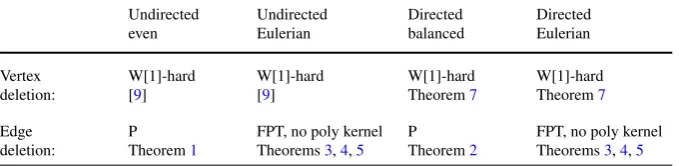
Our Contribution To settle the classical complexity of the examined problems, first we observe (Theorems1 and2) that classical results imply polynomial-time algo-rithms for the edge-deletion problems where the task is to make the given graph even/balanced: in the undirected case, this is essentially aT-join problem, while the directed case can be reduced to a flow problem. These observations answer a question raised by Cai and Yang [9], who observed that the analogous node-deletion problems are NP-hard. Moreover, the aforementioned algorithms are used as subroutines in our FPT results.
By contrast to the polynomial time algorithms, we show that the seemingly similar edge- (or arc-) deletion problems where we aim for an Eulerian graph are NP-hard, even in the extremely restricted case when the input is a cubic planar graph and the number of deletions can be arbitrary (Theorem3). We investigate both the undirected and the directed cases of Eulerian edge-deletion problem thoroughly from the pa-rameterized point of view: we present a fixed-parameter tractable algorithm for both cases where the parameter is the number of deletions allowed (Theorem4), and prove that these problems do not admit a polynomial-size kernel unless NP⊆coNP/poly (Theorem5), which is known to imply a collapse of the polynomial hierarchy to its third level [7,34]. The FPT results use a novel argument that might be of independent interest. Intuitively, we need to find a solutionSto aT-join problem and a witness (disjoint fromS) certifying that the graph remains connected after the removal ofS. Using a random coloring, we partition the edges into two types: each edge can con-tribute either to the solution or to the witness of the solution. This partition ensures that the solution and the witness are disjoint. While the use of random colorings is a standard technique for finding a solution consisting of disjoint objects [3], we use this technique to separate the solution from its proof of feasibility.
The undirected node-deletion problems, where the task is to obtain an Eulerian or an even graph, were already handled by Cai and Yang [9] who proved their W[1]-hardness. We complemented these results by showing W[1]-hardness for the directed cases as well in Theorem7. Additionally, we also focus on a slight modification of the node-deletion problems where certain forbidden vertices are not allowed to be deleted. Theorem8 shows that each of the four node-deletion problems remains W[1]-hard, even if we are only allowed to delete vertices of degree at most 4. This contrasts the easy FPT algorithm applicable if the parameter is not only the number of deletions but also the maximum degree of the graph (Theorem11).
Table 1 Summary of the main results. Parameterized results only appear when the corresponding problem
is NP-hard; the parameter considered is the number of deletions allowed
Undirected even Undirected Eulerian Directed balanced Directed Eulerian Vertex deletion: W[1]-hard [9]
W[1]-hard [9]
W[1]-hard Theorem7 W[1]-hard Theorem7 Edge deletion: P Theorem1
FPT, no poly kernel Theorems3,4,5
P Theorem2
FPT, no poly kernel Theorems3,4,5
Organization of the Paper Section 2 describes our notation, and provides basic
concepts of parameterized complexity. Section3discusses polynomial-time solvable edge-deletion problems. We deal with the NP-hard Eulerian edge-deletion problems in Sect. 4, first covering the issue of NP-completeness, and then fixed-parameter tractability and kernelization. Node-deletion problems are discussed in Sect.5. We summarize our results and draw conclusions in Sect.6.
2 Notation and Preliminaries
Given a graphG, letV (G)denote its vertex set andE(G)denote its edge set (or, in the directed case, its arc set). The degree of a vertexvin an undirected graphG
is denoted by dG(v); we say that v is even, if dG(v) is even. For a vertexv in a
directed graphG, we denote by dGin(v) anddGout(v)its indegree and its outdegree, respectively. We say thatv is balanced, ifdGin(v)=dGout(v). We define the degree ofvinG(whereGis directed), asdG(v)=dGin(v)+dGout(v); whenever we discuss
the maximum degree of a directed graph, we refer to this notion. IfGis clear from the context, we might omit the subscript. A directed graph is weakly connected if the underlying undirected graph is connected. A directed graph is strongly connected if for every two verticesv, wthere is a path fromvtow. An even (balanced) graph is an undirected (directed) graph where each vertex is even (balanced). An undirected Eulerian graph is a connected even graph, and a directed Eulerian graph is a strongly connected balanced graph.1A straightforward degree counting argument shows that a balanced directed graph is weakly connected if and only if it is strongly connected. Given a pathP in a (directed or undirected) graph, the internal vertices ofP are the vertices lying onP except for the two end-vertices. IfdG(v)=2 holds (meaning
dGin(v)=dGout(v)=1 in the directed case) for each internal vertexvof P, then we say that the pathP is an unattached path. In a directed graph, a pair of twin arcs is two arcs(a, b)and(b, a).
Given a setXof vertices, edges, or arcs in a graphG, letG\Xdenote the graph obtained by deletingXfromG. WhenXhas only one elementx, we might also write
G\xinstead ofG\ {x}.
1Strictly speaking, the usual definition of being Eulerian requires only that the graph is connected after
Parameterized Complexity In the parameterized complexity setting, an instance comes with an integer parameterk—formally, a parameterized problemQis a subset ofΣ∗×Nfor some finite alphabetΣ. We say that the problem is fixed-parameter
tractable (FPT) if there exists an algorithm solving any instance (x, k) in time
f (k)poly(|x|)for some (usually exponential) computable function f. It is known that a problem is FPT if and only if it is kernelizable: a kernelization algorithm for a problemQtakes an instance (x, k) and in time polynomial in |x| +k produces an equivalent instance(x, k)(i.e.,(x, k)∈Qif and only if(x, k)∈Q) such that
|x| +k≤g(k)for some computable functiong. The functiongis the size of the
kernel, and if it is polynomial, we say thatQadmits a polynomial kernel.
3 Polynomial-Time Solvable Cases
First, we give a simple polynomial time algorithm for the following problem:
UNDIRECTEDEVENEDGEDELETION Parameter:k
Input: An undirected graphGand an integerk.
Question: Does there exist a setS of at mostk edges inGsuch thatG\Sis even?
It turns out that this problem is strongly connected to the concept of aT-join. If we
defineT to be the set of vertices having odd degree, then UNDIRECTEDEVENEDGE DELETIONis equivalent with the following classical problem of finding aT-join of minimum size:
MINIMUMT-JOIN
Input: A graphG=(V , E)and a setT ⊆V of even size.
Question: Find a minimumT-join, i.e., a setS⊆Eof minimum size such that
T is exactly the set of vertices of odd degree in the graphH=(V , S).
Since MINIMUMT-JOINcan be solved in cubic time by the algorithm of Edmonds and Johnson [14], we obtain the following consequence:
Theorem 1 UNDIRECTEDEVENEDGEDELETIONcan be solved inO(n3)time for ann-vertex graph.
Now we turn our attention to the directed version of the problem:
DIRECTEDBALANCEDEDGEDELETION Parameter:k
Input: A directed graphGand an integerk.
Question: Does there exist a setS of at most k arcs in Gsuch that G\S is balanced?
sink). Each edge ofE(G)has unit capacity and unit cost. For each vertexv∈V (G)
such thatdin(v) < dout(v)we add toG an arc(s, v)of capacitydout(v)−din(v)
and cost zero. Similarly, for each vertexv∈V (G)such thatdin(v) > dout(v)we add toGan arc(v, t )of capacitydin(v)−dout(v)and cost zero. Letf∗denote the total capacity of the added arcs(s, v). In a solvable instance we know thatf∗≤k.
It is straightforward to see that a flow of sizef∗and cost at mostk corresponds to a set S of at most k arcs for which G\S is balanced, and vice versa. Firstly assume that we are given a flow of sizef∗and cost at mostk. As the capacities are integral, the flow is integral as well. LetSbe the set of arcs ofGthrough which a unit flow flows. Clearly,|S| ≤k. As the flow has sizef∗, for every vertex v with
din(v) < dout(v)there is exactlydout(v)−din(v)flow incoming via the arc froms, and for every vertexv withdin(v) > dout(v)there is exactlydin(v)−dout(v)flow leaving via the arc to t. Hence, every vertexv withdin(v) < dout(v)has exactly
dout(v)−din(v)more outgoing arcs fromSthan incoming arcs fromS, every vertex
vwithdin(v) > dout(v)has exactlydin(v)−dout(v)more incoming arcs fromSthan outgoing arcs fromS, while for all the vertices withdin(v)=dout(v)the numbers of incoming and outgoing arcs fromSare equal. This implies that if we remove all the arcs ofSfrom the graph, we end with a balanced graph. On the other hand, ifS is such thatG\S is balanced, then setting unit flow onS, zero flow on the other arcs ofG, and maximum flow on arcs adjacent to the source and the sink yields a correct flow betweensandt of sizef∗and cost|S|.
Therefore, in order to find a solution of minimum size it suffices to find a minimum cost flow of size f∗. As f∗≤k and each arc has unit cost, this can be done in
O(nmlognlog logk) time [1], where n= |V (G)| andm= |E(G)|. Note that the above argument also handles an annotated case, where we require thatS⊆Ea for a
setEa⊆Egiven in the input, as we can put zero capacities onE\Ea. This yields
the following:
Theorem 2 DIRECTED BALANCEDEDGEDELETIONcan be solved in time com-plexityO(nmlognlog logk)for an input graph withnvertices andmedges, even in an annotated case where some edges are forbidden to delete.
4 Eulerian Edge-Deletion Problems
In this section we examine the following problems:
UNDIRECTEDEULERIANEDGEDELETION Parameter:k
Input: A connected undirected graphGand an integerk.
Question: Does there exist a setS of at mostkedges of Gsuch thatG\Sis Eulerian, i.e., even and connected?
DIRECTEDEULERIANEDGEDELETION Parameter:k
Input: A strongly connected directed graphGand an integerk.
The undirected problem can be easily seen to be NP-hard by observing that a cubic graph contains a Hamiltonian cycle if and only if it can be made Eulerian by edge deletions. Indeed, if deleting a set of edges from a cubic graphG results in an Eulerian graphG, then each vertex in G must have degree 2, so G must be a Hamiltonian cycle ofG. Since the HAMILTONIAN CYCLEproblem restricted to cubic planar graphs is NP-hard [16] the result follows. The directed version can be treated in a similar way using NP-hardness from [30].
Theorem 3 The UNDIRECTEDand DIRECTEDEULERIANEDGEDELETION
prob-lems are NP-hard, even when restricted to inputs(G, k) whereG is a planar
(di-rected) graph with maximum degree at most 3, andk= |E(G)|.
In Sect.4.1, we show that both versions of the problem are FPT and can be solved in time 2O(klogk)nO(1). The algorithm is based on a novel randomized selection ar-gument. In Sect.4.3, we sharpen Theorem3 by showing that the problems do not admit a polynomial kernel. In some sense, the nonexistence of polynomial kernels suggests that randomized selection or a similar technique is inherently required for the problems, as they cannot be solved by simple reduction rules.
4.1 FPT Algorithms
We have seen in Sect.3that removing edges to make all the vertices even can be ex-pressed as aT-join problem, whereT is the set of odd vertices. Thus UNDIRECTED EULERIANEDGEDELETIONrequires us to find aT-joinSsuch thatG\Sis con-nected. Observe that ifGis connected, andG\Shas a connected subgraphW con-taining the endpoints of every edge inS, thenG\Sis connected as well. We will call such a subgraphW a witness ofS. Therefore, the right way to look at the problem is that we need to find a pair(S, W ), where isSis aT-join andWis the witness ofS. It is clear that the problem has a solution if and only if such a pair exists.
Our approach for finding a pair(S, W )is the following. We randomly color the edges of the graph red and blue, and try to find a pair(S, W )whereSuses only red edges and the subgraphW uses only blue edges. We would like to ensure that if a suitable pair(S, W )exists, then it is correctly colored red and blue with probability at least 2−O(klogk). However, in general the size ofW can be very large (unbounded ink; an example is provided in Sect.4.2) and therefore the probability of a correct coloring can be very small. We get around this problem by observing that edges “far” fromT can be always colored blue, and there is a witnessWthat uses only a bounded number of edges “close” toT. Formally, we say that an edgeeis close if at least one endpoint ofeis at distance at mostkfromT; otherwise,eis far. The following two lemmas contain the crucial combinatorial ideas of the algorithm:
Lemma 1 IfSis an optimum solution of size at mostk, then each edge ofSis close.
(for example, leaves). Since|S| ≤k, each vertex in such a connected component is at distance at mostkfromT, and thus each edge inSis close.
Lemma 2 IfS is an optimum solution of size at most k, thenS has a witnessW
having at most(2k−1)(2k+2)close edges.
Proof LetX be the set of endpoints of the edges inS. Note thatT ⊆Xand|X| ≤
2|S| ≤2k. Letibe the smallest integer such thatG\Shas a subgraphW containing
X, having exactlyiconnected components and at most(|X| −i)(2k+2)close edges (suchiandW always exist as for i= |X|we can take W=(X,∅)). If i=1, then we are done. Otherwise, we can assume that each component ofW contains a vertex ofX; letP be a shortest path inG\Sthat connects two different components ofW. Denote these componentsK1andK2.
We claim that only the firstk+1 and the lastk+1 edges ofP may be close. If this is true, then addingP toW decreases the number of components and increases the number of close edges by at most 2k+2, contradicting the minimality ofi.
Suppose that an edgeeis close, but it is not among the first or lastk+1 edges, i.e., both of its endpoints are at distance greater thankfrom bothK1andK2onP. Aseis close, it has an endpointv such that there is a pathP of length at mostk
connectingv andT. AsT ⊆X, the pathP connectsv to a componentK ofW. Assuming without loss of generality thatK=K1, the concatenation ofPand the subpath ofP betweenK1andvis a walkP connecting two different components of W. As the distance of v from K2 onP is more than k, the walk P is shorter
thanP, contradicting the minimality ofP.
We observe that even though the number of close edges in the witness can be bounded polynomially ink, the whole witness can be arbitrarily large. An example of such a situation is described in Sect.4.2.
Now, we are ready to state our algorithm, working as follows:
1. Determine which edges are close and which are far.
2. Make each close edge independently with probability 1/ k2red; every edge that is not red becomes blue.
3. If there is more than one connected component of the blue edges containing a vertex fromT, return NO; otherwise letKBbe this unique component.
4. Solve MINIMUMT-JOINinstance(GR, T ), whereGRis the graph induced by the
red edges with both endpoints inKB. If the solution is of size at mostk, return it,
otherwise return NO.
Lemma 3 If the algorithm returns a solutionS, thenSis a proper solution to U NDI-RECTEDEULERIANEDGEDELETION.
Proof By the definition of MINIMUMT-JOIN,G\Sis even. The componentKBof
blue edges ensures that the endpoints ofSare in the same component ofG\S, i.e.,
G\Sis connected.
Proof LetSbe an optimum solution to(G, k), and letWbe a witness having at most
(2k−1)(2k+2)close edges, guaranteed by Lemma2. In the algorithm: 1. With probability at least(1/ k2)k=1/22klogkeach edge ofSbecomes red.
2. With probability at least (1−1/ k2)(2k−1)(2k+2)=Ω(1)each close edge of W
becomes blue (and hence every edge ofW is blue).
The above events are independent, sinceS andW do not share edges. Furthermore, if both events happen, thenW will connect all the endpoints of the edges fromS. Therefore, all of these endpoints will be contained in one connected componentKB
of the graph induced by blue edges, which in particular connects all the vertices fromT. Thus, with probability 1/2O(klogk), every edge ofS appears in GR in the
last step of the algorithm and the MINIMUMT-JOINinstance has a solution of size at
mostk.
Theorem 4 Both the UNDIRECTEDand DIRECTEDEULERIAN EDGE DELETION
problems are fixed-parameter tractable with parameterk.
Proof By Lemmas3and4, the presented algorithm for UNDIRECTED EULERIAN
EDGEDELETIONfinds a solution with probability 1/2O(klogk), and never produces a wrong output, that is removal of the returned set of edges always makes the graph Eu-lerian. Since the algorithm runs inO(n3)time for ann-vertex graph, we immediately obtain a randomized FPT Monte-Carlo algorithm, running in 2O(klogk)n3time.
We present how to derandomize the described algorithm using the standard tech-nique of splitters. An(m, r, r2)-splitter is a family of functions from{1,2, . . . , m}to
{1,2, . . . , r2}, such that for any subsetX⊆ {1,2, . . . , m}of sizer, one of the func-tions in the family is injective onX. Naor et al. [27] gave an explicit construction of an(m, r, r2)-splitter of sizeO(r6logrlogm).
In Step 3 of the algorithm we want to separate the solutionS (of size at mostk) from the set of close edges of the witnessW (of size at most=(2k−1)(2k+2)). Let m be the cardinality of the set of close edges in the graph, we may identify
{1,2, . . . , m}with this set. Instead of the random coloring process, we can try every functionf in a(m, k+, (k+)2)-splitter and every setF ⊆ {1,2, . . . , (k+)2}of sizek. For a particular choice off andF, we color red those close edgesefor which
f (e)∈F. By the definition of the splitter, if there exists a solutionS with a witness
W, there will be a functionf that is injective on the set of close edges ofS∪Wand a subsetF such thatf (e)∈F ife∈Sandf (e) /∈F ifeis a close edge inW. Note that the size of(m, k+, (k+)2)-splitter is bounded polynomially in the input size, whereas there are 2O(klogk)choices for the setF.
is Eulerian, thus the algorithm returns the solution to DIRECTEDBALANCEDEDGE
DELETIONwith high probability, if one exists.
4.2 An Example of a Large Witness SetW
In this section we give a simple example that the witness graphW, considered in the FPT algorithms in Sect.4.1, may be arbitrarily large and may containΩ(k2)close edges. This lower bound on the number of close edges matches the upper bound given by Lemma2. We construct a graphGas follows. First take a cycle of length 2kM for someM >2kand letv0, v1, . . . , v2k−1be a sequence of evenly distributed vertices on this cycle, i.e.,vi=wiM, wherew0, w1, . . . , w2kM−1are vertices of the cycle, lying in this order. Moreover, for each 0≤i < k we connect the verticesv2i
andv2i+1. Note thatS= {v2iv2i+1:0≤i < k}is the only feasible solution of sizek to the UNDIRECTEDEULERIANEDGEDELETIONproblem in the graphG, but any witnessW ofSneeds to contain a path of length(2k−1)M. Moreover, such a path contains roughly 2k(2k−1)=Ω(k2)close edges.
Note that in the above construction it is not crucial to start from a long cycle, as any Eulerian graph of large diameter would suffice. In such a graph we simply take the vertices{vi:0≤i <2k}to be any set of vertices that are pairwise distant.
4.3 Non-existence of a Polynomial Kernel for UNDIRECTEDand DIRECTED EULERIANEDGEDELETION
The aim of this subsection is to prove the following theorem.
Theorem 5 If NP⊆coNP/poly, then there is no polynomial kernel for the UNDI-RECTEDand DIRECTEDEULERIANEDGEDELETIONproblems with parameterk,
even if the input graph has maximum degree at most 4.
We use the cross-composition technique introduced by Bodlaender et al. [5]. Let us recall the crucial definitions.
Definition 1 (Polynomial equivalence relation [5]) An equivalence relationR on
Σ∗is called a polynomial equivalence relation if (1) there is an algorithm that given two stringsx, y∈Σ∗decides whetherR(x, y)in(|x| + |y|)O(1) time; (2) for any finite setS⊆Σ∗the equivalence relationRpartitions the elements ofSinto at most
(maxx∈S|x|)O(1)classes.
Definition 2 (Cross-composition [5]) Let L⊆Σ∗ and let Q⊆Σ∗×N be a pa-rameterized problem. We say thatLcross-composes intoQif there is a polynomial equivalence relation Rand an algorithm which, givenp stringsx1, x2, . . . , xp
be-longing to the same equivalence class ofR, computes an instance(x∗, k∗)∈Σ∗×N
in time polynomial inpi=1|xi|such that (1)(x∗, k∗)∈Qif and only ifxi ∈Lfor
Theorem 6 ([5], Theorem 9) If L⊆Σ∗ is NP-hard under Karp reductions andL
cross-composes into the parameterized problemQthat has a polynomial kernel, then
NP⊆coNP/poly.
We apply Theorem6on the following languageL:
UNDIRECTEDor DIRECTEDs–t PATH WITHFORBIDDENPAIRS OFEDGES Input: An undirected or directed graphG=(V , E), two verticess, t∈V, and a setC⊆E×Ecalled the constraints.
Question: Does there exist ans–t pathP inGsuch that from each constraint
(e1, e2)∈Cat least one edge (arc) does not lie onP?
The undirected version of this problem with forbidden pairs of vertices was proven to be NP-hard by Kolman and Pangrác [19] and their proof can be easily modified to handle our case as well.
Lemma 5 UNDIRECTEDand DIRECTEDs–t PATH WITHFORBIDDENPAIRS OF EDGESare NP-hard under Karp reductions, even in the case where each vertex has maximum degree three,sandthave degree one, and, in the directed case, each vertex has maximum in- and outdegree two.
Proof We first provide a Karp reduction from the CLIQUEproblem to our problems
without the degree condition. Let (H, k) be a CLIQUE instance. We construct an UNDIRECTED or DIRECTED s–t PATH WITH FORBIDDEN PAIRS OF EDGES in-stance(G, s, t,C)as follows. To construct the graphG, we start by adding vertices
s,t and pi for 0≤i≤k and edges sp0 andpkt (arcs (s, p0) and(pk, t )). Then
for each 1≤i≤k andv∈V (H )we introduce a vertexxiv and edgespi−1xvi and
xivpi (arcs(pi−1, xiv)and(xiv, pi)). Finally, for each 1≤i, j≤kandu, v∈V (H )
such thatuv /∈E(H ) (possiblyu=v), we introduce constraints(xiupi, xjvpj)and
(xjupj, xivpi).
Let us now verify the correctness of the above reduction. If {v1, v2, . . . , vk} ⊆
V (H )is a vertex set of a k-clique inH, then a path consisting of edges (or corre-sponding arcs)sp0,pktandpi−1xivi,x
vi
i pi for 1≤i≤kis a feasible solution to the
instance(G, s, t,C). In the other direction, note that any simple path fromstotvisits for each 1≤i≤kexactly one vertex from the set{xiv:v∈V (H )}, sayxvi
i . We claim
that {v1, v2, . . . , vk} induces ak-clique inH. To see this note that the introduced constraints imply that ifi=j thenvi=vj andvivj∈E(H ).
To obtain the degree bounds, note that each vertexv∈V (G)withdG(v)≥3 can
be replaced with a (directed) cycle of lengthdG(v), where each edge (arc) previously
incident tovis now connected to a different vertex on the cycle.
To finish the proof of Theorem5we need to show a cross-composition algorithm. This is done in the following lemma.
-TION. If the input instances have degrees bounded as in Lemma5 then the output instance can be made to have maximum degree 4.
Proof For the equivalence relation Rwe take an almost trivial relation that sorts all malformed instances into one equivalence class and all well-formed into another one. If we are given malformed instances, we simply output a trivial NO-instance. Thus in the rest of the proof we assume we are given a sequence(Gi, si, ti,Ci)pi=1 of UNDIRECTEDor DIRECTEDs–t PATH WITHFORBIDDENPAIRS OFEDGES in-stances.
We now construct an UNDIRECTED or DIRECTED EULERIAN EDGE DELE -TION instance (G, k). We start by obtaining a graph Gi for each 1≤i≤p as follows. First we subdivide each edge e∈E(Gi) with new vertices xeC, one for
each constraintC∈Ci that containse. Then for each constraintC =(e1, e2)∈Ci
we introduce verticeszC1 andzC2 and create a (directed) cycle xeC
1, z C
1, xeC2, z C
2. By
V (Gi) we denote the subset of V (Gi)containing vertices different than xeC and
zCα. To construct the graph G, we first take the union of all graphs Gi and iden-tify all vertices si into one vertex s∗ and all vertices ti into one vertex t∗. Let
V0= {s∗, t∗} ∪pi=1V (Gi)\ {si, ti}. Second, we introduce a new vertex r and
connect it to the rest of the graph as follows. In the undirected case for each
v∈V0\ {s∗, t∗}we connectrandvwith one or two unattached paths of length 2, so that in G the vertex v is even. In the directed case, we connect r andv with some positive number of unattached directed paths of length 2, so that inGthe ver-texv is balanced. We do almost the same construction to connects∗ andt∗ tor, but we ensure that the degrees ofs∗ andt∗ are odd (in the undirected case) or that
dGin(s∗)+1=dGout(s∗)anddGin(t∗)=dGout(t∗)+1 (in the directed case). Note thatr
is even (balanced). Finally, we setk=maxpi=1|V (Gi)| −1=O(maxpi=1|V (Gi)| + |Ci|).
It is clear that the above construction can be done in polynomial time and that the parameterk is bounded polynomially in the maximum size of the input instances. We now verify the correctness of the construction, i.e.,(G, k)is a YES-instance of UNDIRECTEDor DIRECTEDEULERIANEDGEDELETIONif and only if at least one of the instances(Gi, si, ti,Ci)pi=1 of UNDIRECTED or DIRECTED s–t PATH WITH FORBIDDEN PAIRS OF EDGESis a YES-instance. Then, we discuss how we can modify the construction so that all the vertices of the resulting graph have degree bounded by 4.
Correctness First, letPbe a simple path that is a feasible solution to(Gj, sj, tj,Cj)
for some 1≤j ≤p. The path P naturally defines a simple path P inGj and in
G. We claim that the edge setSof Pis a feasible solution to the constructed DI-RECTEDor UNDIRECTEDEULERIANEDGEDELETIONinstance. As it is contained inGj, we have|S| ≤k. Since inGthe only odd (unbalanced) vertices weres∗and
t∗,G\Sis even (balanced). We now verify that each vertexv∈V (G)is (weakly) connected to the vertexr inG\S. It is clear for eachv∈V0, sinceEr∩S= ∅,
whereEr denotes the set of edges in the paths betweenV0 andr (note that each
v∈V0 is connected to r by a positive number of paths). For the other vertices, note that ifC=(e1, e2)∈
p
e1∈/P) and the cyclexe1C, z1C, xe2C, zC2 is connected torvia subdivided edgee1and its endpoints. Note that in the directed case it is sufficient to ensure only weak nectivity, as a balanced graph is weakly connected if and only if it is strongly con-nected.
In the opposite direction, let S be a solution to the constructed DIRECTED or UNDIRECTEDEULERIANEDGE DELETION instance. We assume that|S| is mini-mum possible. It is easy to see that sinceG\Sis even (balanced) and|S|is minimal,
Sneeds to induce a simple pathPfroms∗tot∗. This path cannot contain a neigh-borr ofr, since otherwiser becomes isolated in G\S. ThusP is contained in graphGj for some 1≤j ≤p. Moreover, note that P cannot contain any vertex
zCα, as otherwisezCα becomes isolated inG\S. ThusPnaturally defines a pathP inGjwith endpointssjandtj. Observe that if for someC=(e1, e2)∈Cjthe pathP
contained bothe1ande2, then inG\Sthe cyclexe1C, zC1, x
C
e2, zC2 would be unreach-able from the rest of the graph G. Thus, P is a feasible solution to the instance
(Gj, sj, tj,Cj).
Degree Reduction We now show how to modify the presented construction to obtain
an instance with maximum degree 4. First note that ifv∈V (G)\(V0∪ {r})we clearly havedG(v)≤4. Moreover, if the degrees in(Gi, si, ti,Ci)are bounded as in
Lemma5, then for anyv∈V0\ {s∗, t∗}the number of unattached paths connecting
v andr can be chosen so thatv is even (balanced) and we have dG(v)≤4 in the
undirected case anddGin(v), dGout(v)≤2 in the directed one. Thus, we are left with the verticess∗,t∗andr.
We first reduce the degree of verticess∗ andt∗. By duplicating some input in-stances we may ensure that their number is a power of two,p=2. We replaces∗
andt∗ with full binary treesTs andTt of height , rooted at sr andtr. In the
di-rected case, the edges in the tree Ts are directed towards the leaves, whereas the
edges in the treeTtare directed towards the roottr. For each instance(Gj, sj, tj,Cj)
we identifysj with one leaf inTs andtj with one leaf inTt, so that each instance
is assigned to different leaves inTs andTt. Finally, we connect each vertex of the
trees Ts and Tt with r using one or two unattached paths of length two, so that
dG(sr)=dG(tr)=3 (dGout(sr)=2=1+dGin(sr)and dGin(tr)=2=1+dGout(tr)
in the directed case) and each other vertex inTs andTt is of degree 4 and, in the
directed case, balanced.
As for the vertex r, we replace it with a (directed) cycle of length dG(r)/2,
with each vertex on the cycle adjacent to exactly two edges previously incident tor (one incoming arc and one outgoing arc in the directed case). Finally, we set
k=2+maxpi=1|V (Gi)| −1=O(logp+maxpi=1|V (Gi)| + |Ci|). Note that now
a minimum solutionS to the constructed DIRECTED or UNDIRECTED EULERIAN EDGEDELETIONinstance needs to induce a simple pathPfromsr totr that first goes down the treeTsto a leafsj (for some 1≤j≤p), then traverses the graphGj,
inducing a solutionP to the instance(Gj, sj, tj,Cj), and finally goes up the treeTt
5 Node-Deletion Problems
We first consider the following two node-deletion problems:
DIRECTEDBALANCED(or EULERIAN) NODEDELETION Parameter:k
Input: A directed graphGand an integerk
Question: Does there exist a set of at mostkverticesS⊆V (G)such thatG\S
is balanced (or Eulerian)?
The undirected versions of these problems, namely UNDIRECTED EVEN and UNDIRECTEDEULERIANNODEDELETION, are defined analogously. While these undirected variants were already shown to be W[1]-hard with parameter k by Cai and Yang [9], the complexity of the directed versions has not been studied yet. The following theorem shows that they are intractable as well.
Theorem 7 DIRECTEDBALANCEDNODEDELETIONand DIRECTEDEULERIAN NODEDELETIONare NP-hard and W[1]-hard with parameterk.
Proof We firstly treat the balanced case, then we proceed to the Eulerian case.
Balanced Case We present an FPT-reduction from the DISJOINTSETCOVER
prob-lem to DIRECTED BALANCED NODE DELETION. The input of this problem is a triple(U,F, k)whereU is some universe,F= {F1, . . . , Fn}is a family of subsets ofU, andkis an integer. The task is to decide whether there is a collectionH⊆F with|H| ≤k that covers each element ofU exactly once, i.e., such that the sets in
Hare pairwise disjoint and their union isU. Given such an input, we are going to construct a directed graphGsuch that(G, k)is a YES-instance of DIRECTED BAL-ANCED NODEDELETIONif and only if (U,F, k)is a YES-instance of DISJOINT SETCOVER. Moreover, the presented reduction will be polynomial-time computable. As DISJOINTSETCOVERis NP-hard, and also W[1]-hard with parameterk[25], this suffices to prove the theorem.
Given (U,F, k), for any u∈U, letn(u) denote the number of sets in F that containu. For eachu∈U, we introduce two verticesu1andu2inG, and connect them byn(u)−1 unattached paths of lengthk+2, each starting fromu1and leading tou2. We denote byD the set of all internal vertices on these paths, each having degree 2 inG. Furthermore, for eachFi∈F we introduce a vertexfi, and add the
arcs(fi, u1)and(u2, fi)for eachu∈Fi. This finishes the construction ofG. It is
not hard to see that the reduction is indeed polynomial.
Now, suppose thatG\Sis balanced for someS⊆V (G),|S| ≤k. Note that ifS
contains any vertexd on a path of lengthk+2 leading from someu1tou2(allowing
d=u1ord=u2), then allk+1 internal vertices of this path should be inS, which contradicts|S| ≤k. Thus, we get that S⊆ {fi|Fi ∈F}. Observe also that for each
u∈U, we getdGin(u1)=dGout(u1)+1=dGout\S(u1)+1, hence the deletion ofSmust decrease the indegree of each vertexu1 (u∈U) by exactly one. By the definition of G, this means that the sets Fi for fi ∈S form a family of at most k pairwise
For the other direction, it is straightforward to see that ifS⊆F is a solution for the DISJOINTSET COVERinstance, then deleting the vertex set{fi|Fi∈S}from
G results in a balanced graph. This observation relies on the fact that dGin(u1)= dGout(u1)+1 anddGin(u2)=dGout(u2)−1 hold for each u∈U, and thatdin(v)= dout(v)holds for each remaining vertexv. This proves our statement for DIRECTED BALANCEDNODEDELETION.
Eulerian Case Now, we give a reduction from DIRECTED BALANCED NODE
DELETION problem to DIRECTED EULERIAN NODE DELETION. Given an input
(G, k) we construct(G, k) in polynomial time such that there is a setS⊆V (G)
with|S| ≤kfor whichG\Sis balanced if and only if there is a setS⊆V (G)with
|S| ≤kfor whichG\Sis Eulerian.
To constructG, we simply add toGa new vertexr, and connect each vertex tor
by a pair of twin arcs. On one hand, ifG\Sis Eulerian for someS⊆V (G), then
G\(S\ {r})must be balanced, as deletingr from the balanced graphG\Sstill yields a balanced graph. On the other hand, ifG\Sis balanced for someS⊆V (G), then observe thatG\Sis balanced as well. Furthermore, since each vertex inG\S
is connected by a pair of twin arcs to r, G\S is Eulerian as well, finishing the
proof.
As Table1shows, the node-deletion variant is W[1]-hard in all four cases, while the edge-deletion version is FPT or even polynomial-time solvable. What makes the node-deletion versions harder? One obvious difference is that in the edge-deletion problem the answer is trivially no if there are more than 2kodd/unbalanced vertices, but the node-deletion versions can have a solution even if the number of such nodes is unbounded. This suggests that the higher complexity comes from the ability of affecting the degree of many vertices by a single vertex deletion. Indeed, if every vertex has degree bounded byΔ, then we can solve all of the above defined node-deletion problems in O((Δ+1)k(|V (G)| + |E(G)|)) time by a simple branching algorithm. However, this interpretation is not fully correct: as we shall show, the node-deletion problems are hard even if we are allowed to delete only vertices of constant degree.
To this end, we define the following variation of the four different node-deletion problems, where α can be UNDIRECTED EVEN, UNDIRECTED EULERIAN, DI-RECTEDBALANCED, or DIRECTEDEULERIAN:
αNODEDELETION WITHFORBIDDENNODES Parameter:k
Input: A graphG, a setF⊆V (G)of forbidden nodes, and an integerk. Question: Does there exist a solutionS⊆V (G)for(G, k)with respect to the correspondingαNODEDELETIONproblem such thatS∩F= ∅and|S| ≤k?
In other words, we require the solution to be disjoint from a set of forbidden
ver-tices. A vertex is allowed, if it is not forbidden. For each of the four node-deletion
allowing only the deletion of bounded-degree vertices does not make the problem easier:
Theorem 8 Each of the problemsαNODE DELETION WITHFORBIDDENNODES
where α is UNDIRECTED EVEN, UNDIRECTED EULERIAN, DIRECTED
BAL-ANCED, or DIRECTEDEULERIANremains W[1]-hard with parameterk, even if each
allowed vertex has degree at most 4.
We prove Theorem8in two steps. Theorem9deals with the cases where we aim for an even or a balanced graph, while Theorem10handles the two Eulerian cases. LetΔabe the maximum degree taken over all allowed vertices.
Theorem 9 UNDIRECTED EVEN and DIRECTED BALANCED NODE DELETION
WITHFORBIDDENNODESremain W[1]-hard with parameterk, even ifΔa=4.
Proof We firstly describe the undirected case, then we present how the construction
can be refined for the directed case.
Undirected Case We present a parameterized reduction from the W[1]-hard
MUL-TICOLOURED CLIQUE problem [15] to UNDIRECTED EVEN NODE DELETION WITH FORBIDDENNODESwithΔa=4. The input of MULTICOLOUREDCLIQUE
is a graphG=(V , E)and an integerktogether with a partitionV1, V2, . . . , VkofV
where eachVi is an independent set; the task is to find a clique of sizekinG. W.l.o.g.
we assume thatk≥3, as otherwise the instance can be solved via brute-force. Firstly, we claim that one can assume that for each vertexv and for eachVj it
holds that|N (v)∩Vj|is even. This can be achieved without changing the answer
to our instance in the following manner. For each pairi, j (1≤i, j ≤k,i=j) we introduce a new vertexai,j intoVjand connect it with all the vertices ofVihaving an
odd number of neighbors inVj. Consider the graph induced byVi∪Vj∪ {ai,j, aj,i}.
By the definition ofai,j, aj,i we know that all the vertices ofVi andVj have even
degrees in this graph. As the sum of degrees in every graph is even, ai,j has odd
degree if and only ifaj,ihas. Therefore, we introduce an edgeai,jaj,iif the degree
ofai,j is odd. From the construction we infer that the claimed property holds, i.e., for
each vertexvand for eachVjwe have that|N (v)∩Vj|is even. Note that vertexai,j
cannot be contained in anyk-clique inG, asN (ai,j)⊆Vi (recall thataj,ihas been
introduced intoVi). This ensures the correctness of the construction.
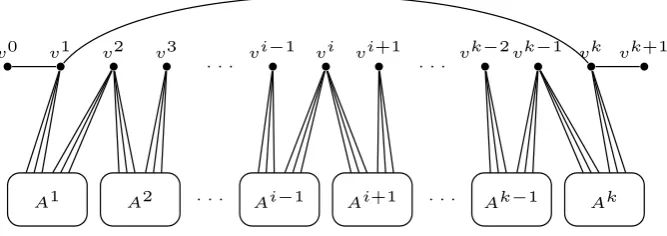
We are going to construct an instance(G, F, k)of UNDIRECTEDEVENNODE DELETION WITH FORBIDDEN NODES withk=k2+k. For each vertex v∈Vi,
we build a node gadgetGv as follows. We introduce verticesvj for each 0≤j ≤
k+1 and a vertexev,z for eachz∈NG(v). For eachz∈NG(v)∩Vj wherej < i
we connectev,z withvj andvj+1, and for each z∈NG(v)∩Vj wherej > i we
connectev,zwithvj−1andvj. For eachj∈ {1,2, . . . , k}\{i}we denote byAj(v)the
Fig. 1 Vertex gadgetGvforv∈Vi
LetGcontain the disjoint union of graphsGvforv∈V, and let us add the vertex
setsP = {si, ti|1≤i≤k}andD= {dx,y, dy,x|xy∈E}toG. We connect eachsi
with the verticesv0wherev∈Vi, and similarly, eachti with the verticesvk+1where
v∈Vi. In addition, for each edgexyinGwe connect the verticesex,y, dx,y, ey,x, dy,x
in this order via a cycle of length 4. To finish the construction ofG, we add the edge
sitiin casesi (and henceti) would have an even degree otherwise. Notice that the odd
degree vertices inGare exactly the vertices ofP. Finally, we let the set of forbidden vertices to beF = {vj|v∈V ,1≤j ≤k} ∪D∪P. As the allowed vertices are only the vertices of the formv0,vk+1, orex,y, the claimed propertyΔa=4 indeed holds.
First suppose that X= {x1, . . . , xk} is a clique in G with each xi ∈Vi. We
prove thatS= {x0, xk+1|x∈X} ∪ {ex,y, ey,x|x, y∈X, x=y}is a solution for
(G, F, k). Clearly,|S| =k2+k=k andS∩F = ∅ hold, so it suffices to show thatG\S is an even graph. AsX contains exactly one vertex from each partition
Vi, each vertex inP has one neighbor in S, so the vertices ofP will become even
inG\S. RegardingD, only those verticesdx,y anddy,x have a neighbor inS, for
whichx, y∈Xholds, and these vertices will lose exactly two neighbors, namelyex,y
andey,x, when deletingS. A vertexvj can only have a neighbor inS ifv∈X, and
in such a case it is not hard to verify thatvj will have exactly two neighbors inS. Verticesex,y∈/S do not have neighbors inS, so they stay even. This shows that the
first direction of the reduction is sound.
For the other direction, suppose thatSis a solution for(G, F, k). For eachi, the vertexsi must have at least one neighbor inS; suppose thatv0is such a vertex. Then,
sincev1is connected tov0andN (v1)\ {v0} =A1(v), we know that|A1(v)∩S|is odd. Using thatN (vj)\Aj−1(v)=Aj(v)for each 2≤j≤k−1, and thatv1, . . . , vk
are forbidden vertices, we can deduce for eachj=2, . . . , k−1 that|Aj(v)∩S|must be odd as well. Hence,vk+1∈Sfollows. Therefore, ifScontains a vertexv0, then it must contain altogether at leastk+1 vertices from the node gadgetGv. By our bound
on the size ofS, we obtain thatScontains vertices from exactlyknode gadgets, and ifScontains a vertex fromGv, then it containsv0,vk+1, and one vertex from each of
the setsA1(v), . . . , Ak−1(v). LetXcontain those verticesx inGfor whichx0∈S, and letY contain those pairs(x, y)for whichex,y∈S. By the previous observations,
we know|Y| =k(k−1)and|X| =k. Suppose that(x, y)∈Y. Note thatx∈Xand
vertices dx,y and dy,x, we get ey,x ∈S, yielding(y, x)∈Y. Therefore, y ∈X as
well, and thus each pair inY must contain the end-vertices of an edge connecting two vertices ofX. By the size ofXandY we get thatXmust be a clique of sizek, finishing the proof for the undirected case.
Directed Case The reduction for the directed case is very similar to the one used
in the undirected case, and hence we only describe the differences. First, we direct the edges of each cycleex,y, dx,y, ey,x, dy,xin a way that they span a directed cycle.
Then for each setVi of the partition and for each v∈Vi, we direct every edge e
incident to a vertex ofGv, except for the edgev1vk, in the direction in whicheis
traversed when going fromsi toti throughevia a shortest path throughGv\ {v1vk}.
We remove the edgev1vk, but for eachvj with 1≤j≤k−1 we introduce a certain number of parallel arcs fromvj+1tovj in order to ensure each vertex ofGv to be
balanced; this means|A1(v)| −1 arcs from v2 tov1,|Ak−1(v)| −1 arcs fromvk
tovk−1, and |Aj(v)|arcs fromvj+1 tovj for each remaining j. As a result, each vertex ofV (G)\P becomes balanced. Finally, we add|Vi| −1 arcs fromti tosi,
for eachi. The set of forbidden verticesF and the parameterkremains unchanged. Also,Δa=4 remains true.
Clearly, eachsimust lose an outgoing arc and each vertextimust lose an incoming
arc in a solution. Arguing along similar thoughts as above, one can show that the constructed instance is equivalent with the original one.
In case we want to get rid of parallel arcs, we can simply subdivide each arc contained in a set of parallel arcs with a newly introduced forbidden vertex of
de-gree 2.
Theorem 10 UNDIRECTED and DIRECTED EULERIAN NODE DELETION WITH FORBIDDENNODESremain W[1]-hard with parameterk, even ifΔa=4.
Proof Considering the directed version of the problem, the theorem follows from the
proof of Theorem9.
Consider the construction given in the proof of Theorem9. Observe that each al-lowed vertex is only connected to forbidden vertices. Thus, if we ensure that the for-bidden vertices remain in one connected component ofGafter deleting an arbitrary set of allowed vertices, then we also ensure that the whole graph remains connected. This can be done by introducing a new forbidden vertexr, and connectingrto each forbidden vertex by a pair of twin arcs. As each allowed vertex has the same degree as originally, we can conclude thatΔa=4 will still hold in the transformed instance.
For the undirected version we can use the modified version of the reduction above, by connecting each forbidden vertex to r using a pair of parallel edges (or two unattached paths of length 2 with middle vertices forbidden) instead of the twin
arcs.
Now we prove that if every vertex has bounded degree, then we can solve all of theα NODEDELETION WITHFORBIDDENNODESproblems, even with forbidden nodes, efficiently. The following simple algorithm works:
1. If the parameterkis negative, or we aim for an Eulerian induced subgraph andG
2. If the given graphGis already balanced/even/Eulerian, then stop and return the solution collected so far.
3. Otherwise, choose an arbitrary vertexv that is not balanced/even, and branch on removing from Geither v or one of its neighbors. In case the deleted vertexx
was forbidden, stop and return NO in the corresponding branch. Otherwise, put the deleted vertexxinto the solution, decrease the value of the parameter tok−1, and go to Step 1.
The above algorithm can clearly be implemented to run inO((Δ+1)k(|V (G)| +
|E(G)|))time. Its soundness can be proven easily by induction w.r.t. the size of the solution, using the simple observation that ifv is a vertex that is not balanced/even, then eitherv or at least one of its neighbors must be in the solution. Thus, we can conclude:
Theorem 11 There is anO((Δ+1)k(|V (G)| + |E(G)|))time algorithm that solves theαNODEDELETION WITHFORBIDDENNODESproblem, whereαcan be U NDI-RECTEDEVEN, UNDIRECTEDEULERIAN, DIRECTEDBALANCED, or DIRECTED EULERIAN.
6 Conclusion
We completed the analysis of the complexity of making a graph Eulerian via edge or vertex deletions. There are two open problems that we would like to emphasize here. First, do there exist FPT algorithms for the edge-deletions problems running in timecknO(1)? It seems hard to obtain such algorithms using our techniques, mainly due to the fact that the witness subgraphW may containΩ(k2)close edges, as was discussed in Sect.4.2.
Second, Cechlárová and Schlotter in [10] asked for the parameterized complexity of a related problem, where the task is to delete at mostkarcs from a directed graph to obtain a graph where each strongly connected component is Eulerian. This problem seems to be significantly different than the problems considered in this paper, as for example it includes DIRECTED FEEDBACK VERTEXSET [10], and, to the best of our knowledge, the question of its parameterized complexity still remains open.
Acknowledgements Authors from the University of Warsaw are partially supported by the Polish Min-istry of Science grant N206 567140 and Foundation for Polish Science. Michał Pilipczuk is supported by the European Research Council (ERC) grant “Rigorous Theory of Preprocessing”, reference 267959. Ildikó Schlotter is supported by the Hungarian National Research Fund (grant OTKA 67651), and by the European Union and the European Social Fund (grant TÁMOP 4.2.1./B-09/1/KMR-2010-0003).
Open Access This article is distributed under the terms of the Creative Commons Attribution License which permits any use, distribution, and reproduction in any medium, provided the original author(s) and the source are credited.
References
2. Alon, N., Shapira, A., Sudakov, B.: Additive approximation for edge-deletion problems. In: FOCS, pp. 419–428. IEEE Comput. Soc., Los Alamitos (2005)
3. Alon, N., Yuster, R., Zwick, U.: Color-coding. J. ACM 42(4), 844–856 (1995)
4. van Bevern, R., Moser, H., Niedermeier, R.: Approximation and tidying—a problem kernel fors-plex cluster vertex deletion. Algorithmica 62(3–4), 930–950 (2012)
5. Bodlaender, H.L., Jansen, B.M.P., Kratsch, S.: Cross-composition: a new technique for kerneliza-tion lower bounds. In: Schwentick, T., Dürr, C. (eds.) STACS. LIPIcs, vol. 9, pp. 165–176. Schloss Dagstuhl–Leibniz-Zentrum für Informatik (2011)
6. Burzyn, P., Bonomo, F., Durán, G.: NP-completeness results for edge modification problems. Discrete Appl. Math. 154(13), 1824–1844 (2006)
7. Cai, J., Chakaravarthy, V.T., Hemaspaandra, L.A., Ogihara, M.: Competing provers yield improved Karp-Lipton collapse results. Inf. Comput. 198(1), 1–23 (2005)
8. Cai, L.: Fixed-parameter tractability of graph modification problems for hereditary properties. Inf. Process. Lett. 58(4), 171–176 (1996)
9. Cai, L., Yang, B.: Parameterized complexity of even/odd subgraph problems. J. Discrete Algorithms
9(3), 231–240 (2011)
10. Cechlárová, K., Schlotter, I.: Computing the deficiency of housing markets with duplicate houses. In: Raman, V., Saurabh, S. (eds.) IPEC. Lecture Notes in Computer Science, vol. 6478, pp. 72–83. Springer, Berlin (2010)
11. Chen, J., Liu, Y., Lu, S., O’Sullivan, B., Razgon, I.: A fixed-parameter algorithm for the directed feedback vertex set problem. Journal of ACM 55(5) (2008)
12. Díaz, J., Thilikos, D.M.: Fast FPT-algorithms for cleaning grids. In: Durand, B., Thomas, W. (eds.) STACS. Lecture Notes in Computer Science, vol. 3884, pp. 361–371. Springer, Berlin (2006) 13. Dorn, F., Moser, H., Niedermeier, R., Weller, M.: Efficient algorithms for Eulerian extension. In:
Thilikos, D.M. (ed.) WG. Lecture Notes in Computer Science, vol. 6410, pp. 100–111. Springer, Berlin (2010)
14. Edmonds, J., Johnson, E.: Matching, Euler tours and the Chinese postman problem. Math. Program.
5, 88–124 (1973)
15. Fellows, M.R., Hermelin, D., Rosamond, F.A., Vialette, S.: On the parameterized complexity of multiple-interval graph problems. Theor. Comput. Sci. 410, 53–61 (2009)
16. Garey, M.R., Johnson, D.S., Tarjan, R.E.: The planar Hamiltonian circuit problem is NP-complete. SIAM J. Comput. 5, 704–714 (1976)
17. Guo, J.: Problem kernels for NP-complete edge deletion problems: split and related graphs. In: Tokuyama, T. (ed.) ISAAC. Lecture Notes in Computer Science, vol. 4835, pp. 915–926. Springer, Berlin (2007)
18. Khot, S., Raman, V.: Parameterized complexity of finding subgraphs with hereditary properties. Theor. Comput. Sci. 289, 997–1008 (2002)
19. Kolman, P., Pangrác, O.: On the complexity of paths avoiding forbidden pairs. Discrete Appl. Math.
157(13), 2871–2876 (2009)
20. Kratsch, S., Wahlström, M.: Two edge modification problems without polynomial kernels. In: Chen, J., Fomin, F.V. (eds.) IWPEC. Lecture Notes in Computer Science, vol. 5917, pp. 264–275. Springer, Berlin (2009)
21. Lewis, J.M., Yannakakis, M.: The node-deletion problem for hereditary properties is NP-complete. J. Comput. Syst. Sci. 20(2), 219–230 (1980)
22. Lokshtanov, D.: Wheel-free deletion is W[2]-hard. In: Grohe, M., Niedermeier, R. (eds.) IWPEC. Lecture Notes in Computer Science, vol. 5018, pp. 141–147. Springer, Berlin (2008)
23. Marx, D.: Chordal deletion is fixed-parameter tractable. Algorithmica 57(4), 747–768 (2010) 24. Mathieson, L., Szeider, S.: The parameterized complexity of regular subgraph problems and
general-izations. In: Harland, J., Manyem, P. (eds.) CATS. Conferences in Research and Practice in Informa-tion Technology, vol. 77, pp. 79–86. Aust. Comput. Soc., Darlinghurst (2008)
25. Moser, H., Raman, V., Sikdar, S.: The parameterized complexity of the unique coverage problem. In: Tokuyama, T. (ed.) ISAAC. Lecture Notes in Computer Science, vol. 4835, pp. 621–631. Springer, Berlin (2007)
26. Moser, H., Thilikos, D.M.: Parameterized complexity of finding regular induced subgraphs. J. Dis-crete Algorithms 7, 181–190 (2009)
27. Naor, M., Schulman, L.J., Srinivasan, A.: Splitters and near-optimal derandomization. In: FOCS, pp. 182–191. IEEE Comput. Soc., Los Alamitos (1995)
29. Philip, G., Raman, V., Villanger, Y.: A quartic kernel for pathwidth-one vertex deletion. In: Thilikos, D.M. (ed.) WG. Lecture Notes in Computer Science, vol. 6410, pp. 196–207 (2010)
30. Plesník, J.: The NP-completeness of the Hamiltonian cycle problem in planar digraphs with degree bound two. Inf. Process. Lett. 8(4), 199–201 (1979)
31. Raman, V., Saurabh, S.: Parameterized algorithms for feedback set problems and their duals in tour-naments. Theor. Comput. Sci. 351, 446–458 (2006)
32. Raman, V., Sikdar, S.: Parameterized complexity of the induced subgraph problem in directed graphs. Inf. Process. Lett. 104, 79–85 (2007)
33. Sorge, M.: On making directed graphs Eulerian. arXiv:1101.4283v2[cs.DM] (2011)
34. Yap, C.K.: Some consequences of non-uniform conditions on uniform classes. Theor. Comput. Sci.