Original citation:
Marwaha, Steven, Sal, Nina and Bebbington, Paul (2016) Chapter 9 Bipolar disorder. In: McManus, S. and Bebbington, Paul and Jenkins, R. and Brugha, T. S. (Traolach S.), (eds.) Mental Health and Wellbeing in England : Adult Psychiatric Morbidity Survey 2014. Leeds: NHS Digitial, pp. 1-18. ISBN 9781783868254
Permanent WRAP URL:
http://wrap.warwick.ac.uk/83135
Copyright and reuse:
The Warwick Research Archive Portal (WRAP) makes this work by researchers of the University of Warwick available open access under the following conditions. Copyright © and all moral rights to the version of the paper presented here belong to the individual author(s) and/or other copyright owners. To the extent reasonable and practicable the material made available in WRAP has been checked for eligibility before being made available.
Copies of full items can be used for personal research or study, educational, or not-for-profit purposes without prior permission or charge. Provided that the authors, title and full bibliographic details are credited, a hyperlink and/or URL is given for the original metadata page and the content is not changed in any way.
This article is made available under the Open Government Licence (v3.0) and may be reused according to the conditions of the license. For more details see
http://www.nationalarchives.gov.uk/doc/open-government-licence/version/3
A note on versions:
The version presented in WRAP is the published version or, version of record, and may be cited as it appears here.
Bipolar disorder
Steven Marwaha | Nina Sal | Paul Bebbington
Summary
• Bipolar disorder, previously known as manic depression, is a common, lifelong, mental health condition characterised by recurring episodes of depression and mania. It is associated with significant impairment.
• Before APMS 2014, bipolar disorder had not been assessed in the UK general population. The World Mental Health Survey initiative incorporated screening for bipolar disorder, identifying a rate of 2.4% across 11 other countries.
• The 15-item Mood Disorder Questionnaire was added to the 2014 survey. A positive screen required endorsement of at least 7 lifetime manic/hypomanic symptoms, as well as several co-occurring symptoms, together with moderate or serious functional impairment. A positive screen indicated the likely presence of bipolar disorder and that fuller assessment would be warranted.
• Overall, 2.0% of the population screened positive for bipolar disorder. Rates were similar in men and women.
• Positive screening for bipolar disorder was more common in younger age-groups. 3.4% of 16–24 year olds screened positive compared with 0.4% of those aged 65–74. None of the participants aged 75 and over screened positive for bipolar disorder. It did not vary by region or ethnic group.
• Rates of positive screening for bipolar disorder were higher in non-employed people, in those receiving particular benefits, and in people living alone.
9.1 Introduction
Bipolar disorder, previously known as manic depression, is a common, lifelong, mental health condition. It is characterised by recurring episodes of depression
(feelings of low mood and lethargy) and of mania (feelings of elation and overactivity) or hypomania (a milder form of mania) (RCPsych 2016). While at one level it is considered to lie on a spectrum, several subtypes can be identified, diagnoses of which are based on the frequency and pattern of episodes of (hypo) mania and depression. Worldwide prevalence rates of bipolar disorder are estimated to be between 1.0% and 5.0% (Bebbington and Ramana 1995). These figures vary depending on the part of the bipolar spectrum researchers assess and the instruments used. The World Mental Health Surveys identified a rate of 2.4% across 11 countries (Akiskal et al. 2000; Merikangas et al. 2011), and in the National Comorbidity Survey Replication, a US nationally representative study, prevalence rates for bipolar spectrum disorders were found to be 4.4% (Merikangas et al. 2007). Prevalence rates have been found to be comparable in men and women, with an inverse relationship with age (Merikangas et al. 2011; Pini et al. 2005).
At present, there is a lack of epidemiological data on the prevalence of bipolar disorder in the UK (Gupta and Guest 2002). One of the reasons that bipolar disorder has not been measured previously on APMS is that it requires information about lifetime symptoms, while APMS tends to focus on more recent time frames. This chapter, newly introduced in APMS 2014, therefore provides crucial data on the prevalence and socio-demographic profile of bipolar disorders in England.
Bipolar disorder is comorbid with a number of other disorders such as substance misuse, anxiety disorders, personality disorders and attention-deficit/ hyperactivity disorder (ADHD) (NICE 2014b). Furthermore, the risk of suicide among those with bipolar disorder is approximately 20–30 times greater than that in the general population (Pompili et al. 2013). It has a peak age of onset between 15–19 years, though it is recognised that there is often considerable delay between onset and treatment, with those seeking help not receiving a correct diagnosis for around six years from the onset of symptoms and very often longer (NICE 2015). Diagnosis of bipolar disorder is challenging, in that it cannot be confidently differentiated from unipolar depression until an episode of hypomania is identified. Further, the prevalence of depressive symptoms in people with bipolar is greater than that of elated mood (Philips and Kupfer 2013).
Treatment options, as based on the guidelines of the National Institute for Health and Care Excellence (NICE), vary depending on whether the individual is experiencing a depressive or manic (hypomanic) episode. For manic or hypomanic episodes, treatment will usually involve some form of mood stabilising medication, which can take the form of anti-psychotic drugs. For depressive episodes NICE currently recommends psychological therapies such as cognitive behavioural therapy (CBT), and/or medication. Long term treatment with mood stabilising medication such as lithium is also recommended as maintenance treatment to reduce the risk of relapse (NICE 2014a). NICE estimates that 25% of adults with bipolar disorder never seek help or treatment (2014b).
9.2 Definition and assessment
Bipolar disorder
Bipolar I disorder is characterised by at least one lifetime episode of mania; a period of elevated mood and increased levels of energy including such symptoms as increased talkativeness, inflated self-esteem, feelings of grandiosity, and a decreased need for sleep, that lasts at least one week and causes significant impairment in social or occupational functioning. Whilst in DSM-5 a manic episode is sufficient to make the diagnosis of bipolar I, in ICD-10 the experience of a depressive episode is required for the bipolar disorder diagnosis to be made. The vast majority of people experiencing a manic episode will however go on to develop a depressive episode in their lifetime (Phillips and Kupfer 2013).
Diagnosis for bipolar II disorder requires at least one episode of hypomania, similar to a manic episode though not severe enough to cause impairment in social or occupational functioning, and at least one episode of major depression.
For a diagnosis of cyclothymia, the individual must experience hypomanic and depressive symptoms that fall short of the criteria for a manic, hypomanic or major depressive episode. DSM-5 also identifies ‘other specified bipolar and related disorders’ (previously referred to as ‘bipolar not otherwise specified (NOS)’ by DSM-IV) for instances in which there is significant distress or impairment but not meeting the full diagnostic criteria for previously defined bipolar disorder subtypes (APA 2000).
Mood Disorder Questionnaire (MDQ)
Bipolar disorder was assessed in the APMS 2014 self-completion using the
Mood Disorder Questionnaire (MDQ), a self-report 15-item scale based on DSM-IV criteria (the diagnostic classification system current at the time the survey was in development). It was designed to screen for bipolar spectrum disorders, i.e. bipolar I, bipolar II, cyclothymia and bipolar NOS. This assesses lifetime experience of manic or hypomanic symptoms by way of 13 yes/no items. It also establishes whether several of the symptoms have been experienced at the same time, and whether they have caused moderate to serious problems (Hirschfield et al. 2000).
A positive screen for bipolar disorder requires endorsement of at least 7 lifetime manic/hypomanic symptoms, as well as several co-occurring symptoms, and moderate or serious associated functional impairment.
and was found to correctly identify seven out of 10 people with bipolar disorder, and successfully screen out nine out of 10 people that did not have bipolar disorder (APA 2013). A general population study showed similarly specificity rates, though limitations were noted since the sensitivity (the ability to identify those with bipolar disorder successfully) was low (0.28) (Hirschfield et al. 2003).
All participants in APMS 2014 were asked the first 13 items on the MDQ. Those who answered ‘yes’ to at least seven of these items were asked whether they had experienced several symptoms at the same time, and if so, how much of a problem this caused in terms of being unable to work; having family, money or legal
troubles; or getting into arguments or fights.
Mood Disorder Questionnaire
Has there ever been a period of time when you were not your usual self and… Yes/No … you felt so good or so hyper that other people thought you were not your
normal self or you were so hyper that you got into trouble?
… you were so irritable that you shouted at people or started fights or arguments?
… you felt much more self-confident than usual?
… you got much less sleep than usual and found you didn’t really miss it?
… you were much more talkative or spoke much faster than usual?
… thoughts raced through your head or you couldn’t slow your mind down?
… you were so easily distracted by things around you that you had trouble concentrating or staying on track?
… you had much more energy than usual?
… you were much more interested in sex than usual?
… you were much more active or did many more things than usual?
… you were much more social or outgoing than usual, for example, you telephoned friends in the middle of the night?
… you did things that were unusual for you or that other people might have thought were excessive, foolish, or risky?
Note that the term ‘screening’ is used here to refer to identifying people with a high likelihood of having a disorder. A definitive diagnosis of bipolar disorder would require a comprehensive clinical assessment which was not carried out in this survey. The MDQ is not used as part of any National Screening Programme in England.
9.3 Results
Screening positive for bipolar disorder, by age and sex
[image:8.595.106.492.403.653.2]Overall, 2.0% of participants screened positive for bipolar disorder, with the rate in the wider population likely to be (with 95% confidence) between 1.6% and 2.4%. There was no significant difference in the rates for men and women (2.1% for men and 1.8% for women). However, the proportion screening positive for bipolar disorder did vary by age, being more common in younger age-groups: 3.4% of 16–24 year-olds screened positive compared with 0.4% of those aged 65–74. None of the participants aged 75 and over screened positive for bipolar disorder. Table 9.1
Figure 9A: Positive bipolar disorder screen, by age and sex
Base: all adults
%
Men Women
Positive bipolar disorder screen
16–24 25–34 35–44 45–54 55–64 65–74 75+
Variation in screening positive for bipolar disorder by other characteristics
Ethnic group
Screening positive for bipolar disorder did not vary by ethnic group. This was the case whether or not the analysis was age-standardised. Table 9.2
Household type
[image:9.595.107.489.308.579.2]Bipolar disorder screen positive rates varied with the type of household people lived in. Among people aged less than 60, 5.5% living in a household as a lone occupant screened positive for bipolar disorder, compared with 1.9% who lived with one other person. Rates for other types of household ranged between 0.4% and 2.6%. Table 9.3
Figure 9B: Positive bipolar disorder screen, by household type and sex
Base: all adults
Men Women
%
1 adult 16–59, no child
2 adults 16–59, no child
Small family Large family Large adult household
2 adults one or both 60+,
no child
1 adult 60+, no child
Household type 0
Region
The proportion screening positive for bipolar disorder did not differ by region.
Table 9.4
Employment status
The likelihood of screening positive for bipolar disorder varied with employment status. 16 to 64 year olds who were either unemployed or economically inactive were more likely to screen positive (3.9% and 4.3% respectively, age-standardised), while their counterparts in employment (1.9%) were less likely to. In men, the highest rates were observed in the economically inactive and in women the highest rates were observed in the unemployed, although this variation was not significant.
[image:10.595.104.489.324.553.2]Table 9.5
Figure 9C: Positive bipolar disorder screen, by employment status and sex
Base: all adults aged 16–64
Men Women
%
0 1 2 3 4 5 6
Employed Unemployed Economically inactive
Benefit status
Benefit status was looked at in relation to three groupings: being in receipt of any out-of-work benefit (including Jobseeker’s Allowance and Employment and Support Allowance (ESA)), receiving an out-of-work benefit specifically related to disability (ESA), and living in a household that received housing benefit support with rent. These categories are further described in the Glossary.
[image:11.595.105.490.358.600.2]Screening positive for bipolar disorder was significantly more likely in people who received any form of benefit than in those who did not. The strongest association was observed for those who received an out-of-work benefit related to disability (ESA); 12.4% screened positive compared with 2.0% who did not receive the benefit. Moreover, among those receiving this type of benefit, women were almost four times more likely to screen positive for bipolar disorder (21.4%) than men (5.7%). Table 9.6
Figure 9D: Positive bipolar disorder screen, by receipt of Employment and Support Allowance and sex
Base: all adults aged 16–64
Men Women
%
0 5 10 15 20 25
Yes No
Self-diagnosis and professional diagnosis of bipolar disorder Participants were asked whether they themselves thought they had ever
experienced bipolar disorder. If they did, they were asked whether this had been diagnosed by a professional, and if they thought that the disorder had been present in the last 12 months.
80 people in the APMS survey sample (1.0%) reported thinking they had had ‘bipolar disorder or manic depression’ at some point. Most of these participants (62) had this diagnosis confirmed by a professional, and for more than half (48 participants) the condition was felt to be present in the last 12 months.
Of people who had had bipolar disorder diagnosed by a professional and for whom this had been present in the past 12 months, 38.3% screened positive on the MDQ. No differences were found between men and women. Table 9.7
Treatment and service use
Participants were asked about a range of types of mental health treatment and service use. These included current medication or psychological therapy for a mental or emotional problem, together with the use of a range of health, community and day care services over the last year.
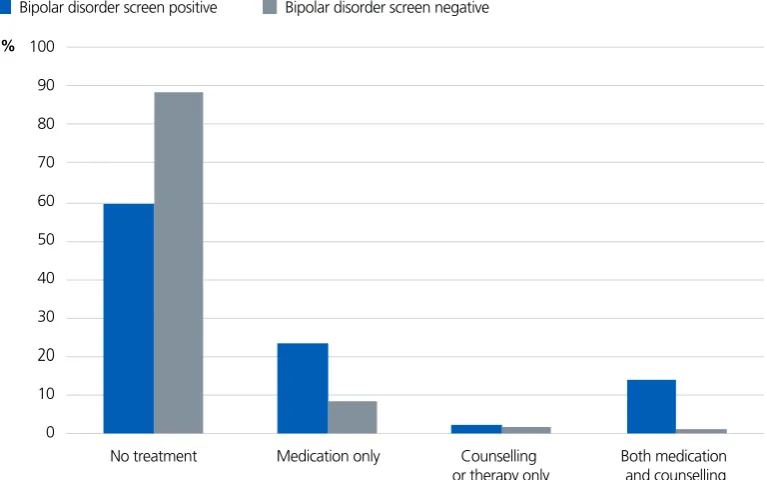
Of those who screened positive for bipolar disorder, 6 out of 10 were not in receipt of any current medication or treatment (59.9%). Those who screened positive were, nonetheless, considerably more likely to report receiving some form of psychotropic medication (37.8%) or psychological therapy (16.4%) than those who screened negative (9.6% and 2.6% respectively).
Regarding the type of medication received by people screening positive for bipolar disorder, the most common medications were those used to treat anxiety (30.0%) or depression (29.6%), followed by 14.5% who took medication specifically for bipolar disorder. For all types of psychotropic medication, with the exception of medication used to treat ADHD, those screening positive were more likely to be taking it than those screening negative. Table 9.9
Participants were asked if they had requested a particular treatment in the past 12 months but had not received it. One in eight people who screened positive for bipolar disorder reported requesting but not receiving some form of mental health treatment (12.7%), this compared with 1.4% of bipolar screen negatives.
[image:13.595.103.487.110.350.2]Table 9.10
Figure 9E: Current treatment for a mental or emotional problem, by bipolar disorder screen
Base: all adults
Bipolar disorder screen positive Bipolar disorder screen negative
No treatment Medication only Both medication
and counselling Counselling
or therapy only 0
10 40
30
20 60
50 70 90
80 100 %
9.4 Discussion
This chapter presents findings on bipolar disorder, a newly-introduced module within APMS 2014, to provide much-needed information on prevalence and sociodemographic profile of people with bipolar disorder in England. The overall prevalence of likely bipolar disorder in the APMS 2014 was 2.0%, closely consistent with findings from epidemiological studies in other countries (Merikangas et al. 2011; Merikangas et al. 2007). Rates were similar for men and women and higher in younger than older people.
Prior to these findings, no lifetime prevalence rates from a UK general
population survey were available for bipolar disorder (Pini et al. 2005). Based on studies conducted in other countries, however, prevalence rates worldwide have been conservatively estimated at between 1–1.5% (Bebbington and Ramana 1995), and as high as 5% (Akiskal et al. 2000) in relation to the full spectrum of bipolar disorder. The World Mental Health Survey Initiative reported that the lifetime aggregate prevalence from 11 countries (not UK) was 2.4% for bipolar disorders (BP-I, BP-II, and subthreshold BP) (Merikangas et al. 2011). The APMS 2014 data are consistent with this range.
It is important to note however, that the instrument used for screening for bipolar disorder while designed to screen for the full bipolar spectrum disorders does have limitations. The MDQ is less sensitive at identifying bipolar II disorders than the longer Hypomania Checklist, another widely used instrument (Meyer et al. 2011). There are also limitations on its use in general population studies (APA 2000). Whilst showing excellent specificity (suggesting a positive result is useful for ruling in bipolar disorder) the instrument has been shown to have limited sensitivity (the proportion of people with a condition who have a positive result); thus these survey prevalence rates may be underestimates.1 Overall the MDQ, albeit limited by these considerations, appears to have performed reasonably well in the APMS 2014.
Bipolar disorder is known to cause considerable disability, together with impairments in work and social life (Sanchez-Moreno et al. 2009), and this
is reflected in the findings presented in this chapter. There was a revealing relationship with household type. People living alone were more likely to screen positive than those living with other people, consistent with evidence suggesting links between bipolar disorder, social isolation and difficulty with relationships. Individuals who were unemployed or economically inactive were also more likely to screen positive for bipolar disorder. This parallels the increased proportion of people screening positive for bipolar disorders among those receiving some form of out of work benefit, or housing benefit. Examination of the data by ethnicity and region showed no associations, although the sample size is small for such comparisons.
The age distribution replicated US data for bipolar disorder and indeed was similar to the distribution for several other mental disorders (Kessler et al. 2005). However, as bipolar disorder is a lifelong condition, we would have expected the prevalence to gradually increase with age. The survey findings may represent a problem of recall. The increased mortality associated with the disorder may also be part of the explanation.
NICE estimate a possible delay of 6 years between the onset of symptoms and treatment, while around 25% of affected adults never seek treatment for bipolar disorder (NICE 2014b). The APMS data presented here shows that around a third of people screening positive for bipolar disorder believed that they have had the disorder, and of those, a third had been diagnosed by a professional.
The majority of people screening positive for bipolar disorder were not currently receiving any form of treatment, either psychological therapy or psychotropic (mental health) medication. Furthermore, one in eight who screened positive for bipolar disorder had asked for, but not received, some particular form of mental health treatment in the last 12 months.
or with medication (NICE 2015b). Almost a third of people screening positive for bipolar disorder reported taking medications indicated for anxiety, consistent with the high prevalence of comorbid anxiety disorder in bipolar disorder reported in previous studies. The second most prevalent medication was that primarily indicated for depression, and again this is consistent with the prevalence of depressive
symptoms being higher in people with bipolar disorder than manic or hypomanic symptoms (Pompili et al. 2013).
Some of the comparisons reported in this chapter are based on small numbers and must be interpreted with caution. In addition, due to the cross-sectional nature of these data, the direction of cause and effect is unclear.
The findings discussed in this chapter were consistent with prevalence studies internationally, despite the limitations of the survey assessment method. They offer much needed information on the characteristics, difficulties and health service contact of people with bipolar disorder living in the community. Future study is warranted to establish the prevalence of bipolar subtypes, why people do not seek or obtain help, and how health services might adapt to better meet the needs of the whole population of people with bipolar disorder.
9.5 Tables
Prevalence and trends
Table 9.1 Number of bipolar disorder characteristics reported (lifetime), by age and sex
Characteristics
Table 9.2 Screen positive for bipolar disorder (observed and age-standardised), by ethnic group and sex
Table 9.3 Screen positive for bipolar disorder, by household type and sex
Table 9.5 Screen positive for bipolar disorder (age-standardised), by employment status and sex
Table 9.6 Screen positive for bipolar disorder (age-standardised), by benefit status and sex
Treatment and service use
Table 9.7 Screen positive for bipolar disorder, self-diagnosis and professional diagnosis of bipolar disorder
Table 9.8 Treatment and service use, by bipolar disorder screen
Table 9.9 Psychotropic medication taken, by bipolar disorder screen
Table 9.10 Requested but not received a particular mental health treatment in the past 12 months, by bipolar disorder screen
9.6 References
Akiskal HS, Bourgeois, ML, Angst J, Post R, Möller HJ, Hirschfeld R. Re-evaluating the prevalence of and diagnostic composition within the broad clinical
spectrum of bipolar disorders. Journal of Affective Disorders, 2000; 59: S5–S30.
American Psychiatric Association. (2000). Diagnostic and statistical manual of mental disorders: DSM-IV-TR. Washington, DC: American Psychiatric Association.
American Psychiatric Association. (2013). Diagnostic and statistical manual of mental disorders (DSM-5). American Psychiatric Pub.
Bebbington P, Ramana R. The epidemiology of bipolar affective disorder. Social Psychiatry and Psychiatric Epidemiology, 1995; 30(6): 279–292.
Coryell W, Scheftner W, Keller M, Endicott J, Maser J, Klerman GL. The enduring psychosocial consequences of mania and depression. American Journal of Psychiatry, 1993; 150: 720.
Hirschfeld RM, Holzer C, Calabrese JR, et al. Validity of the mood disorder questionnaire: a general population study. American Journal of Psychiatry, 2003; 160(1): 178–80.
Hirschfeld RM, Williams JB, Spitzer RL, et al. Development and validation of a screening instrument for bipolar spectrum disorder: the Mood Disorder Questionnaire. American Journal of Psychiatry, 2000; 157(11): 1873–5.
Judd LL, Akiskal HS, Schettler PJ et al. Psychosocial disability in the course of bipolar I and II disorders: a prospective, comparative, longitudinal study. Archives of General Psychiatry, 2005; 62(12): 1322–1330.
Kessler RC, Berglund P, Demler O, et al. Lifetime prevalence and age-of-onset distributions of DSM-IV disorders in the National Comorbidity Survey Replication. Archives of General Psychiatry, 2005; 62(6): 593–602.
Marwaha S, Durrani A, Singh S. Employment outcomes in people with bipolar disorder: a systematic review. Acta Psychiatrica Scandinavica, 2013; 128(3): 179–193.
McCrone PR, Dhanasiri S, Patel A, Knapp M, Lawton-Smith S. (2008). Paying the price: the cost of mental health care in England to 2026. King’s Fund.
www.kingsfund.org.uk/sites/files/kf/Paying-the-Price-the-cost-of-mental- health-care-England-2026-McCrone-Dhanasiri-Patel-Knapp-Lawton-Smith-Kings-Fund-May-2008_0.pdf
Merikangas KR, Akiskal HS, Angst J, et al. Lifetime and 12-month prevalence of bipolar spectrum disorder in the National Comorbidity Survey
replication. Archives of General Psychiatry, 2007; 64(5): 543–552.
Merikangas KR, Jin R, He JP, et al. Prevalence and correlates of bipolar spectrum disorder in the world mental health survey initiative. Archives of General Psychiatry, 2011; 68(3): 241–251.
Murray CJ, Lopez AD. (1996) Global Burden of Disease. Cambridge, MA: Harvard University Press.
National Institute for Health and Care Excellence (NICE) (2014) Bipolar disorder: Assessment and Management. www.nice.org.uk/guidance/cg185/resources/ bipolar-disorder-assessment-and-management-35109814379461
National Institute for Health and Care Excellence (NICE) (2015a) Bipolar disorder in adults: Quality Standard. www.nice.org.uk/guidance/qs95/chapter/introduction
National Institute for Health and Care Excellence (NICE) (2015b) Bipolar disorder: Information for the Public. www.nice.org.uk/guidance/cg185/resources/bipolar-disorder-250400467141
Phillips ML, Kupfer DJ. Bipolar disorder diagnosis: challenges and future directions. The Lancet, 2013; 381(9878): 1663–1671.
Pini S, de Queiroz V, Pagnin D, et al. Prevalence and burden of bipolar disorders in European countries. European Neuropsychopharmacology, 2005; 15(4): 425–434.
Pompili M, Gonda X, Serafini G, et al. Epidemiology of suicide in bipolar disorders: a systematic review of the literature. Bipolar Disorders, 2013; 15(5): 457–490.
Royal College of Psychiatrists (2016) Patient information leaflet on bipolar disorder www.rcpsych.ac.uk/healthadvice/problemsdisorders/bipolardisorder.aspx
Sanchez-Moreno J, Martinez-Aran A, Tabares-Seisdedos R, Torrent C, Vieta E, Ayuso-Mateos JL. Functioning and disability in bipolar disorder: an extensive review. Psychotherapy and psychosomatics, 2009; 78(5): 285–297.
This chapter should be cited as:
Marwaha S, Sal N, Bebbington P. (2016) ‘Chapter 9: Bipolar disorder’ in McManus S, Bebbington P, Jenkins R, Brugha T. (eds) Mental health and wellbeing in England: Adult Psychiatric Morbidity Survey 2014. Leeds: NHS Digital.