Introductory paper prior to a presentation to Working Group 1: Digital Literacy in Homes and Communities, The Digital Literacy and Multimodal Practices of Young Children, DigiLitEY, COST European Cooperation in Science and Technology project meeting, Cyprus, 17-18 March, 2015.
Julia Gillen, Lancaster University, UK.
Introduction
It is now 15 years ago that Ann Cameron and I began discussing our ideas for a methodology that we felt was flexible and yet rigorous enough to study young, resilient children in diverse settings around the globe. The purpose of this short paper is to introduce the research design, explore a few aspects of the methodology in practice and extremely briefly outline projects it has been applied to. This is not going to include findings, and is not even a sketch towards evaluation. Further, it is uncharacteristic of the Day in the Life projects that have always stressed the idea of research as a collaborative endeavour and produced Day in the Life outputs co-authored in many different, international co-authoring teams. (See the project website). In this much more modest individual introduction I will draw on some of our co-authored work and introduce a few reflections that I hope will be of interest to researchers new to the Day in the Life methodology.
Aims of the Day in the Life methodology
Our project design emerged in our attempts to recognise the diversity, across the globe, in the wellbeing of young children. We assumed, with Nsamenang (1992), that the human endeavour to raise thriving children is recognisable across
communities, while notions of what this means will vary. Starting our projects by explaining to our participants that we want to share and explore their perspective on the child as generally ‘growing up well’ brings us into a participatory way of
working. This is the desire to develop emic understandings that characterises holistic or ethnographic approaches, contrary to those that proclaim objectivity and apply external measures of assessment (Jessor, Colby, & Shweder, 1996).
Cognition does not exist outside the life process that in its very nature is a material, practical process. The reflection of reality arises and develops in the process of the development of real ties of cognitive people with the human world surrounding them; it is defined by these ties and, in its turn, has an effect on their development.
Using the concept of a day at the core of our methodology demonstrates that lies more in studying moments of being in situ than investigating developmental change over time. We seek by considering multiple voices from our all research participants including the researchers. Latterly I have come to make connections with Law's (2016) advocacy of STS [science and technology studies] as method. He argues that theory making should not take place outside careful reflection on case studies, in which the knowledge making practices of the researchers are implicated.
Thus, we strove towards the representation of multiple perspectives through the following:
• Utilizing the technology of video, which despite many possible limitations, such as the video camera’s potentially invasive presence in the day, does preserve such a rich record that it is amenable to analyses stemming from many points of interrogation.
• Examining the central data provided in the day against the other sources including parental interviews, etc., increases the potential for a deeper understanding of the data.
• Combining the researchers’ own different disciplinary, national,
professional and indeed even personal standpoints in various ways, creates diverging perspectives, interpretations or approaches to the data.
• Accessing parental feedback on our selection of passages for a compilation tape elicited their retrospective reflections on their child and on
childrearing in general. (Gillen & Cameron, 2010b: 16).
Outline of the method
In a paper of this limited scope, it is not possible to discuss all the stages of the methodology in detail; see (Gillen et al., 2007; Gillen & Cameron, 2010b). I do need to stress that the other stages are equally needed, as multiple data sources and multivoiced involvement are vital. Our work includes many reflective accounts of how interpretations have evolved.
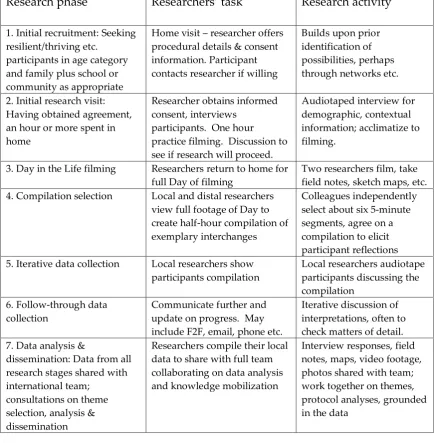
Table 1: Day in the Life methodology
Research phase Researchers’ task Research activity
1. Initial recruitment: Seeking resilient/thriving etc.
participants in age category and family plus school or community as appropriate
Home visit – researcher offers procedural details & consent information. Participant contacts researcher if willing
Builds upon prior identification of possibilities, perhaps through networks etc.
2. Initial research visit: Having obtained agreement, an hour or more spent in home
Researcher obtains informed consent, interviews
participants. One hour
practice filming. Discussion to see if research will proceed.
Audiotaped interview for demographic, contextual information; acclimatize to filming.
3. Day in the Life filming Researchers return to home for
full Day of filming Two researchers film, take field notes, sketch maps, etc. 4. Compilation selection Local and distal researchers
view full footage of Day to create half-hour compilation of exemplary interchanges
Colleagues independently select about six 5-minute segments, agree on a compilation to elicit participant reflections 5. Iterative data collection Local researchers show
participants compilation
Local researchers audiotape participants discussing the compilation
6. Follow-through data
collection Communicate further and update on progress. May include F2F, email, phone etc.
Iterative discussion of interpretations, often to check matters of detail. 7. Data analysis &
dissemination: Data from all research stages shared with international team;
consultations on theme selection, analysis & dissemination
Researchers compile their local data to share with full team collaborating on data analysis and knowledge mobilization
Interview responses, field notes, maps, video footage, photos shared with team; work together on themes, protocol analyses, grounded in the data
Reflections
and products; I acknowledge this as a characteristic, intrinsic feature of our approach rather than variation to be automatically deplored according to an externalised chimera of “objectivity”. I use three stills here that are not offered as in any sense “typical” of the day, but which, rather, indicate moments in which interaction between the filming researchers and the participating families are very much at the fore. This might provoke discussion of the opportunities and limitations of our research methods (see also (Hancock, Gillen, & Pinto, 2010).
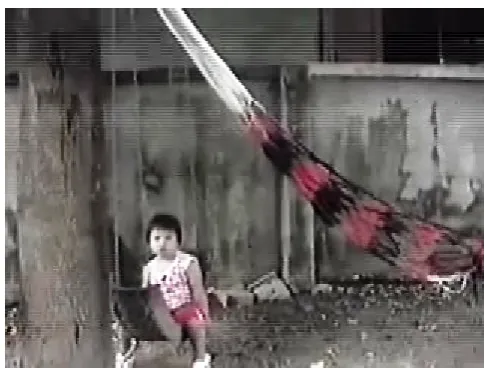
Figure 1: Gai, Thailand
This image, from the early morning, depicts the immediate interest of the child in the videoing process, which quickly diminished, in contrast to more adult participants of the project. It also indicates a fairly typical stance of the researcher doing the video, in this setting, in using a fairly wide angle, at some distance and indeed
occasionally using a tripod. Gai spent her day in a family compound including three buildings and a lot of outside space. The views of her interactions tend to
incorporate considerable details of the environment. However, since audio was collected only through the camera, there were certainly passages when utterances were difficult to transcribe.
Figure 2: Juanita, Peru
Mostly our families quickly accepted the research convention that, as far as possible, they should ignore the presence of the two researchers and carry on with their lives. Very occasionally, as here, the note taker unavoidably enters the frame and her proximity to Juanita and her aunt reminds us what we were asking of them might not always have been easy.
Early in the morning Juanita had spent an hour playing on her bed, with her father talking with her and sometimes videoing her. Her play included some dancing, which her father encouraged. The activity of videoing seemed sometimes associated with dancing by Juanita; this was evidently not uncommon.
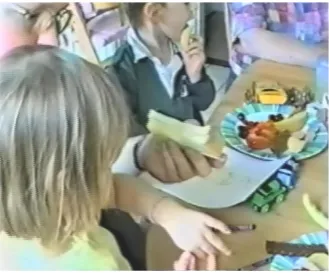
Figure 3: Jessica, UK
[image:5.595.216.381.522.660.2]programme, books, a ride-on slot machine toy at the shopping centre and, during lunch, a shaped piece of ham.
Day in the Life projects
The original project was conducted in Canada, Italy, Peru, Thailand, Turkey, the UK and the USA. It has led to a book, (Gillen & Cameron, 2010a), with an Italian edition including new material (Gillen & Cameron, 2015) and many journal articles and conference papers.
Necessarily, the original methodology has developed as new projects have evolved, although it is beyond the scope of this very short introduction to discuss this further.
The second project explored the resilience of adolescents in Canada, China, Thailand, India and South Africa. Themes of the contributions to thriving of
traditional culture, identities, security strivings, and humour emerged as particularly salient. This project was led by Ann Cameron (Cameron et al., 2013) and I have not been involved at all.
The third initiative is currently studying a day in the life of children in transition to school, and in particular, transitions of children from cultures different from the culture of the larger community in which the school is located. The project investigators include Ann Cameron, Giuliana Pinto, Claudia Stella and Kristiina Kumpulainen in Canada, Italy, Brazil and Finland respectively. I am involved in a minor way, working with one dataset.
Most recently, a team has commenced collecting days of older adults living independently in Canada, Lithuania and the USA with Rachel Heydon, Neringa Kubiliene and Ann Cameron. The days are shorter to accommodate the constraints of these older participants but their enthusiastic engagement and that of younger generations in their families has been indicative of agency and communitarian involvement of the thriving older adults.
Susan Young developed the methodology in new directions, leading MyPlace: MyMusic: an international project to explore everyday music in the home among seven-year-olds in diverse locations, including Brazil, Singapore and Kenya.
The project methodology has occasionally also been cited in projects that have surprised us, most recently in Applied Ergonomics (Li, Tiwari, Alcock, & Bermell-Garcia, 2016)
Cameron, C.A., Hunt, A.K., Pezzica, S., Phillips, L., Heydon, R. & Kumpulainen, K. (2014). Children shaping their identities as readers and writers: A Day in the Life of children in transition to school. Childhood Explorer, 1(4) 22-25.
Cameron, C.A., Theron, L., Tapanya, S., Li, C., Lau, C., Liebenberg, L., & Ungar, M. (2013). Visual perspectives on majority world adolescent thriving. Journal of Research on Adolescence. 23(1), 149-161. doi: 10.1111/j.1532-7795.2012.00794.x Gillen, J., & Cameron, C. A. (Eds.). (2010a). International perspectives on early childhood
research: A Day in the Life. Basingstoke, UK: Palgrave Macmillan.
Gillen, J., & Cameron, C. A. (2010b). Introduction. In J. Gillen & C. A. Cameron (Eds.), International perspectives on early childhood research: a day in the life (pp. 1– 34). Basingstoke, UK: Palgrave Macmillan.
Gillen, J., & Cameron, C. A. (2015). “Un giorno nella vita” Percosi internationali di ricerca della prima infanzia. (G. Pinto & M. Toselli, Eds.). Firenze: Seid. Gillen, J., Cameron, C. A., Tapanya, S., Pinto, G., Hancock, R., Young, S., &
Gamannossi, B. A. (2007). “A day in the life”: advancing a methodology for the cultural study of development and learning in early childhood. Early Child Development and Care, 177(2), 207–218. doi:10.1080/03004430500393763
Hancock, R., Gillen, J., & Pinto, G. (2010). Using video technology. In J. Gillen & C. A. Cameron (Eds.), International perspectives on early childhood research: a day in the life (pp. 35–58). Basingstoke, UK: Palgrave Macmillan.
Jessor, R., Colby, A., & Shweder, R. (Eds.). (1996). Ethnography and human
development: context and meaning in social inquiry. Chicago: University of Chicago Press.
Law, J. (2016). STS as method. In U. Felt, C. Miller, L. Smith-Doerr, & R. Fouche (Eds.), Handbook of Science and Technology Studies. Cambridge, MA: MIT Press. Retrieved from
http://www.heterogeneities.net/publications/Law2015STSAsMethod.pdf Leontiev, A. J. (1978). Activity, consciousness, and personality. Englewood Cliffs, N.J.:
Prentice-Hall.
Li, K., Tiwari, A., Alcock, J., & Bermell-Garcia, P. (2016). Categorisation of
visualisation methods to support the design of Human-Computer Interaction Systems. Applied Ergonomics, 55, 85–107. doi:10.1016/j.apergo.2016.01.009 Nsamenang, A. B. (1992). Human development in cultural context: a third wolrd