
Current Pharmaceutical Design
!"#$%& '$%&()*+,-./ !""#$%&'(&)*&+(
,!""#$%&(-').+(*
0123456 7 8 ! 1 2 8 1 !"#
Albert A. Antolin
a,b,*, Paul Workman
a, Jordi Mestres
band Bissan Al-Lazikani
aaCancer Research UK Cancer Therapeutics Unit, Division of Cancer Therapeutics, The Institute of Cancer Research, London, UK; bSystems Pharmacology, Research Program on Biomedical Informatics (GRIB), IMIM Hospital del Mar Medical Research Institute
and University Pompeu Fabra, Parc de Recerca Biomèdica, Barcelona, Catalonia, Spain
A R T I C L E H I S T O R Y
Received: July 22, 2016 Accepted: September 19, 2016
DOI: 10.2174/1381612822666160923 115828
Abstract: Over the past decade, a more comprehensive, large-scale approach to studying cancer genetics and biology has revealed the challenges of tumor heterogeneity, adaption, evolution and drug resistance, while systems-based pharmacology and chemical biology strategies have uncovered a much more complex interaction between drugs and the human proteome than was previously anticipated. In this mini-review we assess the progress and potential of drug polypharmacology in biomarker-driven precision oncology. Polypharma-cology not only provides great opportunities for drug repurposing to exploit off-target ef-fects in a new single-target indication but through simultaneous blockade of multiple targets or pathways offers exciting opportunities to slow, overcome or even prevent inherent or adaptive drug resistance. We highlight the many challenges associated with exploiting known or desired polypharmacology in drug design and development, and assess computa-tional and experimental methods to uncover unknown polypharmacology. A comprehensive
understanding of the intricate links between polypharmacology, efficacy and safety is urgently needed if we are to tackle the enduring challenge of cancer drug resistance and to fully exploit polypharmacology for the ultimate benefit of cancer patients.
Keywords: Polypharmacology, systems pharmacology, off-target, precision oncology, biomarker, target profiling, side-effects, multi-target drug design.
1. INTRODUCTION: PRECISION ONCOLOGY, POLY-PHARMACOLOGY AND THE LIMITS OF THE SINGLE TARGET APPROACH
Despite advances in basic, translational and clinical research, cancer continues to represent a major global health burden. The lifetime risk of developing cancer by people living in developed countries is now approaching 50% and, worldwide cancer deaths are predicted to rise to 13 million per year within the next two dec-ades [1]. These arresting statistics highlight the urgent need to ac-celerate the discovery of novel cancer therapeutics [1,2]. Our knowledge of oncogenesis and cancer progression has increased dramatically in recent years [2,3], enabling the progressive re-placement of the one-size-fits-all cytotoxic chemotherapy drugs with more personalized, safer, targeted cancer therapeutics that exploit oncogene and nononcogene addiction as cancer vulnerabili-ties [4-6]. However, despite remarkable improvements in survival within certain types of cancer, responses to many single-agent tar-geted therapeutics are relatively short-lived [2]. Increasingly, mo-lecular analysis and deep sequencing are uncovering extraordinary genetic complexity which goes a long way to explain why an overly simplistic, single targeted drug approach to cancer treatment has achieved relatively limited success in terms of prolonged survival [1,2]. Viewed from an evolutionary perspective, cancer is increas-ingly recognized as a complex and adaptive system, and strategies to overcome resistance to both chemotherapy and molecularly tar-geted therapeutics limiting disease control and cure are urgently needed [1].
*Address correspondence to this author at the Division of Cancer Therapeu-tics, The Institute of Cancer Research, London, UK; Tel: +44 20-87-22-46-39: E-mail: [email protected]
Several strategies have been proposed to tackle the issue of cancer drug resistance. First, one could better exploit the full poten-tial of the druggable cancer genome, as only 5% of the more than 500 cancer-causing proteins described to date are targeted by cur-rent therapeutics [7]. However, while this is important, a typical cancer harbors between two and eight pathogenic mutations per tumor [2] so targeting a single mutated protein may be suboptimal, particularly if the target concerned is confined to subclonal branches of the cancer’s evolutionary tree [1]. For this reason, any increase in the number of drugged cancer proteins must be accom-panied by smarter ways to use the drugs concerned. An alternative and increasingly accepted solution to polygenic cancer drug resis-tance is rational combinatorial targeted therapy, that has already yielded several approved drug cocktails [8]. Unfortunately, the exponential number of possible drug combinations means that test-ing all possibilities is prohibitive and smart methods for evaluattest-ing and prioritizing combinations are urgently needed [8]. Moreover, emerging evidence suggests that a large number of cancer driver genes are mutated at very low frequencies [9]. Thus, developing a specific drug for each one might not be cost-effective, and the aim of drugging the entire cancer genome to maximize the potential benefits of combinatorial therapy is not necessarily within easy reach [10]. A third proposed solution is the development of network drugs that are capable of inhibiting more than one of the cellular signaling pathways hijacked in cancer, in order to overcome or prevent resistance [2]. Overall, since drug resistance is the biggest single factor limiting improvements in cancer treatment, a combina-tion of these strategies, together with promising new treatments such as immunotherapies [11], are likely to be needed to achieve long term survival and cure.
In line with the development of a more comprehensive and systems-based approach to cancer research, our understanding of
1873-4286/16 $58.00+.00 © 2016 Bentham Science Publishers
Send Orders for Reprints to [email protected]
Current Pharmaceutical Design, 2016, 22, 6935-6945
6935
REVIEW ARTICLE
the complex pharmacology and mechanisms-of-action of cancer drugs is increasing [12-16]. In the earlier days of modern drug dis-covery, therapeutic agents were developed using phenotypic assays and their mechanism of action remained largely elusive [17]. But advances in pharmacology and molecular biology ushered in a new paradigm of target-based drug discovery, whereby drugs were de-veloped as ‘selective’ inhibitors of a single protein believed to be solely responsible for a disease phenotype. Moreover, the with-drawal of several drugs due to a severe side-effect caused by off-target binding to the potassium channel hERG supported the idea of selective drugs as inherently safer [18]. This new approach was termed ‘rational drug design’ – based on detailed knowledge of the drug target [19]. However, due to insufficient time and resources, as well modern screening technology being unavailable, the selectivity of these targeted drugs or ‘magic bullets’ was commonly evaluated only against a few potential off-target proteins, mainly those shar-ing significant sequence homology with the protein of interest or known to be promiscuous targets and responsible for serious side-effects (such as hERG or cytochrome P450) [20]. This earlier, lim-ited understanding of drug selectivity started to be challenged in the late 2000s, when large scale profiling of drugs uncovered many new targets of drugs that had been considered previously as selec-tive – highlighting the limitations of the classical approach to drug discovery and selectivity [12,21,22]. On the other hand, these newly revealed drug-target interactions illustrated that multi-target drugs could be as safe as single-target drugs and challenged the previous assumption that promiscuity was inherently linked to increased toxicity [18]. In addition, the increasing availability of protein-ligand interaction data in the public domain – going beyond safety pharmacology panels used to derisk lead compounds and drug can-didates to include whole families exemplified by kinases - revealed promiscuous interactions between small-molecules and proteins both within and outside of their target protein’s family [23-25]. The term polypharmacology was coined to refer to the binding of a small-molecule to multiple targets and it rapidly became apparent that our understanding of the interactions between drugs and the proteome, though growing, was far from complete [20,24].
We could distinguish between two kinds of beneficial poly-pharmacology. The first type are cases in which the inhibition of the secondary target could be responsible for activity in another indication where inhibition of the primary target did not cause a relevant effect, and thus the drug could be repurposed in the new indication solely on the basis of the newly identified off-target. The second type is a more complex, more difficult-to-prove, and inter-esting case where the inhibition of two or more targets could act in combination or synergistically in the same indication. Overall, while the notion of drugs binding solely to one protein target is increasingly being challenged and the number of studies uncovering polypharmacology continue to accumulate [15,26-31], the extent to which precise understanding of the binding of drugs to their target protein(s) is actually clearly known to contribute to drug efficacy and safety in the clinic remains to a worrying extent unknown [32].
Precision oncology involves in one definition to ‘coupling an established clinical-pathological index with state-of-the-art molecu-lar profiling to enable diagnostic, prognostic and therapeutic strate-gies precisely tailored to each patient’s requirements’ – and thus requires a detailed understanding of the relationship between drug binding to one or more molecular targets and clinical effectiveness [33]. It is now widely accepted that the successful exploitation of molecularly targeted cancer therapeutics depends on the use of appropriate biomarkers [10]. We can distinguish between several types of biomarkers. Of note, pharmacodynamic (PD) biomarkers, used in parallel with corresponding pharmacokinetic (PK) data, are important to confirm target engagement and pathway modulation in a Pharmacological Audit Trail (PhAT) [34,35]. They provide valu-able supportive evidence (although not definitive proof) that a drug is acting via a known mechanism and they can be used to identify
the ideal dose for administration in follow-up clinical trials [34]. Predictive biomarkers are measurements associated with a response to, or lack of response to, a particular therapy and are used to iden-tify the patient population that will respond to a given molecularly targeted drug [34]. Given impressive advances in cancer genomics, which have enabled patient sequencing, genomic biomarkers have great potential to transform clinical practice. Prior to exploitation in the clinic, all biomarker types must be thoroughly validated and related to the molecular target or the mechanism-of-action of the drug [34]. The development of precision oncology, which requires predictive biomarkers for patient selection, is already transforming clinical trial design and enabling new customized, adaptive, hy-pothesis-testing early trials that incorporate analytically validated and clinically qualified biomarkers. These trials accelerate the drug approval process, maximize the benefit to patients and enable the construction of a framework for rational decision-making in early clinical trials using the PhAT [34]. Furthermore, we can now envis-age a future in which validated biomarkers are combined with lon-gitudinal genome sequencing and other ‘omics’ technologies to inform adaptive combinatorial treatment – facilitated especially by plasma DNA sequencing [36]. Such an approach enables us to tackle genetic and phenotypic heterogeneity and overcome drug resistance, allowing a more nuanced, sophisticated and comprehen-sive approach to cancer treatment [8].
Against this background, in the remainder of this mini-review, we assess the current understanding of, and future prospects for, cancer drug polypharmacology in the context of genomic biomark-ers. First, we discuss how drug polypharmacology is currently be-ing exploited in precision oncology, usbe-ing U.S. Food and Drug Administration (FDA) approved pharmacogenomic biomarkers as a means of establishing a link between drug binding and efficacy. Second, we assess the opportunities for exploiting known poly-pharmacology as we move towards a more comprehensive and systems-based approach to both pharmacology and drug discovery, especially to defeat drug resistance.
2. CURRENT CLINICAL APPLICATIONS OF DRUG POLYPHARMACOLOGY IN ONCOLOGY
poly-pharmacology in a prospective rather than serendipitous way in precision oncology. In the following sections we review the discov-ery of the multi-target drugs listed in Table 1 and their clinical de-velopment.
2.1. Case History of Imatinib
Imatinib was the first kinase inhibitor to be approved by the FDA in 2001 [2]. Given the identification of the Philadelpia chro-mosome and then breakpoint cluster region protein – tyrosine-protein kinase ABL1 (BCR-ABL) translocation as the key trans-formation event in chronic myelogenous leukaemia (CML), scien-tists at Ciba-Geigy (now Novartis) selected BCR-ABL as the target for a drug discovery project [41]. They subsequently evolved a lead compound from a screen against protein kinase C (PKC), eventu-ally identifying a drug candidate devoid of PKC activity and with strong affinity for BCR-ABL [41]. The approval of imatinib trans-formed the treatment of CML to a manageable chronic condition with a six-year survival rate of above 80%. Moreover, the subse-quent identification of BCR-ABL second mutations and also ampli-fications among patients that responded to imatinib initially but relapsed afterwards provides definitive clinical proof that imatinib’s efficacy in CML is driven through BCR-ABL inhibition [42]. Imatinib became the flagship for the development of molecularly targeted cancer therapeutics, although the extent to which the les-sons learned are truly translatable are clearly now questionable, given that CML is a monoclonal disease [43].
Interestingly, imatinib is not only an inhibitor of BCR-ABL, but also strongly inhibits other kinases, including mast/stem cell growth factor receptor Kit(KIT) and platelet-derived growth factor recep-tor beta (PDGFRB) [41]. KIT was known to have a driver role in gastrointestinal stromal tumors (GIST). Accordingly, imatinib was tested and shown to be effective in GIST cancer cell lines and pa-tients, finally gaining FDA approval for use in KIT-mutated GIST in 2002 [44]. Moreover, rearrangement of PDGFRB had been de-scribed in myelodysplastic/myeloproliferative (MDS/MPD) dis-eases [41]. Imatinib was also developed in clinical trials for MDS/MPD diseases with PDGFR gene re-arrangements and finally received FDA approval in 2006 [45]. Overall, although developed as a BCR-ABL kinase inhibitor, imatinib’s serendipitously discov-ered polypharmacology has been exploited in several cancer indica-tions, due to its inhibition of four targets that are all now used as predictive biomarkers. However, the independent use of a single and different biomarker/molecular target for each of these indica-tions suggests strongly that imatinib is always effective through a single target in each case. Mutations in KIT and PDGFR have been isolated in imatinib-resistant patients, providing clinical proof that these are indeed bona fide single targets of imatinib that are in-volved in efficacy [46]. Interestingly, at least one patient showed amplification of both KIT and PDGFRA, providing evidence for a putative combinatorial or synergistic effect by dual inhibition of KIT and PDGFRA in some GIST patients [46]. More recently, several additional targets of imatinib, both kinase and non-kinase, have been identified (mainly through chemical proteomics) but it is not yet known if they are involved in its mechanism of action [47].
2.2. Case History of Crizotinib
Non-small-cell lung cancer (NSCLC) accounts for around 85% of lung cancer cases. Historically, NSCLC was a leading cause of cancer deaths worldwide, often diagnosed at a late stage, and with poor prognosis. Drug treatment involved one-size-fits-all chemo-therapy with significant side effects from which only around 10% of patients responded.
This changed when specific subgroups of patients with exon 19 deletions or exon 21 (L858R) substitution mutations in the epider-mal growth factor receptor (EGFR) were found to respond to the EGFR kinase inhibitors gefitinib and erlotinib. These two drugs were subsequently approved for this patient population,
considera-bly improving prognosis despite the emergence of drug resistance [2,49]. These results prompted research into new driver mutations in NSCLC. In 2007, an echinoderm microtubule associated protein like 4 – anaplastic lymphoma receptor tyrosine kinase (EML4-ALK) rearrangement was identified in another subgroup of NSCLC patients and was shown to have transforming activity. At that time, the kinase inhibitor crizotinib was being developed as a hepatocyte growth factor receptor (MET) inhibitor and was thought to be ‘se-lective’ against 90% of kinases tested in a 120-kinase panel [49,50]. ALK was among the 13 kinases more potently inhibited by crizo-tinib, below 100-fold selectivity from the intended target MET [51]. The discovery of the EML4-ALK rearrangement as a driver genetic abnormality in NSCLC prompted an investigation into the use of crizotinib in this cancer indication [49]. Because of this, crizotinib rapidly received accelerated approval by the FDA in 2011 for ALK-positive NSCLC patients. Soon afterwards, second-site mutations and overexpression of ALK were identified among relapsed pa-tients proving that the efficacy of crizotinib in this patient popula-tion was driven through ALK inhibipopula-tion [52]. Hence, crizotinib was first approved for use against a protein which was not the intended target of the drug discovery program, but an accidental off-target.
Interestingly, crizotinib has just received approval for use in another subgroup of NSCLC patients based on its effect on further off-target protein. The proto-oncogene tyrosine-protein kinase ROS
(ROS1) was not present in the first panel used to determine crizo-tinib selectivity and thus it was not identified as an off-target until a cancer cell line screen was performed in 2012 [53,54]. An initial clinical case report showed preliminary evidence of efficacy and this was rapidly translated into clinical trials, leading to Break-through Therapy Designation, priority review, and finally FDA approval for crizotinib in ROS1-altered NSCLC patients in March 2016 [53]. The first second-site ROS1 mutation in relapsed patients, proving that ROS1 inhibition is likely driving crizotinib efficacy in this patient population, has also been recently reported [55]. To our knowledge, there is no reported evidence of patients with resistant aberrations in both ROS1 and ALK, supporting a distinct and unique target driving crizotinib’s efficacy in each respective NSCLC patient population. In the meantime, crizotinib is still under investigation in clinical trials for cancers harboring alterations of its initially intended target MET [56].
2.3. Polypharmacology Biomarkers in Clinical Trials
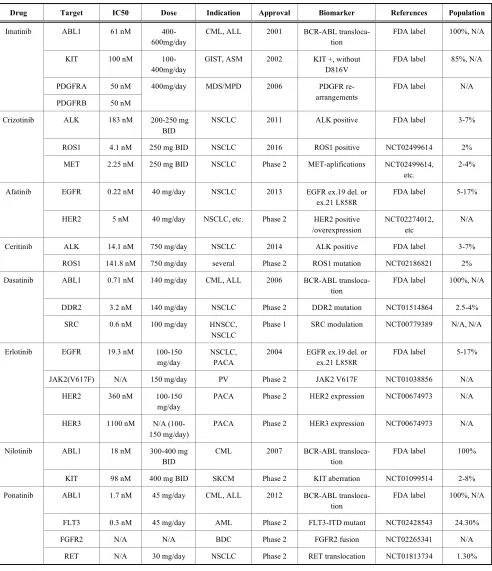
The exploitation of polypharmacology in precision oncology is likely to increase in the near future since at least six approved kinase inhibitors are under clinical investigation in new indications as a result of their activity against additional biomarker targets (Table 1). In this section we examine the status of this research.
Table 1. Multi-target drugs whose polypharmacology is already being exploited in precision oncology or under clinical investigation. Oncology drugs from the FDA Table of Pharmacogenomic Biomarkers in Drug Labeling whose biomarkers are either ap-proved or in clinical trials [38] with further information curated from the FDA drug labelling and from canSAR knowl-edgebase [48].
Drug Target IC50 Dose Indication Approval Biomarker References Population
ABL1 61 nM 400-600mg/day
CML, ALL 2001 BCR-ABL transloca-tion
FDA label 100%, N/A
KIT 100 nM 100-400mg/day
GIST, ASM 2002 KIT +, without D816V
FDA label 85%, N/A
PDGFRA 50 nM Imatinib
PDGFRB 50 nM
400mg/day MDS/MPD 2006 PDGFR re-arrangements
FDA label N/A
ALK 183 nM 200-250 mg BID
NSCLC 2011 ALK positive FDA label 3-7%
ROS1 4.1 nM 250 mg BID NSCLC 2016 ROS1 positive NCT02499614 2% Crizotinib
MET 2.25 nM 250 mg BID NSCLC Phase 2 MET-aplifications NCT02499614, etc.
2-4%
EGFR 0.22 nM 40 mg/day NSCLC 2013 EGFR ex.19 del. or ex.21 L858R
FDA label 5-17% Afatinib
HER2 5 nM 40 mg/day NSCLC, etc. Phase 2 HER2 positive /overexpression
NCT02274012, etc
N/A
ALK 14.1 nM 750 mg/day NSCLC 2014 ALK positive FDA label 3-7% Ceritinib
ROS1 141.8 nM 750 mg/day several Phase 2 ROS1 mutation NCT02186821 2%
ABL1 0.71 nM 140 mg/day CML, ALL 2006 BCR-ABL transloca-tion
FDA label 100%, N/A
DDR2 3.2 nM 140 mg/day NSCLC Phase 2 DDR2 mutation NCT01514864 2.5-4% Dasatinib
SRC 0.6 nM 100 mg/day HNSCC, NSCLC
Phase 1 SRC modulation NCT00779389 N/A, N/A
EGFR 19.3 nM 100-150 mg/day
NSCLC, PACA
2004 EGFR ex.19 del. or ex.21 L858R
FDA label 5-17%
JAK2(V617F) N/A 150 mg/day PV Phase 2 JAK2 V617F NCT01038856 N/A
HER2 360 nM 100-150 mg/day
PACA Phase 2 HER2 expression NCT00674973 N/A Erlotinib
HER3 1100 nM N/A (100-150 mg/day)
PACA Phase 2 HER3 expression NCT00674973 N/A
ABL1 18 nM 300-400 mg BID
CML 2007 BCR-ABL transloca-tion
FDA label 100% Nilotinib
KIT 98 nM 400 mg BID SKCM Phase 2 KIT aberration NCT01099514 2-8%
ABL1 1.7 nM 45 mg/day CML, ALL 2012 BCR-ABL transloca-tion
FDA label 100%, N/A
FLT3 0.3 nM 45 mg/day AML Phase 2 FLT3-ITD mutant NCT02428543 24.30%
FGFR2 N/A N/A BDC Phase 2 FGFR2 fusion NCT02265341 N/A Ponatinib
RET N/A 30 mg/day NSCLC Phase 2 RET translocation NCT01813734 1.30%
sensitivity, supporting a beneficial effect of simultaneous inhibition of EGFR and ERBB2 [61].
In 2014, the FDA granted accelerated approval and Break-through Designation to the kinase inhibitor ceritinib for the
kinase profile, with ceritinib strongly inhibiting insulin-like growth factor 1 receptor (IGF1R) and the insulin receptor (INSR). How-ever, both drugs strongly inhibit ROS1. Accordingly, ceritinib is currently in clinical trials to assess its efficacy against several can-cers in which ROS1is mutated or rearranged. Ceritinib has already shown promise in a NSCLC patient carrying a ROS1 rearrangement whose cancer was refractory to crizotinib [63]. Second site ALK resistant mutations have been identified in patients after relapse to ceritinib but, to our knowledge, no resistant mutations or overex-pression of ROS1 has been described to date [64].
Nilotinib, is a second generation BCR-ABL inhibitor designed to have a 30-fold increased potency over imatinib and approved in 2007 as a second-line treatment for CML [43]. Since imatinib and nilotinib share their off-target inhibition of KIT, nilotinib was also investigated for use in KIT-mutated GIST, although a recent Phase 3 study concluded that it cannot be recommended as first-line treatment for this indication [65]. However, nilotinib is showing promise in Phase 2 clinical trials for its potential to control KIT-mutated melanomas that have progressed after imatinib [66]. Only drug resistant ABL mutations have been described in clinical trials [67].
Ponatinib was developed as a third generation BCR-ABL in-hibitor and designed to block native and second site mutated BCR-ABL, including the gatekeeper mutant T315I which was uniformly resistant to previous BCR-ABL inhibitors leading to FDA approval in 2012 [68]. Thanks to its rich polypharmacology, ponatinib is currently being investigated in several other indications using four non BCR-ABL off-target biomarkers. Ponatinib has been shown to be a strong inhibitor of fibroblast growth factor receptor 1-4 (FGFR1-4), including several activating mutations, prompting its investigation in pre-clinical models of FGFR2-mutated endometrial cancer [69], in clinical trials of advanced biliary cancer harbouring FGFR2 translocations [70] and it has shown clinical activity in a case study of a patient with FGFR1-rearranged mixed-phenotype acute leukemia [71]. Similarly, ponatinib inhibits receptor-type tyrosine-protein kinase FLT3 (FLT3) and several mutated forms including internal tandem duplications (ITD) associated with poor prognosis in acute myeloid leukemia (AML), which has led to the clinical investigation of ponatinib in this and other hematologic malignancies [72,73]. Finally, ponatinib is also being investigated in pre-clinical models of thyroid cancer [74] and in clinical trials of NSCLC [75] due to off-target inhibition of proto-oncogene tyro-sine-protein kinase receptor Ret (RET). BCR-ABL, FGFR2 and FLT3 have all been validated as bona fide targets of ponatinib using drug-resistant alleles in pre-clinical models [72,76,77].
Unfortunately, not all drugs investigated in the clinic with the aim of extending their use through polypharmacology have been successful. Dasatinib and erlotinib have both failed to show effi-cacy in clinical trials against new targets, stressing the challenges associated with this repurposing strategy. Dasatinib was the first of the second-generation BCR-ABL inhibitors to be approved in 2006 [78]. In contrast to nilotinib, dasatinib was designed to inhibit the active conformation of the ABL1 kinase, a much more conserved structure among kinases that confers upon dasatinib a very broad polypharmacology across kinases (Fig. 1). One of the kinases very potently inhibited by dasatinib is the discoidin domain-containing receptor 2(DDR2). Accordingly, the validation of DDR2 as a target in squamous cell cancer (SCC) in 2011 prompted a rapid translation of these findings into clinical trials with dasatinib [79]. However, the early case reports showing clinical efficacy [80] were not sus-tained in a larger Phase 2 clinical trial [81,82]. Similarly, although potent proto-oncogene tyrosine-protein kinase Src(SRC) inhibition was described early on during dasatinib development, so far it has been an unsuccessful biomarker in clinical trials, although pre-clinical studies continue to indicate possible new applications [83,84]. Erlotinib was the second EGFR inhibitor to be approved by the FDA in 2004 and also shows a broad polypharmacology (Fig. 1)
that has been difficult to translate into new predictive biomarker-driven indications [85]. First, erlotinib was shown to effectively inhibit the activity of V617F-mutated tyrosine-protein kinase JAK2 (JAK2) in pre-clinical models of polycythemia vera, but it later failed to show efficacy in the clinic in this setting [86,87]. Second, ERBB2 and ERBB3 have also been difficult to validate as predic-tive biomarkers in clinical trials such as a recent Phase 2 trial in advanced pancreatic carcinoma [88]. Overall, it is clear that having a broad polypharmacology does not guarantee an increased number of approved clinical uses and that polypharmacology-based repur-posing can be very challenging to exploit in the clinic, even when sound pre-clinical evidence is available.
In summary, these examples of kinase inhibitors illustrate that polypharmacology-based repurposing is already being exploited clinically in precision oncology. The pathfinder capacity of imatinib and crizotinib for inhibiting several targets that harbor driving aber-rations in different types of cancer has led to the biomarker-driven approval of these drugs in more than one cancer indication without increased side-effects or toxicity. Moreover, the large number of ongoing clinical trials testing new biomarker-driven drug indica-tions based on polypharmacology suggests that more cases are likely to be approved in the near future. The use of drug resistant alleles in pre-clinical studies and the discovery of mutated or over-expressed proteins in the clinic provides proof that these drugs are achieving efficacy via different targets and suggests that they gen-erally act via a unique target in each of the indications as opposed to having a synergistic or combinatorial effect. However, pre-clinical and pre-clinical evidence suggests that imatinib and afatinib could be benefiting from combinatorial or synergistic polypharma-cology in some of their indications. Finally, several clinical failures illustrate that there are also many challenges ahead.
3. TOWARDS FULLY EXPLOITING POLYPHARMACOL-OGY IN PRECISION ONCOLPOLYPHARMACOL-OGY
Expanding the use of drugs through polypharmacology has the potential to accelerate access to additional precision treatments for cancer patients and to overcome or prevent drug resistance. In this section, we review the challenges associated with prospectively exploiting polypharmacology, assess available experimental and computational methods to identify new targets of drugs, and discuss recent advancements in the emerging fields of systems pharmacol-ogy and multi-target drug design.
3.1. Exploiting Known Polypharmacology
illus-trating that distant polypharmacology can also lead to very potent interactions [92]. The number of targets per drug, within this 10-fold selectivity range, varies considerably. Apart from afatinib, all the drugs have at least one very potent interaction with a target that is not currently under investigation in the clinic. Of these drugs, dasatinib is the most promiscuous drug with 38 targets strongly inhibited. Could these interactions, or any of the known or yet to be discovered off-target interactions of other drugs, be used to repur-pose these drugs in other cancer indications? Can we identify com-binatorial or synergistic polypharmacology and use this information to better tailor drugs to cancer patients in precision oncology?
There are many challenges and considerations that need to be taken into account when repurposing a drug on the basis of a new drug-protein interaction. When the drug was designed through tar-get-based drug discovery it is unlikely that the newly identified off-target is more potent than the intended one. Accordingly, off-target selectivity and side-effects resulting from the interaction with the primary target need to be carefully considered [89]. Another key point is the need to demonstrate clear involvement of the new target in a disease that represents a highly unmet medical need, without difficult competition from other drugs. In this respect, more rigor-ous target validation efforts are very important, especially given the published reports of lack of data reproducibility in the scientific literature [89]. In the context of precision oncology, the association of the new target with a biomarker for patient selection is also a key and often challenging step [10]. Finally, the issue of intellectual property space needs to be also taken carefully into consideration. The publication of many new drug-target interactions in the public domain certainly helps pre-competitive and open source research but challenges the commercial exploitation of these new interac-tions, as they may represent ‘prior art’ and potentially block any new patent indication of the drug [89]. Given the challenges
associ-ated with drug repurposing in the public domain, including re-sourcing costly clinical trials and negotiating public initiatives to ease the process such as the UK Off-Patent Drugs Bill [93] it is paramount for both patient as well as commercial benefit that new drug-target interactions are protected before publication if their further development is believed to be therapeutically relevant. Overall, there are many opportunities for drug repurposing with already known polypharmacology but lack of target validation, biomarker identification and its disclosure prior patenting seriously challenge their exploitation.
The second and distinct case of proactive identification of bene-ficial polypharmacology through combination or synergistic effects within an individual patient and its exploitation for patient benefit – distinct from repurposing – is exciting in terms of potential for overcoming drug resistance but probably far more challenging to achieve. We have already mentioned some evidence of potential combinatorial effects on the targets inhibited by imatinib and afatinib (see above), but this evidence is far from conclusive. A commonly used example to illustrate beneficial polypharmacology through effects of a single drug on more than one target in a par-ticular cancer is sunitinib [18]. Sunitinib is a ‘multi-targeted’ kinase inhibitor that was initially approved by the FDA for renal cell car-cinoma (RCC) and imatinib-resistant GIST in 2006. It is a broadly acting multi-kinase inhibitor that is believed to work in RCC by inhibiting the kinase activities of the multiple vascular endothelial growth factor (VEGF) and PDGF receptors to achieve a potent anti-angiogenic effect, and its inhibition of other kinases such as KIT, FLT3 and RET is likely beneficial for specific types of cancer [94]. Although sunitinib has been authorized in RCC, GIST and pancre-atic neuroendocrine tumors (pNET), its approval has not been ac-companied by validated biomarker(s) for precision oncology. Moreover, only drug-resistant KIT mutations have been identified Fig. (1). Drug-Target network. Drugs (circles) from Table 1 and targets (rounded rectangles) within 10-fold selectivity from a target clinically validated with a biomarker based on information from the knowledgebase canSAR [48]. Node size and edge width are proportional to the clinical validation based on data available in Table 1. As it can be observed, the off-targets being clinically investigated to extend the uses of these drugs are a minority of all the targets already known to be inhibited by these drugs.
Legend
Target validated with an approved biomarker
Target with a biomarker in clinical trials Target withouth a biomarker in clinical trials
Interaction validated with an approved biomarker
Interaction with a biomarker in clinical trials Interaction without a biomarker in clinical trials FLT3 ponatinib
SLC47A1 NQO2 CA14 CA6 PIP4K2C
CA9
CA2 CA7
CA1 TBXAS1
MAPK11 ZAK
EPHA8
EPHA3 FRK
nilotinib imatinib
LCK DDR1
ABL2 DDR2
PDGFRB PDGFRA KIT ABL1
YES1 CSK EPHB1 EPHB4
FGR EPHA5 TXK LYN BTK
TNK2 EPHA2 CSF1R HCK
BMX SIK1 EPHA4
SRC EPHA1
EPHB2
EPHB3 SIK2 FYN
dasatinib
MERTK
LTK MET
ALK
crizotinib
EPHB6
ROS1
TSSK1B
ceritinib
MAP3K19 STK10
ERBB3 MAP2K5
GAK
BLK
SLK
ERBB2
EGFR
in GIST and its mechanisms of resistance in GIST or other cancers do not provide unequivocal proof of the combinatorial benefit of its polypharmacology in individual cancers [95-97]. More recently, pan-RAF inhibitors that also target Src family kinases (SFKs) have been shown to prevent paradoxical pathway activation in pre-clinical models of BRAF-mutant melanoma, a common resistant mechanism to BRAF and dual specificity mitogen-activated protein kinase kinase 1 (MEK) inhibitors, thus illustrating how polyphar-macology can effectively prevent drug resistance [98]. The deliber-ate development of such agents is therefore gaining gredeliber-ater interest. Moreover, polypharmacology has also been shown to enable the synergy in danusertib and bosutinib combination in pre-clinical models of imatinib-resistant CML [99]. A recent computational pan-cancer genomics analysis linking cancer driver identification with in silico drug prescription showed that around 11% of cancer patients harbor genomic alterations – that are predicted as cancer drivers – in more than one protein, and which could potentially be inhibited with a single drug [9]. There is growing evidence of pa-tient populations that could be tested for – and potentially obtain benefit from – combinatorial polypharmacology but the lack of widespread adoption of patient sequencing in routine healthcare systems (although common in clinical trials), of biomarker valida-tion and of repeated sampling for drug-resistant mutavalida-tions all cur-rently limits this approach. We expect that the ongoing implementa-tion of longitudinal genome sequencing and other omics technolo-gies, facilitated by use of plasma DNA, should enable us to better understand, and assess the value of, combinatorial polypharmacol-ogy in the near future.
3.2. Identifying New Targets of Known Drugs
Although there are many options for exploiting known poly-pharmacology, it is essential to comprehensively uncover all of the interactions between drugs and biomolecules in order to maximize the therapeutic potential arising from drug discovery efforts. Ac-cordingly, it is necessary to exploit currently available methods for target profiling – as well as develop completely new ones – if we are to fully characterize drug-protein interactions and exploit them for patient benefit. In this section we briefly discuss some of the available experimental and computational methods.
The first methods that were used to identify polypharmacology were experimental. Advances in recombinant DNA technology, protein production and robotics enabled the development of a num-ber of miniaturized biochemical activity and binding assays to test an increasing number of targets. Initially, these assays were devel-oped for members of the same protein family, as illustrated by the early work on kinases and G protein-coupled receptors (GPCRs) that initially led to the identification of polypharmacology [22,100]. As the use and breadth of these screening panels increased, involv-ing broad safety panels and larger family coverage, new targets of known drugs were identified and many of the panels became com-mercially available through contract research organization compa-nies (CROs) [21,101]. Today, these CROs continue to increase the scope of their target panels, with the largest panels now covering approximately 80% of the human kinome [102,103]. As CROs work to include new members of well-characterized families, and to add new families, research using these panels will continue to be a source of identifying new targets of drugs, which may be unex-pected and surprising - as nicely illustrated by the recent discovery of strong off-target effects on bromodomains among some clinical kinase inhibitors [27]. A second widely-used experimental method for target profiling is chemical proteomics [104]. This was a pio-neering method used to uncover new targets of BCR-ABL inhibi-tors, including the non-kinase oxidoreductase NQO2 [47]. Today, it continues to be used to identify totally unexpected off-targets, such as the recent identification of the nudix family phosphohydrolase MTH1 as an off-target of the (S)-enantiomer of the kinase inhibitor drug crizotinib [105]. This approach is employed increasingly for target deconvolution in phenotypic screening [106]. Exciting new
experimental methods are continually being developed, such as the recent cellular thermal shift assay (CETSA) that enables measure-ment of target engagemeasure-ment in living cells and which has already been used to identify unknown off-target affinity for thymidylate synthase among some known drugs [107,108]. Overall, innovative experimental technologies continue to be a major source of identi-fying new targets of drugs.
Computational methods are becoming increasingly important as a means of identifying potential new targets of drugs, especially since they are increasing in accuracy due to the much greater vol-ume of high-quality publicly available data and their cost-effectiveness compared to experimental technologies [100,109]. Historically, we can distinguish between ligand- and structure-based computational methods. Ligand-structure-based methods rely on anno-tated chemical libraries that connect small molecules with target proteins to facilitate creation of ligand-based protein models. Sev-eral strategies have been successfully implemented to develop computational models, from Bayesian statistics to neural networks and machine learning [110]. Among these, and worth highlighting, are methods that rely on chemical similarity and use fingerprints or feature-based distribution descriptors, as they have now been widely used to successfully identify new targets of drugs [28,111,112]. As an example, serotonin and norepinephrine trans-porters were predicted as putative targets of cyclobenzaprine and subsequently validated in vitro, providing a plausible explanation for its association with the serotonin syndrome [113]. Structure-based methods, in contrast, use information on protein structure and methods such as docking or binding site similarity to identify new drug-target interactions [112,114]. They have also been success-fully used to identify new targets of drugs, such as in the identifica-tion of carbonic anhydrase as a nanomolar off-target of celecoxib [115]. More recently, methods that use both ligand and structural information have also been developed, as well as methods that rely on network biology and text mining, among others [13].
A final group of methods that often mix characteristics of com-putational and experimental methods are also being developed, often using cluster analysis of omics data to infer new targets of known drugs under the hypothesis that clusters should share the same target(s). Several types of omics data have already been suc-cessfully used to identify polypharmacology. These include use of gene expression data (either alone or coupled with network analy-sis) [116,117], cancer cell line profiling coupled with omics data [118] and ex vivo screening of patient cells coupled with genomics that recently enabled the identification of BCR-ABL T315I as a nanomolar off-target of the VEGFR-kinase inhibitor axitinib [26]. Overall, both experimental and computational methods are increas-ingly robust and complement each other in overcoming the limita-tions associated with any one method. Accordingly, all a range of both types of method will play their role as we advance towards a comprehensive understanding of how drugs interact with the whole human proteome.
3.3. Towards Systems Pharmacology and Multi-Target Drug Design
[13,32,119]. Unfortunately, lead-to-drug optimization of multi-target drug candidates – involving enhancement of potency and selectivity toward two or more desired targets, is still technically challenging, especially where the chemical starting points do not serendipitously provide potent multi-targeting. Thus polypharma-cological drug discovery has not been fully embraced in industry [18]. However, we are starting to witness attempts to rationally design multi-target drugs, particularly in academia [120]. There have been several attempts to rationally design dual inhibitors of different protein families, including the construction of dual tyro-sine-phosphoinositide kinase inhibitors and of HSP90-kinase in-hibitors [121-123]. There are also several examples of combination of similar pharmacophores into a single compound or dissimilar pharmacophores being connected by linkers, such as the dual HDAC-PI3K kinase inhibitor CUDC-907 [18,124]. Beyond dual inhibition, a computational method to rationally design ligands against profiles of multiple drug targets has also been described and applied to GPCR targeted polypharmacology [120]. However, iden-tifying the ideal polypharmacological profile to reverse a given disease phenotype is a general limitation, particularly given our incomplete understanding of the function of many proteins and our limited capacity to predict combinatorial polypharmacology [18]. Interestingly, the recent return to phenotypic drug discovery offers new opportunities to facilitate multi-target drug design, as nicely illustrated by the recent use of a fruit fly cancer model to identify the optimal multi-kinase profile to achieve maximal efficacy and minimal toxicity [125]. Overall, a more comprehensive approach to pharmacology and drug discovery is underway which is set to bene-fit from our increasing appreciation of the complex and rich poly-pharmacology of small-molecule drugs and the potential to exploit this for therapeutic benefit.
CONCLUSION AND OUTLOOK
In summary, a more comprehensive, systematic and unbiased approach to studying the genetics, biology and pharmacology of cancer is uncovering the complexity of this set of diseases and the evolutionary nature of cancer while at the same time new techno-logical advances are also enhancing our understanding of the com-plex interaction between cancer (and other) drugs and the proteome. In this mini-review, we have shown that polypharmacology has so far been exploited to a very limited extent within the paradigm of precision oncology. Moreover, the case histories reviewed in detail here – those of imatinib and crizotinib – illustrate that polypharma-cology is mainly being used to repurpose drugs to new cancer indi-cations where only one of the drugs’ targets is suspected to be re-sponsible for therapeutic efficacy in each different indication. While several other cancer drugs are currently in biomarker-driven clinical trials to extend their uses through the binding to new pro-tein targets, these again largely represent single-target repurposing strategies. Our analysis shows that the number of true polypharma-cology approaches that are under investigation for precision oncol-ogy – whereby the aim is to hit more than one target simultaneously to achieve a given anticancer effect – represent a very low propor-tion of the already known polypharmacology. Limitapropor-tions in target validation, biomarker development and patenting, as well the chal-lenges of multi-target drug design and lead optimization, are cur-rently preventing us from exploiting our knowledge of polypharma-cology for the benefit of cancer patients. The application of poly-pharmacology is however likely to increase since pharmacological control of two or more targets or pathways, even amounting to net-work or systems pharmacological perturbation, can be seen as rep-resenting an important approach to overcoming the major clinical challenge of drug resistance due to adaptive response or clonal evolution. With respect to clinical evaluation of polypharmacology drugs, a wider adoption of longitudinal genome sequencing and other omics technologies in the clinic is urgently needed to identify cases in which we can exploit polypharmacology to identify benefi-cial effects of inhibiting several targets simultaneously in the same
indication and maximize therapeutic potential from drug discovery efforts. We must also exploit currently available experimental and computational methods in the drug discovery phase, as well as de-velop exciting new methods, to uncover all the targets of currently available drugs in order to better understand the complex relation-ship between the binding of drugs to their target protein(s) and their efficacy and safety in the clinic – which despite the progress made remains to a worrying extent unknown. The increased understand-ing of the molecular mechanism-of-action of cancer drugs is para-mount if we are to advance to a more systems-based approach to cancer drug discovery in order to overcome or prevent the key clinical challenge of cancer drug resistance.
SUPPLEMENTARY MATERIAL
Supplementary material is available on the publishers Web site along with the published article.
CONFLICT OF INTEREST
Paul Workman is an advisor to Astex Therapeutics, Nuevolu-tion, Nextech Invest and Chroma Therapeutics. Jordi Mestres is affiliated with Chemotargets SL.
ACKNOWLEDGEMENTS
Albert A. Antolin is funded by the People Programme (Marie Curie Actions) of the 7th Framework Programme of the European Union (FP7/2007-2013) under REA grant agreement no. 600388 (TECNIOspring programme), and from the Agency of Business Competitiveness of the Government of Catalonia, ACCIO. Bissan Al-Lazikani and Paul Workman are funded by Cancer Research UK Programme Grant No. C309/A8725. They are also supported by funding from the Cancer Research UK Centre and the NIHR Bio-medical Research Centre at The Institute of Cancer Research, Lon-don (ICR) and the Royal Marsden. Professor Workman is also ac-knowledges support from the ICR and is a Cancer Research UK Life Fellow. Jordi Mestres is funded by the Spanish Ministerio de Economia y Competitividad (project BIO2014-54404-R). We thank Nicky Evans for editorial assistance.
REFERENCES
[1] Greaves M. Evolutionary determinants of cancer. Cancer Discov 2015; 5(8): 806-21.
[2] Workman P, Al-Lazikani B, Clarke PA. Genome-based cancer therapeutics: targets, kinase drug resistance and future strategies for precision oncology. Curr Opin Pharmacol 2013; 13(4): 486-96. [3] Workman P, Al-Lazikani B. Drugging cancer genomes. Nat Rev
Drug Discov 2013; 12(12): 889-90.
[4] Chabner BA, Roberts TG. Timeline: Chemotherapy and the war on cancer. Nat Rev Cancer 2005; 5: 65-72.
[5] Luo J, Solimini NL, Elledge SJ. Principles of cancer therapy: on-cogene and non-onon-cogene addiction. Cell 2009; 136(5): 823-37. [6] Weinstein IB. Addiction to oncogenes — the achilles heal of
can-cer. Science 2002; 297: 63-4.
[7] Patel MN, Halling-Brown MD, Tym JE, Workman P, Al-Lazikani B. Objective assessment of cancer genes for drug discovery. Nat Rev Drug Discov 2013; 12: 35-50.
[8] Al-Lazikani B, Banerji U, Workman P. Combinatorial drug therapy for cancer in the post-genomic era. Nat Biotechnol 2012; 30(7): 679-92.
[9] Rubio-Perez C, Tamborero D, Schroeder MP, et al. Insilico pre-scription of anticancer drugs to cohorts of 28 tumor types reveals targeting opportunities. Cancer Cell 2015; 27(3): 382-96. [10] Gonzalez de Castro D, Clarke PA, Al-Lazikani B, Workman P.
Personalized cancer medicine: molecular diagnostics, predictive biomarkers, and drug resistance. Clin Pharmacol Ther 2013; 93(3): 252-9.
[11] Willyard C. Cancer therapy: an evolved approach. Nature 2016; 532(7598): 166-8.
[12] Kushner D. Playing dirty. IEEE Spectr 2007; 44(12): 32-7. [13] Pérez-Nueno VI. Using quantitative systems pharmacology for
[14] Wathieu H, Issa NT, Byers SW, Dakshanamurthy S. Harnessing polypharmacology with computer-aided drug design and systems biology. Curr Pharm Des 2016; 22(21): 3097-108.
[15] Jalencas X, Mestres J. On the origins of drug polypharmacology. MedChemComm 2012; 4: 80-7.
[16] Tang J, Aittokallio T. Network pharmacology strategies toward multi-target anticancer therapies: from computational models to experimental design principles. Curr Pharm Des 2014; 20: 23-36. [17] Maehle A, Prüll C, Halliwell RF. The emergence of the drug
recep-tor theory. Nar Rev Drug Discov 2002; 1(8): 637-41.
[18] Peters JU. Polypharmacology - Foe or friend? J Med Chem 2013; 56(22): 8955-71.
[19] Keiser MJ, Irwin JJ, Shoichet BK. The chemical basis of pharma-cology. Biochemistry 2010; 49(48): 10267-76.
[20] Mestres J, Gregori-Puigjané E, Valverde S, Solé RV. Data com-pleteness--the Achilles heel of drug-target networks. Nat Biotech-nol 2008; 26(9): 983-4.
[21] Fabian MA, Biggs WH, Treiber DK, et al. A small molecule-kinase interaction map for clinical kinase inhibitors. Nat Biotechnol 2005; 23(3): 329-36.
[22] Roth BL, Sheffler DJ, Kroeze WK. Magic shotguns versus magic bullets: selectively non-selective drugs for mood disorders and schizophrenia. Nat Rev Drug Discov 2004; 3(4): 353-9.
[23] Gaulton A, Bellis LJ, Bento AP, et al. ChEMBL: A large-scale bioactivity database for drug discovery. Nucleic Acids Res 2012; 40(D1): 1100-7.
[24] Paolini GV, Shapland RHB, van Hoorn WP, Mason JS, Hopkins AL. Global mapping of pharmacological space. Nat Biotechnol 2006; 24(7): 805-15.
[25] Yıldırım MA, Goh KI, Cusick ME, Barabási AL, Vidal M. Drug— target network. Nat Biotechnol 2007; 25(10): 1119-26.
[26] Pemovska T, Johnson E, Kontro M, et al. Axitinib effectively in-hibits BCR-ABL1(T315I) with a distinct binding conformation. Nature 2015; 519(7541): 102-5.
[27] Ciceri P, Müller S, O’Mahony A, et al. Dual kinase-bromodomain inhibitors for rationally designed polypharmacology. Nat Chem Biol 2014; 10(4): 305-12.
[28] Antolín AA, Mestres J. Linking off-target kinase pharmacology to the differential cellular effects observed among PARP inhibitors. Oncotarget 2014; 5(10): 3023-8.
[29] Huang X-P, Karpiak J, Kroeze WK, et al. Allosteric ligands for the pharmacologically dark receptors GPR68 and GPR65. Nature 2015; 527(7579): 477-83.
[30] Chen X, Zhao C, Li X, et al. Terazosin activates Pgk1 and Hsp90 to promote stress resistance. Nat Chem Biol 2015; 11(1): 19-25. [31] Flachner B, Lörincz Z, Carotti A, et al. A chemocentric approach
to the identification of cancer targets. PLoS One 2012; 7(4): e35582.
[32] Garcia-Serna R, Vidal D, Remez N, Mestres J. Large-Scale predic-tive drug safety: from structural alerts to biological mechanisms. Chem Res Toxicol 2015; 28(10): 1875-87.
[33] Mirnezami R, Nicholson J, Darzi A. Preparing for precision medi-cine. N Engl J Med 2012; 366(6): 489-91.
[34] Yap TA, Sandhu SK, Workman P, de Bono JS. Envisioning the future of early anticancer drug development. Nat Rev Cancer 2010; 10(7): 514-23.
[35] Workman P. How much gets there and what does it do?: The need for better pharmacokinetic and pharmacodynamic endpoints in con-temporary drug discovery and development. Curr Pharm Des 2003; 9(11): 891-902.
[36] Frenel JS, Carreira S, Goodall J, et al. Serial next-generation se-quencing of circulating cell-free DNA evaluating tumor clone re-sponse to molecularly targeted drug administration. Clin Cancer Res 2015; 21(20): 4586-96.
[37] FDA Table of Pharmacogenomic Biomarkers in Drug Labeling. Available at: http: //www.fda.gov/Drugs/ScienceResearch/ ResearchAreas/Pharmacogenetics/ucm083378.htm accessed 17th M 2016.
[38] Registry Database of Clinicals. Available at: clinicaltrials.gov. [39] Red Brewer M, Pao W. Maximizing the benefits of off-target
kinase inhibitor activity. Cancer Discov 2013; 3(2): 138-40. [40] Tym JE, Mitsopoulos C, Coker EA, et al. CanSAR: An updated
cancer research and drug discovery knowledgebase. Nucleic Acids Res 2014; 42(D1): 61-3.
[41] Capdeville R, Buchdunger E, Zimmermann J, Matter A. Glivec (STI571, imatinib), a rationally developed, targeted anticancer drug. Nat Rev Drug Discov 2002; 1(7): 493-502.
[42] Gorre ME, Mohammed M, Ellwood K, et al. Clinical resistance to STI-571 cancer therapy caused by BCR-ABL gene mutation or amplification. Science 2001; 293(5531): 876-80.
[43] Deininger MW. Nilotinib. Clin Cancer Res 2008; 14(13): 4027-31. [44] Chase F, Veterans P, Medical A, Oncology N, Oncol- B. Efficacy and safety of imatinib mesylate in advanced gastrointestinal stro-mal tumors. N Engl J Med 2002; 347(7): 472-80.
[45] Apperley JF, Gardembas M, Melo JV, et al. Response to imatinib mesylate in patients with chronic myeloproliferative diseases with rearrangements of the platelet-derived growth factor receptor beta. N Engl J Med 2002; 347(7): 481-7.
[46] Debiec-Rychter M, Cools J, Dumez H, et al. Mechanisms of resis-tance to imatinib mesylate in gastrointestinal stromal tumors and activity of the PKC412 inhibitor against imatinib-resistant mutants. Gastroenterology 2005; 128(2): 270-9.
[47] Rix U, Hantschel O, Dürnberger G, et al. Chemical proteomic profiles of the BCR-ABL inhibitors imatinib, nilotinib, and dasatinib reveal novel kinase and nonkinase targets. Blood 2007; 110(12): 4055-63.
[48] Bulusu KC, Tym JE, Coker EA, Schierz AC, Al-Lazikani B. Can-SAR: Updated cancer research and drug discovery knowledgebase. Nucleic Acids Res 2014; 42: 1040-7.
[49] Shaw AT, Yasothan U, Kirkpatrick P. Crizotinib. Nat Rev Drug Discov 2011; 10: 897-8.
[50] Zou HY, Li Q, Lee JH, et al. An orally available small-molecule inhibitor of c-Met, PF-2341066, exhibits cytoreductive antitumor efficacy through antiproliferative and antiangiogenic mechanisms. Cancer Res 2007; 67(9): 4408-17.
[51] Cui JJ, Tran-Dubé M, Shen H, et al. Structure based drug design of crizotinib (PF-02341066), a potent and selective dual inhibitor of mesenchymal-epithelial transition factor (c-MET) kinase and anaplastic lymphoma kinase (ALK). J Med Chem 2011; 54(18): 6342-63.
[52] Katayama R, Shaw AT, Khan TM, Mino-Kenudson M, Iafrate AJ, Engelman JA. Mechanisms of acquired crizotinib resistance in ALK-rearranged lung cancers. Cancer Res 2012; 72(8): 5593-3. [53] Shaw AT, Ou S-HI, Bang Y-J, Camidge DR, Solomon BJ, Salgia
R, et al. Crizotinib in ROS1-rearranged non-small-cell lung cancer. N Engl J Med 2014; 371(21): 1963-71.
[54] Bergethon K, Shaw AT, Ou SHI, et al. ROS1 rearrangements de-fine a unique molecular class of lung cancers. J Clin Oncol 2012; 30(8): 863-70.
[55] Drilon A, Somwar R, Wagner JP, et al. A novel crizotinib-resistant solvent-front mutation responsive to cabozantinib therapy in a pa-tient with ROS1-rearranged lung cancer. Clin Cancer Res 2016; 22(10): 2351-8.
[56] Lennerz JK, Kwak EL, Ackerman A, et al. MET amplification identifies a small and aggressive subgroup of esophagogastric ade-nocarcinoma with evidence of responsiveness to crizotinib. J Clin Oncol 2011; 29(36): 4803-10.
[57] Yu HA, Pao W. Targeted therapies: Afatinib--new therapy option for EGFR-mutant lung cancer. Nat Rev Clin Oncol 2013; 10(10): 551-2.
[58] Lin NU, Winer EP, Wheatley D, et al. A phase II study of afatinib (BIBW 2992), an irreversible ErbB family blocker, in patients with HER2-positive metastatic breast cancer progressing after trastuzu-mab. Breast Cancer Res Treat 2012; 133(3): 1057-65.
[59] Cortes J, Dieras V, Ro J, et al. Afatinib alone or afatinib plus vi-norelbine versus investigator’s choice of treatment for HER2-positive breast cancer with progressive brain metastases after tras-tuzumab, lapatinib, or both (LUX-Breast 3): A randomised, open-label, multicentre, phase 2 tr. Lancet Oncol 2015; 16(16): 1700-10. [60] Choudhury NJ, Campanile A, Antic T, et al. Afatinib activity in platinum-refractory metastatic urothelial carcinoma in patients with ERBB alterations. J Clin Oncol 2016; 34(18): 2165-71.
[61] Takezawa K, Pirazzoli V, Arcila ME, et al. HER2 amplification: A potential mechanism of acquired resistance to egfr inhibition in EGFR -mutant lung cancers that lack the second-site EGFR T790M mutation. Cancer Discov 2012; 2(10): 922-33.
[63] Subbiah V, Hong DS, Meric-Bernstam F. Clinical activity of cerit-inib in ROS1-rearranged non-small cell lung cancer: Bench to bed-side report. Proc Natl Acad Sci USA 2016; 113(11): 1419-20. [64] Toyokawa G, Inamasu E, Shimamatsu S, et al. Identification of a
novel ALK G1123S mutation in a patient with ALK-rearranged non-small-cell lung cancer exhibiting resistance to ceritinib. J Tho-rac Oncol 2015; 10(7): 55-7.
[65] Blay JY, Shen L, Kang YK, et al. Nilotinib versus imatinib as first-line therapy for patients with unresectable or metastatic gastrointes-tinal stromal tumours (ENESTg1): a randomised phase 3 trial. Lan-cet Oncol 2015; 16(5): 550-60.
[66] Carvajal RD, Lawrence DP, Weber JS, Gajewski TF, Gonzalez R, Lutzky J, et al. Phase II study of nilotinib in melanoma harboring KIT alterations following progression to prior KIT inhibition. Clin Cancer Res 2015; 21(10): 2289-96.
[67] Hochhaus A, Saglio G. Nilotinib is associated with a reduced inci-dence of BCR-ABL mutations vs imatinib in patients with newly diagnosed chronic myeloid leukemia in chronic phase. Blood 2013; 121(18): 3703-8.
[68] Cortes JE, Kantarjian H, Shah NP, et al. Ponatinib in refractory Philadelphia chromosome-positive leukemias. N Engl J Med 2012; 367(22): 2075-88.
[69] Kwak Y, Cho H, Hur W, Sim T. Antitumor effects and mecha-nisms of AZD4547 on FGFR2-deregulated endometrial cancer cells. Mol Cancer Ther 2015; 14(10): 2292-302.
[70] Borad M. Ponatinib hydrochloride in treating patients with ad-vanced biliary cancer with FGFR2 fusions. In: ClinicalTrials.gov [Internet]. Bethesda (MD): National Library of Medicine (US) 2000-2016. Available from: URL of the record NLM Identifier: NCT02265341.
[71] Khodadoust MS, Luo B, Medeiros BC, et al. Clinical activity of ponatinib in a patient with FGFR1-rearranged mixed-phenotype acute leukemia. Leukemia 2015; 1-4.
[72] Smith CC, Lasater EA, Zhu X, et al. Activity of ponatinib against clinically-relevant AC220-resistant kinase domain mutants of FLT3-ITD. Blood 2013; 121(16): 3165-71.
[73] Gozgit JM, Wong MJ, Wardwell S, et al. Potent activity of po-natinib (AP24534) in models of FLT3-driven acute myeloid leu-kemia and other hematologic malignancies. Mol Cancer Ther 2011; 10(6): 1028-35.
[74] De Falco V, Buonocore P, Muthu M, et al. Ponatinib (AP24534) is a novel potent inhibitor of oncogenic RET mutants associated with thyroid cancer. J Clin Endocrinol Metab 2013; 98(5): 811-9. [75] Ou I. Ponatinib in Advanced NSCLC w/ RET Translocations. In:
ClinicalTrials.gov [Internet]. Bethesda (MD): National Library of Medicine (US) 2000-2016. Available from: URL of the record NLM Identifier: NCT01813734.
[76] Radich J. Structure, function, and resistance in chronic myeloid leukemia. Cancer Cell 2014; 26(3): 305-6.
[77] Byron SA, Chen H, Wortmann A, et al. The N550K/H mutations in FGFR2 confer differential resistance to PD173074, dovitinib, and ponatinib ATP-competitive inhibitors. Neoplasia 2013; 15(8): 975-88.
[78] Kantarjian H, Jabbour E, Grimley J, Kirkpatrick P. Dasatinib. Nat Rev Drug Discov 2006; 5(9): 717-8.
[79] Hammerman PS, Sos ML, Ramos AH, et al. Mutations in the DDR2 kinase gene identify a novel therapeutic target in squamous cell lung cancer. Cancer Discov 2011; 1(1): 78-89.
[80] Bristol-Myers Squibb. Trial of Dasatinib in Patients With Ad-vanced Cancers Harboring DDR2 Mutation or Inactivating B-RAF Mutation. In: ClinicalTrials.gov [Internet]. Bethesda (MD): Na-tional Library of Medicine (US) 2000- 2016. Available from: URL of the record NLM Identifier: NCT01514864.
[81] Pitini V, Arrigo C, Di Mirto C, Mondello P, Altavilla G. Response to dasatinib in a patient with SQCC of the lung harboring a discoid-receptor-2 and synchronous chronic myelogenous leukemia. Lung Cancer 2013; 82(1): 171-2.
[82] Terai H, Tan L, Beauchamp EM, et al. Characterization of DDR2 inhibitors for the treatment of DDR2 mutated nonsmall cell lung cancer. ACS Chem Biol 2015; 10(12): 2687-96.
[83] Herold CI, Chadaram V, Peterson BL, et al. Phase II trial of dasatinib in patients with metastatic breast cancer using real-time pharmacodynamic tissue biomarkers of Src inhibition to escalate dosing. Clin Cancer Res 2011; 17(18): 6061-70.
[84] Perez M, Lucena-Cacace A, Marín-Gómez LM, et al. Dasatinib, a Src inhibitor, sensitizes liver metastatic colorectal carcinoma to
ox-aliplatin in tumors with high levels of phospho-Src. Oncotarget 2016; Available from: http: //www.ncbi.nlm.nih.gov/pubmed/27105527
[85] Dowell J, Dowell J, Minna JD, Minna JD, Kirkpatrick P, Kirkpa-trick P. Fresh from the Pipeline: Erlotinib hydrochloride. Nat Rev Drug Discov 2005; 4(1): 13-4.
[86] Li Z, Xu M, Xing S, et al. Erlotinib effectively inhibits JAK2V617F activity and polycythemia vera cell growth. J Biol Chem 2007; 282(6): 3428-32.
[87] Cherry M, Khawandanah M, Zhao ZJ, et al. Erlotinib is not effec-tive in patients with JAK2V617F-posieffec-tive polycythemia vera. Ann Hematol 2014; 94(4): 717-9.
[88] Propper D, Davidenko I, Bridgewater J, et al. Phase II, randomized, biomarker identification trial (MARK) for erlotinib in patients with advanced pancreatic carcinoma. Ann Oncol 2014; 25(7): 1384-90. [89] Oprea TI, Mestres J. Drug repurposing: far beyond new targets for
old drugs. AAPS J 2012; 14(4): 759-63.
[90] Bertolini F, Sukhatme VP, Bouche G. Drug repurposing in oncol-ogy—patient and health systems opportunities. Nat Rev Clin Oncol 2015; 12(12): 732-42.
[91] Parkkila S, Innocenti A, Kallio H, Hilvo M, Scozzafava A, Supuran CT. The protein tyrosine kinase inhibitors imatinib and nilotinib strongly inhibit several mammalian alpha-carbonic anhydrase iso-forms. Bioorg Med Chem Lett 2009; 19(15): 4102-6.
[92] Antolin AA, Mestres J. Distant Polypharmacology among MLP Chemical Probes. ACS Chem Biol 2015; 10(2): 395-400. [93] Off-patent Drugs Bill 2015-16. Available from: http:
//services.parliament.uk/bills/2015-16/offpatentdrugs.html. [94] Faivre S, Demetri G, Sargent W, Raymond E. Molecular basis for
sunitinib efficacy and future clinical development. Nat Rev Drug Discov 2007; 6(9): 734-45.
[95] Joosten SC, Hamming L, Soetekouw PM, et al. Resistance to sunit-inib in renal cell carcinoma: From molecular mechanisms to pre-dictive markers and future perspectives. Biochim Biophys Acta - Rev Cancer 2015; 1855(1): 1-16.
[96] Stewart GD, O’Mahony FC, Laird A, et al. Sunitinib treatment exacerbates intratumoral heterogeneity in metastatic renal cancer. Clin Cancer Res 2015; 21(18): 4212-23.
[97] Guo T, Hajdu M, Agaram NP, et al. Mechanisms of sunitinib resis-tance in gastrointestinal stromal tumors harboring KIT AY502-3ins mutation: An invitro mutagenesis screen for drug resistance. Clin Cancer Res 2009; 15(22): 6862-70.
[98] Girotti MR, Lopes F, Preece N, et al. Paradox-Breaking RAF In-hibitors that Also Target SRC Are Effective in Drug-Resistant BRAF Mutant Melanoma. Cancer Cell 2015; 27(1): 85-96. [99] Winter GE, Rix U, Carlson SM, et al. Systems-pharmacology
dissection of a drug synergy in imatinib-resistant CML. Nat Chem Biol 2012; 8(11): 905-12.
[100] Hopkins AL. Drug discovery: Predicting promiscuity. Nature 2009; 462(7270): 167-8.
[101] Krejsa CM, Horvath D, Rogalski SL, et al. Predicting ADME properties and side effects: the BioPrint approach. Curr Opin Drug Discov Dev 2003; 6(4): 470-80.
[102] Jacoby QE, Tresadern G, Bembenek S, et al. Extending kinome coverage by analysis of kinase inhibitor broad profiling data. Drug Discov Today 2015; 20(6): 652-8.
[103] Knapp S, Arruda P, Blagg J, et al. A public-private partnership to unlock the untargeted kinome. Nat Chem Biol 2013; 9(1): 3-6. [104] Rix U, Superti-Furga G. Target profiling of small molecules by
chemical proteomics. Nat Chem Biol 2009; 5(9): 616-24. [105] Huber KVM, Salah E, Radic B, et al. Stereospecific targeting of
MTH1 by (S)-crizotinib as an anticancer strategy. Nature 2014; 508(7495): 222-7.
[106] Dale T, Clarke PA, Esdar C, et al. A selective chemical probe for exploring the role of CDK8 and CDK19 in human disease. Nat Chem Biol 2015; 11(12): 973-80.
[107] Molina DM, Jafari R, Ignatushchenko M, Seki T. Monitoring drug target engagement in cells and tissues using the cellular thermal shift assay. Science 2013; 341(7): 84-7.
[108] Almqvist H, Axelsson H, Jafari R, et al. CETSA screening identi-fies known and novel thymidylate synthase inhibitors and slow in-tracellular activation of 5-fluorouracil. Nat Commun 2016; 7: 11040.
[110] Koutsoukas A, Simms B, Kirchmair J, et al. From insilico target prediction to multi-target drug design: Current databases, methods and applications. J Proteomics 2011; 74(12): 2554-74.
[111] Keiser MJ, Setola V, Irwin JJ, et al. Predicting new molecular targets for known drugs. Nature 2009; 462(7270): 175-81. [112] Ekins S, Mestres J, Testa B. Insilico pharmacology for drug
dis-covery: methods for virtual ligand screening and profiling. Br J Pharmacol 2007; 152(12): 9-20.
[113] Fonslow BR, Stein BD, Webb KJ, et al. Linking Pharmacology to Clinical Reports: Cyclobenzaprine and Its Possible Association With Serotonin Syndrome. Clin Pharmacol Ther 2013; 10(1): 54-6. [114] Jalencas X, Mestres J. Chemoisosterism in the proteome. J Chem
Inf Model 2013; 53(2): 279-92.
[115] Weber A, Casini A, Heine A, et al. Unexpected nanomolar inhibi-tion of carbonic anhydrase by COX-2-selective celecoxib: new pharmacological opportunities due to related binding site recogni-tion. J Med Chem 2004; 47(3): 550-7.
[116] Iorio F, Bosotti R, Scacheri E, et al. Discovery of drug mode of action and drug repositioning from transcriptional responses. Proc Natl Acad Sci U S A 2010; 107(33): 14621-6.
[117] Woo JH, Shimoni Y, Yang WS, et al. Elucidating compound mechanism of action by network perturbation analysis. Cell 2015; 162: 441-51.
[118] Seashore-Ludlow B, Rees MG, Cheah JH, et al. Harnessing con-nectivity in a large-scale small-molecule sensitivity dataset. Cancer Discov 2015; 5(11): 1210-23.
[119] Remez N, Garcia-serna R, Vidal D, Mestres J. The invitro phar-macological profile of drugs as a proxy indicator of potential in vivo organ toxicities. Chem Res Toxicol 2016; 29(4): 637-48. [120] Besnard J, Ruda GF, Setola V, et al. Automated design of ligands
to polypharmacological profiles. Nature 2012; 492(7428): 215-20. [121] Apsel B, Blair JA, Gonzalez B, et al. Targeted polypharmacology:
discovery of dual inhibitors of tyrosine and phosphoinositide kinases. Nat Chem Biol 2008; 4(11): 691-9.
[122] Wu L, Yu J, Chen R, et al. Dual inhibition of Bcr-Abl and Hsp90 by C086 potently Inhibits the proliferation of imatinib-resistant CML cells. Clin Cancer Res 2015; 21: 833-43.
[123] Meng T, Zhang D, Xie Z, et al. Discovery and optimization of 4,5-diarylisoxazoles as potent dual inhibitors of pyruvate dehydro-genase kinase and heat shock protein 90. J Med Chem Chem 2014; 57(23): 9832-43.
[124] Qian C, Lai CJ, Bao R, et al. Cancer network disruption by a single molecule inhibitor targeting both histone deacetylase activity and phosphatidylinositol 3-kinase signaling. Clin Cancer Res 2012; 18(15): 4104-13.
![Fig. (1). Drug-Target network. Drugs (circles) from Table 1 and targets (rounded rectangles) within 10-fold selectivity from a target clinically validated with a biomarker based on information from the knowledgebase canSAR [48]](https://thumb-us.123doks.com/thumbv2/123dok_us/8603462.1724817/6.595.124.506.97.378/circles-rectangles-selectivity-clinically-validated-biomarker-information-knowledgebase.webp)
