Accepted Manuscript
An evaluation of an interprofessional Master’s level programme in Children’s Palliative Care. Part 1 The Students’ Evaluation of the Programme
Honor Nicholl, Jayne Price, Catherine Tracey
PII: S1471-5953(14)00042-0 DOI: 10.1016/j.nepr.2014.03.007 Reference: YNEPR 1863
To appear in: Nurse Education in Practice
Received Date: 11 March 2013 Revised Date: 28 January 2014 Accepted Date: 4 March 2014
Please cite this article as: Nicholl, H., Price, J., Tracey, C., An evaluation of an interprofessional Master’s level programme in Children’s Palliative Care. Part 1 The Students’ Evaluation of the Programme, Nurse Education in Practice (2014), doi: 10.1016/j.nepr.2014.03.007.
M
AN
US
CR
IP
T
AC
CE
PT
ED
ACCEPTED MANUSCRIPT
TITLE:AN EVALUATION OF AN INTERPROFESSIONAL MASTER’S LEVEL PROGRAMME IN
CHILDREN’S PALLIATIVE CARE.PART 1THE STUDENTS’EVALUATION OF THE PROGRAMME.
Dr Honor Nicholl Assistant Professor
The School of Nursing & Midwifery Trinity College Dublin
Ireland
Tel 003531 8963702 Fax +3531 8963001 Email [email protected]
Dr Jayne Price
Senior Teaching Fellow
School of Nursing and Midwifery Queens University Belfast
Belfast
Northern Ireland Tel: 028 90975756 Email:[email protected]
Dr Catherine Tracey Lecturer
The School of Nursing & Midwifery Trinity College Dublin
Ireland
M
AN
US
CR
IP
T
AC
CE
PT
ED
ACCEPTED MANUSCRIPT
Abstract 200 words (NEP 200 max)
In 2010/12 an innovative children’s palliative care interprofessional educational project
funded by the Irish Hospice Foundation was undertaken in a University faculty (AUTHORS
NAMED). This initiative responded to international educational recommendations to meet
the palliative care needs of children. The project involved the development and delivery of 3
standalone modules at Master’s level and a substantive research evaluation of the project to
examine stakeholders and students perspectives to provide an insight into their experiences
and to gather data for future developments. The research evaluation was conducted in two
parts, part one sought students’ evaluation and part two sought stakeholders’, curriculum
developers and lecturers’ feedback.
This paper reports the students’ evaluation. Findings indicate that students perceived
undertaking the modules provided them with the opportunity for improved interprofessional
learning and they found modular content and assessment challenging. They also found the
modules met their educational needs and also promoted an awareness of interprofessional
education and the collaborative teamwork involved in children’s palliative care. These
students already experienced in children’s palliative care indicated that those teaching on
programmes at this level need expertise and programme time needs to be available for
sharing experiences and for consolidation of learning.
Key words (NEP 4 words max)
M
AN
US
CR
IP
T
AC
CE
PT
ED
ACCEPTED MANUSCRIPT
1
INTRODUCTION
COMPLETELY REWRITTEN in line with comments provided
The Republic of Ireland, in keeping with other countries internationally, has experienced an
increased number of children and young people with life-limiting conditions (LLC) who
require palliative care. These children have a wide range of very complex health care needs,
which require sustained services for the child and family not only for the duration of the
child’s life but also into bereavement, have been the focus in current national and
international policies In Ireland, for example, as elsewhere there are recommendations
regarding the need for service improvements and development underpinned by a sound
knowledge base and provided by an educated and competent workforce (Department of
Health and Children (DOH&C), 2001., DoH&C and the Irish Hospice Foundation (IHF)
(2005) and the DOH&C, 2009). Such recommendations for improvement are made clear in
the following directive indicating “the need for staff to develop the competencies required to
address the palliative care needs of children” together with “the development of a core
module of integrated learning for all health professionals” (p.vii).
In addition to policy directives in curriculum development in health care programmes the
need for interprofessional education is emerging nationally and internationally (World Health
Organisation (WHO) 2010) to ensure optimal health care is delivered. Interprofessional
education is said to occur when members or students of two or more health and /or social care
professions engage in interactive learning activities to improve collaboration and or the
delivery of care (Reeves et al., 2010; Barr, 2013). In the United Kingdom the Care Quality
M
AN
US
CR
IP
T
AC
CE
PT
ED
ACCEPTED MANUSCRIPT
2
health care delivery. The need for interprofessional education is also included in many recent
educational initiatives (Kitto et al., 2013) and is linked to the need to reinforce
interprofessional practice internationally (Craddock et al., 2013). Interprofessional education
has been linked to the reduction in medical errors, hospital readmissions, decreased mortality
rates and improved health outcomes for those with chronic conditions (WHO, 2010).
BACKGROUND
In response to the above recommendations and directives, and because there were no inter
professional programmes in children’s palliative care available in the Republic of Ireland,
the IHF in 2010/2011 provided funding for the development and delivery of standalone
interprofessional Master’s level modules at level 9 under the Bologna agreement. This
significant funding enabled the establishment of a research and teaching team to develop an
interprofessional children’s palliative care education programme, a first in the country. The
three modules were developed in the School of Nursing and Midwifery, (AUTHORS
UNIVERSITY) in 2010/2011 and from the outset this modular programme was planned and
delivered in close collaboration as has been identified as central to interprofessional
healthcare education (Webster, 2013) with key stakeholders from a range of professional
background including clinical and specialist experts. The programme curriculum was guided
by the philosophy of interprofessional education (MacDougall et al., 2001) and the
development of the modules was influenced by the curricular cycle (Peyton, 1998).
Critical to the development of the programme content was its academic level, applicability
and relevance to children’s palliative care practice and service needs in all settings across the
M
AN
US
CR
IP
T
AC
CE
PT
ED
ACCEPTED MANUSCRIPT
3
philosophy, principles and practice in children’s palliative care, (2) pain and symptom
management in children’s palliative care and (3) psychosocial and spiritual issues in
children’s palliative care. Each module was awarded 10 credits by the University. The
modules could be taken as standalone or in totality and were delivered face to face in a
classroom setting..Additional educational resources were posted on line for students. Given
the embryonic state of specialist children’s palliative care services in Ireland direct teaching
methods were chosen deliberately and specifically at the outset as there was an identified
need for health professionals to come together to network (Tracey and Nicholl, 2006).
Following a year in which the curriculum was developed three separate interprofessional
modules in children’s palliative care were delivered in 2011/ 2012 by key stakeholders,
interdisciplinary experts and practitioners with expertise in this field of practice. This
included interprofessional specialists from nursing, medicine, social work, physiotherapy,
psychology, play, art therapy, chaplaincy, speech and language therapy, family and childcare
as well as experts in ethics and law. Content related to contemporary national and
international issues and challenges in the delivery of care to children and their families.
Content was also designed to enable participants to develop the knowledge, skills,
competencies and attitudes to enable them to deliver best practice palliative care to support to
children who are living with life-limiting conditions and their families in all care settings
from an interprofessional perspective. The learning outcomes for the modules were written to
be deliberately broad but were sufficiently detailed to act as a guide to the student’s learning.
The achievement of modular outcomes by the student required advanced study in the
theoretical, philosophical and practical aspects of children’s palliative care. On completion of
each module, students completed a formal theoretical assessment to facilitate them to apply
M
AN
US
CR
IP
T
AC
CE
PT
ED
ACCEPTED MANUSCRIPT
4
and role. This required the student to demonstrate critical thinking and reflective practice
skills to the delivery of children’s palliative care. There was no clinical practice element to
the modules as the participants were already qualified professionals working in this field. In
addition to a formal specific written assignment summative informal assessments and oral
class presentations were included to facilitate group learning, networking and to integrate a
theoretical perspective to their professional practice. Each module was also designed to be
delivered over 5 full days one day a week for 5 weeks. This was planned because as all
students would be working it was essential from stakeholders and managers perspectives that
there would to need to be minimal disruption to service delivery. It was also implemented as
students would be travelling from all parts of the country so it was important to maximise
their time in class.
From the outset the planning team recognised the need for constant and complete evaluation
of all aspects of the programme (Mac Dougall et al., 2001; Mellor et al., 2013). This was also
a funding requirement and necessary as part of the University evaluation protocols. In
addition as this was the initial programme, evaluation was needed for the development and
future delivery of the programme. In keeping with the belief that curriculum development is
an ongoing and evolving process, it was agreed at the outset that the programme would be
fully evaluated. Consequently all aspects of the curriculum design and delivery were
subjected to critique by key stakeholders including participants, service providers, employers
and all those involved in the programme. The complete evaluation project examined the
development and delivery of the three interprofessional modules from student and
stakeholders perspectives to identify key issues involved in the further development and
follow up (Ford, 2013) and to the add to an improved understanding of the development of an
M
AN
US
CR
IP
T
AC
CE
PT
ED
ACCEPTED MANUSCRIPT
5
research study was developed to ensure that a summative evaluation of the project by
stakeholders and all students was undertaken. This evaluation was conducted in two parts
student evaluation and stakeholder evaluation.
The aim this paper is to present the evaluation of the students who completed the programme
with a view to identifying what worked, what should be changed and to identify their
suggestions for the future development of the programme based on their experiences of this
first programme.
OBJECTIVES
The substantive research evaluation objectives were carried out in two parts, part one sought
the students’ evaluation and part two sought stakeholders, curriculum developers and lectures
evaluation. This paper specifically reports on the students’ evaluation of their experiences of
the delivery of the 3 standalone interprofessional modular programme in children’s palliative
care.
ETHICAL APPROVAL
Ethical approval to undertake this substantive evaluation research study was granted by the
Faculty of Health Sciences research ethics committee (AUTHORS UNIVERSITY) Dublin.
Throughout the study the principles of good ethical practice were adhered to including
M
AN
US
CR
IP
T
AC
CE
PT
ED
ACCEPTED MANUSCRIPT
6 PARTICIPANTS
All fifteen (n=15) students who participated across the three modules were invited to
participate in the student evaluation. Students represented a range of professional
practitioners [nurses, social workers, physiotherapists and chaplains] involved in the delivery
of children’s palliative care. Given the standalone nature of the modules some students
participated in, and completed, all three modules while others participated in one or two
modules only. Of the (n=15) students, seven nurses participated in all three modules, two
social workers participated in two modules while two chaplains, two nurses, one social
worker and a physiotherapist participated in one module only.
DATA COLLECTION
The student evaluation questionnaire developed for the study was informed by the
University’s standard evaluation tools and School’s module and programme evaluation tools.
These were amended to reflect the specific aspects of the children’s palliative care modules.
Data were collected using a precoded questionnaire distributed by post. A letter of invitation
to participate in the study and a copy of the questionnaire was sent to each student six weeks
after the programme finished and after the release of final results. A reminder email and
second invitation letter and questionnaire were also sent two weeks later. As a requirement of
ethical approval to protect student identities and to avoid potential coercion, questionnaires
and were distributed and returned by post to the independent research assistant recruited to
the team to lead the programme evaluation. No student identities can be linked to the data.
M
AN
US
CR
IP
T
AC
CE
PT
ED
ACCEPTED MANUSCRIPT
7
In the questionnaire students were asked to provide quantitative feedback on three specific
issues. These were the relevance of the modules’ content to children’s palliative care; the
teaching strategies used; the impact of completing a/the module/s on their professional
development and learning in practice. In addition to these structured items qualitative data
were collected by which the students were invited to comment on the three most positive
aspects of the modules, the three most negative aspects and three changes they would
recommend in future programmes. They were also asked to add any additional comments
relevant to the project’s aim and objectives.
DATA ANALYSIS
In analysis both quantitative and qualitative approaches were applied. Quantitative analysis
was undertaken using Microsoft Excel. Qualitative analysis involved reading each
questionnaire to collect the data and to categorise this content into the pre-determined
categories. Qualitative analysis was applied to the questionnaires comments section and
involved transcription, reading each questionnaire to filter data and code into the specifically
determined categories [positive aspects, negative aspects and the way forward] (Stokes and
Urquhart, 2013). Each questionnaire was coded independently by two researchers, identifiers
were removed and final codes were agreed following discussion.
RESULTS
Questionnaires were sent to all students (n=15). Ten completed questionnaires were returned
giving a response rate of (66%). Quantitative and qualitative findings are presented
M
AN
US
CR
IP
T
AC
CE
PT
ED
ACCEPTED MANUSCRIPT
8
QUANTITATIVE FINDINGS
Using a five point Likert scale, students were asked to rate the relevance of the content of
each of the modules they had completed to children’s palliative care; the teaching strategies
used and the impact of completing the module/s on their professional development and
practice and their satisfaction with the module.
Overall the majority of students rated their level of satisfaction across the module/s as “high”
(n=5, 50%) to “very high” (n=2, 20%); neutral (n=2,20%) and low (1,10%) and rated
organisation across the module/s as “good” (n=5, 50%) to “very good” (n=3, 30%); neutral
(n=2,20%).
Modules
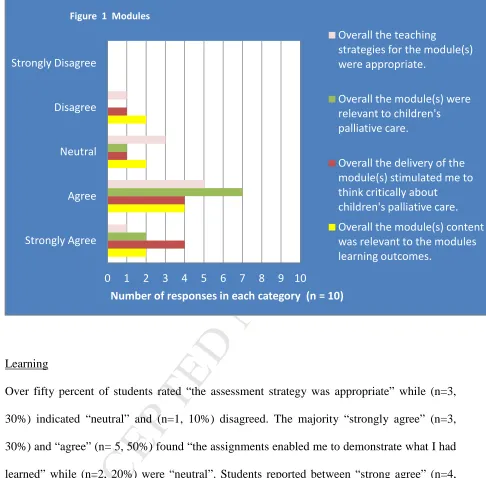
The majority (9, 90%) of students rated that “the module/s were relevant to children’s
palliative care” while (n=2, 20%) scored “neutral” and (1, 10%) scored “low”. In reply to the
question the “overall the delivery of the module/s stimulated me to think critically about
children’s palliative care” eight students (8. 80%) equally indicated “strongly agree” to
“agree” and one (1, 10%) indicated “neutral” and another “disagree”. Neither of these two
students elaborated on these responses in the comments section. One student (1, 10%)
disagreed that “overall the teaching strategies for the module/s were appropriate” while (n=5,
50%) found the teaching strategies appropriate. Two (n=2, 20%) students disagreed that
“overall the module/s content was relevant to the modules learning outcomes” whereas (n=4,
M
AN
US
CR
IP
T
AC
CE
PT
ED
ACCEPTED MANUSCRIPT
9 Learning
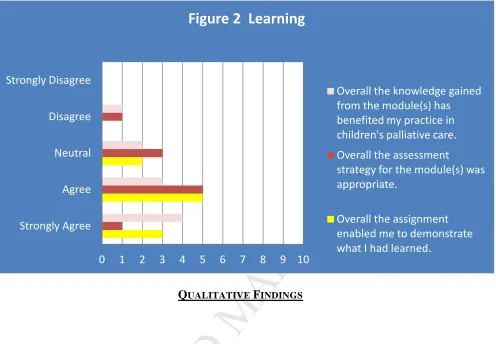
Over fifty percent of students rated “the assessment strategy was appropriate” while (n=3,
30%) indicated “neutral” and (n=1, 10%) disagreed. The majority “strongly agree” (n=3,
30%) and “agree” (n= 5, 50%) found “the assignments enabled me to demonstrate what I had
learned” while (n=2, 20%) were “neutral”. Students reported between “strong agree” (n=4,
40%) and “agree” (n=3, 30%) that “the knowledge gained from the module/s benefited my
practice in children’s palliative care” while two students scored “neutral” and one scored
“disagree” (Figure 2).
Strongly Agree Agree Neutral Disagree Strongly Disagree
0 1 2 3 4 5 6 7 8 9 10
[image:12.595.67.553.106.584.2]Number of responses in each category (n = 10) Figure 1 Modules
Overall the teaching
strategies for the module(s) were appropriate.
Overall the module(s) were relevant to children's palliative care.
Overall the delivery of the module(s) stimulated me to think critically about
children's palliative care.
M
AN
US
CR
IP
T
AC
CE
PT
ED
ACCEPTED MANUSCRIPT
10
QUALITATIVE FINDINGS
In addition to this quantitative data the students were invited to provide qualitative feedback.
This focussed on the three most positive, the three most negative aspects of the module/s and
three changes students would recommend in programme planning. An opportunity was also
provided to make additional comments relevant to the aim of the study. The data returned
reflected issues related to the module/s structure, structural influences and module/s delivery.
The qualitative findings are presented using three themes; strengths, dissatisfaction, and the
way forward.
Strengths
Students generally indicated that the modules overall met with, and for some surpassed, their
expectations. Strengths positively evaluated included the benefits of sharing information and
Strongly Agree Agree Neutral Disagree Strongly Disagree
[image:13.595.74.570.99.443.2]0 1 2 3 4 5 6 7 8 9 10
Figure 2 Learning
Overall the knowledge gained from the module(s) has benefited my practice in children's palliative care.
Overall the assessment
strategy for the module(s) was appropriate.
M
AN
US
CR
IP
T
AC
CE
PT
ED
ACCEPTED MANUSCRIPT
11
meeting the individual student’s personal educational and clinical needs. Completing the
module/s fulfilled the perceived gap in their need for education in children’s palliative care.
In addition students reported that their academic skills were improved by completing the
module/s. In addition to personal development a positive outcome of shared learning for
clinical practice was identified by a number of students. The benefits of sharing and the link
to improved clinical practice were outlined by RQ09:
“Sharing and receiving information from other professionals. Developing my own
personal education. These modules equip me to deliver a better quality of support to
children with life limiting illnesses and their families.” (RQ09)
In addition, role clarification was identified. Completing a module was identified as
promoting and creating an awareness of the significance and importance of collaboration and
teamwork in children’s palliative care. Module/s completion provided an opportunity for the
students from different professions to share perspectives from both students and lecturers,
leading to an improved understanding of each other’s roles, as evidenced below:
“Meeting with experts in the field. Being exposed to appropriate academic writings.
Meeting/sharing experience with colleagues in the field.” (RQO1)
Finally students reported the value of the academic support they received in relation to study
at Master’s level and the provision of help from module lecturers. Overall students reported
positively in the three aspects, module structure, structural influences and module delivery.
M
AN
US
CR
IP
T
AC
CE
PT
ED
ACCEPTED MANUSCRIPT
[image:15.595.73.529.79.606.2]12 Table 1 Strengths
Module Structure
• being exposed to appropriate academic writings
• learning how to research and complete an assignment
• group presentations were very informative
Structural Influences
• meeting experts in the field
• time for reflection and discussion with others
• networking, team work and interdisciplinary team work in children’s palliative care
Module Delivery
• lecturers and others were really helpful
• course coordination was very good, helpful and approachable
• student support was excellent
Dissatisfaction
In addition to strengths students provided feedback on issues with which they were
dissatisfied. This included aspects of the module/s structure, content and lecturer input. The
level of clinical experience and expertise of some lecturers in teaching children’s palliative
care and the lack of significant relevant and current specialist expertise and experience in
children’s palliative care nationally was reflected in the quality of some lecturers was
M
AN
US
CR
IP
T
AC
CE
PT
ED
ACCEPTED MANUSCRIPT
13
Overall students felt that the module/s length was/were short and that more time was required
in classroom sessions for class sharing/discussion, assimilation of knowledge and assignment
work. They felt that modules were delivered in a very tight timeframe and more time was
required within the programme.
“All three modules were rushed and time was not enough. “(RQ08)
In addition students reported managing work life balance during the module/s was
problematic. Each module was delivered over five study days on consecutive Fridays over 5
weeks. This was problematic for students who were simultaneously working full time. Many
attended the module/s on their day off which left students with little time for work and home
life balance and for course study. Managing the module/s workload while working was
difficult as indicated by RQ08:
“Workload was too much, as we have to work fulltime. No breaks between each
module.” (RQ08)
Other practical issues that were reported as causing dissatisfaction included matters related to
the University such as time needed to register and having time to access the library during
their College days. This is reported by RQ05:
“Each day in college was so full there was no time to register/access library etc...”
M
AN
US
CR
IP
T
AC
CE
PT
ED
ACCEPTED MANUSCRIPT
14
In addition students made comments on the modular content and its delivery. Students who
completed all three modules or completed modules 1 and 3 generally evaluated module 1
“philosophy, principles and practice in children’s palliative care” superior to module 2 “pain
and symptom management” and or module 3 “psychosocial and spiritual issues in children’s
palliative care” because of its structure and content. All other students took either module 2
[image:17.595.69.529.195.681.2]only or module 3 only so a comparison cannot be made with their comments (Table 2).
Table 2 Dissatisfaction
Module Structure
• no time to absorb what we were learning and applying to practice
• the 3 modules are really intense and time consuming; five Fridays are not enough to
cover all the topics
• little time for questions at the end of the lecture
Module Content
• the quality of information wasn’t always targeted at our level of education
• too many smaller presentations though interesting not relevant to my work practice
Module Delivery
• some of the lecturers did not appear to have enough knowledge/experience in the area
• more time with palliative care consultants
M
AN
US
CR
IP
T
AC
CE
PT
ED
ACCEPTED MANUSCRIPT
15
In addition students were asked to provide comments that would help in planning future
similar programmes and to make suggestions/ recommendations as to how the programme
might be developed for future cohorts. Students suggested that the modules should be
delivered over a longer timeframe to allow for student exploration and sharing so that mature
postgraduate students would benefit from their individual and shared career experiences.
They also viewed it as necessary to encourage and facilitate the assimilation of knowledge
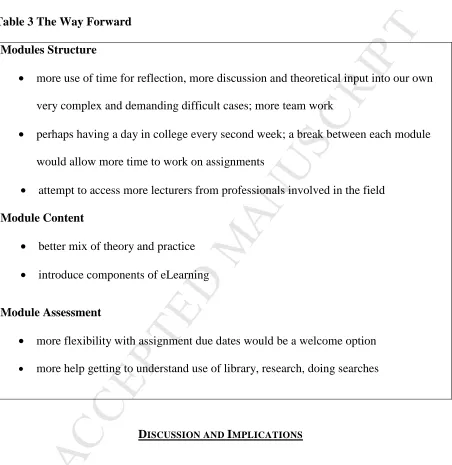
and to allow time to discuss assignments (Table 3). In addition the need for support was
identified .The need for a mentor for the programme was reported by RQ01:
“More use of time for reflection with via class discussions or a mentoring system.”
(RQ01)
In relation to current modules overall students indicated that current modules would benefit
from having more class discussion, having more lecturers with children palliative care
expertise and experience, delivery of modules over wider timeframe and develop towards
greater interprofessional perspective. It was also suggested in relation to the scheduling of the
three modules that this be reviewed to provide a break between each module so that students
could complete modular assignments before taking the next module as RQ04 comments.
“Each module could be in 5 consecutive weeks but should have a break until
assignments submitted then start another module.” (RQ04)
Students additionally suggested the need to develop further modules and a Master’s
programme in children’s palliative care that is not currently available in Ireland as exampled
M
AN
US
CR
IP
T
AC
CE
PT
ED
ACCEPTED MANUSCRIPT
16
“It would be great if these three modules can be added to further studies like Master’s
[image:19.595.77.529.168.633.2]in Palliative Care.” (RQ08)
Table 3 The Way Forward
Modules Structure
• more use of time for reflection, more discussion and theoretical input into our own
very complex and demanding difficult cases; more team work
• perhaps having a day in college every second week; a break between each module
would allow more time to work on assignments
• attempt to access more lecturers from professionals involved in the field
Module Content
• better mix of theory and practice
• introduce components of eLearning
Module Assessment
• more flexibility with assignment due dates would be a welcome option
• more help getting to understand use of library, research, doing searches
DISCUSSION AND IMPLICATIONS
The aim of this paper was to present students perspectives of undertaking a programme in
children’s palliative care, the data collected in the evaluation offers an important perspective
to others involved in interprofessional post-graduate palliative care education and creates
M
AN
US
CR
IP
T
AC
CE
PT
ED
ACCEPTED MANUSCRIPT
17
is important as it offers insights into the outcomes of the first interprofessional education
programme in children’s palliative care in Ireland.
The importance of interprofessional education, evident in the literature (Higgins et al, 1994;
Barr, 1995; Skinner, 2007; Miers 2010;Pollard, 2010) was encompassed by the students on
this programme and students valued it and recognised its value and while some students had
no previous experience in interprofessional as was evident in some student presentations and
case study presentation discussions however despite this and the demands of the programme
the students report positive experiences of their learning and the importance of meeting and
sharing experiences with others from other professions involved in the practice of children’s
palliative care (Sanderson et al., 2004). The relevance of a holistic approach and the need to
meet the learning needs of an interprofessional group was made clear to students at the outset
of the modules.
As is evident from the students evaluation to be effective greater time is required within the
timetable, this needs to be considered in programme planning when teaching in an
interprofessional context and were issues related to continuing education and the importance
of team work are part of the programme (Price et al., 2005; Walsh-Burke and Csikai., 2005;
Oandasan et al., 2006; Liben et al., 2008; Barr, 2013). The project developers were aware that
time needs to be made available for activities to enhance professional socialisation and
boundary work (Witz, 1992) and to address the suspicion and distrust that is reported to exist
(Baker et al., 2011) and to foster development of mutual respect and trust among
professionals (Oandasan and Reeves, 2005). This is includes role clarity ( Hallin et al., 2009)
and role differentiation (Walsh-Burke and Csikai, 2005) and the need to meet disparate needs
M
AN
US
CR
IP
T
AC
CE
PT
ED
ACCEPTED MANUSCRIPT
18
professional view is avoided in teaching activities. Overall the student s appreciated the level
of interprofessional involvement in the programme and advocated for greater
interprofessional involvement in the future. The difficulties in achieving this effectively and
meaningfully for students are not be to under-estimated (Sanderson et al, 2004) and the time
required to do so needs to be carefully considered, particularly if the students are from
disparate backgrounds, differ in their experiences and clinical backgrounds. However in this
project, the student population was already practising and working in children’s palliative
care services nationally and so programme delivery were constrained by the need for
organisational manpower planning; student travel and work life balance and lecturer
availability.
The need for greater class discussion time in palliative care education is identified and is also
supported by Mac Dougall et al., (2001) and by Becker (2007) who suggest, that because of
the unique nature of palliative care in some areas better learning takes place by sharing of
experiences. The benefits of shared learning as identified by students and the sharing of
knowledge and perspectives encourages more creative problem-solving as key to children’s
palliative care (MacDougall et al., 2001). In addition motivating learners and clinicians to
engage in activities that can lead to real changes in behaviour and practice is difficult (Hall et
al., 2013). The time needs for these types of learning activities should not be underestimated
in curriculum planning.
It is interesting to note that the nurses in the programme were very keen to learn about the
practical management of pain and symptoms and placed high importance of drug and
therapeutic regimes for physical symptom management which was of much less importance
to other students, for example the chaplains and social workers. This may have been due to
M
AN
US
CR
IP
T
AC
CE
PT
ED
ACCEPTED MANUSCRIPT
19
unprofessionally who were taken out of their comfort zones to work with others
interprofessionally. However also interestingly to note that neither the social workers nor
chaplains took part in module 2 which addressed pain and symptom management. That said,
and as was found in Mellor et al., study (2013), students in this study enjoyed learning from
other professionals and felt it assisted in broadening their perspectives on children’s palliative
care and increased their confidence in their professional contribution (VanderWielen et al.,
2013).
Students all viewed lecturers’ level of knowledge and clinical expertise in children’s
palliative care was of particular importance to their learning. They identified the need for
lecturer credibility in delivering interprofessional education in children’s palliative care
particularly when students are already practicing in children’s palliative care in various roles,
positions and across different sites. Dissatisfaction with some lecturers’ level of specialist
knowledge and clinical expertise serves to highlight the need for clinical credibility, expertise
in the field and specialist knowledge in teaching in programmes of this type. The importance
of credibility has also been reported in undergraduate palliative care programmes (Nicholl
and Price, 2012). A lack of expertise can cause students to report negatively on teaching, to
display disinterest or to dismiss the content as irrelevant to their practice which can impact on
learner motivation. A lack of specialists in the delivery of palliative care education was
highlighted by Price et al., (2005) and makes finding lecturers for this type of specialist
programme problematic. The difficulty can be overcome by inviting international lecturers to
input but this is costly and may not be sustainable. Important to programmes of this nature
are the skills of the lecturers needed to assess learners needs in terms of emotional and
communication needs which can pose challenges for the healthcare professionals, this as was
M
AN
US
CR
IP
T
AC
CE
PT
ED
ACCEPTED MANUSCRIPT
20
handling emotionally charged issues in helping students manage their own feelings related to
children’s palliative care needs which arise in the classroom and to develop students abilities
to manage sensitive and delicate with families (Sullivan et al., 2005).
Finally most students were self funded and undertaking the programme in their off-duty time
and despite this and the challenges of working, attending modules, studying and maintaining
a work life balance students indicated a high level of satisfaction with the modules. They did
indicate that there is a need to carefully consider the scheduling of the delivery of this type of
modular programmes as the need for students to undertake academic study while
simultaneously completing an academic programme can raise significant challenges when
work demands have to be balanced with academic demands (Timmins and Nicholl, 2005).
In making recommendations for the future the students viewed a Master’s pathway in
children’s palliative care as essential and the need for academic credit did arise. Findings
indicate an overall strong interest in the development of future modules and the development
of the project into an interprofessional Master’s programme in children’s palliative care. The
level of clinical experience and expertise of some lecturers and the lack of significant relevant
and current specialist expertise and experience in children’s palliative care nationally was
reflected in the quality of some lectures was reported. This study’s findings also identified
some further implications for all those involved in interprofessional education (Table 4).
Table 4 Factors to Consider in Children’s Palliative Care Module Delivery
• the absolute importance of lecturer specialised knowledge and clinical expertise in
M
AN
US
CR
IP
T
AC
CE
PT
ED
ACCEPTED MANUSCRIPT
21
• interprofessional education is valued by students but it needs to be planned
• postgraduate programmes need to build time into programmes to permit sharing of
experiences
• student interprofessional group class presentations can help cross professional
learning
• support is needed to assist students manage the impact of material taught and its
potential impact
• given the nature of palliative care content the modules should if possible be spread
out over a number of weeks rather than having one intense day 9-5 every week for 5
weeks. A more spread out approach would permit time for reflection and
consolidation of learning
• support is crucial and is valued by students, regarding assignments
CONCLUSION
The findings from this evaluation indicate that to teach practitioners who are already
experienced in the field it is imperative that that those involved in teaching have credible
relevant expertise in children’s palliative care. .The importance of valuing the students prior
experiences and, embedding them in classroom activities was identified as important. In
future programmes the relevance of the content to the participants practice role needs to be
considered carefully in timetabling. Time needs to be made available in a constrained
timetable to ensure class discussions are facilitated and the students are provided an
M
AN
US
CR
IP
T
AC
CE
PT
ED
ACCEPTED MANUSCRIPT
22
useful method to examine. However in interprofessional programmes such as this it is
considered important that students had face to face contact as reported in this evaluation. The
importance and function of such interpersonal interaction needs to be recognised when
planning newly developing interprofessional programmes.
Mature students personal circumstances and professional roles need to be accommodated in
timetabling where possible as reported. The practical realities and tensions of planning
programmes for these graduate students need to be considered.
Finally it is noted that the findings of this study are from a small cohort of students, but this is
the nature of children’s palliative care and this type of specialist interprofessional programme
and are only applicable to students’ experiences of the project. Nonetheless the findings are
relevant to others involved in planning modules in children’s palliative care providing the
strengths, challenges and opportunities identified by students themselves. It provides insight
into the issues that should be considered by those organising similar programmes.
REFERENCES
Baker, L., Egan-Lee, E., Martimianakis, M.A., Reeves S., 2011. Relationships of power:
implications for interprofessional education. International Journal of Innovation Management
6, 187-206.
Barr, H., 1995. Evaluating Interprofessional Education. Bulletin10. Centre for the
Advancement of Interprofessional Education, London.
Barr, H., 2013. Enigma variations: Unraveling interprofessional education in time and place.
27 (52), 9-13.
Becker, R., 2007. The development of core competencies for palliative care educators.
M
AN
US
CR
IP
T
AC
CE
PT
ED
ACCEPTED MANUSCRIPT
23
Care Quality Commission., 2009. Review of the involvement and action taken by health
bodies in relation to the case Baby P. The Care Quality Commission, London.
Craddock, D., O’Halloran C., McPherson, K., Hean, S., Hammick, M., 2013. A top- down
approach impedes the use of theory? Interprofessional educational leaders’ approaches to
curriculum development and the use of learning theory. Journal of Interprofessional Care 27,
65-72.
Department of Health & Children., 2001. Report of National Advisory Committee on
Palliative Care. Department of Health & Children. Dublin.
Department of Health & Children., 2009. Palliative Care for Children with Life-limiting
conditions in Ireland. A National Policy. Department of Health & Children. Dublin.
Department of Health & Children & Irish Hospice Foundation., 2005. Palliative Care Needs
Assessment for Children. Department of Health & Children & Irish Hospice Foundation.
Dublin.
Hall P., Weaver L.,Grassau, P. A., 2013. Theories, relationships and interprofessionalism:
Learning to weave. Journal of Interprofessional Care 27, 73-80.
Higgins, R., Oldman, C., Hunter, D., 1994. Working Together: lessons for collaboration
between health and social sciences. Health and Social Care 2, (5) 269-277.
Hutchings, M., Scammell, J., Quinney, A., 2013. Praxis and reflexivity for interprofessional
education: towards an inclusive theoretical framework for learning. Journal of
Interprofessional Care 27, (5) 358-366.
Kitto, S., Nordquist J., Peller, J., Grant, R., Reeves, S., 2013. The disconnections between
space, place and learning in interprofessional education: an overview of key issues. Journal of
Interprofessional Care. 27, (s2) 5-8.
Koffman, J., 2001. Multiprofessional Palliative Care Education: Past challenges, future
M
AN
US
CR
IP
T
AC
CE
PT
ED
ACCEPTED MANUSCRIPT
24
Liben, S., Papadatou, D., Wolfe, J., 2008. Paediatric palliative care: Challenges and emerging
ideas. Lancet 371, (9615) 852–64.
Mac Dougall, M.A., Broadhurst, V., Chamberlain, S., 2001. An evaluation of an
interprofessional palliative care education programme. International Journal of Palliative
Nursing 7, (1) 24-28.
Mellor, R., Cottrell, N., Moran, M., 2013. “Just working in a team was a great experience…”
– Student perspective on the learning experiences of an interprofessional education program.
Journal of Interprofessional Care 27, 292-297.
Miers, M., 2010. Professional Boundaries and Interprofessional Working in: Pollard, K.C.,
Thomas J., Miers, M.(Eds) Understanding Interprofessional Working in Health and Social
Care. Palgrave Mamillan, Hampshire, pp.105-120.
Nicholl, H., Price J., 2012. The experiences of providing children’s palliative care education
in undergraduate programmes-A Discussion of some practical issues. Nurse Education In
Practice.12, 143-147.
Oandasan, I., Baker, GR., Barker, K., Bosco, C., D’Amour, D., Jones, L., Kimpton, L.,
Leminex-Charles, L., Nasmith, L., San Martin Rodriguez, L., Tepper, J., Way, D., 2006.
Teamwork in Healthcare: Promoting Effective Teamwork in Healthcare in Canada. Canadian
Health Services Research Foundation. Ottawa.
Oandasan, I., Reeves, S., 2005. Key elements for interprofessional education. Part 1: The
learner, the educator and the learning context. Journal of Interprofessional Care. Supplement
1, 21-38.
M
AN
US
CR
IP
T
AC
CE
PT
ED
ACCEPTED MANUSCRIPT
25
Polard, K.C., 2010. Introduction: Background and Overview of the Book, in: Pollard, K.C.,
Thomas J., Miers, M.(Eds) Understanding Interprofessional Working in Health and Social
Care. Palgrave Mamillan, Hampshire, pp1-7.
Price, J., McNeilly, P., McFarlane M., 2005. Paediatric Palliative Care in the UK – Past,
present and future. International Journal of Palliative Nursing 11, (3) 124-126.
Price, J., McNeilly, P., 2006. Developing an educational programme in paediatric palliative
care. International Journal of Palliative Nursing 12, (11) 536-541.
Reeves, S., Lewin, S., Espin, S., Zwarenstein, M., 2010. Interprofessional teamwork for
health and social care. Wiley- Blackwell, London.
Sanderson, L., Long, T., Hale. C., 2004. Evaluation of educational programmes for paediatric
cancer nursing in England. European Journal of Oncology Nursing 8, 138-147.
Skinner, H., 2007. Shared learning in the National Health Service. Postgraduate Medical
Journal 83, (980) 359-361.
Stokes, P., Urquhart, C., 2013.Qualitative interpretative categorisation for efficient data
analysis in a mixed methods information behaviour study. Information research 8, (1) 1-17.
access http://informationr.net/ir/18-1/paper555.html.
Sullivan, A.M., Lakoma, M.D., Billings, A., Peters, A.S., Block, S.D., 2005. Teaching and
Learning End-of-Life Care: Evaluation of a Faculty Development Program in Palliative Care.
Academic Medicine 80, (7) 657-668.
Timmins, F., Nicholl, H., 2005. Stressors associated with qualified nurses undertaking
part-time degree programmes-some implications for nurse managers to consider. Journal of
Nursing Management 13, 477-482.
Tracey, C.A., Nicholl, H., 2006. Mentoring and Networking. Nursing Management 12, (10)
M
AN
US
CR
IP
T
AC
CE
PT
ED
ACCEPTED MANUSCRIPT
26
VanderWielen, L.M., Enurah A.S., Osburn, I.F., LaCoe, K.N., Vanderbilt, A.A., 2013. The
development of student-led interprofessional education and collaboration. Journal of
Interprofessional Care 27, (5) 422-423.
Webster, W.G., 2013. Cultivating grassroots IPE: the Dalhouse University experience.
Journal of Interprofessional Care 27, 96-97.
Walsh-Burke, K., Csikai, E.L., 2005. Professional Social Work Education in End-of-Life
Care, Journal of Social Work in End-of-Life & Palliative Care 1, (2) 11-26.
Webster, W.G., 2013. Cultivating grassroots IPE: the Dalhouse University experience.
Journal of Interprofessional Care 27, 96-97.
Witz, A., 1992. Professions and patriarchy. Routledge, London.
World Health Organization., 1998. Cancer Pain Relief and Palliative Care in Children. WHO.
Geneva.
World Health Organisation., 2010. A Framework for action on interprofessional education &