City, University of London Institutional Repository
Citation
:
Lavelle, M. ORCID: 0000-0002-3951-0011, Attoe, C., Tritschler, C. and Cross, S. (2017). Managing medical emergencies in mental health settings using an interprofessional in-situ simulation training programme: A mixed methods evaluation study. Nurse Education Today, 59, doi: 10.1016/j.nedt.2017.09.009This is the accepted version of the paper.
This version of the publication may differ from the final published
version.
Permanent repository link:
http://openaccess.city.ac.uk/22426/Link to published version
:
http://dx.doi.org/10.1016/j.nedt.2017.09.009Copyright and reuse:
City Research Online aims to make research
outputs of City, University of London available to a wider audience.
Copyright and Moral Rights remain with the author(s) and/or copyright
holders. URLs from City Research Online may be freely distributed and
linked to.
King’s Research Portal
DOI:
10.1016/j.nedt.2017.09.009
Document Version Peer reviewed version
Link to publication record in King's Research Portal
Citation for published version (APA):
Lavelle, M., Attoe, C., Tritschler, C., & Cross, S. (2017). Managing medical emergencies in mental health settings using an interprofessional in-situ simulation training programme: a mixed methods evaluation study. Nurse Education Today, 59, 103-109. https://doi.org/10.1016/j.nedt.2017.09.009
Citing this paper
Please note that where the full-text provided on King's Research Portal is the Author Accepted Manuscript or Post-Print version this may differ from the final Published version. If citing, it is advised that you check and use the publisher's definitive version for pagination, volume/issue, and date of publication details. And where the final published version is provided on the Research Portal, if citing you are again advised to check the publisher's website for any subsequent corrections.
General rights
Copyright and moral rights for the publications made accessible in the Research Portal are retained by the authors and/or other copyright owners and it is a condition of accessing publications that users recognize and abide by the legal requirements associated with these rights. •Users may download and print one copy of any publication from the Research Portal for the purpose of private study or research.
•You may not further distribute the material or use it for any profit-making activity or commercial gain •You may freely distribute the URL identifying the publication in the Research Portal
Take down policy
If you believe that this document breaches copyright please contact [email protected] providing details, and we will remove access to the work immediately and investigate your claim.
study
Mary Lavelle, Chris Attoe, Christina Tritschler, Sean Cross
PII: S0260-6917(17)30220-4 DOI: doi:10.1016/j.nedt.2017.09.009 Reference: YNEDT 3620
To appear in: Nurse Education Today
Received date: 21 February 2017 Revised date: 18 August 2017 Accepted date: 11 September 2017
Please cite this article as: Lavelle, Mary, Attoe, Chris, Tritschler, Christina, Cross, Sean, Managing medical emergencies in mental health settings using an interprofessional in-situ simulation training programme: a mixed methods evaluation study, Nurse Education Today(2017), doi:10.1016/j.nedt.2017.09.009
ACCEPTED MANUSCRIPT
1
MANAGING MEDICAL EMERGENCIES IN MENTAL HEALTH SETTINGS USING AN
INTERPROFESSIONAL IN-SITU SIMULATION TRAINING PROGRAMME: A MIXED METHODS
EVALUATION STUDY
Mary Lavellea, Chris Attoeb, Christina Tritschlerb, Sean Crossb
aFlorence Nightingale Faculty of Nursing & Midwifery, King’s College London, WC2R 2LS, UK
bMaudsley Simulation, South London & Maudsley NHS Foundation Trust, Lambeth Hospital, SW9
9NT, UK
(+44)02032286149
Acknowledgements:
The authors would like to thank:
The Maudsley Simulation team for their continued support
Health Education England for supporting the development and delivery of simulation
training in South London
All inpatient services and staff of South London & Maudsley NHS Foundation Trust that were
ACCEPTED MANUSCRIPT
2
Funding statement: This research did not receive any specific grant from funding agencies in the
public, commercial, or non-for-profit sectors.
Conflicts of interest: none.
ACCEPTED MANUSCRIPT
3 ABSTRACT
Background– In the UK, people with severe mental illness die up to 20 years earlier than the
general population, prompting increased focus on physical health in mental illness.
However, training for mental health inpatient staff to meet patients’ physical health needs
has not received the same attention, with physical health training often being reactive and
lacking evidence of effectiveness.
Objectives – To evaluate an interprofessional, in situ, simulation training intervention for
managing medical deterioration in mental health settings. Investigating the impact of
training on: 1. Participants’ knowledge, confidence, and attitudes towards managing
medical deterioration; and 2. Incident reporting, as an objective index of incident
management. Participants’ perceptions of the impact on their practice were qualitatively
explored.
Design– This evaluation employed a mixed-methods pre-post intervention design.
Participants & Settings – Fifty-three healthcare professionals participated including: mental
health nurses, psychiatrists, healthcare assistants, and activity co-ordinators from two busy
psychiatric triage wards in South London, UK.
Methods– The intervention comprised eight half-day sessions delivered weekly across two
wards. Structured surveys assessed participants’ knowledge, confidence, and attitudes
towards medical deterioration pre and post training. Participants’ experience of training was
ACCEPTED MANUSCRIPT
4
training. Incident reporting rates for seven-month periods pre and post training were
compared.
Results – Following training, participants showed significant improvement in knowledge
(p<.001), confidence (p<.001), and attitudes towards (p<.02) managing medical
deterioration. Incident reporting increased by 33% following training. Participants’ reported
improved confidence in managing medical deterioration, better understanding of effective
communication, improved self-reflection and team working, and an increased sense of
responsibility for patients’ physical health.
Conclusions– Interprofessional, in situ simulation training for medical deterioration yielded
promising outcomes for individuals and teams. Simulation is an under-used training
modality in mental health, offering a holistic training approach with the potential to provide
educational and clinical benefits while supporting workforce resilience.
Keywords
Mental health, medical emergency, nursing training, healthcare education, interprofessional
ACCEPTED MANUSCRIPT
5
INTRODUCTION
People with severe psychiatric diagnoses are prone to physical co-morbidities, including
cardiovascular disease, respiratory disease and diabetes (Robson & Gray, 2007), which
contribute significantly to their increased mortality, with patients in the UK dying up to 20
years younger than their peers (Doherty & Gaughran, 2014). This momentous health
inequality has prompted adaptations to UK healthcare strategy and service provision,
particularly in community settings (Mental Health Taskforce, 2016). However, people with
severe psychiatric diagnoses may still require inpatient mental health services, which are
frequently located off general hospital sites (Mental Health Foundation, 2013). Thus, it is
imperative that mental health inpatient staff have the skills to effectively manage both
acute medical emergencies and patients’ long term physical health needs (Mental Health
Foundation, 2013; Mental Health Taskforce, 2016).
Deaths from natural causes in mental health settings are over twice as high as that of prison
populations (Coles, Edmundson, & Carmouche, 2015). Inquests of such circumstances cite
some common features including: inadequate emergency response training; a lack of,
and/or poor use of, lifesaving equipment; and poor team cohesion and communication
(Coles, Edmundson, & Carmouche, 2015).
Mental health nurses working in inpatient settings echo these findings, reporting that they
feel unprepared and unskilled in managing physical illness (Nash, 2005, 2009; Walsh, 2015).
Despite welcoming further training (Robson, Haddad, Gray, & Gournay, 2013), staff report
feeling unsupported at a managerial level to do this (Blythe & White, 2012). The need for
training is not limited to nursing staff; improved, mandatory acute medicine training for
ACCEPTED MANUSCRIPT
6
communication barrier between acute and mental health teams (Latoo, Mistry, & Dunne,
2013).
As inquest findings highlight, the management of a medical emergency requires not only the
clinical knowledge and lifesaving skills, but the human factor qualities that underpin this
work such as effective communication with colleagues to work as a coordinated,
interprofessional team (Coles et al., 2015). This is the case across diverse healthcare fields as
incident reporting suggests that poor communication and teamwork are central to medical
errors (Leonard, Graham, & Bonacum, 2004), particularly when adding the complexity of
inter-disciplinary working (Alvarez & Coiera, 2006), which is critical to addressing the
interaction between patients’ mental and physical health (Mental Health Foundation, 2013;
Mental Health Taskforce, 2016).
Simulation Training
Educational research has demonstrated the value of simulation training for improving
technical clinical skills such as use of equipment and procedure, alongside improving the
human factors based aspects of healthcare such as communication and teamwork (Billon et
al., 2016; Cook et al., 2011; Miller, Crandall, Washington, & McLaughlin, 2012; Thomson,
Cross, Key, Jaye, & Iversen, 2013). Delivering simulation training in situ has the additional
benefits of training whole multi-disciplinary teams together (Weaver, Dy, & Rosen, 2014),
while identifying, and addressing, latent threats to patient safety in the environment, such
as inadequate equipment or procedures, gaps in knowledge or skills, or poor
communication (Jordan, Akroyd, & Rowlands, 2014). Although the value of simulation
ACCEPTED MANUSCRIPT
7
(Zendejas, Brydges, Wang, & Cook, 2013), it remains underused in mental health training
(Attoe, Kowalski, Fernando, & Cross, 2016; Jordan et al., 2014).
In response to a series of physical health incidents locally and nationally, clinical educators
in South London have developed an intensive, in situ simulation-based training course
designed to support inpatient mental health teams to manage medical deterioration. As a
simulation training, this intervention will aim to improve participants’ clinical skills alongside
their human factors skills such as teamwork and communication. Furthermore, the delivery
of the training in-situ facilitates identification of latent environmental threats.
The training employs simulated emergency medical scenarios, with high fidelity
mannequins, and structured reflective debriefing in order to improve clinical skills and
human factors. Training interventions of this kind are usually developed in response to a
real incident. As such, priority is given to training delivery rather than evaluation. This has
led to a lack of evidence regarding the impact of educational interventions targeting
physical health care for people with mental illness (Hardy, White, Deane, & Gray, 2011). This
study will contribute to this evidence, providing an evaluation of this training intervention
delivered to all staff on two psychiatric triage wards in South London.
The aim of this study is to explore the impact of the training on: (1) staff knowledge,
confidence, and attitudes towards managing a medically deteriorating patient; and (2)
incident reporting in the triage units, as an objective index of appropriate incident
management. Participants’ perceptions of the training, their own learning and its impact on
ACCEPTED MANUSCRIPT
8 METHODS
Study design
This study was a mixed-methods evaluation of an intensive, in situ simulation training
course for interprofessional management of medical deterioration in mental health settings.
Participants
Training was delivered to all staff working on two 16-bed psychiatric triage units in South
London. Training was attended by 53 participants across the two triage units including;
mental health nurses (n=36), psychiatrists (n=6), healthcare assistants (n=9), and activity
coordinators (n=2). Each session was attended by an average of seven participants
(range=4-10). All participants had completed Basic or Immediate Life Support training.
Course content
Prior to commencing training, a full risk assessment of the training area was carried out to
ensure the safety of patients, staff, and participants. All ward staff were aware that training
was taking place and the nurse in charge was informed at the start and end of each session.
Ward equipment was used but could be accessed at any time as needed, with additional
equipment supplied by the training team.
Training was delivered across eight weekly half-day sessions, two on one triage ward and six
on another. The training session began with an introduction to the principles of simulation,
before participants were oriented to the high fidelity mannequin and its features (i.e.
speech, pulse). Three high fidelity simulated scenarios then followed on topics identified
collaboratively as priority training needs including: respiratory arrest, diabetic
ACCEPTED MANUSCRIPT
9
while those not participating watched the scenario via live video-stream in an adjacent
room. Each scenario was followed by a structured and reflective debrief involving all
participants, using the Diamond model to address human factors, and incorporating brief
didactic teaching on relevant topics (Jaye, Thomas, & Reedy, 2015).
The course aimed to increase confidence in working as part of a multi-disciplinary team;
develop knowledge and skills in managing medical emergencies, including incident
reporting; increase awareness of human factors such as communication, teamwork, and
situational awareness; and improve interprofessional collaborative working.
Data collection procedure
Prior to each training session, participants provided informed consent to take part in the
study and were informed of their right to withdraw and the researchers’ contact details.
Participants anonymously completed a course questionnaire battery before and after
training. Ethical approval was awarded by the Psychiatry, Nursing, and Midwifery Research
Ethics Subcommittee on behalf of the UK Health Department’s National Research Ethics
Committee.
Three months after completion of the training participants (n=8) were invited to a 1-hour
focus group to provide feedback on their experience of training, the impact on individual
learning, team development, and clinical practice. The focus group discussion was
audio-recorded, with participants' informed consent.
The triage wards involved utilise an online incident reporting system (Datix) to record
ACCEPTED MANUSCRIPT
10
incident reporting, the online system was retrospectively used to identify reporting
frequency 7 months prior to and 7 months following the training on each ward.
Quantitative Questionnaire Measures
The training intervention was designed to improve specific clinical and human factors skills
related to management of physical health needs in mental health settings. The learning
objectives were to improve participants’ knowledge of, confidence in and attitudes towards,
managing medical deterioration on a mental health ward. Due to a lack of validated tools to
evaluate human factors skills or clinical competency the team developed quantitative
questionnaires tailored to meet the specific learning objectives of the intervention. The
questionnaires were designed using current best practice methods in educational evaluation
(Simpson, Kitchen, Lavelle, Anderson, & Reedy, 2017) and are detailed below.
Knowledge - Participants' knowledge of managing medical deterioration on a mental health
ward was assessed using clinical vignettes, a method which has been used successfully in
previous evaluations of educational interventions (Peabody, Luck, Glassman, Dresselhaus, &
Lee, 2000; Peabody et al., 2004; Sowden et al., 2017).
Participants were presented with five vignettes, each detailing a different medical
deterioration scenario. Participants were asked to read each vignette and describe what
steps they would take to address: 1. symptom recognition and clinical assessment; 2.
escalation, 3. planning and treatment; 4. inter-professional communication and handover; 5.
incident reporting, 6. staff debriefing, trust policy and procedures. Each category has
ACCEPTED MANUSCRIPT
11
participants can have a maximum of five points per category, with a maximum total score of
30 points.
Confidence- Participants' confidence in their own ability to manage medically deteriorating
patients in mental health settings was assessed using a 6-item self-report questionnaire,
rating statements from 1 (not confident) to 5 (completely confident). This assessed
participants' confidence in: knowing policies and procedures; working effectively as a team;
understanding the roles and responsibilities of individuals required; communicating
effectively; collaborating with people from other professional backgrounds; and managing
the situation overall. Self-report confidence measures using Likert scales have been widely
used in simulation training evaluation (Billon et al., 2016; Fernando et al., 2017; Thomson et
al., 2013).
Attitudes - Participants' attitudes towards managing medical deterioration in a mental
health setting were assessed using a 4-item self-report questionnaire, rating statements
from 1 (strongly disagree) to 5 (strongly agree). This assessed participants' beliefs about:
their role in the process; the importance of inter-professional working; the importance of
communication; the importance of this as a skill required by mental health staff. Items 1 and
3 were reverse scored prior to analysis. This assessment method has been previously used in
the evaluation of attitudes towards interprofessional working and job role in healthcare
(McFadyen, Webster, & Maclaren, 2006; Reid, Bruce, Allstaff, & McLernon, 2006).
ACCEPTED MANUSCRIPT
12
Frequency data was taken from the local incident reporting system for 7 months prior to
and 7 months following the training across three categories pertaining to course content:
medication issues; illness and injury; self-harm and suicide.
Qualitative Structured Survey
Following each session, participants completed a structured survey with open-ended
questions to provide individual feedback on their experience of the training. The survey
assessed participants' perceptions of: the potential benefit of the training to them as
healthcare professionals; the benefits to the clinical team; the impact on patient care; and
expected changes in their own practice following training.
Focus group
The 1-hour focus group three months after the final training session was comprised of three
sections exploring: participants' experience of the training, to ground their memories; the
impact of the training on participants' learning and professional development; and any
subsequent changes in their or the team’s practice, and their views on how this may
influence patient care (Graneheim & Lundman, 2004; Pope & Mays, 2007).
Data analysis
Paired samples t-tests using SPSS 21, explored change in participants' knowledge,
confidence, and attitudes scores pre and post training. The focus group discussion was
transcribed, along with responses from the qualitative survey, and emergent themes were
identified through thematic analysis. Due to sample sizes, incident reporting was described
ACCEPTED MANUSCRIPT
13 RESULTS
Quantitative Questionnaire Battery
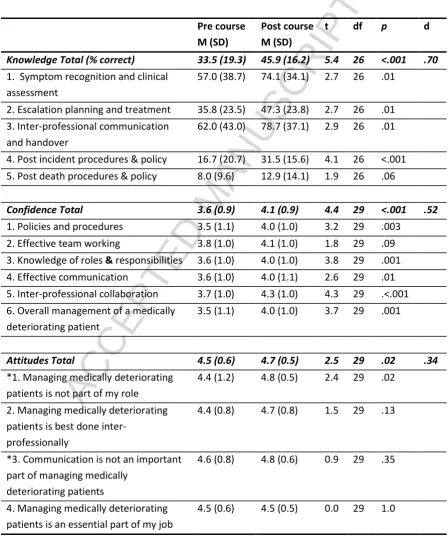
Participants’ mean pre and post training scores on the quantitative assessments are
displayed in table 1. Paired samples t-tests comparing participants’ pre and post training
scores revealed that participants’ knowledge about how to manage a medical deterioration
on the ward improved significantly post training (p<.001), with a large effect size (d=.70).
Similarly, participants’ confidence in managing medical deterioration also improved
significantly (p<.001), with a medium effect size (d=.52). Finally, participants’ attitudes
towards management of medical deterioration also improved significantly post training
(p=.02), with a small to medium effect size (d=.34).
[Insert table 1 here]
Knowledge
Participants showed improvement across all 5 knowledge items (table 1). Items addressing
participants’ ability to recognise and clinically assess medical deterioration in patients and
communicating this information to colleagues from other professional background during
handover showed high post training scores (recognition and assessment 74% &
interprofessional handover 78%). Items addressing procedures and policy showed very poor
pre training scores and, despite improvement, post training scores remained relatively low
(incident procedures 31.5% & death procedures 12.9%).
ACCEPTED MANUSCRIPT
14
Participants reported feeling more confident across all 6 items. The greatest shift in
confidence levels was seen in participants’ interprofessional collaboration. This was closely
followed by their improved overall confidence in managing medical deterioration on the
ward and their confidence in understanding policies and procedures. Participants’
confidence in their ability to display effective team working showed the least improvement.
However, as pre training confidence scores for team working were relatively high, this may
represent a ceiling effect.
Attitudes
Although participants’ attitudes scores showed significant improvement overall, item level
analysis revealed that varying levels of improvement across the 4 attitude questionnaire
items (table 1). Participants showed no improvement on item 4 (medical deterioration
management as an essential part of the job) and little improvement on item 3 (the
importance of communication in managing a medically deteriorating patients). However, in
both cases pre training scores for these items were relatively high (4.5+), which may explain
the findings. Some improvement was seen in items 1 (seeing medical deterioration
management as part of their role) and 2 (medical deterioration management is better done
interprofessionally).
Incident reporting
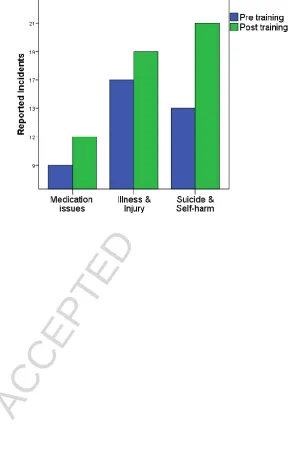
The frequency of incidents reported by staff during the 7 months prior to training
commencing (pre-training) and, by comparison, during the 7 months after training
completion (post training) are displayed in figure 1. Incidents have been divided into three
ACCEPTED MANUSCRIPT
15
training, staff incident reporting on trained wards increased by 33%; 39 reported incidents
pre training and 52 post training. The increase was visible across all three categories, but
most pronounced with suicide and self-harm (figure 1).
As a direct result of training equipment has been checked, updated and re-labelled where
appropriate and ward procedures for medical deterioration have been updated.
[Insert Figure 1 here]
Qualitative findings
Qualitative data explored participants’ experience of the training, direct learning and
development, and how they felt it would influence their practice and that of their clinical
team. Thematic analysis of this data revealed five prominent themes: confidence; team
working skills; communication skills; reflective practice; and personal responsibility.
1. Confidence – Participants frequently reported increased confidence regarding the
management of medical deterioration on their ward. Specifically, participants
reported improved confidence in their ability to execute specific procedures during a
high-risk situation (e.g. ‘I now know how to access and use the medical equipment’;
‘the training has made me more aware of how to respond to a medical emergency’).
Participants reported being more able to cope with such pressured situations, with
participants experiencing more confidence in their own ability to successfully lead
their colleagues during a stressful situation, and to effectively follow the lead of
others when appropriate (e.g. The training has… ’boosted my confidence in
ACCEPTED MANUSCRIPT
16
confident working as a team and following instruction’). Overall, participants
reported an increased confidence in both their own abilities, and that of their
colleagues following the training, that went beyond just the management of medical
deterioration but to routine work on the ward.
2. Team working skills – Participants reported an improved understanding of good
teamwork, describing the awareness of others’ perspectives (e.g. the training made
me… ‘more aware of others’ opinions and observations’) and the importance of
clarifying roles within a team (e.g. following the training I will… ‘make sure people
are clear on their roles’). They also described shifting the focus away from
performance of the individual on a specific task and towards the overall team goal
(e.g. since completing the training… ‘focus on identifying strengths and weaknesses
of the team rather than the individual’). Since completing the training, participants
specifically reported a greater awareness of their colleagues’ professional roles,
experience, and capabilities. Participants attributed this to the improved team
working on their wards following training. (e.g. Since completing the training I have
become… ‘more mindful of the complexity of team working in healthcare’, ‘better
understanding of working with staff from different backgrounds’). The improved
team working described by participants was not limited to management of medical
deterioration but evident more broadly in day-to-day ward activities (e.g. ‘working
as a team rather than on a course gave us a chance to work well together. This will
ACCEPTED MANUSCRIPT
17
3. Communication skills – Participants reported that the training had provided them
with a greater understanding of good communication (e.g. Following the training…‘I
know the importance of good communication’). They described feeling more capable
of communicating effectively with colleagues particularly in challenging,
high-pressure situations that may arise on the wards. Participants made specific reference
to communication techniques introduced on the training, (e.g. following training I
will…‘use more closed loop communication’) providing evidence of their improved
understanding of such concepts. Participants recognized that their improved
understanding of colleagues’ roles, experience and capabilities was highly relevant
for their improved communication and team working (‘I am more aware of my own
communication with others and the important role this plays in teams’; ‘I understand
that communication can be a barrier to good teamwork’).
4. Reflective practice – Following training, participants reported a greater appreciation
for reflective practice, both individually and collectively. Individually, participants
highlighted the value of being able to reflect ‘in action’ during clinical care as well as
‘on action’ following events, showing situational and personal awareness (It was
useful…’being more aware of how intimidating it [not know what to do] can be’).
Participants acknowledged the link between reflection and the subsequent personal
and team development. During the focus group, participants highlighted the value of
team reflection through debriefing in both supporting colleagues to cope with
challenging situations, and improving team performance, clinical care, and patient
safety (‘In the debrief…you can go round about how people feel superficially, but then
ACCEPTED MANUSCRIPT
18
Participants acknowledged the relevance of reflective practice beyond the context of
medical deterioration in improving individual practice, supervision, and team
meetings. (‘I will do more self-analysis’)
5. Personal responsibility – Participants illustrated a shift in attitude, with increased
feelings of personal responsibility for the physical health of patients. This translated
to a desire to be well skilled in managing medical emergencies, as well as to check
equipment, procedures, and policies oneself, rather than relying on others to
complete these duties or making assumptions about these processes (e.g. the
training has… ‘prompted me to keep up to with guidelines and procedures’; ‘seek out
other training courses to update my skills’). This change in attitudes and
understanding was evidenced with improved labelling of green bags, updating
equipment, procedures for checking these, and changes to ward policy following
training. Furthermore, participants reported a greater sense of team responsibility
for the physical health of patients on the wards (e.g. Following training I now...
‘check medical equipment at start of shift and encourage other colleagues to do the
same’).
DISCUSSION
This study evaluated the impact of an interprofessional simulation training course for
medical deterioration in mental health settings, which was delivered in situ to all staff in two
psychiatric triage wards in South London. Following training, the staff showed significant
ACCEPTED MANUSCRIPT
19
deterioration. Reflecting on their experience of training, staff reported improvements in
their clinical working including: feeling more confident to manage medical deterioration in
their own practice; having a better understanding of effective communication and team
working skills; an improved capacity to reflect on their own practice; and an attitude shift
towards taking more personal responsibility for the physical health of patients. At the ward
level, the management of incidents on trained wards showed objective signs of
improvement following training, as evidenced by an increase in the number of incidents
reported by staff. Furthermore, the training resulted in practical changes within the ward
including updating equipment and procedures.
Taken together, these findings demonstrate the far-reaching value of the training
intervention. The assessment of participants’ knowledge and confidence in managing
medical deterioration prior to the intervention (pre-course) confirmed the need for training,
reiterating the findings of others (Nash, 2005, 2009; Walsh, 2015). Following training,
participants demonstrated significant improvement in terms of their ability to recognise,
assess, and treat medical deterioration, including improved communication and
interprofessional teamwork skills. These are precisely the aspects highlighted as problematic
in the management of physical health problems in mental health settings (Coles et al., 2015;
Latoo et al., 2013).
Although simulation training is often under-used in mental health settings (Attoe et al.,
2016) these findings confirm it’s suitability within this context. In contrast to traditional
didactic educational approaches, simulation training provides a holistic learning experience;
ACCEPTED MANUSCRIPT
20
realistic environment, practicing both the technical skills (e.g. resuscitation, equipment
management) and the human factors skills that underpin the technical aspects (e.g.
communication, teamwork) simultaneously.
Participants’ knowledge of policy and procedures prior to training was particularly poor, and
despite some improvement following training, it remained an area of concern. That being
said, participants did report experiencing a greater sense of responsibility for the physical
health needs of patients following training. Therefore it is likely that even if participants
were not familiar with policy and procedure knowledge directly after training, when the
post course assessment was completed, their sense of responsibility may mean they actively
seek out this information themselves. Perhaps dissemination of this content would have
benefited from a didactic component in the training. However, as the ward procedures were
actively amended as a result of the training intervention itself, it is potentially more
beneficial to foster personal responsibility within staff to continually update and challenge
their own knowledge. Moreover, one aspect of ward procedure, with regards to medical
deterioration management, stated that staff should formally record patient incidents in an
online incident reporting system (Datix). Indeed, formal reporting of patient incidents
showed a significant increase following training, suggesting that the training did improve
some the application of procedural knowledge in staff.
Although the focus of this training was medical deterioration, the participants were able to
apply their learning more broadly to other aspects of clinical work. This is evidenced by
participants’ reflections of training, describing greater confidence in their own abilities and
ACCEPTED MANUSCRIPT
21
effectively and an insight into the roles, responsibilities, and skills of colleagues from other
professions. This demonstrates the impact and value of the training beyond the
management of medical deterioration on wards.
The improvements in interprofessional teamwork reported by participants may be further
bolstered by the fact that training was delivered to the whole ward team. Participants’
trained directly with their colleagues, providing a deeper understanding of their roles,
responsibilities and perspectives, including those from other professions. Additionally, the
learning points that are identified and discussed in the post-scenario debriefs can be
explored further, addressing the particular nuances of the team and the specific issues
arising in their unique situation.
Despite the many practical limitations to delivering in situ simulation training on busy
psychiatric wards, this approach had the advantage of enabling problems in the
environment to surface during the training. This had a direct benefit to the ward
environment, with faulty or mislabelled equipment being identified and rectified and wards
environments and procedures being adapted. Training delivered in another venue would
mean these latent environmental threats would go undetected, impeding the management
of medical deterioration on wards, even after staff training. Additionally, in situ training,
particularly training with your own team, removes some of the cognitive steps required to
take learning from a training environment and implement it in practice.
The findings of this study should be considered in the context of its limitations. Firstly, due
ACCEPTED MANUSCRIPT
22
comparisons between professional groups, nor comparison to an external control group.
However, the recruitment of all staff from two multidisciplinary teams in busy triage wards
is an achievement, and within group comparisons were designed in line with prevailing
methodological approaches from existing literature. Secondly, although initial plans had
included an observational assessment of staff management of a medical deterioration post
training this was not feasible due to recording restrictions and the ethical and practical
limitations of conducting this work in a busy triage ward. As an alternative, we employed a
triangulated evaluation approach collecting data including: pre and post training
quantitative assessments; post course qualitative surveys and focus group; and incident
reporting rates, as an objective measures of procedural management. Future evaluations
should give consideration to employing observational assessment tools alongside more
longitudinal makers of impact. However, as with all interventions delivered to a team within
a large complex system (e.g. UK NHS) confounding variables cannot be fully controlled for,
although we can make cautious estimations about impact.
Despite these limitations, this is one of the few evaluations of an educational intervention
targeting physical health for people with mental illness (Hardy et al., 2011) and
demonstrates the value of simulation training to meet patients’ physical health needs.
Furthermore, this training intervention has relevance beyond traditional mental health
facilities to other settings where physical health concerns are prevalent such as homeless
ACCEPTED MANUSCRIPT
23 CONCLUSIONS
We have designed a novel in situ, simulation training course designed to train
interprofessional inpatient mental health teams to manage medical deterioration. The
findings of this evaluation demonstrate that this training is effective in improving the
knowledge, confidence, and attitudes towards management of medical deterioration in
inpatient mental health staff. Beyond this, it refines the human factors skills that underpin
all aspects of clinical working, including effective communication and interprofessional team
working, and fosters a sense of personal responsibility within staff. Objective markers of
incident reporting, suggest that these self-reported improvements are evidenced in
practice. Overall, these findings demonstrate the value of simulation training in mental
health settings as it provides a more holistic approach to training, which can ultimately help
to develop a more resilient and reflective workforce.
REFERENCES
Alvarez, G., & Coiera, E. (2006). Interdisciplinary communication: an uncharted source of medical error? Journal of critical care, 21(3), 236-242.
Attoe, C., Kowalski, C., Fernando, A., & Cross, S. (2016). Integrating mental health simulation into routine health-care education. Lancet Psychiatry, 3(8), 702-703. doi:10.1016/S2215-0366(16)30100-6
Billon, G., Attoe, C., Marshall-Tate, K., Riches, S., Wheildon, J., & Cross, S. (2016). Simulation training to support healthcare professionals to meet the health needs of people with intellectual disabilities. Advances in Mental Health and Intellectual Disabilities, 10(5), 284-292.
Blythe, J., & White, J. (2012). Role of the mental health nurse towards physical health care in serious mental illness: An integrative review of 10 years of UK literature. International Journal of Mental Health Nursing, 21(3), 193-201.
Coles, Edmundson, A., & Carmouche, A. (2015). Deaths in Mental Health Detention: An investigation framework fit for purpose? Retrieved from London:
http://inquest.org.uk/pdf/INQUEST_deaths_in_mental_health_detention_Feb_2015.pdf Cook, D. A., Hatala, R., Brydges, R., Zendejas, B., Szostek, J. H., Wang, A. T., . . . Hamstra, S. J. (2011).
ACCEPTED MANUSCRIPT
24
Doherty, A. M., & Gaughran, F. (2014). The interface of physical and mental health. Soc Psychiatry Psychiatr Epidemiol, 49(5), 673-682. doi:10.1007/s00127-014-0847-7
Fernando, A., Attoe, C., Jaye, P., Cross, S., Pathan, J., & Wessely, S. (2017). Improving
interprofessional approaches to physical and psychiatric comorbidities through simulation. Clinical Simulation in Nursing, 13, 186-193.
Graneheim, U. H., & Lundman, B. (2004). Qualitative content analysis in nursing research: concepts, procedures and measures to achieve trustworthiness. Nurse Education Today, 24(2), 105-112.
Hardy, S., White, J., Deane, K., & Gray, R. (2011). Educating healthcare professionals to act on the physical health needs of people with serious mental illness: a systematic search for evidence. Journal of Psychiatric and Mental Health Nursing, 18(8), 721-727.
Jaye, P., Thomas, L., & Reedy, G. (2015). ‘The Diamond’: a structure for simulation debrief. The clinical teacher, 12(3), 171-175.
Jordan, G., Akroyd, M., & Rowlands, P. (2014). An interpofessional simulation course to address the physical health agenda in mental health. Mental Health Practice, 18(9), 25-30.
Latoo, J., Mistry, M., & Dunne, F. (2013). Physical morbidity and mortality in people with mental illness. British Journal of Medical Practitioners, 6(3), 621-623.
Leonard, M., Graham, S., & Bonacum, D. (2004). The human factor: the critical importance of effective teamwork and communication in providing safe care. Quality and Safety in Health Care, 13(suppl 1), i85-i90.
McFadyen, A. K., Webster, V. S., & Maclaren, W. M. (2006). The test-retest reliability of a revised version of the Readiness for Interprofessional Learning Scale (RIPLS). J Interprof Care, 20(6), 633-639. doi:10.1080/13561820600991181
Mental Health Foundation. (2013). Crossing boundaries. Improving integrated care for people with mental health problems. Retrieved from London:
https://www.mentalhealth.org.uk/publications/crossing-boundaries
Mental Health Taskforce. (2016). The Five Year Forward View for Mental Health. Retrieved from London: https://www.england.nhs.uk/wp-content/uploads/2016/02/Mental-Health-Taskforce-FYFV-final.pdf
Miller, D., Crandall, C., Washington, C., 3rd, & McLaughlin, S. (2012). Improving teamwork and communication in trauma care through in situ simulations. Acad Emerg Med, 19(5), 608-612. doi:10.1111/j.1553-2712.2012.01354.x
Nash, M. (2005). Physical care skills: a training needs analysis of inpatient and community mental health nurses: High rates of physical illness among people with severe mental illness are a cause for concern. . Mental Health Practice, 9(4), 20-23.
Nash, M. (2009). Mental health nurses' diabetes care skills--a training needs analysis. British Journal of Nursing, 18(10).
Peabody, J. W., Luck, J., Glassman, P., Dresselhaus, T. R., & Lee, M. (2000). Comparison of vignettes, standardized patients, and chart abstraction: a prospective validation study of 3 methods for measuring quality. JAMA, 283(13), 1715-1722.
Peabody, J. W., Luck, J., Glassman, P., Jain, S., Hansen, J., Spell, M., & Lee, M. (2004). Measuring the quality of physician practice by using clinical vignettes: a prospective validation study. Ann Intern Med, 141(10), 771-780.
Pope, C., & Mays, N. (2007). Qualitative research in health care (Third edition ed.). London: Blackwell Publishing.
Reid, R., Bruce, D., Allstaff, K., & McLernon, D. (2006). Validating the Readiness for Interprofessional Learning Scale (RIPLS) in the postgraduate context: are health care professionals ready for IPL? Med Educ, 40(5), 415-422. doi:10.1111/j.1365-2929.2006.02442.x
ACCEPTED MANUSCRIPT
25
Robson, D., Haddad, M., Gray, R., & Gournay, K. (2013). Mental health nursing and physical health care: a cross-sectional study of nurses' attitudes, practice, and perceived training needs for the physical health care of people with severe mental illness. Int J Ment Health Nurs, 22(5), 409-417. doi:10.1111/j.1447-0349.2012.00883.x
Simpson, T., Kitchen, S., Lavelle, M., Anderson, J. E., & Reedy, G. (2017). Evaluation Practice Toolkit. Sowden, G. L., Vestal, H. S., Stoklosa, J. B., Valcourt, S. C., Peabody, J. W., Keary, C. J., . . . Huffman, J.
C. (2017). Clinical Case Vignettes: A Promising Tool to Assess Competence in the
Management of Agitation. Acad Psychiatry, 41(3), 364-368. doi:10.1007/s40596-016-0604-1 Thomson, A. B., Cross, S., Key, S., Jaye, P., & Iversen, A. C. (2013). How we developed an emergency
psychiatry training course for new residents using principles of high-fidelity simulation. Med Teach, 35(10), 797-800. doi:10.3109/0142159X.2013.803522
Walsh, A. (2015). Are new mental nurses prepared for practice? Mental Health Review Journal, 20(2), 119-130.
Weaver, S. J., Dy, S. M., & Rosen, M. A. (2014). Team-training in healthcare: a narrative synthesis of the literature. BMJ quality & safety, bmjqs-2013-001848.
Zendejas, B., Brydges, R., Wang, A. T., & Cook, D. A. (2013). Patient outcomes in simulation-based medical education: a systematic review. J Gen Intern Med, 28(8), 1078-1089.
ACCEPTED MANUSCRIPT
[image:29.595.71.520.149.687.2]26
Table 1. Paired samples t-test comparison of participants' mean knowledge confidence and attitudes
scores pre and post training. Participants' overall mean scores are displayed alongside item level
scores.
Pre course M (SD)
Post course M (SD)
t df p d
Knowledge Total (% correct) 33.5 (19.3) 45.9 (16.2) 5.4 26 <.001 .70
1. Symptom recognition and clinical assessment
57.0 (38.7) 74.1 (34.1) 2.7 26 .01
2. Escalation planning and treatment 35.8 (23.5) 47.3 (23.8) 2.7 26 .01 3. Inter-professional communication
and handover
62.0 (43.0) 78.7 (37.1) 2.9 26 .01
4. Post incident procedures & policy 16.7 (20.7) 31.5 (15.6) 4.1 26 <.001 5. Post death procedures & policy 8.0 (9.6) 12.9 (14.1) 1.9 26 .06
Confidence Total 3.6 (0.9) 4.1 (0.9) 4.4 29 <.001 .52
1. Policies and procedures 3.5 (1.1) 4.0 (1.0) 3.2 29 .003 2. Effective team working 3.8 (1.0) 4.1 (1.0) 1.8 29 .09 3. Knowledge of roles & responsibilities 3.6 (1.0) 4.0 (1.0) 3.8 29 .001 4. Effective communication 3.6 (1.0) 4.0 (1.1) 2.6 29 .01 5. Inter-professional collaboration 3.7 (1.0) 4.3 (1.0) 4.3 29 .<.001 6. Overall management of a medically
deteriorating patient
3.5 (1.1) 4.0 (1.0) 3.7 29 .001
Attitudes Total 4.5 (0.6) 4.7 (0.5) 2.5 29 .02 .34
*1. Managing medically deteriorating patients is not part of my role
4.4 (1.2) 4.8 (0.5) 2.4 29 .02
2. Managing medically deteriorating patients is best done
inter-professionally
4.4 (0.8) 4.7 (0.8) 1.5 29 .13
*3. Communication is not an important part of managing medically
deteriorating patients
4.6 (0.8) 4.8 (0.6) 0.9 29 .35
4. Managing medically deteriorating patients is an essential part of my job
4.5 (0.6) 4.5 (0.5) 0.0 29 1.0
ACCEPTED MANUSCRIPT
[image:30.595.141.443.135.603.2]27
ACCEPTED MANUSCRIPT
28
Highlights:
Interprofessional in situ simulation training on medical deterioration was designed
Inpatient psychiatric teams showed increases in confidence, knowledge and attitudes
Incident reporting rates 33% higher in 7 months post training versus 7 months prior
Teams reported improved team working, communication, and reflective practice