Self-stabilizing processes
K.J. Falconer
Mathematical Institute, University of St Andrews, North Haugh, St Andrews, Fife, KY16 9SS, Scotland
and
J. L´
evy V´
ehel
Case Law Analytics & Inria,Universit´e Nantes, Laboratoire de Math´ematiques Jean Leray 2 Rue de la Houssini`ere - BP 92208 - F-44322 Nantes Cedex, France
September 6, 2018
Abstract
We construct ‘self-stabilizing’ processes {Z(t), t∈ [t0, t1)}. These are random
pro-cesses which when ‘localized’, that is scaled aroundtto a fine limit, have the distri-bution of anα(Z(t))-stable process, whereα is some given function onR. Thus the
stability index at t depends on the value of the process at t. Here we address the case where α :R→ (0,1). We first construct deterministic functions which satisfy
a kind of autoregressive property involving sums over a plane point set Π. Taking Π to be a Poisson point process then defines a random pure jump process, which we show has the desired localized distributions.
1
Introduction and background
The irregularity of classes of functions or stochastic processes may be described by var-ious parameters. A H¨older exponent is often used, for example the classical Weierstrass function f(t) = P∞n=1λ−nhsin(λnt) (λ > 2, h > 0) has constant H¨older exponent h, as
does, almost surely, index-h fractional Brownian motion. For α-stable processes, the sta-bility index α controls the intensity of jumps. For such functions and processes, these parameters may be set depending on the application in mind. Nevertheless, in many situations the irregularity may change with time, for example when modelling financial markets where the volatility can vary widely. Thus it is natural to construct functions and processes where the parameter, sayh(t), depends on time t, and close to each timet
It has been observed that, for certain phenomena, the local irregularity of measure-ments may be related to their amplitude [2, 9]. This relationship might be expressed by a functionϕsuch that the irregularity exponent hof a function or processf at timet de-pends onf(t) in a way determined by ϕ, that is near to timet the irregularity parameter is close to h ϕ(f(t)). Such functions are termed self-regulating, and self-regulating ver-sions of the Weierstrass function, of multifractional Brownian motion and of a midpoint displacement process have been constructed in [2, 9].
The aim of this paper is to construct jump processes of a self-regulating nature. We introduce ‘self-stabilizing’ processes, that is variants onα-stable processes where the sta-bility indexαaround time t depends on the value of the process at timet. The construc-tion utilizes the Poisson sum representaconstruc-tion of α-stable processes as a sum over a point set in the plane. We first recall some basic constructions of stable processes.
Symmetric α-stable L´evy motion {Lα(t), t ≥0}(0< α ≤2), is the stochastic process
with stationary independent increments such that Lα(0) = 0 almost surely, and Lα(t)−
Lα(s) has the distribution ofSα((t−s)1/α,0,0), whereSα(c, β, µ) denotes a stable random
variable with stability-indexα, with scale parameter c, skewness parameter β, and shift
µ. We summarize the relevant features of such processes; a detailed account may be found in [4, 10, 27]. The stable motion Lα has stationary increments and is 1/α-self-similar in
the sense that Lα(ct) and c1/αLα(t) have the same law. There is a version of Lα such
that its sample paths are c`adl`ag, that is right continuous with left limits. Throughout the paper we write
rhsi= sign(r)|r|s, r∈
R, s∈R.
Then symmetric α-stable L´evy motion has a representation
Lα(t) =Cα
X
(X,Y)∈Π
1(0,t](X)Yh−1/αi (1.1)
whereCα is a normalising constant given by
Cα =
Z ∞
0
u−αsinu du
−1/α
, (1.2)
and where Π is a Poisson point process on R+ ×
R with plane Lebesgue measure L2 as
mean measure, so that for a Borel set A ⊂ R+×
R the number of points of Π in A is a
Poisson process with parameterL2(A), independently for disjoint sets A, see [27, Section 3.12]. The sum (1.1) is almost surely absolutely convergent if 0< α <1, but if 1≤α <2 then (1.1) must be taken as the almost surely convergent limit asn→ ∞of the sum over {(X,Y)∈Π :|Y| ≤n}.
Multistable L´evy motion {Mα(t), t ≥ 0} is a variant that allows the stability index
α in (1.1) to vary with t. This may be done in two distinct ways. Given a suitable
α:R+→(0,2), we can either let
Mα(t) =
X
(X,Y)∈Π
1(0,t](X)Cα(X)Yh−1/α(X)i,
or we can define
f
Mα(t) = Cα(t) X
(X,Y)∈Π
Then M is a Markov process but Mf is not, although they are both semi-martingales. Properties of multistable L´evy motions have been investigated in [13, 15, 16, 17, 19, 20, 21]. In particular, under certain conditionsMα and Mfα arelocalizable[11, 12], in the sense
that near t they ‘look like’α(t)-stable processes, that is for each t >0 and u∈R,
Mα(t+ru)−Mα(t)
r1/α(t)
dist
→ Lα(t)(u)
as r & 0, where convergence is in distribution with respect to the Skorohod metric and consequently in finite dimensional distributions, with the same holding for Mfα.
With multistable motion, the local stability parameter depends on the time t. Our aim in this paper is to construct a process where the local stability parameter at timet
depends instead on the value of the process at time t. Such a process might be termed ‘self-stabilizing’.
Thus we would like, for suitable α : R → (0,2), to construct a process {Z(t) ≡
Zα(t), t ∈[t0, t1)} that is localizable in the sense that for all t∈[t0, t1) and u >0
Z(t+ru)−Z(t)
r1/α(Z(t))
Ft
dist
→ L0α(Z(t))(u)
asr &0, where convergence is in finite dimensional distributions and in distribution, and where Ft indicates conditioning on the process up to time t. (For notational simplicity
it is easier to construct Zα with local form as the non-normalised α-stable processes
L0
α =C
−1
α Lα.)
We achieve this in the case of α : R → (0,1) in Theorem 3.1 by using Poisson sums to show that there exists a unique process such that
Z(t) =a0+ X
(X,Y)∈Π
1(t0,t](X)Y
h−1/α(Z(X−))i
(t0 ≤t < t1).
and then showing that this process has the desired localizability property in Theorem 3.5. We first obtain a corresponding identity in a deterministic setting in Section 2 and then extend this to the random setting in Section 3. The case of α : R → (0,2), where the sums need not be absolutely convergent needs an alternative approach, and we address this in a sequel paper [14].
2
Deterministic jump functions defined by plane point
sets
This section is entirely deterministic. Given a countable discrete point set Π in the plane we will construct real valued functionsf on an interval [t0, t1) such thatf(t) ‘jumps’ when
t = x for each (x, y) ∈ Π, the magnitude of the jump depending both on y and on the value of limt%xf(t). Thus the jump behaviour of f depends on the values off itself.
Our results are also valid, by trivial extension, on D[t0, t1], but a half-open interval is more natural and convenient when working with c`adl`ag functions.
Throughout this section, fix 0 < a < b < 1. Let α : R → [a, b] be continuously differentiable with bounded derivative and let a0 ∈ R. Let Π ⊂ (t0, t1)×R be a set of points such that
X
(x,y)∈Π
|y|−1/b0 <∞ (2.1)
for someb < b0 <1; this will ensure convergence in (2.6) below.
Our aim in this section is to show that, givenα and Π, there is a unique f ∈D[t0, t1) satisfying
f(t) = a0+ X
(x,y)∈Π
1(t0,t](x)y
h−1/α(f(x−))i
. (2.2)
We will obtain (2.2) by two methods which provide different insights and lead to different properties of f. First we will use a method based on Banach’s contraction mapping theorem, and then we will give a constructive proof where f is approximated by sums over finite point sets.
We will often need the following estimates. By the mean value theorem,
yh−1/α(v)i−yh−1/α(u)i = (v−u)yh−1/α(ξ)ilog|y|α 0(ξ)
α(ξ)2 (y, u, v ∈R),
whereξ ∈(u, v). In particular,
yh−1/α(v)i−yh−1/α(u)i
≤M |v−u||y|−1/(a,b) (y, u, v ∈R), (2.3) where for convenience we write
|y|−1/(a,b) = max|y|−1/a 1 +log|y|
,|y|−1/b 1 +log|y|
; (2.4)
and
M = sup
ξ∈R
|α0(ξ)|
α(ξ)2 (2.5)
From (2.1) and (2.4)
X
(x,y)∈Π
|y|−1/(a,b) <∞. (2.6)
2.1
Contraction approach
In this section we use Banach’s contraction mapping theorem to show that (2.2) has a unique solution. Given a0, α and Π as above, define an operator K on D[t0, t1) by
K(f)(t) =a0+ X
(x,y)∈Π
1(t0,t](x)y
h−1/α(f(x−))i (t
0 ≤t < t1), (2.7)
where the sum is absolutely convergent by (2.1). We need to check that K is indeed an operator on D[t0, t1).
Proof. The set function µ(A) := P
(x,y)∈Π1A(x)yh−1/α(f(x−))i defines an absolutely finite
signed measure on [t0, t1), so in particular the continuity properties hold for this measure. Lett0 ≤t < t+h < t1. Ash&0,
K(f)(t+h)−K(f)(t) = X (x,y)∈Π
1(t,t+h](x)yh−1/α(f(x−))i→0
since T
h>0(t, t+h] =∅, so K(f) is right continuous at all t∈[t0, t1). Now let t0 ≤t−h < t≤t1. As h&0,
K(f)(t−h) =K(f)(t) −X (x,y)∈Π
1(t−h,t](x)yh−1/α(f(x−))i→K(f)(t) − X
{(x,y)∈Π :x=t}
yh−1/α(f(x−))i
since T
h>0(t−h, t] ={t}, so K(f) has a left limit at t.
We would like to use thatK is a contracting operator onD[t0, t1) and apply Banach’s contraction theorem. However, K is contracting only if the value of |y| is not too small at points (x, y)∈ Π. We make this assumption in part (a) of the proof, then in part (b) we apply this to the intervals between such ‘bad’ x and incorporate the jumps at these points directly.
Theorem 2.2. With a0, α and Π as above, there exists a unique f ∈D[t0, t1) such that
f(t) = a0+ X
(x,y)∈Π
1(t0,t](x)y
h−1/α(f(x−))i
(t0 ≤t < t1). (2.8)
In particular f(t0) = a0. Moreover, for each s and t with t0 ≤ s < t < t1, f(t) is
completely determined given f(s) and the points of the setΠ∩((s, t]×R).
Proof. Let N ≥1 be a number chosen so that
M X
(x,y)∈Π,|y|≥N
|y|−1/(a,b) < 1
2, (2.9)
where M is given by (2.5). (Note that 12 will be a contraction constant and could be replaced by any 0< k <1.) We split the proof into two parts.
(a) First we establish a function satisfying (2.8) under the assumption that|y|> N ≥1 for all (x, y)∈Π. Let K :D[t0, t1)→D[t0, t1) be as in (2.7). For f, g∈D[t0, t1),
K(f)(t)−K(g)(t) =
X
(x,y)∈Π
1(t0,t](x)
yh−1/α(f(x−))i−yh−1/α(g(x−))i
≤ M X
(x,y)∈Π
1(t0,t](x)
f(x−)−g(x−)
|y|−1/(a,b),
using (2.3). As|y|> N for all (x, y)∈Π, together with (2.9) this implies
kK(f)−K(g)k∞≤ 1
2kf −gk∞.
Since (D[t0, t1),k · k∞) is complete, Banach’s contraction mapping theorem gives a unique
(b) We now dispense with the requirement that |y| > N for all (x, y) ∈ Π. The set {x : (x, y) ∈Π :|y| ≤ N} is finite, and we number these x so that t0 < x1 ≤x2 ≤ · · · ≤
xn < t1. We will apply part (a) inductively on the intervals between successive xi.
Part (a) with t1 replaced by x1 gives a function f ∈ D[t0, x1) satisfying (2.8) for
t0 ≤ t < x1, to start the induction. Assume inductively that there exists f ∈ D[t0, xk)
satisfying (2.8) for t0 ≤ t < xk, where 1 ≤ k < n; we extend f to D[t0, xk+1). Since
f ∈D[t0, xk) the limit f(xk−) = limt%xkf(t) exists. Define
f(xk) = f(xk−) +
X
(x,y)∈Π :x=xk
yh−1/α(f(xk−))i; (2.10)
for ‘typical’ sets Π there will be a single term in this sum. Note that |y| > N for all {(x, y)∈Π :xk < x < xk+1}and that (2.9) remains valid with Π replaced by this subset. Thus we may apply part (a) with{t0, t1}replaced by {xk, xk+1}taking a0 =f(xk), to get
f ∈D[xk, xk+1) such that for xk ≤t < xk+1
f(t) = f(xk) +
X
(x,y)∈Π :xk<x<xk+1
1(xk,t](x)y
h−1/α(f(x−))i
= lim
t0%x
k
h
a0 +
X
(x,y)∈Π :t0<x<xk
1(t0,t0](x)y
h−1/α(f(x−))ii
+ X
(x,y)∈Π :x=xk
yh−1/α(f(xk−))i+ X (x,y)∈Π :xk<x<xk+1
1(xk,t](x)y
h−1/α(f(x−))i
= a0 +
X
(x,y)∈Π :t0<x<xk+1
1(t0,t](x)y
h−1/α(f(x−))i
,
using the inductive hypothesis. This extends f to D[t0, xk+1), completing the inductive step. Finally, a similar argument on the interval [xn, t1) extends f from D[t0, xn) to
D[t0, t1) so f satisfies (2.8).
For uniqueness, note that by Case (a), f is uniquely defined on [t0, x1), and since f ∈
D[t0, t1), the value of limt%x1f(t) and thus off(x1) = limt%x1f(t)+
P
(x,y)∈Π :x=x1y
h−1/α(f(x1−))i
is uniquely specified. In the same way, under the inductive assumption thatf is uniquely defined on [t0, xk], applying part (a) to the interval [xk, xk+1) gives that the extension of
f to [t0, xk+1] is unique, as is the final extension to [t0, t1).
By applying the result of the theorem to the interval [s, t)⊂[t0, t1) takinga0 =f(s), there is a unique g on [s, t), and thus on [s, t], satisfying
g(t0) =f(s) + X (x,y)∈Π
1(s,t0](x)yh−1/α(g(x−))i (t0 ∈[s, t]).
From (2.8)
f(t0) =f(s) + X (x,y)∈Π
1(s,t0](x)yh−1/α(f(x−))i (t0 ∈[s, t]⊂[t0, t1)),
so, by uniqueness,g(t0) =f(t0) for t0 ∈ [s, t], and we conclude that f(t) is determined by
2.2
Constructive approach
It is useful to be able to approximatef satisfying (2.2) by finite sums. A natural approach is to define a sequence of functions fn(n ∈ N) by restricting the sums to points with
|y| ≤n. Thus we let
fn(t) = a0+
X
(x,y)∈Π :|y|≤n
1(t0,t](x)y
h−1/α(fn(x−))i (2.11)
fort0 ≤t < t1. Thenfn ∈D[t0, t1) is uniquely defined as a sum over a finite set of points and is piecewise constant, so we may evaluatefn using a finite number of inductive steps.
List {x : (x, y) ∈ Π : |y| ≤ n} as t0 < x1 < · · · < xK < t1, and, for convenience, write
xK+1 =t1. Thus, inductively,
fn(t) = a0 (t∈[t0, x1))
fn(t) = fn(xk−) +
X
(x,y)∈Π :x=xk,|y|≤n
yh−1/α(fn(xk−))i (t∈[x
k, xk+1)) ; (2.12)
again for typical Π the sum in (2.12) will normally have a single term.
Note that one of the difficulties with the function given by (2.11) is that if, as n
increases, a new point (x, y) enters the sum then, for all existing (x0, y0) with x0 > x and smaller |y0|, the summands y0h−1/α(f(x0−))i will change, leading to a change in fn(t) for
t > xthat is amplified as t increases past larger x with (x, y)∈Π.
With the indirect definition of f in (2.2) it is not immediately obvious that {fn}
converges tof. This is shown in the following theorem which also provides an alternative, constructive, way of obtaining f as the uniform limit of the fn.
Theorem 2.3. Let a0, α and Π be as above and let fn ∈ D[t0, t1) (n ∈ N) be given by (2.11). Then {fn} is a Cauchy sequence in (D[t0, t1),k · k∞). Moreover, fn→f in k · k∞
where f is the unique function in D[t0, t1) satisfying (2.2).
Proof. Let m > n≥2. Again we list the points
{x: (x, y)∈Π :|y| ≤n}={t0 < x1 <· · ·< xK < t1}.
(Note that there may be several points (x, y) ∈ Π with equal values of x; if we exclude this exceptional situation then the proof becomes notationally simpler, with the sums in (2.13) and elsewhere reducing to single terms.) For notational convenience we setx0 :=t0 and xK+1 :=t1. Write
ck = M
X
(x,y)∈Π :x=xk,|y|≤n
|y|−1/(a,b) (1≤k ≤K) (2.13)
and
k=
X
(x,y)∈Π :xk−1≤x<xk,|y|>n
|y|−1/b, (1≤k ≤K+ 1) (2.14)
We compare fn(t) andfm(t) for increasing values of t to show by induction on k that for
x0 ≤t < xk
Firstly, for t0 ≤t < x1,
|fm(t)−fn(t)| =
a0+
X
(x,y)∈Π :t0<x<x1, n<|y|≤m
1(t0,t](x)y
h−1/α(fm(x−))i−a
0
≤ X
(x,y)∈Π :t0<x<x1, n<|y|≤m
|y|−1/b ≤
1,
from (2.14), noting that|y|> n≥1 in the sum.
Now assume inductively that (2.15) is true for allt0 ≤t < xk for some k(1≤k ≤K).
Then for xk ≤t < xk+1, taking account of the jumps of fn and fm at xk and the jumps
offm in the interval (xk, t),
fn(t) = fn(xk−) +
X
(x,y)∈Π:x=xk,|y|≤n
yh−1/α(fn(xk−))i
fm(t) = fm(xk−) +
X
(x,y)∈Π:x=xk,|y|≤n
yh−1/α(fm(xk−))i + X
(x,y)∈Π :xk≤x≤t, n<|y|≤m
yh−1/α(fm(x−))i.
Hence, using (2.3), (2.13) and (2.14),
fm(t)−fn(t)
≤
fm(xk−)−fn(xk−)
+ X
(x,y)∈Π:x=xk,|y|≤n
yh−1/α(fn(xk−))i− X
(x,y)∈Π:x=xk,|y|≤n
yh−1/α(fm(xk−))i
+ X
(x,y)∈Π :xk≤x≤t, n<|y|≤m
|y|−1/b
≤
fm(xk−)−fn(xk−)
(1 +ck) +k+1,
from which (2.15) follows with k replaced by k + 1 using the inductive hypothesis. By induction (2.15) holds fort0 ≤t < t1, and in particular,
|fm(t)−fn(t)| ≤ K
Y
k=1
(1 +ck) K+1 X
k=1
k
≤ Y
(x,y)∈Π,|y|≤n
1 +M|y|−1/(a,b) X (x,y)∈Π,n<|y|≤m
|y|−1/b
≤ exp
M X
(x,y)∈Π,|y|≤n
|y|−1/(a,b) X (x,y)∈Π,|y|>n
|y|−1/b (2.16)
using (2.13). Since both of the series in (2.16) converge, this can be made arbitrarily small by takingn sufficiently large, so fn is a Cauchy sequence in (D[t0, t1),k · k∞).
Since (D[t0, t1),k · k∞) is complete,fn converges to somef in this space. Write (2.11)
as
fn(t) =a0+ X
(x,y)∈Π
1(t0,t](x)y
h−1/α(fn(x−))i − X
(x,y)∈Π :|y|>n
1(t0,t](x)y
h−1/α(fn(x−))i
for eacht∈[t0, t1). Lettingn → ∞the first sum converges toP(x,y)∈Π1(t0,t](x)y
h−1/α(f(x−))i
by the dominated convergence theorem with the summands dominated by 1(t0,t](x)|y|
−1/b
over a countable union of atomic measures. The second term is dominated by P
(x,y)∈Π :|y|>n1(t0,t](x)|y|
−1/b →0, so f satisfies (2.8), and is the unique such function by
The rate of convergence of {fn} may be estimated in terms of the point set Π and α.
Corollary 2.4. In the setting of Theorem 2.3, fn→f ∈D[t0, t1) with
kfn−fk∞ ≤
Y
(x,y)∈Π,|y|≤n
1 +M|y|−1/(a,b) X (x,y)∈Π,:|y|>n
|y|−1/b (2.17)
≤ expM X
(x,y)∈Π,|y|≤n
|y|−1/(a,b) X (x,y)∈Π :|y|>n
|y|−1/b, (2.18)
where M is as in (2.5). These series are convergent, so taking n large makes this norm difference small.
Proof. Letting m → ∞in (2.16), fm(t)→f(t) in k k∞ to give these estimates.
2.3
Dependence on
Π
It is natural to ask how the function f satisfying (2.2) varies with Π. In fact it is far from continuous in any reasonable sense. To illustrate this let (x, y),(x0, y0) ∈ Π with
x < x0 and assume that there are no (x00, y00) ∈ Π with x < x00 < x0, and also that {y00 : (x, y00) ∈ Π} = y and {y00 : (x0, y00) ∈ Π} =y0 (these assumptions have little effect on this example). From (2.11),
f(x0)−f(x−) = yh−1/α(f(x−))i+y0h−1/(α(f(x−)+yh−1/α(f(x−))i))i. (2.19)
Ifx is increased so thatx0 < x then
f(x)−f(x−0 ) = y0h−1/α(f(x0−))i+yh−1/(α(f(x0−)+y
0h−1/α(f(x0−))i ))i
;
thus, if y and y0 are different, the increment of f due to the combined effect of the two jumps at x and x0 can change discontinuously as x increases through x0. [This phenomenon may not be unreasonable for applications: for a financial example, the result of changing pounds to euros just before Britain voted to leave the European Union was somewhat different to changing currency just afterwards!] Despite this example, it turns out that this type of discontinuity can only occur at point sets Π wherex=x0 for distinct (x, y),(x0, y0)∈Π.
For considerations of continuity, the supremum norm on the the c`adl`ag functions
D[t0, t1) is inappropriate, since a small change in Π may shift a jump point of f slightly but with the resulting function far from f in the norm metric. Moreover, D[t0, t1) is not separable under the supremum norm, leading to topological and measure theoretic difficulties. Thus we now consider the weaker Skorohod metric which regards c`adl`ag functions as close even if there are small shifts in the jump points. The Skorohod metric
ρS onD[t0, t1) may be defined as
ρS(f, g) = inf
A natural metric on the point sets inR2 should regard two sets as close if their points (x, y) with small |y| are ‘close in pairs’ with little weight being given to points with large |y|. Let
Pb =nΠ⊂(t
0, t1)×R: X
(x,y)∈Π
|y|−1/b <∞o.
Then for Π1,Π2 ∈ Pb define
d(Π1,Π2) = sup
g∈G
X
(x,y)∈Π1
g(x, y)|y|−1/b− X (x,y)∈Π2
g(x, y)|y|−1/b
, (2.21)
where the supremum is over the classG of Lipschitzian functionsg : (t0, t1)×R→Rsuch
thatkgk∞≤1 and Lipg ≤1, where Lipg denotes the Lipschitz constant ofg. (Note that an alternative, perhaps more natural, way of expressingd is
d(Π1,Π2) = sup
g∈G
Z
gdµΠ1 −
Z
gdµΠ2
,
where µΠ is the measure on Π ∈ Pb given by µΠ = P
(x,y)∈Π|y| −1/bδ
(x,y) with δ(x,y) the unit point mass at (x, y).) It is easy to see thatd is defined and is a metric on Pb.
Theorems 2.2 and 2.3 and (2.8) show that if b < b0 < 1 then there are well-defined maps
ψn :Pb
0
→D[t0, t1), where ψn(Π) is the uniquefn satisfying (2.11)
ψ :Pb0 →D[t
0, t1), where ψ(Π) is the uniquef satisfying (2.8)
. (2.22)
We show thatψn and ψ are continuous with respect to the metrics at point sets Π apart
from at certain exceptional Π. We let L±n denote the pair of lines y=±n.
Proposition 2.5. Leta0 andα :R→[a, b]⊂(0,1)be as above and let b < b0 <1. Then:
(i) for each n ∈ N, ψn : (Pb
0
, d) → (D[t0, t1), ρS) is continuous at all Π0 ∈ Pb 0
such thatΠ0∩L±n =∅ and x6=x0 for all distinct (x, y),(x0, y0)∈Π0 with |x|,|x0|< n;
(ii) ψ : (Pb, d) →(D[t
0, t1), ρS) is continuous at all Π0 ∈ Pb 0
such that x 6=x0 for all distinct (x, y),(x0, y0)∈Π0.
Proof. For a given n∈Nlet Π0satisfy the conditions of (i); we show thatψnis continuous
at Π0. Order {x : (x, y) ∈ Π0 : |y| ≤ n} as t0 < x1 < · · · < xK < t1 and let xK+1 = t1; by the assumption on Π0 the xi are all distinct. Writing fn = ψn(Π0), the inductive definition in (2.12) simplifies to
fn(t) = a0 (t∈[t0, x1))
fn(t) = fn(xk−1) +ykh−1/α(f(xk−1))i (t∈[xk, xk+1))
. (2.23)
Given >0, if Π0 is formed by the points (x01, y01), . . . ,(xK0 , yK0 ) where max{|xi−x0i|,|yi−
yi0|} is sufficiently small for all i, not least so that t0 < x01 < · · · < x0K < t1 and |yi0| <
n, then replacing (xi, yi) by (x0i, y
0
i) in (2.23) gives a function f
0
n = ψn(Π0) such that
ρS(ψn(Π0), ψn(Π0)) = ρS(fn, fn0) < , since we are using the Skorohod metric and the
Now let Π0 ∈ Pb 0
satisfy the conditions of (ii) and let >0. Assume first that there are arbitrarily largen such that the pair of lines L±n has empty intersection with Π0. Then for suchn, in (2.18) the left-hand sum is bounded independently ofn in a neighbourhood of Π0, and by taking n large enough the right-hand sum may be made arbitrarily small uniformly in a neighbourhood of Π0, so we may find arbitrarily large n ∈ N and δ1 > 0 such that ifd(Π0,Π)< δ1 then
ρS ψn(Π), ψ(Π)
≤ kψn(Π)−ψ(Π)k∞ ≤ 13. (2.24)
By part (i), there isδ2 >0 such that if d(Π0,Π)< δ2 and n is sufficiently large then
ρS ψn(Π0), ψn(Π)
≤ 1
3. Combining with (2.24),ρS ψ(Π0), ψ(Π)
≤if d(Π0,Π)<min{δ1, δ2}, soψ is continuous at Π0.
In the exceptional case where y = ±n has non-empty intersection with Π0 for all sufficiently large n, the same argument holds on replacing fn by fne, where en is a real
number close ton such that y=±en does not intersect Π0.
2.4
Some variants
Weighted case We remark that very similar arguments to those in Theorems 2.2 and 2.3, but with more awkward derivative expressions, give that ifw: [a, b]→Ris a continuously differentiable ‘weight’ function, then there exists a uniquef ∈D[t0, t1) such that
f(t) = a0+ X
(x,y)∈Π
1(t0,t](x)w α(f(x−))
yh−1/α(f(x−))i (2.25)
fort0 ≤t < t1.
Non-autonomous case In applications, especially in finance, we would not expect that the height of the jump at location x to depend only on the value of the function just before the jump. In other words, the exponent of y, in, for example, (2.25) would also depend on other factors. For instance, if the price of, say, Pendragon (which is part of the FTSE 250) jumps at time t, it is likely that the size of the jump will be determined by the value of this asset just before the jump, but also by the timetand probably the value of the composite index FTSE250 at this time. It is thus useful to allow theα function to depend not only onf(x−), but also on t and an auxiliary function g. The results above go through in this slightly more general case with minimal modification. More precisely, letg : [t0, t1)→R be a measurable function andα: [t0, t1)×R2 →(a, b) be continuously
differentiable with bounded derivative with respect to its second variable. We now define
fn by
fn(t) =a0+
X
(x,y)∈Π :|y|≤n
1(t0,t](x)y
h−1/α(t,fn(x−),g(t))i (2.26)
fort0 ≤t < t1.
Theorem 2.6. Let a0, g, α and Π be as above. Let fn ∈ D[t0, t1) (n ∈ N) be given by (2.26). Then {fn}is a Cauchy sequence in (D[t0, t1),k · k∞), the limitf of which satisfies
f(t) = a0+ X
(x,y)∈Π
1(t0,t](x)y
h−1/α(t,f(x−),g(t))i
Proof. The proof only requires trivial modifications to that of Theorem 2.3 and is omitted.
There are many other ways of defining functions as sums over point sets which yield such functional identities. Another possibility would be to replace powers ofyin the sums by more general functions of the formφ(y, f(x−)), subject to reasonable decay of φ and
∂φ(y, u)/∂u as|y| → ∞.
3
Sums over random sets and self-stabilizing
pro-cesses
In this section we take the point set Π in Section 2 to be a random set given by a Poisson point process in the plane. This leads to a random function on D[t0, t1) which we show is right-localizable with the desired self-stabilizing property.
3.1
Sums over random sets
The underlying probability space for our processes will be that of a Poisson point process Π on the plane, which we can take to be defined by the requirement thatN(A), the number of points of Π in every Borel setA⊂(t0, t1)×Ris a random variable. The Poisson point process is defined by amean measure µ, so thatN(A) has Poisson distribution with mean
µ(A), independently for disjoint Borel sets A. Here we will take the mean measure to be plane Lebesgue measureL2 restricted to (t
0, t1)×R. The sums of functions of the points in Π that we consider are random variables and thus the Poisson point process defines a probability distribution onD[t0, t1) in a natural way. See [18] for these and other details of Poisson processes.
The probability measure is transferred toD[t0, t1) by the mappingψ of (2.22). Using the continuity properties of Proposition 2.5 it can be shown that the Borel sets ofD[t0, t1) are measurable.
We derive a random version of Theorem 2.3. As in Section 2, we take α : R → [a, b] to be a continuously differentiable function with bounded derivative with 0< a < b <1 and take a0 ∈R.
Theorem 3.1. Let Π⊂(t0, t1)×R be a Poisson point process with L2 as mean measure.
Then there exists a Markov processZ on[t0, t1)such that, almost surely, the sample paths
are in D[t0, t1) with Z(t0) = a0 and
Z(t) = a0+ X
(X,Y)∈Π
1(t0,t](X)Y
h−1/α(Z(X−))i
(t0 ≤t < t1). (3.1)
Writing
Zn(t) =a0+
X
(X,Y)∈Π:|Y|≤n
1(t0,t](X)Y
h−1/α(Zn(X−))i (t
0 ≤t < t1) (3.2)
Proof. By standard properties of Poisson point processes, Π is almost surely a countable set of isolated points such that
X
(X,Y)∈Π
1(t0,t1](X)|Y|
−1/b0 <∞ (3.3)
for every 0 < b0 < 1. For each such realisation of Π, Theorem 2.2 gives a unique Z ∈
D[t0, t1) satisfying (3.1) and Theorem 2.3 gives that kZn−Zk∞→0.
Let t0 ≤ s < t < t1 and let Ft denote the σ-field underlying the restricted point
process Π∩ (t0, t]×R
, so that (Ft, t0 ≤t < t1) is a filtration with respect to the usual ordering andZ(t) is adapted to this filtration. By the final part of Theorem 2.2,
Z(t) = Z(s) + X (X,Y)∈Π
1(s,t](X)Yh−1/α(Z(X−))i
with the right-hand sum independent of Fs, so for A ⊂ R a Lebesgue measurable set, P Z(t)∈A| Fs
=P Z(t)∈A|Z(s), thus Z is a Markov process.
We note here that it is possible to define a related random process satisfying
e
Z(t) = X (X,Y)∈Π
1(t0,t](X)Y
h−1/α(Ze(t−))i
(t0 ≤t < t1)
instead of (3.1). Thus Ze is the self-stabilizing version of Mfα in (1.3). However, Ze is not a Markov process and is not even causal, i.e. it cannot be constructed progressively in time. It is therefore not adapted to the modelling of time series. It could however prove a useful model for other data, such as natural terrains.
It is useful to estimate the speed of convergence ofZntoZ in Theorem 3.1, for example
for purposes of simulating these random functions. However, getting reasonable estimates for the rates of convergence in Theorem 3.1 is awkward since the probability of (X,Y)∈Π with |Y| very small is high enough to make expectation estimates diverge. Nevertheless, we can obtain some concrete convergence estimates if we modify the setting slightly by assuming |Y| ≥ K for some K > 0; in practice this is a realistic assumption in that it essentially just excludes the possibility ofZ having unboundedly large jumps.
We will need Campbell’s theorem on expectations of sums over Poisson point sets.
Theorem 3.2 (Campbell’s Theorem). Let Π be a Poisson process on S ⊂Rn with mean
measureµ and let f :S →R be measurable. Then
E
X
P∈Π
f(P)
= Z
S
f(u)dµ(u)
provided this integral converges, and
E
expX
P∈Π
f(P)
= exp Z
S
expf(u)−1dµ(u)
provided RSmin{|f(u)|,1}dµ(u)<∞.
Theorem 3.3. LetK >0and letΠ be a Poisson process on(t0, t1)×(−∞,−K]∪[K,∞)
with mean measure L2. With Z and Z
n as in (3.1) and (3.2) for this restricted domain
Π, E kZn−Zk∞
→0 as n → ∞ with
E kZn−Zk∞
≤ 2b(t1−t0) 1−b exp
2M(t1−t0) Z ∞
K
y−1/(a,b)dy
n−(1−b)/b. (3.4)
Proof. This follows by setting fn =Zn and f =Z in (2.17) and taking the expectation.
Then, for n > K, using the independence of the Poisson point process Π on (t0, t1)× [−n,−K]∪[K, n] and (t0, t1)×(−∞,−n)∪(n,∞), and Theorem 3.2,
E kZn−Zk∞
≤ E Y (X,Y)∈Π:|Y|≤n
1 +M|Y|−1/(a,b) X (X,Y)∈Π:|Y|>n
|Y|−1/b
= E Y
(X,Y)∈Π:|Y|≤n
1 +M|Y|−1/(a,b)
E
X
(X,Y)∈Π:|Y|>n
|Y|−1/b
= Eexp X (X,Y)∈Π:|Y|≤n
log 1 +M|Y|−1/(a,b)
E
X
(X,Y)∈Π:|Y|>n
|Y|−1/b
= exp
2(t1−t0) Z n
K
M y−1/(a,b)dy
2(t1−t0) Z ∞
n
y−1/bdy (3.5)
and lettingn → ∞in the first integral and evaluating the second integral gives (3.4).
3.2
Local properties of random functions and self-stabilizing
processes
Not only are the sample paths of the process given by Theorem 3.1 right-continuous, but we can obtain a local H¨older-type continuity estimate. We will show this by comparison with theα-stable subordinatorSα, for constant 0< α <1, which may be expressed as an
almost surely convergent sum over a plane Poisson point process with mean measureL2 as
Sα(t) :=
X
(X,Y)∈Π
1(0,t](X)|Y|−1/α.
ThenSα is a self-similar process with stationary increments such that for all 0< <1/α
there is almost surely a random constantC <∞ such that
Sα(t) ≤ Ct(1/α)− (t ≥0), (3.6)
see for example [4, Section III.4] or [28].
Proposition 3.4. Let Z be the random function given by Theorem 3.1. Then, given
0< <1/b, for each t∈[t0, t1) there exists almost surely a random C >0 such that for
all 0< h < t1−t,
|Z(t+h)−Z(t)| ≤Ch1/α(Z(t))−. (3.7)
Proof. By (3.6), using that the subordinator has stationary increments, there is an almost surely finite C1 such that for all 0≤h≤t1−t,
X
(X,Y)∈Π
SinceZ is almost surely right-continuous at tand αis continuous, there is, almost surely, a random 0 < H0 < max{t1 − t,1} such that if 0 ≤ h ≤ H0 then |1/α(Z(t +h))− 1/α(Z(t))|< /2. Thus from (3.1), almost surely, if 0≤h≤H0 then
|Z(t+h)−Z(t)| ≤ X (X,Y)∈Π
1(t,t+h](X)|Y|−1/α(Z(X−))
≤ C2 X
(X,Y)∈Π
1(t,t+h](X)|Y|−1/α(Z(t))−/2
≤ C1C2h1/α(Z(t))−
whereC2 is a random constant. By increasingC1C2 to a suitable value C we can ensure that (3.7) holds for all 0≤h < t1−t.
We next show that near a time t, the random function Z ‘looks like’ an α-stable process. Recall that a processW is localizable att with a processY as its local form if
W(t+ru)−W(t)
r1/α → Y(u) (u∈I) (3.8)
as r & 0, where I is an interval containing 0 and convergence is in finite dimensional distributions. We say W is strongly localizable if the convergence is in distribution with respect to an appropriate metric on the function space, see for example [12, 13]. In our case, with the nature ofZ neart depending onZ(t), it only makes sense to consider limits in (3.8) for u≥0, in which case we refer to the process as right-localizable.
We will show that the process Z is right-localizable at each t with local form an
α(Z(t))-stable process, so that Z may indeed be thought of as self-stablizing. We write
L0α for the non-normalized α-stable process, which has a representation
L0α(t) = X (X,Y)∈Π
1(0,t](X)Yh−1/αi (t≥0). (3.9)
As beforeFt is the σ-field underlying the point process Π∩ (t0, t]×R
.
Theorem 3.5. Let Z be the process given by Theorem 3.1. Then Z is strongly right-localizable at each t∈[t0, t1), in the sense that
Z(t+ru)−Z(t)
r1/α(Z(t))
Ft
dist
→ L0α(Z(t))(u) (3.10)
as r & 0, where convergence is in distribution with respect to (D[0, t1), ρS), where ρS is
the Skorohod metric, and so is also convergent in finite dimensional distributions.
Proof. Let t ∈ [0, t1); throughout this proof we condition on Ft. Let u ∈ [0,1] and let
0< r < t1−t. We compareZ(t+ru)−Z(t) andL0α(Z(t))(t+ru)−L 0
Then foru∈[0,1] and 0< r < t1−t,
Z(t+ru)−Z(t)
− L0α(Z(t))(t+ru)−L0α(Z(t))(t) = X
(X,Y)∈Π
1(t,t+ru](X)Yh−1/α(Z(X−))i− X
(X,Y)∈Π
1(t,t+ru](X)Yh−1/α(Z(t))i
≤ X (X,Y)∈Π
1(t,t+ru](X)
Yh−1/α(Z(X−))i−Yh−1/α(Z(t))i
≤ M X
(X,Y)∈Π
1(t,t+ru](X)
Z(X−)−Z(t)
|Y|−1/(a,b)
≤ M C1r1/α(Z(t))− X
(X,Y)∈Π
1(t,t+ru](X)|Y|−1/b−
≤ M C1r1/α(Z(t))−C2(ru)1/b−2 ≤C3r1/α(Z(t))+1/b−3
where C1, C2, C3 are almost surely finite random constants. Here we have used (2.3), inequality (3.7), and (3.6) noting that the final sum is a stable subordinator. Thus, almost surely, there is a finite random constantC3 such that foru∈[0,1] and 0< r < t1−t,
Z(t+ru)−Z(t)
r1/α(Z(t)) −
L0α(Z(t))(t+ru)−L0α(Z(t))(t)
r1/α(Z(t))
∞
≤ C3
r1/α(Z(t))+1/b−3 r1/α(Z(t)) = C3r1/b−3 →0
almost surely asr&0. In particular, as k · k∞ dominates ρS on D[0, t1),
ρS
Z(t+ru)−Z(t)
r1/α(Z(t)) ,
L0α(Z(t))(t+ru)−L0α(Z(t))(t)
r1/α(Z(t))
→0
almost surely and in probability. Using scaling and stationary increments of theα(Z(t ))-stable process,
L0α(Z(t))(t+ru)−L0α(Z(t))(t)
r1/α(Z(t))
dist
= L0α(Z(t))(u)−L0α(Z(t))(0)dist= L0α(Z(t))(u),
so we conclude, using [5, Theorem 3.1] to combine convergence in probability and in distribution, that
Z(t+ru)−Z(t)
r1/α(Z(t)) Ft dist
→ L0α(Z(t))(u)
asr&0. Convergence in finite dimensional distributions is an immediate consequence.
3.3
Some variants
bounded derivative. Thus a refinement of Theorem 3.1 gives a process Z with sample paths inD[t0, t1) such that
Z(t) = X (X,Y)∈Π
1(0,t](X)w α(Z(X−))
Yh−1/α(Z(X−))i. (3.11)
In particular, takingw(α) =Cα to be the normalizing constant for α-stable L´evy motion
(1.2), there is a process satisfying
Z(t) = X (X,Y)∈Π
1(0,t](X)Cα(Z(X−))Yh−1/α(Z(X−))i,
which, by the same arguments used to prove Theorem 3.5, satisfies
Z(t+ru)−Z(t)
r1/α(Z(t))
Ft
dist
→ Lα(Z(t))(u)
asr&0, where Lα is standard (normalized) α-stable L´evy motion.
Tempered self-stabilizing processes For certain applications, it is essential that the stochastic processes used for modelling possess an expectation or even have finite variance. This is particularly the case in financial engineering, where pricing typically amounts to taking expectations. Because of the constraint b < 1, the processes defined in the pre-vious sections do not meet these requirements. Popular models in financial applications that retain some of the useful properties of stable processes but possess finite moments of all orders are ones belonging to the class oftempered stable processes[26]. Well-known instances include the Variance-Gamma and the CGMY processes [6]. A tempered version of self-stabilizing process may easily be constructed using the theory developed above.
Let us briefly recall the shot noise representation of tempered stable processes given in [26]. We need the following ingredients:
• (Yi)i≥1 is a sequence of arrival times of a Poisson process with unit mean arrival time,
• (Xi)i≥1 is a sequence of i.i.d. random variables with uniform distribution on (0, t1),
• (ηi)i≥1 is a sequence of i.i.d. random variables with distributionP(ηi = 1) =P(ηi =
−1) = 1/2,
• (Ei)i≥1 is a sequence of exponential distributed i.i.d. random variables with param-eter 1,
• (Ui)i≥1 is a sequence of i.i.d. random variables with uniform distribution on [0,1].
All these sequences are assumed to be independent. Applying [26, Theorem 5.3] to our particular case,
T L(t) = X
i≥1
1(0,t](Xi)
αYi
t1
−1/α
∧EiU
1/α i
ηi, (3.12)
observing that Π ={(Xi,Yiηi/2t1)}i≥1 has the distribution of a Poisson point process on (0, t1)×R and that α−1/α is simply a normailzation constant.
The settings of Sections 2 and 3 are easily adapted to deal with tempering. For
α : R → [a, b] ⊂ (0,1) and a sequence of isolated points (xi, yi, ei, ui, εi)i ∈ (t0, t1)× (R+)2×[0,1]× {−1,1} such that (y
i)i is increasing with
P
i≥1y −1/b
i <∞, set
f(t) =a0+ X
i≥1
1(t0,t](xi)
α(f(xi−))yi
t1−t0
−1/α(f(xi−))
∧eiu
1/α(f(xi−))
i
ηi (3.13)
fort∈[t0, t1). Then the series is absolutely convergent, and an inspection of the proofs of Theorems 2.3 and 2.2 reveals that the same steps can be followed with little modification.
The only notable change is that the function z 7→ α(z))yi
t1−t0
−1/α(z)) ∧eiu
1/α(z))
i
is not necessarily differentiable. However, as the pointwise minimum of two Lipschitz functions, it is again Lipschitz with Lipshitz constant the maximum of the norm of the derivatives of the two functions involved, which is all we need. Thus there exists a unique functionf
satisfying (3.13).
Moving to the stochastic case, and choosing (Yi)i≥1,(Xi)i≥1,(ηi)i≥1,(Ei)i≥1 and (Ui)i≥1 as above, we find there exists a Markov process satisfying:
T Z(t) = X
i≥1
1(0,t](Xi)
α(Z(Xi−))Yi
T
−1/α(Z(Xi−))
∧EiU
1/α(Z(Xi−))
i
ηi.
The proof of Proposition 3.4 adapts without any modification, so thatT Z is also almost surely right-β-H¨older continuous for all 0< β <1/α(Z(t)).
4
Simulation
4.1
Difficulties with simulation
Simulation of these processesZ is fraught with difficulties. Methods for simulating paths of random process are usually based on the joint probability distribution function or the joint characteristic function. Such probabilistic properties of Z are not known at this time. This strongly restricts the tools available for simulation and the only method that can be used at this stage is based on the Poisson point representations (3.1) and (3.2)
In general, using series representations to simulate stable random variables is not considered a practical method because convergence is rather slow [27, p. 26]. A further complication arises in our case, even for calculating deterministic jump functions defined by summation over point sets described in Section 2. One might hope that the error in approximating f in (2.8) by fn in (2.11) obtained by restricting the sum to (x, y) ∈ Π
with|y| ≤n would be of the order
X
(x,y)∈Π :|y|>n
yh−1/α(fn(x−))i
≤
X
(x,y)∈Π :|y|>n
|y|−1/b.
Nevertheless, this need not be the case. For m > n the differences between fm and fn
there is some (x0, y0)∈ Π with x0 < x and n <|y0| ≤m, then α(fn(x−)) and α(fm(x−))
are likely to differ, in which case the terms yh−1/α(fn(x−))i and yh−1/α(fm(x−))i may differ
enormously if y is small. Thus points (x, y) ∈ Π with y small can lead to unexpectedly large changes whenn is incremented in (2.11). Thus whilst fn converges uniformly to f,
convergence may be much slower than one might hope. Clearly this phenomenum will also be present in the random function Z in (3.1). The calculation of Corollary 2.4 and estimate of Theorem 3.3 provides some control of this effect.
A further complication of any simulation based on Poisson sums is that error estimates will inevitably depend on the rate of convergence of the sums, which will depend on the particular realisation of the point distribution. For a Poisson point process Π on (t0, t1)×R with Lebesgue measure L2 as mean measure, #{(X,Y)∈Π :|Y| ≤n} ≤Cn for all n for some randomC <∞ almost surely. However, C cannot be determined by sampling any bounded set of points. Thus the best that can be hoped for is to simulate an approximation depending on a bounded set of (X,Y) in such a way that there is a high probability that this will differ from the random function by at most a prescribed small amount. We will show below how to find a value ofnrequired to ensure thatkZn−Zk∞ < with prescribed
probability. However, such ann will be extremely large for practical values. At this time we recognize that no practical method exists to simulate quickly these processes with high precision.
4.2
An approach to simulation
We first assume that we do not allow points (X,Y)∈Π such that|Y| is too small. Thus, as in Theorem 3.3, we make the assumption that |Y| ≥ K for some K > 0; in other words we run the Poisson process on (t0, t1)×(−∞,−K]∪[K,∞). We can then apply Markov’s inequality to (3.4) to estimate the value ofn required. For convenience we take [t0, t1] = [0, T]. In the setting we propose the following procedure to obtain a number
N() such that
P(kZN()−Zk∞< ) > 1− (4.1) whereZn is given by (3.2), so thatZ may be simulated by the approximation ZN().
• Given α : R → (0,1) find the optimal a, b such that α(ξ) ∈ [a, b] for all ξ. Let
M = supξ∈R|α0(ξ)|/α(ξ)2 (it may be enough just to considerξ ranging over a subinterval of Rhere).
• ProvidedK ≥1, (3.4) implies that
E kZn−Zk∞
≤ 2bT 1−b exp
2T M
Z ∞
K
y−1/blogy dy
n−(1−b)/b
= 2bT 1−b exp
2T M b
1−blogK+
b 1−b
2
K−(1−b)/b
n−(1−b)/b.(4.2)
Use this estimate to choosen=N() so that E kZn−Zk∞
< 2. Then ,
P(kZN()−Zk∞≥) < E kZN()−Zk∞
/ < .
semi-infinite strip (0, T)×R+ form a one-dimensional Poisson process with intensity T. In particular, the differences between successive increasingYare independent realisations of an exponentially distributed random variable with distribution function F(v) = 1− exp (−T v), v > 0. Thus starting at K and incrementing by these exponential random variables until we get a value withY> N() and taking the correspondingXindependently and uniformly distributed on (0, T), we get a realisation of Π on (0, T) ×[K, N()). Similarly we get a realisation of Π on (0, T)×(−N(),−K].
•To simulateZngiven this Poisson point process we discretise [0, T] in an uniform way
so that the time step is smaller than min1≤K≤N−1 X(K+1)−X(K)
, where (X(K))
K is the
ordered sequence ofXvalues in Π on (0, T)×(−N(),−K]∪[K, N()). This is to ensure that at most one jump may occur between successive points at which the approximating process is estimated. Let 0 = t0 < t1 < . . . < tL = T be the times at which we will
estimate Zn. Starting with Zn(0) = 0, we letZn(tk) = 0 for all k such that tk <X(1). We
then set Zn(tk+1) = Y(1)
h−1/α(Zn(tk))i
= Y(1)h−1/α(0)i. We iterate this procedure until the terminal time is reached.
• If we remove the assumption that |Y| ≥ K for all (X,Y), so that Π becomes a Poisson point process over (0, T)×R, we can still get an estimate for N() such that (4.1) is satisfied, but it is likely to be much larger. Since #{(X,Y)∈Π : |Y| ≤K} has a Poisson distribution with mean 2KT, setting K = log(1/(1−))2T gives P(#{(X,Y)∈ Π :|Y| ≤K}= 0)< . Thus, proceeding as above with thisK, we obtain a value ofN() such that
P(kZN()−Zk∞ < ) > 1−2 in place of (4.1).
Whilst for certain parameters, using (4.2) will give an impossibly large estimate for
N(), in other cases the values given are not unusuable. For example, taking K = 1, and
α(t) with 0< b <0.5 givesN()≥2T(exp(2M T))/2.
4.3
Examples
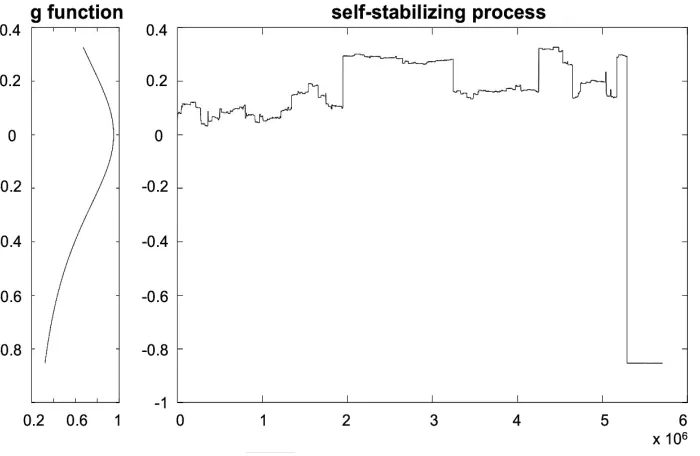
Examples of simulated self-stabilizing processes are displayed on Figures 1 and 2. One remarks that the intensity of jumps is indeed governed by the value of the process through the α function. In addition, the local roughness of the paths seems in visual agreement with Proposition 3.4.
Acknowledgements
The authors thank the two referees for their careful reading of the paper and helpful com-ments. KJF gratefully acknowledges the hospitality of Institut Mittag-Leffler in Sweden, where part of this work was carried out. JLV is grateful to SMABTP for financial support.
References
[1] A. Ayache and J. L´evy V´ehel. The generalized multifractional Brownian motion.
Figure 1: left : self-stabilizing function α(z) = 0.57 + 0.4 cos(z). Right: corresponding realization of a self-stabilizing process.
Figure 2: left : self-stabilizing function α(z) = 0.15 + 1+50.8z2. Right: corresponding
[image:21.612.119.469.434.662.2][2] O. Barri`ere, A. Echelard and J. L´evy V´ehel. Self-regulating processes. Electron. J. Probab., 17 (2012), no. 103, 30 pp.
[3] A. Benassi, S. Jaffard and D. Roux. Elliptic Gaussian random processes. Rev. Mat. Iberoam.,13 (1997), 19–90.
[4] J. Bertoin. L´evy Processes, Cambridge University Press, 1996.
[5] P. Billingsley. Convergence of Probability Measures, 2nd Ed., John Wiley, 1999.
[6] P. Carr, H. Geman, D. Madan and M. Yor. The fine structure of asset returns: an empirical investigation. Journal of Business, 75 (2002), 305–332.
[7] K. Daoudi, J. L´evy V´ehel and Y. Meyer. Construction of continuous functions with prescribed local regularity. Constr. Approx., 14 (1998), 349–385.
[8] P. J. Diggle. Statistical Analysis of Spatial and Spatio-Temporal Point Patterns, 3rd Ed., Chapman and Hall/CRC Press, 2013.
[9] A. Echelard, J. L´evy V´ehel and A. Philippe. Statistical estimation of a class of self-regulating processes. Scand. J. Stat., 42 (2014), 485-503.
[10] P. Embrechts and M. Maejima.Selfsimilar Processes, Princeton University Press, 2002.
[11] K. J. Falconer. Tangent fields and the local structure of random fields.J. Theoret. Probab., 15 (2002), 731–750.
[12] K. J. Falconer. The local structure of random processes. J. Lond. Math. Soc.(2), 67 (2003), 657–672.
[13] K. J. Falconer and J. L´evy V´ehel. Multifractional, multistable, and other pro-cesses with prescribed local form. J. Theoret. Probab., 22 (2009), 375-401.
[14] K. J. Falconer and J. L´evy V´ehel. Self-stabilizing processes based on random signs. To appear, J. Theoret. Probab., arXiv:1802.03231.
[15] K. J. Falconer, R. Le Gu´evel and J. L´evy V´ehel. Localizable moving average stable multistable processes. Stoch. Models, 25 (2009), 648-672.
[16] K. J. Falconer and L. Liu. Multistable Processes and Localisability. Stoch. Mod-els, 28 (2012), 503-526.
[17] X. Fan and J. L´evy V´ehel. Multistable L´evy motions and their continuous ap-proximations. Preprint.,arXiv:1503.06623.
[18] J. F. C. Kingman. Poisson Processes, Oxford University Press, 1996.
[20] R. Le Gu´evel, J. L´evy V´ehel and L. Liu. On two multistable extensions of stable L´evy motion and their semi-martingale representations. J. Theoret. Probab., 28 (2015), 1125–1144.
[21] J. L´evy V´ehel and R. Le Gu´evel. A Ferguson-Klass-LePage series representation of multistable multifractional motions and related processes.Bernoulli,181099– 1127.
[22] P. A. W. Lewis and G. S. Shedler. Simulation of nonhomogeneous Poisson pro-cesses by thinning. Naval Research Logistics, 26 (3) (1979), 403–413.
[23] I. Molchanov and K. Ralchenko. Multifractional Poisson process, multistable subordinator and related limit theorems. Statist. Probab. Lett., 96 (2015), 95– 101.
[24] R. F. Peltier and J. L´evy V´ehel. Multifractional Brownian motion: definition and preliminary results. Rapport de recherche de l’INRIA, No. 2645, 1995.
[25] D. Pollard. Convergence of Stochastic Processes, Springer-Verlag, 1984.
[26] J. Rosi´nski. Tempering stable processes.Stochastic Process. Appl.,117, 677–707, 2007.
[27] G. Samorodnitsky and M. Taqqu. Stable Non-Gaussian Random Process, Chap-man and Hall, 1994.