2D
J
–INEPT NMR Spectroscopy for CD
n
Groups: A
Theoretical Study
Azmi Gençten, İrfan Şaka Ondokuz Mayıs University, Samsun, Turkey E-mail: [email protected], [email protected]
Received March 15,2011; revised May 13, 2011; accepted June 1, 2011
Abstract
2D J-INEPT NMR experiment is a combination of heteronusclear 2D J-Resolved and INEPT experiments.
In this study, 2D J-INEPT experiment was analytically investigated by using product operator theory for
weakly coupled ISn (I = 1/2, S = 1; n = 1, 2, 3) spin systems. The obtained theoretical results represent the FID values of CD, CD2 and CD3 groups. In order to make Fourier transform of the obtained FID values, a
Maple program is used and then simulated spectra for of 2D J-INEPT experiment are obtained for CD, CD2
and CD3 groups. It is found that 2D J-INEPT is a useful experiment for both polarisation transfer and 2D
J-resolved spectral assignment for CDn groups in complex molecules.
Keywords:NMR, 2D J-INEPT, Product Operator Formalism, CDn Groups
1. Introduction
Polarization transfer from high natural abundance nu-cleus to low natural abundance nunu-cleus is widely used for heteronuclear weakly coupled spin systems in liq-uid–state NMR experiments [1-3]. The most common examples for the polarization transfer experiments are Distortionless Enhancement by Polarization Transfer (DEPT) and Insensitive Nuclei Enhanced by Polarization Transfer (INEPT). They both are used to increase sensi-tive enhancement of 13C spectra from spin-1/2 or spin-1
nucleus [4,5]. In order to resolve the chemical shift and spin-spin coupling parameters along the two different axes heteronuclear 2D J-Resolved NMR spectroscopy is used. Sometimes, spectral assignments of 2D J-Resolved NMR spectra become too difficult due to complex over-lapping spectra. In order to overcome this problem, 2D J-INEPT experiment [6], which is the combination of 2D J-Resolved and INEPT NMR experiments, can be used.
As NMR is a quantum mechanical phenomenon, the product operator theory as a quantum mechanical method is widely used for the analytical description of multi- pulse NMR experiments on weakly coupled spin systems in liquids having spin-1 2 and spin-1 nuclei [7-18]. Analytical description of polarization transfer in INEPT experiment using product operator formalism has been presented for IS and IS2 (I = 1/2 and S = 1) spin systems
[12]. So far, the product operator description of 2D
J-INEPT NMR experiment is not investigated for het-eronuclear weakly coupled ISn (I = 1/2; S = 1; n = 1, 2, 3)
spin systems.
In this study, by using product operator formalism, analytical description of 2D J-INEPT NMR experiment is presented for heteronuclear weakly coupled ISn (I =
1/2; S = 1; n = 1, 2, 3) spin systems. Then, using the ob-tained theoretical results and a Maple program, the simulated spectra of the experiment are obtained for CD,
CD2 and CD3 groups. Simulated spectra of 2D J-INEPT
NMR spectroscopy are explained in detail for CDn
groups. It is shown that this experiment can be used for the polarization transfer and J-resolved spectral assign-ment of CDn groups in complex molecules.
2. Theory
The product operator theory is the expansion of the den-sity matrix operator in terms of matrix representation of angular momentum operators for individual spins. For IS (I = 1/2, S = 1) spin system, four Cartesian spin angular momentum operators for I = 1/2; EI, Ix, Iy, Iz and nine
Cartesian spin angular momentum operators for S=1; ES,
Sx, Sy, Sz,
2
z
S
S Sx, z
, S Sy, z, S Sx, y,
2 2
x y
t spin system.
Time dependency of the density matrix is given by [11]
t exp
i t
0 exp
i (1) where His the total Hamiltonian which consists of radio frequency (r.f.) pulse, chemical shift and spinspin cou-pling Hamiltonians and (0) is the density matrix at t = 0. After employing the Hausdorff formula [11]
2
3
exp exp
( ) , , ,
2!
, , ,
3!
i t A i t
it
A it A A
it
A
(2)
evolutions of product operators under the r.f. pulse, chemical shift and spin-spin coupling Hamiltonians can easily be obtained [7,11,13,16]. A complete product op-erator theory for IS (I = 1/2, S = 1) spin system and its application to some NMR experiments are presented elsewhere [16-18].
At any time during the experiment, the ensemble av-eraged expectation value of the spin angular momentum, e.g. for Iy, is
Tr
y y
I I t (3)
where is the density matrix operator calculated from Eq. (6) at any time. As
t
y
I is proportional to the magnitude of the y-magnetization, it represents the signal detected on y-axis. So, in order to estimate the free in-duction decay (FID) signal of a multiple-pulse NMR experiment, density matrix operator should be obtained at the end of the experiment.
3. Results and Discussion
In this study, the product operator formalism is used for the analytical description of 2D J-INEPT NMR experi-
ment. Pulse sequence of 2D J-INEPT, shown in Figure 1, is used [6]. The density matrix operator at each stage of the experiment is labelled with numbers. 13C is treated as
spin I and D (2H) as spin S. For the analytical descrip-tions of the experiment, we have written a computer pro-gram in Mathematica which is very flexible for the im-plementation and the evolutions of the product operators under the Hamiltonians [20].
3.1. IS Spin System
0
is the density matrix operator at thermal equilibrium for IS spin system. Evolutions of density matrix operator for each labelled point are obtained:
0 Sz
(4)
90
0 x 1
S
y
S
(5)
1/ 4
1
1 2
2
J J
z x y
I S
S (6)
180 /180 2
1 2
2
x S x I
z x y
I S
S (7)
1/ 4
3 J 2
J
z x
I S
(8)
At the end of the experiment we obtain
9
2 2
2 2 2
2I S c cy z J I 2I S s cx z J I 2I S c sx z J I 2I S s sy z 2J I
(9)
In Equation (9), snJ sin
nJ t1
, cnJ cos
nJ t1
,
2
sin
nI I
s nt and I . In density
matrix operator theory, only the last term of Equation (9) contributes to the signal as acquisition is taken along y-axes. It is necessary to obtain the
Tr
2 nt
y
cos
nI
c
I O
Tr y
values of observable product operators indicated by O. For ISn (I =
1/2, S = 1; n = 1, 2, 3) spin systems, I O values
of all the observable product operators can be found elsewhere [16].
[image:2.595.168.429.561.691.2]Using TrI Oy values and making trigonometric
xpansions, e
2 9
1 2 1 2
Tr
cos 2 cos 2
y y
I I
I I IS
1,
y
M t t
J t t J t t
(10)
is obtained. This equation shows that the spin–s
pling information appears on F1 axis and represents two pin
cou-coherences for I nucleus with phase of 2Jt1 It2.
Therefore, they give doublets signals with opposite di-rection and no signal for central peak. The -dinate are
,
signals coor
I
J
,
I and
J,I
withinten-sity distribution of –1:0:1, respectively.
3.2. IS2 Spin System
For IS2 spin system, 0 is the density matrix operator at
ermal equilibrium
th :
0 S1z S2z
(11) The density matrix operator at the
is
end of the experiment
9 1 2 1
2 2
1 2 1 2
2 2
1 2 1 2
2 2
1 2 1 2
2 2
1 2 1 2
2 2
1 2 1 2
2 cos 2
cos 2
2 cos 2
cos 4 cos 4
y z z I
y z z I
y z z I
y z z I
y z z I
y z z I
2 2 cos 2
2
I S S J t t
I S S J t t
I S S J t t
I S S J t t I S S J t t I S S J t t
(12)
Using TrI Oy
r I values;
I I
2 T S
91 2 1 2
1 2 1 2
2 cos 4 2 cos 2
2cos 2 2cos 4
y
I
I
I
J t t J t t
J t t J t t
is obtained. This equation represents five signals at the coordinates of
2 ,J I
,
J, I
,
I ,
J,I
and
2 ,J I
with the relative intensities of–2:–2:0:2:2, respectively.
3.3. IS3 Spin System
For IS3 spin system, applying the same procedure
9 3
1 2 1 2
1 2 1 2
1 2 1 2
Tr
3cos 6 6 cos 4
6 cos 2 6cos 2
6 cos 4 3cos 6
y I I I I I I I IS
J t t J t t
J t t J t t
J t t J t t
(14)
is obtained. As seen in this equation, there exist seven signals at
3 ,J I
,
2 ,J I
,
J, I
,
I ,
J,I
,
2 ,J I
and
3 ,J I
coordinates with therelative intensities of –3:–6:–6:0:6:6:3, respectively.
3.4. Simulated Spectra
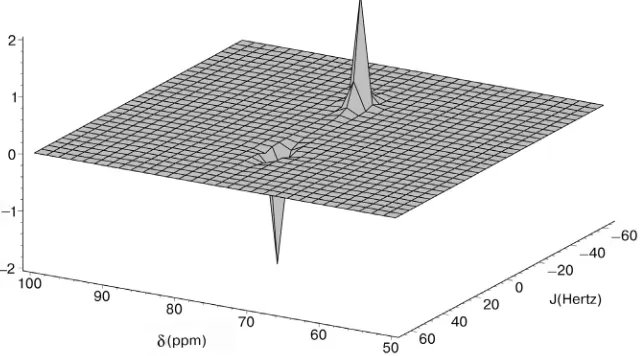
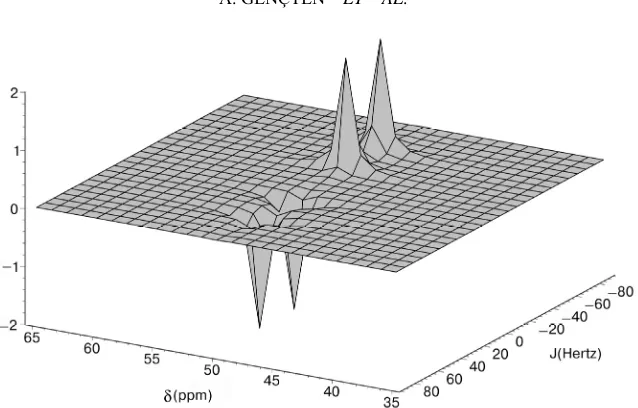
A computer program was written by Kanters et. al. for product operator description of NMR experiments and for the simulations of FID signals [21,22]. This is called Product Operator Formalism (POF.M) using Maple. In this study, in order to obtain the simulated spectra of the FID results, POF.M program is implemented for this experiment. TrIy9
ISn
values obtained for IS, IS2 and IS3 spin systems are given in Eqs. (10), (13) and
(14), respectively. They represent the FID signals of 2D J-INEPT NMR spectroscopy for CDngroups. By using
9
TrIy ISn values, simulated spectra of this
ex-periment are obtained and they are given in Figures 2-4 (13)
[image:3.595.140.461.528.706.2]for CD, CD2 and CD3 groups, respectively. In simulated
Figure 3. Simulated spectrum of 2D J–INEPT NMR experiment for CD group.2
Figure 4. Simulated spectrum of 2D J-INEPT NMR experiment for CD3 group.
spectra, 13C chemical shift values of CD, CD
2 and CD3
groups were assumed to be 75 ppm, 50 ppm and 25 ppm, respectively. Spin-spin coupling constants between 13C
and 2D nuclei for all CD, CD
2 and CD3 groups were
taken as 25 Hz. It can be seen from the theoretical results and the simulated spectra that 2D J-INEPT NMR ex-periment can be used to identify CD, CD2 and CD3
groups from each other and also to determine spin-spin coupling constant between 13C and 2D nuclei in CD
n
groups.
4. Conclusions
In this study, by using product operator theory, analytical description of 2D J
-sented for CDn group
represent the FID values of CDn groups. Then, in order
to obtain the simulated spectra for CD, CD2 and CD3
groups, the Fourier transforms of the FID values are performed in Maple. Simulated spectra of 2D J-INEPT NMR spectroscopy are explained in detail for CDn
groups. It is shown that, by using 2D J-INEPT NMR experiment, CDn groups can be identified from each
other and 1
J(C,D) coupling constants can be determined in deuterated complex molecules.
5. References
[1] J. M. Bulsing, W. M. Brooks, J. Field. and D. M. Dod-drell, “Polarization Transfer via an termediate
Multi-rde Journal of
Mag-984, pp. 167-173. INEPT NMR experiment is
pre-s. The obtained theoretical results ple-quantum State of Maximum Onetic Resonance, Vol. 56, No. 1, 1
[image:4.595.133.460.315.497.2]] J. M. Bulsing, W. M. Brooks, J. Field and D. M. Doddrell,
[2 [12] N. Chandrakumar, “Polarization Transfer between Spin 1
“Princi-,” Spectroscopy Letters, Vol. 30,
“Reverse Polarization Transfer through Maximum Order Multiple-Quantum Coherence. A Reverse POMMIE Se-quence,” Chemical Physics Letters, Vol. 104, No. 2-3
1984, pp. 229-234. doi:10.1016/0009-2614(84)80201-8 [3] J. M. Bulsing and D. M. Doddrell, “Multiple-Quantum
Polarization-Transfer Coherence Pathways in Liquids,”
Journal of Magnetic Resonance, Vol. 61, No. 2, 1985, pp.
197-219.
[4] D. M. Doddrell, D. T. Pegg and M. R. Bendall, “Distor-tionless Enhancement of NMR Signals by Polarization Transfer,” Journal of Magnetic Resonance, Vol. 48, No.
2, 1982, pp. 323-327.
d R. J. Freeman, “Enhancement off Nu-clear Magnetic-Resonance Signals by Polarization T [5] G. A. Morris an
rans-fer,” Journal of the American Chemical Society, Vol. 101,
No. 3, 1979, pp. 760-762.
[6] “Enhancement of Signals with Polarization Transfer via: INEPT.”
http:www.chem.queensu.ca/facilities/NMR/nmr/webcour se/inept.htm
[7] W. Srensen, G. W. Eich, M. H. Levitt, G. Bodenhausen and R. R. Ernst, “Product Operator Formalism for the Description of Pulse NMR Experiments,” Progress in
NMR Spectroscopy, Vol. 16, 1983, pp. 163-192.
[8] F. J. M. Van de Ven and C. W. Hilbers, “A Simple For-malism for the Description of Multiple-Pulse Experi-ments. Application to a Weakly Coupled 2-Spin (I = 1/2) System,” Journal of Magnetic Resonance, Vol. 54, No. 3,
520.
nd K. M. Wright, “The Use of Single-Spin Operator Basis Sets in the NMR Spectroscpy of S 1983, pp.
512-[9] K. J. Packer a
ca-lar-Coupled Spin Systems,” Molecular Physics, Vol. 50, No. 4, 1983, pp. 797-813.
doi:10.1080/00268978300102691
[10] J. Shriver, “Product Operators and Coherence Transfer In Multiple-Pulse NMR Experiments,” Concepts in
Mag-netic Resonance, Vol. 4, No. 1, 1992, pp. 1-33.
doi:10.1002/cmr.1820040102
[11] N. Chandrakumar and S. Subramanian, “Modern Tech-niques in High Resolution FT NMR,” Springer, New York, 1987.
and Spin 1/2 Nuclei,” Journal of Magnetic Resonance,
Vol. 60, No. 1, 1984, pp. 28-36.
[13] R. R. Ernst, G. Bodenhausen and A. Wokaum, ples of Nuclear Magnetic Resonance in One and Two Dimentions,” Clarendon Press, Oxford, 1987.
[14] A. Gençten and F. Köksal, “A Product Operator Descrip-tion of 2D-J Resolved NMR Spectroscopy for ISn Sspin System (I = 1/2, S = 1)
No. 1, 1997, pp. 71-78. doi:10.1080/00387019708002590 [15] A. Gençten, Ö. Tezel and A. Köroğlu, “A Theoretical
Application of SEMUT NMR Spectroscopy to Deuter-ated compounds,” Applied Magnetic Resonance
No. 1-2, 2001, pp. 265-273. , Vol. 20,
olecular
, pp. 2983-2989.
[16] A. Gençten and İ. Şaka, “A Complete Product Operator Theory for IS (I = (1)/(2), S = 1) Spin System and Appli-cation to DEPT-HMQC NMR Experiment,” M
Physics, Vol. 104, No. 18, 2006
doi:10.1080/00268970600909197
[17] İ. Şaka and A. Gençten, “A Theoretical Application of MAXY NMR for CDn Groups,” Verlag der Zeitchrift
= 1, 2, 3, 4) Spin
Sys-Naturforsch, Vol. 62a, No. 5-6, 2007, pp. 259-264.
[18] İ. Şaka, “Analytical Descriptions of DEPT NMR Spec-troscopy for ISn (I = 1, S = 1; n
tems,” Brazilian Journal of Physics, Vol. 38, No. 3A,
2008, pp. 323-328.
P. Allard and T. Härd, “A Complete Hermitia
[19] n Operator
Basis Set for Any Spin Quantum Number,” Journal of
Magnetic Resonance, Vol. 153, No. 1, 2001, pp. 15-23.
doi:10.1006/jmre.2001.2416
[20] S. Wolfram, “The Mathematica Book 3rd Edition,” Wolf-ram Media/Cambridge University Press, New York, 1996.
[21] R. P. F. Kanters, B. W. Char and A. W. Addison, “A Computer Algebra Appilcation for the Description of NMR Experiments Using the Product-operator Formal-ism,” Journal of Magnetic Resonance A, Vol. 101, No. 1,
1993, pp. 23-29.doi:10.1006/jmra.1993.1003
[22] R. P. F. Kanters, “Product Operator Formalism Using Maple.” 1993.
![Figure 1. Pulse sequence of 2D J . BB: Broad band decoupling [6].-INEPT NMR experiment](https://thumb-us.123doks.com/thumbv2/123dok_us/9065396.402922/2.595.168.429.561.691/figure-pulse-sequence-broad-band-decoupling-inept-experiment.webp)