STUDY OF THE EFFECT OF HUMIDITY ON THE SOUND
LOCAL MATERIALS USED IN THE CONSTRUCTION OF RESIDENTIAL BUILDINGS IN BENIN
DJIKOU M. Sylvain
1, HOUNGAN C. Aristide
Macaire
1, ANJORIN Malahimi
1
Laboratoire de Caractérisation Thermophysique des
De l’école Polytechnique
2
Laboratoire de Recherche Pluridisciplinaire de l’Enseignement
3
Laboratoire D’énergétique et de Mécanique Appliquée
ARTICLE INFO ABSTRACT
In the building sector, noise is a source of deterioration in the health status of the population. The choice of building materials is
focused on the stabilized earth, and the cement
characterized using the Kundt tube where the absorption coefficient of these materials was mea according to the water content. It shows that the humidity influences the acoustic absorption coefficient of each material in the standardized frequency zones ranging from 315 Hz to 2000 Hz.
Copyright © 2019, DJIKOU M. Sylvain et al. This unrestricted use, distribution, and reproduction in any medium,
INTRODUCTION
In the building sector, noise nuisances such as traffic, walking, talking and equipment noises are the source of inconveniences, which can range from a deterioration in the quality of life, to repercussions on the health of the inhabitants. o
Indeed, the middle ear is damaged by noise when the sound level is higher than 120 dB (decibels). This can lead to rupture of the eardrum [1]. The fight against noise has therefore become an important issue that results in regulations, acoustic standards that set minimum acoustic performance to be achieved inside buildings to ensure acoustic comfort to occupants and users [2]. Every building constructed must verify the standard of airborne and impact sound insulation, the insulation of facades, the noise produced by technical equipment or the reduction of the reverberation of certain rooms [3]. Our research consists of determining the sound absorption coefficient of stabilized earth and cement
*Corresponding author: DJIKOU M. Sylvain
Laboratoire de Caractérisation Thermophysique des Matériaux et D’appropriation Énergétique (Labo-CTMAE) De l’école
ISSN: 0975-833X
Article History:
Received 24th August, 2019 Received in revised form 28th September, 2019
Accepted 25th October, 2019
Published online 26th November, 2019
Citation:DJIKOU M. Sylvain, HOUNGAN C. Aristide, KIKI Gratien Jesugo Dieudonné,
DEGAN Gérard. 2019. “Study of the effect of humidity on the sound absorption coefficient of some local materials used in the construction of residential buildings in
Benin.”, International Journal of Current Research, 11, ( Key Words:
Moisture, sound absorption coefficient, stabilized earth, mortar, cement-wood composite, Kundt tube.
RESEARCH ARTICLE
STUDY OF THE EFFECT OF HUMIDITY ON THE SOUND ABSORPTION COEFFICIENT OF SOME
LOCAL MATERIALS USED IN THE CONSTRUCTION OF RESIDENTIAL BUILDINGS IN BENIN
, HOUNGAN C. Aristide
1, 2, KIKI Gratien Jesugo Dieudonné
, ANJORIN Malahimi
1, VIANOU Antoine
1, and DEGAN Géra
hermophysique des Matériaux et D’appropriation É
olytechnique D’Abomey-Calavi (EPAC), 01 BP 2009, Cotonou (Benin)
Laboratoire de Recherche Pluridisciplinaire de l’Enseignement Technique LARPET/ENSET/Lokoss
Abomey BP 133 Lokossa
Mécanique Appliquée (LEMA) de l’EPAC, 01 BP 2009,
ABSTRACT
In the building sector, noise is a source of deterioration in the health status of the population. The choice of building materials is essential to ensure the acoustic comfort of buildings. Our study focused on the stabilized earth, and the cement-wood composite where each sample is acoustically characterized using the Kundt tube where the absorption coefficient of these materials was mea according to the water content. It shows that the humidity influences the acoustic absorption coefficient of each material in the standardized frequency zones ranging from 315 Hz to 2000 Hz.
is an open access article distributed under the Creative Commons medium, provided the original work is properly cited.
In the building sector, noise nuisances such as traffic, walking, talking and equipment noises are the source of inconveniences, which can range from a deterioration in the quality of life, to repercussions on the health of the inhabitants. occupants. Indeed, the middle ear is damaged by noise when the sound level is higher than 120 dB (decibels). This can lead to rupture The fight against noise has therefore become an important issue that results in regulations, acoustic standards that set minimum acoustic performance to be achieved inside buildings to ensure acoustic comfort to Every building constructed must verify the standard of airborne and impact sound insulation, the the noise produced by technical equipment or the reduction of the reverberation of certain Our research consists of determining the sound absorption coefficient of stabilized earth and cement-wood
Laboratoire de Caractérisation Thermophysique des Matériaux et CTMAE) De l’école
Polytechnique D’Abomey-Calavi (EPAC), 01 BP 2009, Cotonou (Benin)
composite two materials involved in the construction of the building. Then study the influence of the moisture content on the acoustic absorption of these two materials to ensure the acoustic comfort or insulation of residential buildings. Our research consists of determining the sound absorption coefficient of stabilized earth and cement
materials involved in the construction of the building. Then we will study the influence of the moisture content on the sound absorption of these two materials to ensure the comfort or acoustic insulation of residential buildi
present the materials and the method finally used the results and discussion.
MATERIALS AND METHOD
Presentation of materials
• Stabilized earth: earth + cement + water [1]
Dosage: 2 wheelbarrows of bar ground (1900 kg / m of cement; 60 l of water
• Composite cement - wood ... [4]
International Journal of Current Research Vol. 11, Issue, 11, pp.8076-8081, November, 2019
DOI: https://doi.org/10.24941/ijcr.36593.11.2019
, HOUNGAN C. Aristide, KIKI Gratien Jesugo Dieudonné, AGBOMAHENAN Macaire, ANJORIN Malahimi
humidity on the sound absorption coefficient of some local materials used in the construction of residential buildings in , (11), 8076-8081.
Available online at http://www.journalcra.com
ABSORPTION COEFFICIENT OF SOME
LOCAL MATERIALS USED IN THE CONSTRUCTION OF RESIDENTIAL BUILDINGS IN BENIN
, KIKI Gratien Jesugo Dieudonné
1, AGBOMAHENAN
DEGAN Gérard
3Énergétique (Labo-CTMAE)
AC), 01 BP 2009, Cotonou (Benin)
Technique LARPET/ENSET/Lokossa/UNSTIM
(LEMA) de l’EPAC, 01 BP 2009, Cotonou, Benin
In the building sector, noise is a source of deterioration in the health status of the population. The essential to ensure the acoustic comfort of buildings. Our study wood composite where each sample is acoustically characterized using the Kundt tube where the absorption coefficient of these materials was measured according to the water content. It shows that the humidity influences the acoustic absorption coefficient of each material in the standardized frequency zones ranging from 315 Hz to 2000 Hz.
Commons Attribution License, which permits
Calavi (EPAC), 01 BP 2009, Cotonou
composite two materials involved in the construction of the study the influence of the moisture content on the acoustic absorption of these two materials to ensure the acoustic comfort or insulation of residential buildings. Our research consists of determining the sound absorption and cement-wood composite two materials involved in the construction of the building. Then we will study the influence of the moisture content on the sound absorption of these two materials to ensure the comfort or acoustic insulation of residential buildings. To do this we will present the materials and the method finally used the results
MATERIALS AND METHOD
Stabilized earth: earth + cement + water [1]
bar ground (1900 kg / m3); 25 kg
wood ... [4]
INTERNATIONAL JOURNAL OF CURRENT RESEARCH
AGBOMAHENAN Macaire, ANJORIN Malahimi, VIANOU Antoine,
Dosage: 3 wheelbarrows of 15,5kg of sawdust; 65 kg of cement; 110 l of water.
• The materials are immersed in water for 24 hours to determine their absolute humidity, then the latter are dried in the microwave to obtain their relative humidity at two different positions. To finish the materials stay for 24 hours in an oven at a temperature of 105 ° C to make them anhydrous (0% humidity).
[image:2.595.303.544.393.598.2]• The weighing of the mass of each sample taken respectively in the contexts described above is obtained using a precision balance and the results are recorded in Table 1:
• Starting from the different masses determined, the moisture content of each type of material is calculated by using formula (1)
= . 100 = (1)
With:
me: The mass of water contained in the material in (kg) mh: The mass of material immersed completely in water (kg) mS: The mass of the dry material in (kg)
τ: Absolute humidity or water content of a material in (%)
The moisture content results are shown in Table 2:
Method
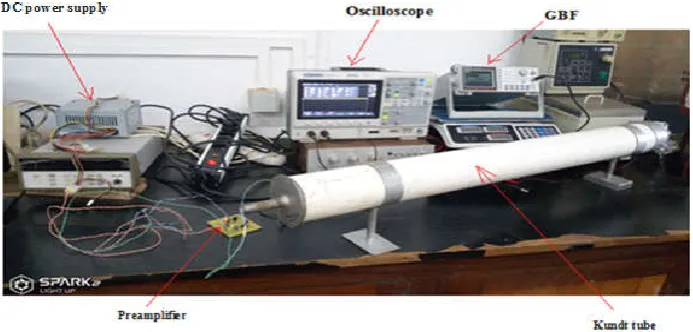
• The device used for the sound characterization of the two study materials is the Kundt tube. Measurements of the sound absorption coefficient are made with the acquisition bench of photo 2:
For data acquisition, it is necessary to:
Carry out the assembly of the acquisition chain by wiring between the different devices.
Insert the rod with microphone into the sample holder.
Put the study material in the sample holder.
Turn on the Low Frequency Generator and the oscilloscope (A table is displayed on the oscilloscope screen showing the characteristics of the signal)
Read the value of the no-load voltage across the U0 preamplifier on the oscilloscope
Select the appropriate frequency on the GBF by entering the value and then confirm with the button marked "Hz" or "kHz".
Press the "output" button on the GBF to send the signal to the speaker. The loudspeaker generates a sound wave then the microphone picks up the standing wave in the tube.
Slowly move the rod carrying the microphone and read the value of the voltage U ' max on the screen (the value of "max") of the oscilloscope when the signal becomes sinusoidal and the amplitude is maximal (the bellies)
Slowly move the microphone rod, read and read the value of the voltage U ' min on the screen (the "max" value) of the oscilloscope when the signal becomes sinusoidal and the amplitude is minimal (the nodes)
Calculate for each frequency Umax and Umin with the formulas Umax = U ' max- Uo and Umin = U'min- Uo
The value of the reflection coefficient g according to equation (2) and that of the absorption coefficient α of the tested material according to equation (4) are then calculated.
The reflection coefficient g of material is given by relation:
g = (2)
Where Umax is the maximum voltage measured at the terminals of the microphone and Umin is the minimum voltage measured at the terminals of the same microphone
g + α =1 (3)
We then deduce:
α = 1 – g (4)
RESULTS AND DISCUSSION
Results
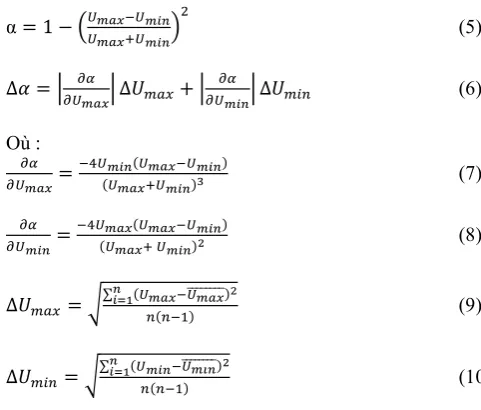
Using the Kundt tube, the two materials under study were characterized respectively after several measurement tests. Taking into account the repeatability of the measurements, the uncertainties on the measurements are determined through the formulas [6]:
α= 1 − (5)
∆ = ∆ + ∆ (6)
Où :
= ( )
( ) (7)
= ( ( ) ) (8)
∆ = ∑ ( )
( ) (9)
∆ = ∑ ( )
( ) (10)
With:
α: the absorption coefficient of the material;
Umax: the maximum voltage given by the V oscilloscope; Umin: the minimum voltage given by the V oscilloscope; Δα: the measurement uncertainty;
: the partial derivative of the absorption coefficient with
respect to the maximum tension;
: the partial derivative of the absorption coefficient with
respect to the minimum voltage;
ΔUmax: the uncertainty associated with the measurement of the maximum voltage;
ΔUmin: the uncertainty associated with the measurement of the minimum voltage;
Photo 1: Stabilized earth and cement-wood composite
Photo 2. Stabilized earth and cement-wood composite immersed in water
[image:3.595.130.477.385.551.2]Photo 3. Measurement bench of absorption coefficient and acoustic impedance of materials
Table 1. The different masses of each material
Materials Mass ai in the open air (t = 38 ° C) in kg
Moist mh mass (t =
16 ° C) in kg
Mass m1 at the
microwave outlet 1 (t = 52 ° C) in kg
Mass m2 at the exit of
microwave 2 (t = 80 ° C) in kg
Mass mS at the
outlet of the oven (t = 105 ° C) in kg Stabilized earth 0,645 0,765 0,735 0,685 0,620 Composite
cement-wood
[image:4.595.61.525.200.251.2]0,450 0,660 0,620 0,560 0,420
Table 2. Moisture of materials
Materials Humidity in the open in %
Absolute humidity in %
Moisture at the microwave exit 1 in %
Moisture at the microwave exit 2 in %
Stabilized earth 4,03 23,39 18,55 10,48 Composite
cement-wood
[image:4.595.108.481.287.338.2]7,14 57,14 47,62 33,33
Table 3. Earth stabilized in the open air (mTo = 0,645kg)
f(Hz) 315 400 500 640 800 1000 1250 1600 Umax(V) 5,1 4,7 4,9 5 5,1 4,5 4,7 4,7
Umin(V) 2,4 2,5 1,5 1,9 2,1 1,7 1,4 1,9
[image:4.595.105.479.377.429.2]g 0,13 0,09 0,28 0,20 0,17 0,20 0,29 0,18 α 0,87 0,91 0,72 0,80 0,83 0,80 0,71 0,82
Table 4. Stabilized immersed earth (mT1= 0,765kg)
f(Hz) 315 400 500 640 800 1000 1250 1600 Umax 4,94 5,02 4,94 5 4,78 5,02 4,73 3,38
Umin 1,42 1,66 1,26 1,08 1,34 1,34 3,82 0,82
g 0,31 0,25 0,35 0,42 0,32 0,33 0,01 0,37 α 0,69 0,75 0,65 0,58 0,68 0,67 0,99 0,63
Table 5. Stabilized earth exit of the microwave (mT2= 0,735kg)
f(Hz) 315 400 500 640 800 1000 1250 1600 Umax 4,56 4,80 4,64 4,72 4,56 4,72 4,80 2,80
Umin 1,84 1,76 0,96 2,96 0,83 0,80 1,28 0,56
g 0,18 0,21 0,43 0,05 0,48 0,50 0,34 0,44 α 0,82 0,79 0,57 0,95 0,52 0,50 0,66 0,56
Table 6. Stabilized earth leaving the microwave (mT3= 0,685kg)
f(Hz) 315 400 500 640 800 1000 1250 1600 Umax 4,40 4,24 4,00 4,48 4,16 4,40 4,43 3,76
Umin 1,52 0,80 0,86 2,43 0,72 0,40 0,88 0,72
g 0,24 0,47 0,42 0,09 0,50 0,69 0,45 0,46 α 0,76 0,53 0,58 0,91 0,50 0,31 0,55 0,54
Table 7. Dry stabilized earth (mTs= 0,620kg)
f(Hz) 315 400 500 640 800 1000 1250 1600 Umax 4,48 4,64 4,32 4,56 4,32 4,4 4,48 2
Umin 2,24 1,52 1,28 2,96 0,96 0,64 1,28 0,32
g 0,11 0,26 0,29 0,05 0,40 0,56 0,31 0,52 α 0,89 0,74 0,71 0,95 0,60 0,44 0,69 0,48
Table 8. Cement-wood composite in the open air (mCo= 0,450kg)
f(Hz) 315 400 500 640 800 1000 1250 1600 Umax 4,4 4,4 4 4,1 4 3,6 4 2,8
Umin 1,2 1,6 0,7 0,89 0,8 0,7 0,9 0,1
[image:4.595.105.480.463.516.2] [image:4.595.114.475.552.604.2] [image:4.595.108.479.642.695.2] [image:4.595.109.479.737.789.2]From this uncertainty study, the values of the acoustic absorption coefficients for the two samples are obtained with an uncertainty of between 0.6% and 5% according to the frequencies. Measurements carried out over the tolerable frequency range (255 Hz to 2000 Hz) by the Kundt tube allowed according to the normalized frequencies to obtain the results presented in the tables below:
Stabilized earth
Composite cement-wood: The treatment of the different
results resulting from the measurements made it possible to carry out the histograms of figures 1 and 2 below:
DISCUSSION
• The curve in Figure 2 shows the variation of the
[image:5.595.111.489.82.135.2]sound absorption coefficient of the stabilized earth as a function of humidity (0% for the anhydrous stabilized earth at 23.39% absolute humidity of the stabilized earth). Looking closely at this curve, we notice that in the frequency ranges (from 315 Hz to 750 Hz), the absorption coefficient of the stabilized earth decreases when its humidity increases, which means that the moisture content clogs the pores. of the material, that is to say decreases its porosity and
Table 9. Submerged Cement-Wood Composite (mC1= 0,660kg)
f(Hz) 315 400 500 640 800 1000 1250 1600 Umax 4,7 4,3 3,9 4 3,9 4,2 4,46 3,02
Umin 1,5 1,9 0,7 1,2 1,1 0,9 3,8 0,54
[image:5.595.113.486.177.229.2]g 0,27 0,15 0,48 0,29 0, 31 0,42 0,006 0,49 α 0,73 0,85 0,52 0,71 0,69 0,58 0,994 0,51
Table 10. Cement-wood composite taken out of the microwave (mC2= 0,620kg)
f(Hz) 315 400 500 640 800 1000 1250 1600 Umax 4,82 4,56 4,4 4,64 4,72 4,8 4,8 4
Umin 2 2,16 1,84 4,4 1,76 1,52 4,08 2,8
[image:5.595.114.485.272.324.2]g 0,17 0,13 0,17 0,001 0,21 0,27 0,007 0,03 α 0,83 0,87 0,83 0,999 0,79 0,73 0,993 0,97
Table 11. Cement-wood composite taken out of the microwave (mC3= 0,560kg)
f(Hz) 315 400 500 640 800 1000 1250 1600 Umax 4,4 4,8 4 3,6 4 4 3,6 3,2
Umin 1,6 2,4 0,8 3,2 0,4 0,4 2,8 0,2
g 0,22 0,11 0,44 0,003 0,67 0,67 0,02 0,78 α 0,78 0,89 0,56 0,997 0,33 0,33 0,98 0,22
Table 12. Dry cement-wood composite (mCs= 0,420kg)
f(Hz) 315 400 500 640 800 1000 1250 1600 Umax 4,4 4,16 4,32 4,4 4,4 4,4 4 3,76
Umin 1,6 2,96 0,88 1,1 1,44 1,38 0,9 1,12
g 0,22 0,03 0,44 0,36 0,26 0,27 0,40 0,29 α 0,78 0,97 0,56 0,64 0,74 0,73 0,60 0,71
[image:5.595.297.553.417.611.2]Fig. 2. Demonstration of the effect of moisture on the absorption coefficient of the stabilized earth
prevents sound absorption. From 750 Hz to 1000 Hz, the absorption coefficient of the material increases or decreases in this frequency range when the humidity increases, the amount of water in the pores of the material also decreases or increases its porosity and favors or not the absorption of sound [7]. From 1000 Hz to 1600 Hz, the absorption coefficient of the material increases with absolute humidity; the water enlarges the pores of the material further, that is to say increases its porosity which is manifested by a better absorption of the sound.
• The same phenomena are observed at the level of
the acoustic absorption of the cement-wood composite and is translated as follows:
The moisture content of the cement-wood composite varies from 0% for the dry material to 57.14% for the material completely immersed in water for 24 hours (absolute humidity). This variation of the moisture content in this material causes an increasing or sometimes decreasing variation of the sound absorption coefficient over given frequency areas as shown in the curve of Fig. 3.
• From these analyzes, the two samples are good sound absorbers over the different frequency ranges, but their acoustic absorption coefficients are strongly influenced by their moisture content. We note the structure of the material (its porosity) has an influence on the sound absorption coefficient.
Conclusion
The Kundt tube made it possible to determine the values of the maximum and minimum electrical voltages which were used to calculate the reflection coefficient of each type of material even if it is necessary to deduce the acoustic absorption coefficients of the materials previously whose humidifies have been determined. A detailed study clearly shows that the moisture content of each type of sample influences their sound absorption coefficient on the frequency zones given by increasing or decreasing.
This state of affairs reflects the behavior of water in the pores of the material on the sound absorption quality of the samples. It should be noted that the samples tested are very good absorbers (because having α ≥0.5) that can be used to ensure the acoustic comfort or insulation of buildings despite the influence of their water content.
RÉFÉRENCES
[1] Aristide Comlan HOUNGAN, Christophe AWANTO, Malahimi ANJORIN, Armand Ayihaou DJOSSOU, Antoine. VIANOU, 2013. Caractérisation phonique de trois matériaux locaux utilisés dans la construction de l’habitat au BENIN. Rev. CAMES – Sciences Struct. Mat. Vol. 1, Déc. p1-16.
[2] Saint GOBAIN, 2012. Introduction à l’acoustique du bâtiment, Edition.
[3] La nouvelle norme NBN S01-400-1: Critères acoustiques
pour les immeubles d’habitation, 1er trimestre 2007.
[4] Adolphe D. TCHEHOUALI, Valorisation de la sciure de bois tropicaux. Mise au point et caractérisation au point et caractérisation de matériaux ciment-sciure; thèse 2002. [5] M. Ghomari F. et Bendi-Ouis A. 2008. Science des
matériaux de construction, travaux pratiques; Université ABOUBEKR BELKAID, 2007.
[6] Biansan JM., Blat S., Nicoules C., Olive JF., 2017. Notion d’erreurs et d’incertitudes en sciences expérimentales. Toulouse, Académie de Toulouse, 10 p.
[7] K. Hamzé et al. 2018. « Hygrothermal and Acoustical
Performance of Starch-Beet Pulp Composites for Building Thermal Insulation », p. 18, 05-sept.