AN EMPIRICAL STUDY ON CONSUMER BEHAVIOR TOWARDS ONLINE
REFERENCE TO KARIM NAGAR DISTRICT, TELENGANA
1
Ambati Sai
1
Research Scholar, School of Management Studies (SMS), Jawaharlal Nehru Technological University, Hyderabad
2
Associate Professor, School of Management Studies (SMS), Jawaharlal Nehru Technological University,
ARTICLE INFO ABSTRACT
The present paper is an attempt to study the consumer behavior towards online shopping. The objectives of the study are: to identify the relationship of demographical factors that influence onlin shopping, to study the preferences of the consumers toward online shopping and to study the satisfaction level of the consumers while they shop online. To achieve the objective, null hypothesis ‘Online shopping is not reliable and trustworthy to the cons
been conducted among the consumers of
been used to select the sample. The primary data was collected from 100 respondents by means of a structured
software. The major findings of the study are: Cash on delivery is found most popular payment method for online shopping among consumers. The price of the products is the most influen factor on online purchase and online shopping is getting popular in the younger generation. Majority of the respondent’s buy from
India. Online shopping is very popular for electronics items followed by movie tickets and clothes. Unreliable online delivery system as well as personal privacy or security concerns have a significant impact on online shopping. The main barrier in the process of online shopping is the payment safety and privacy issue
Copyright © 2018, Ambati Sai Vishwagna and Dr. M. Sudhir Reddy
which permits unrestricted use, distribution, and reproduction
INTRODUCTION
With the rapid global growth in electronic
commerce), businesses are attempting to gain a competitive advantage by using e-commerce to interact with customers (Demangeot and Broderick, 2007). Online shopping is a form of electronic commerce which allows consumers to directly buy goods or services from a seller over the Internet using a web browser. Michael Aldrich is the man who invented online shopping in 1979. Growing numbers of consumers shop online to purchase goods and services, gather product information or even browse for enjoyment. Online shopping environments are therefore playing an increasing role in the overall relationship between marketers and their consumers (Koo, Kim and Lee 2008). With the increasing internet literacy, the prospect of online marketing is increasing in India. Alternative names of
online shopping are: e-web-store, e-shop,
shop, web-shop, web-store, online store, online storefront and virtual store.
*Corresponding author: Ambati Sai Vishwagna
Research Scholar, School of Management Studies (SMS), Jawaharlal Nehru Technological University, Hyderabad
ISSN: 0975-833X
Vol. 10, Issue,
Article History:
Received 25th September, 2018
Received in revised form 04th October, 2018
Accepted 29th November, 2018
Published online 29th December, 2018
Citation: Ambati Sai Vishwagna and Dr. M. Sudhir Reddy
Karim Nagar District, Telengana”, International Journal of Current Research
Key Words:
Consumer behaviour, Online Shopping and Cash on Delivery.
RESEARCH ARTICLE
EMPIRICAL STUDY ON CONSUMER BEHAVIOR TOWARDS ONLINE
REFERENCE TO KARIM NAGAR DISTRICT, TELENGANA
Ambati Sai Vishwagna and
2Dr. M. Sudhir Reddy
Research Scholar, School of Management Studies (SMS), Jawaharlal Nehru Technological University, Hyderabad
Associate Professor, School of Management Studies (SMS), Jawaharlal Nehru Technological University,
Hyderabad
ABSTRACT
The present paper is an attempt to study the consumer behavior towards online shopping. The objectives of the study are: to identify the relationship of demographical factors that influence onlin shopping, to study the preferences of the consumers toward online shopping and to study the satisfaction level of the consumers while they shop online. To achieve the objective, null hypothesis ‘Online shopping is not reliable and trustworthy to the consumers’ was tested. The present study has been conducted among the consumers of Karimnagar District. Convenience sampling method has been used to select the sample. The primary data was collected from 100 respondents by means of a structured questionnaire having 15 questions. The collected data was analyzed using Excel and SPSS software. The major findings of the study are: Cash on delivery is found most popular payment method for online shopping among consumers. The price of the products is the most influen factor on online purchase and online shopping is getting popular in the younger generation. Majority of the respondent’s buy from flipkart and Amazon which are the leading online shopping websites in India. Online shopping is very popular for electronics items followed by movie tickets and clothes. Unreliable online delivery system as well as personal privacy or security concerns have a significant act on online shopping. The main barrier in the process of online shopping is the payment safety and privacy issue
Dr. M. Sudhir Reddy. This is an open access article distributed under the reproduction in any medium, provided the original work is properly cited.
With the rapid global growth in electronic commerce (e-businesses are attempting to gain a competitive
to interact with customers (Demangeot and Broderick, 2007). Online shopping is a form of electronic commerce which allows consumers to directly or services from a seller over the Internet using a Michael Aldrich is the man who invented online shopping in 1979. Growing numbers of consumers shop online to purchase goods and services, gather product information or nt. Online shopping environments are therefore playing an increasing role in the overall relationship between marketers and their consumers (Koo, Kim and Lee 2008). With the increasing internet literacy, the prospect of dia. Alternative names of shop, e-store, Internet online store, online storefront and
*Corresponding author: Ambati Sai Vishwagna
Studies (SMS), Jawaharlal
As the Internet has now become a truly global phenomenon, the number of Internet users worldwide is increasing considerable (Kotler & Armstrong (2008)). These growing and diverse Internet populations mean that people having diverse tastes and purposes are now going to the web for information and to buy products and services. Thus, the impact of these online shopping environments on consumer behaviour necessitates a critical understanding
The present paper is an attempt to study the consumer’s behaviour towards online shopping.
LITERATURE REVIEW
(Mahalaxmi and Nagamanikandan, 2016) studied that the internet has given rise to great potential for businesses through connecting globally. In case online purchasing many problems are stills pertinent, specially for apparel sector. Every consumer has faced number of difficulties. Based on finding it is concluded that online shopping is getting popular in the younger generation. The main barrier in the process of online shopping is the safety issue and low level of trust on online stores therefore; sellers have to make proper strategies to increase the consumer’s level of trust on them.
International Journal of Current Research
Vol. 10, Issue, 12, pp.76140-76144, December, 2018
DOI: https://doi.org/10.24941/ijcr.33210.12.2018
Ambati Sai Vishwagna and Dr. M. Sudhir Reddy. 2018. “An empirical study on consumer behavior towards
International Journal of Current Research, 10, (11), 76140-76144.
EMPIRICAL STUDY ON CONSUMER BEHAVIOR TOWARDS ONLINE SHOPPING WITH
REFERENCE TO KARIM NAGAR DISTRICT, TELENGANA
Dr. M. Sudhir Reddy
Research Scholar, School of Management Studies (SMS), Jawaharlal Nehru Technological University, Hyderabad
Associate Professor, School of Management Studies (SMS), Jawaharlal Nehru Technological University,
The present paper is an attempt to study the consumer behavior towards online shopping. The objectives of the study are: to identify the relationship of demographical factors that influence online shopping, to study the preferences of the consumers toward online shopping and to study the satisfaction level of the consumers while they shop online. To achieve the objective, null hypothesis umers’ was tested. The present study has . Convenience sampling method has been used to select the sample. The primary data was collected from 100 respondents by means of a aving 15 questions. The collected data was analyzed using Excel and SPSS software. The major findings of the study are: Cash on delivery is found most popular payment method for online shopping among consumers. The price of the products is the most influencing factor on online purchase and online shopping is getting popular in the younger generation. Majority which are the leading online shopping websites in India. Online shopping is very popular for electronics items followed by movie tickets and clothes. Unreliable online delivery system as well as personal privacy or security concerns have a significant act on online shopping. The main barrier in the process of online shopping is the payment safety
the Creative Commons Attribution License, cited.
As the Internet has now become a truly global phenomenon, the number of Internet users worldwide is increasing considerable (Kotler & Armstrong (2008)). These growing and t populations mean that people having diverse tastes and purposes are now going to the web for information and to buy products and services. Thus, the impact of these online shopping environments on consumer behaviour necessitates a critical understanding for marketing planning. The present paper is an attempt to study the consumer’s behaviour towards online shopping.
(Mahalaxmi and Nagamanikandan, 2016) studied that the internet has given rise to great potential for businesses through connecting globally. In case online purchasing many problems are stills pertinent, specially for apparel sector. Every consumer has faced number of difficulties. Based on finding it is concluded that online shopping is getting popular in the tion. The main barrier in the process of online shopping is the safety issue and low level of trust on online stores therefore; sellers have to make proper strategies to increase the consumer’s level of trust on them. (Shanthi and
OF CURRENT RESEARCH
Kannaiah, 2015) studied that mostly the youngsters are attached to the online shopping and hence the elder people don’t use online shopping much as compared to the younger ones. The study highlights the fact that the youngsters between the ages of 20-25 are mostly poised to use the online shopping. It is also found that the majority of the people who shop online buys books online as it is cheaper compared to the market price with various discounts and offers. The study also reveals that the price of the products have the most influencing factor on online purchase. (Bhatt, 2014) found in his study that Online shopping is gaining popularity among people specially the younger generation but in today scenario to become equally popular among all age groups e-marketing will have to cover a longer distance. The result of our study shows that mode of payment is depended upon income of the respondents. People having annual income below Rs 1,50,000 prefer cash on delivery payment and above Rs 2,50,000 prefers Internet banking payments. People from different age groups are doing online shopping regularly. (Chandra and Sinha, 2013), studied that, now days the new and latest type of retail shopping are online shopping. It has now been adopted all over the world including India. In many other countries this shopping method is still not as well known or accepted, and though the knowledge of online shopping in India is now beginning to increase rapidly. To analyze factors affecting on online shopping behavior of consumers that might be one of the most important issues of e-commerce and marketing field, this is the main objective of the study. It is a complicated socio-technical phenomenon and involves too many factors so that there is very limited knowledge about online consumer behavior.
According to(Kapoor ,2012), online decision making and online shopping phenomena are governed by a number of consumer acceptance and behavior characteristics and grounded in theoretical aspects of consumer decision making. There are number of factors that affect what we buy, when we buy, and why we buy. In reference to buying online, the factors that influence consumers are marketing efforts, socio-cultural influences, psychological factors, personal questions, post decision behavior, experience etc., (Jun and Jaafar, 2011), business revolution is a good example which is provided by online shopping. Ecommerce is experiencing a period of rapid development currently in China; for the expansion of the online shopping market, large number of Internet users provides a good foundation. After studying and analyzing different variables this research found that there were relationships between the perceived usability, perceived security, and perceived privacy, perceived after-sales service, perceived marketing mix, perceived reputation and consumer’s attitude to adopting online shopping in China. However, only marketing mix and reputation were significantly influence consumer’s attitude to adopt online shopping. After studying this journal the researcher is able to understand consumer’s online purchase behaviour. Ramirez Nicolas (2010) state that "The Internet has changed many facets of our daily lives: the way we relate and communicate with one another, how we interact with a bank, read newspapers or watch television. Even the way we buy and sell. These changes have occurred due to the constant flow of companies offering new business models and innovative formulae. Discount coupons have always been a powerful marketing tool. Whether inserted in printed media or posted through letter boxes, they attracted new customers and were also offered at the time of purchase to promote consumer loyalty by encouraging repeat purchases at
outlets. Sharma and Mittal (2009) in their study, "Prospects of e-commerce in India”, mentions that India is showing tremendous growth in the e-commerce. Undoubtedly, with the population of millions of people, online shopping shows unlimited potential in India. Today e-commerce is a common word in Indian society and it has become an integral part of our daily life. There are websites providing a number of goods and services. There are vendors, who provide specific product along with its allied services. There are also Multi-product e-commerce sevices. These Indian e-e-commerce portals provide goods and services in a variety of categories. To name a few: Apparel and accessories for men and women, Health and beauty products, Books and magazines, Computers and peripherals, Vehicles, Software, Consumer electronics, Household appliances, Jewelry, Audio/video, entertainment, goods, Gift articles, Real estate, services etc., The earlier studies revealed that certain attributes making impact on intention to purchase through online. But there are scanty research studies to consider factors with the focus of specific demographical characteristics, preferences and perception in the present geographical area of study. Thus, the present study tries to understand the consumer’s behavior towards online shopping with reference to their demographic characteristics, preferences and perception in the semi urban area of Karimnagar district of, Telengana state.
Statement of the Problem
An empirical study of the consumer behavior towards online shopping.
Objectives
To identify the relationship of demographical factors
that influence online shopping
To study the preferences of the consumers toward
online shopping.
To study the satisfaction level of the consumers while
they shop online.
To analyze the customer perception with respect to the
safety and trustworthiness of payments.
Hypothesis
Null Hypothesis (HO): Online shopping is not reliable and
trustworthy to the consumers.
MATERIALS AND METHODS
Data Analysis and Results
Demographic factors and Online Shopping: Online
shopping in terms of demography is an important aspect. The present study is aimed at to study demography in terms of age, income and education as are there any differences while consumers shop online.
It is clearly indicated in table-1 that out of the 100 people surveyed, 48% people uses cash on delivery, 31% people uses debit card or net banking and only 21% people uses credit card method to purchase the products online. The people having annual income below Rs 2,50,000 prefer cash on delivery and above Rs 2, 50,000 prefers Internet banking payments. Cash on delivery is found most popular and credit card payment method is found least popular for online shopping among consumers. As per given data in table-2, 21% people spends below Rs.1500 per month in average, 41% people spends
between 1500-3000, 20% people spends between
3000-5000 and 18% people spends above 3000-5000 to purchase the products online. Most of the people spends between 1500-3000 per month for online shopping. The most of the people
having annual income below Rs 4,50,000 spends
between 1500-3000 per month for online shopping. People having annual income above Rs 4,50,000 spends above 3000 per month for online shopping. It concludes that amount spent by consumer depends on the annual income of the consumer. Table-3 indicates that, 25% people prefer brand of the product,
32% people prefer quality, 38% people prefer price and 5% people prefer variety of the product during online shopping. Table also indicates that consumers below 15 years of age prefers brand of the product, consumers between 15-25 years of age prefers quality of the product and consumers above 25 years of age prefers price of the product during online shopping.
Above discussion concludes that, price is the number one preference followed by quality during online shopping. Table-4 indicates that out of the 100 people surveyed, 10% said that reputation of the company of the product is very unimportant, 8% said unimportant, 12% were neutral, 44% said important and 26% said very important during online shopping. Table also indicates that reputation of the company of the product is unimportant for the consumers having education as XII class and reputation of the company of the product is important or very important for graduate and post graduate consumers. This discussion concludes that more educated consumers prefer reputation of the company of product.
Consumer Preferences and Online Shopping
[image:3.595.104.497.165.245.2]In terms of product categories, consumer interest on Google search for apparels & accessories emerged as the second biggest product category after consumer electronics. When we purchase a service or product through internet with an electronics media, it is called “Online Shopping”.
Table 1. Consumer Income and Payment Method
Payment Method
Debit Card/ Cash on
Credit Card Net Banking Delivery Total
Consumer Below Rs.150000 0 0 14 14
Income Between Rs.150000-250000 0 6 15 21
(Per Annum) Between Rs. 250000-450000 7 13 16 36
Above Rs.450000 14 12 3 29
[image:3.595.92.521.277.355.2]Total 21 31 48 100
Table 2. Consumer Income and Amount Spent for online shopping
Amount Spent in Rs. by Consumer (per month)
Between Between
Below 1500 1500-3000 3000-5000 Above 5000 Total
Below Rs.1,50,000 13 1 0 0 14
Consumer Income Between Rs.1,50,000-2,50,000 8 13 0 0 21
(Per Annum) Between Rs. 2,50,000-4,50,000 0 25 11 0 36
Above Rs.4,50,000 0 2 9 18 29
Total 21 41 20 18 100
Table 3. Consumer Age and Product features
Product Features
Brand Quality Price Variety Total
Consumer Age Below 15 Years 19 8 7 0 34
Between 15 and 25 Years 6 24 11 0 41
Between 25 and 45 Years 0 0 13 3 16
Above 45 Years 0 0 7 2 9
[image:3.595.83.515.484.555.2]Total 25 32 38 5 100
Table 4. Consumer Education Level and Company Reputation of the Product
Company Reputation of the Product
Very Unimportant Neutral Important Very
Unimportant Important Total
XII th class 6 2 2 0 0 10
Consumer UG 4 6 10 29 0 49
Education Level PG 0 0 0 15 26 41
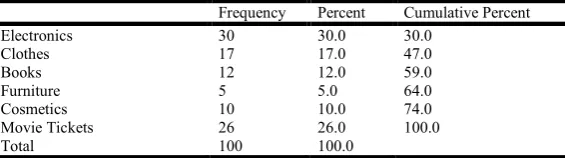
Online Retail Business websites are like Makemytrip.com, Bookmyshow.com and Yatra.com. Table-5 indicates that out of the 100 people surveyed 14% said that they use snapdeal.com, 20% shop through Amazon, 10% use myntra.com., 6% use yepme.com, 11% use ebay.com, 8% use homeshop.com., 22% use flipkart.com and 8% use other sites to purchase the products online. The maximum number of websites accessed online is Flipcart.com followed by Amazon, Snapdeal etc., Table-6 indicates that out of the 100 people surveyed the total number of various products purchased by them online, 30% purchased are electronics items, 17% purchased are clothes, 12% purchased are books, 5% purchased are furniture, 10% purchased are cosmetics and 26% purchased are movie tickets. The results indicates that online shopping is very popular for electronics items followed by movie tickets and clothes.
Satisfaction level of Consumers and Online Shopping:
Shopping online has never been so easy. With the flourishing numbers of online merchants, people nowadays have various choices to do their shopping. All they have to do are just browse for the product they want in the website and within a few mouse clicks they are off. Such simplicity is what makes online shopping appealing for consumers. The question is why do many people still deny shopping online? Well, for most people, privacy and security issues are their concerns.
Testing Hypothesis: In order to test the null hypothesis (HO)
that “Online shopping is not reliable and trustworthy to the consumers” the results of t-test are as follows.
From Table-8, it can be said that the significant value of all variables is less than 0.05. As the hypothesis was derived from these variables and their significant value is less than 0.05, thus
null hypothesis (HO) accepted and alternative hypothesis (H1)
is rejected. So for hypothesis, it can be conclude that unreliable online delivery system as well as personal privacy or security concerns have a significant impact on online shopping.
The main barrier in the process of online shopping is the safety and privacy issue.
Conclusion
Online shopping is rapidly changing the way people do business all over the world. In the business-to consumer segment, sales through the web have been increasing dramatically over the last few years. Customers, not only those from well developed countries but also those from developing countries, are getting used to the new shopping channel. The internet has given rise to great potential for businesses through connecting globally. The people having annual income below Rs 2,50,000 prefer cash on delivery and above Rs 2, 50,000 prefers Internet banking payments. Cash on delivery is found most popular payment method for online shopping among consumers. The result of our study shows that mode of payment is depended upon income of the respondents.
The most of the people having annual income below Rs 4,50,000 spends between Rs.1500-3000 per month for online shopping. People having annual income above Rs 4,50,000 spends above 3000 per month for online shopping. Consumers below 15 years of age prefers brand of the product, consumers between 15-25 years of age prefers quality of the product and consumers above 25 years of age prefers price of the product during online shopping. The price of the products has the most influencing factor on online purchase and online shopping is getting popular in the younger generation. Reputation of the company of the product is unimportant for the consumers having education as XII and reputation of the company of the product is important or very important for graduate and post graduate consumers. Majority of the respondents buys from flipkart.com which is thus one of the leading online shopping websites in India. Online shopping is very popular for electronics items followed by movie tickets and clothes. Every consumer has faced number of difficulties. Unreliable online
Table 6. Products bought online
Frequency Percent Cumulative Percent
Electronics 30 30.0 30.0
Clothes 17 17.0 47.0
Books 12 12.0 59.0
Furniture 5 5.0 64.0
Cosmetics 10 10.0 74.0
Movie Tickets 26 26.0 100.0
[image:4.595.91.514.68.361.2]Total 100 100.0
Table 7. One-Sample Statistics
N Mean Std. Deviation Std. Error Mean 1.Product Delivery 100 3.55 1.175 .118
2.Product Information 100 2.36 1.235 .124
3.Payment Safety 100 3.87 1.107 .111
4.Return Policy 100 3.42 1.265 .126
5.Consumer Privacy 100 3.60 1.110 .111
Table 8.
One-Sample Test Test Value = 3
95% Confidence Interval of the Difference
t df Sig. (2-tailed) Mean Difference Lower Upper
1.Product Delivery 4.680 99 .000 .550 .550 .78
2.Product Information -5.181 99 .000 -.640 -.640 -.39
3.Payment Safety 7.859 99 .000 .870 .870 1.09
4.Return Policy 3.321 99 .001 .420 .420 .67
[image:4.595.158.441.83.162.2]delivery system as well as personal privacy or security concerns has a significant impact on online shopping. The main barrier in the process of online shopping is the payment safety and privacy issue. This increases low level of trust on online stores therefore; sellers have to make proper strategies to increase the consumer’s level of trust on them.
REFERENCES
Bhatt, A. 2014. Consumer attitude towards online shopping in
selected regions of Gujarat, Journal of Marketing
Management, 2(2), pp 29-56.
Chandra, A.K. & Sinha, D. K 2013. Factors affecting the online shopping behaviour: a study with reference to Bhilai
Durg, International Journal of Advanced Research in
Management and Social Sciences, Vol.2, No. 5.
Demangeot, C. & Broderick, A. J. 2007. Conceptualizing consumer behaviour in online shopping environments,
International Journal of Retail & Distribution
Management, 35(11), pp 878-894.
Jun, Guo and Jaafar, Noor Ismawati, 2011. A study on consumers‟ attitude towards online shopping in China,
International Journal of Business and Social Science, No.
22, Vol. 2. [5].
Kapoor, R. 2012. Consumer Behaviour: Text & Cases, New Delhi, Tata McGraw Hill Education Pvt. Ltd.,p.104 Koo, D.M., Kim, J.J. and Lee, S.W. 2008. Personal values as
underlying motives of shopping online. Asia Pacific Journal of Marketing and Logistics, 20(2), pp 156-173. Mahalaxmi K. R. and Nagamanikandan P. 2016. A study on
online shopping behavior for apparel: literature review,
International Journal of Innovative research in
Technology, 2 (11),pp 194-199. [8].
Ramírez Nicolas, 2010. Title, Asian Journal of management
and research 3(2), 396-405.[9].
Shanthi, R. and Kannaiah, D. 2015. Consumers‟ perception on
online shopping, Journal of Marketing and Consumer
Research, 13, pp 14-20.
Sharma and Mittal, 2009. Prospects of e-commerce in India,
Asian Journal of Management and Research. 3(2)
,396-408.