DEMOGRAPHIC RESEARCH
A peer-reviewed, open-access journal of population sciences
DEMOGRAPHIC RESEARCH
VOLUME 33, ARTICLE 41, PAGES 1153–1164
PUBLISHED 27 NOVEMBER 2015
http://www.demographic-research.org/Volumes/Vol33/41/ DOI: 10.4054/DemRes.2015.33.41
Descriptive Finding
Income sources and intergenerational transfers
in different regimes: The case of East
Germany’s transformation
Tobias C. Vogt
Fanny A. Kluge
c
2015 Tobias C. Vogt & Fanny A. Kluge.
1 Introduction 1154
2 Data and methods 1155
3 Results 1156
3.1 Changes in income sources 1156
3.2 The importance of private transfers from old to young 1159
4 Discussion 1160
Demographic Research: Volume 33, Article 41
Descriptive Finding
Income sources and intergenerational transfers in different regimes:
The case of East Germany’s transformation
Tobias C. Vogt1
Fanny A. Kluge2
Abstract
BACKGROUND
Intergenerational transfers are a fundamental feature of the economic life cycle. In west-ern welfare states, private transfers typically flow from members of the older generations to their children and grandchildren, especially when in need, while public transfers tend to flow in the opposite direction.
OBJECTIVE
This paper shows the changes in the relative importance of various income sources, such as labor income and public and private transfers, among eastern Germans of different age groups from 1988 to 2008. This period of rapid societal transition represents a quasi-natural experiment setting that allows us to study how different political regimes shape the patterns of income and transfers among different age groups.
METHODS
To study the income and transfer patterns among different age groups, we use the Na-tional Transfer Accounts method and rarely used data sources, such as the income sur-vey of blue-collar and white-collar worker households conducted in 1988 in the German Democratic Republic (GDR).
RESULTS
We find that there was a shift in income and transfer patterns immediately after the fall of the Berlin Wall. We show that the elderly gained the most from reunification, and transferred an increasing fraction of their income to their children and grandchildren.
1Max Planck Institute for Demographic Research, Rostock, Germany. E-Mail: [email protected].
1. Introduction
As individuals age and progress through various life stages, the relative importance of specific income sources changes. People are initially dependent on transfers, and then work to support themselves. In most western welfare states, individuals can look forward to receiving a public pension when they reach older ages. However, as the living and family arrangements of individuals vary, people may have different preferences regard-ing how their income is used. For example, some people may want to use their income to finance their own consumption, to save their income, or transfer it to others. We study these issues within the natural-experiment setting of Germany before and after reunifi-cation. During this period, eastern Germany underwent a structural break that changed societal arrangements and influenced almost all areas of life. The Berlin Wall fell unex-pectedly in 1989, after four decades of separation. Just half a year later, eastern Germans were integrated into the western German welfare state. From 1990 onward, money was channeled to the east through the social security system and in the form of direct subsidies to raise the living standards of easterners to equal those of westerners (Wagner 2001).
Earlier research has shown that case studies from countries in which clear structural breaks have occurred are very valuable for helping us gain a better understanding of the impact sudden political changes have on the lives of individuals. The end of the Apartheid regime in South Africa is an important example. Case and Deaton (1998) showed that when elderly black South Africans were granted access to the country’s pension system, their living conditions changed. The study also found that having a higher income was beneficial not only for the health and material circumstances of the individuals who re-ceived these pension benefits, but also for the health and well-being of their families. Downward transfers from the elderly were equally beneficial for young women in these extended families (Duflo 2003).
Our case study on eastern Germany contributes to this research. We focus on a structural break, and describe two emerging patterns. First, we document how the in-come patterns of eastern Germans changed after reunification. We show that the relative importance of different income sources and the relative magnitude of labor income and public pension transfers for different age groups changed after reunification. Second, we study how elderly people in eastern Germany used their increased pension income. In relative terms, eastern German pensioners and individuals close to pension age experi-enced the biggest gains in income, as they benefited from the generous western German pension system. Meanwhile, a large percentage of younger individuals suffered from un-employment. Our study suggests that the wealth gained by the elderly was shared within families across generations.
Demographic Research: Volume 33, Article 41
the National Transfer Account methodology, we are able to make these combined pre-and post-reunification data internationally comparable. Thus, we show, for the first time, the rapid transformation of a country as it transitioned from having a socialist economy to having a market economy. Especially as the population ages, studies that focus on how individuals support themselves as they age offer important insights (Lee and Mason 2011). By comparing the years before and after reunification, we are able to describe how eastern Germans supported themselves while living in the GDR, and how these patterns changed as they were integrated into the economic, political, and social system of the Federal Republic of Germany (FRG).
2. Data and methods
To address the question of how patterns of income and of public and private transfers among eastern Germans changed after reunification, we use the National Transfer Ac-count (NTA) methodology. This theoretical framework is based on Samuelson (1958), Diamond (1965), and Lee (1994). NTAs offer detailed information on income, the utiliza-tion of public expenditures and revenues by age, and the corresponding private transfers by age. To estimate the NTAs for eastern Germany, a micro-survey is used that allows us to calculate relative age shares for synthetic cohorts. The income variables used for this analysis are reported on the individual level. The age profiles are then scaled to match the macroeconomic control totals of the respective year. The micro-surveys used for this study are the 1988 income survey for the GDR, and the Income and Expenditure Surveys for 1993, 2003, and 2008, by region.
The 1988 income survey of blue-collar and white-collar worker households (Statis-tik des Haushaltsbudgets 1988/89) is one of the rare representative, individual-level data sources from the GDR. It contains information on 30,000 households with around 80,000 individuals. The survey collected information on income level, income composition, and changes in income (Staatliche Zentralverwaltung f¨ur Statistik 1988). The German Income and Expenditure Surveys in 1993, 2003, and 2008 (Einkommens- und Verbrauchsstich-probe, or EVS) serve as the micro-foundation of the relative age shares for the later years. The EVS is based on a representative quota sample of Germany’s private households, and provides information on income, consumption, transfers, savings, and assets. We assume that the originally reported values for private transfers hold true, and that the transfers from the rest of the world equal zero.
Population estimates are available in one-year age groups, and are provided by the German Federal Statistical Office. Macro-control totals to match the System of National Accounts are provided by the National Accounts of the Federal Statistical Office of the respective year.
them relative to the average labor income of a prime-age adult (age 30–49). This nor-malization is especially useful given that the realistic exchange rate for the GDR mark is unknown. Estimates of the value of the currency range from the official exchange rate of 1:1 to 10:1. All of the results are smoothed with the Friedman “supersmoother” in R, using the population of eastern Germany as weights.
3. Results
3.1 Changes in income sources
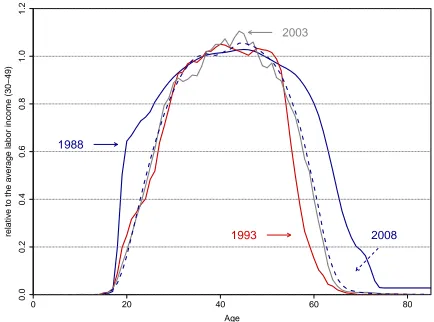
We show the major income sources (i.e., labor income and public pension income) of individuals at different ages, and how these sources changed during the transition period. Figure 1 displays the labor income by age, normalized to the average income of a prime-age adult in the respective year. Labor income refers to the compensation of employees, and does not include income from self-employment, as very few eastern Germans were and are self-employed. In 1988, we see a very evenly distributed income profile over all ages. A steep rise in income before age 20 indicates that most people entered the labor market early; less than one percent of the population were enrolled in tertiary education (Statistisches Amt der DDR 1990). At around age 60, individuals started to exit the labor market, and thus no longer generated income from paid employment. The majority of eastern Germans were employed, even most mothers (Rosenfeld, Trappe, and Gornick 2004). The profiles for the later years are more compressed due to the longer periods of time spent in education, early retirement, and unemployment.
Demographic Research: Volume 33, Article 41
Figure 1: Labor income by age relative to the average labor income of a prime-age adult in the respective year, eastern Germany 1988, 1993, 2003, 2008
0 20 40 60 80
0.0 0.2 0.4 0.6 0.8 1.0 1.2 Age relativ
e to the a
v
er
age labor income (30−49)
1988
1993 2003
2008
Source: Income survey 1988, Income and Expenditure surveys 1993, 2003, and 2008.
Figure 2: Labor income by age, eastern Germany 1988–2008, expressed in 2005 prices
0 20 40 60 80
0 5000 10000 15000 20000 25000 Age
In 2005 pr
ices 1988 (5:1) 1988 (1:1) 1993 2003 2008
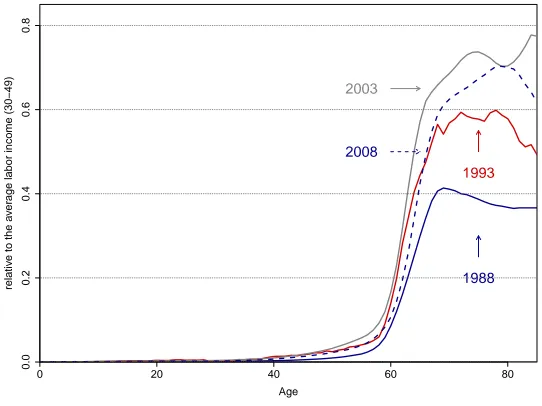
Although the increase expressed in 2005 prices is substantial, in relative terms, peo-ple of younger and older working ages earned less than they did in 1988. It appears that another age group may have gained more income than people of working ages. In-deed, public pension benefits for the elderly rose substantially (Figure 3). Before 1990, an average pensioner in the east only had around 38% of the average labor income of a prime-age adult with which to support himself, and no additional savings to rely on. This changed dramatically after reunification, when eastern Germans became eligible to receive benefits from the generous western German pension system. The average eastern German pensioner had 53% of the average labor income of a prime-age adult by 1993, and 68% by 2003. Within just 15 years, the relative income of the average eastern Ger-man pensioner had doubled. However, it appears that this sharp rise in pensioner income was transitory, as by 2008 the income of the average eastern German pensioner had fallen to 62% (Table 1). The first group of eastern German pensioners, and especially the female pensioners had spent more years in employment than their western German counterparts, which resulted in higher per capita public pension benefits than western Germans. Later, indivuduals suffered from unemployment and disrupted working histories, which lowered their pension benefits.
Figure 3: Public pensions by age, eastern Germany 1988–2008
0 20 40 60 80
0.0
0.2
0.4
0.6
0.8
Age
relativ
e to the a
v
er
age labor income (30−49)
1988 1993 2003
2008
Demographic Research: Volume 33, Article 41
Table 1: Development of pension income and amount transferred to younger generations, East Germany, results for individuals aged 65+
(average per capita)
1988 1993 2003 2008 Pension income as a percentage of the
average earnings of a prime-age adult 38% 53% 68% 62%
Percentage of income transferred
to younger generations >0 2.7% 5.7% 1.7%
Transfers received if unemployed
(% of disposable income) - 0.3% 11.5% 5.0%
Source: National Transfer Accounts, own calculations.
3.2 The importance of private transfers from old to young
Table 1 shows the rise in pension income and the increase in the relative share of pri-vate transfers to succeeding generations. Our data do not allow us to generate precise calculations of the transfer amounts in 1988, the survey indicates small positive values. The micro profiles show inflows at younger rather than at older ages, which suggests that familial transfers were flowing from older people to younger people. Shortly after reuni-fication, we find that only a small fraction of the income of older people is transferred to succeeding generations. As pension wealth increased, the size of the average private transfer from the older to the younger generation became larger. Estimates of the size of these intergenerational transfers are based on reported values from the surveys. Ear-lier studies have shown that patterns of private transfers vary depending on the survey. Borchers (1997) found that more than 80% of adult individuals transferred money to a family member over the past year, whereas Kohli et al. (2006) found that less than one percent of the population in eastern Germany receive a gift or an inheritance in a given year. Previous studies suggest that individuals tend to not report having received smaller gifts. Thus, it appears that the number of donors is larger than the number of recipi-ents (Szydlik and Motel 1999). Nonetheless, the Income and Expenditure Surveys offer some data suitable for studying private transfers, and our method allows us to conduct a meaningful analysis, despite the limitations of the data.
in-terview. Unemployment soared during the economic contraction of the 1990s and many families were affected by job losses. Shortly after reunification, inter-household trans-fers were low: on average, individuals received less than 10 euros of private transtrans-fers per month. In 2003, individuals in the same age range who reported that they were unem-ployed received around 50 euros of net transfers per month, independent of their current family situation. These transfers represented about 11% of their total disposable personal income. Given the findings of other studies, which indicate that family transfers usually flow from older to younger individuals, and are mostly between close family members (Albertini, Kohli, and Vogel 2007), our results indicate that elderly people in the east were using their increased income to help younger family members in need. In 2008, when public pension benefit levels had declined because a growing number of pensioners had interrupted work histories, private intergenerational transfers were also lower.
4. Discussion
The results of our descriptive analysis show, for the first time, the development of income, pensions, and private transfers for different age groups, beginning before the dissolution of the GDR to 18 years after reunification. During this period of transition, the living conditions and the relative incomes of eastern Germans of all ages changed markedly. We show that although income levels rose sharply after reunification, as a percentage of the average labor income of a prime-age adult, income was distributed more evenly across the age groups before reunification. We also find that older people, and especially individuals who were pensioners or were close to retirement age, saw their incomes rise after reunification. Within just 13 years after reunification, the average pension income rose from less than 40% to almost 70% of the average labor income of a prime-age adult. Over the same period, the share of their income that elderly eastern Germans transferred to younger generations doubled.
Demographic Research: Volume 33, Article 41
References
Aguila, E., Kapteyn, A., and Smith, J.P. (2015). Effects of income supplementation on health of the poor elderly: The case of Mexico.Proceedings of the National Academy
of Sciences112(1): 70–75. doi:10.1073/pnas.1414453112.
Albertini, M., Kohli, M., and Vogel, C. (2007). Intergenerational transfers of time and money in European families: common patterns – different regimes? Journal of
Euro-pean Social Policy17(4): 319–334.doi:10.1177/0958928707081068.
Borchers, A. (1997). Die Sandwich-Generation: ihre zeitlichen und finanziellen
Leistun-gen und BelastunLeistun-gen. Campus Verlag.
Case, A. (2004). Does money protect health status? Evidence from South African pen-sions. In:Perspectives on the Economics of Aging. University of Chicago Press: 287– 312.doi:10.7208/chicago/9780226903286.003.0008.
Case, A. and Deaton, A. (1998). Large cash transfers to the elderly in South Africa.The
Economic Journal108(450): 1330–1361.doi:10.1111/1468-0297.00345.
Diamond, P. (1965). National Debt in a Neoclassical Growth Model. The American
Economic Review55(5): 1126–1150.
Duflo, E. (2003). Grandmothers and Granddaughters: Old-Age Pensions and Intrahouse-hold Allocation in South Africa. The World Bank Economic Review 17(1): 1–25.
doi:10.1093/wber/lhg013.
Gjonc¸a, A., Brockmann, H., and Maier, H. (2000). Old-Age Mortality in Ger-many prior to and after Reunification. Demographic Research 3(1): xxx–xxx.
doi:10.4054/DemRes.2000.3.1.
Klenk, J., Rapp, K., B¨uchele, G., Keil, U., and Weiland, S.K. (2007). Increas-ing life expectancy in Germany: quantitative contributions from changes in age-and disease-specific mortality. The European Journal of Public Health17(6): 587–592.
doi:10.1093/eurpub/ckm024.
Kohli, M., K¨unemund, H., Motel, A., and Szydlik, M. (2000). Families apart? Intergener-ational Transfers in East and West Germany. In: Arber, S. and Attias-Donfut, C. (eds.).
The myth of generational conflict: The family and state in ageing societies. London:
Routledge: 88–99.
Kohli, M., K¨unemund, H., Sch¨afer, A., Schupp, J., and Vogel, C. (2006). Erbschaften und ihr Einfluss auf die Verm¨ogensverteilung. Vierteljahrshefte zur Wirtschaftsforschung
75(1): 58–76. doi:10.3790/vjh.75.1.58.
Eco-Demographic Research: Volume 33, Article 41
nomic Life Cycle. In: Martin, L.G. and Preston, S.H. (eds.).Demography of Aging. National Academy Press Washington, DC: 8–49.
Lee, R. and Mason, A. (2011).Population aging and the generational economy: a global
perspective. Edward Elgar Pub.doi:10.4337/9780857930583.
Rosenfeld, R., Trappe, H., and Gornick, J. (2004). Gender and Work in Ger-many: Before and After Reunification. Annual Review of Sociology 30: 103–124.
doi:10.1146/annurev.soc.30.012703.110531.
Samuelson, P.A. (1958). An Exact Consumption-Loan Model of Interest with or without the Social Contrivance of Money. The Journal of Political Economy66(6): 467–482.
doi:10.1086/258100.
Staatliche Zentralverwaltung f¨ur Statistik (1988). Arbeitsrichtlinie f¨ur das Bezirksz¨ahlb¨uro zur Vorbereitung und Durchf¨uhrung der Einkommensstichprobe 1988 in Arbeiter- und Angestelltenhaushalten.Drucksache E4. Ministerrat der DDR.
Statistisches Amt der DDR (1990). Statistisches Jahrbuch der Deutschen
Demokratis-chen Republik. Statistisches Amt der DDR. 35. Jahrgang. Rudolf Haufe Verlag Berlin.
Szydlik, M. and Schupp, J. (1998). Stabilit¨at und Wandel von Generationenbeziehungen.
Zeitschrift f¨ur Soziologie27(4): 297–315.
Szydlik, M. and Motel, A. (1999). Private Transfers zwischen den Generationen.
Zeitschrift f¨ur Soziologie28(1): 3–22.
Vogt, T. and Kluge, F.A. (2013). Care for money? Mortality improvements, increasing intergenerational transfers, and time devoted to the elderly. MPIDR Working Paper
WP-2013-014.
Wagner, I. (2001). Gegenstand und finanzielle Bedeutung des Solidarpakts. ifo Dresden