ISSN Print: 2164-2745
DOI: 10.4236/jasmi.2019.92003 Jun. 5, 2019 22 Journal of Analytical Sciences, Methods and Instrumentation
Design and Construction of a Digital
Multichannel Analyzer for HPGe Detector
Using Digital Signal Processing Technique
Dang Hong Ngoc Quy
*, Pham Ngoc Tuan, Nguyen Nhi Dien
Nuclear Research Institute, DaLat, Viet NamAbstract
The outstanding advantage of digital signal processing (DSP) techniques and Field Programmable Gate Array (FPGA) technology is capable of improving the quality of the experimental measurements for nuclear radiation. In this article, a compact DMCA 8 K was designed and manufactured using DSP technique based on FPGA technology. In particular, the output of the pream-plifier is completely processed by digital techniques which are obtained from the analog-to-digital converter (ADC) to calculate the baseline, DC offset, energy peaks, pile up, threshold discrimination and then the form of energy spectrum. The Spartan-6 board is used as a hardware for the development of the digital multichannel analyzer (DMCA), which is equipped with the 14-bit AD6645 with 62.5 Msps sample rate. The application software for in-strument control, data acquisition and data processing was written under C++ builder via the RS-232 interface. The designed DMCA system has been tested with a HPGe detector using gamma sources of 60Co and 137Cs and a
reference pulser.
Keywords
Field Programmable Gate Arrays, Digital Multichannel Analyzer, Integral Nonlinearity, Digital Signal Processing
1. Introduction
The task of electronics in systems of nuclear physics is to collect the electrical charge deposited in a radiation detector and to convert it into a digital code to be further analyzed by digital elements. In most cases, the significant quantities are the particle energy and the time of particle occurrence. The traditional spectros-How to cite this paper: Quy, D.H.N.,
Tuan, P.N. and Dien, N.N. (2019) Design and Construction of a Digital Multichannel Analyzer for HPGe Detector Using Digital Signal Processing Technique. Journal of Analytical Sciences, Methods and Instru-mentation, 9, 22-29.
https://doi.org/10.4236/jasmi.2019.92003
Received: March 28, 2019 Accepted: June 2, 2019 Published: June 5, 2019
Copyright © 2019 by author(s) and Scientific Research Publishing Inc. This work is licensed under the Creative Commons Attribution International License (CC BY 4.0).
http://creativecommons.org/licenses/by/4.0/
DOI: 10.4236/jasmi.2019.92003 23 Journal of Analytical Sciences, Methods and Instrumentation copy systems for the particle detectors have been made of almost all analog parts constituting a chain of the preamplifier, shaping amplifier and peak sensing ADC configured as separate units. In the recent period, most of the radiation measurement systems designed at Dalat Nuclear Research Institute have been digitalized such as the FPGA-based MCA-8K [1]. However, the above-mentioned system only approaches DSP technique to obtain the exact peak and store to DPRAM. The goal of our design was to build a digital multi-channel analyzer system that would completely base on DSP techniques. This system has func-tioned as follows:
- Digital implementation of the shaping amplifier and peak sensing ADC, - Charge sensitive preamplifier directly connected to the digitizer, - Providing pulse height, time-stamp (16 ns) and optionally raw data, - Pile-up rejection, baseline restoration, ballistic deficit correction, - Best suited for high-resolution spectroscopy (HPGe and Si detectors).
For such purposes, a set of algorithms used in the digital spectrometric chan-nel containing all necessary data acquisition elements have been developed.
2. The Overall Design of DMCA System
The block diagram of DMCA is shown in Figure 1 The DMCA is composed of A/D converter, the CR and pole-zero cancellation, digital pulse processing (DPP) integrated into FPGA, RS-232 communication interface and power supply unit.
2.1. A/D Converter
The analog signal from particle detector is transferred to the high-speed sam-pling ADC for analog-to-digital conversion in real time into FIFO (First-in First-Out) within FPGA. In this design, 14-bitAD6645 is used as a waveform di-gitizer at a sampling rate of 62.5 MHz.
2.2. CR Differentiator and Pole Zero Cancellation
[image:2.595.213.539.584.716.2]The output of collected data from FIFO is an exponential signal with long decay time (50 µs) which is shortened to 3 µs by C-R differentiator. However; it creates an undershoot. A pole-zero cancellation (PZC) circuit is often applied to elimi-nate undershoot in many radiation detectors.
DOI: 10.4236/jasmi.2019.92003 24 Journal of Analytical Sciences, Methods and Instrumentation
2.3. DPP for DMCA
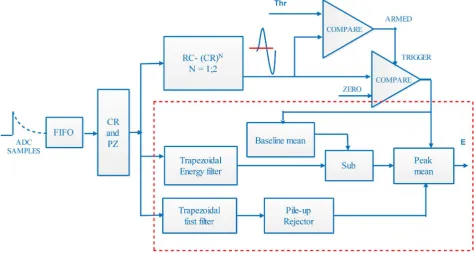
Figure 2 illustrates the DPP system consisting of the various component circuits. In particular, the RC-(CR)N filter identifies pulses, generates triggers and
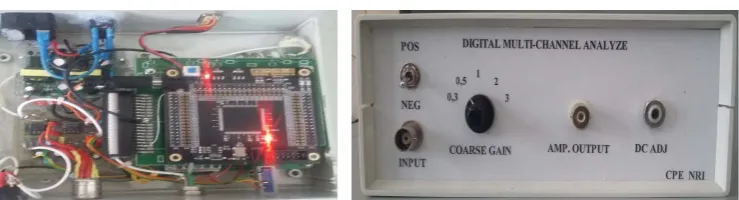
time-stamp. These triggers are also used to initialize all components in the sys-tem. The trapezoidal energy filter shapes the input signal to form a symmetrical shape of the trapezoid [2], restores the baseline and calculates the pulse height. The drift of the baseline mainly is due to respiration or patient movement, varia-tions in temperature and bias in the instrumentation as well. In order to elimi-nate baseline drift, an efficient algorithm for baseline drift correction is imple-mented by digital averaging of the trapezoid wave in cases when the spectrome-tric channel is not busy. The accurate pulse height is obtained by subtracting the raw pulse height of the trapezoidal energy filter with the level of average base-line. At the same time, a fast trapezoidal filter is used for detecting the pile-up input pulse, eliminating pile-up pulses and improving energy resolution. Energy spectrum stored in the built-in RAM of DPP is transferred to the computer via RS-232 port under the controlling of small microprocessor named KPCSM6 supported from Xilinx [3]. The fabricated layout and front panel are illustrated in Figure 3.
2.4. The Application Software
[image:3.595.61.536.452.705.2]For controlling of data acquisition, setting of parameters and interfacing with the computer, an application program was developed, achieving lots of functions including RS-232 serial communication, system parameter settings, spectrum display and spectrum data management, energy calibration, etc.
DOI: 10.4236/jasmi.2019.92003 25 Journal of Analytical Sciences, Methods and Instrumentation Figure 3. Layout of the DMCA on the left and its front on the right.
3. Experimental Measurements and Results
3.1. Determination of Integral Nonlinearity of DMCA
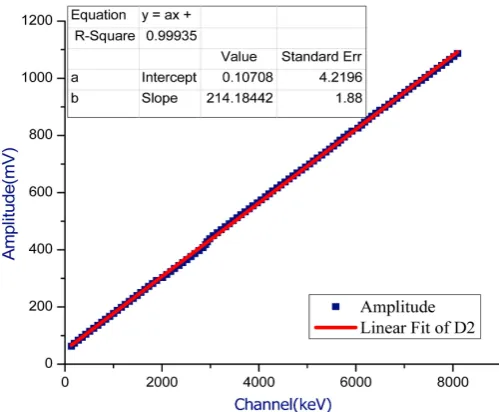
With DMCA system, precise energy calibration of a spectrum depends on the linearity of the system. To test the integral nonlinearity of DMCA, an experi-mental configuration is performed with reference pulser DB-2 generating a posi-tive nuclear tail pulse with the rise time of 100 ns and fall time of 50 μs. Chang-ing the incremental steps from 0 to 1100 mV, with the 44 mV step up. The cor-responding channel-voltage value pairs are listed in Table 1.
Figure 4 reveals the experimental fitting function of y = 0.10708x + 214.18442, where x is the amplitude of the input signal, y is the estimated channel. The coefficient of determination R2 = 0.99935. Replacing X
i = (197 ÷ 866.8 mV) with
i є [1, 44], then 44 values of Yi is obtained. Therefore, ΔYmax = (Yr – Yi)max =
22.354 and Ymax = 7777. According to reference (ORTEC, CAMAC ADCs and
Memories), integral nonlinearities are calculated as follows:
max
max
22.354
100% 0.28%
7777
DMCA Y
INL
Y
∆
= × = =
3.2. The Effects of Input Rise Time on Peak Shape and FWHM
Figure 5 shows the comparison of the peak of 137Cs from HPGe detector withdifferent input rise times. The lowest amplitude peak is for input rise time of 20 ns (FWHM = 7 keV), the center peak is for input rise time of 50 ns (FWHM = 5 keV) and the highest peak is for input rise time of 100 ns (FWHM = 4 keV).
3.3. The Effects of Pile-Up Rejection on Energy Spectrum
Figure 6 shows the effects of pil-up mode on Compton background in gamma spectroscopy. To optimize for a Compton suppression detector system, pile-up mode is added. When being activated, it provides more-clear photopeak from a
137Cs and 60Co source above the Compton continuum.
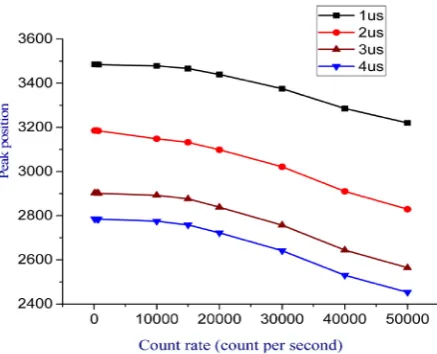
3.4. The Effects of Input Count Rate on the Peak Position
DOI: 10.4236/jasmi.2019.92003 26 Journal of Analytical Sciences, Methods and Instrumentation Figure 4. Integral nonlinearity of DMCA.
Figure 5. Comparison of spectrum peak shapes with different shaping times.
[image:5.595.256.491.531.704.2]DOI: 10.4236/jasmi.2019.92003 27 Journal of Analytical Sciences, Methods and Instrumentation Table 1. Results of integral nonlinearity of the DMCA.
No. X (mV) Yr Yi ∆Ymax No. X (mV) Yr Yi ∆Ymax
1 197 48 219.354 −22.354 23 630.4 3912 635.538 −5.138
2 216.7 109 225.925 −9.225 24 650.1 4095 655.249 −5.149
3 236.4 263 242.512 −6.112 25 669.8 4271 674.205 −4.405
4 256.1 429 260.391 −4.291 26 689.5 4462 694.778 −5.278
5 275.8 615 280.425 −4.625 27 709.2 4644 714.380 −5.180
6 295.5 759 295.935 −0.435 28 728.9 4823 733.660 −4.760
7 315.2 941 315.538 −0.338 29 748.6 4947 747.016 1.584
8 344.9 1118 334.602 0.298 30 768.3 5130 766.726 1.574
9 354.6 1297 353.882 0.718 31 788 5230 777.497 10.503
10 374.3 1458 371.223 3.077 32 807.7 5476 803.993 3.707
11 394 1655 392.441 1.559 33 827.4 5671 824.996 2.404
12 413.7 1795 407.520 6.180 34 847.1 5858 845.138 1.962
13 433.4 1963 425.615 7.785 35 866.8 6105 871.742 −4.942
14 453.1 2161 446.941 6.159 36 866.5 6308 893.606 −7.106
15 472.8 2330 465.144 7.656 37 906.2 6517 916.117 −9.917
16 492.5 2498 483.239 9.261 38 925.9 6696 935.397 −9.497
17 512.2 2698 504.781 7.419 39 945.6 6880 955.215 −9.615
18 531.9 2906 527.184 4.716 40 965.3 7058 974.387 −9.087
19 551.6 3183 557.019 −5.419 41 985 7239 993.883 −8.883
20 571.3 3375 577.699 −6.399 42 1004.7 7408 1012.085 −7.385 21 591 3551 596.656 −5.656 43 1024.4 7595 1032.227 −7.827 22 610.7 3727 615.612 −4.912 44 1044.1 7777 1051.830 −7.730
Table 2. Count-rate performance of DMCA 8K.
Count rate (Kcps)
1 µs 2 µs 3 µs 4 µs
Peak
channel (ch) shift (%) Peak channel Peak Peak shift channel Peak Peak shift channel Peak Peak shift
0.1 3485 0 3185 0 2903 0 2785 0
0.5 3485 0 3185 0 2903 0 2785 0
0.7 3484 0.02 3184 0.03 2901 0.07 2784 0.04
10 3478 0.2 3148 1.2 2892 0.3 2775 0.4
15 3466 0.5 3132 1.7 2876 0.9 2758 0.9
20 3439 1.3 3098 2.7 2838 2.2 2722 2.2
30 3375 2.3 3021 4 2757 4.7 2641 4.8
40 3285 5.2 2910 7.1 2644 8.1 2530 8.2
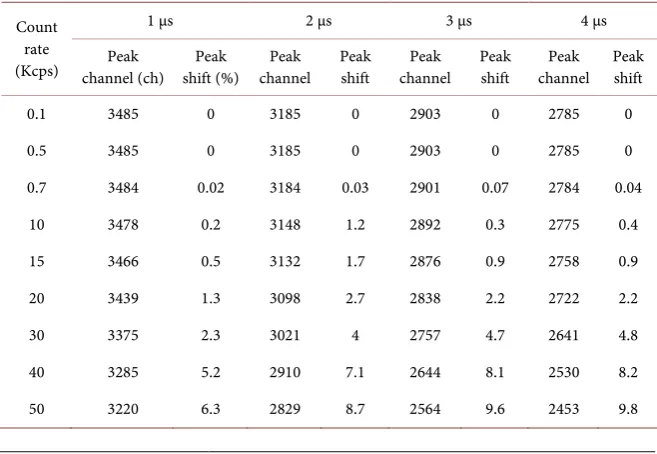
[image:6.595.209.538.512.739.2]DOI: 10.4236/jasmi.2019.92003 28 Journal of Analytical Sciences, Methods and Instrumentation Figure 7 shows a slight descending trend with increasing ICR for the position of peaks with different shaping time (1; 2; 3 and 4 µs). This means that with the increase of count rate, all the energy peaks shifted to lower energies.
3.5. Energy Resolution (FWHM)
The energy spectra collected from the 60Co are shown in Figure 8 with the
per-cent FWHM energy resolution of each discernible peak labeled. In particular, FWHM of 60Co at 1173 is 5 keV comparing to 4 keV with ORTECT’s DSPEC jr.
4. Conclusions
[image:7.595.265.484.312.489.2]This work carried out a design and construction of a compact DMCA-8K based on FPGA for high resolution gamma spectroscopy. This article also conducts an observation on the performance and quality of this system such as input count rate, FWHM, peak shape, peak position, pile up rejection, integral nonlinearity. Main technical characteristics are as follows:
[image:7.595.257.493.521.707.2]Figure 7. The effects of various input count rate on peak position.
DOI: 10.4236/jasmi.2019.92003 29 Journal of Analytical Sciences, Methods and Instrumentation
ADC conversion bit: 14-bit, sampling rate: 62.5 MHz
Resolution: 8192 channels, The integral nonlinearity: 0.23%,
Maximum count capacity per channel: 232−1,
Shaping time: 1; 2; 4; 6 and 12 µs by software,
Course gain: 0.3; 0.5; 1; 2 and 3,
DB9 connector for preamplifier power supply
On-line pile-up rejection,
The input receiving positive, unipolar pulse peak amplitude from 0 to 1.1 V,
Data acquisition program MCA DAQ has written in CBuilder ++ 6.0,
self-executing under Windows XP environment.
Conflicts of Interest
The authors declare no conflicts of interest regarding the publication of this pa-per.
References
[1] Lanh, D., Son, P.N. and Son, N.A. (2014) In-House Development of an FPGA-Based MCA8K for the Gamma-Ray Spectrometer. SpringerPlus, 3, 665.
https://doi.org/10.1186/2193-1801-3-665