ISSN Online: 2162-2086 ISSN Print: 2162-2078
DOI: 10.4236/tel.2019.95089 Jun. 14, 2019 1383 Theoretical Economics Letters
Bitcoin—Upsides, Downsides and Bone of
Contention—A Deep Dive
Awadhesh Pratap Singh, Vikrant Kulkarni
Indian Institute of Management, Lucknow, India
Abstract
The purpose of this study is to perform a systematic literature review on Bit-coin and unveil its upsides, downside and divergent views from previous stu-dies. The paper presents a systematic literature review of key studies pub-lished on Bitcoin between 2008 and 2019. The focus is given to three topics: benefits of Bitcoin; its shortcomings; and divergent views presented by pre-vious cryptocurrency scholars in details. The results indicate that Bitcoin of-fers four key benefits—its acceptance as a digital currency, effective portfolio diversifier, hedging capabilities and higher security. Literature review re-vealed five major shortcomings of Bitcoin—weak substitute for traditional currency, higher volatility, idiosyncratic risks, uncertain regulatory impact and its exogenous supply. Finally, the review reveals three major areas wherein cryptocurrency scholars found to have divergent view—acceptance of its hedging capabilities across regions and portfolios, consensus on Bitcoin as highly secured and safe asset and, general acceptance of Bitcoin as a subs-titute of traditional currencies.
Keywords
Cryptocurrency, Bitcoin, Peer to Peer Electronic Cash System
1. Introduction
“We should be looking at Cryptocurrencies like Bitcoin very seriously because of the way they can be used, particularly by criminals”, said Theresa May, the Prime Minister of UK about explaining the danger cryptocurrencies can pose. Cryptocurrencies are becoming increasingly popular due to their creative tech-nology, secured implementation, relevant usage across diverse fields and
in-vestment prospects [1]. Due to their assessment of investment assets, they are
considered to be an attractive topic for technologist, financial analysts and in-How to cite this paper: Singh, A.P. and
Kulkarni, V. (2019) Bitcoin—Upsides, Down-sides and Bone of Contention—A Deep Dive. Theoretical Economics Letters, 9, 1383-1392.
https://doi.org/10.4236/tel.2019.95089
Received: April 2, 2019 Accepted: June 11, 2019 Published: June 14, 2019
Copyright © 2019 by author(s) and Scientific Research Publishing Inc. This work is licensed under the Creative Commons Attribution International License (CC BY 4.0).
DOI: 10.4236/tel.2019.95089 1384 Theoretical Economics Letters vestors. Though there are certain issues that are associated with Bitcoin which make them a risky bet especially for financial markets. Most notably, their usage in unregulated markets augments the ambiguity to its perceived valuation and implementation in the relevant context such as temporary shutdown of ex-changes in China that resulted in a cascading effect of other exex-changes and
caused price buster and huge price movements [2].
The increase in market value of Bitcoin indicates that it is an investment asset; however at the same time, its restricted transaction usability forced the previous
scholars to question whether it is comparable to gold and currency [3]. Probably
due to its potential to replace the existing currency markets, many financial ser-vices organizations started questioning its unregulated regime [4]. If Bitcoin be-comes the universally accepted medium of transaction and thus replaces the global currencies, this could create unsettling results for large financial firms, in-fluence the monetary policies, financial sector and global economy. In this back-drop, the paper explores the cryptocurrency literature and reviews the key stu-dies published on Bitcoin between 2008 and 2019. The review is structured on three key themes, namely, benefits of Bitcoin, its shortcomings and areas wherein previous cryptocurrency scholars had divergent views.
The study offers two novelties. First, this study revisits benefits and con-straints of Bitcoin by reviewing the key papers between 2008 and 2019; thus, this includes the latest findings and evidences provided by cryptocurrency literature. Second, to the author’s knowledge, this is the first study that explores divergent observations made by cryptocurrency scholars.
The rest of the paper is organized as follows. Section 2 covers key studies on Bitcoin and outlines its upsides, downsides and divergent outcomes observed by cryptocurrency scholars. Section 3 concludes and outlines the key findings.
2. Bitcoin: Key Studies and Their Findings
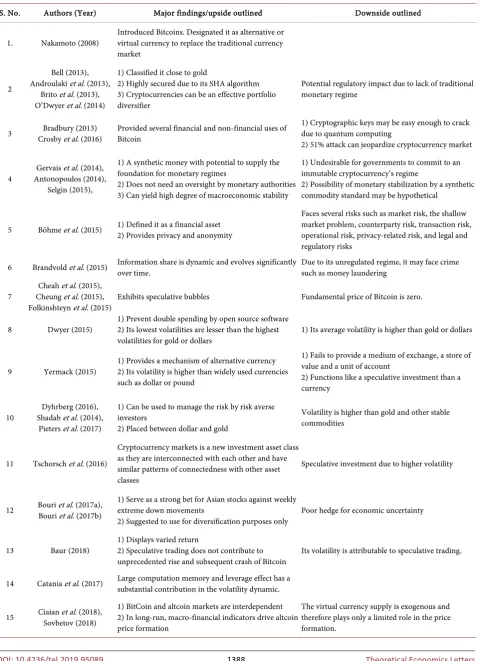
In his seminal paper, namely, “Bitcoin as a Peer-to-Peer Electronic Cash Sys-tem”, [5] first talked about the alternative or virtual currency which has a power to compliment the current financial systems and may have potential to root out the current currency market. Following that, many scholars investigated on Bit-coin and outlined advantages, shortcomings and its potential use cases on vari-ous businesses. Table 1 displays the key Bitcoin studies, their upsides and down-sides. The findings of the table can be classified into three major categories, ad-vantages of Bitcoin, its shortcomings and inconsistent observations obtained by cryptocurrency scholars.
2.1. Bitcoin: Advantages
Cryptocurrency literature offers four major advantages of Bitcoin. First, Bitcoin
as an alternative or virtual currency [3][6] [7]. Many scholars termed it as an
asset. Most notably, [8] who argued that cryptocurrencies are capable of
macroeco-DOI: 10.4236/tel.2019.95089 1385 Theoretical Economics Letters nomic stability. On the similar topic, [9][10] and [11] debated that Bitcoin is a synthetic money and argued that while it has potential to supply the foundation for monetary regimes, it does not require oversight by any monetary authority.
To establish that cryptocurrencies play a role of economic exchange, [12]
ex-plained several financial and non-financial uses of Bitcoins.
Second, Bitcoin as an effective portfolio diversifier. For example, several
cryptocurrency scholar such as [13] [14] [15] explained that cryptocurrencies
can be leveraged for managing the risk especially by risk averse investors in the
event of negative shocks to the market. Similarly, [3] [16] [17][18] compared
cryptocurrencies with other assets such as gold and debated that it is an effective portfolio diversifier.
Third, leveraging Bitcoin as an effective hedging tool to mitigate risk. For
ex-ample, [19] debated that Bitcoin returns are negatively associated with the
Eco-nomic policy uncertainty (EPU) and can serve as a hedging tool against ecoEco-nomic
policy uncertainty. [13] examined the hedging capabilities of cryptocurrencies
and explained that bitcoin can be used as a hedge against American dollar in the short-term. On comparing with gold, he found that Bitcoin possess some of the same hedging abilities as gold and can be included in the variety of tools availa-ble to market analysts to hedge market specific risk. [20] investigated the nature of interaction between Bitcoin and financial variables and their transmission mechanisms while analyzing the diversification and hedging effectiveness across gold asset and stock market. The finding suggested that a short position in the Bitcoin market allows hedging the risk investment for various financial assets. Especially, hedging strategies involving gold, oil, equities and Bitcoin reduce portfolio’s risk considerably, as compared to the risk of the portfolio made up of gold, oil and equities only.
Fourth, Bitcoin as highly secured digital currency. [3] and [17] debated that due to its public and private key pairs wherein private key helps to decrypt the encrypted messages, it is one of the most secured way of carrying out economic transactions. [16] explained that Bitcoin transactions are immutable, therefore, it
ideally cannot be stolen or changed once they are made. [8] argued that Bitcoin
provides anonymity to perform transactions. [21] introduced ByzCoin, a new
Byzantine consensus protocol that uses scalable collective signing to commit Bitcoin transactions irreversibly.
While there have been other advantages outlined as well such as diverse usage of Bitcoin [8][12], freedom of payment due to lack of central counterparty [16]
[22], low transaction fee due to its digital nature [23] and many more, however
they were broadly fitting into these four themes explained by the study.
2.2. Bitcoin: Shortcomings
DOI: 10.4236/tel.2019.95089 1386 Theoretical Economics Letters of monetary stabilization by a synthetic currency such as Bitcoin may look hy-pothetical due to its higher volatility. Similarly, [6] argued that as an ideal cur-rency provides a medium of exchange, a store of value, and a unit of account, but bitcoin largely fails to satisfy these conditions.
Second, several scholars argued that Bitcoin’s volatility is higher than the vo-latilities of widely used currencies such as dollar or pound, therefore, this poses a large short-term risk to function like a speculative investment than a currency [6][8][24] [25]. Similarly, [26] argued that cryptocurrency market contains its
own idiosyncratic risks that are difficult to hedge against. [27] debated that
cryptocurrency shows the attributes of speculative bubbles. They built an eco-nomic and econometric modelling of Bitcoin prices and explained that Bitcoin exhibits speculative bubbles and the fundamental price of Bitcoin is zero. Simi-larly, [28] conducted an econometric investigation of the existence of bubbles in
the bitcoin market based on bubbles detecting technique proposed by [29]. For
the period 2010-2014, they detected a number of short-lived bubbles, most im-portantly, they found three huge bubbles in the latter part of the period 2011-2013 lasting from 66 days to 106 days, with the last and biggest one demonstrating the departure of Mt Gox exchange in early 2014.
Third, Bitcoin posses several risk such as market risk, the shallow market problem, counterparty risk, transaction risk, operational risk and privacy-related risk [8]. Market risk refers to higher volatility of cryptocurrency due to market factors [26]. Prices are often more volatile and assets are less liquid. Shallow market problem in Bitcoin arises due to limited number of actors involved in the transactions and that makes its prices more volatile [6]. Counterparty risk arises due to lack of central counterparty in Bitcoin transaction as no neutral party in-tervenes in case of disputes [12]. Transaction risk refers to the transaction
im-mutability which means a transaction cannot be edited once made [9].
Opera-tion risk is related to mass failure of Bitcoin network that could cause hazard
and may lead to shut down of Cryptocurrency markets [30]. Privacy risk is
linked to the identity of people carrying out Bitcoin transactions. Many Bitcoin scholars explained that Bitcoin transactions are not completely anonymous and can be traced back to individuals [8][12]. Due to these risks, the acceptance of Bitcoin as a substitute of traditional currency looks to be an unlikely scenario.
Fourth, regulatory impact appears to be a grey area for the usage of Bitcoin. Many scholars argued about its potential regulatory constraints. For example,
[3] explained that while the regulatory regime is somewhat unclear due to
Bit-coin’s digital nature, however potential implementation is likely as the usage in-creases. [16] [17] [18] argued that potential regulatory implication is likely as
cryptocurrency has possibility to be misused and can invite fraud. [31] argued
DOI: 10.4236/tel.2019.95089 1387 Theoretical Economics Letters Fifth, cryptocurrency supply is exogenous and depends on several factors such as inflation, market policy and economic growth impacts, which makes its price
highly unpredictable and volatile. [32] argued that macro financial factors such
as inflation, economic output, employment and investments play an important role for the supply of Bitcoin and therefore impact the price discovery of Bitcoin.
[33] explained that cryptomarket-related factors such as market beta, trading
volume, and volatility are the significant determinant for the cryptocurrencies both in short- and long-run. Besides, attractiveness of cryptocurrencies also
plays an important role for price determination [7]. This indicates that price
discovery of Bitcoin is a complex phenomenon which is highly influenced by economic and market factors.
2.3. Bitcoin: Divergent Views
While the upsides and downsides of Bitcoin have been clearly outlined by pre-vious scholars, there have been divergent views on four of its attributes. First, acceptance of Bitcoin’s hedging capabilities across regions and portfolios. For example, many cryptocurrency scholars such as [13][19] and [20] hailed Bitcoin as a good hedging mean for economic policy uncertainty and selected currencies
i.e. American dollars. However, there are many other scholars who argued
oth-erwise. For example, by taking several developed economies, [34] and [35]
ar-gued that Bitcoin is a poor hedge for economic uncertainty and is suggested to use for diversification purposes only with an exception of Asian stocks. Similar-ly, [27] and [36] argued that due to its highly speculative nature, Bitcoin may not be an ideal candidate of hedging. Overall, the topic of hedging through Bitcoin has generated somewhat mixed views across regions and type of assets.
Second, a broader consensus on Bitcoin as highly secured and safe asset. For example, [3][17] and [16] debated in favor of Bitcoin’s security and accepted it as one of the most secured way of doing economic transactions. On the other
hand, [12] challenged this premise and argued that while Bitcoin is highly
se-cured due to its private and public key mechanism, its cryptographic keys may
be easy enough to crack due to advanced quantum computing. [30] [37]
ex-plained about the 51% attack wherein if 51% transactions owned by colluding entities can lead to massive fraud in cryptocurrency landscape. Similarly, [8] de-bated about Bitcoin’s privacy risk and explained while Bitcoin’s transactions are anonymized, however due to its distributed ledger technology which is driven by open source, their linkages can be traced using complex algorithms.
Third, acceptance of Bitcoin as a substitute of traditional currencies. While
many cryptocurrency scholars [3] [7][8][9][10] argued and accepted Bitcoin as
an alternative currency regime, several scholars provided a divergent view and explained Bitcoin’s shortcomings that hinder it to be accepted as traditional
currency. Most notably, [6] debated that despite of offering a mean for
DOI: 10.4236/tel.2019.95089 1388 Theoretical Economics Letters Table 1. Literature review: bitcoin—upsides and downsides.
S. No. Authors (Year) Major findings/upside outlined Downside outlined
1. Nakamoto (2008) Introduced Bitcoins. Designated it as alternative or virtual currency to replace the traditional currency market
2
Bell (2013), Androulaki et al. (2013),
Brito et al. (2013), O’Dwyer et al. (2014)
1) Classified it close to gold
2) Highly secured due to its SHA algorithm 3) Cryptocurrencies can be an effective portfolio diversifier
Potential regulatory impact due to lack of traditional monetary regime
3 Crosby et al. (2016) Bradbury (2013) Provided several financial and non-financial uses of Bitcoin 1) Cryptographic keys may be easy enough to crack due to quantum computing 2) 51% attack can jeopardize cryptocurrency market
4 Antonopoulos (2014), Gervais et al. (2014), Selgin (2015),
1) A synthetic money with potential to supply the foundation for monetary regimes
2) Does not need an oversight by monetary authorities 3) Can yield high degree of macroeconomic stability
1) Undesirable for governments to commit to an immutable cryptocurrency’s regime
2) Possibility of monetary stabilization by a synthetic commodity standard may be hypothetical
5 Böhme et al. (2015) 1) Defined it as a financial asset 2) Provides privacy and anonymity
Faces several risks such as market risk, the shallow market problem, counterparty risk, transaction risk, operational risk, privacy-related risk, and legal and regulatory risks
6 Brandvold et al. (2015) Information share is dynamic and evolves significantly over time. Due to its unregulated regime, it may face crime such as money laundering
7 Cheung et al. (2015), Cheah et al. (2015),
Folkinshteyn et al. (2015) Exhibits speculative bubbles Fundamental price of Bitcoin is zero.
8 Dwyer (2015) 1) Prevent double spending by open source software 2) Its lowest volatilities are lesser than the highest
volatilities for gold or dollars 1) Its average volatility is higher than gold or dollars
9 Yermack (2015) 1) Provides a mechanism of alternative currency 2) Its volatility is higher than widely used currencies such as dollar or pound
1) Fails to provide a medium of exchange, a store of value and a unit of account
2) Functions like a speculative investment than a currency
10 Shadab et al. (2014), Dyhrberg (2016), Pieters et al. (2017)
1) Can be used to manage the risk by risk averse investors
2) Placed between dollar and gold
Volatility is higher than gold and other stable commodities
11 Tschorsch et al. (2016)
Cryptocurrency markets is a new investment asset class as they are interconnected with each other and have similar patterns of connectedness with other asset classes
Speculative investment due to higher volatility
12 Bouri et al. (2017a), Bouri et al. (2017b) 1) Serve as a strong bet for Asian stocks against weekly extreme down movements
2) Suggested to use for diversification purposes only Poor hedge for economic uncertainty
13 Baur (2018) 1) Displays varied return 2) Speculative trading does not contribute to
unprecedented rise and subsequent crash of Bitcoin Its volatility is attributable to speculative trading.
14 Catania et al. (2017) Large computation memory and leverage effect has a substantial contribution in the volatility dynamic.
15 Ciaian et al. (2018), Sovbetov (2018) 1) BitCoin and altcoin markets are interdependent 2) In long-run, macro-financial indicators drive altcoin price formation
DOI: 10.4236/tel.2019.95089 1389 Theoretical Economics Letters Continued
16 Corbet et al. (2018) Limited connectedness between cryptocurrency markets and other financial markets such as gold, bond FX, SP 500, VIX and GSCI
Cryptocurrency market contains its own idiosyncratic risks that are difficult to hedge against
17 Demir et al. (2018) Bitcoin can serve as a hedging tool against economic policy uncertainty
18 Guesmi et al. (2018) Dyhrberg (2016)
1) A short position in the Bitcoin market allows hedging the risk investment for various financial assets 2) Portfolio made of gold, oil, equities and Bitcoin reduce portfolio’s risk considerably as compared to the risk of the portfolio made up of gold, oil and equities only.
Tax treatment of Bitcoin is not very clear across borders
19 Eyal et al. (2018)
Explained an attack on Bitcoin which can have significant consequences: rational miners will prefer to join the selfish miners, and the colluding group will increase in size until it becomes a majority
1) Bitcoin protocol is not incentive-compatible 2) Explained an attack with which colluding miners obtain a revenue larger than their fair share
an ideal substitute for traditional currency [13][14][38]. While Bitcoin is fairly well recognized as an alternative currency, however its acceptance as a tradition-al currency has been questioned. Overtradition-all while Bitcoin has been accepted as a synthetic or virtual currency, it’s role to replace traditional currency generated mixed opinions.
3. Conclusion
The paper examines key studies in Bitcoin between 2008-2019 to draw upsides, downsides and divergent views. The results indicate that Bitcoin offers following four key benefits. First, its acceptance is as a digital or virtual currency. Second, it acts as an effective portfolio diversifier. Third, it can be used to hedge risk due to its hedging capabilities; fourth, it is considered to be a safe bet due to higher security. The literature review revealed following five major shortcomings of Bitcoin. First, it is a weak substitute for traditional currency. Second, its volatility is relatively higher compared to other assets such as gold or traditional curren-cies such as American dollar. Third, idiosyncratic risks make this a complex as-set. Fourth, despite being an electronic currency, Bitcoin is not regulated and therefore, its regulatory impact is uncertain. Fifth, its supply is exogenous and depends on several factors such as inflation, market policy and economic growth impacts, which makes its price highly unpredictable and volatile. Finally, the re-view reveals following three major areas wherein cryptocurrency scholars found to have divergent views. First, acceptance of its hedging capabilities is across re-gions and portfolios. Second, consensus on Bitcoin is highly secured and safe asset and third and finally, general acceptance of Bitcoin is as a substitute of tra-ditional currencies.
Conflicts of Interest
DOI: 10.4236/tel.2019.95089 1390 Theoretical Economics Letters
References
[1] Klein, T., Thu, H.P. and Walther, T. (2018) Bitcoin Is Not the New Gold—A Com-parison of Volatility, Correlation, and Portfolio Performance. International Review of Financial Analysis, 59, 105-116.https://doi.org/10.1016/j.irfa.2018.07.010 [2] Chuen, D.L.K. (2015) Handbook of Digital Currency: Bitcoin, Innovation, Financial
Instruments, and Big Data. Academic Press,Cambridge, MA.
[3] Bell, C. (2013) Bitcoin: Virtual Money or Risky Investment? Technical Report. https://Bankrate.com
[4] Glaser, F., Zimmermann, K., Haferkorn, M., Weber, M.C. and Siering, M. (2014) Bitcoin—Asset or Currency? Revealing Users’ Hidden Intentions. ECIS 2014. https://ssrn.com/abstract=2425247
[5] Nakamoto, S. (2008) Bitcoin: A Peer-to-Peer Electronic Cash System.
[6] Yermack, D. (2015) Is Bitcoin a Real Currency? An Economic Appraisal. In: Hand-book of Digital Currency, Elsevier, Amsterdam, 31-43.
https://doi.org/10.1016/B978-0-12-802117-0.00002-3
[7] Tschorsch, F. and Scheuermann, B. (2016) Bitcoin and Beyond: A Technical Survey on Decentralized Digital Currencies. IEEE Communications Surveys & Tutorials, 18, 2084-2123.https://doi.org/10.1109/COMST.2016.2535718
[8] Böhme, R., Christin, N., Edelman, B. and Moore, T. (2015) Bitcoin: Economics, Technology, and Governance. Journal of Economic Perspectives, 29, 213-238. https://doi.org/10.1257/jep.29.2.213
[9] Selgin, G. (2015) Synthetic Commodity Money. Journal of Financial Stability, 17, 92-99. https://doi.org/10.1016/j.jfs.2014.07.002
[10] Gervais, A., Karame, G.O., Capkun, V. and Capkun, S. (2014) Is Bitcoin a Decentra-lized Currency? IEEE Security & Privacy, 12, 54-60.
https://doi.org/10.1109/MSP.2014.49
[11] Antonopoulos, A.M. (2014) Mastering Bitcoin: Unlocking Digital Cryptocurrencies. O’Reilly Media, Sebastopol, CA.
[12] Crosby, M., Pattanayak, P., Verma, S. and Kalyanaraman, V. (2016) Blockchain Technology: Beyond Bitcoin. AppliedInnovation, 2, 71.
[13] Dyhrberg, A.H. (2016) Hedging Capabilities of Bitcoin. Is It the Virtual Gold? Finance Research Letters, 16, 139-144.https://doi.org/10.1016/j.frl.2015.10.025 [14] Shadab, H.B. (2014) Regulating Bitcoin and Block Chain Derivatives. NYLS Legal
Studies Research Paper.https://doi.org/10.2139/ssrn.2508707
[15] Pieters, G. and Vivanco, S. (2017) Financial Regulations and Price Inconsistencies across Bitcoin Markets. Information Economics and Policy, 39, 1-14.
https://doi.org/10.1016/j.infoecopol.2017.02.002
[16] Androulaki, E., Karame, G.O., Roeschlin, M., Scherer, T. and Capkun, S. (2013) Evaluating User Privacy in Bitcoin. In: Sadeghi, A.R., Eds., Financial Cryptography and Data Security, FC 2013, Lecture Notes in Computer Science, Springer, Berlin, Heidelberg, 34-51. https://doi.org/10.1007/978-3-642-39884-1_4
[17] Brito, J. and Castillo, A. (2013) Bitcoin: A Primer for Policymakers. Mercatus Cen-ter at George Mason University,Arlington, VA.
[18] O’Dwyer, K.J. and Malone, D. (2014) Bitcoin Mining and Its Energy Footprint. 25th IET Irish Signals Systems Conference 2014 and 2014 China-Ireland International
Conference on Information and Communications Technologies, Limerick, 26-27
DOI: 10.4236/tel.2019.95089 1391 Theoretical Economics Letters [19] Demir, E., Gozgor, G., Lau, C.K.M. and Vigne, S.A. (2018) Does Economic Policy
Uncertainty Predict the Bitcoin Returns? An Empirical Investigation. Finance Re-search Letters,26, 145-149.https://doi.org/10.1016/j.frl.2018.01.005
[20] Guesmi, K., Saadi, S., Abid, I. and Ftiti, Z. (2018) Portfolio Diversification with Virtual Currency: Evidence from Bitcoin. International Review of Financial Analy-sis,in press. https://doi.org/10.1016/j.irfa.2018.03.004
[21] Kogias, E.K., Jovanovic, P., Gailly, N., Khoffi, I., Gasser, L. and Ford, B. (2016) En-hancing Bitcoin Security and Performance with Strong Consistency via Collective Signing. Proceedings of 25th USENIX Security Symposium, Austin, TX, 10-12 Au-gust 2016, 279-296.
[22] Woo, D. (2013) Bitcoin: A First Assessment.
[23] Kaşkaloğlu, K. (2014) Near Zero Bitcoin Transaction Fees Cannot Last Forever.The International Conference on Digital Security and Forensics, VSB-Technical Univer-sity of Ostrava, Czech Republic, June 2014, 91-99.
[24] Baur, D.G., Dimpfl, T. and Kuck, K. (2018) Bitcoin, Gold and the US Dollar–A Rep-lication and Extension. Finance Research Letters, 25, 103-110.
https://doi.org/10.1016/j.frl.2017.10.012
[25] Catania, L. and Grassi, S. (2017) Modelling Crypto-Currencies Financial Time-Series.
SSNR.https://doi.org/10.2139/ssrn.3028486
[26] Corbet, S., Meegan, A., Larkin, C., Lucey, B. and Yarovaya, L. (2018) Exploring the Dynamic Relationships between Cryptocurrencies and Other Financial Assets. Economics Letters, 165, 28-34.https://doi.org/10.1016/j.econlet.2018.01.004 [27] Cheah, E.T. and Fry, J. (2015) Speculative Bubbles in Bitcoin Markets? An
Empiri-cal Investigation into the Fundamental Value of Bitcoin. Economics Letters, 130, 32-36. https://doi.org/10.1016/j.econlet.2015.02.029
[28] Cheung, A., Roca, E. and Su, J.J. (2015) Crypto-Currency Bubbles: An Application of the Phillips-Shi-Yu (2013) Methodology on Mt. Gox Bitcoin Prices. Applied Economics, 47, 2348-2358.https://doi.org/10.1080/00036846.2015.1005827 [29] Phillips, P.C., Shi, S. and Yu, J. (2015) Testing for Multiple Bubbles: Historical
Epi-sodes of Exuberance and Collapse in the S & P 500. International Economic Review, 56, 1043-1078.https://doi.org/10.1111/iere.12132
[30] Bradbury, D. (2013) The Problem with Bitcoin. Computer Fraud & Security, 2013,
5-8.https://doi.org/10.1016/S1361-3723(13)70101-5
[31] Brandvold, M., Molnár, P., Vagstad, K. and Andreas Valstad, O.C. (2015) Price Discovery on Bitcoin Exchanges. Journal of International Financial Markets, Insti-tutions and Money, 36, 18-35.https://doi.org/10.1016/j.intfin.2015.02.010
[32] Ciaian, P., Kancs, A. and Rajcaniova, M. (2018) Virtual Relationships: Short-and Long-Run Evidence from BitCoin and Altcoin Markets. Journal of International Financial Markets, Institutions and Money, 52, 173-195.
https://doi.org/10.1016/j.intfin.2017.11.001
[33] Sovbetov, Y. (2018) Factors Influencing Cryptocurrency Prices: Evidence from Bit-coin, Ethereum, Dash, LitBit-coin, and Monero. Journal of Economics and Financial Analysis, 2, 1-27.
[34] Bouri, E., Gupta, R., Tiwari, A.K. and Roubaud, D. (2017) Does Bitcoin Hedge Glo-balun Certainty? Evidence from Wavelet-Based Quantile-in-Quantile Regressions. Finance Research Letters, 23, 87-95. https://doi.org/10.1016/j.frl.2017.02.009 [35] Bouri,E., Molnár, P., Azzi, G., Roubaud, D. and Hagfors, L.I. (2017) On the Hedge
DOI: 10.4236/tel.2019.95089 1392 Theoretical Economics Letters Research Letters, 20, 192-198.https://doi.org/10.1016/j.frl.2016.09.025
[36] Folkinshteyn, D., Lennon, M.M. and Reilly, T. (2015) The Bitcoin Mirage: An Oasis of Financial Remittance. Journal of Strategic and International Studies, Forthcom-ing.
[37] Eyal, I. and Sirer, E.G. (2018) Majority Is Not Enough: Bitcoin Mining Is Vulnera-ble. Communications of the ACM, 61, 95-102.https://doi.org/10.1145/3212998 [38] Dwyer, G.P. (2015) The Economics of Bitcoin and Similar Private Digital