ADOLESCENT RESPONSE IN A NUCLEAR AGE: AN EXPLORATORY STUDY
A thesis
submitted partial fulfilment of the requiremen~s for the Degree
Master of Arts Psycholcgy in the
University Canterbury by
Greta Barnhart-Thomson
ABSTHACT
The present study investigates the awareness of New Zealand adolescents towards nuclear issues and
towards New Zealand's nuclear prospects in world affairs. A questionnaire was constructed 'I.'lhich was used to examine the level of awareness, as well as cognitive, emotional and political reactions to the fu·ture in relation to these issues. Five hundred and seventy adolescents
(287 males and 283 females) aged 13 to 18 inclusive took part in the study. The results show that the
adolescents believed that nuclear war is likely in the future, and that New Zealand has enemies without there being a consensus over the enemies. The results
further reveal sex and age differences in attitudes. Females were more pessimistic and less politically knowledgeable than males. Pessimism and cynicism increased with age. The results suggest that whi these adolescents were pessimistic about the future in the wider realm, on a personal level they were respond-ing in a positive way with efficacy towards the issues. The qualitative data also indicate that these young people were angry about New Zealand's prospects and towards nuclear issues. Cross-national comparisons are made between the present findings and sJcudies from other nations. The results are further discussed with reference to political socialization and the
to the
united Nations' International Year
of Peace,
given
thesis.
ACKNOI'VLEDGMENTS
I am very grateful to the manypeop who have
assistance with the preparation of this
My sincerest thanks are due to those special
staff fellovl workmates within the Departmen't of
Psychology, particularly Dr B.G. stacey who directed
and guided this research from its outset. Through
his assistance, insights, constructive criticism and
support, this thesis took shape. I am also much indebted to Drs M.S.R. Singer and C. Ward who very generously gave of
and helpful advice.
i r time, offering much instructive
The computer centre staff, and in particular
Dr W.J. Rosenberg, have devoted considerable effort to
advise and assist with the statistical analyses.
The library f from both the University and
the Clinical School of Medicine were tireless in their
efforts to obtain requested materials and were always
approachable and helpful.
I am indebted to the many young people, on which this study is based, who have shared their
private thoughts and concerns.
enthusiasm underl
to me.
why this
ideast comments
is so important
Finally, I save my deepest expressions for John,
the one closest to me and my companion throughout.
continuous support and encouragement helped to
CONTENTS
ABSTRACT II
DEDICATION III
ACKNOWLEDGMENTS IV
CONTENTS V
LIST OF TABLES VII
LIST OF FIGURES VIII
CHAPTER
ONE INTRODUCTION 1
TWO LITERATURE REVIEW 4
2.1 INTRODUCTION 4
2.2 GENEPiliL BACKGROUND 5
2.3 YOUTH' RESEARCH FINDINGS IN
THE 1940' s M\lD 1950's 8
2.4 YOUTH RESEARCH FINDINGS IN
THE 1960's AND 1970's 9
2.5 YOUTH RESEARCH FINDINGS IN
THE 1980's 19
THREE METHODOLOGY 32
3.1 RATIONALE 32
3.2 RESEARCH DESIGN 33
3.2.1 The Study-Design Stage 33 3.2.2 Anticipatory Data Analysis 33
3.3 THE SOCIAL SURVEY 34
3.3.1 The pilot Study 34
3.3.2 The Questionnaire 34
3.4 SUBJECTS 37
3.5 PROCEDURE 38
3.5.1 Setting 39
FOUR FIVE RESULTS 4.1 4.2 4.3 4.4 4.5 4.6 4.7 4.8 4.9 INTRODUCTION DATA ANALYSIS RESPONSE RATE GENERAL FINDINGS
SURVEY RESULTS INCLUDING SEX AND AGE DIFFERENCES
THE CONSERVATIVE SCALE
COMPARATIVE STUDIES - NEW ZEALAND AND AUSTRALIA
COMPARATIVE STUDIES - NORTHERN HEMISPHERE
COMPARATIVE STUDIES -CONSERVATIVE SCALE
DISCUSSION 41 41 41 42 44 44 59 61 67 75 77
5.1 INTRODUCTION 77
5.2 INTERPRETATION OF FINDINGS WITH
SEX AND AGE DIFFERENCES 77 5.2.1 Political Beliefs and Conservatism 77
5.2.2 Cognitive Reactions 80
5.2.3 Emotional Reactions 83
5.2.4 Politic Knowledge and the Role
of Education 87
5.3 IMPLICATIONS 88
5.3.1 Clinical/Mental Health
Considerations 88
5.3.2 Media Effects and Considerations 89
5.3.3 Political Socialization and
Educational Considerations 90 5.4 LIMITATIONS AND RECOlfwrnNDATIONS 93
SIX CONCLUSIONS 97
SEVEN BIBLIOGRAPHY 101
EIGHT APPENDICES
I THE SOCIAL SURVEY QUESTIONNAIRE
TABLE I
II
III
LIST OF TABLES
Dis.tribution of Subjects by Sex and Age within each of 4 Schools
Sex Distribution of Correct Answers to Knowledge Questions
Two-way Frequency Table of Variables "Easy to accept own expectationsll
IV Two-way Frequency Table of Variables "Desire to be a survivor of a nuclear war"
V
VI
VII
VIII
IX
X
Two-way Frequency Table of Variables "Justification for nuclear war"
Two-way Frequency Table of Variables "Desirability of n~clear weapons on a limited basis" .
Two-way Frequency Table of Variables lI'the Bible predicts nuclear war" Two-way Frequency Table of Variables
IIApproval on ban of nuclear-armed shipsll
Conservative Scale Ratings Scorers Two-way Frequency Table of Variables indicating Political Point View
37
52
53
53
55
55
55
56 59
[image:7.569.60.493.91.511.2]FIGURE I
II
III
IV
V
LIST OF FIGURES
Sex/Age Distribution of Respondents to Question: Would you let the prospects of nuclear war affect your plans to ever have children?
Age Distribution of Nuclear Conflict Questions
Sex/Age Distribu-tion of Respondents who Disagree with Statement: New Zealand's civil defence is prepared in event of nuclear war in Australia/NeZ.
Age Distribution of Subjects Studied in School
Sex/Age Distribution of Respondents who Disagree with Question: Would you want to be a survivor of a nuclear war?
VI Sex/Age Distribution of Respondents to Question: Do you feel more secure without nuclear ships visiting N.Z. ports?
VII VIII
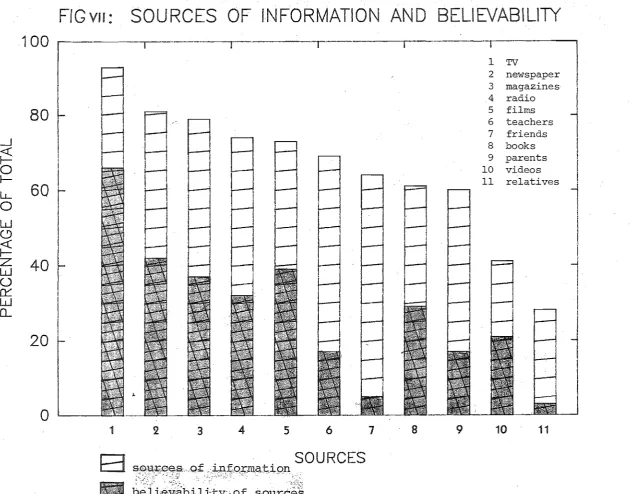
Sources of Information and Believabili-ty Distribution of 31 Conservative
Respondents by Sex/Age/School
46
48
49
51
54
57
58
INTRODUCTION
Living in a nuclear age has presented researchers with a new set of issues which health professionals and educators are viewing with growing concern. In recent years, there has been increased northern hemisphere research directed towards the impact of the threat of nuclear war on children and adolescents (e.g. Beardslee and Mack, 1982, 1983~ Chivian et al., 1983~ Escalona, 1982; Goldberg et al., 1985~ Goldenring and Doctor,
1984~ Holmborg and Bergstfom, 1984~ Schwebel and Schwebel, 1982; Solantaus et al., 1984, 1985). However, the
extent to which findings in the United States, Scandinavia and the Soviet Union apply to adolescents in countries historically and geographically "distant" from areas of overt superpower confrontation has not been so well
documented. Australian researchers (Mann and Digby, 1984; McMurray and Prior, 1985) have presented findings with
differing results, one indicating a global awareness while the latter showing more egocentrism. Shallcrass (1968), Shallcrass and Gavriel (1982) and Gray and Valentine
(1984) were the first studies in New Zealand, the results of which indicate that young people are concerned about the future with regard to nuclear issues, if lacking in-depth information and knowledge.
polled by Remmers and others (1947) to discover that the majority of them expected their country to be involved in another war within 25 years. This may in fact be the initial survey of young people in the nuclear age. It was some 15 years after this opinion poll before
other studies emerged which assessed awareness and beliefs of united states' children and adolescents about nuclear weapons and the possibilities of war (Allerhand, 1965; Darr, 1963; Escalona, 1962, 1963, 1965; Schwebel, 1965). It was argued that the pessimism about the future as
recorded in these early studies was having a destructive and denigrating influence on the developmental processes of otherwise "normal" youth.
The research from the sixties in the northern
hemisphere was interpreted as revealing increased youthful fear, anxiety, uncertainty, and a sense of hopelessness and helplessness about the future. There was also
evidence of cynicism, apathy, denial and avoidance of the issues which extends through into some of the eighties' literature. The nuclear age was partially to blame for youth's egocentrism and escape into drugs. Failure to adopt long-term goals meant that no plans for the future or hope existed - only impending doom, according to some reports. Tizard (1984) acknowledged these findings, but made worthy comments about the difficulty in validating such assumptions. It had become clear that such patterns in young people had not eventuated and some of the more recent research results were found to differ in ways contrary to these earlier findings. Of particular
from countries other than the United states.
There has been very little investigation of adolescent awareness nuclear issues in New Zealand. Therefore, i t is the aim of this study to ascertain
whether adolescents have any formulated ideas or opinions about current issues involving war, peace and nuclear weapons. If so, the intention will then be to ascertain the level of political understanding which these
adolescents are knowledgeable and to objectively substan-tiate the nature of their beliefs. This study's results will then be compared with other New Zealand research findings as well as those from overseas studies.
In Chapter Two, the literature pertaining to adolescent avlareness, attitudes and opinions abou·t war, peace and nuclear issues is reviewed, focussing on work relevant to the aims of this study. Chapter Three sets out the research rationale and methods including the instrumen·t conducting the study and its procedure. Chapters Four and Five contain the results of this study's findings and discussion respectively, with some
implications for future research. presented in the final chapter.
CHAPTER T~tJO
LITERATURE REVIEW
2.1 INTRODUCTION
There are many reasons for predicting that the ever present possibility of nuclear war, and all of the associated -tensions of nuclear war, should produce a wide variety of human responses. It might also be predicted that such responses would be maladaptive and, in general, difficult to identify and evaluate owing to the nature of attitude research. A review of the adolescent literature pert~ining to the nuclear predic-ament indicates that such studies, to da"te, are pioneer inquiries which may best serve to promote additional research as ;,vell as impress the need for further investigation.
The reactions of adults to nuclear threats have been the subject of a large amount of research by
2.2 GENEP~L BACKGROUND
From the earliest. moments of ·the atomic age, according to Boyer (1986), a spontaneous and
well-j us·ti uncertainty as well as fear s'\vept over America; triggered partially by politicization of terror in lectures, radio programmes, mass magazines such as LIFE and COLLIER'S, and artic like "Mist of Death over New York" in a 1947 READER'S DIGEST. This article described the worst panic known in human history, and depicted in realistic detail an atomic explosion in Nevi York
harbour that sent a deadly radioactive cloud drifting over the city and beyond. . The magazine's editor vlrote at this time: "I think that we . . . are that a sense of fear is probably necessary to break public apathy." In fact, the earl literature generally provoked a sense of fear and loathing, with horrors of atomic war depicted in the most vivid imaginable terms. This type
literature remains the most widespread today, supported by a large number research scientists, psychologis·ts and political activists. In recent , however, researchers have found that apathy and self-cenJcredness may prevail as well in response to a nuclear awareness. These at·ti tudes may be tied to the envisaged proximity
(or alternatively the lack of proximity) to the imminent danger of the nuclear threat. Less prolific is any research suggesting much hopefulness or optimism about the aJcomic age.
over-whelming nature and the requirements of very rapid adjusJcments. They claimed that this contribu·ted to a turning away from rational solutions.and towards traditionalism and nationalism. "Psychological
numbing" a concept which Robert J. Lifton coined in his book, THE BROKEN CONNECTION (1979) to describe in neo-Freudian terms the defence mechanisms which have evolved in IIlearning to live with the bomb". Political and military leaders as well as scientists are able to "ge"t on wi th things" by exc 1 uding the personal
feelings a coniliination of blocking and absence of
images. kmong the general population, this
.
i~mobilisingcondition is often tied to either apathy or to a feeling of helplessness and hopelessness, according to Beck and Frankel (198l) and other theorists. The psychological mechanisms which come into play include avoidance ("I
don't want Jco think about itll} , resignation (lilf i t happens,
i t happens ll ), and a blocking of feelitig; This blocking tends to lead to the result that people go about their daily business as though the nuclear threat does not exist. It is this phenomenon of psychological numbing which researchers have come to recognise as being the most paralysing; for although too much anxiety inhibits one from taking action, so too does emotional numbing
(Boyer, 1986; Sandman and Valenti, 1986).
Kraus, Mehling and El-Ass (1963) claimed that reactions of populations to danger (varying from mass hysteria to general apathy) provoke perplexing problems
which some anti-nuclear activists and researchers have published has served to achieve oppos and opposing effects -to what may have been desired or to what has indeed been expected. Much of the early literature and tha-c which has followed may have unwi t-tingly contributed to a nuclear build-up on the part of government policy* as a consequence of public attitudes.
Volkan (1985) takes phenomenon of nuclear proliferation further by suggesting that people (and consequently governments) need to have enemies; that there is a natural, psychologically based necessity to have advers in order to maintain and regulate their sense of "self". Frank (1982) says that the "image of
.Iche enemy" is universal. When threatened by political
or military conflic'c, members any group revert to childhood ways of reinforcing bonding. Volkan sees this need as the basis of political psychology and
such character traits are crystallised in adolescence. The cogency of this developmental approach suggests that youthful attitudes must be tapped and better understood.
Much of the adolescent literature to date comprises research which is ly anxiety-based, full of fear, helplessness and lessness, or apathy and denial. Only very recently have there been some studies to
indicate emotional responses which might lead to possible useful action, if the theorists are correct.
*
Such government policy had the e ofThe following literature revieliv is presen"ted chronologically by decade, beginning with the 1940's and 1950's, then turning to the 1960's and 1970 l s, and
concluding finally with the most current you"th-orientated research relating to the nuclear threat in the 1980's.
2.3 YOUTH RESEARCH FINDINGS IN THE 1940l s A~D 1950l s
The work of J.B. Watson during the early part of the century established that fear is an emo"tional response with psychological underpinnings. It was not until
nearer mid-century, however, that fears of a political nature ",[ere more selective!ly examined. Generally,
investigators disclosed that lower socio-economic children tended to have more fears than upper socio-economic
children (Angelino, Dollins and rilech, 1956). Girls were reported to hold more fears than boys, Negro children more than Caucasian children and that fears in young
children increased with age (Jersild, Goldman and Loftus,
1941~ Lapouse and Monk, 1953; Pratt, 1943). Fear of
animals ,"vas recorded as the most common fear along with supernatural events and beings, as well as their own
personal safety. Gastwirth and Silverblatt (1943) found little or no difference in the number of fear reactions towards war among "normal" young adolescents of different intellectual levels. From childhood to adolescence, various studies (Angelino and Shedd, 1953; Lapouse and !-10nk, 1953; Pintner and Levy, 1940) were not in agree-ment as to the most prevalent types of fears. Of these studies, only Angelino and Shedd es·tablished that
The Purdue University Division of Educational Reference polled 10,000 high school students throughout the United Sta·tes in 1947 to establish how young people looked at war and peace. Remmers, together with other members of the Division, found that almost half of their
sample believed that the United states would fight in another war within five years, whi two-thirds expected their country to become involved in another war within t.he next twenty-five years. This survey was conduc'ced before the Soviet Union tested their first atomic bomb
1948.
2.4 YOUTH RESEARCH FINDINGS IN THE 1960's AND 1970's
studies in early 1960's occurred at a time of heightened cold war tensions between Western powers and
communist bloc countries. Research undertaken by Adams (1963), A11erhand (1963), Escalona (1962., 1963 and 1965), Sch\.vebe1 (1965), ~vade (1962) and Wrightsman (1964) assessed the awareness and beliefs of American young people about nuclear weapons and the chance of war. Apparently, some of these studies were prompted by the Berlin Wall and Cuban missile crises.
A majority of those interviewed during this time spontaneously referred to nuc weapons and war.
A11erhand is one researcher who has suggested that these young peop
situation.
were aware and reacting to the cold war His .investigation (an indirect approach which acquired reactions of youth through parents' report) indicated that 70% of young people talked
reported that 35% of parents heard their primary school children express concern and presumably some emotional reactions about becoming sick from fallout or fear of actual a-ttack. These chi ldren, 1Ilho came from some 200 families, revealed more concern about their own self-protection than an awareness about the needs of others; although their attitudes generally reflected a world vie'\v in their thinking about the future.
Escalona (1963) reported that more than 70% of her sampling of about 300 youth aged 10-17 spontaneously
mentioned the issue of war and peace when asked to
project into the world of the future. In this question-naire, there was careful avoidance of any reference to the bomb or war. Escalona simply asked: IIThink about the world as i t may be about 'cen years from now. What are some of the ways in which i t may be different from what i t is today?" Replies included visions of a grue-some existence underground, or in terms of possible wholesale destruction. Escalona concluded that youth of all ages were responding to the dangers of a nuclear war.
A much larger study by Schwebel (1962) came to very similar conclusions. In sum, from a sample of 2500 young people, the majority said that in the event of a nuclear war they would have the most to lose.
portion their lives, and they would miss the opportunity to enjoy the pleasures they had hardly
even begun to taste, according to Schwebel. When asked what they expected if there were a nuclear war, many of the responses were eloquent in their simplicity: iiI will die", or "We will all die. 1I Most of those who
thought that they might live, nevertheless felt that
their fate would be as bad as death. They were confused about wanting and hoping to be safe if i t meant enduring a bomb shelter existence. Schwebel reported that there was virtually unanimous concern about the prospects of
nuclear war, although the "brighter" and older students were more optimistic. He suggested that those subjects who were from survival needs faced the social crises
in a different manner than did those who were more tied to satisfying their primary needs. Schwebel commented in his discussion that the higher aptitude and better-informed classes students at all levels tended to oppose the bomb shelter programme. They believed that there was little value in the shelters.
Remmers joined together with Blumenfeld and
Franklin in a 1962 Purdue Panel to poll youth attitudes towards civil fence and fallout shelters. Of the 2,000 high school students, 78% reported that they had heard at least some talk about fallout shelters in their home. At all ages there was clear evidence of an
awareness, with 37% believing that the possibility of war was likely, 43% thinking that there was at least a
subjects turned to media sources in 64% of -the cases. During this same , Wade (1962) conducted a study of indirect method or disguised approach in the form of a sentence completion test. School leavers and first-year university studen-ts were asked to comp sentences like: "r_ly greatest fear regarding the future is ... II and II I worry about . . . Ii Although 23% of the
sample of 600, in ansvlering the first question, used words relating to \'var and weapons, this was small
compared with those who indicated personal fears relating to school, family, marriage and career. The item on worry showed the same pattern, but more sharply - with only 4% making any mention of war, security or survival. Wade concluded tha-t than 4% could be described as greatly affected by nuclear war threat, and that s than 8% of his first-year university student sample
responded to the fear-of-the-future item with war-related words. Considering that the purpose· of vJade I s study was
not known to the subjects, and the nature of the open-ended questions gave them several opportunities to express fear of war, the results contrast with earlier findings thus far.
study as evidence decreases with
On the contrary, ~i7ade used his this kind of fear or anxiety
A study by Adams (1963) also confirmed that
attitude and opinion change with age. From a sample of 4,000 young people, opinions vlere sought as to the major problem of the country. The one mentioned most
frequently was "war with Russ II but in increasing age
percentage of those who this as the major problem. Both Adams and Schwebel established that almost 50% of their samples believed a war was possible or likely.
In a questionnaire study of 400 young adolescent boys, Wrightsman (1964) found that almos·t 60% worried
II some, a lot, or all of ·the time" about a war starting,
and 70% expected war within the next 20 years. The pessimism about the future which was recorded in
early studies, particularly those involving younger age samples, resulted in speculation that the threat war in general, and nuclear war in particular, migh'c be having a destructive and maladaptive influence on developmental processes in otherwise "normctl" wel functioning American
children.
Notable research of international scope was the Mankind 2000 Project, administered in 1967-68 under the direction of Johan Galtung (1969). A questionnaire was devised in Europe, involving 14 countries and 11,000 people between the ages of 14 and 40. The object was to discover the attitudes of the group who would be providing much of the influence in their respective
countries by the 2000 A.D. Galtung made clear that the research would have no predictive value; that i t only intended to tap attitudes at that time. A condensed summary of the maj or findings in the student. samples
(which came from West Germany, tain, New Zealand, Sweden and the United States) indicated that students were highly expo to and concerned "\tTi th the future,
perspectives of the countries in which they lived. They lacked a map of the fu"cure and -the future did not seem to have a direction for them. They knew better wha"t they did no t want, did not accept and did not
believe in than the opposite. students tended to have a more gloomy vie-;;,v of the present and future standing of "the world than older subjects in the sam-pIe. They were -the most sceptical about peace proposals.
Galtung is credited with having established the conceptual dimensions of "negative peace" and "positive peace II • The former he defined as absence of organised
violence or war be"tween groups or nations. Peace is
,
here seen as a state of passivity and absence of contacts between such groups or nations. The latter concept is defined as something like co-operation patterns, and aims at integration between groups or nations. Peace in this context is seen more as an active process, where contacts are exchanged and activity is expressed. Galtung believed that i t was important to differentiate between these two concepts because he did not consider peace to be merely the absence of war.
In 1968, Shal1crass administered to New Zealand schools a questionnaire which was patterned after the Mankind 2000 Project. He found that over half of the sample of 600 sixth formers thought about the future of the world and talked and read about i t . Only 11% had a very pessimistic view for themselves, their country, and the world. Generally, opinion was optimistic, although 23% thought people would be less happy, 48% thought
would be s job satisfaction, and 25% thought that there would be lesspersonal kindness in future. This sample revealed that students we~e cynical about science and its ability to influence what ,\.yere seen as important elements in Ii On the question of the possible influence of science on peace, 83% hoped i t would have a positive luence, but only 10% Jchought i t would be effective. The gap between hope and expectation was large. On the likelihood of nuclear war, 38% believed that there would be a world war within
20 however, 30% believed that total disarmament was possible. Given there was a war, however, 80%
.
bel that there would be total destruction or, at best, irreparable losses. Only 15% believed -that NewZealand could stay out of a world war. Forty per cent believed that there could be justification for conven-tional warfare and only 36% could see no justification
for Vlar. In terms of nuclear war, however, 68%
believed i t was unjustified.
Shallcrass found his 1968 sample to be sceptical of peace propositions, and females were significantly more pessimistic than ,,'lere males. Nevertheless, females expected to exercise increasing control of own
lives where males thought there would be more external control. Females were more concerned for the general good than for the individual good, whereas males reversed this choice. Shallcrass suggested that although
strong support for those policies ~hich were expressions of hope.
A cross-cultural comparison of British and
Japanese youth was undertaken, by Cooper '(1965). About
350 young people aged 7-16 w'ere asked to relate their images of "war" and IIpeacell
• He considered that
children less than 7 years old would not have an aware-ness of war and peace, but by 8 years old, that their images would be fairly defined., His results from
interviews indicated that "peace" prompted fe\-ver responses than Ilwar", ,that justification for war grew more
necessary with age, and that fewer females than males believed war is justi.fiable. More females believed that war is more likely and that they would survive it. By age 11-13, youth seemed to be aware of the destructive
effects of a nuclear conflict, but nevertheless felt somehow that they would escape it. Inf ac'c, Cooper identified a tendency at all ages for youth to subjec-tively view their own personal probability of survival of a nuclear war as being better than others. weinstein
(1980) has labelled this hopeful outlook on life as "unrealistic optimism", a bias which, he confirmed from studies \with an older age sample's perception of various
life events.
Japanese youth tended to differ from the British sample in that they were more aware of contemporary events, people, countries, and personalities than
They were preoccupied with peace and activities which actively expressed more protest and anti-war
associations. Japanese respondents were more optimistic
about the future of nuclear energy, less likely to predict a war in the future and were more preoccupied with peace as an international movement, compared with British youth. The results were consistent with certain findings about attitudes as reported by Galtun'g (1969).
Rlvik (1968) replicate4 Cooper's investigation in part, having dropped what were considered to be provocative questions. In interviews with'170 Norwegian'youth, Alvlk o . concluded that older ones make more use of available
f,
sources of information concerning war and peace. with age, the subjects increasingly made more use of all the
sources mentioned to them. Young people from higher socio-economic levels tended to.converse with their
parents more. However, the main. agents for socialisation were the media. Socio-economic background seemed to
playa greater role for youth with higher abilities in reciprocal reasoning, but not· with utilisation of
available sources. Rlvik indicated that reciprocal
reasoning as well· as the type of socio"':"economic background
played ari important role in the moral judgment of 'ivar. Rosell (1968) conducted an exploratory- study in Sweden in the same year,' patterned after Cooper and
1\1
vik 's studies. He found from his sample of 200 thatfemales mentioned more about war consequences and less
about war processes" while males were the opposite. His ,subjects perceived peace as the negation of war, a
.,)'.
female "\vill to defend II tendencies increased with age
\!'lhen their family was concerned, male "will to defend" friends decreased with age. His results confirmed
i terns in Cooper and
lh
vik 's research 'l.vi th the dimensionsof war being perceived mainly as "war processes" and "consequences". The concept of "peace"'l.vas mainly
perceived as a state of stillness or~silence and not as an active process towards integration.
Kramer, K:alick and Milburn (1983) examined
respon-ses to nuclear-related survey items from 1945'-1982.
They found that one indicator of public concern regarding nuclear weapons was the amount of public opinion polling on the subject at different points in time. In fact, there was a significant positive correlation between their item count and a count of .magazine articles con-cerning nuclear items over the years. Peaks in item counts corresponded to the. initial AmeriGan use of atomic bombs (1945) ; the Soviet acquisition of the hydrogen bomb (1953); the cold war crises of the early 1960's; and anti-nuclear political activity in the West
(from 1981 onwards). Lowther (1973) correlated
first-year university students' sense of powerlessness regarding nuclear weapons with their feelings of
complacency on the subject. However, apart from this Kansas study, and a task force formed by the American Psychiatric Association in 1977, research which tapped
on nuclear attitudes was noticeably lacking in the 1970's. Consequently, this literature review resumes with current studies which have taken form in the
2.5 YOUTH RESEARCH FINDINGS IN THE 1980's
Tizard (1984) outlined a fairly' extensive review of developmental research on young people's understanding of nuclear issues in the 1980's while highlighting
problematic aspects of such research. Studies which she has already examined will only be referred to in brief.
In 1977, the American Psychiatric Association formed a task force to look at the nphychosocial Aspects of Nuclear Developmentsll
• Between 1978 and 1980,
questionnaires were administered to approximately
lPOO
students aged TO-18, from Boston, Baltimore, Philadelphia and Los Angeles in the United States. More detailed responses were obtained through questionnaires and
discussions wfth 100 students aged 1 18. In this very widely-cited study by Beardslee and Mack (1982), more
than 50% of one sample surveyed thought that a nuclear war was possible and the great majority did not believe
that they could survive a nuclear attack. They reported that the possibility of nuclear war had affected their plans for marriage' or having children. The interviews revealed uncertainty, anxiety, helplessness· and a sense
.
of hopelessness about -the future. There was also much sadness, cynicism and bitterness among these adolescents, owing to a lack of trust of adult society, as well as being faced with the prospect of inheriting a world verging on doom.
Other recent investigations involving both
of nuclear war .and live in fear of i t (Bachman, 1983; Chivian et al., 1985; Chivian and Snow, 1983;
Escalona, 1982; Goldberg et al., 1985; 'Goldenring and Doctor, 1985; Goodman et al., 1983; Gray and Valentine, 1984; Holmborg and Bergstrom, 1984f : Mack, 1981; Hann and Digby, 1984; Schwebel and Schwebel, 1982; Smith, 1982; Solantaus et al., 1984, 1985). Further, there is evidence that preoccupation with these issues among youth has increased' over time. According' to Bachman.
(19a3), in 1975, 7%~f about 20,000 10~17 yea~ olds
polled in 130 schools around the United states said that they often worried 'about the chance of' nuclear war;
whereas in 1982, the corresponding figure was over 31%. In the A.rnerican Psychiatric Task.Force Report, Beardslee. and .~1ack suggested that adolescent personality development may be distorted by.fears of imminent
annihilation. .. Healthy ?evelopment, they argued,
depended on an adolescent's ability to reduce disappoint-ments by looking forward to a future time in which they might possess what cannot be had now. An individual's establishment of enduring values depends upon the delay of present satisfaction in favour of. future goals. But they suggested that: " ... such development is compromised in a settinQ (wher~) a future appears to have been
development of. (youth)" (1982, pp. 6067607).
\
The Institute of Social Research at the University of Michigan administered to high schools across the
United States a. survey entitled, "I'-1.onitoring the Future" (Smi th, 1982). The questionnaire included the following questions: "Of all the problems facing the nation today,
how often do you worry about the following?" Problems addressed in the questionnaire included "crime and
violencell
, tleconomic problemsl l, . "race relations.", and
IIchance of nuclear war". Students responded by choosing between "never" and "seldoni", "sometimes" or "often". Over an 8 year period,.the proportion of the sample of 16-19,000 senior high students who often worried about
the chance of nuclear war increased fourfold. If the categories are collapsed to include "sometimes", the
trend goes from 40% to 64%. In response to the state-ment, liMy guess is that this country will be caught up in a major world upheaval in the next 10 yearsl,~, 43% of
the males and 21% of the females agreed. In response to the statement, "Nuclear or biological annihilation will probably be the fate of all mankind within my
lifetime", one-third agreed. Citing the Michigan Institute of Social Research data, Yankelovich (1982) linked the shift specifically to the perceived threat of nuclear war and the sense of futurelessness ,that
results from it. An associate of Yankelovich,
Elisabeth Noelle~Neumann, reported tha,t "no future" was a widespread slogar:- among young people in vJest Germany.
Similarly, Yankelovich reported despair, gloom and a
.I . .'
throughout Weste:r::n Europe and the United states. He related that the mood of the fu·ture 'was very
threatening - one of shortages, greater,difficulty and a closing in of horizons.
The data from the United Stat~s tends to dominate
'che literature vdth many of the conclusions having a similar mood of distress and disillusionment. The United States' research may in part .be a reflection of
the researchers' emphasis, but it may also'show that young people may differin~umerous ways, not least of
all by their nationality and experience. It has been found that some. studies undertaken outside of the
United states have some differing conclusions.
Indications from Elder (1965) and more recently from Tizard (1984, 1986 } have suggested that· in spite
of the studies' conclusions, there is still very little scienti c evidence to support such claims. Elder cautioned making generalisation or basing belief on logical inference. He wrote: "We forget that our
(youth) are maturing in a world which to us is bizarre but to them commonplace. (Young people) accept the
world as they find it, and, lacking the broad perspec-tive of adults, do not.have the same basis for anxiety"
(1965, p. l23). Tizard said that.al,though the assump-tions (about how youth are reacting) seem reasonable, that there is difficulty with accurately assessing this
n impactu.
problems.
She is concerned with these,methodological The remaining research studies are arguably no more rigorous in their assessments; however, they
Chi vian, X1ack, Waletzky, Lazar~ff, 'Doctor and Goldenring (1985) undertook a study of 540 Soviet
subjects to be compared with an age-matchl3d Californian sample of 900. Soviet adolescents were found 'co possess optimism quite contrary to other survey research. This attitude in no way discounted their unanimous concern that the prospects of a nuclear war were very disturbing, but they were of the opinion that nuclear war would
not
eventuate. By comparison, the majority of Goldenring
and Doctor's Californian sample expressedmuch'pessimism about the future. These same pessimistic adolescents were found to be the most mature and be'tter academically of their group, contrary to earlier research that found "brighter" students to be the more optimistic (Schwebel,
1965). The Soviet optimism may be attrib"l,ltable to their invol vement in peace-related activities - ." an observation made by Goldberg and her colleagues in a recent Canao.ian
study.
Goldberg, LaCombe, Levinson, Parker, Ross and
Sommers (1985) considered that while their data indicated that thinking about. nuclear issues does appear to elicit many worries in young people, it was pos.sible that the very asking' of such questions stimulated m0re' anxiety and worry than students actually experienced in their
everyday lives. Consequently, the direct questioning strategy may in fact be creating the anxiety it is
supposed to be measuring.
With this in mind, an open-ended questionnaire was designed incorporating questions modelled after the
been conducted just prior to their research .. The survey was administered to 2,,000 Ontario·subjects, divided into two samples. The first sample was carr~d out in
...
metropolitan high schools, half of which were comprised of immigrant groups (Chinese, Italian and Portuguese) and the other half of which were Canadian-born. The
( ..
second sample were largely English-speaking Caucasians of middle and lower socio-economic status." The findings indicated that the nuclear threat was a fu·ture concern. Nuclear war was spontaneously mentioned by over half of both samples, .but i t was suggested that the concern with the threat of nuclear war was not more intrusive than other worries and did not necessarily lead subjects to foreclose their personal futures. Nevertheless, a large group were classified as .helpless, with an inability to express their fears. Only a minority were. willing to acknowledge their anxieties. This minority group was also optimistic that .constructive. action could. be taken, and had a stronger sense of personal and social efficacy than the rest. . In ,fact, those· who were most often
fearful and anxiousabout.the threat of nuclear war were also those who felt the least helpless, whereas those who said they had not felt fearful. and .anxious also
expressed the stronges.t. feelings of helplessness. Socio-economic status was not a determinant of whether or not students w0rJ:ied about nuclear war . However, i t was concluded that those who worried most about nuclear war also worried most about personal plans.
general health questionnaire to ask 5,600 students throughout Finland about the future. Solantaus,
Rimpela and Taipale (1984) and Solantaus, Rimpela and Rahkonen (1985) confirmed that a large.percentage of
,
their samples. mentioned fear of war; although~ older subjects expressed more optimism and ideC!_s, vfhich were efficacious. Fears of war
and
hopes for'peace declined with age, with the former largely outweighing anyc'.
projected hopes £orpeace. Females expressed stronger "
fears of war.than males and like Rosell (1968), females were more concerned with \varconsequences than processes. There were also interesting socio-economic differences in their sample. While Coles (1984) suggested that preoccupation with the threat of nuclear war was a
middle-class issue that did not affect the lower socio-economic class, Solantaus found that the highest (upper white collar)
and
the lowest (unskilled worker) groups(a) thought about 'i{far the most, (b) discussed war and peace the most, and (c) were most optimistic about their own possibilities to prevent war. These findings
contrast \vith Croake and Knox (1973) whose lower socio-economic group of subjects reported significantly more political fear than the upper socio...,economic status group. Blackwell and Gessner (1984) found that Negro young people were more fearful' and pessimistic than Caucasian youth, but i t is not clear whether this may be an ethnic rather than a class difference.
Possibly of most current interest, Solantaus and RimpeHa (in press) confirmed that those who had
confident in their own ability to contribute to the prevention of war. Thinking and anxiety tended·to
correlate positively with confidence. Their datt.a
suggested that these discussions support these youth in facing up to the anxiety and in coping with the situation by social action. other findings" were that subjects had increased hope in areas concerning \vork, education, human relations and material aspects of
Ii
and·these hopes became more frequent with ag~. Solantaus implied that this· increase in areas of personal concern was due· to the phase in adolescence preoccupi.ed with such
issues. The Melbourne study which follows has come to
similar conclusions.
A~ielbourne . study by McMurray and Prior (1985)
looked at 100 Australian adolescents' level of involve-ment in nuclear issues.by specifically focusing on how they answered a question asked in three different ways
(open-ended, picked from a list and closed .... response type) •
They found clear inconsistencies in response to these items, confirming that the way in which a question
asked important.
*
It waS clear from their question-naires that for the majority of the subjects, otherproblems \were seen as more important to them than nuclear
issues. A large majority of their sample were optimistic about the.future, suggesting that Australian youth may feel geographically "safe". While one-third of their sample did report feeling anxious about nuclear issues,
their anxiety appea;t"ed not to affect their outlook for
*
Galvin (1986) reported a similar finding from an opinion poll conducted by the Defence Committee ofthe future. As occurred with some of the older Finnish youth, they expressed involvement in more eg0centri!c issues of immediate concern. With respect to'efficacy expectations, students who had had peace studies il'\" schools were distinct and different from the rest. It appeared that with ,increased awareness comes also an increased sense of self-efficacy. This final
conclusion was shared by the Canadian, FinnisTh and Soviet studies.
Results from another Australian study, however, have some differing, conclusions. Mann and Digby (1984) conducted open...,ended interviews with over 300 Sydney young people wh0 were decidedly more pessimistic, with over half spontaneously mentioning'nuclear war as a major concern. Their expectations of the 'future indicated that they felt angry, fearful and helpless. Two-thirds believed that nuclear war was likely to happen and even more of the sample expected another v10rld ,war. This sample was found tohave'a reasonable level of knowledge about the destructive power of nuclear weapons even
though the average age level was younger than the
Melbourne sample. Mann and Digby concluded that their results 'go against the preconceptions ,that, in general, youth (and specifically Australian youth) are not aware of or affected ,by political issues. Their results suggested that Australians are not insulated from such influences by geography, history or complagency.
A New Zeala~d study by Gray and Valentine (1984) indicated that a sample of nearly 900 students were
~:
issues, even though nearly all admi"tted to having seen,
heard or read something about nuclear weapons. The majority wanted to know more about the issues ;raised, however, and were not apathetic. Nearly one-quarter
predicted a vmrld war by 2000 A.D. and very few believed that arms reduction was possible. Generally, femq.les were more pessimistic than males, with males justifying war more readily. Eight .per cent believed that~ nuclear war could be justified with 31% believing that there was nothing New Zealand could. do to prevent it. "This is not to discount those who offered a wide range of
suggestions as to what could be done to prevent nuclear war.
Compared with Shallcrass (1968) and Shallcrass and Gavriel (1982), Gray and Valent-ine's results were low for those who believed that there would be a. world war,
but similar in terms. of the possibility of arms reduction. Shallcrass and Gavriel's 1982 sample were only half as
likely to believe that partial or total disarmament was possible compared with the 1968 sample and over one-fifth thought nuclear \1Tar could be justified (which is' more than three times those who believed similarly in 1968) . The 1982\sample of 600 revealed a marked increase in
uncertainty about policies that were held.in some hope in 1968, with more reservations about the future and a
tendency towards more self-centredness -away from
concern for the general good. In fact, while these New )
proposals, even if these adolescents vlere sceptical. These researchers noted that some of the data \vere 'open to interpretation. This fact has plaguedat~itude
research'in this area since its outset.
Some other New Zealand research findings by'raylor, Patten and Chung (in press) are similar to the Finnish study. Even the most pessimistic of their sam121e were not entirely despondent, even though one-quarte~ thought that nuclear war was likely, over half thought that New Zealand would not survive one and nearly three-quarters thought that there was little that they could do about it. What seemed most important was that ,subjects \v-ere not resigned to inactivity in the matter. Those
subjects who worried either frequently; or all the time about nuclear warfare aZso felt more able to do something to prevent such a war. In another study, Prior, Patten, Mellsop, Taylor and Wagemaker (in press) found that those subjects who were more worried about the nuclear threat also talked more about i t \1i th others - results vlhichare consistent with the Canadian, Finnish ,and Soviet data.
Although i t might be assumed that Jewish and Arab young people might have very differing 'atti'cudes and future expectations, Spielmann (19,86) has found many simi'larities. Unlike findings by Cooper (1965), 1\lvik
(1968) and Rosell (1968), Israeli youth of both ethnic groups have projected more active than passive attitudes about peace. This researqh was based on compositions from over ~200 essCl-Ys about "Though-ts about Peace".
age groups expressed more scepticism about the possi-bility of peace. Similar to previous studies, these young people believed that i t was something beyond their own influence or control, and that peace has a price.
Newcombe (1986) believed that the threat of,
nuclear war (and accidents) was significantly related to psychological distress and may disturb normal
maturational development. Given this, assumption, he devised a nuclear attitudes questionnaire (NAQ) in order to better measure young adults· concern, support, fear and denial which'together he claimed represented a second order construct of anxiety. Findings indicated that females, who sat the NAQ were more 'concerned,. less
supportive of nuclear~related advancemel,1ts, more fearful of the future, however, expressed less denial. Newcombe found that nuclear anxiety was associated with less
purpose in life, more depression, more d,rug use I less
satisfaction and more powerlessness.
Many attitudes and emotions have surfaced from the literature, with fear and anxiety '(accompanied\by associated helplessness and hopelessness) gen~rally being the most pronounced expressions, followed by a more self-centred group who seem to be either apathetic or
psychologically numbed. By comparison, little appears in the literature about those youth who feel angry and incensed at the world situation. Goldenring and Doctor
(1984) reported such attitudes and J'.1ann ant;! Digby (1984)
also made mention of anger as one of several reactions to the threat of nuclear war . Beardslee and Mack (1982)
.,;'
among youth .. Gray and Valentine (1984) quoted excerpts from comments which included:· lilt .gives you a feel of hate for those people who play with these dangerous toYS . . . 1I and "I really hate nuclear weapons." Further
confirmation of angry feelings comes from a study by Holmborg and Bergstrom (1984). Swedish young. people
I
aged 13-15 thought that adults were very little concerned about the nuclear threat, and these particular
adolescents felt quite angry about this lack. of concern. This sample rated nuclear war as their greate~st worry, out of a choice of fourteen items, and over.one-quarter of these youth expected nuclear war.in their lifetime. Considering that this younger adolescent age'group were, according to the other research, a group.most commonly cited as feeling fearful, helpless cand hopeless, this Swedish sample together with some recent findings about adolescents from the Uni tedSta'ces, Australia and Ne'\rJ
Zealand convey an emotional reactionwhich'Sandman and Valenti (1986) believed has useful channels for action -energy for actiontha t is othenlise· bound up in fear or depression. What makes Holmborg. and Bergstrom's general findings different is the focus on this mode of dealing with the\threat of.nuclear war.
CHAPTER THREE
METHODOLOGY
3.1 RATIONALE
This study is part of a field of research progres-sing along the lines of work begun under. the direc'tion of
/
Johan Galtung (1966) of the University of Oslo. Similar research has subsequently been conducted in New Zealand by Jack Shallcrass (1968, 1982), Victoria University of Wellington. Drs Ben Gray and John Valentine (1984) of the International Physicians for the Prevention of Nuclear War have also published results from a New Z-ealand survey which they conducted in North Island secondary schools.
This study proposed to comp.are political attitudes and opinions of adolescents to establish their awareness of, or knowledge of nuclear issuE~s in particular. The study aimed to follow a strategy similar to-other New
Ze.aland studies, while extending' the scope of the research into adolescentpolLtical attitudes. It was also intended that the results obtained from this study might be
comparable with results obtained by other investigators in New Z.ealand, Australia and the northern hemisphere. This study hoped to reflect current issues, concerns and the level of political consciousness of the subjects surveyed, and planned to examine implications for school curriculum studies. No hypotheses were formulated
3.2 RESEARCH DESIGN
There is a growing amount of research dealing with adolescent atti tudes tovvards war, peace and nuclear
issues.. However, few of the studies can be compared . directly due to the differing forms' o·f measurement and
methodology employed. The' study reported here atten;lpts to replicate, in part, certain. aspects of previous
research, in order that inter-study comparisons might be made. To this end, asocial ,survey design was used, incorporating a subject-administered questionnaire.
3.2.1 The Study-Design Stage
Having decided to conduct a survey,a porulation in the South' Island was required. A district with four schools comprising varying socio-economic groupings and backgrounds was approached.
3.2.2. Anticipat0ry.Data Analysis
A larger sampling of.the population was manageable due to the str~cturing of the questionnaire. No open-ended questions were included. Instead, a series of
closed-response it~ms in the form of attitudinal+y-scaled and forced-choice questions were used. These provided a ·uniform frame of reference for respondents to use in
determining 'their answers to each question. statistical analysis could then be tabulated and age/sex/school
3.3 THE SOCIAL SURVEY
3.3.1 The Pilot Study
A pilot.study was constructed and tested in an attempt to investiga-tethe specific areas of research and to scrutinise the wording of questions to be included in the survey. Several revisions were required to
clarify ambiguities. The final revision of the
questionnaire was administered to a pilot sample of 10 subjects. I-t vms determined that comprehension of items was satisfactory and that the average time taken for completion was about 20 minutes, which was
considered practicable.
The questions included were items which
- looked at the subjec-t I s present attitudes and
opinions about various issues,
- were relatively easy to administer and compu-te (closed-response type), and
were considered to be appropriate for the subject population.
3.3.2 The Questionnaire
A 10 page questionnaire (see Appendix I) comprised the social survey. The questibnnairewas designed to elicit information about the respondent's level of po itical awareness, attitudes and opi~ions towards nuclear issues in particular, and New Zealand's political
prospects in world affairs generally. The questionnaire consisted of 4 sections:
towards the future in relation to themselves, their country and the world; whether they believed human destructiveness was innately determined or not and
whether they expected nuclear conflict as an inevitable scenario. They were asked about their expectations and \vhether or not )chey were optimistic about the fu·cure. A 7 point equal-appearing scale was used in this section because i t had the advantage of rendering finer distinctions beb..reen subjects according to the attitudes which they possessed. In the analysis of data, the scale has been collapsed to 4 categories:
ATTITUDE (1 - 2) - yes I very much (3 .4) - moderately more (5 - 6} - moderately less (7 - not at all; or e.g. My
Zife
will be better in 15 years.(agreement) (agteement) (agreement) (disagreement) ATTITUDE 1 - 7 (b) The second section of 30 questions asked more directly about what they knew about nuclear issues; where they obtained their information;. if they thought
conventional or nuclear warfare could-be justified;
whether the prospects of a nuclear conflict would affect their fU,ture plans; whether they approved of New Zealand's ban on nuclear ship visits; whether they ever dreamt
e.g. Does New Zealand itself have anv foreign enemies? y I N
(c) The third section was patterned after
Sidanius (l976) and Jamieson (1978) incorpora"ting 34
items which had been generated bv a sample of independen'c
assessors from politically-opposed organisatioris. I t
was intended to establish a scaling format which· might
measure and/or.havethe discriminative power to index
conservative beliefs, values and attitudes. A
three-response category mode was used, and the scale content
was divided between positively and negatively keyed
i"tems. The subjects were asked to rate each of the
items by responding "yes" i f they had a positive'
reaction,
"?"
if they were unsure·or had no opinion,or "no" if they had a negative reaction to "the. item.
Conservative.responses were "211 points, "?" rated 11111, and non-conserva"ti ve responses were scored II 0 II • Four
items in section III were not discriminative, leaving
a total of 30 items to be scaled.*
e.g. A.N.Z.U.S. (Australia/N.Z./U.S.A. Treaty) Y
/?
INto.}
The final section contained 2 questionspertaini\ng to demographic details~ with space provided for personal comments. Comments were optional, however,
and not required.
*
30 points=
non-conservative30 points = indifferent (no political persuasion} 30 points = conservative
3.4 SUBJECTS
Data w'ere obtained from 570 subjects, as shown in Table I, of which 287 were males and 283 were
females. The age the subjects ranged from 13 -18 years, the largest group being aged 15 - 16. For computational purposes, subjects were grouped as
13 - 14, 15 - 16, and 1 7 - 18. This grouping tended to correspond fairly precisely with their form levels
(IV, V, VI-VII). The sample population from 4
different schools in a South Island district came from non-streamed academically mixed classes of students of various socio-economic backgrounds with no
particular group or social class dominating.
TABLE I: Distribution of Subjects, by SEX and AGE within each of the 4 SCHOOLS+
SCHOOL
age
SUBJECTScf
sex
«
TOTAL +SSG RUR SUB SSBSSG RUR
'<:j< ~ co '<:j< ~ co
r-I r-I r-I r-I r-I r-I
I I I I I I
M lli r-- M lli
r--r-I r-I r-I H r-I r-I
- 15 15
-
15 15 630 30
-
15 15 30 30 16 15 15136 132
single-sex girls' rural
suburban
single-sex boys' 6
SUB SSB
o::t' ~ co '<:j< ~ co
r-I r-I r-I r-I r-I r-I
I I I I I I
M lli r-- M lli
r--r-I ....; r-I r-I r-I r-I
-15 -15 -15
-
30 30 15 15 7 30 30 19 15 15 1515
'is
6 -;163 139
TOTAL
287
[image:45.569.52.515.53.795.2]The secondary schools included a rural co-educational group of 132 students, a suburban co-educational group of 163, and two single-sex urban
schools of 139 male and 136 female students' respectively. The rural co-:--educational high school had a studen"t
population of over 1,000 in 1985. The school serviced the local community and surrounding farming/horticultural areas. The suburban co-educational high school of over 1,000 students compris.ed residents (mainly) from the
I
local neighbourhood of state housing as well as execut±ve-classed homes. The two single-sex high schools, located central city, were surrounded by an executive-classed neighbourhood. These two schools each had populations of just under 1,000, the lower forms in each being
private tuition, with boarders comprising q PQrtion of each school's roll.
3.5 PROCEDURE
Permission to conduct the survey was granted by the District Senior Inspector of Educa'cion (Wellington). The principal of each high school was 90ntacted
initially by letter and subsequently by telephone to arrange :for an appointment to discuss the ,feasibility of asking students to complete the questionnaire. A copy of the questionnaire was usual,ly perused in detail before arrangements were made. At least two forms from each age level at each school were approached
3.5.1 Setting
This s.tudy attempted to attain some degree of external validity by using an educational setting to conduct research. students were approached in a group setting 1 . either in their classroom or in an assembly hall (supplied with desIcs) •. In the assembly hall setting, students' preparatory period was partially utilised. Generally, however, actual classtime was allotted from regularly scheduled English, History pr Social Studies classes. The "familiar" setting for the subjects lent a studious atmosphere.
3.5.2 Distribution and Collection
The questionnaire ,'las distributed among subjects from Forms IV - VII during late September through early October 1985. The attending teacher/couns~llor made introductions, after which the author invited students to complete the questionnaire. Participation in the survey was voluntary.
The following s·tatement was included with the instructions:
This survey takes about 20 minutes and is part of research which will be compared with other students your own age here in New Zealand and overseas.
Your comments, ideas and criticisms are welcomed. You may write bet''ITeen the lines or at the end of the survey if you wish.
One clarification to the instructions in Section I, before you begin:
if you DISAGREE with the statement, tick '7', otherwise tick from ' I ' - '6', depending on how much you agree with the statement.