Synthesis and Characterization of
La
0.75
Sr
0.25
Cr
0.5
Mn
0.5
O
3-
δ
Nanoparticles
Using a Combustion Method for Solid Oxide
Fuel Cells
V. S. Reddy Channu
1, Rudolf Holze
1, Edwin H. Walker Jr.
2, Rajamohan R. Kalluru
31
Institut für Chemie, AG Elektrochemie, Technische Universität Chemnitz, Chemnitz, Germany; 2Department of Chemistry, South-ern University and A&M College, Baton Rouge, USA; 3KITE College of Professional Engineering Sciences, Jawaharlal Nehru Technological University of Hyderabad, Shabad, India.
Email: [email protected]
Received April 11th, 2011; revised May 9th, 2011; accepted May 16th, 2011.
ABSTRACT
La0.75Sr0.25Cr0.5Mn0.5O3-δ (LSCM) perovskite nanoparticles for use as anode material in intermediate temperature solid oxide fuel cells (IT-SOFCs) were synthesized using 3,3’,3”-nitrilotripropionic acid (NTP), citric acid and oxalic acid as carriers via a combustion method. The influence of the carrier on phase and morphology of the obtained pristine prod-ucts was characterized using X-ray diffraction (XRD), thermal gravimetric analysis (TGA), and scanning electron mi-croscopy (SEM). XRD results showed, that the LSCM had rhombohedral symmetry with R-3c space group; a single phase LSCM perovskite formed after calcination of fired gel at 1200˚C for 7 h. Scanning electron microscopy analysis of the pristine powders showed spherical shape and particle sizes in the range of 50 - 500 nm..
Keywords:Nanoparticles, Combustion method, Morphology, Carriers
1. Introduction
A fuel cell is an electrochemical device that converts chemical energy of fuels (hydrogen, methane, butane or even gasoline and diesel) into electrical energy by ex-ploiting the natural tendency of oxygen and hydrogen to react. Fuel cells are simple devices containing no moving parts and only four functional components namely ca-thode, electrolyte, anode and interconnect. Solid oxide fuel cells (SOFCs) are considered to be among the most versatile power production facilities. Their unique cha-racteristics include extreme efficiency, significant energy conversion rate with a wide range of fuels and pollu-tion-free operation. On the other hand high operating
temperature (about 1000˚C) of the SOFC results in
prob-lems including difficult sealing between cells with flat plate configurations and thermal expansion mismatches between components. In addition, the high operating temperature places rigorous constraints on materials se-lection and results in difficult fabrication processes [1].
Recently, perovskite based conducting oxides, such as
substituted lanthanum chromites or lanthanum manga-nates and strontium titamanga-nates, received great attention as alternative anode materials for solid oxide fuel cells [2].
Particularly, (La0.75Sr0.25)1-xCr0.5Mn0.5O3−δ perovskite phase
(LSCM) has been considered as a capable anode material for SOFCs due to its electrocatalytic/catalytic activity for oxidation of methane fuel in the absence of steam, re-duced carbon deposition, and high durability against sul-fur poisoning and good electrical properties [3,4]. Pre-dominantly, this composition of LSCM has shown good stability in fuels and in air, and has good resistance to-wards carbon deposition and low polarization resistance when used with hydrocarbon fuels [5]. LSCM can also be used as a cathode, thus facilitating fuel cells with a symmetrical structure (LSCM/electrolyte/LSCM) [6,7].
method has some disadvantages such as high temperature
(above 1300˚C) and long duration of synthesis of LSCM
and non-homogeneity in particle size and low purity [19]. However, to synthesize homogeneous fine particles of pure phase LSCM powders requires low temperature and short duration of synthesis. The solution combustion method is suitable to synthesize nanosize LSCM particles with good homogeneity [20]. The present work reports on
the synthesis of nanostructured La0.75Sr0.25Cr0.5Mn0.5O3−δ
(LSCM) perovskite by a combustion method using 3,3’,3”-nitrilotripropionic acid, oxalic acid and citric acid as carriers.
2. Experimental
Nanostructured La0.75Sr0.25Cr0.5Mn0.5O3−δ (LSCM) pero-
vskite anode material was synthesized by a combustion technique. Three batches of LSCM solutions are pre-pared with stoichiometric amounts of lanthanum nitrate
(La(NO3)3·6H2O), strontium nitrate (Sr(NO3)2),
chro-mium nitrate (Cr(NO3)3·9H2O) and manganese nitrate
(Mn(NO3)2) in distilled water under constant stirring.
First, a stoichiometric amount of citric acid (C6H8O7
H2O) and 15 ml ethylene glycol, second, oxalic acid and
15 ml ethylene glycol, and 3,3’,3”-nitrilotripropionic acid and 15 ml ethylene glycol which are chelating agents and fuel, were also dissolved in LSCM solution. The stoi-chiometric ratio of carriers to nitrates was 2 [21]. A gel was formed with continuous stirring and mild heating at
120˚C. The gel was dried at room temperature for
over-night and then heated at 350˚C for 30 min. The resulting
powders were ground in an agate mortar and heated in air
at 1000˚C for 7 h. Finally, the ground product was heated
at 1200˚C for 7 h in air.
Crystallographic information of the samples was ob-tained using an X-ray powder diffractometer (D8
Ad-vanced Brucker) with graphite monochromatized Cu Kα
radiation (λ = 1.54187 Å). Diffraction data were
col-lected over the 2θ range of 15˚ to 80˚. The morphologies
of the resulting products were characterized using a scanning electron microscope (SEM, JEOL JSM 6390). For the TGA measurements a TA 600, operating in
dy-namic mode (heating rate = 10˚C/min), was employed.
3. Results and Discussion
Phase purity and crystallographic information of the
synthesized La0.75Sr0.25Cr0.5Mn0.5O3-δperovskite
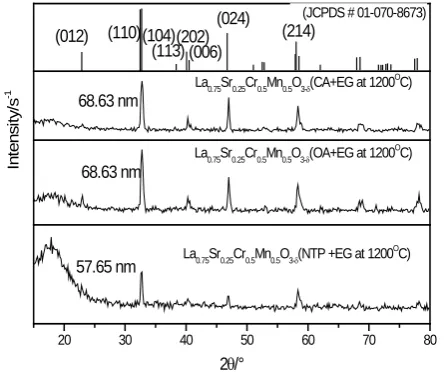
nanopar-ticles were characterized using powder X-ray diffraction. The XRD patterns of LSCM perovskite nanoparticles
are shown in Figure 1. All diffraction patterns of
La0.75Sr0.25Cr0.5Mn0.5O3-δ perovskite nanoparticles show
characteristic peaks of the perovskite phase. The XRD patterns are in good agreement with the standard data for
rhombohedral symmetry with a = 5.4736 Å, b = 5.4736 Å, c = 13.2898 Å and R-3c space group (JCPDS # 01-070-8673). No impurity phases were observed pre-sumably because in the solid-state reaction the pure
phase of La0.75Sr0.25Cr0.5Mn0.5O3-δ (LSCM) perovskite
was formed at 1200˚C [21]. The crystallite size of the
LSCM nanoparticles was calculated using Debye-Scherrer formula at (110) plane. The size of the LSCM-particles prepared NTP-assisted is 57.65 nm, with citric acid and oxalic acid the value is 68.63 nm.
In the synthesis of La0.75Sr0.25Cr0.5Mn0.5O3-δ (LSCM)
perovskite nanoparticles the carriers (NTP, oxalic acid and citric acid) help in obtaining a homogeneous mixture of the cations in a solution through forming metal com-plexes, they also help in the reduction of nitrates in a combustion process, releasing a large amount of heat.
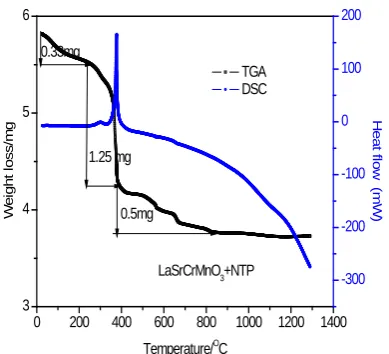
This is shown by an exothermic peak at 377˚C on a DSC
curve (Figure 2). During the solid-state reduction
process, metal cations and oxygen anions stay in the react and mixture during the formation of perovskite phase in this combustion process. The large heat released during combustion might be of the help to overcome the lattice energy, which is required for the formation of the perovskite phase, and also the completion of the nu-cleation by the rearrangement of atoms by short distance diffusion. The fast combustion process might not be of help for the diffusion of atoms far from each other and hence the particle size of LSCM powder remained in the nanometer range [22].
Thermogravimetric analysis and differential scanning calorimetry (TGA-DSC) curves with NTP-assisted
LSCM dried as a gel at 120˚C are shown in Figure2. The
weight losses happen in three steps. The total weight loss
20 30 40 50 60 70 80
La0.75Sr0.25Cr0.5Mn0.5O3-δ(NTP +EG at 1200O C)
2θ/°
57.65 nm 68.63 nm
La0.75Sr0.25Cr0.5Mn0.5O3-δ(OA+EG at 1200O C)
68.63 nm
La0.75Sr0.25Cr0.5Mn0.5O3-δ(CA+EG at 1200O C)
In
te
n
s
ity
/s
-1
(214) (024)
(006) (202) (113) (104) (110)
(JCPDS # 01-070-8673)
(012)
[image:2.595.312.535.504.690.2]0 200 400 600 800 1000 1200 1400 3
4 5 6
LaSrCrMnO3+NTP 0.5mg
0.33mg
TGA DSC
Temperature/OC
W
ei
ght
l
os
s
/m
g
1.25 mg
-300 -200 -100 0 100 200
H
eat
f
low
(
m
W
)
Figure 2. TGA-DSC curves of La0.75Sr0.25Cr0.5Mn0.5O3-δ (LSCM) perovskite gel precursor dried at 120˚C.
was 2.1 mg from room temperature to 1300˚C. The first
weight loss is 0.33 mg in the temperature range 22˚C -
236˚C; this can be attributed to evaporation of water
from the layers of LSCM. The second weight loss is 1.25
mg in the temperature range 236˚C - 383˚C and the third
weight loss is 0.5 mg in the temperature range 383˚C -
837˚C. The second and third weight losses are attributed
to decomposition of the carrier (NTP) and evaporation of structurally bounded water. The peaks located at about 295˚C and 377˚C are exothermic on the DSC curve due to decomposition of nitrates and organic matter and cor-respond to the second weight loss of 1.25 mg from about
236˚C to 400˚C as observed in the TGA curve.
To observe thermal effects above 350˚C, different
carrier-assisted LSCM samples were fired at 350˚C for 1
h. Figure 3 shows TGA-DTA curves of the different car-rier’s assisted LSCM samples. The total weight loss was 0.97 mg in NTP assisted LSCM, 0.39 mg in oxalic acid assisted LSCM, and 0.77 mg in citric acid assisted
LSCM from room temperature to 1300˚C. The first
weight loss is 0.32 mg in NTP assisted LSCM in the
temperature range 30˚C - 490˚C, whereas the first weight
loss is 0.2 mg in the oxalic acid used LSCM in range
30˚C - 338˚C and the first weight loss is 0.25 mg in citric
acid used LSCM in range 30˚C - 334˚C. The second
weight loss is 0.9 mg in NTP used LSCM in the
temper-ature range 490˚C - 822˚C, whereas the second weight
loss is 0.42 mg in citric acid used LSCM in range 334˚C -
688˚C. The second weight loss was attributed to the
reac-tion between the residual nitrate and carriers after the decomposition of the precursor and subsequent combus-tion of organic components.
The morphologies of La0.75Sr0.25Cr0.5Mn0.5O3-δ
pe-rovskite nan-oparticles synthesized using different car-
0 200 400 600 800 1000 1200 1400 3.5
4.0 4.5 5.0 5.5 6.0
0.42mg 0.25mg
0.2mg 0.9mg
LaSrCrMnO3+NTP LaSrCrMnO
3+Citiric Acid LaSrCrMnO
3+Oxalic Acid
W
ei
ght
los
s/
m
g
Temperature/OC 0.32mg
Figure 3. TGA curves of La0.75Sr0.25Cr0.5Mn0.5O3-δ (LSCM) perovskite gel precursor dried at 120ºC and then fired at 350˚C for 1h.
(a)
(b)
(c)
Figure 4. SEM images of La0.75Sr0.25Cr0.5Mn0.5O3-δ perovs-kite phase nanoparticles (a) NTP-assisted, (b) oxalic acid assisted and (c) citric acid assisted.
1μm
1μm
[image:3.595.75.270.93.270.2] [image:3.595.314.538.98.247.2] [image:3.595.345.499.300.685.2]riers by combustion method as examined with scanning
electron microscopy are shown in Figure 4. NTP-assisted
LSCM shows many nanosized particles of sphericalshape
in the range 100 - 500 nm (Figure 4(a)). The LSCM
powders synthesized using oxalic acid and citric acid as carriers consist of uniform nanoparticles shwoing less agglomeration. The average particle size of the
La0.75Sr0.25Cr0.5Mn0.5O3-δ perovskite powders calcinated
at 1200˚C is about 50 - 500 nm (Figures 4(a) and (b)).
The small size La0.75Sr0.25Cr0.5Mn0.5O3-δ perovskite nano-
particles are very active, small size is also beneficial for decreasing the fabrication temperature of the anode film and enhancing the catalytic properties.
4. Conclusions
La0.75Sr0.25Cr0.5Mn0.5O3-δ (LSCM) perovskite phase
na-noparticles were successfully synthesized by solution combustion method using different carriers (NTP, oxalic acid, and citric acid) after calcination of fired gel at
1200˚C for 7 h. Scanning electron microscopy of the
as-synthesized powders showed spherical particle shapes and sizes in the range of 50 - 500 nm. An exothermic reaction between carriers and nitrates initiates the com-bustion process. TGA and DSC analysis confirmed the decomposition process of nitrates and the organic matter. The combustion reactions took place in the temperature
range 200˚C to 400˚C.
5. Acknowledgements
One of the authors (V S Reddy Channu) thanks the Al-exander von Humboldt Foundation for a fellowship.
REFERENCES
[1] Ch. Sun and U. Stimming, “Recent Anode Advances in Solid Oxide Fuel Cells,” Journal of Power Sources, Vol. 171, No. 2, 2007, pp. 247-260.
[2] E. Lay, G. Gauthier, S. Rosini, C. Savaniu and J. T. S. Irvine, “Ce-Substituted LSCM as New Anode Material for SOFC Operatingin Dry Methane,” Solid State Ionics, Vol. 179, No. 2, 2008, pp.1562-1566.
[3] S. Zha, P. Tsang, Z. Cheng and M. Liu, “Electrical Prop-erties and Sulfur Tolerance of La0.75Sr0.25Cr1−xMnxO3 under Anodic Conditions,” Journal of Solid State Chemi-stry, Vol. 178, No. 6, 2005, pp. 1844-1850.
[4] S. Tao and J. T. S. Irvine, “Synthesis and Characterization of (La0.75Sr0.25)Cr0.5Mn0.5O3—A Redox-Stable, Efficient Perovskite Anode for SOFCs,” Journal of the
Electro-chemical Society, Vol. 151, No. 2, 2004, pp. A252-A259.
[5] S. TaO and J. T. S. Irvine, “A Redox-Stable, Efficient Anode for Solid-Oxide Fuel Cells,” Nature Materials,
Vol. 2, No. 5, 2003, pp. 320-323.
[6] J. C. Ruiz-Morales, J. Canales-Vazquez, J. Pena-Martinez, D. M. Lopez and P. Nunez, “On the Simultaneous Use of La0.75Sr0.25Cr0.5Mn0.5O3−δ as Both Anode and Cathode Material with Improved Microstructure in Solid Oxide Fuel Cells,” Electrochim. Acta, Vol. 52, No. 1, 2006, pp.
278-2
[7] D. M. Bastidas, S. Tao and J. T. S. Irvine, “A Symmetric-al Solid Oxide Fuel Cell Demonstrating Redox Stable Perovskite Electrodes,” Journal of Materials Chemistry, Vol. 16, No. 17, 2006, pp. 1603-1605.
[8] J. Wan, J. H. Zhu and J. B. Goodenough, “La0.75Sr0.25 Cr0.5Mn0.5O3−δ + Cu composite anode running on H2 and CH4 fuels,” Solid State Ionics, Vol. 177, No. 13-14, 2006,
pp. 1211-121
[9] X. C. Lu and J. H. Zhu, “Cu(Pd)-Impregnated La0.75Sr0.25 Cr0.5Mn0.5O3−δ Anodes for Direct Utilization of Methane in SOFC,” Solid State Ionics, Vol. 178, No. 25-26, 2007,
pp. 1467-147
[10] B. Huang, S. R. Wang, R. Z. Liu, X. F. Ye, H. W. Nie, X. F. Sun and T. L. Wen, “Performance of La0.75Sr0.25Cr0.5 Mn0.5O3−δ Perovskite-Structure Anode material at Lan-thanum Gallate Electrolyte for IT-SOFC Running on Ethanol Fuel,” Journal of Power Sources, Vol. 167, No. 1,
2007, pp. 39-46
[11] S. P. Jiang, X. J. Chen, S. H. Chan and J. T. Kwok, “GDC-Impregnated (La0.75Sr0.25)(Cr0.5Mn0.5)O3 Anodes for Direct Utilization of Methane in Solid Oxide Fuel Cells,” Journal of Electrochemical Society, Vol. 153, No.
5, 2006, pp. A850-A856
[12] J. Pena-Martinez, D. Marrero-Lopez, J. C. Ruiz-Morales, B. E. Buergler, P. Nunez and L. J. Gauckler, “Fuel Cell Studies of Perovskite-Type Materials for IT-SOFC,”
Journal of Power Sources, Vol. 159, No. 2, 2006, pp.
914-9
[13] S. P. Jiang, X. J. Chen, S. H. Chan, J. T. Kwok, K. A. Khor, “(La0.75Sr0.25)(Cr0.5Mn0.5)O3/YSZ Composite Anodes for Methane Oxidation Reaction in Solid Oxide Fuel Cells,” Solid State Ionics, Vol. 177, No. 1-2, 2006,
pp. 149-157
[14] J. Pena-Martinez, D. Marrero-Lopez, J. C. Ruiz-Morales, C. Savaniu, P. Nunez and J. T. S.Irvine, “Anodic Perfor-mance and Intermediate Temperature Fuel Cell Testing of La0.75Sr0.25Cr0.5Mn0.5O3-δ at Lanthanum Gallate Electro-lytes,” Chemistry of Materials, Vol. 18, 2006, pp. 1001-1006.
[15] J. C. Ruiz-Morales, J. Canales-Vazquez, B. Balleste-ros-Perez, J. Pena-Martinez, D. Marrero-Lopez, J. T. S. Irvine and P. Nunez, “LSCM–(YSZ–CGO) Composites as Improved Symmetrical Electrodes for Solid Oxide Fuel Cells,” Journal of the European Ceramic Society, Vol. 27, No. 13-15, 2007, pp. 4223-4227.
Stron-tium Manganese Chromite Perovskite Oxides Synthesized by Gelcasting for Solid Oxide Fuel Cells,” Journal of
Material Chemistry, Vol. 17, No. 25, 2007, pp. 2627-
263
[17] L. Zhang, S. P. Jiang, C. S. Cheng and Y. Zhang, “Syn-thesis and Performance of (La0.75Sr0.25)1−x(Cr0.5Mn0.5)O3 Cathode Powders of Solid Oxide Fuel Cells by Gel- Casting Technique,” Journal of Electrochemical Society, Vol. 154, No. 6, 2007, pp. B577-B582.
[18] S. B. Ha, P-S. Cho, Y. H. Cho, D. Lee and J.-H. Lee, “Preparation of La0.75Sr0.25Cr0.5Mn0.5O3−δ Fine Powders by Carbonate Coprecipitation for Solid Oxide Fuel Cells,” Journal of Power Sources, Vol. 195, No. 1, 2010,
pp. 124-129
[19] Z. Hu, Y. Yang, X. Shang and H. Pang, “Preparation and Characterization of Nanometer Perovskite-Type Complex Oxides LaMnO3.15 and Their Application in Catalytic
Oxidation,” Materials Letters, Vol. 59, No. 11, 2005, pp.
1373-13
[20] K. C. Patila, S. T. Arunab and T. Mimania, “Combustion Synthesis: An Update,” Current Opinion in Solid State
and Materials Science, Vol. 6, No. 6, 2002, pp. 507-512.
[21] M. A. Raza, I. Z. Rahman and S. Beloshapkin, “Synthesis of Nanoparticles of La0.75Sr0.25Cr0.5Mn0.5O3−δ (LSCM) Perovskite by Solution Combustion Method for Solid Oxide Fuel Cell Application,” Journal of Alloys and
Compounds, Vol. 485, No. 1-2, 2009, pp.593-597.
[22] B. Liu and Y. Zhang, “Ba0.5Sr0.5Co0.8Fe0.2O3 Nanopowd-ers Prepared by Glycine-Nitrate Process for Solid Oxide Fuel Cell Cathode,” Journal of Alloys and Compounds, Vol. 453, No. 1-2, 2008, pp. 418-422.