Writing, Medium, Machine
Modern Technographies
Sean Pryor and David Trotter
London 2016
This is an open access book, licensed under Creative Commons By Attribution Share Alike license. Under this license, authors allow anyone to download, reuse, reprint, modify, distribute, and/or copy their work so long as the authors and source are cited and resulting derivative works are licensed under the same or simi-lar license. No permission is required from the authors or the publisher. Statutory fair use and other rights are in no way affected by the above. Read more about the license at creativecommons.org/licenses/by-sa/4.0
Freely available onlne at: http://www.openhumanitiespress.org/books/titles/ writing-medium-machine/
Cover Art, figures, and other media included with this book may be under different copyright restrictions.
Cover Illustration: Writin, Machin, Cod (2016) gouache on paper
Copyright © 2016 Navine G. Khan-Dossos, Creative Commons CC-BY-NC-ND
Print ISBN 978-1-78542-006-1 PDF ISBN 978-1-78542-018-4
Open Humanities Press is an international, scholar-led open access publishing collective whose mission is to make leading works of contemporary critical thought freely available worldwide. More at http://openhumanitiespress.org
Contents
Introduction
Sean Pryorand david TroTTer 7
1. How to Do Things with Writing Machines 18
STeven Connor
2. Stereopticon 35 KriSTen Treen
3. The Great American Novel and the Census 52
KaSia Boddy
4. The Milieu Is the Message: Henry James and Mediation 67 John aTTridge
5. D.W. Griffith, Victorian Poetry, and the Sound of Silent Film 84 ruTh aBBoTT
6. Enigma Variations: Mallarmé, Joyce, and
the Aesthetics of Encryption 106
Paul Sheehan
7. Teletype 120 JameS Purdon
8. Ticker Tape and the Superhuman Reader 137
roBBie moore
9. Bibliographic Technography: Ezra Pound’s Cantos
as Philological Machine 153
marK Byron
10. Modernist Measure: Poetry and Calculation 166
Sean Pryor
11. Absolutist Slot Machines 178
7
Teletype
JameS Purdon
And so it is with written words; you might think they spoke as if they had intelligence, but if you question them, wishing to know about their sayings, they always say only one and the same thing.
Plato, Phaedrus
The tap of the telegraph key inaugurates the age of electronic signalling; the telephone’s insistent ring marks the beginning of audible telecommunications. Yet for most of the twentieth century there existed another communications medium as distinctive as either the telegraph or the telephone. In the interim between Morse-click and mouse-click, the incessant mechanical clatter of the teletypewriter and the teleprinter sounded through offices, newsrooms, government ministries, and other sites of networked labour. These devices became an object of fascination for writers as diverse as William Saroyan and Don DeLillo, and a common trope in films ranging from the suspense classics of Alfred Hitchcock and Fritz Lang to the paranoid thrillers of the 1970s. How to explain the fact that this ubiquitous medium has remained invisible to cultural history even as the scholarly study of twentieth-century multimedia has flourished?
to an extensive field of nineteenth-century culture not only of telegraphy as a medium but of the specific features (visible, acoustic, haptic) of telegraphic equipment itself (Standage 1998; Otis 2001; Menke 2008; Wenzlhuemer 2013). By contrast, the history of the transformation of tele-graphing into tele-typing remains decidedly hazy despite the astonishing rapidity with which that transition took place. To put things in perspective: in 1927, according to Post Office estimates, teletype machines handled four and a half per cent of all British domestic telegraph traffic; within six years that share had increased to well over seventy per cent.
This essay sketches the history of teletype’s development and adoption and attempts to account for the relative invisibility of the medium in studies of telecommunications culture. It argues that teletype has been misconstrued as a straightforward combination of existing technologies rather than as a distinct medium giving rise to unique conventions of transmission and reception as well as unique forms of attention and affect. From a technical point of view, teletype machines didindeed combine elements of the telegraph and the typewriter. But to begin from sheer technical fact is to overlook how advertising, technical descriptions, and cultural appearances in fiction and film shaped the common understanding of teletype as a new and distinctive communications technology. Notwithstanding its individual components, teletype was promoted and imagined less as a fusion of telegraph and typewriter than as a supplement to that other thoroughly modern medium, the telephone. Over time, however, it evolved its own rituals and rules of procedure. In the newsflash – teletype’s characteristic form or genre – it created a new kind of communicative temporality, one that depended as much on a rhythmic process of inscription as on the eventual permanence of the printed text, and helped to reconfigure twentieth-century media around the idea that an instantaneous ‘live’ transmission could also, and simultaneously, stand as a verifiable historical record.
Almost from its invention, the new technology was seen not merely as uniting two formerly distinct devices, but as transecting several formerly distinct modes of communication: vocal and textual, receptive and interactive, instantaneous and permanent, private and public. For this reason, it is not adequately accounted for by media theories that stress the relative orality or literacy of media, their discursivity or materiality, their heat or coolness, their connective or representational functions, or their capacities for transmission or storage.
Audiovisibility
Alfred Hitchcock’s The Lodger (1927) has been described, with good reason, as ‘the noisiest silent picture ever made’ (Spoto 1992: 5). For although Blackmail
122 James Purdon
opening close-up of a woman’s silent scream to the justly celebrated sequence in which the suspicious pacing of Ivor Novello’s shady lodger is filmed from below through a floor made of reinforced glass, Hitchcock everywhere seeks, and generally finds, visual equivalents for audible phenomena. If these striking effects do not yet inaugurate the audio-visual attractions of sound cinema proper, they nonetheless contribute to an effect of audio-visibility that both anticipates the forthcoming era of the talking picture and marks the apex of silent cinema’s experiments with visible sound. Blackmail may have been Hitchcock’s first official ‘talkie’, but it was The Lodger that demonstrated technology’s capacity to reproduce speech in the cinema.
I am thinking here of a third audio-visible moment, between the screaming girl and the glass ceiling, which has not attracted anything like the same degree of critical attention. As the film begins, the corpse of a young woman has been discovered: the latest victim of the serial killer known as The Avenger. Among the crowd surrounding the body is a newspaper reporter, who heads to a telephone booth to call in his story. Hitchcock gave his own account of the sequence to François Truffaut:
[image:7.432.58.364.64.293.2]First, the item is typed out on a wire-service machine so that we are able to read a few sentences. Then it is forwarded on the teletypes. People in clubs learn the news. Then there is a radio announcement, with people tuned in to the broadcast. Finally,
it is flashed on an electric news sign – you know, like on Times Square. And each time, we give additional information, so that you learn more about the crime. (Truffaut 1983: 45)
As the reporter calls in his copy from a nearby telephone box, Hitchcock cuts to the desk-bound copy-taker who passes the written sheet off-screen, before it reappears, after a back-and-forth cut to the reporter, on top of a printing telegraph transmitter unit. The operator duly begins keying in the dispatch on an early form of teletype transmitter (Figure 1), whereupon another cut takes us to the receiving end of the device: a teleprinter in a glass case printed with the livery of The Exchange Telegraph Company (Figure 2). There is a dissolve to close-up as the machine rattles off the text (Figure 3):
8 20 P M THE SEVENTH GOLDEN HAIRED VICTIM OF THE MYSTERIOUS MURDERER KNOWN AS THE AVENGER WAS DISCOVERED ON THE EMBANKMENT EARLY THIS EVENING A WOMAN WITNESS DESCRIBED THE
MURDERER AS WEARING A SCARF COVERING THE LOWER HALF OF HIS FACE AND[.]
[image:8.432.67.378.64.296.2]Between the voice of the reporter and the fixity of newsprint, word of The Avenger’s latest crime passes through an intermediate stage in which we are
124 James Purdon
invited to watch not one but two teletechnic transformations: first that of the telephone’s analogue transmission of voice and then the literally digital fingerings that encode the text of the message as a signal to be reconstituted by the teleprinter.
[image:9.432.58.365.64.297.2]Medium here conditions message in a very specific way. The intervening presence of the printing apparatus traverses the page, blocking it from view while gradually producing, in a precisely controlled rhythmic movement, the text read by the cinema audience. This is an odd sort of intertitle. Rather than flashing up complete, it proceeds letter by letter, imprinting the message and concealing it at the same time: as the type basket moves across the face of the page to produce new letters, the existing text is obscured by the rollers that keep the paper in place and by the bar on which the printing apparatus is mounted. Instead of waiting for the audience to assimilate an immediately visible on-screen text, the teleprinter requires the audience to process a sequential text that appears according to its own rhythm. The teleprinter controls not only the temporality of printing, but the temporality of attention, and unifies an audience in the need to keep pace with a visible text before it disappears out of focus or out of visibility. Speed-readers lose their advantage. The shot ends with the teleprinter hammering out a tantalizing ‘AND’, directing attention back to the action of the film while introducing the thematic of partial knowledge that governs its development.
Film criticism of the 1920s had shown signs of dissatisfaction with the intertitle even before the introduction of sound. The pages of Photoplay,
Screenland, Picture Play, Moving Picture World,and other fan magazines abounded with complaints about verbose, hackneyed, or mis-spelled title cards, while the critic Iris Barry complained that she could only enjoy Lang’s Die Nibelungen
if she shut her eyes when the titles appeared. For Barry, title cards were most necessary when they gave what film as yet could not: speech. ‘At a flash-point of the emotions,’ she wrote, ‘a sub-title is needed, unless the actors can let us, by their bearing or by lip-reading, get what their words must inevitably be’ (Barry 1926: 78-9).
In The Lodger, we know what the reporter’s words must inevitably be because we see them transcribed twice over: first by a human copy-taker and then by a machine. Speech becomes visible. One might take this as early evidence of Hitchcock’s preference for diegetic economy: just as all the music in Rear Window (1954)can be attributed to a source within the housebound protagonist’s earshot, The Lodger keeps the audience within the story-world while the teleprinter accomplishes the formal function of a written title card in representing speech.
The term of art for such a diegetically integrated shot is an ‘insert’. Inserts, in the form of letters, telegrams, cheques, and other written or typed documents had long been a common device in silent film, but such shots were usually static, representing the written or printed word. The added visual interest of The Lodger’s teleprinter arises precisely from its movement, inasmuch as it represents the immediacy of a spoken news report. Hitchcock, himself a former title designer, was particularly attentive to the intertitles of The Lodger, hiring the artist E. McKnight Kauffer to jazz them up. And it seems more than coincidental that the teleprinter insert immediately precedes the famous shot of the director himself in his first cameo, centred among typewriters, talking on the telephone. It begins to seem as if Hitchcock not only placed himself at the centre of a teletechnic media apparatus, but acknowledged the readiness of the machine to take over his old job.
The New Telegraphy
Fantasies of using an ordinary typewriter as a real-time communications medium had been in circulation at least since 1899, when the narrator of John Kendrick Bangs’s The Enchanted Type-Writer, having discovered a dusty typewriter in his attic among ‘old bill-files and collections of Atlantic cable-ends’, finds to his shock that the device has a supernatural direct line to the shade of James Boswell (Bangs 1899: 11). The development of a working teletype for mundane uses took rather longer.
126 James Purdon
by the name of Royal Earl House had already developed an ingenious mechanical printing telegraph by the mid-1840s. House’s system, a precursor of teletype, required messages to be entered on a ‘composing-machine’ consisting of a piano-like keyboard, where each key corresponded to a single letter of the alphabet and input was conveyed to the transmitter by means of a fiendishly complicated mechanical system (House 1846). It could transmit around forty words per minute to be printed automatically at the receiving terminal, but required rigorous training, was difficult to manufacture, and was liable to lose contact between its two terminals unless great care was taken to keep them synchronized. In 1854, an Englishman, David Edward Hughes, invented a rival system while working as a professor of music in Kentucky. He returned to England shortly afterwards, and successfully marketed his invention to European telegraph companies. Like House’s system, it required a great deal of skill, as well as a sense of timing: because of the arrangement of the keys and the print wheel, signals had to be sent in a regular tempo in order to register properly.
In contrast with one-to-one key-to-signal systems like those of House and Hughes, the system invented by Émile Baudot in the 1870s for the French telegraph service relied on operators to learn a new and highly complex coding language which was, in the literal sense, digital. Baudot built his machine around a five-bit code, with a transmitter consisting of a set of five parallel keys. Each letter input was assigned to a combination of fingers – two on the left hand and three on the right – formed simultaneously, like a chord on a piano. So, for instance, to send an ‘A’, the operator would typically depress the left middle and index fingers; to send a ‘G’, he or she would depress the left index finger along with the right middle and ring fingers, and so on. To compose a message of any length on such a device demanded a prodigious memory, extensive training, and considerable physical endurance.
All of these systems, from House to Baudot, relied upon the labour of highly skilled operators trained to perform repetitive actions of a very specialized kind. A major advance came at the turn of the twentieth century with the development of new keyboard-based printing telegraphs. Several versions of typewriter-based systems were developed independently by inventors working on three continents. They were Frederick George Creed, a Canadian telegraph operator living in Glasgow; Donald Murray, a New Zealand farmer and newspaper print worker; father-and-son team Charles and Howard Krum in Chicago; and Ernst Kleinschmidt, a German-American inventor who was later to become the Krums’ business partner (Huurdeman 2003).
signals, and a receiving device which produced identical punch-marks on another length of tape. This tape could then be fed into a letter-printer to produce text. Creed was successful in promoting his device: in 1902 the Post Office bought a dozen, and within a few years Creed & Co. were supplying printing telegraph machines to the Glasgow Herald, the Daily Mail, and the Press Association. Creed may have supplied the teleprinter that propels the narrative of The Lodger – one of their clients was the Exchange Telegraph Company, whose branding is clearly visible on the printer’s glass case in the film – although the transmitting terminal looks like a Hughes keyboard of an earlier vintage (Creed & Co. c.1934).
Murray’s system, in prototype by 1901, worked in a similar way to Creed’s, but Murray also made modifications on the software side. Recognizing that the introduction of the QWERTY keyboard had made operator fatigue a less pressing problem than mechanical fatigue, he re-mapped Baudot’s five-bit code in order to optimize the efficiency and durability of the machine. At the same time, he added new code sequences to control non-printing operations such as carriage-returns. In 1925, Creed & Co. bought the patent to Murray’s code, and successfully pressed for its adoption as the international teletype standard.
The Krums’ major innovations were to improve the synchronization of printing telegraph systems by developing an additional start-and-stop signal between transmitted characters, and to produce the first integrated teleprinter by eliminating the need for a perforator: their device converted electrical signals directly into printed text without the intervening stage of a punched tape. (Creed & Co. promptly redesigned their machines along similar lines.) The Krums began supplying teletype systems to the US Postal Service in 1910, and two years later installed six circuits for Western Union. After merging with Kleinschmidt in 1928, they rebranded their company as the Teletype Corporation (Teletype Corporation 1958).
By the mid-1920s, these independent innovations had begun to cohere into a recognisably new technology, with Donald Murray as its most determined and eloquent champion. In a paper on ‘The New Telegraphy’ delivered to the Institute of Electrical Engineers in 1924, Murray emphasised the game-changing features of teletype by invoking another technological triumph, the mass-produced automobile: ‘It can work at from forty to eighty words a minute over any distance from 100 feet to 5000 miles, and any girl typist can use it. This is the business-man’s printing telegraph – the Ford car of telegraphy’ (Murray 1924: 245). And there was more. The new telegraphy didn’t just improve on the old telegraphy; it was even better in some respects than that modern marvel, the telephone:
128 James Purdon
must teletype as well as teletalk. A telephone message is a voice, and nothing more – a sound leaving no record. Nothing is more evanescent. There are sound-recording machines, but the sounds are still sounds, and there is no conceivable mechanism, outside the human brain, that will translate a sound-message into a sight-message. (247-8)
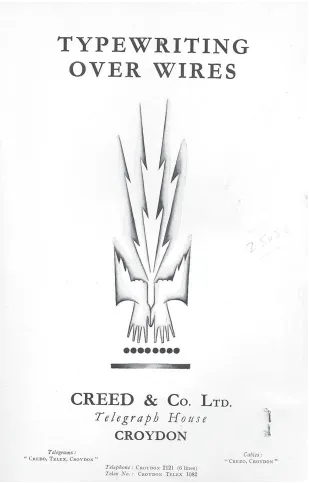
Through Murray’s advocacy, the ‘new telegraphy’ pitched itself as telephony’s material supplement, promising to combine talkativeness with textuality in its ability to record, in indelible and easily-legible alphabetic signs, the precise message it transmitted at speeds rapid enough to pass for conversation. That hybridity – of sound-message and sight-message – became teletype’s major selling point. The promotional booklets produced for Creed & Co. promised ‘a private communication service, combining the personal touch of the telephone with the permanency of the telegraphed message’, and the frontispiece of one such booklet shows a lightning-flash incarnated in a pair of hands supplied with Mercury-wings reaching out to a stylized keyboard (Figure 4).
Although Murray distinguishes between ‘teletyping’ and the ‘teletalking’ enabled by telephony, he repeatedly associates teletype with spoken communications rather than with print. The talkativeness of the new medium reappears in his suggestion that a network of teletype machines could be used by businessmen to conduct secure conferences at a distance, with the conversation happening in real time and the teletypes automatically producing a verbatim record:
There would be no overhearing or eavesdropping. The teletype language is spoken and understood only by teletypes, and the code-bars can be mixed at will to scramble the messages and make them doubly secure against overhearing by outsiders. There is something deeply impressive about this idea of a conference taking place between men hundreds or even thousands of miles apart, with no sound but the slight tapping of the typebars, and the men in silence, each alone, watching the words being recorded, or transmitting on his keyboard. (257)
130 James Purdon
Teletalk
The ability to talk silently at a distance was not without compensating attractions. Mr Romano, the narrator of William Saroyan’s short story ‘1, 2, 3, 4, 5, 6, 7, 8’ (1934) is a nineteen-year-old teletype operator whose job requires him ‘to send important telegrams to important people accurately’. The teletype machine, he explains, is ‘a great mechanical triumph […] a great stroke of efficiency, the perfection of the machine’, though like most strokes of efficiency it comes at a cost. For one thing, ‘old time telegraphers’, formerly on a wage of a dollar an hour, have been replaced by young teletypists like him, earning twenty-eight cents an hour for handling twice as much traffic (Saroyan 1939: 50-51). Worse still, the machine has the disagreeable effect of attuning his body and mind to its own rhythms: ‘I seemed to feel that they had gotten me so deeply into the mechanical idea of the age that I was doomed eventually to become a fragment of a machine myself’ (44).
The teletype is not the only such mechanism in Romano’s life, however. At home, he listens with intermittent obsessiveness to phonograph records. ‘The phonograph was pretty much himself. He had gotten into the machine and come out of it, singing, or being a symphony, or a wild jazz composition’ (43). Jazz above all seems to speak to Romano’s awareness of being integrated into the rhythms of a particular time and place: ‘He had learned something about machinery, American machines working, through jazz’ (46). One record in particular moves him in this way. ‘There was one passage of syncopation in this record that was tremendously interesting to me. […] It was eight swift chords on the banjo, repeated fourteen times, while the melody grew in emotional intensity, reached a climax, and then dwindled to silence. One two three four five six seven eight, swiftly, fourteen times. The sound was wiry’ (49).
Saroyan’s narrator, evidently, has internalized the repetitive, syncopated rhythm of the teletype machine, and the passage stays with him long after he has put the records away and returned from their wiry sounds to the wired texts that occupy his working hours. If he regards the phonograph as a space to inhabit, he feels no such connection to the teletype machine – at least as long as it handles only official business. Things begin to change when the machine becomes a medium not for exchanging messages, but for conducting conversations:
regular business. […] I typed the word hello, and we began a conversation.
The party at the other end of the line is (of course) a love-interest. ‘I talked with the other operator for about an hour. It was a girl, and she was working in the operating room at the main office’ (51-2). Text-message romance blossoms.
Clandestinity adds to the thrill: the teletype lovers have to conduct their trysts in between visits from a watchful wire-chief. But the real excitement arises from their unsanctioned use of teletype itself, which is thereby transformed from a medium used to send and receive official ‘messages’ into a medium for unofficial, real-time ‘conversation’. (The same trajectory, according to which an institutional medium develops into a popular one by way of unsanctioned private use, has been characteristic of new communications media from the telephone to the internet.) For Romano, teletype reconfigures ‘talking’ as a form of symbolic exchange defined not with reference to its oral/aural qualities, but as a matter of sequence (it appears gradually rather than all at once), fluency(it requires no decoding), and continuity (the channel remains open until one or other party signs off). Romano may conduct his flirtation at a distance by text, but he thinks of teletype conversation as possessing all the presence and plenitude that has traditionally been associated with speech. In the enforced gaps between conversations – that pesky wire chief – he begins to hear the insistent strumming of his syncopated banjo tune again, bridging the gap between machinic staccato and emotional melody. He thinks of inviting the girl to move with him to a house in the countryside, a place of ‘meaning and fullness’ (52).
132 James Purdon
returned’. An incompatibility has been discovered (or disguised) through the operation of a technological medium. So complete is Romano’s integration with the mechanical idea of the age that the shared presence offered by bodily proximity seems no more authentic than teletype’s transgressive promise of intimacy at a distance. Indeed, it seems less so.
The medium did not always appear to drop away. During the Second World War, teletype, as the primary form of military communications, became visible to an army of new users, including the young signals clerk Catherine Saxon, heroine of Edith Pargeter’s She Goes to War (1942). Visibility was the least of it: Catherine’s first impression of the Signal Office teleprinter room is ‘of a demoniac, unremitting, inhuman noise; […] for besides the staccato effect of the keys there is the deep hum of the power which drives the machines; and if the one hammering on your senses from outside doesn’t drive you crazy, the other will sneak in and complete the work from inside’ (Pargeter 1989: 22). But Catherine Saxon is too live a wire in her own right to allow herself to become subdued to the rhythms of the teleprinter after the manner of Mr Romano. The end of the novel will find her resolved to turn herself into a left-wing journalist-activist, and her technological struggles give an early indication of her lack of fit with the apparatus of the war machine:
They’re such intriguing things, too; they have character, and differ from one another in the most startling ways. They purr when they’re pleased with life, they rattle and grow hot when they’re angry, and I believe that once, exasperated beyond all endurance, one of our most ill-used specimens burst into flames. I find them impatient with incompetence; they let me tap my slow and cautious way along a whole line, and then carriage return violently and spit a series of X’s and figures across the paper, or cast up the answer-back of the station to which I’m transmitting […] to the accompaniment of a wildly ringing bell. (28)
Catherine comes to regard her ‘teles’ not as points of access to a transparent conversational medium, but as unknowable entities with an agency of their own. ‘One gets into the habit of regarding them as sentient, malicious, fascinating beings, and talking to them accordingly’. Then as now, talking to machines generally means berating them, as the teleprinter girls discover: ‘Myra, working at the end machine, finally got sick of the irritating noise, and addressed it in a few pungent words which should have silenced it forever. Teleprinters have that effect on one’s language, I find’ (74).
You are alone in the room, except for two computer terminals flickering in the dim light. You use the terminals to communicate with two entities in another room, whom you cannot see. Relying solely on their responses to your questions, you must decide which is the man, which the woman. Or, in another version of the famous ‘imitation game’ proposed by Alan Turing in his classic 1950 paper ‘Computer Machinery and Intelligence’, you use the responses to decide which is the human, which the machine. (Hayles 1999: xi)
Turing’s famous ‘imitation game’ has long since taken on the status of an origin myth for the era of digital computing, and like all origin myths it has been altered in the course of repeated tellings. As N. Katherine Hayles points out in How We Became Posthuman, Turing’s original description of the thought-experiment begins not with the task of distinguishing between a man and a computer, but of distinguishing between a man and a woman. Restoring the significance of gender, Hayles argues persuasively that the test is more than just a method for assessing machine intelligence; more radically, it implies the possibility of a fundamental discordance between the fleshly body and its own electronically-mediated self-image. Whatever the outcome of the test, she suggests, Turing’s subjects are already integrated into circuits of distributed cognition where they flicker as post-human ghosts in digital machines (xv).
‘Flickering’ – a key term which appears in both the first and last sentences of the prologue to How We Became Posthuman –is the word used by Hayles to express the idea that unstable digital symbols have replaced writing in the age of virtual displays, as well as the claim that such virtual realities usher in a new mode of existence: ‘As you gaze at the flickering signifiers scrolling down the computer screens, no matter what identifications you assign to the embodied entities that you cannot see, you have already become posthuman’ (xiv).
The objection I wish to raise here has to do not with Hayles’s conclusions about the stakes of the imitation game, nor with her wider analysis of the key role played by post-war cybernetics in the transformation of human subjectivity. Rather – in the spirit of her own description of Turing’s test as a ‘magic trick’ that ‘relies on getting you to accept at an early stage assumptions that will determine how you interpret what you see later’ – it has to do with one assumption in particular which leads her to link Turing’s test with post-human subjectivity. That objection is easily stated: Turing’s text didn’t flicker.
134 James Purdon
obscures another feature of its embodied form: the nature of the technology which mediates the conversation. The plain white sheet of the teleprinter becomes a virtual ghost.
Of course, Hayles is not alone in recalling Turing’s test through the technological framework of a later era equipped with VDUs and microprocessors. The image of an individual sitting before a desktop monitor and pinging messages off to invisible interlocutors has become a common illustration of the thought experiment and a staple of undergraduate introductions to artificial intelligence in disciplines ranging from computer science to philosophy of mind. But it seems to me that this moment of medium-blindness matters for Hayles’s argument, which hinges on the relationship between virtuality and material embodiment. Hayles wants to claim that the flickering signifiers of electronic computing mark a qualitative transformation in the nature of the human subject. But what if that transformation was less a sudden shift into distributed cognitive virtuality than a gradual reconfiguration of the space of conversation? If Saroyan’s Mr Romano feels himself to be talking intimately with another human being through a textual machine, and Pargeter’s Catherine Saxon begins to feel as if her teletype machines are lifelike enough to require a good talking to, perhaps the time was ripe for a theory of conversation that could extend that space beyond the norms of (masculine) communication. The prospect of machine-conversation tests the limits of political subjectivity, and does so in specifically textual terms.
The model of the signifier assumed by Turing, here at the conceptual origin of digital computing, is not yet destabilized by a flickering virtuality. But neither is it exactly analogous to the stable symbolic structure that Hayles seems to have in mind as exemplary of traditional texts. Between the ‘durable inscription’ of print and the ‘constantly refreshed image’ of virtuality intervenes a third moment of semi-stability as text unfolds in linear time, a conversable temporality in which statements may be made and modified. It is this unfolding temporality that permits the Turing test – and permits all human-machine interaction – to take place. The ‘imitation’ aspect of Turing’s imitation game doesn’t extend beyond semantic content: tone of voice, intonation, rhythm, and other features of communication are ruled out of court before the test begins. As John Durham Peters remarks, ‘Turing gives us communication as if bodies did not matter […] “communication” allows him to equate a teleprinter and a breathing human presence as doppelgängers. He had learned to equate the proxy sent at a distance with its bodily origin’ (Peters 1999: 237).
to features of the medium that must be understood both technically and culturally, in light of a complex history of marketing campaigns, protocols of operation, informal conventions, and the unique modulations of temporality and symbolic exchange established by the device itself.
Such technographic details should matter to us, not least because teletype was of primary importance to advances in computing technology after the Second World War. The abstract machine that Turing had already hypothesized in his paper ‘On Computable Numbers’ was modelled on a tape-based teleprinter apparatus, and the findings of that paper formed the basis both of his work in decipherment at Bletchley Park and the subsequent development of digital computers (Turing 1936). Early mainframes used paper-based teletypes for input and output; the command-line familiar to anyone who has used an MS-DOS machine or a UNIX terminal is the direct descendant of these devices. The forms taken by our interactions with computers, and our interactions with other humans through computer-mediated networks, have been determined in part by assumptions and decisions that were engineered into teletype long before the semiconductor revolution, while the concepts and vocabularies we draw on in describing those interactions have been shaped by a century of real-time textual telecommunications. The technography of teletype, in other words, is a technography of all contemporary telemedia. We are all teletypists now.
Works Cited
Bangs, John K. 1899. The Enchanted Type-Writer. New York: Harper & Brothers. Barry, Iris. 1926. Let’s Go to the Pictures. London: Chatto & Windus.
Creed & Co. c.1934. Typewriting Over Wires. Croydon: Creed & Co.
Hayles, N. Katherine. 1999. How We Became Posthuman: Virtual Bodies in Cybernetics, Literature, and Informatics. Chicago: University of Chicago Press. House, Royal E. 1846. ‘Printing Telegraph’. US Patent No. 4464.
Huurdeman, Anton A. 2003. The Worldwide History of Telecommunications. Oxford: Wiley.
Menke, Richard. 2008. Telegraphic Realism: Victorian Fiction and Other Information Systems. Stanford: Stanford University Press.
Murray, Donald. 1924. ‘Speeding Up The Telegraphs: A Forecast of the New Telegraphy’. Journal of the Institution of Electrical Engineers 63: 245-72.
Otis, Laura. 2001. Networking: Communicating with Bodies and Machines in the Nineteenth Century. Ann Arbor: University of Michigan Press.
136 James Purdon
Peters, John Durham. 1999. Speaking Into the Air: A History of the Idea of Communication. Chicago: University of Chicago Press.
Saroyan, William. 1939. The Daring Young Man on the Flying Trapeze. London: Penguin.
Spoto Donald. 1992. The Art of Alfred Hitchcock. New York: Doubleday.
Standage, Tom. 1998. The Victorian Internet: The Remarkable Story of the Telegraph and the Nineteenth Century’s On-Line Pioneers. New York: Walker & Co.
Teletype Corporation. 1958. The Teletype Story. Chicago: The Teletype Corporation.
Truffaut, Francois. 1983. Hitchcock/Truffaut. Revised edition. New York: Simon & Schuster.
Turing, Alan. 1936. ‘On Computable Numbers, With an Application to the Entscheidungsproblem’. Proceedings of the London Mathematical Society 2: 230-65.
Turing, Alan. 1950. ‘Computing Machinery and Intelligence’. Mind 59: 433-460.