In Proceedings of the 6th Conference on Empirical Methods in Natural Language Processing (EMNLP 2001), L. Lee and D. Harman (Eds.), pp. 44–50, Carnegie Mellon University, Pittsburgh, PA, USA, 2001.
Stacking classifiers for anti-spam filtering of e-mail
Georgios Sakkis♦♦♦♦, Ion Androutsopoulos♣♣♣♣, Georgios Paliouras♣♣♣♣, Vangelis Karkaletsis♣♣♣♣, Constantine D. Spyropoulos♣♣♣♣, and Panagiotis Stamatopoulos♦♦♦♦
♦Department of Informatics
University of Athens
TYPA Buildings, Panepistimiopolis GR-157 71 Athens, Greece
e-mail: {stud0926, T.Stamatopoulos}@di.uoa.gr
♣Software and Knowledge Engineering
Laboratory
Institute of Informatics and Telecommunications National Centre for Scientific Research
“Demokritos”
GR-153 10 Ag. Paraskevi, Athens, Greece e-mail: {ionandr, paliourg, vangelis,
costass}@iit.demokritos.gr
Abstract
We evaluate empirically a scheme for combining classifiers, known as stacked generalization, in the context of anti-spam filtering, a novel cost-sensitive application of text categorization. Unsolicited commercial e-mail, or “spam”, floods mailboxes, causing frustration, wasting bandwidth, and exposing minors to unsuitable content. Using a public corpus, we show that stacking can improve the efficiency of automatically induced anti-spam filters, and that such filters can be used in real-life applications.
Introduction
This paper presents an empirical evaluation of
stacked generalization, a scheme for combining automatically induced classifiers, in the context of anti-spam filtering, a novel cost-sensitive application of text categorization.
The increasing popularity and low cost of e-mail have intrigued direct marketers to flood the mailboxes of thousands of users with unsolicited messages, advertising anything, from vacations to get-rich schemes. These messages, known as
spam or more formally Unsolicited Commercial E-mail, are extremely annoying, as they clutter mailboxes, prolong dial-up connections, and often expose minors to unsuitable content (Cranor & Lamacchia, 1998).
Legal and simplistic technical counter-measures, like blacklists and keyword-based filters, have had a very limited effect so far.1 The
success of machine learning techniques in text categorization (Sebastiani, 2001) has recently led to alternative, learning-based approaches (Sahami, et al. 1998; Pantel & Lin, 1998; Drucker, et al. 1999). A classifier capable of distinguishing between spam and non-spam, hereafter legitimate, messages is induced from a manually categorized learning collection of messages, and is then used to identify incoming spam e-mail. Initial results have been promising, and experiments are becoming more systematic, by exploiting recently introduced benchmark corpora, and cost-sensitive evaluation measures (Gomez Hidalgo, et al. 2000; Androutsopoulos, et al. 2000a, b, c).
Stacked generalization (Wolpert, 1992), or
stacking, is an approach for constructing classifier ensembles. A classifier ensemble, or
committee, is a set of classifiers whose individual decisions are combined in some way to classify new instances (Dietterich, 1997). Stacking combines multiple classifiers to induce a higher-level classifier with improved performance. The latter can be thought of as the
president of a committee with the ground-level classifiers as members. Each unseen incoming message is first given to the members; the president then decides on the category of the
message by considering the opinions of the members and the message itself. Ground-level classifiers often make different classification errors. Hence, a president that has successfully learned when to trust each of the members can improve overall performance.
We have experimented with two ground-level classifiers for which results on a public benchmark corpus are available: a Naïve Bayes classifier (Androutsopoulos, et al. 2000a, c) and a memory-based classifier (Androutsopoulos, et al. 2000b; Sakkis, et al. 2001). Using a third, memory-based classifier as president, we investigated two versions of stacking and two different cost-sensitive scenarios. Overall, our results indicate that stacking improves the performance of the ground-level classifiers, and that the performance of the resulting anti-spam filter is acceptable for real-life applications.
Section 1 below presents the benchmark corpus and the preprocessing of the messages; section 2 introduces cost-sensitive evaluation measures; section 3 provides details on the stacking approaches that were explored; section 4 discusses the learning algorithms that were employed and the motivation for selecting them; section 5 presents our experimental results followed by conclusions.
1 Benchmark corpus and
preprocessing
Text categorization has benefited from public benchmark corpora. Producing such corpora for anti-spam filtering is not straightforward, since user mailboxes cannot be made public without considering privacy issues. A useful public approximation of a user’s mailbox, however, can be constructed by mixing spam messages with messages extracted from spam-free public archives of mailing lists. The corpus that we used, Ling-Spam, follows this approach (Androutsopoulos, et al. 2000a, b; Sakkis, et al. 2001). It is a mixture of spam messages and messages sent via the Linguist, a moderated list about the science and profession of linguistics. The corpus consists of 2412 Linguist messages and 481 spam messages.
Spam messages constitute 16.6% of Ling-Spam, close to the rates reported by Cranor and
LaMacchia (1998), and Sahami et al. (1998).
Although the Linguist messages are more topic-specific than most users’ e-mail, they are less standardized than one might expect. For example, they contain job postings, software availability announcements and even flame-like responses. Moreover, recent experiments with an encoded user mailbox and a Naïve Bayes (NB) classifier (Androutsopoulos, et al. 2000c) yielded results similar to those obtained with Ling-Spam (Androutsopoulos, et al. 2000a). Therefore, experimentation with Ling-Spam can provide useful indicative results, at least in a preliminary stage. Furthermore, experiments with Ling-Spam can be seen as studies of anti-spam filtering of open unmoderated lists.
Each message of Ling-Spam was converted into a vector
x
=
x
1,
x
2,
x
3,
h
,
x
n , wheren
x
x
1,
,
are the values of attributesn
X
X
1,
h
,
. Each attribute shows if a particular word (e.g. “adult”) occurs in the message. All attributes are binary:X
i=
1
if the word is present; otherwiseX
i=
0
. To avoid treating forms of the same word as different attributes, a lemmatizer was applied, converting each word to its base form.To reduce the dimensionality, attribute selection was performed. First, words occurring in less than 4 messages were discarded. Then,
the Information Gain (IG) of each candidate
attribute
X
was computed:)
(
)
(
)
,
(
log
)
,
(
)
,
(
} , { }, 1 , 0
{
P
x
P
c
c
x
P
c
x
P
C
X
IG
legit spam c
x
⋅
⋅
=
∑
∈ ∈
The attributes with the m highest IG-scores were
selected, with m corresponding to the best
configurations of the ground classifiers that have been reported for Ling-Spam (Androutsopoulos, et al. 2000a; Sakkis, et al. 2001); see Section 4.
2 Evaluation
measures
Blocking a legitimate message is generally more severe an error than accepting a spam message.
Let L→S and S →L denote the two error
types, respectively, and let us assume that
S
L→ is λ times as costly as S →L.
Previous research has considered three cost
(Androutsopoulos, et al. 2000a, b, c; Sakkis, et
al. 2001). In the scenario where λ = 999,
blocked messages are deleted immediately.
S
L→ is taken to be 999 times as costly as
L
S → , since most users would consider losing
a legitimate message unacceptable. In the
scenario where λ = 9, blocked messages are
returned to their senders with a request to resend them to an unfiltered address. In this case,
S
L→ is penalized more than S →L, to
account for the fact that recovering from a blocked legitimate message is more costly (counting the sender’s extra work) than recovering from a spam message that passed the filter (deleting it manually). In the third scenario,
where λ = 1, blocked messages are simply
flagged as possibly spam. Hence, L→S is no more costly than S →L. Previous experiments indicate that the Naïve Bayes ground-classifier is unstable when λ = 999 (Androutsopoulos, et al. 2000a). Hence, we have considered only the cases where λ = 1 or 9.
Let
W
L(
x
)
andW
S(
x
)
be the confidence of a classifier (member or president) that messagex
is legitimate and spam, respectively. The
classifier classifies x as spam iff:
λ
>
)
(
)
(
x
W
x
W
L SIf
W
L(
x
)
andW
S(
x
)
are accurate estimates of )| (legit x
P and P(spam|x), respectively, the
criterion above achieves optimal results (Duda & Hart, 1973).
To measure the performance of a filter,
weighted accuracy (WAcc) and its
complementary weighted error rate (WErr = 1 –
WAcc) are used (Androutsopoulos, et al. 2000a, b, c; Sakkis, et al. 2001):
S L S S L L
N
N
N
N
WAcc
+
⋅
λ
+
⋅
λ
=
→ →where
N
Y→Z is the number of messages incategory
Y
that the filter classified asZ
,S L L L
L
N
N
N
=
→+
→ ,N
S=
N
S→S+
N
S→L. That is, when a legitimate message is blocked, this counts as λ errors; and when it passes the filter, this counts as λ successes.We consider the case where no filter is present as our baseline: legitimate messages are
never blocked, and spam messages always pass. The weighted accuracy of the baseline is:
S L L b
N
N
N
WAcc
+
⋅
λ
⋅
λ
=
The total cost ratio (TCR) compares the performance of a filter to the baseline:
L S S L S b
N
N
N
WErr
WErr
TCR
→ →+
⋅
=
=
λ
Greater TCR values indicate better performance. For TCR < 1, not using the filter is better.
Our evaluation measures also include spam
recall (SR) and spam precision (SP):
L S S S S S
N
N
N
SR
→ → →+
=
S L S S S SN
N
N
SP
→ → →+
=
SR measures the percentage of spam messages
that the filter blocks (intuitively, its
effectiveness), while SP measures how many
blocked messages are indeed spam (its safety). Despite their intuitiveness, comparing different filter configurations using SR and SP is difficult: each configuration yields a pair of SR and SP
results; and without a single combining measure, like TCR, that incorporates the notion of cost, it is difficult to decide which pair is better.
In all the experiments, stratified 10-fold cross-validation was used. That is, Ling-Spam was partitioned into 10 equally populated parts, maintaining the original spam-legitimate ratio. Each experiment was repeated 10 times, each time reserving a different part Sj (j = 1, …, 10) for testing, and using the remaining 9 parts as the training set Lj.
3 Stacking
the members were trained on the union
LL
i of the other two parts. Eachx
=
x
1,
,
x
m ofi
LS
was enhanced with the members’confidence W1(x)
S
and W2(x) S
that x is spam,
yielding an enhanced
LS
i'
with vectors) ( ), ( , , ,
' 1 2
1 x W x W x
x
x m S S
= . At the end of
the 3-fold cross-validation, the president was trained on Lj'=LS1'LS2'LS3'. It was then tested on Sj, after retraining the members on the entire Lj and enhancing the vectors of Sj
with the predictions of the members.
The second stacking version that we explored, dubbed holdout stacking, is similar to Kohavi’s (1995) holdout accuracy estimation. It differs from the first version, in two ways: the members are not retrained on the entire Lj; and each partitioning of Lj into
LL
i andLS
i leads to a different president, trained onLS
i'
, which is then tested on the enhanced Sj. Hence, there are 3×10 presidents in a 10-fold experiment, while in the first version there are only 10. In each case, WAcc is averaged over the presidents, and TCR is reported as WErrb over the average WErr.Holdout stacking is likely to be less effective than cross-validation stacking, since its classifiers are trained on smaller sets. Nonetheless, it requires fewer computations, because the members are not retrained. Furthermore, during classification the president consults the same members that were used to prepare its training set. In contrast, in cross-validation stacking the president is tested using members that have received more training than those that prepared its training set. Hence, the model that the president has acquired, which shows when to trust each member, may not apply to the members that the president consults when classifying incoming messages.
4
Inducers employed
As already mentioned, we used a Naïve Bayes (NB) and a memory-based learner as members of the committee (Mitchell 1997; Aha, et al.
1991). For the latter, we used TiMBL, an
implementation of the k-Nearest Neighbor
algorithm (Daelemans, et al. 2000).
With NB, the degree of confidence WS (x) that x is spam is:
=
= ( | )
)
(x P spam x WNB S
∑
∏
∏
∈ = = ⋅ ⋅ = } , { 1 1 ) | ( ) ( ) | ( ) ( legit spam k m i i m i i k x P k P spam x P spam PNB assumes that
X
1,
,
X
m are conditionally independent given the category (Duda & Hart, 1973).With k-NN, a distance-weighted method is
used, with a voting function analogous to the inverted cube of distance (Dudani 1976). The k
nearest neighbors
x
i of x are considered:∑
∑
= =
−
=
δ
k i i k i i i NN k S
x
x
d
x
x
d
x
C
spam
x
W
1 3 1 3)
,
(
1
)
,
(
))
(
,
(
)
(
,where
C
(
x
i)
is the category of neighborx
i, ), (xi xj
d is the distance between
x
i and xj, andδ
(
c
1,
c
2)
=
1
, ifc
1=
c
2, and 0 otherwise. This formula weighs the contribution of each neighbor by its distance from the message to be classified, and the result is scaled to [0,1]. The distance is computed by an attribute-weighted function (Wettschereck, et al. 1995), employingInformation Gain (IG):
) , ( ) , ( 1 j r i r n t t j
i x IG x x
x d
∑
= ⋅ ≡ δ ,where xi = x1i,l,xmi , xj = x1j,l,xmj , and
t
IG
is the IG score ofX
t (Section 1).In Tables 1 and 2, we reproduce the best performing configurations of the two learners on Ling-Spam (Androutsopoulos, et al. 2000b; Sakkis, et al. 2001). These configurations were used as members of the committee.
The same memory-based learner was used as the president. However, we experimented with several configurations, varying the
providing the president with the
m
best word-attributes, as in Section 1, withm
ranging from 50 to 700 by 50. The same attribute- and distance-weighting schemes were used for the president, as with the ground-level memory-based learner.λ m SR SP ΤCR
1 100 82.4% 99.0% 5.41
9 100 77.6% 99.5% 3.82
Λ k m SR SP ΤCR
1 8 600 88.6% 97.4% 7.18
9 2 700 81.9% 98.8% 3.64
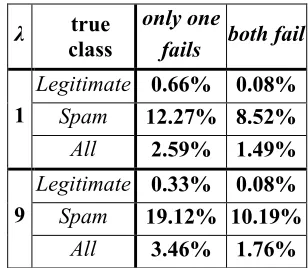
λ true class
only one
fails both fail Legitimate 0.66% 0.08%
Spam 12.27% 8.52%
1
All 2.59% 1.49% Legitimate 0.33% 0.08%
Spam 19.12% 10.19%
9
All 3.46% 1.76%
Our motivation for combining NB with k-NN emerged from preliminary results indicating that the two ground-level learners make rather uncorrelated errors. Table 3 shows the average percentages of messages where only one, or both ground-level classifiers fail, per cost scenario (λ) and message category. The figures are for the configurations of Tables 1 and 2. It can be seen that the common errors are always fewer than the cases where both classifiers fail. Hence, there is much space for improved accuracy, if a president can learn to select the correct member.
5 Experimental
results
Tables 4 and 5 summarize the performance of the best configurations of the president in our experiments, for each cost scenario. Comparing
the TCR scores in these tables with the
corresponding scores of Tables 1 and 2 shows that stacking improves the performance of the overall filter. From the two stacking versions, cross-validation stacking is slightly better than holdout stacking. It should also be noted that stacking was beneficial for most of the configurations of the president that we tested, i.e. most sub-optimal presidents outperformed the best configurations of the members. This is encouraging, since the optimum configuration is often hard to determine a priori, and may vary from one user to the other.
λ k m SR SP ΤCR
1 5 100 91.7% 96.5% 8.44
9 3 200 84.2% 98.9% 3.98
λ k m SR SP ΤCR
1 7 300 89.6% 98.7% 8.60
9 3 100 84.8% 98.8% 4.08
There was one interesting exception in the positive impact of stacking. The 1-NN and 2-NN (k = 1, 2) presidents were substantially worse than the other k-NN presidents, often performing worse than the ground-level classifiers. We witnessed this behavior in both cost scenarios,
and with most values of m (number of
attributes). In a “postmortem” analysis, we ascertained that most messages misclassified by 1-NN and 2-NN, but not the other presidents, are legitimate, with their nearest neighbor being spam. Therefore, the additional errors of 1-NN and 2-NN, compared to the other presidents, are of the L→S type. Interestingly, in most of
Table 2: Best configurations of k-NN per usage scenario and the corresponding performance.
Table 1: Best configurations of NB per usage scenario and the corresponding performance.
[image:5.612.106.260.361.495.2]Table 5: Best configurations of cross-validation stacking per usage scenario and the corresponding performance.
Table 4: Best configurations of holdout
stacking per usage scenario and the
corresponding performance.
Table 3: Analysis of the common errors of the
best configurations of NB and k-NN per
those cases, both members of the committee classify the instance correctly, as legitimate. This is an indication, that for small values of the parameter k the additional two features, i.e., the members’ confidence W1(x)
S
and W2(x) S
, do
not enhance but distort the representation of instances. As a result, the close neighborhood of the unclassified instance is not a legitimate, but a spam e-mail. This behavior of the memory-based classifier is also noted in (Sakkis, et al. 2001). The suggested solution there was to use a
larger value for k, combined with a strong
distance weighting function, such as the one presented in section 4.
Conclusion
In this paper we adopted a stacked generalization approach to anti-spam filtering, and evaluated its performance. The configuration that we examined combined a memory-based and a Naïve Bayes classifier in a two-member committee, in which another memory-based classifier presided. The classifiers that we chose as members of the committee have been evaluated individually on the same data as in our evaluation, i.e. the Ling-Spam corpus. The results of these earlier studies were used as a basis for comparing the performance of our method.
Our experiments, using two different approaches to stacking and two different misclassification cost scenarios, show that stacking consistently improves the performance of anti-spam filtering. This is explained by the fact that the two members of the committee disagree more often than agreeing in their misclassification errors. Thus, the president is able to improve the overall performance of the filter, by choosing the right member’s decision when they disagree.
The results presented here motivate further work in the same direction. In particular, we are interested in combining more classifiers, such as decision trees (Quinlan, 1993) and support vector machines (Drucker, et al. 1999), within the stacking framework. A larger variety of classifiers is expected to lead the president to more informed decisions, resulting in further improvement of the filter’s performance. Furthermore, we would like to evaluate other
classifiers in the role of the president. Finally, it would be interesting to compare the performance of the stacked generalization approach to other multi-classifier methods, such as boosting (Schapire & Singer, 2000).
References
Aha, W. D., Kibler D., and Albert, M.K., (1991) Instance-Based Learning Algorithms. “Machine Learning”, Vol. 6, pp. 37–66.
Androutsopoulos, I., Koutsias, J., Chandrinos, K.V., Paliouras, G., and Spyropoulos, C.D. (2000a) “An evaluation of naïve Bayesian anti-spam filtering”. In Proceedings of the Workshop on Machine Learning in the New Information Age, 11th European Conference on Machine Learning (ECML 2000), Barcelona, Spain, pp. 9–17.
Androutsopoulos, I., Paliouras, G., Karkaletsis, V., Sakkis, G., Spyropoulos, C.D., and Stamatopoulos, P. (2000b). “Learning to filter spam e-mail: a comparison of a naïve Bayesian and a memory-based approach”. In Proceedings of the Workshop on Machine Learning and Textual Information Access, PKDD 2000, Lyon, France, pp. 1– 3. Androutsopoulos, I, Koutsias, J, Chandrinos, K.V.,
and Spyropoulos, C.D. (2000c) “An experimental comparison of naïve Bayesian and keyword-based anti-spam filtering with encrypted personal e-mail messages”. In Proceedings of SIGIR 2000, Athens, Greece, pp. 160–167.
Cranor, L.F., and LaMacchia, B.A. (1998). “Spam!”, Communications of ACM, 41(8):74–83.
Daelemans, W., Zavrel, J., van der Sloot, K., and van den Bosch, A. (2000) TiMBL: Tilburg Memory Based Learner, version 3.0, Reference Guide. ILK, Computational Linguistics, Tilburg University. http:/ilk.kub.nl/~ilk/papers.
Dietterich, G. T. (1997). “Machine Learning Research: Four Current Directions”. AI Magazine 18(4):97-136.
Drucker, H. D. ,Wu, D., and Vapnik V. (1999). “Support Vector Machines for Spam Categorization”. IEEE Transactions On Neural Networks, 10(5).
Duda, R.O, and Hart, P.E. (1973). “Bayes decision theory”. Chapter 2 in Pattern Classification and Scene Analysis, pp. 10–43, John Wiley.
Dudani, A. S. (1976). “The distance-weighted k-nearest neighbor rule”. IEEE Transactions on Systems, Man and Cybernetics, 6(4):325–327. Gómez Hidalgo, J.M., Maña Lσpéz, M., and Puertas
cost-sensitive spam filtering”. In Proceedings of the 4th Computational Natural Language Learning Workshop,CoNLL-2000, Lisbon, Portugal, pp. 99– 102.
Kohavi, R. (1995). “A study of cross-validation and bootstrap for accuracy estimation and model selection”. In Proceedings of the 12th International
Joint Conference on Artificial Intelligence
(IJCAI-1995), Morgan Kaufmann, pp. 1137–1143. Mitchell, T.M. (1997). Machine Learning.
McGraw-Hill.
Pantel, P., and Lin, D. (1998). “SpamCop: a spam classification and organization program”. In Learning for Text Categorization – Papers from the AAAI Workshop, pp. 95–98, Madison Wisconsin. AAAI Technical Report WS-98-05. Quinlan, J.R. (1993). C4.5: Programs for Machine
Learning, Morgan Kaufmann, San Mateo, California.
Sahami, M., Dumais, S., Heckerman D., and Horvitz, E. (1998). “A Bayesian approach to filtering junk e-mail”. In Learning for Text Categorization – Papers from the AAAI Workshop, pp. 55–62, Madison Wisconsin. AAAI Technical Report WS-98-05.
Sakkis, G., Androutsopoulos, I., Paliouras, G., Karkaletsis, V., Spyropoulos, C.D., and Stamatopoulos, P. (2001) “A memory-based approach to anti-spam filtering”. NCSR “Demokritos” Technical Report, Athens, Greece. Schapire, R.E., and Singer, Y. (2000). “BoosTexter: a
boosting-based system for text categorization”. Machine Learning, 39(2/3):135–168.
Sebastiani, F. (2001). Machine Learning in Automated Text Categorization. Revised version of Technical Report IEI-B4-31-1999, Istituto di Elaborazione dell’Informazione, Consiglio Nazionale delle Ricerche, Pisa, Italy.
Wettschereck, D., Aha, W. D., and Mohri, T. (1995). A Review and Comparative Evaluation of Feature Weighting Methods for Lazy Learning Algorithms. Technical Report AIC-95-012, Naval Research Laboratory, Navy Center for Applied Research in Artificial Intelligence, Washington, D.C.