S p l i t t i n g t h e R e f e r e n c e T i m e : T e m p o r a l A n a p h o r a and
Q u a n t i f i c a t i o n in D R T
Rani Nelken
Tel-Aviv University
Tel-Aviv 69978, Israel
n e l k e n @ m a t h , tau. ac. ilNissim
Francez
Computer Science Department
The Technion
Haifa 32000, Israel
f r a n c e z ~ c s , t e c h n i o n , ac. ilAbstract
This paper presents an analysis of tem- poral anaphora in sentences which con- tain quantification over events, within the framework of Discourse Representa- tion Theory. The analysis in (Partee, 1984) of quantified sentences, introduced by a temporal connective, gives the wrong truth-conditions when the tempo- ral connective in the subordinate clause is
before
orafter.
This problem has been previously analyzed in (de Swart, 1991) as an instance of theproportion problem,
and given a solution from a Generalized Quantifier approach. By using a care- ful distinction between the different no- tions of
reference time,
based on (Kamp and Reyle, 1993), we propose a solu- tion to this problem, within the frame- work of Dt~T. We show some applica- tions of this solution to additional tem- poral anaphora phenomena in quantified sentences.1 Introduction
The analysis of temporal expressions in natural language discourse provides a challenge for con- temporary semantic theories. (Partee, 1973) in- troduced the notion of
temporal anaphora,
to ac- count for ways in which temporal expressions de- pend on surrounding elements in the discourse for their semantic contribution to the discourse. In this paper, we discuss the interaction of tempo- ral anaphora and quantification over eventualities. Such interaction, while interesting in its own right, is also a good test-bed for theories of the semantic interpretation of temporal expressions. We dis- cuss c a s e s s u c h a s :(1)
Before
John makes a phone call, healways
lights up a cigarette. (Partee, 1984)
(2)
Often, when
Anne came home late, Paul hadalready prepared
dinner. (de Swart, 1991)(3)
When
he came home, healways
switched on the tv. He took a beer and sat down in his armchair to forget the day. (de Swart, 1991) (4) When John is at the beach, healways
squintswhen the sun is shining. (de Swart, 1991) The analysis of sentences such as (1) in (Partee, 1984), within the framework of
Discourse Repre-
sentation Theory
(DRT) (Kamp, 1981) gives the wrong truth-conditions, when the temporal con- nective in the sentence isbefore
orafter.
In DRT, such sentences trigger box-splitting with the even- tuality of the subordinate clause and an updated reference time in the antecedent box, and the eventuality of the main clause in the consequent box, causing undesirable universal quantification over the reference time.This problem is analyzed in (de Swart, 1991) as an instance of the
proportion problem
and given a solution from a Generalized Quantifier approach. We were led to seek a solution for this problemwithin
DRT, because of DRT's advantages as a general theory of discourse, and its choice as the underlying formalism in another research project of ours, which deals with sentences such as 1-4, in the context of natural language specifications of computerized systems. In this paper, we pro- pose such a solution, based on a careful distinction between different roles of Reichenbach'sreference
time
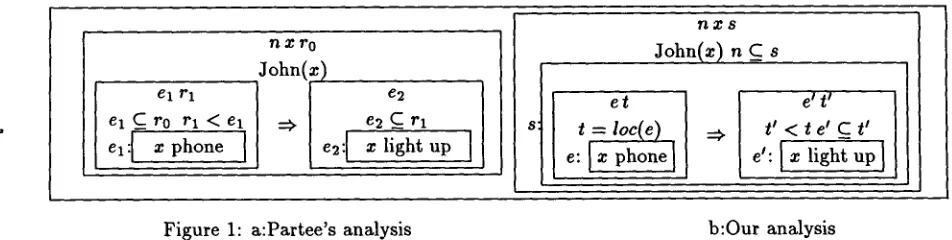
(Reichenbach, 1947), adapted from (Kamp and Reyle, 1993). Figure 1 shows a 'minimal pair' of DRS's for sentence 1, one according to Par- tee's(1984) analysis and one according to ours.2
Background
An analysis of the mechanism of temporal anaphoric reference hinges upon an understand- ing of the ontological and logical foundations of temporal reference. Different concepts have been used in the literature as primitives. These range from temporal instants in
Tense logic
(Prior, 67), through intervals of time (Bennet and Partee, 1978(1972)) as in the analysis of temporal con- nectives in (Hein~mKki, 1978), to event structures (Kamp, 1979) as in Hinrichs' (1986) analysis of temporal anaphora.el rl el C r 0 rl < el
el:l phono I
I~,Z r 0 J o h n ( z )
e 2
e 2 ~ r l
z light up I
8t
n z 8 J o h n ( z ) n C s
e t
t = l o t ( e )
e: Iz phone I
et ~t =:~ t ~ < t e I __ t ~
e ' : [ z light up I
Figure 1: a:Partee's analysis b:Our analysis
An i m p o r t a n t factor in the interpretation of temporal expressions is the classification of situ- ations ihto different aspectual classes (or Aktion- sarten), which is based on distributional and se- mantic properties. In this paper, we only consider
events and states, together termed eventualities
in (Bach, 1981). In narrative sequences, event clauses seem to advance the narrative time, while states block its progression. T h e mechanism used to account for this phenomena in (Hinrichs, 1986) and (Partee, 1984), is based on the notion of ref- erence time, originally proposed by Reichenbach (1947).
Reichenbach's well - known account of the inter- pretation of the different tense forms uses the tem- poral relations between three temporal indices: the utterance time, event t i m e and reference time.
T h e reference time according to (Reichenbach, 1947) is determined either by context, or by tem- poral adverbials.
2.1 St u n i f i e d a n a l y s i s o f t e m p o r a l a n a p h o r a
Hinrichs' and Partee's use of a notion of refer- ence time, provides for a unified t r e a t m e n t of tem- poral anaphoric relations in discourse, which in- clude narrative progression especially in sequences of simple past tense sentences, temporal adverbs and temporal adverbial clauses, introduced by a temporal connective. This concept of reference time is no longer an instant of time, but rather, an interval. This approach can be summarized as follows: in the processing of a discourse, the discourse-initial sentence is argued to require some contextually determined reference time. Further event clauses in the discourse introduce a new event, which is included within the then-current reference time. Each such event also causes the reference time to be u p d a t e d to a time 'just after' (Partee, 1984) this event. State clauses introduce new states, which include the current reference time, and do not u p d a t e it.
As an example of such an analysis consider the following narrative discourse (Partee, 1984):
(5) John
got up, went to the window, and raisedthe blind. It was light out. He pulled the
blind
down and went back to bed. He wasn't ready to face the day. He was too depressed.
Figure 2 shows a DRS for the first two sen- tences of this discourse, according to Hinrichs' and Partee's analysis. T h e ' n ' in the top DRS is a mnemonic for 'now'- the u t t e r a n c e time. T h e first event in the discourse, el - John's getting up - is interpreted relative to a contextually understood reference time, r0. T h e event et is included in the current reference time, r0. A new reference time marker, rl is then introduced, r l lies immediately after r0 (recorded as r0 _~ r l ) . rl serves as the cur- rent reference time for the following event e2. We continue in this fashion, updating the reference time, until the second sentence in the discourse is processed. This sentence denotes a state, sl, which includes the then-current reference time.
r o e l r l e 2 r 2 e 3 8 1
ro < n el C_ f o r d ~_ rl
r l < h e 2 C r l r l ~ r 2 r2 < n e 3 C r2r2 C Sl
e l : I John get up J
e2: . . .
Figure 2:
Adverbial phrases, whether phrasal (e.g. 'On Sunday') or clausal (e.g. 'When Bill left'), are pro- cessed before the main clause. T h e y introduce a reference time, which overrides the current refer- ence time, and provides an anaphoric antecedent for the tense in the main clause. This mechanism is used to explain how tense and t e m p o r a l adver- bials can combine to temporally locate the occur- rence, without running into problems of relative scope (ttinrichs, 1988). T h e tense m o r p h e m e of the main clause locates the event time with re- spect to the reference time, whereas t e m p o r a l ad- verbials are used to locate the reference time.
[image:2.596.68.544.75.195.2]ro
@
<~ r l < eseer2
r3
< r 4
Figure 3:
clause, this event introduces a new reference time, just after the event time of the main clause. As an example, consider the following discourse (Partee, 1984):
(6) Mary turned the corner. When John saw her,
she
crossed the street. She hurried into a store.Following Partee (1984), we will not construct a full DRS for this discourse, but illustrate it with a diagram in Figure 3, with circles denoting inclu- sion.
2.2 Q u a n t i f i c a t i o n o v e r e v e n t s
(Partee, 1984) extends Hinrichs' treatment of tem- poral anaphora to the analysis of sentences, which contain a temporal adverbial and quantificatiort over eventualities. According to her analysis, these trigger box-splitting as do
if or every
clauses in DRT (Kamp, 1981). Consider the following ex- ample from (Partee, 1984):(7) Whenever Mary telephoned, Sam was asleep.
nxyro I
Mary(y) Sam(=)
l
el rl
el C r0 el < n
el "~ rl rl < n el: [y telephone]
=:~ 81: [
81
r l c_ sl z sleep ]
Figure 4:
The subordinate clause cannot be interpreted relative to a single reference time, since Mary's telephoning is not specified to occur at some spe- cific time. Still, the sentence needs to be inter- preted relative to a reference time. This reference time can be a large interval, and should contain each of the relevant occurrences of Mary's tele- phoning during which Bill was asleep. This refer- ence time is represented as r0 in the top sub-DRS. The
'whenever'
triggers box-splitting. The event marker - ez is introduced in the antecedent box, with the condition that it be temporally in- cluded in the current reference time, r0 and be prior to n. The'whenever'
also causes the intro- duction of rl, a new reference time marker, rl lies'just after' el. The stative clause causes the intro- duction of Sl, which includes the reference time
rl.
The embedding conditions for the whole con- struction are just like those for a regular
'if'
or'every'
clause, i.e. the sentence is true, if every proper embedding of the antecedent box can be extended to a proper embedding of the combina- tion of the antecedent and the consequent boxes. This means, as desired, that for each choice of an event el of Mary's telephoning, and reference time rl 'just after' it, there is a state of Sam's being asleep, that surrounds rl.A sentence such as (Ta) which is the same as sentence 7, except the
'whenever'
is replaced by'when',
and'always'is
added in the main clause, would get the same DtLS.(Ta) When Mary telephoned, Sam was always
asleep.
2.3 E x t e n d i n g t h e a n a l y s i s
As noted in (Partee, 1984), this analysis does not extend in a straightforward manner to cases in which the operator
when
is replaced by (an un- restricted)before
orafter,
in such quantified con- texts. Constructing a similar DRS for such sen- tences gives the wrong truth conditions. For ex- ample, Figure l a shows a DRS for sentence 1, according to the principles above, rl - the ref- erence time, used for the interpretation of the main clause is placed in the universe of the an- tecedent box. Because the temporal connective is 'before', rl is restricted to lie before el. The embedding conditions determine, that this refer- ence time be universally quantified over, causing an erroneous reading in which for each event, el, of John's calling, for each earlier time r l , he lights up a cigarette. Paraphrasing this, we could say that John lights up cigarettes at all times preced- ing each phone call, not just once preceding each phone call. We did not encounter this problem in the DRS in Figure 4, since although the refer- ence time r l , is universally quantified over in t h a t DRS as well, it is also restricted, to immediately follow el. It is similarly restricted if 'before' is re- placed with 'just before' or 'ten minutes before'. But, (unrestricted) 'before' is analyzed as 'some time before', and thus the problem arises. We will henceforth informally refer to this problem as Partee's quantification problem.Partee (1984) suggests t h a t in these cases we somehow have to insure t h a t the reference time, rz, appears in the universe of the consequent DRS, causing it to be existentially quantified over, giv- ing the desired interpretation. De Swart (1991) notes that simply moving rl to the right-hand box does not agree with Hinrichs' assumption, t h a t temporal clauses are processed before the main clause, since they update the reference time, with respect to which the main clause will be inter-
preted. In our proposed solution, the 'reference time' is indeed moved to the right box, but it is a different notion of reference time, and (as will be shown) exempt from this criticism.
3 T h e p r o p o r t i o n p r o b l e m
De Swart (1991) sees Partee's quantification prob- lem as a temporal manifestation of the
proportion
problem,
which arises in cases such as (Kadmon, 1990):(8) Most women who own a cat are happy.
T h e sentence is false in the case where out of ten women, one owns 50 cats and is happy, while the other nine women own only one cat each, and are miserable. This will not be predicted by the unselective binding of quantifiers in DRT, which quantify over all the free variables in their scope, in this case women-cat pairs. According to (de Swart, 1991) Partee's quantification problem is similar- the universal quantifier in sentences such as (1) binds pairs of events and updated reference times, where the desired quant.ificational scheme is universal quantification for the event and exis- tential for the reference time.
De Swart (1991) offers a solution from a Gener- alized Quantifier approach, based on the analysis of quantified NPs in transitive sentences. In this analysis, the reference time is an implicit variable, which is needed in the interpretation of the tempo- ral relation, but is not part of the quantificational structure.
Temporal connectives are viewed as relations,
TC,
between two sets of events:(9) {< el, e2 > I < el, e2 > E
TC}
T h e quantificational structure of such sentences can be analyzed either by an iteration of monadic quantifiers, or as a single dyadic quantifier of type < 1, 1, 2 >. In the first approach, adverbs of quan- tification (Q-adverbs) are assigned the structure:
(10)
Q(S,, {e,13(S,,,TC,,)})
In 10, S~ and
Sm
denote, respectively, the sets of events described by the subordinate and the main clause,TCe,
denotes the image set of el un- der the temporal connectiveTC,
i.e. the set of events e2 which are related to el via the relationTC,
(presented in 9). In the second approach, the structure is:(11)
[Q,3](S,,Sm,TC)
De Swart's solution does overcome Partee's quantification problem, although not within DRT. As such, the existential quantification in 11 has to be stipulated, whereas our analysis acquires this existential quantification 'for free'.
4 S p l i t t i n g t h e r o l e o f r e f e r e n c e t i m e
Our analysis of Partee's quantification problem uses a different notion of reference time than t h a t used by the accounts in the exposition above. Fol- lowing ( K a m p and Reyle, 1993), we split the role of the reference time, used to account for a large array of phenomena, into several independent mechanisms. This separation allows for an anal- ysis in D R T of temporal subordinate clauses in quantified sentences, which avoids Partee's prob- lem altogether. T h e mechanisms we discuss are: the l o c a t i o n t i m e , R p t and p e r f 1. DRSs will contain temporal markers corresponding to loca- tion times and Rpts.
T h e location time is an interval, used to tem- porally locate eventualities, in accordance with their aspectual classification. Events are included in their location time (recorded in the DRS as e C t on the respective markers), while states temporally overlap their location time (recorded as s O t). T h e verb tense determines the relation between the location time and the utterance time e.g. if the tense is simple past, the location time lies anteriorly to the utterance time. When it is simple present, the location time coincides with the utterance time 2. T e m p o r a l adverbials restrict the location time: temporal adverbs introduce a DRS-condition on the location time, while tem- poral subordinate clauses introduce a relation be- tween the event time s of the subordinate clause and the location time of the main clause. The ex- act temporal relation denoted by a temporal con- nective depends on the aspectual classes of the eventualities related by it 4. For example, in the following sentence 12, the event triggers the intro- duction of an event marker e, and location time marker t, into the DRS with the DRS-condition e c_ t. T h e past tense of the verb adds the con- dition t < n. In sentence 13, the location time of the event in the main clause is restricted to fall (just) after the event time of the event of the sub- ordinate clause.
(12) Mary wrote the letter.
(13) Mary wrote the letter when Bill left.
1An additional mechanism is the T P p t , which for simplicity's sake will not be discussed in this paper.
~Since the utterance time, n is a point in (Kamp and Reyle, 1993), the overlap relation between a state that holds in the present and n reduces to inclusion.
3The event time t of an eventuality e is the smallest interval which includes e (recorded as t =
loc(e)).
4For the sake of the current presentation, we as- sume the following relations for When: if both t h e
Narrative progression is dealt with by using the feature Rpt (or reference point). The Rpt can be either an event or a time discourse marker, al- ready present in the DRS (recorded as assignment Rpt := e). Eventualities are interpreted with re- spect to the Rpt - events are taken to follow the current Rpt, while states include it. The Rpt is reset during the processing of the discourse. Note that in a 'terminal' DRS (ready for an embedding test), all the auxiliary Rpts 'disappear' (do not participate in the embedding).
The perfect is analyzed by using the notion of a nucleus (Moens and Steedman, 1988) to account for the inner structure of an eventuality. A nucleus is defined as a structure containing a preparatory process, culmination and consequent state. The categorization of verb phrases into different as- pectual classes can be phrased in terms of which part of the nucleus they refer to. The perfect is seen in (Kamp and Reyle, 1993) as an aspectual operator. The eventualities described by the per- fect of a verb refer to the consequent state of its nucleus. For example, the following sentence 14 denotes the state, s, holding at the present, that Mary has met the president. This state is a result of the event e, in which Mary met the president." Temporally, the state s starts just when e ends, or as it is put in (Kamp and Reyle, 1993):e and s abut, (represented as e DCs).
(14) Mary has met the president.
5
A n a l t e r n a t i v e s o l u t i o n
By extending the analysis of temporal subordinate clauses in (Kamp and Reyle, 1993), to sentences which include quantification over eventualities, we can propose an alternative DRT solution to Par- tee's quantification problem. As in (Partee, 1984), such sentences trigger box-splitting. But now, the location time of the eventuality in the subordi- nate clause serves as the antecedent for the loca- tion time of the eventuality in the main clause. In this approach, each of the relevant temporal markers resides in its appropriate box, yielding the correct quantificational structure. This quan- tification structure does not need to be stipulated as part of the Q-adverb's meaning, but arises di- rectly from the temporal system. We illustrate this analysis by constructing a DRS in Figure lb for sentence 1.
In this DRS, n denotes the utterance time. The subordinate clause triggers the introduction of an event marker, e, with its event time marker t. The main clause triggers the introduction of an event marker e ~, and its location time marker t ~, with the DRS-condition e' C t ~. The assymetry in using the event time for e and the location time for e ~ arises from the interpretation rules of tem- poral connectives (for both quantified and non- quantified sentences). Since the temporal connec-
tire in this sentence is before, the relation between these two markers is one of precedence.
We adopt a suggestion by Chierchia in (Partee, 1984), that the whole implication be rendered as a state. This state is no longer an atomic eventu- ality. It is a complex state denoting John's habit. This state holds during the present, and so its lo- cation time is n.
This solution is not prone to de Swart's (1991) criticism against the naive solution of moving the reference time to the right DRS. The temporal clause m a y be processed before the main clause, since t', the location time of e', which 'replaces' rl, the reference time of Partee's analysis, as the temporal index of the eventuality in the the main clause, arises from processing the main clause (not updating the reference time of the subordinate clause).
6
Additional phenomena
In this section we present some applications of our analysis to related constructions. First, we con- sider the past perfect, as in sentence 2. De Swart (1991) gives this example to illustrate the inability to interpret temporal connectives without the use of the reference times. According to (de Swart, 1991), the subordinate clause determines the ref- erence time of the verb, which lies anteriorly to the event time. Trying to use the event times would give the wrong analysis. This would seem to be troublesome for our approach, which uses the loca- tion time of the event in the main clause, and not its reference time. However, this is not a problem, since our analysis of the perfect by the use of the operator p e r f , analyses the eventuality referred to by the main clause, as the result state of a previ- ous event. The temporal relation in the sentence is inclusion between the event time of Anne's com- ing home, and the location time of the result state of Paul's already having prepared dinner.
Next, we consider narrative progression in quantified contexts, as in sentence 3. The basic construction is just the same as in the paradigm structure, but now we have narrative progression in the consequent box. This narrative progres- sion is handled as ordinary narrative progression in (Kamp and Reyle, 1993), i.e. by resetting the Rpt. The DRS in Figure 5 describes the complex state sl, that after each event of John's coming home, there is a sequence of subsequent events according to his activities.
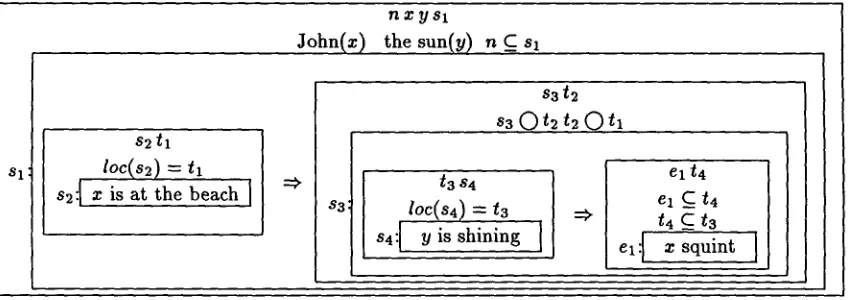
Finally, we deal with sentences such as (4), which contain an iteration of an implicit generic quantifier and always. The situation described by John's always squinting when the sun is shining is analyzed as a complex state s3. This state holds whenever John is at the beach, recorded by the condition that the location time t~ of sa overlaps the event time, tl of John's being at the beach, s2 in Figure 6.
Sl:
S2 tl
loc(s~) = t l
s2:[ z is at the beach [
aohn(z)
=¢,
83
n z y s l
the sun(y) n C sl
szt2
sa
Ot~t~ Or1
t3 84
loc(s4)=t3
s4: y is shining
e l t 4
el _C t4
t4 C t3 el:[ z squint
Figure 6:
n X S l t l
s l O t 1 Q < n
$1
el t2
el:l x c.n. I
e2 e3 e4 t3 t4 t5 e2 C t z t 2 < t 3
e2:[z
sw. on t~Rpt
:= e~ ea C t4 e2 < ea ca: Ix take beer IRpt
:= e3 e4 C t4 ez < e4e4: ...
Figure 5:
7
A c k n o w l e d g m e n t s
The work of the second author was partially sup- ported by a grant from the Israeli ministry of sci- ence "Programming languages induced computa- tional linguistics", and by the fund for the pro- motion of research in the Technion. The authors would like to thank Nirit Kadmon and Uwe Reyle for reading a preliminary version of this paper.
R e f e r e n c e s
Emmon Bach. 1981. On time, tense and aspect. An essay in English metaphysics, in Peter Cole (ed.),
Radical Pragmatics
Academic Press, New York 63-81.Michael Bennet and Barbara Partee. 1978(1972). Toward the Logic of Tense and Aspect in En- glish ms. Reproduced by the Indiana University Linguistics Club
Orvokki ttein,imgki. 1978.
Semantics of English
temporal connectives.
Bloomington: Indiana University Linguistics Club.Erhard W. Hinrichs. 1986. Temporal anaphora in discourses of English.
Linguistics and Philoso-
phy
9:63-82.Erhard W. IIinrichs. 1988. Tense, quantifiers and contexts.
Computational Linguistics
volume 14, number 2, pages 3-14.Nirit Kadmon. 1990. Uniqueness
Linguistics and
Philosophy
13:273-324Hans Kamp. 1979. Events, instants and temporal reference. In R. Baiierle, U. Egli and A. yon Stechow (eds.) Semantics from different points of view Springer Verlag, Berlin.
Hans Kamp. 1981. A theory of Truth and Se- mantic Representation in J. Groenendijk, TH. Janssen and M. Stokhof(eds.) Formal Methods in the Study of Language, Part I. Mathema- tisch Centrum, Amsterdam. pages 277-322 Hans Kamp and Uwe Reyle 1993. From Dis-
course to Logic
Introduction to Modeltheoretic
Semantics of Natural Language, Formal Logic
and Discourse Representation Theory.
Kluwer Academic Publishers, Dordrecht.Marc Moens and Mark Steedman 1988. Tempo- ral Ontology and Temporal Reference
Compu-
tational Linguistics
14 15-28.Barbara II. Partee. 1973. Some structural analo- gies between tenses and pronouns in English.
Journal of Philosophy
LXX 601-609Barbara If. Partee. 1984. Nominal and Temporal Anaphora Linguistics and Philosophy 7.3 (243-
286)
Arthur Prior. 1967. Past, Present and Future. Oxford University Press, Oxford
Hans Reichenbach. 1947. Elements of Symbolic Logic. Reprinted in 1966 by The Free Press, New York.
[image:6.596.110.534.82.232.2]