Supervised Models for Coreference Resolution
Altaf Rahman and Vincent Ng
Human Language Technology Research Institute University of Texas at Dallas
Richardson, TX 75083-0688
{altaf,vince}@hlt.utdallas.edu
Abstract
Traditional learning-based coreference re-solvers operate by training a mention-pair classifier for determining whether two mentions are coreferent or not. Two in-dependent lines of recent research have attempted to improve these mention-pair classifiers, one by learning a mention-ranking model to rank preceding men-tions for a given anaphor, and the other by training an entity-mention classifier to determine whether a preceding clus-ter is coreferent with a given mention. We propose a cluster-ranking approach to coreference resolution that combines the strengths of mention rankers and entity-mention models. We additionally show how our cluster-ranking framework natu-rally allows discourse-new entity detection to be learned jointly with coreference res-olution. Experimental results on the ACE data sets demonstrate its superior perfor-mance to competing approaches.
1 Introduction
Noun phrase (NP) coreference resolution is the task of identifying which NPs (or mentions) re-fer to the same real-world entity or concept. Tra-ditional learning-based coreference resolvers op-erate by training a model for classifying whether two mentions are co-referring or not (e.g., Soon et al. (2001), Ng and Cardie (2002b), Kehler et al. (2004), Ponzetto and Strube (2006)). Despite their initial successes, these mention-pair models have at least two major weaknesses. First, since each candidate antecedent for a mention to be resolved (henceforth an active mention) is considered inde-pendently of the others, these models only deter-mine how good a candidate antecedent is relative to the active mention, but not how good a candi-date antecedent is relative to other candicandi-dates. In
other words, they fail to answer the critical ques-tion of which candidate antecedent is most prob-able. Second, they have limitations in their ex-pressiveness: the information extracted from the two mentions alone may not be sufficient for mak-ing an informed coreference decision, especially if the candidate antecedent is a pronoun (which is se-mantically empty) or a mention that lacks descrip-tive information such as gender (e.g., Clinton).
To address the first weakness, researchers have attempted to train a mention-ranking model for determining which candidate antecedent is most probable given an active mention (e.g., Denis and Baldridge (2008)). Ranking is arguably a more natural reformulation of coreference resolution than classification, as a ranker allows all candidate antecedents to be considered simultaneously and therefore directly captures the competition among them. Another desirable consequence is that there exists a natural resolution strategy for a ranking approach: a mention is resolved to the candidate antecedent that has the highest rank. This con-trasts with classification-based approaches, where many clustering algorithms have been employed to co-ordinate the pairwise coreference decisions (because it is unclear which one is the best).
To address the second weakness, researchers have investigated the acquisition of entity-mention coreference models (e.g., Luo et al. (2004), Yang et al. (2004)). Unlike mention-pair models, these entity-mention models are trained to determine whether an active mention belongs to a preced-ing, possibly partially-formed, coreference cluster. Hence, they can employ cluster-level features (i.e., features that are defined over any subset of men-tions in a preceding cluster), which makes them more expressive than mention-pair models.
Motivated in part by these recently developed models, we propose in this paper a cluster-ranking approach to coreference resolution that combines the strengths of mention-ranking
els and entity-mention models. Specifically, we recast coreference as the problem of determining which of a set of preceding coreference clusters is the best to link to an active mention using a learned cluster ranker. In addition, we show how discourse-new detection (i.e., the task of determin-ing whether a mention introduces a new entity in a discourse) can be learned jointly with corefer-ence resolution in our cluster-ranking framework. It is worth noting that researchers typically adopt a pipeline coreference architecture, performing discourse-new detection prior to coreference res-olution and using the resulting information to pre-vent a coreference system from resolving men-tions that are determined to be discourse-new (see Poesio et al. (2004) for an overview). As a re-sult, errors in discourse-new detection could be propagated to the resolver, possibly leading to a deterioration of coreference performance (see Ng and Cardie (2002a)). Jointly learning discourse-new detection and coreference resolution can po-tentially address this error-propagation problem.
In sum, we believe our work makes three main contributions to coreference resolution:
Proposing a simple, yet effective coreference model. Our work advances the state-of-the-art in coreference resolution by bringing learning-based coreference systems to the next level of performance. When evaluated on the ACE 2005 coreference data sets, cluster rankers outperform three competing models — mention-pair, entity-mention, and mention-ranking models — by a large margin. Also, our joint-learning approach to discourse-new detection and coreference reso-lution consistently yields cluster rankers that out-perform those adopting the pipeline architecture. Equally importantly, cluster rankers are conceptu-ally simple and easy to implement and do not rely on sophisticated training and inference procedures to make coreference decisions in dependent rela-tion to each other, unlike relarela-tional coreference models (see McCallum and Wellner (2004)).
Bridging the gap between machine-learning approaches and linguistically-motivated ap-proaches to coreference resolution. While ma-chine learning approaches to coreference resolu-tion have received a lot of attenresolu-tion since the mid-90s, popular learning-based coreference frame-works such as the mention-pair model are ar-guably rather unsatisfactory from a linguistic point of view. In particular, they have not leveraged
advances in discourse-based anaphora resolution research in the 70s and 80s. Our work bridges this gap by realizing in a new machine learn-ing framework ideas rooted in Lappin and Leass’s (1994) heuristic-based pronoun resolver, which in turn was motivated by classic salience-based ap-proaches to anaphora resolution.
Revealing the importance of adopting the right model. While entity-mention models have pre-viously been shown to be worse or at best marginally better than their mention-pair counter-parts (Luo et al., 2004; Yang et al., 2008), our cluster-ranking models, which are a natural exten-sion of entity-mention models, significantly out-performed all competing approaches. This sug-gests that the use of an appropriate learning frame-work can bring us a long way towards high-performance coreference resolution.
The rest of the paper is structured as follows. Section 2 discusses related work. Section 3 de-scribes our baseline coreference models: mention-pair, entity-mention, and mention-ranking. We discuss our cluster-ranking approach in Section 4, evaluate it in Section 5, and conclude in Section 6.
2 Related Work
Heuristic-based cluster ranking. As men-tioned previously, the work most related to ours is Lappin and Leass (1994), whose goal is to perform pronoun resolution by assigning an anaphoric pro-noun to the highest-scored preceding cluster. Nev-ertheless, Lappin and Leass’s work differs from ours in several respects. First, they only tackle pronoun resolution rather than the full coreference task. Second, their algorithm is heuristic-based; in particular, the score assigned to a preceding clus-ter is computed by summing over the weights as-sociated with the factors applicable to the cluster, where the weights are determined heuristically, rather than learned, unlike ours.
con-straints in a separate filtering step. In particular, we attempt to determine the compatibility between a cluster and an active mention, using factors that determine not only salience (e.g., the distance be-tween the cluster and the mention) but also lexical and grammatical compatibility, for instance.
Entity-mention coreference models. Luo et al. (2004) represent one of the earliest attempts to investigate learning-based entity-mention models. They use the ANY predicate to generate
cluster-level features as follows: given a binary-valued feature X defined over a pair of mentions, they introduce an ANY-X cluster-level feature, which
has the valueTRUEifX is true between the active mention and any mention in the preceding clus-ter under consideration. Contrary to common wis-dom, this entity-mention model underperforms its mention-pair counterpart in spite of the general-ization from mention-pair to cluster-level features. In Yang et al.’s (2004) entity-mention model, a training instance is composed of an active men-tion mk, a preceding cluster C, and a mention
mj in C that is closest in distance to mk in the associated text. The feature set used to repre-sent the instance is primarily composed of fea-tures that describe the relationship between mj and mk, as well as a few cluster-level features. In other words, the model still relies heavily on features used in a mention-pair model. In par-ticular, the inclusion of mj in the feature vector representation to some extent reflects the authors’ lack of confidence that a strong entity-mention model can be trained without mention-pair-based features. Our ranking model, on the other hand, is trained without such features. More recently, Yang et al. (2008) have proposed another entity-mention model trained by inductive logic programming. Like their previous work, the scarcity of cluster-level predicates (only two are used) under-exploits the expressiveness of entity-mention models.
Mention ranking. The notion of ranking can-didate antecedents can be traced back to center-ing algorithms, many of which use grammatical roles to rank forward-looking centers (see Grosz et al. (1995), Walker et al. (1998), and Mitkov (2002)). However, mention ranking has been employed in learning-based coreference resolvers only recently. As mentioned before, Denis and Baldridge (2008) train a mention-ranking model. Their work can be viewed as an extension of Yang et al.’s (2003) twin-candidate coreference model,
which ranks only two candidate antecedents at a time. Unlike ours, however, their model ranks mentions rather than clusters, and relies on an independently-trained discourse-new detector.
Discourse-new detection. Discourse-new de-tection is often tackled independently of coref-erence resolution. Pleonastic its have been de-tected using heuristics (e.g., Kennedy and Bogu-raev (1996)) and learning-based techniques such as rule learning (e.g., M ¨uller (2006)), kernels (e.g., Versley et al. (2008)), and distributional methods (e.g., Bergsma et al. (2008)). Non-anaphoric defi-nite descriptions have been detected using heuris-tics (e.g., Vieira and Poesio (2000)) and unsu-pervised methods (e.g., Bean and Riloff (1999)). General discourse-new detectors that are applica-ble to different types of NPs have been built using heuristics (e.g., Byron and Gegg-Harrison (2004)) and modeled generatively (e.g., Elsner and Char-niak (2007)) and discriminatively (e.g., Uryupina (2003)). There have also been attempts to perform joint inference for discourse-new detection and coreference resolution using integer linear pro-gramming (ILP), where a discourse-new classifier and a coreference classifier are trained indepen-dently of each other, and then ILP is applied as a post-processing step to jointly infer discourse-new and coreference decisions so that they are consis-tent with each other (e.g., Denis and Baldridge (2007)). Joint inference is different from our joint-learning approach, which allows the two tasks to be learned jointly and not independently.
3 Baseline Coreference Models
In this section, we describe three coreference mod-els that will serve as our baselines: the mention-pair model, the entity-mention model, and the mention-ranking model. For illustrative purposes, we will use the text segment shown in Figure 1. Each mention m in the segment is annotated as [m]cid
mid, where mid is the mention id and cid is
the id of the cluster to which m belongs. As we can see, the mentions are partitioned into four sets, with Barack Obama, his, and he in one cluster, and each of the remaining mentions in its own cluster.
3.1 Mention-Pair Model
As noted before, a mention-pair model is a clas-sifier that decides whether or not an active men-tionmkis coreferent with a candidate antecedent
[Barack Obama]11 nominated[Hillary Rodham Clinton]22 as
[[his]13secretary of state]34on[Monday]45.[He]16...
Figure 1: An illustrative example
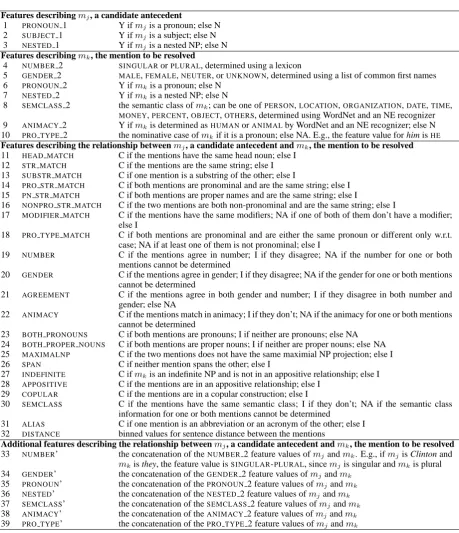
mk and consists of the 39 features shown in Ta-ble 1. These features have largely been employed by state-of-the-art learning-based coreference sys-tems (e.g., Soon et al. (2001), Ng and Cardie (2002b), Bengtson and Roth (2008)), and are com-puted automatically. As can be seen, the features are divided into four blocks. The first two blocks consist of features that describe the properties of
mj andmk, respectively, and the last two blocks
of features describe the relationship between mj andmk. The classification associated with a train-ing instance is either positive or negative, depend-ing on whethermjandmkare coreferent.
If one training instance were created from each pair of mentions, the negative instances would significantly outnumber the positives, yielding a skewed class distribution that will typically have an adverse effect on model training. As a result, only a subset of mention pairs will be generated for training. Following Soon et al. (2001), we create (1) a positive instance for each discourse-old mention mk and its closest antecedent mj; and (2) a negative instance for
mkpaired with each of the intervening mentions,
mj+1, mj+2, . . . , mk−1. In our running example shown in Figure 1, three training instances will be generated for He: i(Monday, He), i(secretary of state, He), and i(his, He). The first two of these instances will be labeled as negative, and the last one will be labeled as positive. To train a mention-pair classifier, we use the SVM learning algorithm from the SVMlight package (Joachims, 2002), converting all multi-valued features into an equivalent set of binary-valued features.
After training, the resulting SVM classifier is used to identify an antecedent for a mention in a test text. Specifically, an active mention mk se-lects as its antecedent the closest preceding men-tion that is classified as coreferent withmk. Ifmk is not classified as coreferent with any preceding mention, it will be considered discourse-new (i.e., no antecedent will be selected formk).
3.2 Entity-Mention Model
Unlike a mention-pair model, an entity-mention model is a classifier that decides whether or not
an active mention mk is coreferent with a par-tial cluster cj that precedes mk. Each training instance, i(cj, mk), represents cj and mk. The features for an instance can be divided into two types: (1) features that describe mk (i.e, those shown in the second block of Table 1), and (2) cluster-level features, which describe the relation-ship between cj and mk. Motivated by previ-ous work (Luo et al., 2004; Culotta et al., 2007; Yang et al., 2008), we create cluster-level fea-tures from mention-pair feafea-tures using four pred-icates: NONE, MOST-FALSE, MOST-TRUE, and
ALL. Specifically, for each feature X shown in
the last two blocks in Table 1, we first convert X
into an equivalent set of binary-valued features if it is multi-valued. Then, for each resulting binary-valued feature Xb, we create four binary-valued cluster-level features: (1) NONE-Xb is true when
Xbis false betweenmkand each mention incj; (2)
MOST-FALSE-Xb is true when Xb is true between
mkand less than half (but at least one) of the men-tions incj; (3)MOST-TRUE-Xb is true whenXb is true between mk and at least half (but not all) of the mentions incj; and (4)ALL-Xbis true whenXb
is true betweenmkand each mention incj. Hence, for eachXb, exactly one of these four cluster-level
features evaluates to true.
Following Yang et al. (2008), we create (1) a positive instance for each discourse-old mention
mk and the preceding cluster cj to which it be-longs; and (2) a negative instance for mk paired with each partial cluster whose last mention ap-pears betweenmkand its closest antecedent (i.e., the last mention of cj). Consider again our run-ning example. Three trairun-ning instances will be generated for He: i({Monday}, He), i({secretary of state}, He), and i({Barack Obama, his}, He). The first two of these instances will be labeled as negative, and the last one will be labeled as pos-itive. As in the mention-pair model, we train an entity-mention classifier using the SVM learner.
After training, the resulting classifier is used to identify a preceding cluster for a mention in a test text. Specifically, the mentions are processed in a left-to-right manner. For each active mention
mk, a test instance is created between mk and each of the preceding clusters formed so far. All the test instances are then presented to the classi-fier. Finally, mk will be linked to the closest pre-ceding cluster that is classified as coreferent with
Features describingmj, a candidate antecedent
1 PRONOUN1 Y ifmjis a pronoun; else N 2 SUBJECT1 Y ifmjis a subject; else N 3 NESTED1 Y ifmjis a nested NP; else N
Features describingmk, the mention to be resolved
4 NUMBER2 SINGULARorPLURAL, determined using a lexicon
5 GENDER2 MALE,FEMALE,NEUTER, orUNKNOWN, determined using a list of common first names 6 PRONOUN2 Y ifmkis a pronoun; else N
7 NESTED2 Y ifmkis a nested NP; else N
8 SEMCLASS 2 the semantic class ofmk; can be one ofPERSON,LOCATION,ORGANIZATION,DATE,TIME,
MONEY,PERCENT,OBJECT,OTHERS, determined using WordNet and an NE recognizer 9 ANIMACY 2 Y ifmkis determined asHUMANorANIMALby WordNet and an NE recognizer; else N 10 PRO TYPE 2 the nominative case ofmkif it is a pronoun; else NA. E.g., the feature value for him isHE
Features describing the relationship betweenmj, a candidate antecedent andmk, the mention to be resolved
11 HEAD MATCH C if the mentions have the same head noun; else I 12 STR MATCH C if the mentions are the same string; else I 13 SUBSTR MATCH C if one mention is a substring of the other; else I
14 PRO STR MATCH C if both mentions are pronominal and are the same string; else I 15 PN STR MATCH C if both mentions are proper names and are the same string; else I
16 NONPRO STR MATCH C if the two mentions are both non-pronominal and are the same string; else I
17 MODIFIER MATCH C if the mentions have the same modifiers; NA if one of both of them don’t have a modifier; else I
18 PRO TYPE MATCH C if both mentions are pronominal and are either the same pronoun or different only w.r.t. case; NA if at least one of them is not pronominal; else I
19 NUMBER C if the mentions agree in number; I if they disagree; NA if the number for one or both mentions cannot be determined
20 GENDER C if the mentions agree in gender; I if they disagree; NA if the gender for one or both mentions cannot be determined
21 AGREEMENT C if the mentions agree in both gender and number; I if they disagree in both number and gender; else NA
22 ANIMACY C if the mentions match in animacy; I if they don’t; NA if the animacy for one or both mentions cannot be determined
23 BOTH PRONOUNS C if both mentions are pronouns; I if neither are pronouns; else NA 24 BOTH PROPER NOUNS C if both mentions are proper nouns; I if neither are proper nouns; else NA 25 MAXIMALNP C if the two mentions does not have the same maximial NP projection; else I 26 SPAN C if neither mention spans the other; else I
27 INDEFINITE C ifmkis an indefinite NP and is not in an appositive relationship; else I 28 APPOSITIVE C if the mentions are in an appositive relationship; else I
29 COPULAR C if the mentions are in a copular construction; else I
30 SEMCLASS C if the mentions have the same semantic class; I if they don’t; NA if the semantic class information for one or both mentions cannot be determined
31 ALIAS C if one mention is an abbreviation or an acronym of the other; else I 32 DISTANCE binned values for sentence distance between the mentions
Additional features describing the relationship betweenmj, a candidate antecedent andmk, the mention to be resolved
33 NUMBER’ the concatenation of theNUMBER2 feature values ofmjandmk. E.g., ifmjis Clinton and
mkis they, the feature value isSINGULAR-PLURAL, sincemjis singular andmkis plural 34 GENDER’ the concatenation of theGENDER2 feature values ofmjandmk
[image:5.595.78.538.52.586.2]35 PRONOUN’ the concatenation of thePRONOUN2 feature values ofmjandmk 36 NESTED’ the concatenation of theNESTED2 feature values ofmjandmk 37 SEMCLASS’ the concatenation of theSEMCLASS2 feature values ofmjandmk 38 ANIMACY’ the concatenation of theANIMACY2 feature values ofmjandmk 39 PRO TYPE’ the concatenation of thePRO TYPE2 feature values ofmjandmk
Table 1: The feature set for coreference resolution. Non-relational features describe a mention and in most cases take on a value of YESor NO. Relational features describe the relationship between the two mentions and indicate whether they are COMPATIBLE, INCOMPATIBLEor NOTAPPLICABLE.
preceding cluster, it will be considered discourse-new. Note that all partial clusters preceding mk are formed incrementally based on the predictions of the classifier for the firstk−1mentions.
3.3 Mention-Ranking Model
As noted before, a ranking model imposes a ranking on all the candidate antecedents of an
The only difference lies in the assignment of class values to training instances. Assuming that
Sk is the set of training instances created for
anaphoric mention mk, the class value for an in-stance i(mj, mk) inSk is the rank of mj among competing candidate antecedents, which is 2 if
mj is the closest antecedent of mk, and 1
other-wise.1 To exemplify, consider our running exam-ple. As in the mention-pair model, three training instances will be generated for He: i(Monday, He),
i(secretary of state, He), i(his, He). The third
in-stance will have a class value of 2, and the remain-ing two will have a class value of 1.
After training, the mention-ranking model is ap-plied to rank the candidate antecedents for an tive mention in a test text as follows. Given an ac-tive mentionmk, we follow Denis and Baldridge (2008) and use an independently-trained classifier to determine whether mk is discourse-new. If so,
mkwill not be resolved. Otherwise, we create test instances formkby pairing it with each of its ceding mentions. The test instances are then pre-sented to the ranker, and the preceding mention that is assigned the largest value by the ranker is selected as the antecedent ofmk.
The discourse-new classifier used in the resolu-tion step is trained with 26 of the 37 features2 de-scribed in Ng and Cardie (2002a) that are deemed useful for distinguishing between anaphoric and non-anaphoric mentions. These features can be broadly divided into two types: (1) features that encode the form of the mention (e.g., NP type, number, definiteness), and (2) features that com-pare the mention to one of its preceding mentions.
4 Coreference as Cluster Ranking
In this section, we describe our cluster-ranking ap-proach to NP coreference. As noted before, our approach aims to combine the strengths of entity-mention models and entity-mention-ranking models.
4.1 Training and Applying a Cluster Ranker
For ease of exposition, we will describe in this subsection how to train and apply a cluster ranker when it is used in a pipeline architecture, where discourse-new detection is performed prior to coreference resolution. In the next subsection, we will show how the two tasks can be learned jointly.
1
A larger class value implies a better rank in SVMlight.
2The 11 features that we did not employ are
CONJ,
POSSESSIVE,MODIFIER,POSTMODIFIED,SPECIAL NOUNS,
POST,SUBCLASS,TITLE, and the positional features.
Recall that a cluster ranker ranks a set of pre-ceding clusters for an active mention mk. Since a cluster ranker is a hybrid of a mention-ranking model and an entity-mention model, the way it is trained and applied is also a hybrid of the two. In particular, the instance representation employed by a cluster ranker is identical to that used by an entity-mention model, where each training in-stance i(cj,mk) represents a preceding cluster cj and a discourse-old mention mk and consists of cluster-level features formed from predicates. Un-like in an entity-mention model, however, in a cluster ranker, (1) a training instance is created be-tween each discourse-old mentionmkand each of its preceding clusters; and (2) since we are train-ing a model for ranktrain-ing clusters, the assignment of class values to training instances is similar to that of a mention ranker. Specifically, the class value of a training instance i(cj,mk) created formkis the rank ofcj among the competing clusters, which is 2 ifmkbelongs tocj, and 1 otherwise.
Applying the learned cluster ranker to a test text is similar to applying a mention ranker. Specifi-cally, the mentions are processed in a left-to-right manner. For each active mention mk, we first apply an independently-trained classifier to deter-mine ifmkis discourse-new. If so,mkwill not be resolved. Otherwise, we create test instances for
mk by pairing it with each of its preceding clus-ters. The test instances are then presented to the ranker, and mk is linked to the cluster that is as-signed the highest value by the ranker. Note that these partial clusters precedingmkare formed in-crementally based on the predictions of the ranker for the firstk−1mentions; no gold-standard coref-erence information is used in their formation.
4.2 Joint Discourse-New Detection and Coreference Resolution
The cluster ranker described above can be used to determine which preceding cluster a discourse-old mention should be linked to, but it cannot be used to determine whether a mention is discourse-new or not. The reason is simple: all the training instances are generated from discourse-old men-tions. Hence, to jointly learn discourse-new de-tection and coreference resolution, we must train the ranker using instances generated from both discourse-old and discourse-new mentions.
a new cluster by creating an additional instance that (1) contains features that solely describe the active mention (i.e., the features shown in the sec-ond block of Table 1), and (2) has the highest rank value among competing clusters (i.e., 2) if it is discourse-new and the lowest rank value (i.e., 1) otherwise. The main advantage of jointly learning the two tasks is that it allows the ranking model to evaluate all possible options for an active men-tion (i.e., whether to resolve it, and if so, which preceding cluster is the best) simultaneously.
After training, the resulting cluster ranker pro-cesses the mentions in a test text in a left-to-right manner. For each active mention mk, we create test instances for it by pairing it with each of its preceding clusters. To allow for the possibility that
mkis discourse-new, we create an additional test instance that contains features that solely describe the active mention (similar to what we did in the training step above). All these test instances are then presented to the ranker. If the additional test instance is assigned the highest rank value by the ranker, thenmkis classified as discourse-new and will not be resolved. Otherwise, mk is linked to the cluster that has the highest rank. As before, all partial clusters precedingmkare formed incre-mentally based on the predictions of the ranker for the firstk−1mentions.
5 Evaluation
5.1 Experimental Setup
Corpus. We use the ACE 2005 coreference cor-pus as released by the LDC, which consists of the 599 training documents used in the official ACE evaluation.3 To ensure diversity, the corpus was created by selecting documents from six different sources: Broadcast News (bn), Broadcast Con-versations (bc), Newswire (nw), Webblog (wb), Usenet (un), and conversational telephone speech (cts). The number of documents belonging to each source is shown in Table 2. For evaluation, we par-tition the 599 documents into a training set and a test set following a 80/20 ratio, ensuring that the two sets have the same proportion of documents from the six sources.
Mention extractor. We evaluate each corefer-ence model using both true mentions (i.e., gold standard mentions4) and system mentions (i.e.,
au-3
Since we did not participate in ACE 2005, we do not have access to the official test set.
4Note that only mention boundaries are used.
Dataset bn bc nw wl un cts
# of documents 60 226 106 119 49 39
Table 2: Statistics for the ACE 2005 corpus
tomatically identified mentions). To extract sys-tem mentions from a test text, we trained a men-tion extractor on the training texts. Following Flo-rian et al. (2004), we recast mention extraction as a sequence labeling task, where we assign to each token in a test text a label that indicates whether it begins a mention, is inside a mention, or is outside a mention. Hence, to learn the extractor, we create one training instance for each token in a training text and derive its class value (one of b, i, and o) from the annotated data. Each instance represents
wi, the token under consideration, and consists of 29 linguistic features, many of which are modeled after the systems of Bikel et al. (1999) and Florian et al. (2004), as described below.
Lexical (7): Tokens in a window of 7:
{wi−3, . . . , wi+3}.
Capitalization (4): Determine whether wi
IsAllCap,IsInitCap,IsCapPeriod, and
IsAllLower(see Bikel et al. (1999)).
Morphological (8): wi’s prefixes and suffixes of length one, two, three, and four.
Grammatical (1): The part-of-speech (POS) tag of wi obtained using the Stanford log-linear POS tagger (Toutanova et al., 2003).
Semantic (1): The named entity (NE) tag ofwi obtained using the Stanford CRF-based NE recog-nizer (Finkel et al., 2005).
Gazetteers (8): Eight dictionaries containing pronouns (77 entries), common words and words that are not names (399.6k), person names (83.6k), person titles and honorifics (761), vehicle words (226), location names (1.8k), company names (77.6k), and nouns extracted from WordNet that are hyponyms ofPERSON(6.3k).
We employ CRF++5, a C++ implementation of conditional random fields, for training the mention detector, which achieves an F-score of 86.7 (86.1 recall, 87.2 precision) on the test set. These ex-tracted mentions are to be used as system mentions in our coreference experiments.
Scoring programs. To score the output of a coreference model, we employ three scoring pro-grams: MUC (Vilain et al., 1995), B3(Bagga and Baldwin, 1998), andφ3-CEAF (Luo, 2005).
There is a complication, however. When scor-ing a response (i.e., system-generated) partition against a key (i.e., gold-standard) partition, a scor-ing program needs to construct a mappscor-ing between the mentions in the response and those in the key. If the response is generated using true mentions, then every mention in the response is mapped to some mention in the key and vice versa; in other words, there are no twinless (i.e., unmapped) men-tions (Stoyanov et al., 2009). However, this is not the case when system mentions are used. The aforementioned complication does not arise from the construction of the mapping, but from the fact that Bagga and Baldwin (1998) and Luo (2005) do not specify how to apply B3 and CEAF to score partitions generated from system mentions.
We propose a simple solution to this problem: we remove all and only those twinless system mentions that are singletons before applying B3 and CEAF. The reason is simple: since the coref-erence resolver has successfully identified these mentions as singletons, it should not be penal-ized, and removing them allows us to avoid such penalty. Note that we only remove twinless (as op-posed to all) system mentions that are singletons: this allows us to reward a resolver for success-ful identification of singleton mentions that have twins, thus overcoming a major weakness of and common criticism against the MUC scorer. Also, we retain twinless system mentions that are non-singletons, as the resolver should be penalized for identifying spurious coreference relations. On the other hand, we do not remove twinless mentions in the key partition, as we want to ensure that the resolver makes the correct (non-)coreference de-cisions for them. We believe that our proposal ad-dresses Stoyanov et al.’s (2009) problem of hav-ing very low precision when applyhav-ing the CEAF scorer to score partitions of system mentions.
5.2 Results and Discussions
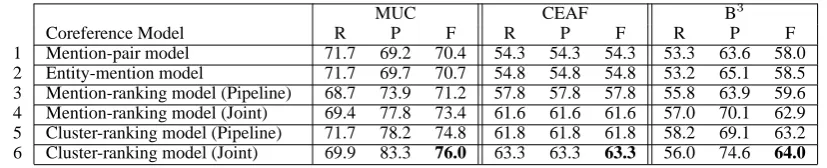
The mention-pair baseline. We train our first baseline, the mention-pair coreference classifier, using the SVM learning algorithm as implemented in the SVMlight package (Joachims, 2002).6 Re-sults of this baseline using true mentions and sys-tem mentions, shown in row 1 of Tables 3 and 4, are reported in terms of recall (R), precision (P), and F-score (F) provided by the three scoring
pro-6For this and subsequent uses of the SVM learner in our
experiments, we set all parameters to their default values.
grams. As we can see, this baseline achieves F-scores of 54.3–70.0 and 53.4–62.5 for true men-tions and system menmen-tions, respectively.
The entity-mention baseline. Next, we train our second baseline, the entity-mention corefer-ence classifier, using the SVM learner. Results of this baseline are shown in row 2 of Tables 3 and 4. For true mentions, this baseline achieves an F-score of 54.8–70.7. In comparison to the mention-pair baseline, F-score rises insignificantly accord-ing to all three scorers.7 Similar trends can be ob-served for system mentions, where the F-scores between the two models are statistically indistin-guishable across the board. While the insignifi-cant performance difference is somewhat surpris-ing given the improved expressiveness of entity-mention models over entity-mention-pair models, similar trends have been reported by Luo et al. (2004).
The mention-ranking baseline. Our third base-line is the mention-ranking coreference model, trained using the ranker-learning algorithm in SVMlight. To identify discourse-new mentions, we employ two methods. In the first method, we adopt a pipeline architecture, where we train an SVM classifier for discourse-new detection inde-pendently of the mention ranker on the training set using the 26 features described in Section 3.3. We then apply the resulting classifier to each test text to filter discourse-new mentions prior to corefer-ence resolution. Results of the mention ranker are shown in row 3 of Tables 3 and 4. As we can see, the ranker achieves F-scores of 57.8–71.2 and 54.1–65.4 for true mentions and system mentions, respectively, yielding a significant improvement over the entity-mention baseline in all but one case (MUC/true mentions).
In the second method, we perform discourse-new detection jointly with coreference resolution using the method described in Section 4.2. While we discussed this joint learning method in the con-text of cluster ranking, it should be easy to see that the method is equally applicable to a men-tion ranker. Results of the menmen-tion ranker using this joint architecture are shown in row 4 of Ta-bles 3 and 4. As we can see, the ranker achieves F-scores of 61.6–73.4 and 55.6–67.1 for true men-tions and system menmen-tions, respectively. For both types of mentions, the improvements over the cor-responding results for the entity-mention baseline
7We use Approximate Randomization (Noreen, 1989) for
MUC CEAF B3
Coreference Model R P F R P F R P F
1 Mention-pair model 71.7 69.2 70.4 54.3 54.3 54.3 53.3 63.6 58.0
2 Entity-mention model 71.7 69.7 70.7 54.8 54.8 54.8 53.2 65.1 58.5 3 Mention-ranking model (Pipeline) 68.7 73.9 71.2 57.8 57.8 57.8 55.8 63.9 59.6 4 Mention-ranking model (Joint) 69.4 77.8 73.4 61.6 61.6 61.6 57.0 70.1 62.9 5 Cluster-ranking model (Pipeline) 71.7 78.2 74.8 61.8 61.8 61.8 58.2 69.1 63.2 6 Cluster-ranking model (Joint) 69.9 83.3 76.0 63.3 63.3 63.3 56.0 74.6 64.0
Table 3: MUC, CEAF, and B3coreference results using true mentions.
MUC CEAF B3
Coreference Model R P F R P F R P F
1 Mention-pair model 70.0 56.4 62.5 56.1 51.0 53.4 50.8 57.9 54.1
[image:9.595.94.508.61.145.2]2 Entity-mention model 68.5 57.2 62.3 56.3 50.2 53.1 51.2 57.8 54.3 3 Mention-ranking model (Pipeline) 62.2 68.9 65.4 51.6 56.7 54.1 52.3 61.8 56.6 4 Mention-ranking model (Joint) 62.1 73.0 67.1 53.0 58.5 55.6 50.4 65.5 56.9 5 Cluster-ranking model (Pipeline) 65.3 72.3 68.7 54.1 59.3 56.6 55.3 63.7 59.2 6 Cluster-ranking model (Joint) 64.1 75.4 69.3 56.7 62.6 59.5 54.4 70.5 61.4
Table 4: MUC, CEAF, and B3coreference results using system mentions.
are significant, and suggest that mention ranking is a precision-enhancing device. Moreover, in com-parison to the pipeline architecture in row 3, we see that F-score rises significantly by 2.2–3.8% for true mentions, and improves by a smaller margin of 0.3–1.7% for system mentions. These results demonstrate the benefits of joint modeling. Our cluster-ranking model. Finally, we evalu-ate our cluster-ranking model. As in the mention-ranking baseline, we employ both the pipeline ar-chitecture and the joint arar-chitecture for discourse-new detection. Results are shown in rows 5 and 6 of Tables 3 and 4, respectively, for the two ar-chitectures. When true mentions are used, the pipeline architecture yields an F-score of 61.8– 74.8, which represents a significant improvement over the mention ranker adopting the pipeline ar-chitecture. With the joint architecture, the clus-ter ranker achieves an F-score of 63.3–76.0. This also represents a significant improvement over the mention ranker adopting the joint architecture, the best of the baselines, and suggests that cluster ranking is a better precision-enhancing model than mention ranking. Moreover, comparing the re-sults in these two rows reveals the superiority of the joint architecture over the pipeline architec-ture, particularly in terms of its ability to enhance system precision. Similar performance trends can be observed when system mentions are used.
6 Conclusions
We have presented a cluster-ranking approach that recasts the mention resolution process as the
prob-lem of finding the best preceding cluster to link an active mention to. Crucially, our approach com-bines the strengths of entity-mention models and mention-ranking models. Experimental results on the ACE 2005 corpus show that (1) jointly learn-ing coreference resolution and discourse-new de-tection allows the cluster ranker to achieve bet-ter performance than adopting a pipeline corefer-ence architecture; and (2) our cluster ranker signif-icantly outperforms the mention ranker, the best of the three baseline coreference models, under both the pipeline architecture and the joint architecture. Overall, we believe that our cluster-ranking ap-proach advances the state-of-the-art in coreference resolution both theoretically and empirically.
Acknowledgments
We thank the three anonymous reviewers for their invaluable comments on the paper. This work was supported in part by NSF Grant IIS-0812261.
References
A. Bagga and B. Baldwin. 1998. Entity-based cross-document coreferencing using the vector space model. In Proc. of COLING-ACL, pages 79–85. D. Bean and E. Riloff. 1999. Corpus-based
identifica-tion of non-anaphoric noun phrases. In Proc. of the
ACL, pages 373–380.
E. Bengtson and D. Roth. 2008. Understanding the values of features for coreference resolution. In
Proc. of EMNLP, pages 294–303.
S. Bergsma, D. Lin, and R. Goebel. 2008. Distribu-tional identification of non-referential pronouns. In
D. Bikel, R. Schwartz, and R. Weischedel. 1999. An algorithm that learns what’s in a name. Machine
Learning, 34(1–3):211–231.
D. Byron and W. Gegg-Harrison. 2004. Eliminating non-referring noun phrases from coreference resolu-tion. In Proc. of DAARC, pages 21–26.
A. Culotta, M. Wick, and A. McCallum. 2007. First-order probabilistic models for coreference resolu-tion. In Proc. of NAACL-HLT, pages 81–88.
P. Denis and J. Baldridge. 2007. Global, joint determi-nation of anaphoricity and coreference resolution us-ing integer programmus-ing. In Proc. of NAACL-HLT, pages 236–243.
P. Denis and J. Baldridge. 2008. Specialized models and ranking for coreference resolution. In Proc. of
EMNLP, pages 660–669.
M. Elsner and E. Charniak. 2007. A generative discourse-new model for text coherence. Technical Report CS-07-04, Brown University.
J. R. Finkel, T. Grenager, and C. Manning. 2005. In-corporating non-local information into information extraction systems by Gibbs sampling. In Proc. of
the ACL, pages 363–370.
R. Florian, H. Hassan, A. Ittycheriah, H. Jing, N. Kambhatla, X. Luo, N. Nicolov, and I. Zitouni. 2004. A statistical model for multilingual entity de-tection and tracking. In Proc. of HLT/NAACL.
B. J. Grosz, A. K. Joshi, and S. Weinstein. 1995. Centering: A framework for modeling the local co-herence of discourse. Computational Linguistics,
21(2):203–226.
B. J. Grosz and C. L. Sidner. 1986. Attention, inten-tions, and the structure of discourse. Computational
Linguistics, 12(3):175–204.
T. Joachims. 2002. Optimizing search engines using clickthrough data. In Proc. of KDD, pages 133–142.
A. Kehler, D. Appelt, L. Taylor, and A. Simma. 2004. The (non)utility of predicate-argument frequencies for pronoun interpretation. In Proc. of HLT/NAACL.
C. Kennedy and B. Boguraev. 1996. Anaphor for ev-eryone: Pronominal anaphora resolution without a parser. In Proc. of COLING, pages 113–118.
S. Lappin and H. Leass. 1994. An algorithm for pronominal anaphora resolution. Computational Linguistics, 20(4):535–562.
X. Luo, A. Ittycheriah, H. Jing, N. Kambhatla, and S. Roukos. 2004. A mention-synchronous coref-erence resolution algorithm based on the Bell tree. In Proc. of the ACL, pages 135–142.
X. Luo. 2005. On coreference resolution performance metrics. In Proc. of HLT/EMNLP, pages 25–32.
A. McCallum and B. Wellner. 2004. Conditional mod-els of identity uncertainty with application to noun coreference. In Advances in NIPS.
R. Mitkov. 2002. Anaphora Resolution. Longman.
R. Mitkov. 1998. Robust pronoun resolution with lim-ited knowledge. In Proc. of COLING/ACL, pages 869–875.
C. M¨uller. 2006. Automatic detection of nonrefer-ential it in spoken multi-party dialog. In Proc. of
EACL, pages 49–56.
V. Ng and C. Cardie. 2002a. Identifying anaphoric and non-anaphoric noun phrases to improve coreference resolution. In Proc. of COLING, pages 730–736. V. Ng and C. Cardie. 2002b. Improving machine
learn-ing approaches to coreference resolution. In Proc. of
the ACL, pages 104–111.
E. W. Noreen. 1989. Computer Intensive Methods for
Testing Hypothesis: An Introduction. John Wiley &
Sons.
M. Poesio, O. Uryupina, R. Vieira, M. Alexandrov-Kabadjov, and R. Goulart. 2004. Discourse-new detectors for definite description resolution: A sur-vey and a preliminary proposal. In Proc. of the ACL
Workshop on Reference Resolution.
S. P. Ponzetto and M. Strube. 2006. Exploiting seman-tic role labeling, WordNet and Wikipedia for coref-erence resolution. In Proc. of HLT/NAACL, pages 192–199.
W. M. Soon, H. T. Ng, and D. Lim. 2001. A machine learning approach to coreference resolu-tion of noun phrases. Computaresolu-tional Linguistics, 27(4):521–544.
V. Stoyanov, N. Gilbert, C. Cardie, and E. Riloff. 2009. Conundrums in noun phrase coreference resolution: Making sense of the state-of-the-art. In Proc. of the
ACL.
K. Toutanova, D. Klein, C. Manning, and Y. Singer. 2003. Feature-rich part-of-speech tagging with a cyclic dependency network. In Proc. of
HLT-NAACL, pages 252–259.
O. Uryupina. 2003. High-precision identification of discourse new and unique noun phrases. In Proc. of
the ACL Student Research Workshop.
Y. Versley, A. Moschitti, M. Poesio, and X. Yang. 2008. Coreference systems based on kernel meth-ods. In Proc. of COLING, pages 961–968.
R. Vieira and M. Poesio. 2000. Processing definite de-scriptions in corpora. In Corpus-based and
Compu-tational Approaches to Discourse Anaphora, pages
189–212. UCL Press.
M. Vilain, J. Burger, J. Aberdeen, D. Connolly, and L. Hirschman. 1995. A model-theoretic coreference scoring scheme. In Proc. of MUC-6, pages 45–52. M. Walker, A. Joshi, and E. Prince, editors. 1998.
Centering Theory in Discourse. Oxford University
Press.
X. Yang, G. Zhou, J. Su, and C. L. Tan. 2003. Coreference resolution using competitive learning approach. In Proc. of the ACL, pages 176–183. X. Yang, J. Su, G. Zhou, and C. L. Tan. 2004. An
NP-cluster based approach to coreference resolution. In
Proc. of COLING, pages 226–232.
X. Yang, J. Su, J. Lang, C. L. Tan, and S. Li. 2008. An entity-mention model for coreference resolution with inductive logic programming. In Proc. of the