Original Article
Functional constipation and bladder capacity
and severity of enuresis in children:
a
correlation
study
Yanli Ma1, Ying Shen1, Xiaomei Liu2
1Department of Nephrology, Beijing Children’s Hospital, Capital Medical University, Beijing Key Laboratory of
Chronic Kidney Disease and Blood Purification of Children, China; 2The General Ward, Beijing Children’s Hospital,
Capital Medical University, No. 56, South Lishi Road, Xicheng District, Beijing, China
Received June 2, 2017; Accepted November 26, 2017; Epub February 15, 2018; Published February 28, 2018
Abstract: Background: Primary nocturnal enuresis (PNE) is the most common voiding problem among pediatric patients. Enuresis has a complex etiology involving bladder function derangements, circadian rhythm, genetics, psy-chological factors, and the central nervous system. In this study, we studied the correlations among constipation, bladder capacity, and severity of PNE in children. Methods: The study was conducted in children and adolescents aged 5-15 years and diagnosed with PNE in Beijing Children’s Hospital, Capital Medical University. Severity of
noc-turnal enuresis was classified as mild-moderate and severe according to the frequency of enuresis. In particular, more than six wet nights weekly was classified as severe and six or less as mild-moderate. Rome III questionnaire
was used to determine whether a patient has constipation. Urinalysis and urinary ultrasound were performed for all participants. A logistic regression model was used to investigate the relationship between the severity of enuresis and possible predictive variables. Results: The mean age of the patients was 7.13 ± 2.45 years. A total of 92 pa-tients were male, and 72 were female. Sixty percent of the papa-tients had constipation for more than 6 months, and a negative association was found between constipation and bladder capacity (P = 0.000, r = -0.656). Rome III score was an independent predictor of severity of enuresis (P < 0.05). Constipated children were 1.47 times more likely to have severe enuresis than those not constipated (P = 0.002, 95% CI: 1.147-1.877). However, no significant relation -ship was observed between constipation and bladder residual urine volume (P = 0.725). Conclusion: Constipation was correlated with the severity of enuresis and bladder capacity. We strongly recommend careful inspection of constipation in each patient with enuresis.
Keywords: Constipation, enuresis, bladder capacity, correlation, Rome III score
Introduction
Functional constipation is characterized by
infrequent stool evacuation, passing of hard
stools, or painful defecation without fundamen-tal organic causes [1]. No structural, endocrine,
or metabolic etiology is identified in
childho-od constipation, which is often categorized as “functional” [2, 3]. The worldwide preva-lence of childhood constipation ranges from 0.3% to 28% [4]. Functional constipation is the second most common reason that a child is referred to a pediatric gastroenterologist, and such children account for up to 25% of all visits [3, 5].
Nocturnal enuresis (NE) refers to urinary incon-tinence during sleep in children aged 5 years
and above [6] and is the most common voiding
problem in children. NE can be classified as pri -mary or secondary. Pri-mary nocturnal enuresis
(PNE) is defined as enuresis since childhood
without at least 6 months of dryness. The pathophysiology of enuresis is complex and involves bladder function derangements, circa-dian rhythm (e.g., sleep and diuresis), genetics, psychological factors, and the central nervous system (e.g., several neurotransmitters and receptors).
night-time detrusor overactivity, which is associated with constipation, plays an important role in enuresis.
The association between enuresis and con- stipation is also well established and known. Hogdes [10]showed that 80% of enuretic pa- tients are also constipated and laxative therapy
obtained significant resolution of their enuretic
problem. However, this association remains un- clear. To the best of our knowledge, there is a lack of studies that extensively assessed the association of constipation systems with blad-der capacity and severity of enuresis in enuret-ic children. Thus, this study aims to discuss these issues.
Materials and methods
The study was conducted in children and ado-lescents aged 5-15 years and diagnosed with PNE between September 2016 and February 2017 in Beijing Children’s Hospital, Capital Me- dical University. The inclusion criteria were as follows: (1) age of 5-15 years, PNE (i.e. two or more wet nights per week and not dry for more than 6 months); (2) no medication for PNE rec- eived during the last 6 months; (3) lack of cli- nical or laboratory signs suggestive of some underlying diseases other than NE (e.g., kidney diseases, endocrine diseases, and nervous system diseases that may contribute to enure-sis); (4) voluntarily agreed to participate in this study and signed the informed consent. The exclusion criteria were as follows: (1) a pres-ence or a history of organic urological, hepatic,
pulmonary, cardiovascular, endocrinological, or neurological disease that would interfere with evaluation; (2) received treatment for NE within the past 6 months; (3) unwillingness to sign informed consent.
To evaluate the presence of constipation, we
used the Rome III child questionnaire for
pa-tients aged 4-18 years. All papa-tients were en-
couraged to complete the questionnaire by
themselves. When the patients experienced
any difficulty, they sought help from their par
-ents. The questionnaires can be completed by
parents if necessary (e.g., for those with
read-ing difficulty, 5-8 years old). Participants who responded positively to two of the six
ques-tions were considered constipated [11]. The
severity of NE was classified as mild-moderate and severe according to the frequency of
en-uresis. More than six wet nights weekly was
classified as severe, whereas six or less as
mild-moderate. Urinalysis and urinary ultra-sound were performed in all the participants. The study was submitted to the ethics com- mittee of our institution and obtained approval for its implementation. Written consent was obtained from the parents.
Statistical analysis
The collected data were analyzed using SPSS 20.0 (Statistical Package for the Social Sci- ences, version 20.0, SPSS Inc., Chicago, Illinois, USA). Numerical variables, such as age, were expressed as mean and SD. Categorical vari-ables, such as the incidence of severe or mild-moderate enuresis, were compared using the
chi-square test, where a P value of < 0.05 was
considered significant. Nonparametric
variabl-es of bladder capacity and Rome III scorvariabl-es
and frequency of enuresis were compared
us-ing the Spearman correlation, where P < 0.05
was considered significant. A logistic regres -sion model was used to investigate the rela-tionship between the severity of enuresis and possible predictive variables.
Results
Patient characteristics
A total of 164 PNE patients aged between 5
and 15 years fulfilled the inclusion criteria. Of
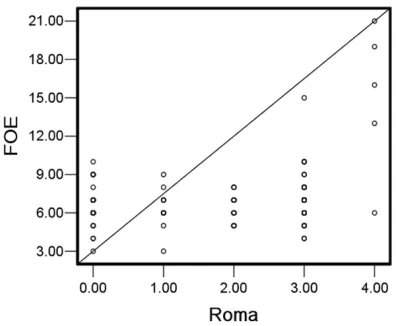
[image:2.612.90.288.70.233.2]them, 92 patients (56.1%) were male and 72 (43.9%) were female. The mean age of the Figure 1. Spearman correlation between frequency
of enuresis (FOE) and Rome III criteria (R2 = 0.097
patients was 7.13 ± 2.45 years. A total of 99 patients (60.0%) had constipation for more than 6 months, and 60.9% of them were male and 59.7% were female.
Correlation between constipation and symp-toms of enuresis
A positive correlation was found between
con-stipation (Rome III scores) and frequency of
enuresis (Figure 1, P = 0.001, coefficient and
correlation of 0.267).
We also found that constipated children, ac- cording to the Rome III criteria, had a higher incidence of severe enuresis and lower inci-dence of mild-moderate enuresis than those without constipation (68.7% versus 44.6%, 31.3% versus55.4%, P = 0.003, Table 1).
Correlation between constipation and bladder capacity
A negative association was found between con-stipation (Rome III scores) and bladder capacity (Figure 2, P = 0.000, coefficient and correlation
of -0.656).
Correlation between constipation and bladder residual urine volume
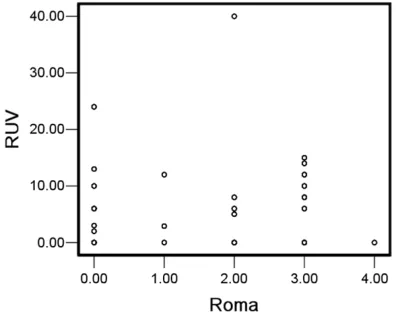
No significant relationship was observed
be-tween constipation and bladder residual urine volume (Figure 3, P = 0.725, coefficient and
correlation of 0.028).
Multivariate analysis of predictive risk factors of severe enuresis
A logistic regression model was used to investi-gate the relationship between severity of enure-sis and possible predictive variables, including age, gender, family history of NE, residual urine volume, and Roman III score, which was the only independent predictor of severe enuresis (Table 2). Constipated children were 1.47 times more likely to have severe enuresis than those not constipated.
Discussion
Constipation is a common pediatric problem that remains underdiagnosed and poorly treat-ed and thus often lead to severe functional impairment [12]. It is a commonly unrecognized etiologic factor in enuresis, and its treatment contributes to the resolution of enuresis [13]. The reported prevalence of constipation am- ong enuretic children ranged from 7.06% in a Turkish population study [14] to 69.8% at a tertiary US pediatric voiding dysfunction clinic [15]. The prevalence of constipation among enuretic children in this study (60.0%) was
con-sistent with findings of Robson [15]. Hodges
[image:3.612.88.297.106.334.2][10] determined that 80% of enuretic children are constipated, and their conditions can be improved through laxative therapy. Given the high incidence of constipation in children with enuresis, thoroughly assessing constipation in Table 1. Incidence of severe and mild-moderate
enuresis in constipated and not constipated patients with enuresis
mild-moderate
enuresis enuresisSevere P value Not constipated 36 (55.4%) 29 (44.6%) 0.003 Constipated 31 (31.3%) 68 (68.7%)
[image:3.612.90.288.384.542.2]Total 67 97
Figure 2. Spearman correlation between bladder ca-pacity and Rome III criteria (R2 = 0.474 Linear).
each enuretic patient is necessary. In the pres-ent study, a positive correlation between
con-stipation (Rome III scores) and frequency of
enuresis was observed, although the
correla-tion coefficient was low, suggesting a weak
relationship between them. From another per-spective, constipated children, according to the Rome III criteria, had a higher incidence of severe enuresis and lower incidence of mild-moderate enuresis than those without consti-pation, and the differences had statistical
sig-nificance. Furthermore, Rome III score was the
only independent predictor of severe enure- sis. Constipated children were 1.47 times more likely to have severe enuresis than those not constipated. Previous research also supports this view. McGrath et al. [16] conducted a pro-spective cross-sectional study and found that the prevalence of constipation is high among children with NE. The severity of bedwetting was higher in their cohort (95.3% wetted the bed at least once per week) compared with 5.1% in a large Australian population study of school-aged children [17], supporting that the severity of wetting may be associated with the presence of constipation. Thus, severe en- uresis often occurs concomitantly with
consti-pation, and constipation should be identified
and treated before managing enuresis if ne- cessary.
Nevertheless, the relationship between
consti-pation and enuresis remains controversial. Our
results are in contrast to those in previous stud-ies, indicating no association between noctur-nal enuresis and constipation. Sampaio [18] reported that 12.6% of children and adoles-cents had constipation in association with NE,
although this association was nonsignificant (P
= 0.483). Sureshkumar et al. [19] evaluated potential risk factors for the presence and severity of nocturnal enuresis and found no
sig-nificant association between constipation and
severe nocturnal enuresis. These differences
might be related to different definitions and
severity of NE used in different studies, differ-ent scales for evaluating constipation [19], dif-ferent age groups, difdif-ferent race, and sociocul-tural differences.
fecal retention in chronic functional constipa-tion causes bladder distorconstipa-tion and stimulaconstipa-tion of detrusor stretch receptors, resulting in detru-sor proneal dyssynergism [21]. Bladder func-tion derangements play an important role in the
pathogenesis of enuresis [22]. One important finding in our study was that children with more
severe constipation symptoms had more re- duced bladder capacity (r = -0.656). According to a study by Burgers [23], rectal distention
sig-nificantly and at times markedly affects bladder
capacity, contractility, and sensation. Franco [24] also suggested that when the rectum is distended, it compresses the adjacent blad- der and decreases functional bladder capacity. Kim et al. [25] reported that overactive bladder symptoms that contribute to enuresis can be improved by treating constipation. Constipation induces bladder dysfunction when the rectum
is filled with stool and stretch receptors are
stimulated and transmitted to the brain, induc-ing temporary involuntary contraction of the external anal sphincter and the puborectalis muscles [25]. In our study, we analyzed the re- lationship between constipation and residual urine volume, but the difference was not
statis-tically significant (P = 0.725), suggesting no cor-relation between the two.
Our study has several limitations. Restricted by
objective reality condition, we did not evaluate constipation by digital rectal examination or by rectal diameter on ultrasound. As this is a cross-sectional study, we cannot establish any causal relationship because of the small sam-ple size, and no participant responded
positive-ly to five or six of the six questions based on
Rome III criteria. Therefore, future research in this direction is necessary.
Conclusions
[image:4.612.89.375.84.125.2]Constipation was negatively associated with bladder capacity. Children with more severe constipation exhibited more reduced bladder capacity. Constipation was also correlated with the severity of enuresis. For enuretic patients with constipation, constipation should be eval-uated and treated to increase bladder capacity and therefore relieve enuresis.
Table 2. Multivariate analysis of severity of enuresis
Factors Standard error valueWald P OR 95% confidence interval
Lower limit Upper limit Rome III scores 0.126 9.313 0.002 1.47 1.147 1.877
Acknowledgements
The authors gratefully acknowledge the pa- tients and clinical investigators who participat-ed in this trial and thank the support from the research special project of capital health de- velopment. This study was funded by research special project of capital health development (grant number 2016-1-2095).
Disclosure of conflict of interest
None.
Address correspondence to: Ying Shen, Department of Nephrology, Beijing Children’s Hospital, Capital Medical University, Beijing Key Laboratory of Chronic
Kidney Disease and Blood Purification of Children,
China. Tel: 13370115116; E-mail: xdaspiwn@163. com; Xiaomei Liu, The General Ward, Beijing Children’s Hospital, Capital Medical University, No. 56, South Lishi Road, Xicheng District, Beijing, China. Tel: 13370115078; E-mail: xmliu16@163. com
References
[1] Voskuijl WP, Heijmans J, Heijmans HS, Tamin-iau JA and Benninga MA. Use of Rome II crite-ria in childhood defecation disorders: applica-bility in clinical and research practice. J Pediatr 2004; 145: 213-217.
[2] Biggs WS and Dery WH. Evaluation and treat-ment of constipation in infants and children. Am Fam Physicion 2006; 73: 469-477. [3] Lewis G and Rudolph CD. Practical approach
to defecation disorder in children. Pediatr Ann 1997; 26: 260-268.
[4] Dehghani SM, Basiratnia M, Matin M, Hamid-pour L, Haghighat M and Imanieh MH. Urinary tract infection and enuresis in children with chronic functional constipation. Iran J Kidney Dis 2013; 7: 363-366.
[5] Youssef NN and Di Lorenzo C. Childhood con-stipation: evaluation and treatment. J Clin Gastroenterol 2001; 33: 199-205.
[6] Austin PF, Bauer SB, Bower W, Chase J, Franco I, Hoebeke P, Rittig S, Vande Walle J, von Gon-tard A, Wright A, Yang SS and Nevéus T. The standardization of terminology of lower urinary tract function in children and adolescents: up-date report from the Standardization Commit-tee of the International Children’s Continence Society. J Urol 2014; 191: 1863-1865. [7] Veiga ML, Lordelo P, Farias T, Barroso C,
Bon-fim J and Barroso U Jr. Constipation in children
with isolated overactive bladders. J Pediatr Urol 2013; 6: 945-949.
[8] Panayi D, Khullar V, Spiteri M, Hendricken C and Fernando R. A pilot randomised study to determine if rectal distension alters urodynam-ics. Meeting of the International-continence-society 2008; 19: 636-636.
[9] De Wachter S and Wyndaele JJ. Impact of rec-tal distention on the results of evaluations of lower urinary tract sensation. J Urol 2003; 169: 1392-1394.
[10] Hodges SJ and Anthony EY. Occult megarec -tum-a commonly unrecognized cause of en-uresis. Urology 2012; 79: 421-424.
[11] Rasquin A, Di Lorenzo C, Forbes D, Guiraldes
E, Hyams JS, Staiano A and Walker LS. Child-hood functional gastrointestinal disorders: ch- ild/adolescent. Gastroenterology 2006; 130: 1527-1537.
[12] Culbert TP and Banez GA. Integrative ap-proaches to childhood constipation and en-copresis. Pediatr Clin North Am 2007; 54: 927-930.
[13] O’ Regan S, Yazbeck S, Hamberger B and
Schick E. Constipation a commonly unrecog-nized cause of enuresis. Am J Dis Child 1986; 140: 260-261.
[14] Cayan S, Doruk E, Bozlu M, Nass Duce M, Ulu-soy E and Akbay E. The assessment of consti-pation in monosymptomatic primary nocturnal enuresis. Int Urol Nephrol 2001; 33: 513-6. [15] Robson LM, Leung AK and Van Howe R.
Pri-mary and secondary nocturnal enuresis: simi-larities in presentation. Pediatrics 2005; 115: 956-9.
[16] McGrath KH, Caldwell PH and Jones MP. The
frequency of constipation in children with noc -turnal enuresis: a comparison with parental reporting. J Paediatr Child Health 2008; 44: 19-27.
[17] Bower WF, Moore KH, Shepherd RB and Ad-ams RD. The epidemiology of childhood enure-sis in Australia. Br J Urol 1996; 78: 602-6. [18] Sampaio C, Sousa AS, Fraga LG, Veiga ML,
Bastos Netto JM and Barroso U Jr. Constipation and lower urinary tract dysfunction in children and adolescents: a population-based study. Front Pediatr 2016; 4: 101.
[19] Sureshkumar P, Jones M, Caldwell PH and Craig JC. Risk factors for nocturnal enuresis in school-age children. J Urol 2009; 182: 2893-2899.
[20] Burgers RE, Mugie SM, Chase J, Cooper CS, von Gontard A, Rittig CS, Homsy Y, Bauer SB and Benninga MA. Management of functional constipation in children with lower urinary tract symptoms: report from the Standardization Committee of the International Children’s Con-tinence Society. J Urol 2013; 190: 29-36. [21] Hyman PE and Fleisher D. Functional fecal
[22] Vande Walle J, Rittig S, Bauer S, Eggert P, Marschall-Kehrel D and Tekgul S. Practical consensus guidelines for the management of enuresis. Eur J Pediatr 2012; 171: 971-983. [23] Burgers R, Liem O, Canon S, Mousa H, Ben
-ninga MA, Di Lorenzo C and Koff SA. Effect of rectal distention on lower urinary tract function in children. J Urol 2010; 184: 1680-1685.
[24] Franco I. Overactive bladder in children. Part 1:
pathophysiology. J Urol 2007; 178: 761-768. [25] Kim JH, Lee JH, Jung AY, Lee JW. The