Entity Extraction in Biomedical Corpora: An Approach to Evaluate Word
Embedding Features with PSO based Feature Selection
Shweta Yadav, Asif Ekbal, Sriparna Saha, Pushpak Bhattacharyya
Indian Institute of Technology Patna Bihar, India
{shweta.pcs14,asif,sriparna,pb}@iitp.ac.in
Abstract
Text mining has drawn significant atten-tion in recent past due to the rapid growth in biomedical and clinical records. Entity extraction is one of the fundamental com-ponents for biomedical text mining. In this paper, we propose a novel approach of feature selection for entity extraction that exploits the concept of deep learning and Particle Swarm Optimization (PSO). The system utilizes word embedding features along with several other features extracted by studying the properties of the datasets. We obtain an interesting observation that compact word embedding features as de-termined by PSO are more effective com-pared to the entire word embedding fea-ture set for entity extraction. The pro-posed system is evaluated on three bench-mark biomedical datasets such as GENIA, GENETAG and AiMed. The effective-ness of the proposed approach is evident with significant performance gains over the baseline models as well as the other ex-isting systems. We observe improvements of 7.86%, 5.27% and 7.25% F-measure points over the baseline models for GE-NIA, GENETAG, and AiMed dataset re-spectively.
1 Introduction
The tremendous amount of information accumu-lated in the domains of molecular biology has drawn the attention of biomedical natural lan-guage processing (BioNLP) community in order to facilitate the development of various tools for various text processing applications, curation and organization of ever-growing biomedical literature etc. Entity extraction is crucial step for solving
several pipelined applications such as information extraction, automatic summarization, question-answering, word sense disambiguation etc. Bio-medical entities mostly refer to the biological se-quences of protein & gene such as DNA, RNA, cell type, cell line etc. (Kim et al., 2004). The way of extracting these information from biomed-ical and clinbiomed-ical texts refers to as entity extraction. An automatic system which can extract biomed-ical names such as gene, protein or any disease name from text can substantially reduce the human efforts. However, extracting these entities from text poses several challenges which are presented as follows:
1. Named entities are very generative in nature, i.e. many new names are continuously being generated. Any dictionary can not capture all the various forms of a given name.
2. Similar words convey different meanings, and therefore, a word can have multiple NE types. For example, gene names often con-tain alphabets, digits, hyphens, and other characters, thus having many variants (e.g., “HIV-1 enhancer” versus “HIV 1 enhancer”). Moreover, many abbreviations (e.g., “IL2” for “Interleukin 2”) constitute integral parts of biomedical named entities (NEs).
3. Biomedical names are usually of long length, and contains different types of symbols, and hence boundary detection becomes problem-atic.
4. Ambiguity: Same name could be used to rep-resent variety of biological entities which fur-ther worsen the problem.
The challenges as of these kinds are the pri-mary causes behind the low accuracies of the sys-tems developed for entity extraction in
cal text. The research challenges have been ad-dressed in the literature including in some shared-task challenges, such as JNLPBA (Joint Workshop on Natural Language Processing in Biomedicine and its Applications) in 2004 (Kim et al., 2004) and BioCreative (Critical Assessment for Informa-tion ExtracInforma-tion in Biology Challenge) II GM (gene mention) subtask in 2007 (Smith et al., 2008). Over the years several benchmark corpora have been created that do not conform to the uniform annotation guidelines. Therefore the system, de-veloped by targeting a specific domain, often fails to show reasonable accuracy when it is evaluated for some other domains. In our work we attempt to build a system for entity extraction that performs well across various biomedical corpora.
Popular existing system mostly rely on rule-based system or supervised machine learning technique to automatically extract entities. They looked upon this problem as in terms of sequence label-ing and used algorithm such as hidden markov models (HMM) (Zhao, 2004), support vector ma-chines (SVM) (Kazama et al., 2002; GuoDong and Jian, 2004), maximum entropy Markov model (MEMM) (Finkel et al., 2005) and conditional random fields (CRF) (Ekbal et al., 2013; Settles, 2004; Kim et al., 2005). These supervised learn-ing models is fully dependent on the features that we use for training. Some of the popular fea-tures used in the existing studies include linguistic features such as morphological, syntactic and se-mantic information of words and domain-specific features from biomedical ontologies such as Bio-Thesaurus (Liu et al., 2006) and UMLS (Unified Medical Language System) (Bodenreider, 2004). However, these features heavenly account to the problem of data sparsity.
In the recent past, there has been huge interest in using large unlabeled corpus to generate word representation feature using deep neural network technique. We are motivated by the strength of deep learning concepts to build our model. We use the well-known word embedding model that is a robust framework to incorporate word repre-sentation features (Mikolov et al., 2013b). Word representation feature is a mathematical descrip-tion of the word in vector form. Each posidescrip-tion of vector corresponds to a feature with some se-mantic or grammatical inference which leads to the term word feature. Word representation fea-tures contains latent syntactic/semantic
informa-tion of a word. The main objective to use word embedding is to provide more useful information to the model being trained. Vector based word representation has powerful capability that cap-tures the phenomenon that words having the sim-ilar meanings should appear together (Mikolov et al., 2013b). In traditional machine learning, data sparsity is a problem that often causes the degra-dation in performance. This drawback could be overcome by the incorporation of word embed-ding with the presumption that similar type of word (as to semantics) appear in the similar con-text (Mikolov et al., 2013b).
The aim is to exploit the usefulness of neural network based word embedding (Bengio et al., 2003) as a feature for entity extraction in biomed-ical text. In addition we also make use of a very diverse feature set that exploits the properties of data and problem specific knowledge. We restrict ourselves from using much domaspecific in-formation for feature extraction, keeping in view easy adaptability of the system to more than one biomedical corpora.
embedding features. The key contribution of this paper are, (i) proposal of PSO based feature se-lection technique in bio-medical entity extraction.
(ii)analysis of feature selection on only word rep-resentation features. (iii)impact of feature selec-tion on word representaselec-tion features with hand-craft features.
2 Related Works
There has been quite a significant number of ex-isting works available for biomedical named en-tity recognition (BNER). These approaches can be divided into three major categories: (1) dictio-nary based, (2) rule based and (3) machine learn-ing based techniques. Among these existlearn-ing ap-proaches, machine learning based techniques have gained a lot more attention due to the availabil-ity of sufficiently good amount of annotated cor-pus. For example, majority of the systems sub-mitted to the JNLPBA challenge made use of ma-chine learning algorithms which have been ob-served to significantly outperform the dictionary based methods.
Some of the recent works in BNER includes the unsupervised model as proposed in (Zhang and Elhadad, 2013), and the system based on CRF (Li et al., 2015a). A two-phase approach based on semi-Markov CRF is proposed in (Yang and Zhou, 2014). In the first phase boundaries of entities are identified while in the second phase semantic labeling is performed to label the de-tected entities. A CRF based system has been proposed by (Tang et al., 2015), where in the first step boundaries of NEs are identified and in the second step appropriate labels are assigned. (Grouin, 2014) performed experiments on the i2b2/VA-2010 challenge dataset to detect bacte-ria and biotopes names. They developed a model based on CRFs. An unsupervised approach is proposed in (Han et al., 2016) that made use of clustering based active learning. They have used Shared Nearest Neighbor (SNN) clustering tech-nique. The work reported in (Li et al., 2015a), authors have proposed a parallel CRF algorithm (MapReduce CRF) which provides a mechanism to minimise the time taken for CRF learning. They showed that the proposed approach outperforms other traditional models in terms of time and ef-ficiency. While, most of the proposed system used CRF, recently (Patra and Saha, 2013) proposed a an entity extraction system based on SVM.
Par-ticularly, they have introduced a tree kernel based function that can efficiently solve the full NER task. The work proposed in (Tohidi et al., 2014) aims to improve the performance of entity extrac-tion using statistical character-based syntax simi-larity (SCSS) algorithm. This algorithm computes the similarity between the identified candidate en-tities and a known set of well-known NEs. This set of NEs is created by extracting the most frequently occurring NEs in the GENIA V3.0 corpus. In re-cent times deep learning based approaches such as Recurrent Neural Network and Bi-directional LSTM have also used for entity extraction(Li et al., 2015b; Limsopatham and Collier, 2016). It is well known that relevant features play an impor-tant role for building a high accurate system. In our work, in addition to the standard features we also use the features extracted from the word em-bedding model.
Bengio et al.(Bengio et al., 2003) have proposed a neural network based model for vector represen-tation of words. Distributed represenrepresen-tation (also known as word embedding) of a word has been used to improve the performance of various NLP tasks like Part-of-Speech (POS) tagging, NER in news-wire domain (Collobert et al., 2011), parsing (Socher et al., 2013; Turian et al., 2010) etc. Word cluster has been used used by Miller et al.(Miller et al., 2004) to boost the performance of a NER system. Tang et al. (Tang et al., 2012; Tang et al., 2013) have reported that performance of biomed-ical entity extraction can be improved when word representation is used as a feature to CRF and SVM classifiers.
model based word representation features with ef-fective feature selection have not been exploited so far in the literature.
2.1 A Brief Introduction to Particle Swarm Optimization (PSO)
Particle Swarm Optimization (PSO) is a meta-heuristic intelligent technique inspired by social behavior of the swarm for its survival (Eberhart and Shi, 1998; Kennedy and Eberhart, 1997). This is a population based technique which is perceived in birds and fishes for the search of the best path. In general, PSO consists of the swarm of the par-ticle where each parpar-ticle has its particular position in the search space with which it moves around the search space by some velocity. The parti-cle selects the best path on each iteration by us-ing its memory and by learnus-ing the effective path that was followed previously by the swarm. The new position is chosen on the basis of the knowl-edge gained previously by its self-best position and the best position of the swarm. PSO, being a meta-heuristic model, makes few or no assump-tion about the problem being optimized and can search very large spaces of candidate solutions. This makes PSO highly efficient for the optimiza-tion purpose (Yan et al., 2013). The algorithm it-erates by keeping track of two variables:
Global best position represents the most promis-ing vector found so far, and Personal best position denotes the particle’s own personal best solution.
2.1.1 Algorithm: PSO based Feature Selection
1. Initially, we randomly set the swarm popu-lation. Each particle of the swarm is repre-sented by binary-valued features of lengthn (total no. of feature) and has its position and velocity with which it moves in search space. Mathematically, particle position and particle velocity are represented as: −→P(i) and−→V(i) respectively:
−
→P(i) = (p(i,1), p(i,2), ..., p(i, n))
−
→V(i) = (v(i,1), v(i,2), ..., v(i, n))
where p(i, j) ∈ {0,1}, i = 1,2, ..., N and j = 1,2, ..., n where N is no. of particle. Particle maintains its best position (−→B(i)) that they have achieved so far and also the global best position(−→G)i.e., the best position of the particle having the best solution.
2. Particle’s position −→P(i) value is set either
{0,1}on the basis of following expression:
p(i,j)=
1 if random≥0.5 0 otherwise
3. Each particle is evaluated on the basis of fitness function (F-measure value)f(−→P(i)). The memory is updated by keeping track of the best position and global best position.
4. Initially, the value of best position(−→B(i))of every particle is set to 0. At every epoch(ep) the value of the best position is updated as follows:
f(−→B(i))ep =max(f(−→P(i))ep, f(−→B(i)ep−1)
5. Update in the global best position value is done when the fitness function f(−→B(i)) in the swarm is superior than the existingf(−→G).
6. Originally, the velocity vector is generated randomly. At each iteration, velocity of a particle is updated according to the following equation:
v(i,j)=ω∗v(i,j)+φ1(b(i,j)−p(i,j))+φ2(g(j)−p(i,j)) (1)
whereω(0 < ω < 1),φ1 andφ2 are known
as inertia weights. These parameters are ini-tialized with an uniformly generated random numbers in the range (0,1). Theb(i,j),p(i,j), andg(j)denote thejthcomponents of−→B(i), −
→P(i)and−→G, respectively.
7. The position of a particle is updated by the following mathematical expression:
p(i,j)=
1 if(random < S(v(i,j)))
0 otherwise
where 0≤random≤1 is an uniform random number.
S(v(i,j)) = 1+exp(−−1→v (i,j))
This represents the sigmoid function. Thus, we update the particle position value of0or 1on the basis of the value of velocity.
2.2 Learning Word Representations
Word embedding (also known as distributed word representations) persuade a real-valued latent se-mantic or syntactic vector for each word from a large unlabeled corpus by using continuous space language models (Tang et al., 2014). Better word representation can be obtained if we have a large amount of training data as the obtained real-valued vectors of words become more representa-tive. We use the popularword2vec1tool proposed
by Mikolov et al. (Mikolov et al., 2013a) to ex-tract the vector representations of words. Owing to its simpler architecture which reduces the com-putational complexity, this technique can be used for large corpus. Two models have been proposed in (Mikolov et al., 2013a) to learn vector represen-tation known as Continuous Bag-of-Words Model (CBOW) and Skip-gram model. Since skip-gram model is able to capture the semantic informa-tion of a word, we adapt this to train the model for vector representation. The Skip-gram archi-tecture tries to maximize the classification of a word based on the other words in the same sen-tence. More formally, given a sequence of training wordsw1,w2,..., wT, the objective of the
Skip-gram model is to maximize the average log proba-bility
1 T
T
X
t=1
X
−c≤j≤c j=0
logp(wt+j|wt) (2)
where c is the window size. Here, we show few words that are more nearby to any biomed-ical entity: ‘antigen’, ‘lymphocytes’ and
‘inhib-ited’. If we look at the most similar words
for the word ‘lymphocytes’, we observe that apart from syntactically similar words like ‘T-lymphocytes’, ‘B-lymphocytes’, it is also able to capture the words which are semantically similar like‘CD3+’,‘PBLs’and‘T-cells’.
3 Features for Entity Extraction
The features being extracted are described as fol-lows:
1. Contextual feature: It is the local contextual feature which refers to the tokens which ap-pear within the window size of 10 words, i.e 5 to the left and 5 to the right w.r.t current token.
1https://code.google.com/p/word2vec/
2. Word prefixes and suffixes: These features refer to the fixed length character sequences stripped either from the left or rightmost po-sitions of the words.
3. Word length: It is observed that short words are rarely the NEs. We define a binary-valued feature that triggers the value 1 if the length of current word is greater than the threshold value specified. The threshold value is set as 5 in this case.
4. Part-of-Speech (PoS) information: PoS pro-vides useful syntactic evidence for detecting named entities (NEs).We use PoS informa-tion of the current and/or the surrounding token(s) as the feature. The PoS informa-tion was extracted from the GENIA tagger2
V2.0.2.
5. Chunk information: We use GENIA tagger V2.0.2 corpus to extract the chunk informa-tion. We employ the chunk information of the present and neighboring tokens as the fea-tures.
6. Word shape: Word shape is defined as the mapping of each word to its equivalent class. In order to implement this feature we nor-malize the words by converting every capital character by ‘A’, small character to ‘a’ and digit to ‘0’. After this conversion, we squeeze the consecutive characters into a single char-acter. For example, if we consider the token ‘Ly-49’, the normalized word for this token would be ‘Aa-00’.
7. Word class feature : This feature is based on the concept that entities present in the same class are mostly similar. Here, all the cap-ital letters are converted to ‘A’, small let-ters to ‘a’, numbers to ‘O’ and non-English characters to ‘-’. After this conversion, we squeeze the consecutive characters into a sin-gle character. For example, the word class feature for the token ‘IL-2-mediated’ is ‘AA-O-aaaaaaaa’, which is further reduced to ‘A-O-a’.
8. Orthographic features: We use several ortho-graphic features that consider capitalization and digit information. These features are:
initial capital, all capital, capital in inner, initial capital then mix, only digits, digit with special character, initial digit then alphabet, digit in inner. It is observed that some sym-bols like (‘,’, ‘-’, ‘.’, ‘ ’) are very common in the biomedical text. Some symbols like ‘,’ are also very helpful for the identification of NE boundaries.
4 Methodology
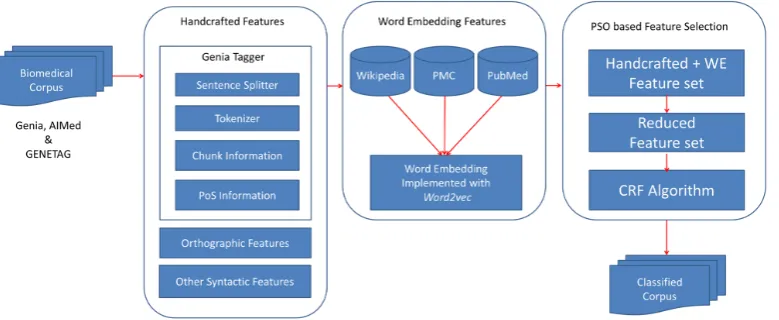
We propose a PSO based feature selection tech-nique that determines the most relevant features from a set of features, containing both hand-crafted as well as word embedding based features. We use Conditional Random Field (CRF) (Laf-ferty et al., 2001) as a base learning algorithm. For each token, a feature vector is generated from the training and test dataset using the features as de-scribed in the previous section. Basic steps of our algorithm are as follows:
1. Initially, we design 32 features (listed in Section-3) for three datasets, namely GE-NIA, GENETAG and AiMed. These fea-tures are used for the classifier’s training. The models built using these features are termed as the baseline models.
2. We generate the word embedding feature vector of 200 dimensions based on the model trained on a large corpus like Wikipedia and the biomedical corpora such as PubMed3and
PubMed Central Open Access (PMC OA)4.
3. A new feature set is generated by combin-ing both word embeddcombin-ing based features and handcrafted features.
4. PSO based feature selection is performed to determine the most relevant feature set.
5. CRF classifier is trained with the features se-lected by PSO. The model, thus generated, is evaluated on all the three datasets.
Figure-1 depicts the various steps of our proposed approach.
5 Datasets and Experiments 3http://www.ncbi.nlm.nih.gov/pubmed
4http://www.ncbi.nlm.nih.gov/pmc/tools/openftlist
5.1 Dataset
Our system is evaluated on three distinguished biomedical datasets, namely GENIA5, AiMed6
and GENETAG7. The GENIA corpus is derived
from the MEDLINE corpus. It comprises of 500,000 and 100,000 words in training and test dataset, respectively. These datasets are manu-ally annotated with five NE tags, namelyProtein,
DNA,RNA,Cell line&Cell type.
AiMed corpus was created using 20,000 sen-tences having gene/protein names extracted from the Database of Interacting Protein (DIP). We use 7,500 labeled sentences for training and 2,500 sen-tences for validation. For evaluation we use a test set consisting of 5,000 sentences.
GENETAG dataset is derived from the ‘Med-Tag’ dataset. Training and test datasets comprise of 118K and 142K words, respectively. In order to properly denote the boundaries of NE, we use the IOB28encoding scheme. We evaluate our system
in terms of recall, precision and F-measure values. For evaluation we use the script, which was made available with the JNLPBA 2004 shared task9.
5.2 Baseline Models and Analysis
We start experiments with the first baseline (i.e. Baseline-1) by developing the model trained with all the features as discussed in Section-3. We evaluate the presence of word embedding features trained on various unlabeled data sets obtained from the different text sources. In order to real-ize the effect of each trained word representation model, we augment the word vector obtained from the respective model one by one to the baseline feature set. In order to obtain word embedding, we use four different models trained on the unlabeled data extracted from PubMed 10, PubMed Central
Open Access (PMC OA)11 and the latest English
Wikipedia dump12. Corpus statistics of PubMed
and PMC OA are provided in Table-1.
The extracted text upon which four different mod-els are trained are as follows:
5 http://www.geniaproject.org/shared-tasks/bionlp-jnlpba-shared-task-2004
6ftp://ftp.cs.utexas.edu/pub/mooney/bio-data/
7ftp://ftp.ncbi.nlm.nih.gov/pub/tanabe/GENETAG.tar.gz 8I, O and B represent the intermediate, outside and begin-ning token of a NE
9http://www.nactem.ac.uk/tsujii/GENIA/ERtask/report.html 10http://www.ncbi.nlm.nih.gov/pubmed
Figure 1: Proposed model architecture for biomedical entity extraction
1. Model developed using extracted data from PubMed biomedical literature: denoted as WE(1).
2. Model built on the extracted text from PMC biomedical literature: denoted as WE(2). 3. Model developed using the combination
of extracted text from PubMed and PMC biomedical texts: denoted as WE(3).
4. Model trained using the extracted text from PubMed, PMC and Wikipedia: denoted as WE(4).
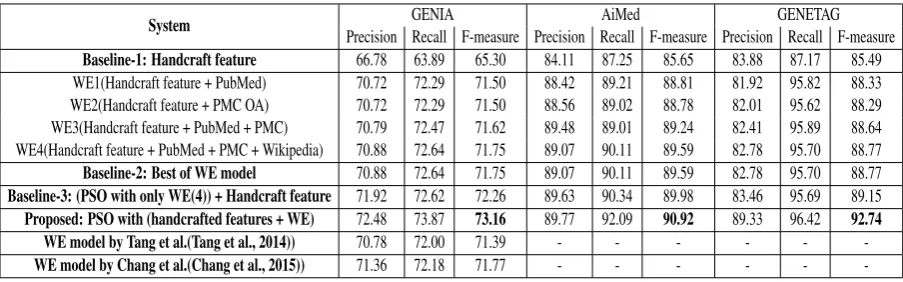
We develop the second baseline (i.e. Baseline-2) by executing the best word embedding model in combination with the hand-crafted feature set. We further develop the third baseline, i.e. Baseline-3 by merging word embedding feature set as de-termined by PSO along with the full handcrafted feature set. We observe that selection of relevant word embedding features helps in improving per-formance over the whole word embedding feature set.
We generate 200-dimensional word vectors using the parameters 13 as follows: skip-gram model
with a window size of 5, hierarchical soft-max training, and a frequent word sub-sampling thresh-old of 0.001. In order to make our proposed sys-tem generic, i.e. not biased to any particular do-main of data, we use the same parameters of PSO in all our settings. We fine-tune the parameters ω, φ1 andφ2 by performing 3-fold cross
valida-tion experiments. We keep the number of particles
13We use same parameters for training of all the four mod-els
Corpus Documents Sentences Tokens PubMed 22,120,269 124,615,674 2,896,348,481
PMC 672,589 105,194,341 2,591,137,744 PubMed+PMC 22,792,858 229,810,015 5,487,486,225
Table 1: Corpus statistics (Pyysalo et al., 2013) of PubMed and PMC OA openly available biomed-ical literature; PubMed abstracts for articles that are also present in PMC OA were discarded while creating the data
and the number of iterations as10and100, respec-tively throughout all the experiments.
Effectiveness of PSO based feature selection is evident with performance improvement as shown in Table-5.
5.3 Comparison with Existing Feature Selection Techniques
Here we compare our PSO based feature selec-tion technique with other existing feature selecselec-tion techniques. We perform experiments with both fil-ter and wrapper based models. For filfil-ter based model, we use univariate feature selection based on information theoretical concept like Informa-tion Gain. While for multivariate filter model we use correlation based feature selection. Our results indicate that PSO performs better than univariate by 3.03 % and multivariate by 2.60 % F-measure points for the GENIA dataset. We also observe quite similar behaviors for the other two datasets.
Feature Selection Precision Recall F-measure Precision Recall F-measure Precision Recall F-measureGENIA GENETAG AiMed Filter (Information Gain) 69.02 71.28 70.13 88.25 94.47 91.25 87.46 90.47 88.93 Filter (Correlation) 70.19 70.95 70.56 88.89 93.68 91.22 87.18 89.85 88.49 Wrapper (GA) 72.48 71.98 72.22 89.19 95.04 92.02 89.07 91.11 90.07 Wrapper (RFE) 71.28 71.54 71.40 89.25 94.81 91.94 88.67 91.66 90.14 CRF[PSO] 72.48 73.87 73.16 89.33 96.42 92.74 89.77 92.09 90.92
Table 2: Comparison of PSO with other filter (Information Gain & Correlation) and wrapper (G.A & RFE) based feature selection technique
based approach. Genetic algorithm belongs to the class of randomized wrapper model where feature selection is always classifier dependent and is less prone to stuck at local optima. The RFE is catego-rized under the deterministic type wrapper model which is computationally less complex than ran-domized type but has the disadvantage to stuck at local optima.
Results show that PSO performs better than RFE for all the datasets and GA for two datasets (GE-NIA & GENETAG) in terms of F-measure and the number of features selected. Results are depicted in Table-2. On AiMed dataset, GA and RFE based feature selection techniques perform quite compa-rable to our PSO based method. It is to be noted that PSO based feature selection yields better per-formance even with a smaller set of features. The pruned and compact feature set incurs less less computational complexity.
6 Result and Discussion
Table-3 shows the extensive results of our proposed system on all three datasets, namely GENIA, AiMed and GENETAG by augmenting word embedding features. It seems that word embedding features generated from the model which is trained on the combined datasets of PubMed, PMC and Wikipedia [WE(4)] perform better than the other models. The unsupervised word representation features help in detecting unseen entities, i.e. those not appearing in the training data set.
We augment word embedding WE(4) features to the hand-crafted features, and then apply feature selection using PSO on this combined set. Feature selection through PSO not only helps in improving the performance, but at the same time it reduces the feature dimensionality. Evaluation results as reported in Table-4 reveal this fact. Table-3 clearly depicts the effectiveness
of word embedding features in BNER (biomed-ical NER) system. We observe improvements of 7.86%, 5.27% and 7.25% F-measures over the first baseline (i.e. Baseline-1) for GENIA, AiMed and GENETAG data sets, respectively by using PSO based feature selection on PubMed-PMC-wikipedia trained word embedding and handcrafted features. Evaluation also suggests that performance does not degrade significantly, even when we use word embedding features obtained only from Pubmed & PMC OA. It seems that word embedding features obtained from the combination of Pubmed and PMC are more representatives compared to the individual one. We also show evaluation of some of the existing approaches that attempt to make use of word representation features. A F-measure of71.39% is reported in the work (Tang et al., 2014). Word representation feature was also used in (Chang et al., 2015) that reported to have achieved F-measure value of71.77%.
We perform statistical significance (t-test) test on the results obtained by our proposed model. For different datasets, experiments are executed for 10 independent runs and the t-statistic is adopted to analyze the obtained experimental re-sults. Using the known distribution of the test statistic,p-value is calculated. It is observed thatp values are less than0.04for all the three data sets, which signify that our obtained results are statisti-cally significant.
6.1 Error Analysis
Here, we analyze the outputs obtained for each dataset in order to identify the possible errors.We categorize the errors in three ways as follows:
System Precision Recall F-measure Precision Recall F-measure Precision Recall F-measureGENIA AiMed GENETAG Baseline-1: Handcraft feature 66.78 63.89 65.30 84.11 87.25 85.65 83.88 87.17 85.49 WE1(Handcraft feature + PubMed) 70.72 72.29 71.50 88.42 89.21 88.81 81.92 95.82 88.33 WE2(Handcraft feature + PMC OA) 70.72 72.29 71.50 88.56 89.02 88.78 82.01 95.62 88.29 WE3(Handcraft feature + PubMed + PMC) 70.79 72.47 71.62 89.48 89.01 89.24 82.41 95.89 88.64 WE4(Handcraft feature + PubMed + PMC + Wikipedia) 70.88 72.64 71.75 89.07 90.11 89.59 82.78 95.70 88.77 Baseline-2: Best of WE model 70.88 72.64 71.75 89.07 90.11 89.59 82.78 95.70 88.77 Baseline-3: (PSO with only WE(4)) + Handcraft feature 71.92 72.62 72.26 89.63 90.34 89.98 83.46 95.69 89.15 Proposed: PSO with (handcrafted features + WE) 72.48 73.87 73.16 89.77 92.09 90.92 89.33 96.42 92.74 WE model by Tang et al.(Tang et al., 2014)) 70.78 72.00 71.39 - - - -WE model by Chang et al.(Chang et al., 2015)) 71.36 72.18 71.77 - - -
-Table 3: Performance evaluation on GENIA, AiMed and GENETAG data sets using various word em-bedding (WE) features trained on different unlabeled data.
Approach GENIA GENETAG AiMedDataset
Handcraft Features + W.E Features 232 230 232
PSO based feature selection 129 136 121
Table 4: Comparison of no. of features being used to train the model: Before feature selection and after feature selection
Approach GENIA GENETAG AiMedDataset Only W.E features 57.78 55.63 41.22 PSO selected W.E features 58.96 57.41 42.74
Table 5: Comparisons (in terms of F-score) between whole word embedding features using WE(4) and the PSO selected word embedding fea-tures excluding handcrafted feafea-tures. Here, W.E: Word embedding
mostly with the entities having long and compounded wordforms such as ‘T cell activation-specific enchance’. We also ob-serve that our system lacks in correctly clas-sifying the instances which includes brackets. 2. Incorrect entity type: This error is obtained when the entity is properly identified but it belongs to some other entity class. This er-ror is more prominent in case of GENIA and GENETAG datasets. For GENIA dataset, classifier is mostly confused with ‘Protein’ vs. ‘Cell line’ or ‘Cell type’. In total 126 Protein words are wrongly classified either as the ‘Cell line’ or ‘Cell type’. While with the use of PSO, the rate of mis-classification was reduced to 97. In GENETAG, majority of classes are predicted as ‘I-NEWGENE’. This may be due to the fact that majority of the instances belongs to the ‘I-NEWGENE’
cat-egory. While after applying PSO, we observe that mis-classification of ‘I-NEWGENE’ is significantly reduced from 325 to just 129.
3. Missed entity: Our system misses significant number of NE instances.It is found that num-ber of false negatives count to 1357, 155 and 40 for GENTIA, AiMed and GENETAG, re-spectively. All these NEs are mis-classfied to belong to the other-than-NE category.
7 Conclusions & Future work
[image:9.595.72.524.61.202.2]References
Dima Alamedine, Catherine Marque, and Mohamad Khalil. 2013. Binary particle swarm optimiza-tion for feature selecoptimiza-tion on uterine electrohystero-gram signal. InAdvances in Biomedical Engineer-ing (ICABME), 2013 2nd International Conference on, pages 125–128. IEEE.
J.C. Bansal, P.K. Singh, Mukesh Saraswat, Abhishek Verma, Shimpi Singh Jadon, and Ajith Abraham. 2011. Inertia weight strategies in particle swarm optimization. In Nature and Biologically Inspired Computing (NaBIC), 2011 Third World Congress on, pages 633–640. IEEE.
Yoshua Bengio, R´ejean Ducharme, Pascal Vincent, and Christian Janvin. 2003. A neural probabilistic lan-guage model. The Journal of Machine Learning Re-search, 3:1137–1155.
Olivier Bodenreider. 2004. The unified medical lan-guage system (umls): integrating biomedical termi-nology. Nucleic acids research, 32(suppl 1):D267– D270.
F.X. Chang, J. Guo, W.R. Xu, and S. Relly Chung. 2015. Application of word embeddings in biomedi-cal named entity recognition tasks. Journal of Digi-tal Information Management, 13(5).
Ronan Collobert, Jason Weston, L´eon Bottou, Michael Karlen, Koray Kavukcuoglu, and Pavel Kuksa. 2011. Natural language processing (almost) from scratch. The Journal of Machine Learning Re-search, 12:2493–2537.
Chris Ding and Hanchuan Peng. 2005. Minimum redundancy feature selection from microarray gene expression data.Journal of bioinformatics and com-putational biology, 3(02):185–205.
Russell C. Eberhart and Yuhui Shi. 1998. Comparison between genetic algorithms and particle swarm opti-mization. InEvolutionary Programming VII, pages 611–616. Springer.
Asif Ekbal and Sriparna Saha. 2016. Simultaneous feature and parameter selection using multiobjec-tive optimization: application to named entity recog-nition. Int. J. Machine Learning & Cybernetics, 7(4):597–611.
Asif Ekbal, Sriparna Saha, Utpal Kumar Sikdar, and Md Hasanuzzaman. 2010. A genetic approach for biomedical named entity recognition. In2010 22nd IEEE International Conference on Tools with Artifi-cial Intelligence, volume 2, pages 354–355. IEEE. Asif Ekbal, Sriparna Saha, and Utpal Kumar
Sik-dar. 2013. Biomedical named entity extraction: some issues of corpus compatibilities. Springer-Plus, 2(1):1–12.
Jenny Finkel, Shipra Dingare, Christopher D. Man-ning, Malvina Nissim, Beatrice Alex, and Claire
Grover. 2005. Exploring the boundaries: gene and protein identification in biomedical text. BMC bioinformatics, 6(1):1.
Cyril Grouin. 2014. Biomedical entity extraction us-ing machine-learnus-ing based approaches. substance, 6:1–611.
Zhou GuoDong and Su Jian. 2004. Explor-ing deep knowledge resources in biomedical name recognition. In Proceedings of the International Joint Workshop on Natural Language Processing in Biomedicine and its Applications, pages 96–99. As-sociation for Computational Linguistics.
Deepak Kumar Gupta, Kandula Srikanth Reddy, Shweta, and Asif Ekbal. 2015. Pso-asent: Fea-ture selection using particle swarm optimization for aspect based sentiment analysis. In Natural Lan-guage Processing and Information Systems - 20th International Conference on Applications of Natural Language to Information Systems, NLDB 2015 Pas-sau, Germany, June 17-19, 2015 Proceedings, pages 220–233.
Isabelle Guyon, Jason Weston, Stephen Barnhill, and Vladimir Vapnik. 2002. Gene selection for cancer classification using support vector machines. Ma-chine learning, 46(1-3):389–422.
Xu Han, Chee Keong Kwoh, and Jung-jae Kim. 2016. Clustering based active learning for biomed-ical named entity recognition. In Neural Networks (IJCNN), 2016 International Joint Conference on, pages 1253–1260. IEEE.
John H. Holland. 1975. Adaptation in natural and artificial systems: an introductory analysis with ap-plications to biology, control, and artificial intelli-gence. U Michigan Press.
Jun’ichi Kazama, Takaki Makino, Yoshihiro Ohta, and Jun’ichi Tsujii. 2002. Tuning support vector machines for biomedical named entity recognition. In Proceedings of the ACL-02 workshop on Natu-ral language processing in the biomedical domain-Volume 3, pages 1–8. Association for Computational Linguistics.
James Kennedy and Russell C. Eberhart. 1997. A dis-crete binary version of the particle swarm algorithm. InSystems, Man, and Cybernetics, 1997. Computa-tional Cybernetics and Simulation., 1997 IEEE In-ternational Conference on, volume 5, pages 4104– 4108. IEEE.
Seonho Kim, Juntae Yoon, Kyung-Mi Park, and Hae-Chang Rim. 2005. Two-phase biomedical named entity recognition using a hybrid method. In Natu-ral Language Processing–IJCNLP 2005, pages 646– 657. Springer.
John D. Lafferty, Andrew McCallum, and Fernando C. N. Pereira. 2001. Conditional Random Fields: Probabilistic Models for Segmenting and Labeling Sequence Data. InICML, pages 282–289.
Kenli Li, Wei Ai, Zhuo Tang, Fan Zhang, Lingang Jiang, Keqin Li, and Kai Hwang. 2015a. Hadoop recognition of biomedical named entity using condi-tional random fields. IEEE Transactions on Parallel and Distributed Systems, 26(11):3040–3051. Lishuang Li, Liuke Jin, Zhenchao Jiang, Dingxin Song,
and Degen Huang. 2015b. Biomedical named entity recognition based on extended recurrent neural net-works. InBioinformatics and Biomedicine (BIBM), 2015 IEEE International Conference on, pages 649– 652. IEEE.
Nut Limsopatham and Nigel Collier. 2016. Learn-ing orthographic features in bi-directional LSTM for biomedical named entity recognition. BioTxtM 2016, page 10.
Hongfang Liu, Zhang-Zhi Hu, Jian Zhang, and Cathy Wu. 2006. Biothesaurus: a web-based thesaurus of protein and gene names. Bioinformatics, 22(1):103– 105.
Tomas Mikolov, Kai Chen, Greg Corrado, and Jeffrey Dean. 2013a. Efficient estimation of word represen-tations in vector space.CoRR, abs/1301.3781. Tomas Mikolov, Ilya Sutskever, Kai Chen, Greg S.
Cor-rado, and Jeff Dean. 2013b. Distributed representa-tions of words and phrases and their compositional-ity. InAdvances in neural information processing systems, pages 3111–3119.
Scott Miller, Jethran Guinness, and Alex Zamanian. 2004. Name tagging with word clusters and dis-criminative training. In Daniel Marcu Susan Du-mais and Salim Roukos, editors,HLT-NAACL 2004: Main Proceedings, pages 337–342, Boston, Mas-sachusetts, USA, May 2 - May 7. Association for Computational Linguistics.
Rakesh Patra and Sujan Kumar Saha. 2013. A kernel-based approach for biomedical named entity recog-nition.The Scientific World Journal, 2013.
S. Pyysalo, F. Ginter, H. Moen, T. Salakoski, and S. Ananiadou. 2013. Distributional semantics re-sources for biomedical text processing. In Proceed-ings of LBM 2013, pages 39–44.
Ayan Seal, Suranjan Ganguly, Debotosh Bhattachar-jee, Mita Nasipuri, and Consuelo Gonzalo-Martin. 2015. Feature selection using particle swarm opti-mization for thermal face recognition. In Applied Computation and Security Systems, pages 25–35. Springer.
Burr Settles. 2004. Biomedical named entity recog-nition using conditional random fields and rich fea-ture sets. In Proceedings of the International Joint Workshop on Natural Language Processing in Biomedicine and its Applications, pages 104–107. Association for Computational Linguistics.
Utpal Kumar Sikdar, Asif Ekbal, Sriparna Saha, Olga Uryupina, and Massimo Poesio. 2015. Differen-tial evolution-based feature selection technique for anaphora resolution. Soft Comput., 19(8):2149– 2161.
Larry Smith, Lorraine K. Tanabe, Rie J. Ando, Cheng-Ju Kuo, I-Fang Chung, Chun-Nan Hsu, Yu-Shi Lin, Roman Klinger, Christoph M. Friedrich, Kuz-man Ganchev, et al. 2008. Overview of biocre-ative ii gene mention recognition. Genome biology, 9(Suppl 2):S2.
Richard Socher, John Bauer, Christopher D. Manning, and Ng Andrew Y. 2013. Parsing with composi-tional vector grammars. InProceedings of the 51st Annual Meeting of the Association for Computa-tional Linguistics (Volume 1: Long Papers), pages 455–465, Sofia, Bulgaria, August. Association for Computational Linguistics.
Buzhou Tang, Hongxin Cao, Yonghui Wu, Min Jiang, and Hua Xu. 2012. Clinical entity recognition us-ing structural support vector machines with rich fea-tures. InProceedings of the ACM sixth international workshop on Data and text mining in biomedical in-formatics, pages 13–20. ACM.
Buzhou Tang, Hongxin Cao, Yonghui Wu, Min Jiang, and Hua Xu. 2013. Recognizing clinical entities in hospital discharge summaries using structural sup-port vector machines with word representation fea-tures. BMC medical informatics and decision mak-ing, 13(Suppl 1):S1.
Buzhou Tang, Hongxin Cao, Xiaolong Wang, Qingcai Chen, and Hua Xu. 2014. Evaluating word repre-sentation features in biomedical named entity recog-nition tasks. BioMed research international, 2014.
Zhuo Tang, Lingang Jiang, Li Yang, Kenli Li, and Ke-qin Li. 2015. Crfs based parallel biomedical named entity recognition algorithm employing mapreduce framework.Cluster Computing, 18(2):493–505.
Hossein Tohidi, Hamidah Ibrahim, and Masrah Azri-fah Azmi Murad. 2014. Improving named en-tity recognition accuracy for gene and protein in biomedical text literature. International journal of data mining and bioinformatics, 10(3):239–268.
Xuesong Yan, Qinghua Wu, Hanmin Liu, and Wenzhi Huang. 2013. An improved particle swarm op-timization algorithm and its application. Interna-tional Journal of Computer Science Issues (IJCSI), 10(1).
Li Yang and Yanhong Zhou. 2014. Exploring feature sets for two-phase biomedical named entity recog-nition using semi-crfs. Knowledge and information systems, 40(2):439–453.
Shaodian Zhang and No´emie Elhadad. 2013. Unsu-pervised biomedical named entity recognition: Ex-periments with clinical and biological texts. Journal of biomedical informatics, 46(6):1088–1098. Shaojun Zhao. 2004. Named entity recognition in