64
Multi-Modal Generative Adversarial Network for Short Product Title
Generation in Mobile E-Commerce
Jian-Guo Zhang,1 Pengcheng Zou,2Zhao Li,2 Yao Wan,3 Xiuming Pan,2Yu Gong,2 Philip S. Yu1
1 University of Illinois at Chicago, USA;2Alibaba Group;3Zhejiang University, China {jzhan51,psyu}@uic.edu,[email protected]
{xuanwei.zpc,lizhao.lz}@alibaba-inc.com {xuming.panxm,gongyu.gy}@alibaba-inc.com
Abstract
Nowadays, more and more customers browse and purchase products in favor of using mobile E-Commerce Apps such as Taobao and Ama-zon. Since merchants are usually inclined to describe redundant and over-informative prod-uct titles to attract attentions from customers, it is important to concisely display short prod-uct titles on limited screen of mobile phones. To address this discrepancy, previous studies mainly consider textual information of long product titles and lacks of human-like view during training and evaluation process. In this paper, we propose a Multi-Modal Gen-erative Adversarial Network (MM-GAN) for short product title generation in E-Commerce, which innovatively incorporates image infor-mation and attribute tags from product, as well as textual information from original long ti-tles. MM-GAN poses short title generation as a reinforcement learning process, where the generated titles are evaluated by the discrimi-nator in a human-like view. Extensive exper-iments on a large-scale E-Commerce dataset demonstrate that our algorithm outperforms other state-of-the-art methods. Moreover, we deploy our model into a real-world online E-Commerce environment and effectively boost the performance of click through rate and click conversion rate by 1.66% and 1.87%, respec-tively.
1 Introduction
E-commerce companies such as TaoBao and Ama-zon put many efforts to improve the user experience of their mobile Apps. For the sake of improving re-trieval results by search engines, merchants usually write lengthy, over-informative, and sometimes in-correct titles, e.g., the original product title in Fig.
[image:1.595.317.511.205.390.2]1 contains more than 20 Chinese words, which may be suitable for PCs. However, these titles are cut down and no more than 10 words can be dis-played on a mobile phone with limited screen size varying from 4 to 5.8 inches. Hence, to properly
Figure 1: A product with original long titles (green box), cutoff short titles (red box), the main image (blue box), and attribute tags (yellow box).
display products in mobile screen, it is important to produce succinct short titles to preserve impor-tant information of original long titles and accurate descriptions of products.
This problem is related to text summarization, which can be categorized into two classes: extrac-tive (Cao et al.,2016;Miao and Blunsom,2016;
Nallapati et al.,2017) and abstractive (Chen et al.,
holistic view of the whole generated short product titles.
More recent state-of-the-art methods (Gong et al., 2018;Wang et al., 2018) treat short prod-uct titles generation as a sentence compression task following attention-based extractive mech-anism. They extract key characteristics mainly from original long product titles. However, in real E-Commerce scenario, product titles are usually redundant and over-informative, and sometimes even inaccurate, e.g., long titles of a cloth may in-clude both “å»å|çé (hip-pop|wild)" and “æèo|æ·å (artsy|delicate)" simultaneously. It is a tough task to generate succinct and accurate short titles merely relying on the original titles. Therefore, it is insuf-ficient to regard short title generation as traditional text summarization problem in which original text has already contained complete information.
In this paper, we propose a novelMulti-Modal
Generative Adversarial Network, named MM-GAN, to better generate short product titles. It contains a generator and a discriminator. The gen-erator generates a short product title based on orig-inal long titles, with additional information from the corresponding visual image and attribute tags. On the other hand, the discriminator tries to distin-guish whether the generated short titles are human-produced or machine-human-produced in a human-like view. The task is treated as a reinforcement learn-ing problem, in which the quality of a machine-generated short product title depends on its ability to fool the discriminator into believing it is gen-erated by human, and output of the discriminator is a reward for the generator to improve generated quality. The main contributions of this paper can be summarized as follows:
• In this paper, we focus on a fundamental prob-lem existing in the E-Commerce industry, i.e., generating short product titles for mobile E-Commerce Apps. We formulate the problem as a reinforcement learning task;
• We design a multi-modal generative adversar-ial network to consider multiple modalities of inputs for better short product titles generation in E-commerce;
• To verify the effectiveness of our proposed model, we deploy it into a mobile E-commerce App. Extensive experiments on a large-scale real-world dataset with A/B testing show that our proposed model outperforms state-of-the-art methods.
2 Related Work
Our work is related to text summarization tasks and generative adversarial networks (GANs).
Text Summarization. In terms of text sum-marization, it mainly includes two categories of approaches: extractive and abstractive methods. Extractive methods produce a text summary by extracting and concatenating several words from original sentence. Whereas abstractive methods generate a text summary based on the original sen-tence, which usually generate more readable and coherent summaries. Traditional extractive meth-ods such as graphic models (Mihalcea,2005) and optimization-based models (Woodsend and Lap-ata,2010) usually rely on human-engineered fea-tures. Recent RNN-based methods (Chopra et al.,
2016; Gong et al., 2018; Nallapati et al., 2017;
Wang et al., 2018) have become popular in text summarization tasks. Among them, (Gong et al.,
2018; Wang et al., 2018) design attention-based neural networks for short product titles generation in E-commerce. (Gong et al.,2018) considers rich semantic features of long product titles. (Wang et al.,2018) designs a multi-task model and uses user searching log data as additional task to facili-tate key words extraction from original long titles. However, they mainly consider information from textual long product titles, which sometimes are not enough to select important words and filter out over-informative and irrelevant words from long product titles. In addition, these methods mainly apply MLE objective and predict next word based on previous words. As a consequence, these mod-els usually suffer fromexposure biasand lack of human-like view.
Generative Adversarial Networks (GANs). GAN is firstly proposed in (Goodfellow et al.,
2014), which is designed for generating real-valued, continuous data, and has gained great success in computer vision tasks (Dai et al.,2017;Isola et al.,
task such as poem generation and music gener-ation. MaskGan (Fedus et al., 2018) designs a actor-critic reinforcement learning based GAN to improve qualities of text generation through fill-ing in missfill-ing texts conditioned on the surround-ing context. There are also some other RL based GANs for text generation such as LeakGan (Guo et al.,2017), RankGan (Lin et al.,2017), SentiGan (Wang and Wan,2018), etc. All above methods are designed for unsupervised text generation tasks. (Li et al., 2017) designs an adversarial learning method for neural dialogue generation. They train a seq2seq model to produce responses and use a discriminator to distinguish whether the responses are human-generated and machine-generated, and showing promising results. It should be noticed that our work differs from other similar tasks such as image captioning (Dai et al.,2017) and visual question answering (Antol et al.,2015). The image captioning can be seen as generating caption from a single modality of input, while the visual question answering mainly focuses on aligning the input im-age and question to generate a correct answer. In our task, we put more attention on learning more in-formation from the multi-modal input sources (i.e., long product titles, product image and attribute tags) to generate a short product title.
3 Multi-Modal Generative Adversarial Network
In this section, we describe in details the pro-posed MM-GAN. The problem can be formulated as follows: given an original long product title
L = {l1, l2, ..., lK} consisted of K Chinese or
English words, a single word can be represented in a form like “skirt" in English or “半身裙" in Chinese. With an additional image I and at-tribute tags A = {a1, a2, ..., aM}, the model
tar-gets at generating a human-like short product title
S ={s1, s2, ..., sN}, whereMandNare the
num-ber of words inAandS, respectively.
3.1 Multi-Modal Generator
The multi-modal generative model defines a policy of generating short product titles S given origi-nal long titlesL, with additional information from product imageIand attribute tagsA. Fig.2 illus-trates the architecture of our proposed multi-modal generator which follows the seq2seq (Sutskever et al.,2014) framework.
Multi-Modal Encoder. As we mentioned
be-Figure 2: Overall Framework of MM-GAN.
fore, our model tries to incorporate multiple modal-ities of a product (i.e., product image, attribute tags and long title). To learn the multi-modal embedding of a product, we first adopt a pre-trained VGG16 (Simonyan and Zisserman,2015) as the CNN architecture to extract featuresV = [v1, v2, ..., vZ]of an imageI from the condensed
fully connected layers, whereZ is the number of latent features. In order to get more descriptive features, we fine-tune the last 3 layers of VGG16 based on a supervised classification task given classes of products images. Second, we encode the attribute tagsAinto a fixed-length feature vec-torU = [u1, u2, . . . , uM0], andU =f1(A), where
f1 denotes fully connected layers, M0 is the
out-put size of f1. Third, we apply a recurrent
neu-ral network to encode the original long titles L
asO = [o1, o2, . . . , oK], whereot =f2(ot−1, lt).
Heref2represents a non-linear function, and in this
paper the LSTM unit (Hochreiter and Schmidhuber,
1997) is adopted.
Decoder.The hidden statehtfor thet-th target
wordstin short product titlesScan be calculated
asht=f2(ht−1, st−1,oˆt). Here we adopt an
atten-tion mechanism (Bahdanau et al.,2015) to capture important words from original long titlesL. The context vectorˆotis a weighted sum of hidden states O, which is represented as:
ˆ
ot= K
X
k=1
αt,kok, (1)
whereαt,kis the contribution of an input wordlk
to thet-th target word using an alignment modelg
(Bahdanau et al.,2015):
αt,k=
exp(g(ht−1, ok))
PK
k0=1exp(g(ht−1, ok0))
[image:3.595.306.527.59.206.2]After obtaining all featuresU,V,OˆfromA,I
andL, respectively, we then concatenate them into the final feature vector:
C = tanh(W[ ˆO;V;U]), (3)
whereW are learnable weights and[; ]denotes the concatenation operator.
Finally,Cis fed into the LSTM based decoder to predict the probability of generating each target word for short product titles S. As the sequence generation problem can be viewed as a sequence decision making process (Bachman and Precup,
2015), we denote the whole generation process as a policyπ(S|C).
3.2 Discriminator
The discriminator model Dis a binary classifier which takes an input of a generated short prod-uct titlesSand distinguishes whether it is human-generated or machine-human-generated. The short prod-uct titles are encoded into a vector representation through a two-layer LSTM model, and then fed into a sigmoid function, which returns the probabil-ity of the input short product titles being generated by human:
Rφ(S) =sigmoid(Wd[LST M(S)] +bd), (4)
whereφare learnable parameters for D,Wd is a
weight matrix andbdis a bias vector.
3.3 End-to-End Training
The multi-modal generator G tries to generate a sequence of tokensS under a policyπ and fool the discriminator D via maximizing the reward signal received fromD. The objective ofGcan be formulated as follows:
J(θ) =ES∼πθ(S|C)[Rφ(S)], (5)
whereθare learnable parameters forG.
Conventionally, GANs are designed for gener-ating continuous data and thusGis differentiable with continuous parameters guided by the objective function fromD(Yu et al.,2017). Unfortunately, it has difficulty in updating parameters through back-propagation when dealing with discrete data in text generation. To solve the problem, we adopt the REINFORCE algorithm (Williams,1992). Specif-ically, once the generator reaches the end of a se-quence (i.e.,S =S1:T), it receives a rewardRφ(S)
fromDbased on the probability of being real.
In text generation,Dwill provide a reward toG
only when the whole sequence has been generated, and no intermediate reward is obtained before the final token ofS is generated. This may cause the discriminator to assign a low reward to all tokens in the sequence though some tokens are proper re-sults. To mitigate the issue, we evaluate the reward function by aggregating theN0-time Monte-Carlo simulations (Yu et al.,2017) at each decoding step:
R0φ(S1:t−1, a0 =st)≈ (6)
(
1 N0
PN0
n=1R(S1:t, St(+1:n) N), t < N R(S1:t−1, st), t=N,
where{St(1)+1:N, . . . , St(+1:N0)N}is the set of generated short titles, which are sampled from thet+ 1-th de-coding step based current state and action. Now we can compute the gradient of the objective function for the generatorG:
∇θJ(θ)≈ (7)
ES∼πθ(S|C)
" N X
t=1
∇θlog(πθ(st|C))R
0
φ(S1:t−1, st)
#
,
where∇θis the partial differentiable operator for
θinG, and the rewardR0φis fixed during updating of generator.
The objective function for the discriminatorD
can be formulated as:
ES∼Pθ(S|C) h
logR0φ(S|C)
i
−ES∼πθ(S|C) h
logR0φ(S|C)
i
,
(8)
where S ∼ Pθ and S ∼ πθ denote that S is
from human-written sentences and synthesized sen-tences, respectively.
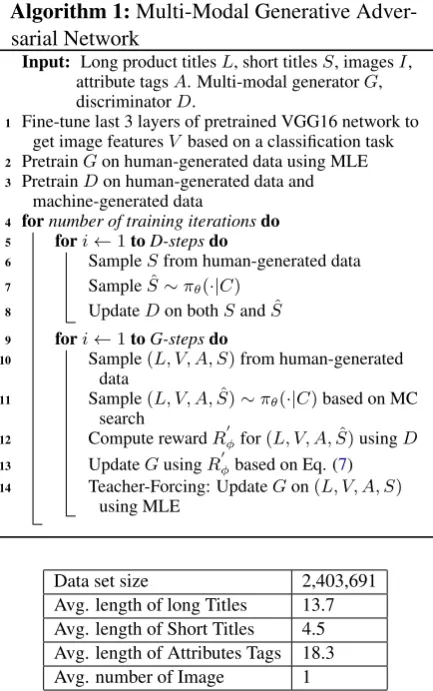
Algorithm 1:Multi-Modal Generative Adver-sarial Network
Input: Long product titlesL, short titlesS, imagesI, attribute tagsA. Multi-modal generatorG, discriminatorD.
1 Fine-tune last 3 layers of pretrained VGG16 network to
get image featuresV based on a classification task
2 PretrainGon human-generated data using MLE 3 PretrainDon human-generated data and
machine-generated data
4 fornumber of training iterationsdo
5 fori←1toD-stepsdo
6 SampleSfrom human-generated data 7 SampleSˆ∼πθ(·|C)
8 UpdateDon bothSandSˆ
9 fori←1toG-stepsdo
10 Sample(L, V, A, S)from human-generated
data
11 Sample(L, V, A,Sˆ)∼πθ(·|C)based on MC
search
12 Compute rewardR 0
φfor(L, V, A,Sˆ)usingD 13 UpdateGusingR
0
φbased on Eq. (7) 14 Teacher-Forcing: UpdateGon(L, V, A, S)
using MLE
[image:5.595.72.289.67.413.2]Data set size 2,403,691 Avg. length of long Titles 13.7 Avg. length of Short Titles 4.5 Avg. length of Attributes Tags 18.3 Avg. number of Image 1
Table 1: Statistics of the crawled dataset. Here all the lengths are counted by Chinese or English words.
4 Experiments
4.1 Experimental Setup
Dataset. The dataset used in our experiment is crawled from a module named有好货 (Youhao-huo) of the well-known淘宝(TAOBAO) platform in China. Every product in the dataset includes a long product title and a short product title written by professional writers, along with product sev-eral high quality visual images and attributes tags, here for each product we use its main image. This Youhaohuo module includes more than100 cate-gories of products, we crawled top 7 categories of them in the module, and exclude the products with original long titles shorter than 10 Chinese characters. We further tokenize the original long tittles and short titles into Chinese or English words, e.g. “skirt” is a word in English and半身裙is a word in Chinese. Table 1shows some details of the dataset. We randomly select1.6M samples for training,0.2M samples for validation, and test our proposed model on5000samples.
Baselines. We compare our proposed model with the following four baselines: (a) Pointer Network (Ptr-Net) (See et al., 2017) which is a seq2seq based framework with pointer-generator network copying words from the source text viapointing. (b) Feature-Enriched-Net (FE-Net) (Gong et al.,2018) which is a deep and wide model based on attentive RNN to generate the textual long product titles. (c) Agreement-based MTL ( Agree-MTL) (Wang et al., 2018) which is a multi-task learning approach to improve product title com-pression with user searching log data. (d) Genera-tive Adversarial Network (GAN) (Li et al.,2017) which is a generative adversarial method for text generation with only one modality of input.
Implementation Details. We first pre-train the multi-modal generative model given human-generated data via maximum likelihood estima-tion (MLE), and we transfer the pretrained model weights for the multi-modal encoder and decoder modules. Then we pre-train the discriminator us-ing human-generated data and machine-generated data. To get training samples for the discriminator, we sample half of data from multi-modal generator and another half from human-generated data. After that, we perform normal training process based on pre-trained MM-GAN.
Specifically, we create a vocabulary of 35K words for long product titles and short titles, and another vocabulary of 35k for attribute tags in train-ing data with size of1.6M. Words appear less than 8times in the training set are replaced as<UNK>. We implement a two-layer LSTM with 100 hid-den states to encoder attribute tags, and all other LSTMs in our model are two layers with512 hid-den states. The last 3 layers of the pre-trained VGG16 network are fine tuned based on the prod-ucts visual images with7classes. The Adam opti-mizer (Kingma and Ba,2015) is initialized with a learning rate10−3. The multi-modal generator and discriminator are pre-trained for10000steps, the normal training steps are set to13000, the batch size is set to512for the discriminator and256for the generator, the MC search time is set to7.
4.2 Automatic Evaluation
To evaluate the quality of generated product short titles, we follow (Wang et al., 2018;Gong et al.,
be-Models
Ptr-Net
FE-Net
Agree-MTL
GAN
MM-GAN
ROUGE-1
59.21
61.07
66.19
60.67
69.53
ROUGE-2
42.01
44.16
49.39
46.46
52.38
ROUGE-L
57.12
58.00
64.04
60.27
65.80
Table 2: ROUGE performance of different models on the test set.
Data Methods Results
Product Long Titles
Artka阿卡夏新花边镂空荷叶边抽绳民族狂野复古衬衫S110061Q (Artka Artka summer lace hollow-out flounce drawstring
nation wild retro shirt S110061Q)
FE-Net 阿卡花边镂空荷叶边衬衫 (Artka lace hollow-out flounce shirt)
Image Attributes Tags
修身常规款圆领Artka米白长袖 套头 复古通勤纯色夏季喇叭袖棉
(slim common round-neck Artka off-white long-sleeve pullover retro commuting plain summer flare-sleeve cotton)
Agree-MTL Artka阿卡夏新花边镂空荷叶边衬衫 (Artka Artka summer lace hollow-out flounce shirt) GAN Artka荷叶边抽绳衬衫
(Artka lace flounce drawstring shirt) MM-GAN Artka花边荷叶边镂空复古衬衫
(Artka lace flounce hollow-out retro shirt)
Table 3: The comparison of generated short titles among different methods.
tween the machine-generated and human- gener-ated titles. Here we consider ROUGE-1 (1-gram), ROUGE-2 (bi-grams), ROUGE-L (longest com-mon subsequence). Experimental results on the test set are shown in Table2. From this table, we note that our proposed MM-GAN achieves best performance on three metrics. Furthermore, when comparing MM-GAN with GAN, we can see that our proposed MM-GAN achieves an improvement of8.86%,5.92%,5.53%, in terms of ROUGE-1, ROUGE-2, ROUGE-3, respectively. This verifies that additional information such as image and at-tribute tags from product can absolutely facilitate our model to generate better short titles. In addition, compared with the best model Agree-MTL, MM-GAN improves 1, 2, ROUGE-L by3.34%, 2.99%, 1.76%, respectively. We at-tribute the outperformance of MM-GAN to two facts: (a) it incorporates multiple sources, con-taining more information than other single-source based models. (b) it applies a discriminator to dis-tinguish whether a product short titles are human-generated or machine-human-generated, which makes the model evaluate the generated sequence in a human-like view, and naturally avoid exposure bias in other methods.
4.3 Online A/B Testing
In order to further verify the effectiveness of MM-GAN, we test our method in the real-world online environment of the TaoBao App.
We perform A/B testing in seven categories of products in the E-commerce App, i.e., “连衣 裙| (one-piece)", “男士T恤| (Man T-shirt), “衬
衫|(shirt)”, “休闲裤|(Casual pants)", “女士T恤
| (Woman T-shirt)”, “半身裙| (skirt)", “毛针
织衫| (Sweaters)". During online A/B testing, users (3 ×10⁶ users per day) are split equally into two groups and are directed into a baseline bucket and an experimental bucket. For users in the baseline bucket, product short titles are gen-erated by the default online system, following an ILP based method (Clarke and Lapata,2008). While for users in the experimental bucket, product short titles are generated by MM-GAN. All con-ditions in the two buckets are identical except for short titles generation methods. We apply Click Through Rate (CTR) and Click Conversion Rate (CVR) to measure the performance. CT R =
#click_of_product
#pv_of_product , and CV R =
#trade_of_product #click_of_product,
where #click_of_product indicates clicking times of a product, #pv_of_product is the number of page views of the product and #trade_of_productis the number of purchases of the product.
We deploy A/B testing for 7 days and calcu-late overall CTR for all products in the baseline bucket and experimental bucket. MM-GAN im-proves CTR by1.66%and CVR by1.87%in the experimental bucket over the default online system in the baseline bucket. It verifies the effectiveness of our proposed method. Moreover, through online A/B testing, we find that with more readable, infor-mative product short titles, users are more likely to click, view and purchase corresponding products, which indicates good short product titles can help improving the product sales on E-commerce Apps.
4.4 Qualitative Analysis
Table3shows a sample of product short titles gen-erated by MM-GAN and baselines.
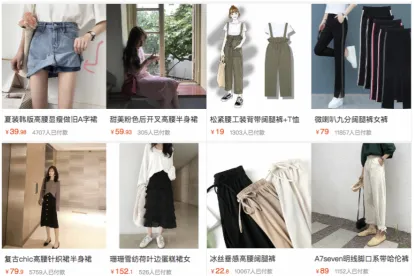
Figure 3: Some samples generated by MM-GAN.
short titles generated by our model are more flu-ent, informative than baselines, and core prod-uct words (e.g., “Artka|(阿卡)", “复古|(retro)", “衬 衫| (shirt)") can be recognized. (b) There
are over-informative words (e.g., “阿卡|(Artka)", “S110061Q") and irrelevant words (e.g., “狂野|
(wild)") in product long titles. Over-informative words may disturb model’s generation process, ir-relevant words may give incorrect information to the model. These situations could happen in real E-commerce environment. FE-Net misses the English brand name “Artka" and gives its Chinese name ‘阿
卡" instead. Agree-MTL using user searching log data performs better than GAN. However, Agree-MTL still generates the over-informative word ‘阿
卡". MM-GAN outperforms all baselines, infor-mation in additional attribute tags such as “复古|
(retro)", “Artka"), and other information from the product main image are together considered by the model and help the model select core words and fil-ter out irrelevant words in generated product short titles. It shows that MM-GAN using different types of inputs can help generate better product short titles. To leave a deeper impression on the perfor-mance of our proposed model, we also put more online samples generated by the MM-GAN in a module of the TaoBao App, as shown in Fig. 3. From all generated samples we also find few bad
cases which are not shown online (e.g., repetitive words in the generated short titles, wrong generated words which are not related to the product at all), leaving a great space for further improvement.
5 Conclusion
In this paper, we propose a multi-modal generative adversarial network for short product title genera-tion in E-commerce. Different from convengenera-tional methods which only consider textual information from long product titles, we design a multi-modal generative model to incorporate additional informa-tion from product image and attribute tags. Exten-sive experiments on a large real-world E-commerce dataset verify the effectiveness of our proposed model when comparing with several state-of-the-art baselines. Moreover, the online deployment in a real environment of an E-commerce app shows that our method can improve the click through rate and click conversion rate.
6 Acknowledgement
References
Stanislaw Antol, Aishwarya Agrawal, Jiasen Lu, Mar-garet Mitchell, Dhruv Batra, C Lawrence Zitnick, and Devi Parikh. 2015. Vqa: Visual question an-swering. InICCV.
Philip Bachman and Doina Precup. 2015. Data genera-tion as sequential decision making. InNIPS.
Dzmitry Bahdanau, Kyunghyun Cho, and Yoshua Ben-gio. 2015. Neural machine translation by jointly learning to align and translate. InICLR.
Ziqiang Cao, Wenjie Li, Sujian Li, Furu Wei, and Yan-ran Li. 2016. Attsum: Joint learning of focusing and summarization with neural attention. InCOLING.
Qian Chen, Xiaodan Zhu, Zhenhua Ling, Si Wei, and Hui Jiang. 2016. Distraction-based neural networks for document summarization. InIJCAI.
Sumit Chopra, Michael Auli, and Alexander M Rush. 2016. Abstractive sentence summarization with at-tentive recurrent neural networks. InNAACL-HLT.
James Clarke and Mirella Lapata. 2008. Global infer-ence for sentinfer-ence compression: An integer linear programming approach. Journal of Artificial Intel-ligence Research.
Bo Dai, Sanja Fidler, Raquel Urtasun, and Dahua Lin. 2017. Towards diverse and natural image descrip-tions via a conditional gan. InICCV.
William Fedus, Ian Goodfellow, and Andrew M Dai. 2018. Maskgan: Better text generation via filling in the _. InICLR.
Yu Gong, Xusheng Luo, Kenny Q Zhu, Shichen Liu, and Wenwu Ou. 2018. Automatic generation of chi-nese short product titles for mobile display. InIAAI.
Ian Goodfellow, Jean Pouget-Abadie, Mehdi Mirza, Bing Xu, David Warde-Farley, Sherjil Ozair, Aaron Courville, and Yoshua Bengio. 2014. Generative ad-versarial nets. InNIPS.
Jiaxian Guo, Sidi Lu, Han Cai, Weinan Zhang, Yong Yu, and Jun Wang. 2017. Long text generation via adversarial training with leaked information. In
AAAI.
Sepp Hochreiter and Jürgen Schmidhuber. 1997. Long short-term memory.Neural computation.
Phillip Isola, Jun-Yan Zhu, Tinghui Zhou, and Alexei A Efros. 2017. Image-to-image translation with condi-tional adversarial networks. InICCV.
Diederik P Kingma and Jimmy Ba. 2015. Adam: A method for stochastic optimization. InICLR.
Alex M Lamb, Anirudh Goyal ALIAS PARTH GOYAL, Ying Zhang, Saizheng Zhang, Aaron C Courville, and Yoshua Bengio. 2016. Professor forc-ing: A new algorithm for training recurrent net-works. InNIPS.
Christian Ledig, Lucas Theis, Ferenc Huszár, Jose Caballero, Andrew Cunningham, Alejandro Acosta, Andrew P Aitken, Alykhan Tejani, Johannes Totz, Zehan Wang, et al. 2017. Photo-realistic single im-age super-resolution using a generative adversarial network. InCVPR.
Jiwei Li, Will Monroe, Tianlin Shi, Sébastien Jean, Alan Ritter, and Dan Jurafsky. 2017. Adversarial learning for neural dialogue generation. InEMNLP.
Chin-Yew Lin. 2004. Rouge: A package for auto-matic evaluation of summaries. Text Summarization Branches Out.
Kevin Lin, Dianqi Li, Xiaodong He, Zhengyou Zhang, and Ming-Ting Sun. 2017. Adversarial ranking for language generation. InNIPS.
Yishu Miao and Phil Blunsom. 2016. Language as a latent variable: Discrete generative models for sen-tence compression. InEMNLP.
Rada Mihalcea. 2005. Language independent extrac-tive summarization. InACL.
Ramesh Nallapati, Feifei Zhai, and Bowen Zhou. 2017. Summarunner: A recurrent neural network based se-quence model for extractive summarization of docu-ments. InAAAI.
Marc’Aurelio Ranzato, Sumit Chopra, Michael Auli, and Wojciech Zaremba. 2016. Sequence level train-ing with recurrent neural networks. InICLR.
Abigail See, Peter J Liu, and Christopher D Manning. 2017. Get to the point: Summarization with pointer-generator networks. InACL.
Karen Simonyan and Andrew Zisserman. 2015. Very deep convolutional networks for large-scale image recognition. InICLR.
Ilya Sutskever, Oriol Vinyals, and Quoc V Le. 2014. Sequence to sequence learning with neural networks. InNIPS.
Yao Wan, Zhou Zhao, Min Yang, Guandong Xu, Haochao Ying, Jian Wu, and Philip S Yu. 2018. Im-proving automatic source code summarization via deep reinforcement learning. InProceedings of the 33rd ACM/IEEE International Conference on Auto-mated Software Engineering, pages 397–407. ACM.
Jingang Wang, Junfeng Tian, Long Qiu, Sheng Li, Jun Lang, Luo Si, and Man Lan. 2018. A multi-task learning approach for improving product title com-pression with user search log data. InAAAI.
Ke Wang and Xiaojun Wan. 2018. Sentigan: Gener-ating sentimental texts via mixture adversarial net-works. InIJCAI.
Kristian Woodsend and Mirella Lapata. 2010. Auto-matic generation of story highlights. InACL.