3557
Playing Text-Adventure Games with
Graph-Based Deep Reinforcement Learning
Prithviraj Ammanabrolu School of Interactive Computing
Georgia Institute of Technology Atlanta, GA
Mark O. Riedl
School of Interactive Computing Georgia Institute of Technology
Atlanta, GA
Abstract
Text-based adventure games provide a plat-form on which to explore reinforcement learning in the context of a combinatorial action space, such as natural language. We present a deep reinforcement learning architecture that represents the game state as a knowledge graph which is learned during exploration. This graph is used to prune the action space, enabling more efficient exploration. The question of which action to take can be reduced to a question-answering task, a form of transfer learning that pre-trains certain parts of our architecture. In experi-ments using the TextWorld framework, we show that our proposed technique can learn a control policy faster than baseline alterna-tives. We have also open-sourced our code at https://github.com/rajammanabrolu/KG-DQN.
1 Introduction
Natural language communication can be used to affect change in the real world. Text adventure games, in which players must make sense of the world through text descriptions and declare ac-tions through natural language, can provide a step-ping stone toward more real-world environments where agents must communicate to understand the state of the world and indirectly affect change in the world. Text adventure games are also useful for developing and testing reinforcement learning algorithms that must deal with the partial observ-ability of the world (Narasimhan et al.,2015;He et al.,2016).
In text adventure games, the agent receives an incomplete textual description of the current state of the world. From this information, and pre-vious interactions with the world, a player must determine the next best action to take to achieve some quest or goal. The player must then
com-pose a textual description of the action they in-tend to make and receive textual feedback of the effects of the action. Formally, a text-based game is a partially observable Markov decision process (POMDP), represented as a 7-tuple of
hS, T, A,Ω, O, R, γi representing the set of en-vironment states, conditional transition probabil-ities between states, words used to compose text commands, observations, observation conditional probabilities, reward function, and the discount factor respectively (Cˆot´e et al.,2018).
In text-based games, the agent never has access to the true underlying world state and has to rea-son about how to act in the world based only on the textual observations. Additionally, the agent’s ac-tions must be expressed through natural language commands, ensuring that the action space is com-binatorially large. Thus, text-based games pose a different set of challenges than traditional video games. Text-based games require a greater un-derstanding of previous context to be able to ex-plore the state-action space more effectively. Such games have historically proven to be difficult to play for AI agents, and the more complex variants such asZorkstill remain firmly out of the reach of existing approaches.
We introduce three contributions to text-based game playing to deal with the combinatorially large state and action spaces. First, we show that a state representation in the form of aknowledge graphgives us the ability to effectively prune an action space. A knowledge graph captures the re-lationships between entities as a directed graph. The knowledge graph provides a persistent mem-ory of the world over time and enables the agent to have a prior notion of what actions it should not take at a particular stage of the game.
Our second contribution is a deep reinforcement learning architecture, Knowledge Graph DQN
rep-resentation to estimate the Q-value for a state-action pair. This architecture leverages recent ad-vances in graph embedding and attention tech-niques (Guan et al.,2018;Veliˇckovi´c et al.,2018) to learn which portions of the graph to pay atten-tion to given an input state descripatten-tion in addi-tion to having a mechanism that allows for natu-ral language action inputs. Finally, we take initial steps toward framing the POMDP as a question-answering (QA) problem wherein a knowledge-graph can be used to not only prune actions but to answer the question of what action is most ap-propriate. Previous work has shown that many NLP tasks can be framed as instances of question-answering and that we can transfer knowledge be-tween these tasks (McCann et al.,2017). We show how pre-training certain parts of our KG-DQN network using existing QA methods improves per-formance and allows knowledge to be transferred from different games.
We provide results on ablative experiments comparing our knowledge-graph based approach approaches to strong baselines. Results show that incorporating a knowledge-graph into a reinforce-ment learning agent results in converges to the highest reward more than 40% faster than the best baseline. With pre-training using a question-answering paradigm, we achieve this fast conver-gence rate while also achieving high quality quest solutions as measured by the number of steps re-quired to complete the quests.
2 Related Work
A growing body of research has explored the chal-lenges associated with text-based games (Bordes et al., 2010; Narasimhan et al., 2015; He et al.,
2016;Fulda et al.,2017;Haroush et al.,2018;Cˆot´e et al., 2018;Tao et al., 2018). Narasimhan et al.
(2015) attempts to solve parser-based text games by encoding the observations using an LSTM. This encoding vector is then used by an action scoring network that determines the scores for the action verb and each of the corresponding argu-ment objects. The two scores are then averaged to determineQ-value for the state-action pair. He et al.(2016) present the Deep Reinforcement Rel-evance Network (DRRN) which uses two separate deep neural networks to encode the state and ac-tions. The Q-value for a state-action pair is then computed by a pairwise interaction function be-tween the two encoded representations. Both of
these methods are not conditioned on previous ob-servations and so are at a disadvantage when deal-ing with complex partially observable games. Ad-ditionally, neither of these approaches prune the action space and so end up wasting trials explor-ing state-action pairs that are likely to have lowQ -values, likely leading to slower convergence times for combinatorially large action spaces.
Haroush et al. (2018) introduce the Action Eliminating Network (AEN) that attempts to re-strict the actions in each state to the top-k most likely ones, using the emulator’s feedback. The network learns which actions should not be taken given a particular state. Their work shows that reducing the size of the action space allows for more effective exploration, leading to better per-formance. Their network is also not conditioned on previous observations.
Knowledge graphs have been demonstrated to improve natural language understanding in other domains outside of text adventure games. For example, Guan et al. (2018) use commonsense knowledge graphs such asConceptNet(Speer and Havasi,2012) to significantly improve the ability of neural networks to predict the end of a story. They represent the graph in terms of a knowl-edge context vector using features from Concept-Netand graph attention (Veliˇckovi´c et al.,2018). The state representation that we have chosen as well as our method of action pruning builds on the strengths of existing approaches while simultane-ously avoiding the shortcomings of ineffective ex-ploration and lack of long-term context.
3 Knowledge Graph DQN
In this section we introduce our knowledge graph representation, action pruning and deepQ -network architecture.
3.1 Knowledge Graph Representation
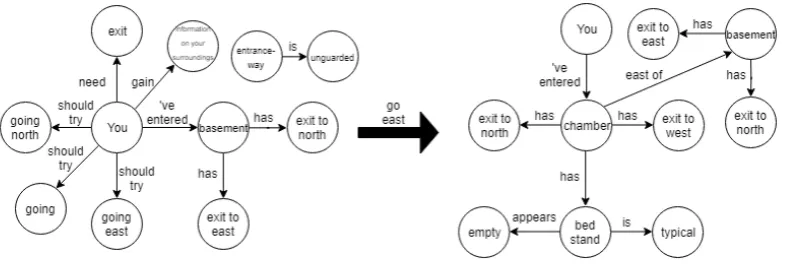
Figure 1: Graph state update example given two observations
location and the direction of the exit. These addi-tional rules fill in the information not provided by OpenIE. The resultant knowledge graph gives the agent what essentially amounts to a mental map of the game world.
The knowledge graph is updated after every agent action (see Figure 1). The update rules are defined such that there are portions of the graph offering short and long-term context. A special node—designated “you”—represents the agent and relations out of this node are updated af-ter every action with the exception of relations de-noting the agent’s inventory. Other relations per-sist after each action. We intend for the update rules to be applied to text-based games in different domains and so only hand-craft a minimal set of rules that we believe apply generally. They are:
• Linking the current room type (e.g. “base-ment”, “chamber’) to the items found in the room with the relation “has”, e.g.
hchamber, has, bed standi
• Extracting information regarding entrances and exits and linking them to the current room, e.g.hbasement, has, exit to northi
• Removing all relations relating to the “you” node with the exception of inventory every action, e.g.hyou, have, cubical keyi
• Linking rooms with directions based on the action taken to move between the rooms, e.g.
hchamber, east of, basementi after the ac-tion “go east” is taken to go from the base-ment to the chamber
All other RDF triples generated are taken from OpenIE.
3.2 Action Pruning
The number of actions available to an agent in a text adventure game can be quite large: A =
O(|V| × |O|2) whereV is the number of action verbs, andO is the number of distinct objects in the world that the agent can interact with, assum-ing that verbs can take two arguments. Some ac-tions, such as movement, inspecting inventory, or observing the room, do not have arguments.
The knowledge graph is used to prune the com-binatorially large space of possible actions avail-able to the agent as follows. Given the current state graph representationGt, the action space is
pruned by ranking the full set of actions and se-lecting the top-k. Our action scoring function is:
• +1 for each object in the action that is present in the graph; and
• +1 if there exists a valid directed path be-tween the two objects in the graph.
We assume that each action has at most two ob-jects (for example inserting a key in a lock).
3.3 Model Architecture and Training
Following Narasimhan et al. (2015), all actions
A that will be accepted by the game’s parser are available to the agent at all times. When playing the game, the agent chooses an action and receives an observation ot from the simulator, which is a
textual description of current game state. The state graphGtis updated according to the given
obser-vation, as described in Section3.1.
We use theQ-Learning technique (Watkins and Dayan, 1992) to learn a control policy π(at|st), at ∈ A, which gives us the probability of taking
determined by the Q-value of a particular state-action pair, which is updated using the Bellman equation (Sutton and Barto,2018):
Qt+1(st+1,at+1) =
E[rt+1+γmax
a∈At
Qt(s, a)|st, at] (1)
where γ refers to the discount factor and rt+1 is the observed reward. The policy is thus to take the action that maximizes theQ-value in a partic-ular state, which will correspond to the action that maximizes the reward expectation given that the agent has taken actionatat the current statestand
followed the policyπ(a|s)after.
The architecture in Figure 2 is responsible for computing the representations for both the statest
and the actionsa(i)∈Aand coming to an estima-tion of the Q-value for a particular state and ac-tion. During the forward activation, the agent uses the observation to update the graph Gtusing the
rules outlined in Section3.2.
The graph is then embedded into a single vec-torgt. We use Graph Attention (Veliˇckovi´c et al., 2018) with an attention mechanism similar to that described in Bahdanau et al. (2014). For-mally, the Multi-headed Graph Attention com-ponent receives a set of node features H =
{h1,h2, . . . ,hN},hi∈IRF, whereN is the
num-ber of nodes andF the number of features in each node, and the adjacency matrix ofGt. Each of the
node features consist of the averaged word embed-dings for the tokens in that node, as determined by the preceding graph embedding layer. The atten-tion mechanism is set up using self-attenatten-tion on the nodes after a learnable linear transformation
W ∈IR2F×F applied to all the node features:
eij =LeakyReLU(p·W(hi⊕hj)) (2)
wherep ∈IR2Fis a learnable parameter. The at-tention coefficientsαij are then computed by
nor-malizing over the choices ofk∈ N using the soft-max function. HereN refers to the neighborhood in which we compute the attention coefficients. This is determined by the adjacency matrix forGt
and consists of all third-order neighbors of a par-ticular node.
αij =
exp(eij)
P
k∈Nexp(eik)
(3)
Multi-head attention is then used, calculating mul-tiple independent attention coefficients. The re-sulting features are then concatenated and passed
into a linear layer to determinegt:
gt=f(Wg(kKk=1σ( X
j∈N
α(ijk)W(k)hj)) +bg) (4)
where k refers to the parameters of the kth
in-dependent attention mechanism, Wg and bg the
weights and biases of this component’s output lin-ear layer, andkrepresents concatenation.
Simultaneously, an encoded representation of the observation ot is computed using a Sliding
Bidirectional LSTM (SB-LSTM). The final state representationstis computed as:
st=f(Wl(gt⊕ot) +bl) (5)
where Wl, bl represent the final linear layer’s
weights and biases andot is the result of
encod-ing the observation with the SB-LSTM.
The entire set of possible actions A is pruned by scoring each a ∈ A according to the mech-anism previously described using the newly up-dated Gt+1. We then embed and encode all of these action strings using an LSTM encoder (Sutskever et al.,2014). The dashed lines in Fig-ure2denotes non-differentiable processes.
The finalQ-value for a state-action pair is:
Q(st,at) =st·at (6)
This method of separately computing the repre-sentations for the state and action is similar to the approach taken in the DRRN (He et al.,2016).
We train the network using experience replay (Lin,1993) with prioritized sampling (cf., (Moore and Atkeson,1993)) and a modified version of the
-greedy algorithm (Sutton and Barto,2018) that we call the1, 2-greedy learning algorithm. The experience replay strategy finds paths in the game, which are then stored as transition tuples in a ex-perience replay bufferD. The1, 2-greedy algo-rithm explores by choosing actions randomly from
Awith probability1and fromAtwith a
probabil-ity2. The second threshold is needed to account for situations where an action must be chosen to advance the quest for which the agent has no prior in Gt. That is, action pruning may remove
ac-tions essential to quest completion because those actions involve combinations of entities that have not been encountered before.
Figure 2: KG-DQN architecture, blue shading (or the symbol ’B’) indicates components that can be pre-trained and red (or the symbol ’R’) indicates no pre-training. The solid lines indicate gradient flow for learnable components.
Dand compute the temporal difference loss as:
L(θ) =rk+1+
γ max a∈Ak+1
Q(st,a;θ)−Q(st,at;θ) (7)
Replay sampling from D is done by sampling a fraction ρ from transition tuples with a positive reward and 1 − ρ from the rest. As shown in (Narasimhan et al., 2015), prioritized sampling from experiences with a positive reward helps the deepQ-network more easily find the sparse set of transitions that advance the game. The exact train-ing mechanism is described in Algorithm 1.
4 Game Play as Question Answering
Previous work has shown that many NLP tasks can be framed as instances of question-answering and that in doing so, one can transfer knowledge be-tween these tasks (McCann et al.,2017). In the ab-stract, an agent playing a text adventure game can be thought of as continuously asking the question “What is the right action to perform in this situa-tion?” When appropriately trained, the agent may be able to answer the question for itself and select a good next move to execute. Treating the problem as question-answering will not replace the need for exploration in text-adventure games. However, we hypothesize that it will cut down on the amount of exploration needed during testing time, theoreti-cally allowing it to complete quests faster; one of the challenges of text adventure games is that the quests are puzzles and even after training, execu-tion of the policy requires a significant amount of exploration.
To teach the agent to answer the question of what action is best to take given an observation,
we use an offline, pre-training approach. The data for the pre-training approach is generated using an oracle, an agent capable of finishing a game perfectly in the least number of steps possible. Specifically, the agent knows exactly what action to take given the state observation in order to ad-vance the game in the most optimal manner pos-sible. Through this process, we generate a set of traces consisting of state observations and ac-tions such that the state observation provides the context for the implicit question of ”What action should be taken?” and the oracle’s correct action is the answer. We then use the DrQA (Chen et al.,2017) question-answering technique to train a paired question encoder and an answer encoder that together predict the answer (action) from the question (text observation). The weights from the SB-LSTM in the document encoder in the DrQA system are then used to initialize the weights of the SB-LSTM. Similarly, embedding layers of both the graph and the LSTM action encoder are ini-tialized with the weights from the embedding layer of same document encoder. Since the DrQA em-bedding layers are initialized with GloVe, we are transferring word embeddings that are tuned dur-ing the traindur-ing of the QA architecture.
Small Large
Rooms 10 20
Total objects 20 40
Quest length 5 10
Branching factor 143 562
Vocab size 746 819
[image:6.595.71.275.61.146.2]Average words per obs. 67.5 94.0 Average new RDF triples per obs. 7.2 10.5
Table 1: Generated game details.
means that the agent cannot simply memorize quests. For pre-training to work, the agent must develop a general question-answering competence that can transfer to new quests. Our approach to question-answering in the context of text adven-ture game playing thus represents a form of trans-fer learning.
5 Experiments
We conducted experiments in the TextWorld framework (Cˆot´e et al.,2018) using their “home” theme. TextWorld uses a grammar to randomly generate game worlds and quests with given pa-rameters. Games generated with TextWorld start with a zero-th observation that gives instructions for the quest; we do not allow our agent to access this information. The TextWorld API also pro-vides a list ofadmissibleactions at each state—the actions that can be performed based on the objects that are present. We do not allow our agent to ac-cess the admissible actions.
We generated two sets of games with different random seeds, representing different game diffi-culties, which we denote assmallandlarge. Small games have ten rooms and quests of length five and large games have twenty rooms and quests of length ten. Statistics on the games are given in Table1. Quest length refers to the number of ac-tions that the agent is required to perform in order to finish the quest; more actions are typically nec-essary to move around the environment and find the objects that need to be interacted with. The branching factor is the size of the action setAfor that particular game.
The reward function provided by TextWorld is as follows: +1 for each action taken that moves the agent closer to finishing the quest; -1 for each action taken that extends the minimum number of steps needed to finish the quest from the current stage; 0 for all other situations. The maximum achievable reward for the small and large sets of games are 5 and 10 respectively. This allows for
EM Precision Recall F1
[image:6.595.324.507.63.94.2]Small 46.20 56.57 63.38 57.94 Large 34.13 52.53 64.72 55.06
Table 2: Pre-training accuracy.
a large amount of variance in quest quality—as measured by steps to complete the quest—that re-ceives maximum reward.
The following procedure for pre-training was done separately for each set of games. Pre-training of the SB-LSTM within the question-answering architecture is conducted by generating 200 games from the same TextWorld theme. The QA system was then trained on data from walkthroughs of a randomly-chosen subset of 160 of these generated games, tuned on a dev set of 20 games, and eval-uated on the held-out set of 20 games. Table 2
provides details on the Exact Match (EM), preci-sion, recall, and F1 scores of the QA system af-ter training for the small and large sets of games. Precision, recall, and F1 scores are calculated by counting the number of tokens between the pre-dicted answer and ground truth. An Exact Match is when the entire predicted answer matches with the ground truth. This score is used to tune the model based on the dev set of games.
A random game was chosen from the test-set of games and used as the environment for the agent to train its deepQ-network on. Thus, at no time did the QA system see the final testing game prior to the training of the KG-DQN network.
We compare our technique to three baselines:
• Random command, which samples from the list of admissible actions returned by the TextWorld simulator at each step.
• LSTM-DQN, developed by Narasimhan et al. (2015).
• Bag-of-Words DQN, which uses a bag-of-words encoding with a multi-layer feed for-ward network instead of an LSTM.
To achieve the most competitive baselines, we used a randomized grid search to choose the best hyperparameters (e.g., hidden state size,γ,ρ, final
, update frequency, learning rate, replay buffer size) for the BOW-DQN and LSTM-DQN base-lines.
We tested three versions of our KG-DQN:
Algorithm 11, 2-greedy learning algorithm for KG-DQN 1: forepisode=1 toMdo
2: Initialize action dictionaryAand graphG0
3: Reset the game simulator 4: Read initial observationo1
5: G1←updateGraph(G0, o1);A1←pruneActions(A, G0) .Section3.2
6: forstept=1 toTdo 7: ifrandom()< 1then 8: ifrandom()< 2then
9: Select random actionat∈A 10: else
11: Select random actionat∈At 12: else
13: ComputeQ(st,a(i);θ)fora(i)∈Afor network parametersθ .Section3.3, Eq.6 14: Selectatbased onπ(a|st)
15: Execute actionatin the simulator and observe rewardrt 16: Receive next observationot+ 1
17: Gt+1←updateGraph(Gt, ot+1);At+1←pruneActions(A, Gt+1) .Section3.1
18: Computest+1andAt+1={a0(i)for alla0(i)∈A} .Section3.3 19: Set prioritypt= 1ifrt>0, elsept= 0
20: Store transition (st,at, rt,st+1,At+1, pt) in replay bufferD
21: Sample mini-batch of transitions (sk,ak, rk,sk+1,Ak+1, pk) fromD, with fractionρhavingpk= 1 22: Setyk=rk+γmaxa∈Ak+1Q(st,a;θ), oryk=rkifsk+1is terminal
23: Perform gradient descent step on loss functionL(θ) = (yk−Q(st,at;θ))2
2. Pruned actions without pre-training
3. Pruned actions with pre-training (full)
Our models use 50-dimensional word embed-dings, 2 heads on the graph attention layers, mini-batch size of 16, and perform a gradient descent update every 5 steps taken by the agent.
All models are evaluated by observing the (a) time to reward convergence, and (b) the av-erage number of steps required for the agent to finish the game with = 0.1over 5 episodes af-ter training has completed. FollowingNarasimhan et al.(2015) we setto a non-zero value because text adventure games, by nature, require explo-ration to complete the quests. All results are re-ported based on multiple independent trials. For the large set of games, we only perform experi-ments on the best performing models found in the small set of games. Also note that for experiments on large games, we do not display the entire learn-ing curve for the LSTM-DQN baseline, as it con-verges significantly more slowly than KG-DQN. We run each experiment 5 times and average the results.
Additionally, human performance on the both the games was measured by counting the number of steps taken to finish the game, with and with-out instructions on the exact quest. We modified Textworld to give the human players reward feed-back in the form of a score, the reward function itself is identical to that received by the deep re-inforcement learning agents. In one variation of this experiment, the human was given instructions on the potential sequence of steps that are required
to finish the game in addition to the reward in the form of a score and in the other variation, the hu-man received no instructions.
6 Results and Discussion
Recall that the number of steps required to finish the game for the oracle agent is 5 and 10 for the small and large maps respectively. It is impossi-ble to achieve this ideal performance due to the structure of the quest. The player needs to interact with objects and explore the environment in order to figure out the exact sequence of actions required to finish the quest. To help benchmark our agent’s performance, we observed people unaffiliated with the research playing through the same TextWorld “home” quests as the other models. Those who did not receive instructions on how to finish the quest never finished a single quest and gave up after an average of 184 steps on the small map and an av-erage of 190 steps on the large map. When given instructions, human players completed the quest on the large map in an average of 23 steps, fin-ishing the game with the maximum reward possi-ble. Also note that none of the deep reinforcement learning agents received instructions.
On both small and large maps, all versions of KG-DQN tested converge faster than baselines (see Figure 3 for the small game and Figure 4
Figure 3: Reward learning curve for select experiments with the small games. Best viewed in color.
Model Steps
Random Command 319.8
BOW-DQN 83.1±8.0
LSTM-DQN 72.4±4.6
Unpruned, pre-trained KG-DQN 131.7±7.7
Pruned, non-pre-trained KG-DQN 97.3±9.0
Full KG-DQN 73.7±8.5
Table 3: Average number of steps (and standard devia-tion) taken to complete the small game.
agents achieve the maximum reward of 10, and the LSTM-DQN requires more than 300 episodes to converge at the same level as KG-DQN. Since all versions of KG-DQN converge at approximately the same rate, we conclude that the knowledge graph—i.e., persistent memory—is the main fac-tor helping convergence time since it is the com-mon element across all experiments.
[image:8.595.313.506.79.225.2]After training is complete, we measure the num-ber of steps each agent needs to complete each quest. Full KG-DQN requires an equivalent num-ber of steps in the small game (Table 3) and in the large game (Table 4). Differences between LSTM-DQN and full KG-DQN are not statisti-cally significant,p= 0.199on an independent T-test. The ablated versions of KG-DQN—unpruned KG-DQN and non-pre-trained KG-DQN—require many more steps to complete quests. TextWorld’s reward function allows for a lot of exploration of the environment without penalty so it is pos-sible for a model that has converged on reward to complete quests in as few as five steps or in many hundreds of steps. From these results, we conclude that the pre-training using our question-answering paradigm is allowing the agent to find a general understanding of how to pick good ac-tions even when the agent has never seen the final
Figure 4: Reward learning curve for select experiments with the large games. Best viewed in color.
Model Steps
Random Command 2054.8
LSTM-DQN 260.3±4.5
Pruned, non-pre-trained KG-DQN 340±6.4
[image:8.595.86.278.271.346.2]Full KG-DQN 265.9±9.4
Table 4: Average number of steps (and standard devia-tion) taken to complete the large game.
test game. LSTM-DQN also learns how to choose actions efficiently, but this knowledge is captured in the LSTM’s cell state, whereas in KG-DQN this knowledge is made explicit in the knowledge graph and retrieved effectively by graph attention. Taken together, KG-DQN converges faster with-out loss of quest solution quality.
7 Conclusions
We have shown that incorporating knowledge graphs into an deepQ-network can reduce training time for agents playing text-adventure games of various lengths. We speculate that this is because the knowledge graph provides a persistent mem-ory of the world as it is being explored. While the knowledge graph allows the agent to reach optimal reward more quickly, it doesn’t ensure a high qual-ity solution to quests. Action pruning using the knowledge graph and pre-training of the embed-dings used in the deepQ-network result in shorter action sequences needed to complete quests.
re-lated games. However, question-answering alone cannot solve the text-adventure playing problem because there will always be some trial and error required.
By addressing the challenges of partial observ-ability and combinatorially large action, spaces through persistent memory, our work on play-ing text-adventure games addresses a critical need for reinforcement learning for language. Text-adventure games can be seen as a stepping stone toward more complex, real-world tasks; the hu-man world is one of partial understanding through communication and acting on the world using lan-guage.
References
Gabor Angeli, Johnson Premkumar, Melvin Jose, and Christopher D. Manning. 2015. Leveraging Lin-guistic Structure For Open Domain Information Ex-traction. In Proceedings of the 53rd Annual Meet-ing of the Association for Computational LMeet-inguistics and the 7th International Joint Conference on Natu-ral Language Processing (Volume 1: Long Papers).
Dzmitry Bahdanau, Kyunghyun Cho, and Yoshua Ben-gio. 2014. Neural machine translation by jointly learning to align and translate.arXiv:1409.0473.
Antoine Bordes, Nicolas Usunier, Ronan Collobert, and Jason Weston. 2010. Towards understanding sit-uated natural language. InProceedings of the 2010 International Conference on Artificial Intelligence and Statistics.
Danqi Chen, Adam Fisch, Jason Weston, and Antoine Bordes. 2017. Reading Wikipedia to answer open-domain questions. In Association for Computa-tional Linguistics (ACL).
Marc-Alexandre Cˆot´e, ´Akos K´ad´ar, Xingdi Yuan, Ben Kybartas, Emery Fine, James Moore, Matthew Hausknecht, Layla El Asri, Mahmoud Adada, Wendy Tay, and Adam Trischler. 2018. TextWorld :
A Learning Environment for Text-based Games. In
Proceedings of the ICML/IJCAI 2018 Workshop on Computer Games, page 29.
Nancy Fulda, Daniel Ricks, Ben Murdoch, and David Wingate. 2017.What can you do with a rock?
affor-dance extraction via word embeddings. In
Proceed-ings of the Twenty-Sixth International Joint Con-ference on Artificial Intelligence, IJCAI-17, pages 1039–1045.
Jian Guan, Yansen Wang, and Minlie Huang. 2018. Story Ending Generation with
Incre-mental Encoding and Commonsense Knowledge.
arXiv:1808.10113v1.
Matan Haroush, Tom Zahavy, Daniel J Mankowitz, and Shie Mannor. 2018. Learning How Not to Act in Text-Based Games. In Workshop Track at ICLR 2018, pages 1–4.
Ji He, Jianshu Chen, Xiaodong He, Jianfeng Gao, Li-hong Li, Li Deng, and Mari Ostendorf. 2016. Deep Reinforcement Learning with a Natural Language Action Space. In Association for Computational Linguistics (ACL).
Long-Ji Lin. 1993. Reinforcement learning for robots using neural networks. Ph.D. thesis, Carnegie Mel-lon University.
Bryan McCann, Nitish Shirish Keskar, Caiming Xiong, and Richard Socher. 2017. The Natural Language Decathlon : Multitask Learning as Question An-swering.arXiv:1806.08730.
Andrew W. Moore and Christopher G. Atkeson. 1993. Prioritized sweeping: Reinforcement learning with less data and less time. Machine Learning, 13(1):103–130.
Karthik Narasimhan, Tejas Kulkarni, and Regina Barzilay. 2015. Language Understanding for Text-based Games Using Deep Reinforcement Learning. In Conference on Empirical Methods in Natural Language Processing (EMNLP).
Robert Speer and Catherine Havasi. 2012. Repre-senting General Relational Knowledge in Concept-Net 5. In Proceedings of the Eighth International Conference on Language Resources and Evaluation (LREC).
Ilya Sutskever, Oriol Vinyals, and Quoc V Le. 2014. Sequence to sequence learning with neural net-works. InAdvances in neural information process-ing systems, pages 3104–3112.
Richard S Sutton and Andrew G Barto. 2018. Rein-forcement Learning: An Introduction. MIT Press.
Ruo Yu Tao, Marc-Alexandre Cˆot´e, Xingdi Yuan, and Layla El Asri. 2018. Towards solving text-based games by producing adaptive action spaces. In Pro-ceedings of the 2018 NeurIPS Workshop on Word-play: Reinforcement and Language Learning in Text-based Games.
Petar Veliˇckovi´c, Guillem Cucurull, Arantxa Casanova, Adriana Romero, Pietro Li`o, and Yoshua Bengio. 2018. Graph Attention Networks. International Conference on Learning Representations (ICLR).