Transition-Based Disfluency Detection using LSTMs
Shaolei Wang1, Wanxiang Che∗1, Yue Zhang2, Meishan Zhang3 and Ting Liu1 1Center for Social Computing and Information Retrieval, Harbin Institute of Technology, China
2Singapore University of Technology and Design
3School of Computer Science and Technology, Heilongjiang University, China {slwang, car, tliu}@ir.hit.edu.cn
yue [email protected], [email protected]
Abstract
We model the problem of disfluency detec-tion using a transidetec-tion-based framework, which incrementally constructs and labels the disfluency chunk of input sentences us-ing a set of transition actions without syn-tax information. Compared with sequence labeling methods, it can capture non-local chunk-level features; compared with joint parsing and disfluency detection methods, it is free for noise in syntax. Experiments show that our model achieves state-of-the-art F-score on both the commonly used English Switchboard test set and a set of in-house annotated Chinese data.
1 Introduction
Disfluency detection is the task of recognizing non-fluent word sequences in spoken language transcripts (Zayats et al.,2016;Wang et al.,2016;
Wu et al., 2015). As shown in Figure 1, stan-dard annotation of disfluency structure (Shriberg,
1994) indicates the reparandum (words that are discarded, or corrected by the following words), the interruption point (+) marking the end of the reparandum, the associated repair, and an optional interregnum after the interruption point (filled pauses, discourse cue words, etc.).
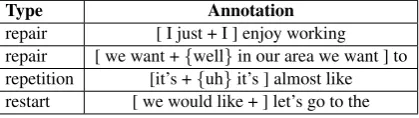
Ignoring the interregnum, disfluencies can be categorized into three types: restarts, repetitions, and corrections, based on whether the repair is empty, the same as the reparandum or different, respectively. Table 1 gives a few examples. In-terregnums are easy to detect as they often consist of fixed phrases (e.g. “uh”, “you know”). How-ever, reparandums are more difficult to detect, be-cause they can be in arbitrary form. Most
previ-*Email corresponding.
I want a flight [ to Boston + {um} to Denver ]
[image:1.595.313.523.332.391.2]RM IM RP
Figure 1: Sentence with disfluencies annotated in English Switchboard corpus. RM=Reparandum, IM=Interregnum, RP=Repair. The preceding RM is corrected by the following RP.
Type Annotation
repair [ I just + I ] enjoy working repair [ we want +{well}in our area we want ] to repetition [it’s +{uh}it’s ] almost like restart [ we would like + ] let’s go to the
Table 1: Different types of disfluencies.
ous disfluency detection work focuses on detect-ing reparandums.
The main challenges of detecting reparandums include that they vary in length, may occur in dif-ferent locations, and are sometimes nested. For example, the longest reparandum in our training set has fifteen words. Hence, it is very important to capture long-range dependencies for disfluency detection. Since there is large parallelism between the reparandum chunk and the following repair chunk (for example, in Figure1, the reparandum begins withtoand ends before another occurrence ofto), it is also useful to exploit chunk-level rep-resentation, which explicitly makes use of resulted infelicity disfluency chunks.
Common approaches take disfluency detection as a sequence labeling problem, where each sen-tential word is assigned with a label (Zayats et al.,
2016;Hough and Schlangen,2015;Qian and Liu,
2013; Georgila, 2009). These methods achieve good performance, but are not powerful enough to capture complicated disfluencies with longer spans or distances. Another drawback of these ap-proaches is that they are unable to exploit
level features. Semi-CRF (Ferguson et al.,2015) is used to alleviate this issue to some extent. Semi-CRF models still have their inefficiencies because they can only use the local chunk information lim-ited by the markov assumption when decoding.
A different line of work (Rasooli and Tetreault,
2013; Honnibal and Johnson, 2014; Wu et al.,
2015) adopts transition-based parsing models for disfluency detection. This line of work can be seen as a joint of disfluency detection and parsing. The main advantage of the joint models is that they can capture long-range dependency of disfluencies as well as chunk-level information. However, they introduce additional annotated syntactic structure, which is very expensive to produce, and can cause noise by significantly enlarging the output search space.
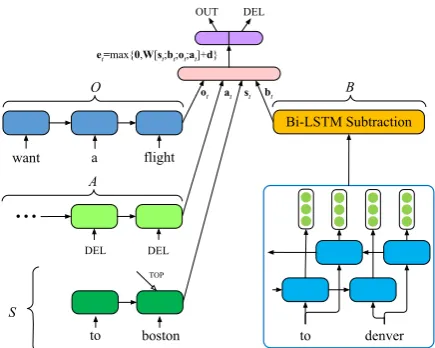
Inspired by the above observations, we inves-tigate a transition-based model without syntactic information. Our model incrementally constructs and labels the disfluency chunks of input sentences using an algorithm similar to transition-based de-pency parsing. As shown in Figure2, the model state consists of four components: (i)O, a conven-tional sequential LSTM (Hochreiter and Schmid-huber,1997) to store the words that have been la-beled as fluency. (ii)S, a stack LSTM to represent partial disfluency chunks, which captures chunk-level information. (iii)A, a conventional sequen-tial LSTM to represent history of actions. (iiii) B, a Bi-LSTM to represent words that have not yet been processed. A sequence of transition ac-tions are used to consume input tokens and con-struct the output from left to right. To reduce error propagation, we use beam-search (Collins and Roark, 2004) and scheduled sampling ( Ben-gio et al.,2015), respectively.
We evaluate our model on the commonly used English Switchboard test set and a in-house an-notated Chinese data set. Results show that our model outperforms previous state-of-the-art sys-tems. The code is released1.
2 Background
For a background, we briefly introduce transition-based parsing and its extention for joint disfluency detection. An arc-eager transition-based parsing system consists of a stackσ containing words be-ing processed, a bufferβ containing words to be processed and a memory A storing dependency
1https://github.com/hitwsl/transition disfluency
TOP
et=max{0,W[st;bt;ot;at]+d}
A
DEL OUT
denver to
O
want a flight
B
Bi-LSTM Subtraction
DEL
S
DEL
to boston
bt
st
at
[image:2.595.307.525.56.230.2]ot
Figure 2: model state when processing the sen-tence “want a flight to boston to denver”.
arcs which have been generated. There are four types of transition actions (Nivre,2008)
• Shift : Remove the front of the buffer and push it to the stack.
• Reduce: Pop the top of the stack.
• LeftArc : Pop the top of the stack, and link the popped word to the front of the buffer.
• RightArc: Link the front of the buffer to the top of the stack, remove the front of the buffer and push it to the stack.
Many neural network parsers have been con-structed under this framework, such as (Dyer et al.,
2015), who use different LSTM structure to repre-sent information fromσtoβ.
For disfluency detection, the input is a sentence with disfluencies from automatic speech recogni-tion (ASR). We denote the word sequence aswn
1 = (w1, ..., wn). The output of the task is a sequence
of binary tags denoted as Dn
1 = (d1, ..., dn),
where eachdicorresponds to the wordwi,
indicat-ing whetherwi is a disfluent word or not. Hence
the task can be modeled as searching for the best sequencD∗given the stream of wordswn
1
D∗ =argmaxDP(Dn1|wn1)
• BCT : Classify whether the current word is disfluent or not. If it is, remove it from the buffer, push it into the stack which is similar toShiftand then mark it as disfluent. Other-wise the original parser transition actions will be used.
Disfluency detection and parsing are jointly opti-mized
(D∗, T∗) =argmax
D,T n Y
i=1
P(di|w1i, T1i−1)
×P(Ti
1|wi1, T1i−1, di),
whereTi
1 is the partial tree after word wi is
con-sumed, di is the disfluency tag of wi. P(T1i|.)is
the parsing model and P(di
1|.) is the disfluency
model used to predict the disluency tags on the contexts of partial trees that have been built. 3 Our Transition-Based Model
The BCT model serves as a state-of-the-art transition-based baseline. However, it requires that the training data contains both syntax trees and disfluency annotations, which reduces the practicality of the algorithm. Also, BCT does not explicitly make use of resulting infelicity disflu-ency chunks. Being a discrete model, the perfor-mance relies heavily on manual feature engineer-ing.
To address the constraints above, we apply a transition-based neural model for disfluency de-tection that does not use any syntax information. Our transition-based method incrementally con-structs and labels the disfluency chunk of input sentences by performing a sequence of actions. The task is modeled as
(D∗, T∗) =argmaxD,T n Y
i=1
P(di, T1i|wi1, T1i−1),
whereTi
1 is the partial model state after word wi
is consumed. diis the disfluency tag ofwi.
3.1 Transition-Based Disfluency Detection
Our model incrementally constructs and labels the disfluency chunks of input sentences, where a state is represented by a tuple (O,S,A,B):
• output (O) : the output is used to represent the words that have been labeled as fluent. • stack(S) : stackis used to represent the
par-tially constructed disfluency chunk.
• action (A) : action is used to represent the complete history of actions taken by the tran-sition system.
• buffer (B) : buffer is used to represent the sentences that have not yet been processed.
Given an input disfluent sentence, the stack,
outputandactionare initially empty and thebuffer
contains all words of the sentence, a sequence of transition actions are used to consume words in the
bufferand build the output sentence:
• OUT: which moves the first word in thebuffer
to theoutput and clears out thestack if it is not empty.
• DEL: which moves the first word in thebuffer
to thestack.
Search Algorithm
Based on the transition system, the decoder searches for an optimal action sequence for a given sentence. The system is initialized by pushing all the input words and their representations (of
§3.3) onto B in the reverse order, such that the
first word is at the top ofB, andS,OandAeach contains an empty-stack token.
At each step, the system computes a composite representation of the model states (as determined by the current configurations of B, S, O, and A), which is used to predict an action to take. Decoding completes when B is empty (except for the empty-stack symbol), regardless of the state ofS. Since each token inB is either moved directly to O or S every step, the total number of actions equals to the length of input sentence. Table2shows the sequence of operations required to process the sentence “want a flight to boston to denver”.
As shown in Figure2, the model state represen-tation at timet, which is written aset, is defined
as:
et=max{0, W[st;bt;ot;at] +d},
whereW is a learned parameter matrix, stis the
representation ofS,btis the representation ofB,
otis the representation ofO,atis the
representa-tion ofA,dis a bias term.(W[st;bt;ot;at]+d)is
Step Action Output Stack Buffer
0 [] [] [a, flight, to, boston, to, denver]
1 OUT [a] [] [flight, to, boston, to, denver]
2 OUT [a, flight] [] [to, boston, to, denver]
3 DEL [a, flight] [to] [boston, to, denver]
4 DEL [a, flight] [to, boston] [to, denver]
5 OUT [a, flight, to] [] [denver]
[image:4.595.73.288.405.532.2]6 OUT [a, flight, to, denver] [] []
Table 2: Segmentation process ofa flight to boston to denver
Finally, the model state et is used to compute
the probability of the action at timetas:
p(zt|et) = exp(g
T
ztet+qzt) P
z0∈A(S,B)exp(gzT0et+qz0), wheregzis a column vector representing the
em-bedding of the transition actionz, andqz is a bias
term for actionz. The setA(S, B)represents the valid actions that may be taken given the current state. Since et = f(st, bt, at, ot) encodes
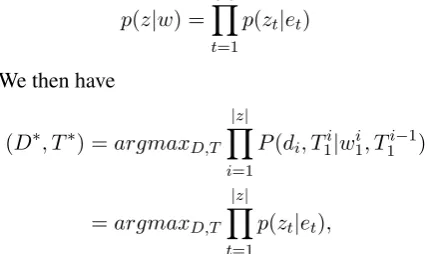
infor-mation about all previous decisions made by the transition system, the probability of any valid se-quence of transition actionsz conditioned on the input can be written as:
p(z|w) =
|z|
Y
t=1
p(zt|et)
We then have
(D∗, T∗) =argmax
D,T
|z|
Y
i=1
P(di, T1i|w1i, T1i−1)
=argmaxD,T
|z|
Y
t=1
p(zt|et),
where the disfluency detection task is merged into the transition-based system.
Beam Search
The mainly drawback of greedy search is error propagation. An incorrect action will have a neg-ative influence to its subsequent actions, leading to an incorrect output sequence. One way to re-duce error propagation is beam-search. Because the number of actions taken always equals to the number of input sentence for every valid path, it is straightforward to use beam search. We use beam-search for both training and testing. The early up-date strategy fromCollins and Roark(2004) is ap-plied for training. In particular, each training se-quence is decoded, and we keep track of the lo-cation of the gold path in the beam. If the gold
path falls out of the beam at stept, decoding pro-cess is stopped and parameter update is performed using the gold path as a positive example, and beam items as negative examples. We also use the global optimization method (Andor et al., 2016;
Zhou et al.,2015) to train our beam-search model.
Scheduled Sampling
Scheduled sampling (Bengio et al.,2015) can also be used to reduce error propagation. The train-ing goal of the greedy baseline is to maximize the likelihood of each action given the current model state, which means that the correct action is taken at each step. Doing inference, the action predicted by the model itself is taken instead. This discrep-ancy between training and inference can yield er-rors that accumulate quickly along the searching process. Scheduled sampling is used to solve the discrepancy by gently changing the training pro-cess from a fully guided scheme using the true pre-vious action, towards a less guided scheme which mostly uses the predicting action instead. We take the action gaining higher p(zt|et) with a certain
probabilityp, and a probability(1−p)for the cor-rect action when training.
3.2 State Representation
For better capturing non-local context informa-tion, we use LSTM structures to represent differ-ent compondiffer-ents of each state, includingbuffer, ac-tion, stack, and output. In particular, we exploit LSTM-Minus (Wang and Chang,2016) to model thebuffersegment, conventional LSTM to model the action andouptut segment, and stack LSTM (Dyer et al., 2015) to model the stack segments, which demonstrates highly effectively in parsing task.
Buffer Representation
In order to construct more informative represen-tation, we use a Bi-LSTM to represent thebuffer
boston to denver to
hb(to) hf(to) hb(denver)hf(denver)
O
want a flight to boston
S
to denver B
hb(to)
hb(denver) hf(to) hf(denver)
[image:5.595.72.288.54.240.2]bb = - bf = -
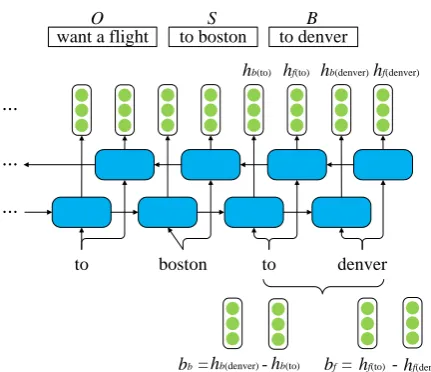
Figure 3: Illustration for learningbuffer represen-tation based on a Bi-LSTM,hf(*) andhb(*)
indi-cate the hidden vectors of forward and backward LSTM respectively.
LSTM hidden vectors is utilized to represent a segment’s information. We perform a similar method in a Bi-LSTM to obtain the representa-tion of the buffer. The forward and backward subtractions for the buffer can be described as bf = hf(l) −hf(f) and bb = hb(f)− hb(l),
respectively, where hf(f) and hf(l) are the
hidden vectors of the first and the last words in the forward LSTM, respectively. Similarly,hb(f)and
hb(l)are the hidden vectors of the first and the last
words in the backward LSTM, respectively. Then these subtractions are concatenated as the repre-sentation of thebufferbt=bf ⊕bb. As illustrated
in Figure 3, the forward and backward subtrac-tions for buffer are bf = hf(to)−hf(denver)
and bb = hb(denver) − hb(to), respectively.
Hereto is the first word inbuffer anddenver is the last. Then bf andbb are concatenated as the
representation ofbuffer.
Action Representation
We represent an actionawith an embeddingea(a)
from a looking-up tableEa , and apply a
conven-tional LSTM to represent the complete history of actions taken by the transition system. Once an ac-tionais taken, the embeddingea(a)will be added
to the right-most position of the LSTM.
Stack Representation
We use a stack LSTM (Dyer et al., 2015) to rep-resent partial disfluency chunk. The stack LSTM tries to augment the conventional LSTM with a
“stack pointer”. For a conventional LSTM, new inputs are always added in the right-most position; but in a stack LSTM, the current location of the stack pointer determines which cell in the LSTM providesct−1 andht−1 when computing the new
memory cell contents. In addition to adding ele-ments to the end of the sequence, the stack LSTM provides a pop operation which moves the stack pointer to the previous element. Thus, the LSTM can be understood as a stack implemented so that contents are never overwritten, When the action OUT is taken, thestack is cleared by moving the stack pointer to the initial position. When the ac-tion DEL is taken, the representaac-tion of thebuffer
will be added directly to the stack LSTM.
Output Representation
We use a conventional LSTM to represent the out-put. When the action OUT is taken, the repre-sentation of the buffer will be added directly to the right-most position of the LSTM. Because the words in theoutputare a continuous subsequence of the final output sentence with disfluencies re-moved, the LSTM representation can be seen as a pseudo language model and thus has the ability to keep the generated sentence grammatical, which is very important for disfluency detection.
3.3 Token Embeddings
We use four vectors to represent each input token: a learned word embedding w; a fixed word em-beddingw; a learned POS-tag embeddinge p; and a hand-crafted feature representationd. The four vectors are concatenated, transformed by a matrix V and fed to a rectified layer to learn a feature combination:
x=max{0, V[we;w;p;d] +b}, whereV means vector concatenation.
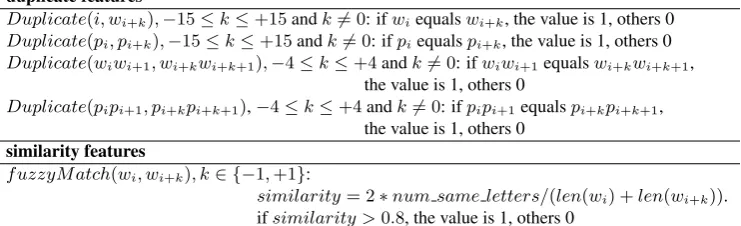
Following the work of Wang et al. (2016), we extract two types of hand-crafted discrete features (as shown in Table3) for each token in a sentence, and incorporate them into our neural networks by translating them into a 0-1 vector d. The dimension ofdis 78, which equals to the number of discrete features. For a tokenxt,di fires if xt
matches the i-th pattern of the feature templates. The duplicate features indicate whether xt has a
duplicatedword/POS-tag in certain distance. The
duplicate features
Duplicate(i, wi+k),−15≤k≤+15andk6= 0: ifwiequalswi+k, the value is 1, others 0
Duplicate(pi, pi+k),−15≤k≤+15andk6= 0: ifpiequalspi+k, the value is 1, others 0
Duplicate(wiwi+1, wi+kwi+k+1),−4≤k≤+4andk6= 0: ifwiwi+1equalswi+kwi+k+1, the value is 1, others 0
Duplicate(pipi+1, pi+kpi+k+1),−4≤k≤+4andk6= 0: ifpipi+1equalspi+kpi+k+1, the value is 1, others 0
similarity features
fuzzyMatch(wi, wi+k), k∈ {−1,+1}:
[image:6.595.115.486.70.183.2]similarity= 2∗num same letters/(len(wi) +len(wi+k)). ifsimilarity >0.8, the value is 1, others 0
Table 3: Discrete features used in our transition-based neural networks.p-POS tag.w-word.
4 Experiments
4.1 Settings
Dataset. Our training data include the Switch-board portion of the English Penn Treebank ( Mar-cus et al., 1993) and a in-house Chinese data set. For English, two annotation layers are pro-vided: one for syntactic bracketing (MRG files), and the other for disfluencies (DPS files). The Switchboard annotation project was not fully com-pleted. Because disfluency annotation is cheaper to produce, many of the DPS training files do not have matching MRG files. Only 619,236 of the 1,482,845 tokens in the DPS disfluency de-tection training data have gold-standard syntac-tic parses. To directly compare with transition-based parsing methods (Honnibal and Johnson,
2014; Wu et al., 2015), we also use the subcor-pus of PARSED/MRG/SWBD. Following the ex-periment settings inCharniak and Johnson(2001), the training subcorpus contains directories 2 and 3 in PARSED/MRG/SWBD and directory 4 is split into test, development sets and others. Follow-ingHonnibal and Johnson(2014), we lower-case the text and remove all punctuations and partial words2. We also discard the ‘um’ and ‘uh’
to-kens and merge ‘you know’ and ‘i mean’ into sin-gle tokens. Automatic POS-tags generated from pocket crf (Qian and Liu,2013) are used as POS-tag in our experiments.
For Chinese experiments, we collect 25k spo-ken sentences from meeting minutes, which are transcribed using the iflyrec toolkit3, and annotate
them with only disfluency annotations according to the guideline proposed byMeteer et al.(1995).
2words are recognized as partial words if they are tagged as ‘XX’ or end with ‘-’
3the iflyrec toolkit is available at http://www.iflyrec.com/
4.2 Neural Network Training
Pretrained Word Embeddings. Following
Dyer et al.(2015) andWang et al.(2016), we use a variant of the skip n-gram model introduced by Ling et al. (2015), named “structured skip n-gram”, to create word embeddings. The AFP portion of English Gigaword corpus (version 5) is used as the training corpus. Word embeddings for Chinese are trained on Chinese baike corpus. We use an embedding dimension of 100 for English, 300 for chinese.
Hyper-Parameters. Both the Bi-LSTMs and the stack LSTMs have two hidden layers and their dimensions are set to 100. Pretrained word embeddings have 100 dimensions and the learned word embeddings have also 100 dimensions. Pos-tag embeddings have 12 dimensions. The dimension of action embeddings is set to 20.
4.3 Performance On English Swtichboard
We build two baseline systems using CRF and Bi-LSTM, respectively. The hand-crafted dis-crete features of CRF refer to those in Ferguson et al.(2015). For the Bi-LSTM model, the token embedding is the same with our transition-based method. Table4shows the result of our model on both the development and test sets. Beam search improves the F-score form 87.1% to 87.5%, which is consistent with the finding of Buckman et al.
(2016) on the LSTM parser of (Dyer et al.,2015) (improvements by about 0.3 point). Scheduled sampling achieves the same improvements com-pared to beam-search. Because of high training speed, we conduct subsequent experiments based on scheduled sampling.
F-Method P DevR F1 P TestR F1 CRF 93.9 78.3 85.4 91.7 75.1 82.6 Bi-LSTM 94.1 79.3 86.1 91.7 80.6 85.8 greedy 91.4 83.7 87.4 91.1 83.3 87.1 +beam 93.6 83.6 88.3 92.8 82.7 87.5 +schedualed 92.3 84.3 88.1 91.1 84.1 87.5
Table 4: Experiment results on the development and test data of English Switchboard data.
Method P R F1
Our 91.1 84.1 87.5
Attention-based (Wang et al.,2016) 91.6 82.3 86.7 Bi-LSTM (Zayats et al.,2016) 91.8 80.6 85.9 semi-CRF (Ferguson et al.,2015) 90.0 81.2 85.4 UBT (Wu et al.,2015) 90.3 80.5 85.1 M3N (Qian and Liu,2013) - - 84.1
Table 5: Comparison with previous state-of-the-art methods on the test set of English Switchboard.
score as shown in Table5. It achieves 2.4 point im-provements over UBT (Wu et al.,2015), which is the best syntax-based method for disfluency detec-tion. The best performance by linear statistical se-quence labeling methods is the semi-CRF method of Ferguson et al. (2015), achieving a 85.4% F-score leveraging prosodic features. Our model ob-tains a 2.1 point improvement compared to this. Our model also achieves 0.8 point improvement over the neural attention-based model (Wang et al.,
2016), which regards the disfluency detection as a sequence-to-sequence problem. We attribute the success to the strong ability to learn global chunk-level features and the good state representation such as the stack-LSTM.
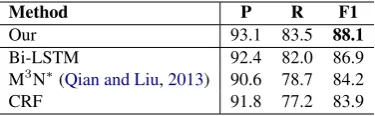
4.4 Result On DPS Corpus
As described in section 3.1, to directly compare with the transition-based parsing methods ( Hon-nibal and Johnson, 2014; Wu et al., 2015), we only use MRG files, which are less than the DPS files. In fact, many methods, such as Qian and Liu (2013), have used all the DPS files as train-ing data. We are curious about the performance of our system using all the DPS files. Following the experimental settings ofJohnson and Charniak
(2004), the corpus is split as follows: main train-ing consisttrain-ing of all sw[23]*.dps files, develop-ment training consisting of all sw4[5-9]*.dps files and test training consisting of all sw4[0-1]*.mrg files. Table 6 shows the result on the DPS files.
Method P R F1
Our 93.1 83.5 88.1
Bi-LSTM 92.4 82.0 86.9
M3N∗(Qian and Liu,2013) 90.6 78.7 84.2
CRF 91.8 77.2 83.9
Table 6: Test result of our transition-based model using DPS files for training.
Method Dev Test
P R F1 P R F1
[image:7.595.72.297.62.144.2]Our 68.9 40.4 50.9 77.2 37.7 50.6 Bi-LSTM 60.1 41.3 48.9 65.3 38.2 48.2 CRF 73.7 33.5 46.1 77.7 32.0 45.3
Table 7: performance on Chinese annotated data
The result of M3N∗ comes from our experiments with the toolkit4released byQian and Liu(2013),
which use the same data set and pre-processing. Our model achieves a 88.1% F-score by using more training data, obtaining 0.6 point improve-ment compared with the system training on MRG files. The performance is far better than the se-quence labeling methods that use DPS files for training.
4.5 Performance on Chinese
Table 7 shows the results of Chinese disfluency detection. Our model obtains a 2.4 point im-provement compared with the baseline Bi-LSTM model and a 5.3 point compared with the baseline CRF model. The performance on Chinese is much lower than that on English. Apart from the smaller training set, the main reason is that the proportion of repair type disflueny is much higher.
5 Analysis
5.1 Ablation Tests
As described in section 3.1, the sate representa-tion has four components. We explicitly compare the impact of different parts. As shown in Table8, the F-score decreases most heavily withoutstack, which indicates that it is very necessary to cap-ture chunk-level information for disfluency detec-tion and our model can model it effectively. The results also show thatoutput, which can be seen as a pseudo language model, has important influence on model performance. Seen from the result, his-tory of actions represented inactionis also useful for predicting at each step. The F-score decreases
4The toolkit is available at
[image:7.595.73.289.199.278.2]Method P R F1
ALL 91.1 84.1 87.5
-stack 93.5 80.6 86.5
-action 91.6 83.0 87.1
-output 89.0 84.4 86.7
[image:8.595.79.286.61.132.2]- Bi-LSTM 93.6 81.4 87.1
Table 8: Results of feature ablation experiments on English Switchboard test data. “- Bi-LSTM” means using unidirectional LSTM forbuffer
about 0.4 point, which shows that Bi-LSTM can capture more information compared to simple uni-directional LSTM.
5.2 Repetitions vs Non-repetitions
Repetition disfluencies are easier to detect and even some simple hand-crafted features can han-dle them well. Other types of reparandums such as repair are more complex (Zayats et al., 2016;
Ostendorf and Hahn, 2013). In order to bet-ter understand model performances, we evalu-ate our model’s ability to detect repetition vs. non-repetition (other) reparandum. The results are shown in Table 9. All the three mod-els achieve high score on repetition reparan-dum. Our transition-based model is much bet-ter in predicting non-repetitions compared to CRF and Bi-LSTM. We conjecture that our transition-based structure can capture more of the reparan-dum/repair “rough copy” similarities by learning represention of both chunks and global state.
6 Related Work
Common approaches take disfluency detection as a sequence labeling problem, where each senten-tial word is assigned with a label (Georgila,2009;
Qian and Liu,2013). These methods achieve good performance, but are not powerful enough to cap-ture complicated disfluencies with longer spans or distances. Another drawback is that they have no ability to exploit chunk-level features. There are also works that try to use recurrent neural network (RNN), which can capture dependencies at any length in theory, on disfluency detection problem (Zayats et al.,2016;Hough and Schlangen,2015). The RNN method treats sequence tagging as clas-sification on each input token. Hence, it also has no power to exploit chunk-level features. Some works (Wang et al., 2016) regard the disfluency detection as a sequence-to-sequence problem and propose a neural attention-based model for it. The
Method Repetitions Non-repetitions Either
CRF 93.8 61.4 82.6
Bi-LSTM 93.1 65.3 85.8
[image:8.595.314.517.63.109.2]OUR 93.3 68.7 87.5
Table 9: F-score of different types of reparandums on English Switchboard test data.
attention-based model can capture a global repre-sentation of the input sentence by using a RNN when encoding. It can strongly capture long-range dependencies and achieves good performance, but are also not powerful enough to capture chunk-level information. To capture chunk-chunk-level infor-mation,Ferguson et al.(2015) try to use semi-CRF for disfluency detection, and reports improved re-sults. Semi-CRF models still have their inefficien-cies because they can only use the local chunk in-formation limited by the markov assumption when decoding.
Many syntax-based approaches (Lease and Johnson,2006;Rasooli and Tetreault,2013; Hon-nibal and Johnson, 2014; Wu et al., 2015) have been proposed which jointly perform dependency parsing and disfluency detection. The main advan-tage of joint models is that they can capture long-range dependency of disfluencies. However, it re-quires that the training data contains both syntax trees and disfluency annotations, which reduces the practicality of the algorithm. The performance relies heavily on manual feature engineering.
Transition-based framework has been widely exploited in a number of other NLP tasks, includ-ing syntactic parsinclud-ing (Zhang and Nivre,2011;Zhu et al., 2013), information extraction (Li and Ji,
2014) and joint syntactic models (Zhang et al.,
2013,2014).
Recently, deep learning methods have been widely used in many nature language processing tasks, such as name entity recognition (Lample et al., 2016), zero pronoun resolution (Yin et al.,
2017) and word segmentation (Zhang et al.,2016). The effectiveness of neural features has also been studied for this framework (Zhou et al., 2015;
7 Conclusion
We introduced a transition-based model for dis-fluency detection, which does not use any syntax information, learning represention of both chunks and global contexts. Experiments showed that our model achieves the state-of-the-art F-scores on both the commonly used English Switchboard test set and a in-house annotated Chinese data set.
Acknowledgments
We thank the anonymous reviewers for their valu-able suggestions. This work was supported by the National Key Basic Research Program of China via grant 2014CB340503 and the National Natu-ral Science Foundation of China (NSFC) via grant 61370164 and 61632011. The Chinese disfluency data is annotated by IFLYTEK CO.,LTD.
References
Daniel Andor, Chris Alberti, David Weiss, Aliaksei Severyn, Alessandro Presta, Kuzman Ganchev, Slav
Petrov, and Michael Collins. 2016. Globally
nor-malized transition-based neural networks. In Pro-ceedings of the 54th Annual Meeting of the Associa-tion for ComputaAssocia-tional Linguistics (Volume 1: Long Papers), pages 2442–2452, Berlin, Germany. Asso-ciation for Computational Linguistics.
Samy Bengio, Oriol Vinyals, Navdeep Jaitly, and Noam Shazeer. 2015. Scheduled sampling for se-quence prediction with recurrent neural networks. InAdvances in Neural Information Processing
Sys-tems, pages 1171–1179.
Jacob Buckman, Miguel Ballesteros, and Chris Dyer. 2016. Transition-based dependency parsing with
heuristic backtracking. InProceedings of the 2016
Conference on Empirical Methods in Natural Lan-guage Processing; 2016 Nov 1-5; Austin, Texas, USA. Stroudsburg (USA): Association for Compu-tational Linguistics (ACL); 2016. p. 2313-18.ACL (Association for Computational Linguistics).
Eugene Charniak and Mark Johnson. 2001. Edit
detec-tion and parsing for transcribed speech. In
Proceed-ings of the second meeting of the North American Chapter of the Association for Computational Lin-guistics on Language technologies, pages 1–9. As-sociation for Computational Linguistics.
Michael Collins and Brian Roark. 2004. Incremental
parsing with the perceptron algorithm. In
Proceed-ings of the 42nd Annual Meeting on Association for Computational Linguistics, page 111. Association for Computational Linguistics.
Chris Dyer, Miguel Ballesteros, Wang Ling, Austin
Matthews, and Noah A. Smith. 2015.
Transition-based dependency parsing with stack long short-term memory. InProceedings of the 53rd Annual Meeting of the Association for Computational Lin-guistics and the 7th International Joint Conference on Natural Language Processing (Volume 1: Long Papers), pages 334–343, Beijing, China. Associa-tion for ComputaAssocia-tional Linguistics.
James Ferguson, Greg Durrett, and Dan Klein. 2015. Disfluency detection with a semi-markov model and
prosodic features. InProceedings of the 2015
Con-ference of the North American Chapter of the Asso-ciation for Computational Linguistics: Human Lan-guage Technologies, pages 257–262. Association for Computational Linguistics.
Kallirroi Georgila. 2009. Using integer linear
program-ming for detecting speech disfluencies. In
Proceed-ings of Human Language Technologies: The 2009 Annual Conference of the North American Chap-ter of the Association for Computational Linguistics, Companion Volume: Short Papers, pages 109–112. Association for Computational Linguistics.
Xavier Glorot, Antoine Bordes, and Yoshua Bengio.
2011. Deep sparse rectifier neural networks. In
Ais-tats, volume 15, page 275.
Sepp Hochreiter and J¨urgen Schmidhuber. 1997.
Long short-term memory. Neural computation,
9(8):1735–1780.
Matthew Honnibal and Mark Johnson. 2014. Joint incremental disfluency detection and dependency
parsing. Transactions of the Association for
Com-putational Linguistics, 2:131–142.
Julian Hough and David Schlangen. 2015. Recurrent neural networks for incremental disfluency
detec-tion. InSixteenth Annual Conference of the
Inter-national Speech Communication Association. Mark Johnson and Eugene Charniak. 2004. A
tag-based noisy channel model of speech repairs. In
Proceedings of the 42nd Annual Meeting on Asso-ciation for Computational Linguistics, page 33. As-sociation for Computational Linguistics.
Guillaume Lample, Miguel Ballesteros, Sandeep Sub-ramanian, Kazuya Kawakami, and Chris Dyer. 2016. Neural architectures for named entity recognition.
arXiv preprint arXiv:1603.01360.
Matthew Lease and Mark Johnson. 2006. Early dele-tion of fillers in processing conversadele-tional speech. In Proceedings of the Human Language Technol-ogy Conference of the NAACL, Companion Volume: Short Papers, pages 73–76. Association for Compu-tational Linguistics.
Qi Li and Heng Ji. 2014. Incremental joint
for Computational Linguistics (Volume 1: Long Pa-pers), pages 402–412, Baltimore, Maryland. Asso-ciation for Computational Linguistics.
Wang Ling, Chris Dyer, Alan Black, and Isabel Trancoso. 2015. Two/too simple adaptations of
word2vec for syntax problems. In Proceedings of
the 2015 Conference of the North American Chap-ter of the Association for Computational Linguistics: Human Language Technologies, pages 1299–1304. Mitchell P Marcus, Mary Ann Marcinkiewicz, and
Beatrice Santorini. 1993. Building a large annotated
corpus of english: The penn treebank.
Computa-tional linguistics, 19(2):313–330.
Marie W Meteer, Ann A Taylor, Robert MacIntyre, and
Rukmini Iyer. 1995. Dysfluency annotation
style-book for the switchboard corpus. University of Pennsylvania.
Joakim Nivre. 2008. Algorithms for deterministic
in-cremental dependency parsing. Computational
Lin-guistics, 34(4):513–553.
Mari Ostendorf and Sangyun Hahn. 2013. A sequential repetition model for improved disfluency detection. InINTERSPEECH, pages 2624–2628.
Xian Qian and Yang Liu. 2013. Disfluency detection
using multi-step stacked learning. InHLT-NAACL,
pages 820–825.
Mohammad Sadegh Rasooli and Joel R Tetreault. 2013. Joint parsing and disfluency detection in
lin-ear time. InEMNLP, pages 124–129.
Elizabeth Ellen Shriberg. 1994. Preliminaries to a
the-ory of speech disfluencies. Ph.D. thesis, Citeseer. Shaolei Wang, Wanxiang Che, and Ting Liu. 2016.
A neural attention model for disfluency detection. In Proceedings of COLING 2016, the 26th Inter-national Conference on Computational Linguistics: Technical Papers, pages 278–287, Osaka, Japan. The COLING 2016 Organizing Committee.
Wenhui Wang and Baobao Chang. 2016. Graph-based
dependency parsing with bidirectional lstm. InProc.
of ACL, pages 2306–2315.
Taro Watanabe and Eiichiro Sumita. 2015.
Transition-based neural constituent parsing. In Proceedings of the 53rd Annual Meeting of the Association for Computational Linguistics and the 7th International Joint Conference on Natural Language Processing (Volume 1: Long Papers), pages 1169–1179, Bei-jing, China. Association for Computational Linguis-tics.
Shuangzhi Wu, Dongdong Zhang, Ming Zhou, and Tiejun Zhao. 2015. Efficient disfluency detection
with transition-based parsing. InProceedings of the
53rd Annual Meeting of the Association for Compu-tational Linguistics and the 7th International Joint
Conference on Natural Language Processing (Vol-ume 1: Long Papers), pages 495–503. Association for Computational Linguistics.
Qingyu Yin, Yu Zhang, Weinan Zhang, and Ting Liu. 2017. A deep neural network for chinese zero
pro-noun resolution. InProceedings of the 26th
Inter-national Conference on Artificial Intelligence, IJ-CAI’17. AAAI Press.
Vicky Zayats, Mari Ostendorf, and Hannaneh Ha-jishirzi. 2016. Disfluency detection using a
bidirec-tional lstm. arXiv preprint arXiv:1604.03209.
Meishan Zhang, Yue Zhang, Wanxiang Che, and Ting
Liu. 2013. Chinese parsing exploiting characters.
In Proceedings of the 51st Annual Meeting of the Association for Computational Linguistics (Volume 1: Long Papers), pages 125–134, Sofia, Bulgaria. Association for Computational Linguistics.
Meishan Zhang, Yue Zhang, Wanxiang Che, and Ting
Liu. 2014. Character-level chinese dependency
parsing. In Proceedings of the 52nd Annual Meet-ing of the Association for Computational LMeet-inguistics (Volume 1: Long Papers), pages 1326–1336, Bal-timore, Maryland. Association for Computational Linguistics.
Meishan Zhang, Yue Zhang, and Guohong Fu. 2016.
Transition-based neural word segmentation. In Pro-ceedings of the 54th Annual Meeting of the Associa-tion for ComputaAssocia-tional Linguistics (Volume 1: Long Papers), pages 421–431, Berlin, Germany. Associa-tion for ComputaAssocia-tional Linguistics.
Yue Zhang and Joakim Nivre. 2011. Transition-based
dependency parsing with rich non-local features. In
Proceedings of the 49th Annual Meeting of the Asso-ciation for Computational Linguistics: Human Lan-guage Technologies, pages 188–193, Portland, Ore-gon, USA. Association for Computational Linguis-tics.
Hao Zhou, Yue Zhang, Shujian Huang, and Jiajun
Chen. 2015. A neural probabilistic
structured-prediction model for transition-based dependency parsing. In Proceedings of the 53rd Annual Meet-ing of the Association for Computational LMeet-inguistics and the 7th International Joint Conference on Natu-ral Language Processing (Volume 1: Long Papers), pages 1213–1222, Beijing, China. Association for Computational Linguistics.
Muhua Zhu, Yue Zhang, Wenliang Chen, Min Zhang,
and Jingbo Zhu. 2013. Fast and accurate