Initializing Convolutional Filters with Semantic Features for Text
Classification
Shen Li1,2
[email protected] Zhe Zhao
4,5
Tao Liu4,5
[email protected] Renfen Hu
3,†
[email protected] Xiaoyong Du
4,5
1Institute of Chinese Information Processing, Beijing Normal University
2UltraPower-BNU Joint Laboratory for Artificial Intelligence, Beijing Normal University 3College of Chinese Language and Culture, Beijing Normal University
4School of Information, Renmin University of China
5Key Laboratory of Data Engineering and Knowledge Engineering, MOE
Abstract
Convolutional Neural Networks (CNNs) are widely used in NLP tasks. This pa-per presents a novel weight initialization method to improve the CNNs for text clas-sification. Instead of randomly initializ-ing the convolutional filters, we encode se-mantic features into them, which helps the model focus on learning useful features at the beginning of the training. Experiments demonstrate the effectiveness of the ini-tialization technique on seven text classifi-cation tasks, including sentiment analysis and topic classification.
1 Introduction
Recently, neural networks (NNs) dominate the state-of-the-art results on a wide range of natu-ral language processing (NLP) tasks. The com-monly used neural networks in NLP include Re-current NNs, Convolutional NNs, Recursive NNs and their combinations. NNs are known for their strong abilities to learn features automatically. However, the lack of data or inappropriate param-eter settings might greatly limit the generalization abilities of the models (Bengio et al., 2009; Le-Cun et al., 2015;Krizhevsky et al.,2012; Srivas-tava et al.,2014). To enhance the performance, a lot of improved methods have been proposed, e.g. developing advanced structures (Zhao et al.,2015;
Zhang et al.,2016a), introducing prior knowledge (Hu et al., 2016) and utilizing external resources (Xie et al.,2016;Qian et al.,2016).
It is also noteworthy that the neural networks’ performance is sensitive to weight initialization
†Corresponding author.
because their objectives are non-convex (Glorot and Bengio,2010;Saxe et al.,2013;Mishkin and Matas, 2015). In fact, initialization techniques even play a role of catalyst for the revival of neu-ral networks (Hinton et al., 2006; LeCun et al.,
2015). Most improvements on initializing weights are based on mathematical methods, e.g. xavier initialization (Glorot and Bengio, 2010) and or-thogonal initialization (Saxe et al., 2013). For NLP tasks, an influential technique is to use pre-trained word vectors to initialize embedding layers (Kim,2014;Chen and Manning,2014). Consider the embedding layers could be initialized by pre-trained word vectors, how about weights in other layers that are still randomly initialized?
Inspired by this question, we propose a sim-ple yet effective method to improve CNNs by ini-tializing convolutional layers (filters). Unlike the previous weight initialization based on mathemati-cal methods, we encode semantic features into the filters instead of initializing them randomly. As CNNs exploit 1-D convolutional filters to extract n-gram features, our method aims at helping the filters focus on learning useful n-grams, e.g. “not bad” which is more useful than “watch a movie” for determining reviews’ polarities. Specifically, we select n-grams from training data via a novel Naive Bayes (NB) weighting technique, and then cluster the n-gram embeddings with K-means al-gorithm. After that, we use the centroid vectors of the clusters to initialize the filters.
With this initialization method, CNN filters tend to extract important n-gram features at the begin-ning of the traibegin-ning process. By integrating our method into a classic CNN model for text classi-fication (Kim, 2014), we observe significant
provements in sentiment analysis and topic classi-fication tasks. The advantages of our approach are as follows:
• Features are directly extracted from train-ing data without involvtrain-ing any external re-sources;
• The computation brought by our method is relatively small, resulting in small additional training costs;
• The filter initialization is task independent. It could be easily applied to other NLP tasks. Also, we further analyze the filters, shedding some light on the mechanism how our method influences the training process. The source code is released at https://github.com/ shenshen-hungry/Semantic-CNN.
2 Related Work
Most recently, CNNs are becoming increasingly popular in a variety of NLP tasks. An influential one is the work of (Kim, 2014), where a simple CNN with a single layer of convolution is used for feature extraction. Despite its simple structure, the model achieves strong baselines on many sentence classification datasets. Following this work, sev-eral improved models are proposed. Zhang and Wallace (2015) improve the model by optimiz-ing hyper-parameters and provide a detailed anal-ysis of the CNN (Kim, 2014). Yin and Sch¨utze
(2016) and Zhang et al. (2016b) exploit different pre-trained word embeddings (e.g. word2vec and GloVe) to enhance the model.
In addition to initializing embedding layers with pre-trained word vectors, other pre-designed fea-tures also prove to be very effective in assisting the training of neural models. For example, in (Hu et al.,2016), neural models are harnessed by logic rules.Li et al.(2016) propose to use pre-calculated words’ weights to guide Paragraph Vector model.
Dai and Le (2015) combine the hidden layers of RNNs with linearly increasing weights. Xie et al.
(2016) use entity descriptions from knowledge bases (e.g. Freebase) to learn knowledge repre-sentations for entity classification and knowledge graph completion. Qian et al.(2016) propose lin-guistically regularized LSTMs for sentiment anal-ysis with sentiment lexicons, negation words, and intensity words. In this work, we encode seman-tic features into convolutional layers by initializ-ing them with important n-grams. Beinitializ-ing aware of which n-grams are important, CNN is able to
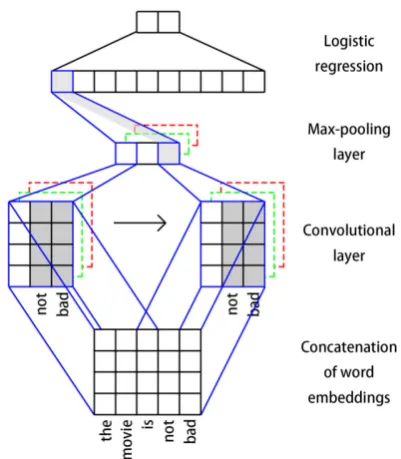
ex-Figure 1: The framework of CNN with one layer of convolution and pooling.
tract more discriminative features for text classifi-cation.
3 Our Method
The intuition behind our method is simple: Since CNNs essentially capture semantic features of n-grams, we can use important n-grams to initial-ize the filters. As a result, the filters are able to focus on extracting those important n-gram fea-tures at the beginning of the training. As shown in Figure 1, we use embeddings of “not” and “bad” to initialize the filter. A larger score will be ob-tained when the “not bad” filter matches the bi-gram “not bad” in the text, otherwise a relatively smaller score will be returned.
3.1 N-gram Selection
Firstly, we extract important n-grams from the training data. Intuitively, n-gram “not bad” is much more important than “watch a movie” for determining reviews’ polarities. Naive Bayes (NB) weighting is an effective technique for de-termining the words’ importance (Martineau and Finin, 2009; Wang and Manning, 2012). NB weightrof a n-gramwin classcis calculated as follows:
r= (pwc +α)/||pc||1 (pw
˜
c +α)/||pc˜||1 where pw
[image:2.595.315.516.63.293.2]Figure 2: Uni-gram cluster examples.
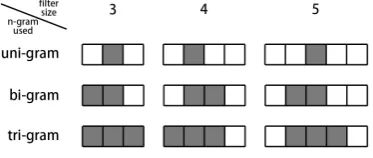
Figure 3: Filter initialization.
n-gram w in class c, pw
˜
c is the number of texts
that contain n-gramwin other classes,||pc||1is the number of texts in class c, ||p˜c||1 is the number of texts in other classes,αis a smoothing param-eter. For positive class in movie review dataset, the ratios of n-grams like “amazing” and “not bad” should be large since they appear much more fre-quently in positive texts than in negative texts. For neutral n-grams like “of the” and “movie”, their ratios should be around 1. For each class, we se-lect the n-grams whose ratios are much higher than 1 for filter initialization. We give examples of n-grams selected by our method in Appendix. 3.2 Filter Initialization
We concatenate word embeddings to construct n-gram embeddings. For example, a tri-n-gram em-bedding has 3*100 dimensions when word embed-ding has 100 dimensions. This concatenation fol-lows the mechanism of convolutional filters,where a filter with n*d dimensions is able to capture n-gram features (d is the dimension of word embed-ding). Because the number of filters in CNNs is much smaller than the number of n-grams, a fil-ter tends to extract the features of a class of n-grams rather than an individual n-gram. Based on this observation, we don’t use n-gram embed-dings to initialize the filters directly. Instead, we firstly use K-means to cluster features of the se-lected n-grams, and then use the clusters’ centroid vectors to initialize the filters. In this work, we consider clustering uni-gram (word), bi-gram and tri-gram features. Figure 2 shows two uni-gram cluster examples extracted from the location ques-tions in TREC dataset (Li and Roth,2002).
After obtaining the n-gram clusters, we feed
their centroid vectors into the center of the filters. The remaining positions are still initialized ran-domly. Taking filters with size 3, 4, 5 as examples, Figure 3 shows how we fill uni, bi, and tri-gram features into the filters. By doing this, we encode semantic features into the filters. For example, in the TREC question classification task, the initial-ization will result in six types of filters which are sensitive to abbreviation, entity, description, hu-man, location and number questions respectively.
4 Experiments
4.1 Datasets and Hyper-parameter Settings CNN-non-static1 (short for CNN) proposed by
Kim (2014) is used as our baseline, which con-sists of one embedding layer, one convolutional layer, one max pooling layer, and one fully con-nected layer. The model proposed byKim(2014) is a strong baseline in sentence classification. For details of the model, one can see (Kim, 2014;
Zhang and Wallace,2015). Pre-trained word em-beddings on Google News via word2vec toolkit2 are used for initializing the convolutional filters, besides initializing the embedding layer of CNN as in (Kim,2014). For a fair comparison, we use the same seven datasets3and hyper-parameter set-ting withKim(2014)’s work for training and test-ing. Uni, bi, and tri-gram features are used to ini-tialize the filters. For a K-way classification prob-lem, we select top10%n-grams in each class ac-cording to NB weighting. Since 300 filters are used in Kim (2014)’s work, we follow this set-ting and aggregate n-grams into300/Kclusters for each class. Centroid vectors are used for filling the filters. Taking binary classification dataset MR as an example,150“positive” filters and150 “nega-tive” filters are obtained after initialization.
4.2 Effectiveness of Filter Initialization In this section, we demonstrate the effectiveness of our initialization technique. We respectively use uni, bi and tri-gram centroid vectors to fill the filters. Table 1 lists the results. The CNN has provided very strong baselines. Our method
1The embedding layer in CNN-non-static is initialized
with pre-trained vectors from word2vec toolkit and fine-tuned for each task.
2https://code.google.com/p/word2vec/
3(MR (Pang and Lee, 2005), SST-1/2 (Socher et al., 2013), Subj (Pang and Lee, 2004), TREC (Li and Roth,
2002), CR (Hu and Liu, 2004), and MPQA (Wiebe et al.,
Model MR SST-1 SST-2 Subj TREC CR MPQA
CNN-non-static 81.5 48.0 87.2 93.4 93.6 84.3 89.5
+UNI 82.1 50.8 89.0 93.7 94.4 86.0 89.3
+BI 82.2 50.7 88.3 93.7 94.6 85.8 89.5
[image:4.595.149.450.63.115.2]+TRI 82.1 49.8 88.2 93.8 94.2 85.9 89.2
Table 1: Effectiveness of filter initialization.
Model MR SST-1 SST-2 Subj TREC CR MPQA
CNN-non-static (Kim,2014) 81.5 48.0 87.2 93.4 93.6 84.3 89.5
MV-CNN (Yin and Sch¨utze,2016) - 49.6 89.4 93.9 - - -MGNC-CNN (Zhang et al.,2016b) - 48.7 88.3 94.1 95.5 -
-CNN-Rule (Hu et al.,2016) 81.7 - 89.3 - - 85.3
-Our Model (CNN-non-static+UNI) 82.1 50.8 89.0 93.7 94.4 86.0 89.3 combine-skip (Kiros et al.,2015) 76.5 - - 93.6 92.2 80.1 87.1 Adasent (Zhao et al.,2015) 83.1 - - 95.5 92.4 86.3 93.3
DSCNN (Zhang et al.,2016a) 82.2 50.6 88.7 93.9 95.6 - -PV (Le and Mikolov,2014) 74.8 48.7 87.8 90.5 91.8 78.1 74.2 NBSVM (Wang and Manning,2012) 79.4 - - 93.2 - 81.8 86.3
Tree LSTM (Tai et al.,2015) - 51.0 88.0 - - -
-Table 2: Comparisons of state-of-the-arts.
further improves the accuracies significantly on all datasets except MPQA. The results are con-sistent with (Wang and Manning, 2012), where NB weighting produces little improvement over MPQA. We can also observe that the performance of uni, bi and tri-grams are comparable. None of them outperforms the others on all datasets.
4.3 Comparisons with State-of-the-arts
Table 2 lists the results of our model and other state-of-the-arts. Models in the first group are improved CNNs based on (Kim, 2014). Among them, MV-CNN and MGNC-CNN utilize multi-ple pre-trained embeddings as inputs, and CNN-Rule integrates logic rules. Our model achieves the best performance on three tasks without requir-ing any extra trainrequir-ing costs and resources. With this simple initialization method, our model also gives competitive results against more sophisti-cated deep learning models in the second group, e.g. Adasent (Zhao et al., 2015) and DSCNN (Zhang et al.,2016a) that have complex structures or use the combinations of NNs.
Experiments show that our n-gram features make great contribution to both two-class and multi-class classification. Essentially, our method enables CNNs to obtain better generalization abil-ities. Furthermore, as the initialization does not rely on any external prior knowledge or resources, it could be easily applied to other NLP tasks or other languages.
positive filters negative filters
+ - +
-UNI 29.5 20.5 21.3 28.7 BI 31.3 18.7 18.1 31.9 TRI 31.4 18.6 17.2 32.8
Table 3: “+” and “-” are used to denote the num-ber of positive and negative weights respectively. The data in the table are obtained from MR by the average of 10 times training. Every time we select 100 filters. 50 of them are initialized with positive n-grams and the rest are with negative n-grams.
4.4 Further Analysis of Filters
We further analyze the filter initialization with an example of binary sentiment classification. Through the initialization we have determined which filters are positive or negative in advance. The corresponding neurons of positive filters upon max-pooling layer are supposed to be activated by positive samples. Since positive (negative) samples have labels of 1 (0), the corresponding weights (in logistic regression) of those “positive” neurons tend to be positive. For the same reason, the negative filters tend to have negative weights. The results shown in Table 3 confirm our hypoth-esis: Positive/negative filters respectively tend to have positive(+)/negative(-) weights. The differ-ence between positive and negative filters are more obvious in bi-gram and tri-gram cases. It is be-cause bi and tri-gram centroid vectors could ini-tialize more parameters of filters than uni-gram.
[image:4.595.336.495.315.368.2]choices of uni, bi, and tri-grams have little influ-ence on the results. The following is our assump-tion: Compared to uni-grams (words), bi and tri-grams can cover more spaces of filters and intro-duce more NB information to filters. Filters ini-tialized by them thus pay more attention to NB information than filters initialized by uni-grams according to Table 3. However, bi and tri-grams are also sparser in data than uni-grams. Their NB weights are not as accurate as those of uni-grams, even applied smoothing. As NB weight of a n-gram denotes its contribution to the classification, model initialized with tri-grams does not always perform the best.
5 Conclusion
This paper proposes a novel weight initialization technique for CNNs. We discover that convolu-tional filters that encode semantic features at the beginning of the training tend to produce better results than being randomly initialized. This has a similar effect with embedding layer initializa-tion via pre-trained word vectors. Experimental results demonstrate the effectiveness of the ini-tialization technique on multiple text classification tasks. In addition, our method requires few ex-ternal resources and relatively small calculation, making it attractive for scenarios where training costs may be an issue.
In textual data, the features extracted by CNNs are n-grams. However, in fields like computer vi-sion, features extracted by filters are more difficult to interpret. It still requires further exploration to apply our method to fields beyond NLP.
Acknowledgments
This work is supported by the National High Technology Research and Development Program of China (No. 2012AA011104), National Lan-guage Committee Research Program of China (No. YB125-124), and National Natural Science Foundation of China (No. 61472428).
References
Yoshua Bengio et al. 2009. Learning deep architec-tures for ai. Foundations and trends® in Machine Learning2(1):1–127.
Danqi Chen and Christopher D Manning. 2014. A fast and accurate dependency parser using neural net-works. InEMNLP. pages 740–750.
Andrew M. Dai and Quoc V. Le. 2015.
Semi-supervised sequence learning. In Proceedings of NIPS 2015. pages 3079–3087.
Xavier Glorot and Yoshua Bengio. 2010. Understand-ing the difficulty of trainUnderstand-ing deep feedforward neural networks. InAistats. volume 9, pages 249–256.
Geoffrey E. Hinton, Simon Osindero, and Yee Whye Teh. 2006. A fast learning algorithm for deep belief nets.Neural Computation18(7):1527–1554.
Minqing Hu and Bing Liu. 2004. Mining and sum-marizing customer reviews. InProceedings of ACM SIGKDD 2004. ACM, pages 168–177.
Zhiting Hu, Xuezhe Ma, Zhengzhong Liu, Eduard H. Hovy, and Eric P. Xing. 2016. Harnessing deep neu-ral networks with logic rules. InProceedings of ACL 2016.
Yoon Kim. 2014. Convolutional neural networks for sentence classification. InProceedings of EMNLP 2014. pages 1746–1751.
Ryan Kiros, Yukun Zhu, Ruslan Salakhutdinov, Richard S. Zemel, Raquel Urtasun, Antonio Tor-ralba, and Sanja Fidler. 2015. Skip-thought vectors. InProceedings of NIPS 2015. pages 3294–3302.
Alex Krizhevsky, Ilya Sutskever, and Geoffrey E. Hin-ton. 2012. Imagenet classification with deep con-volutional neural networks. In Advances in neural information processing systems. pages 1097–1105.
Quoc V. Le and Tomas Mikolov. 2014. Distributed rep-resentations of sentences and documents. In Pro-ceedings of ICML 2014. pages 1188–1196.
Yann LeCun, Yoshua Bengio, and Geoffrey Hinton. 2015. Deep learning. Nature521(7553):436–444.
Bofang Li, Zhe Zhao, Tao Liu, Puwei Wang, and Xi-aoyong Du. 2016. Weighted neural bag-of-n-grams model: New baselines for text classification. In Pro-ceedings of COLING 2016. pages 1591–1600.
Xin Li and Dan Roth. 2002. Learning question classi-fiers. InProceedings of ACL 2002. Association for Computational Linguistics, pages 1–7.
Justin Martineau and Tim Finin. 2009. Delta TFIDF: an improved feature space for sentiment analysis. In
Proceedings of ICWSM 2009.
Dmytro Mishkin and Jiri Matas. 2015. All you need is a good init.CoRRabs/1511.06422.
Bo Pang and Lillian Lee. 2005. Seeing stars: Ex-ploiting class relationships for sentiment categoriza-tion with respect to rating scales. InProceedings of ACL 2005. Association for Computational Linguis-tics, pages 115–124.
Qiao Qian, Minlie Huang, and Xiaoyan Zhu. 2016. Linguistically regularized lstms for sentiment clas-sification.arXiv preprint arXiv:1611.03949. Andrew M. Saxe, James L. McClelland, and Surya
Ganguli. 2013. Exact solutions to the nonlinear dy-namics of learning in deep linear neural networks.
CoRRabs/1312.6120.
Richard Socher, Alex Perelygin, Jean Y. Wu, Jason Chuang, Christopher D. Manning, Andrew Y. Ng, Christopher Potts, et al. 2013. Recursive deep mod-els for semantic compositionality over a sentiment treebank. InProceedings of EMNLP 2013. Citeseer, volume 1631, page 1642.
Nitish Srivastava, Geoffrey E Hinton, Alex Krizhevsky, Ilya Sutskever, and Ruslan Salakhutdinov. 2014. Dropout: a simple way to prevent neural networks from overfitting. Journal of Machine Learning Re-search15(1):1929–1958.
Kai Sheng Tai, Richard Socher, and Christopher D. Manning. 2015. Improved semantic representations from tree-structured long short-term memory net-works. arXiv preprint arXiv:1503.00075.
Sida I. Wang and Christopher D. Manning. 2012. Base-lines and bigrams: Simple, good sentiment and topic classification. InProceedings of ACL 2012, Volume 2: Short Papers. pages 90–94.
Janyce Wiebe, Theresa Wilson, and Claire Cardie. 2005. Annotating expressions of opinions and emo-tions in language. Language resources and evalua-tion39(2):165–210.
Ruobing Xie, Zhiyuan Liu, Jia Jia, Huanbo Luan, and Maosong Sun. 2016. Representation learning of knowledge graphs with entity descriptions. InAAAI. pages 2659–2665.
Wenpeng Yin and Hinrich Sch¨utze. 2016. Multichan-nel variable-size convolution for sentence classifica-tion. CoRRabs/1603.04513.
Rui Zhang, Honglak Lee, and Dragomir R. Radev. 2016a. Dependency sensitive convolutional neural networks for modeling sentences and documents. In
Proceedings of NAACL 2016. pages 1512–1521. Ye Zhang, Stephen Roller, and Byron C. Wallace.
2016b. MGNC-CNN: A simple approach to exploit-ing multiple word embeddexploit-ings for sentence classifi-cation. CoRRabs/1603.00968.
Ye Zhang and Byron C. Wallace. 2015. A sensitiv-ity analysis of (and practitioners’ guide to) convo-lutional neural networks for sentence classification.
CoRRabs/1510.03820.