Proceedings of the 2011 Conference on Empirical Methods in Natural Language Processing, pages 1257–1268,
A Fast, Accurate, Non-Projective, Semantically-Enriched Parser
Stephen TratzandEduard Hovy
Information Sciences Institute University of Southern California Marina del Rey, California 90292
{stratz,hovy}@isi.edu
Abstract
Dependency parsers are critical components within many NLP systems. However, cur-rently available dependency parsers each ex-hibit at least one of several weaknesses, in-cluding high running time, limited accuracy, vague dependency labels, and lack of non-projectivity support. Furthermore, no com-monly used parser provides additional shal-low semantic interpretation, such as prepo-sition sense disambiguation and noun com-pound interpretation. In this paper, we present a new dependency-tree conversion of the Penn Treebank along with its associated fine-grain dependency labels and a fast, accurate parser trained on it. We explain how a non-projective extension to shift-reduce parsing can be in-corporated into non-directional easy-first pars-ing. The parser performs well when evalu-ated on the standard test section of the Penn Treebank, outperforming several popular open source dependency parsers; it is, to the best of our knowledge, the first dependency parser capable of parsing more than 75 sentences per second at over 93% accuracy.
1 Introduction
Parsers are critical components within many natu-ral language processing (NLP) systems, including systems for information extraction, question answer-ing, machine translation, recognition of textual en-tailment, summarization, and many others. Unfortu-nately, currently available dependency parsers suf-fer from at least one of several weaknesses includ-ing high runninclud-ing time, limited accuracy, vague de-pendency labels, and lack of non-projectivity sup-port. Furthermore, few parsers include any sort of
additional semantic interpretation, such as interpre-tations for prepositions, possessives, or noun com-pounds.
In this paper, we describe 1) a new dependency conversion (Section 3) of the Penn Treebank (Mar-cus, et al., 1993) along with the associated de-pendency label scheme, which is based upon the Stanford parser’s popular scheme (de Marneffe and Manning, 2008), and a fast, accurate dependency parser with non-projectivity support (Section 4) and additional integrated semantic annotation modules for automatic preposition sense disambiguation and noun compound interpretation (Section 5). We show how Nivre’s (2009) swap-based reordering tech-nique for non-projective shift-reduce-style parsing can be integrated into the non-directional easy-first framework of Goldberg and Elhadad (2010) to sup-port non-projectivity, and we resup-port the results of our parsing experiments on the standard test section of the PTB, providing comparisons with several freely available parsers, including Goldberg and Elhadad’s (2010) implementation, MALTPARSER(Nivre et al.,
2006), MSTPARSER (McDonald et al., 2005;
Mc-Donald and Pereira, 2006), the Charniak (2000) parser, and the Berkeley parser (Petrov et al., 2006; Petrov and Klein, 2007).
The experimental results show that the parser is substantially more accurate than Goldberg and El-hadad’s original implementation, with fairly simi-lar overall speed. Furthermore, the results prove that Stanford-granularity dependency labels can be learned by modern dependency parsing systems when using our Treebank conversion, unlike the Stanford conversion, for which Cer et al. (2010) show that this isn’t the case.
perform well, with the preposition sense disam-biguation module exceeding the accuracy of the pre-vious best reported result for fine-grained preposi-tion sense disambiguapreposi-tion (85.7% vs Hovy et al.’s (2010) 84.8%), the possessives interpretation sys-tem achieving over 85% accuracy, and the noun compound interpretation system performing simi-larly to an earlier version described by Tratz and Hovy (2010) at just over 79% accuracy.
2 Background
The NLP community has recently seen a surge of interest in dependency parsing, with several CoNLL shared tasks focusing on it (Buchholz and Marsi, 2006; Nivre et al., 2007). One of the main advan-tages of dependency parsing is the relative ease with which it can handle non-projectivity1. Additionally,
since each word is linked directly to its head via a link that, ideally, indicates the syntactic dependency type, there is no difficulty in determining either the syntactic head of a particular word or the syntactic relation type, whereas these issues often arise when dealing with constituent parses2.
Unfortunately, most currently available depen-dency parsers produce relatively vague labels or, in many cases, produce no labels at all. While the Stanford fine-grain dependency scheme (de Marn-effe and Manning, 2008) has proven to be popular, recent experiments by Cer et al. (2010) using the Stanford conversion of the Penn Treebank indicate that it is difficult for current dependency parsers to learn. Indeed, the highest scoring parsers trained us-ing the MSTPARSER(McDonald and Pereira, 2006)
and MALTPARSER(Nivre et al., 2006) parsing suites
achieved only 78.8 and 81.1 labeled attachment F1, respectively. This contrasted with the much
higher performance obtained using a constituent-to-dependency conversion approach with accurate, but much slower, constituency parsers such as the Char-niak and Johnson (2005) and Berkeley (Petrov et al., 2006; Petrov and Klein, 2007) parsers, which achieved 89.1 and 87.9 labeled F1 scores,
respec-tively.
1A tree is non-projective if the sequence of words visited in a left-to-right, depth-first traversal of the sentence’s parse tree is different than the actual word order of the sentence.
2These latter two issues are not problems for constituent parses with binarized output and functional tags.
Though there are many syntactic parsers than can reconstruct the grammatical structure of a text, there are few, if any, accurate and widely accepted sys-tems that also produce shallow semantic analysis of the text. For example, a parser may indicate that, in the case of ‘ice statue’, ‘ice’ modifies ‘statue’ but will not indicate that ‘ice’ is the substance of the statue. Similarly, a parser will indicate which words a preposition connects but will not give any seman-tic interpretation (e.g., ‘the boywiththe pirate hat’ →wearing or carrying, ‘wash withcold water’ →
means, ‘shavewiththe grain’→ in the same direc-tion as). While, in some cases, it may be possible to use the output from a separate system for this pur-pose, doing so is often difficult in practice due to a wide variety of complications, including program-ming language differences, alternative data formats, and, sometimes, other parsers.
3 Dependency Conversion
3.1 Relations and Structure
Most recent English dependency parsers produce one of three sets of dependency types: unlabeled, some variant of the coarse labels used by the CoNLL dependency parsing shared-tasks (Buchholz and Marsi, 2006; Nivre et al., 2007) (e.g., ADV, NMOD, PMOD), or Stanford’s dependency labels (de Marneffe and Manning, 2008). Unlabeled de-pendencies are clearly too impoverished for many tasks. Similarly, the coarse labels of the CoNLL tasks are not very specific; for example, the same re-lation, NMOD, is used for determiners, adjectives, nouns, participle modifiers, relative clauses, etc. that modify nouns. In contrast, the Stanford relations provide a more reasonable level of granularity.
Our dependency relation scheme is similar to Stanford’s basic scheme but has several differ-ences. It introduces several new relations including
ccinit“initial coordinating conjunction”,cleft“cleft clause”, combo“combined term”,extr “extraposed element”,infmark“infinitive marker ‘to’ ”,objcomp
“object complement”, postloc “post-modifying lo-cation”,sccomp“clausal complement of ‘so’ ”,vch
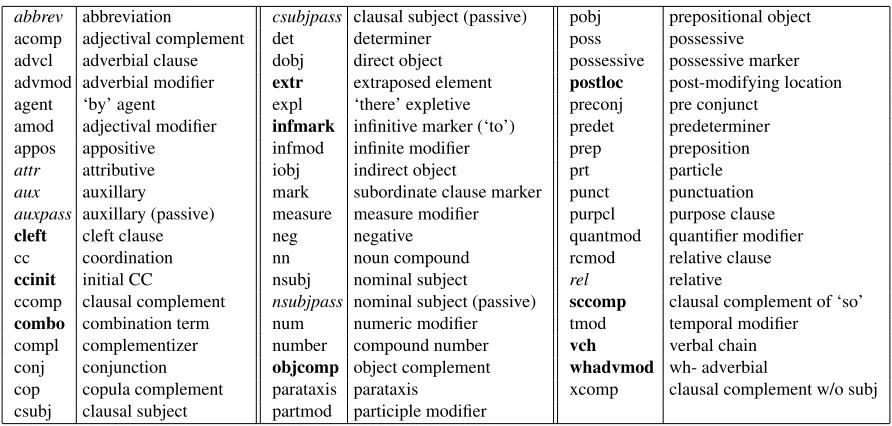
abbrev abbreviation csubjpass clausal subject (passive) pobj prepositional object acomp adjectival complement det determiner poss possessive advcl adverbial clause dobj direct object possessive possessive marker advmod adverbial modifier extr extraposed element postloc post-modifying location agent ‘by’ agent expl ‘there’ expletive preconj pre conjunct
amod adjectival modifier infmark infinitive marker (‘to’) predet predeterminer appos appositive infmod infinite modifier prep preposition
attr attributive iobj indirect object prt particle
aux auxillary mark subordinate clause marker punct punctuation auxpass auxillary (passive) measure measure modifier purpcl purpose clause
cleft cleft clause neg negative quantmod quantifier modifier
cc coordination nn noun compound rcmod relative clause
ccinit initial CC nsubj nominal subject rel relative
ccomp clausal complement nsubjpass nominal subject (passive) sccomp clausal complement of ‘so’
combo combination term num numeric modifier tmod temporal modifier compl complementizer number compound number vch verbal chain conj conjunction objcomp object complement whadvmod wh- adverbial
[image:3.612.83.529.69.282.2]cop copula complement parataxis parataxis xcomp clausal complement w/o subj csubj clausal subject partmod participle modifier
Table 1: Dependency scheme with differences versus basic Stanford dependencies highlighted. Bold indicates the relation does not exist in the Stanford scheme. Italics indicate the relation appears in Stanford’s scheme but not ours.
that ansubj,csubj, orauxis passive can easily be de-termined from the final tree. Stanford’saux depen-dencies are replaced using verbal chain (vch) links; conversion of these to Stanford-styleaux dependen-cies is also trivial as a post-processing step.3Theattr
dependency is excluded because it is redundant with thecoprelation due to different handling of copula, and the dependency scheme does not have anabbrev
label because this information is not provided by the Penn Treebank. The dependency scheme with dif-ferences with Stanford highlighted is presented in Table 1.
In addition to using a slightly different set of de-pendency names, a handful of relations, notablycop,
conj, andcc, are treated in a different manner. These differences are illustrated by Figure 1. The Stan-ford scheme’s treatment of copula may be one rea-son why dependency parsers have trouble learning and applying it. Normally, the head of the clause is a verb, but, under Stanford’s scheme, if the verb happens to be a copula, the complement of the cop-ula (cop) is treated as the head of the clause instead.
[image:3.612.321.535.340.443.2]3The parsing system includes an optional script that can con-vertvcharcs intoauxandauxpassand the subject relations into csubjpassandnsubjpass.
Figure 1: Example comparing Stanford’s (top) handling of copula and coordinating conjunctions with ours (bot-tom).
3.2 Conversion Process
(WH)?NP|NX|NML|NACFW|NML|NN*JJR$|#CD|FW QPJJ|NACJJSPRP ADJP RB[SR]VBG|DT|WP RB NP-S|SBAR|UCP|PP SINV|SBARQ|SQ UH VP|NP VB|VBP
ADJP|JJP NNS QP NN$|#JJ VBN VBG(AD|J)JPADVPJJR NP|NML JJS DT FW RBR RBS SBAR RB ADVP RB|RBR|JJ|JJRRBS FW ADVP TO CD IN NP|NML JJS NN
PRN S*VP NN*|NX|NML NPW*PP|IN ADJP|JJ ADVP RBNAC VP INTJ
QP $|#NNS NNCDJJ RB DT NCD QP INCCJJR JJS
SBARQ SQ S SBARQSINVFRAG
SQ VBZ VBD VBP VB MD*-PRD SQ VPFRAG X
UCP [QNVP]P|S*|UCP|NML|PR[NT]|RRC|NX|NAC|FRAG|INTJ|AD[JV]P|LST|WH*|X VP VBD|AUX VBN MD VBZ VB VBG VBP VPPOS*-PRD ADJP JJ NN NNS NP|NML
WHADJP CCJJWRB ADJP
WHADVP CC WRB|RB
X [QNVP]P|S*|UCP|NML|PR[NT]|RRC|NX|NAC|FRAG|INTJ|AD[JV]P|LST|WH*|X|CONJP
[image:4.612.72.536.74.238.2]LST LS:DT|NN|SYM
Figure 2: Modified head-finding rules. Underline indicates that the search is performed in a left-to-right fashion instead of the default right-to-left order. NML and JJP are both products of Vadas and Curran’s (2007) patch. Bold indicates an added or moved element; for the original rules, see the paper by Johansson and Nugues (2007).
in bold, are provided in Figure 2. Finally, an addi-tional script makes addiaddi-tional changes and converts the intermediate output into the dependency scheme. This dependency conversion has several advan-tages to it. Using the modified head-finding rules for Johansson and Nugues’ (2007) converter results in fewer buggy trees than were present in the CoNLL shared tasks, including fewer trees in which words are headed by punctuation marks. For sections 2– 21, there are far fewer generic dep/DEP relations (2,765) than with the Stanford conversion (34,134) or the CoNLL 2008 shared task conversion (23,811). Also, the additional conversion script contains vari-ous rules for correcting part-of-speech (POS) errors using the syntactic structure as well as additional rules for some specific word forms, mostly common words with inconsistent taggings. Many of these changes cover part-of-speech problems discussed by Manning (2011), including VBD/VBN, VBZ/NNS, NNP/NNPS, and IN/WDT/DT issues. In total, the script changes over 9,500 part-of-speech tags, with the most common change being to change preposi-tion tags (IN) into adverb tags (RB) for cases where there is no prepositional complement/object. The top fifteen of these changes are presented in Table 2. The conversion script contains a variety of ad-ditional rules for modifying the parse structure and fixing erroneous trees as well, including cases where one or more POS tags were incorrect and, as such, the initial dependency parse was flawed. Quick manual inspections of the changes suggested that the
vast majority are accurate.
In the final output from the conversion, the num-ber of sentences with one or more words dependent on non-projective arcs in sections 2–21 is 3,245— about 8.1% of the dataset. About 1.3% of this, or 556 of sentences, is due to the secondary conver-sion script, with sentences containing approximate currency amounts (e.g.,about $ 10) comprising the bulk of difference. For these, the quantifying text (e.g., about, over, nearly), is linked to the number following the currency symbol instead of to the cur-rency symbol as it was in the CoNLL 2008 task.
Original New # of changes
IN RB 1128
JJ NN 787
VBD VBN 601
RB IN 462
VBN VBD 441
NN JJ 409
NNPS NNP 405
IN WDT 388
VBG NN 223
DT IN 220
RB JJ 214
VB VBP 184
NN NNS 169
RB NN 157
NNS VBZ 148
[image:4.612.355.497.477.670.2]4 Parser
4.1 Algorithm
The parsing approach is based upon the non-directional easy-first algorithm recently presented by Goldberg and Elhadad (2010). Their original al-gorithm behaves as follows. For a sentence of length
n, the algorithm performs a total ofnsteps. In each
step, one of the unattached tokens is added as a child to one of its current neighbors and is then removed from the list of unprocessed tokens. When only one token remains unprocessed, it is designated as the root. Provided that only a constant number of po-tential attachments need to be re-evaluated after each step, which is the case if one restricts the context for feature generation to a constant number of neigh-boring tokens, the algorithm can be implemented to run in O(nlogn). However, since only O(n) dot
products must be calculated by the parser and these have a large constant associated with them, the run-ning time will rival O(n) parsers for any reasonable n, and, thus, a naive O(n2) implementation will be
nearly as fast as a priority queue implementation in practice.4
The algorithm has a couple potential advantages over standard shift-reduce style parsing algorithms. The first advantage is that performing easy ac-tions first may make the originally difficult deci-sions easier. The second advantage is that perform-ing parse actions in a more flexible order than left-to-right/right-to-left shift-reduce parsing reduces the chance of error propagation.
Unfortunately, the original algorithm does not support non-projective trees. To extend the algo-rithm to support non-projective trees, we introduce
move-right and move-left operations similar to the stack-to-bufferswapsproposed by Nivre (2009) for shift-reduce style parsing. Thus, instead of attaching a token to one of its neighbors at each step, the algo-rithm may instead decide to movea token past one of its neighbors. Provided that no node is allowed to be moved past a token in such a way that a previ-ousmoveoperation is undone, there can be at most O(n2)movesand the overall worst-case complexity
becomes O(n2logn). While theoretically slower,
this has a limited impact upon actual parsing times
4See Goldberg and Elhadad (2010) for more explanation.
in practice, especially for languages with relatively fixed word order such as English.5 Though
Gold-berg and Elhadad’s (2010) original implementation only supports unlabeled dependencies, the algorithm itself is in no way limited in this regard, and it is simple enough to add labeled dependency support by treating each dependency label as a specific type of attach operation (e.g., attach_as_nsubj), which is the method used by this implementation. Pseu-docode for the non-directional easy-first algorithm with non-projective support is given in Algorithm 1.
input :w1...wn, #the sentence
m, #the model
k, #the context width
actions, #the list of parse actions
φ, #the feature generator
output:tree#a collection of dependency arcs
words=copyOf(s);
stale=copyOf(s);
cache; #cache of action scores while |words| > 1do
forw∈staledo foract∈actionsdo
cache[w,act] =score(act,φ(w,...), m);
stale.remove(w);
best= arg max
a∈actions&valid(a),w∈words
cache[w, a]
ifisMove(best)then i=
words.index(getTokenToMove(best));
words.move(i,isMoveLeft(best)? -1 : 1);
else
arc=createArc(best);
tree.add(arc);
i=words.index(getChild(arc));
words.remove(i);
forx∈-k,...,kdo
stale.add(words.get(index+x));
returntree
Algorithm 1: Modified version of Goldberg and Elhadad’s (2010) Easy-First Algorithm with non-projective support.
4.2 Features
One of the key aspects of the parser is the complex set of features used. The feature set is based off the features used by Goldberg and Elhadad (2010) but has a significant number of extensions. Various feature templates are specifically designed to pro-duce features that help with several syntactic issues including preposition attachment, coordination, ad-verbial clauses, clausal complements, and relative clauses. Unfortunately, there is insufficient space in this paper to describe them all here. However, a list of feature templates will be provided with the parser download.
Several of the feature templates use unsupervised word clusters created with the Brown et al. (1992) hierarchical clustering algorithm. The use of this al-gorithm was inspired by Koo et al. (2008), who used the top branches of the cluster hierarchy as features. However, unlike Koo et al.’s (2008) parser, the fine-grained cluster identifiers are used instead of just the top 4-6 branches of the cluster hierarchy. The 175 word clusters utilized by the parser were created from the New York Times corpus (Sandhaus, 2008). Some examples from the clusters are presented in Figure 3. The ideal number of such clusters was not thoroughly investigated.
while where when although despite unless unlike ... why what whom whatever whoever whomever whence ... based died involved runs ended lived charged born ... them him me us himself themselves herself myself ... really just almost nearly simply quite fully virtually ... know think thought feel believe knew felt hope mean ... into through on onto atop astride Saturday/Early thru ... Ms. Mr. Dr. Mrs. Judge Miss Professor Officer Colonel ... John President David J. St. Robert Michael James George ... wife own husband brother sister grandfather beloved ... often now once recently sometimes clearly apparently ... everyone it everybody somebody anybody nobody hers ... around over under among near behind outside across ... Clinton Bush Johnson Smith Brown Williams King ... children companies women people men things students ...
Figure 3: High frequency examples from 15 of the Brown clusters.
4.3 Training
The parsing model is trained using a variant of the structured perceptron training algorithm used in the original Goldberg and Elhadad (2010)
implementa-tion. The general idea of the algorithm is to iterate over the sentences and, whenever the model predicts an incorrect action, update the model weights. Fol-lowing Goldberg and Elhadad, parameter averaging is used to reduce overfitting.
Our implementation varies slightly from that of Goldberg and Elhadad (2010). The difference is that, at any particular step for a given sentence, the algorithm continues to update the weight vector as long asanyinvalid action is scored higher thanany
valid action, not just the highest scoring valid ac-tion; unfortunately, this change significantly slowed down the training process. In early experiments, this change produced a slight improvement in accuracy though it also slowed training significantly. In later experiments using additional feature templates, this change ceased to have any notable impact on the overall accuracy, but it was kept anyway.6
The oracle used to determine whether amove op-eration should be considered legal during the train-ing phase is similar to Nivre et al.’s (2009) improved oracle based upon maximal projective subcompo-nents. As an additional restriction, during training,
moveactions were only considered valid either if no other action was valid or if the token to be moved already had all its children attached and moving it caused it to be adjacent to its parent. This fits with Nivre et al.’s (2009) intuition that it is best to delay word reordering as long as possible.
4.4 Speed Enhancements
To enhance the speed for practical use, the parser uses constraints based upon the part-of-speech tags of the adjacent word pairs to eliminate invalid de-pendencies from even being evaluated. A rela-tion is only considered between a pair of words if such a relation was observed in the training data between a pair of words with the same parts-of-speech (with the exception of the generic dep de-pendency, which is permitted between any POS tag pair). Early experiments utilizing similar constraints showed an improvement in parsing speed of about 16% with no significant impact on accuracy, regard-less of whether the constraints were enforced during training.
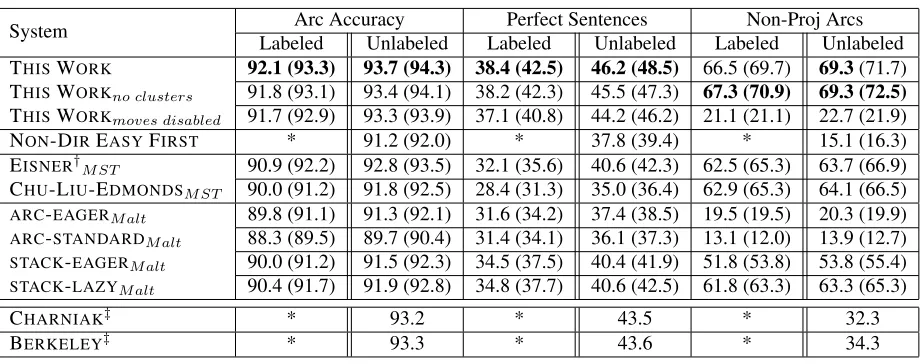
System LabeledArc AccuracyUnlabeled LabeledPerfect SentencesUnlabeled LabeledNon-Proj ArcsUnlabeled THISWORK 92.1 (93.3) 93.7 (94.3) 38.4 (42.5) 46.2 (48.5) 66.5 (69.7) 69.3(71.7)
THISWORKno clusters 91.8 (93.1) 93.4 (94.1) 38.2 (42.3) 45.5 (47.3) 67.3 (70.9) 69.3 (72.5)
THISWORKmoves disabled 91.7 (92.9) 93.3 (93.9) 37.1 (40.8) 44.2 (46.2) 21.1 (21.1) 22.7 (21.9)
NON-DIREASYFIRST * 91.2 (92.0) * 37.8 (39.4) * 15.1 (16.3) EISNER†M ST 90.9 (92.2) 92.8 (93.5) 32.1 (35.6) 40.6 (42.3) 62.5 (65.3) 63.7 (66.9) CHU-LIU-EDMONDSM ST 90.0 (91.2) 91.8 (92.5) 28.4 (31.3) 35.0 (36.4) 62.9 (65.3) 64.1 (66.5)
ARC-EAGERM alt 89.8 (91.1) 91.3 (92.1) 31.6 (34.2) 37.4 (38.5) 19.5 (19.5) 20.3 (19.9)
ARC-STANDARDM alt 88.3 (89.5) 89.7 (90.4) 31.4 (34.1) 36.1 (37.3) 13.1 (12.0) 13.9 (12.7)
STACK-EAGERM alt 90.0 (91.2) 91.5 (92.3) 34.5 (37.5) 40.4 (41.9) 51.8 (53.8) 53.8 (55.4)
STACK-LAZYM alt 90.4 (91.7) 91.9 (92.8) 34.8 (37.7) 40.6 (42.5) 61.8 (63.3) 63.3 (65.3)
CHARNIAK‡ * 93.2 * 43.5 * 32.3
[image:7.612.77.537.68.250.2]BERKELEY‡ * 93.3 * 43.6 * 34.3
Table 3: Parsing results for section 23 of the Penn Treebank (punctuation excluded). Results in parentheses were produced using gold POS tags. †Eisner (1996) algorithm with non-projective rewriting and second order features. ‡Results not directly comparable; see text.∗Labeled dependencies not available/comparable.
4.5 Evaluation
The following split of the Penn Treebank (Marcus, et al., 1993) was used for the experiments: sections 2–21 for training, 22 for development, and 23 for testing.
For part-of-speech (POS) tagging, we used an in-house SVM-based POS tagger modeled after the work of Giménez and Márquez (2004)7. The
train-ing data was tagged in a 10-fold fashion; each fold was tagged using a tagger trained from the nine re-maining folds. The development and test sections were tagged by an instance of the tagger trained us-ing the entire trainus-ing set. The full details of the POS tagger are outside the scope of this paper; it is included with the parser download.
The final parser was trained for 31 iterations, which is the point at which its performance on the development set peaked. One test run was per-formed with non-projectivity support disabled in or-der to get some idea of the impact of themove opera-tions on the parser’s overall performance; also, since the parsers used for comparison had no access to the unsupervised word clusters, an additional instance of the parser was trained with every word treated as belonging to the same cluster so as to facilitate a more fair comparison.
Seven different dependency parsing models were
797.42% accuracy on traditional POS evaluation (Penn Tree-bank WSJ sections 22-24).
trained for comparison using the following open source parsing packages: Goldberg and Elhadad’s (2010)’s non-directional easy-first parser, MALT
-PARSER (Nivre et al., 2006), and MSTPARSER
(McDonald and Pereira, 2006)8. The model trained
using Goldberg and Elhadad’s (2010) easy-first parser serves as something of a baseline. The four MALTPARSER parsing models used the arc-eager,arc-standard,stack-eager, andstack-lazy al-gorithms. One of the MSTPARSER models used
the Chu-Liu-Edmonds maximum spanning tree ap-proach, and the other used the Eisner (1996) al-gorithm with second order features and a non-projective rewriting post-processing step.
Unfortunately, it is not possible to directly com-pare the parser’s accuracy with most popular con-stituent parsers such as the Charniak (2000) and Berkeley (Petrov et al., 2006; Petrov and Klein, 2007) parsers9 both because they do not
The results of the experiment are given in Ta-ble 3, including accuracy for individual arcs, non-projective arcs only, and full sentence match. Punc-tuation is excluded in all the result computations. To determine whether an arc is non-projective, the fol-lowing heuristic was used. Traverse the sentence in a depth-first search, starting from the imaginary root node and pursuing child arcs in order of increasing absolute distance from their parent. Whenever an arc being traversed is found to cross a previously tra-versed arc, mark it as non-projective and continue. To evaluate the impact of part-of-speech tagging er-ror, results for parsing using the gold standard part-of-speech tags are also included.
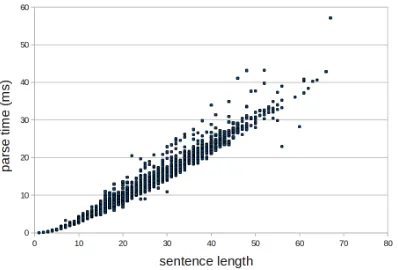
[image:8.612.329.528.315.450.2]We also measured the speed of the parser on the various sentences in the test collection. For reason-able sentence lengths, the parser scales quite well. The scatterplot depicting the relation between sen-tence length and parsing time is presented in Figure 5.
Figure 4: Parse times for Penn Treebank section 23 for the parsers on a PC with a 2.4Ghz Q6600 processor and 8GB RAM. MALTPARSERran substantially slower than the others, perhaps due to its use of polynomial kernels, and isn’t shown. (CLE ChuLiuEdmonds, G&E -Goldberg and Elhadad (2010)).
4.5.1 Results Discussion
The parser achieves 92.1% labeled and 93.7% un-labeled accuracy on the evaluation, a solid result and about 2.5% higher than the original easy-first imple-mentation of Goldberg and Elhadad (2010). Further-more, the parser processed the entire test section in
8Versions 1.4.1, 0.4.3b, and 0.2, respectively 9Versions 1.1 and 05Aug16, respectively
just over 30 seconds—a rate of over 75 sentences per second, substantially faster than most of the other parsers.
Not surprisingly, the results for non-projective arcs are substantially lower than the results for all arcs, and the systems that are designed to handle them outperformed the strictly projective parsers in this regard.
The negative effect of part-of-speech tagging er-ror appears to impact the different parsers about the same amount, with a loss of .6% to .8% in unlabeled accuracy and 1.1% to 1.3% in labeled accuracy.
The 93.2% and 93.3% accuracy scores achieved by the Charniak and Berkeley parsers are not too different from the 93.7% result, but, of course, it is important to remember that these scores are not di-rectly comparable.
Figure 5: Sentence length versus parse time. Median times for five runs over section 23.
5 Shallow Semantic Annotation
To create a more informative parse, the parser in-cludes four optional modules, a preposition sense disambiguation (PSD) system, a work-in-progress
’s-possessive interpretation system, a noun com-pound interpretation system, and a PropBank-based semantic role labeling system10. Taken together,
these integrated modules enable the parsing sys-tem to produce substantially more informative out-put than a traditional parser.
Preposition Sense Disambiguation The PSD system is a newer version of the system described
[image:8.612.76.298.354.495.2]by Tratz and Hovy (2009) and Hovy et al. (2010); it achieves 85.7% accuracy on the SemEval-2007 fine-grain PSD task (Litkowski and Hargraves, 2007), which is a statistically significant (p<=0.05;
upper-tailed z test) increase over the previous best reported result for this dataset, Hovy et al.’s (2010) 84.8%.
Noun Compound InterpretationThe noun com-pound interpretation system is a newer version of the system described by Tratz and Hovy (2010) with similar accuracy (79.6% vs 79.3% using 10-fold cross-validation11).
Possessives InterpretationThe possessive inter-pretation system assigns interinter-pretations to ’s pos-sessives (e.g., John’s arm → PART-OF, Mowgli’s
capture → PATIENT/THEME). The current system
achieves over 85.0% accuracy, but it is important to note that the annotation scheme, automatic classifier, and dataset are all still under active development.
PropBank SRL The PropBank-based semantic role labeling system achieves 86.8 combined F1
measure for automatically-generated parse trees cal-culated over both predicate disambiguation and ar-gument/adjunct classification (89.5 F1 on predicate
disambiguation, 85.6 F1 on argument and adjuncts
corresponding to dependency links, and 86.8 F1);
this score is not directly comparable to any previ-ous work due to some differences, including differ-ences in both the parse tree conversion and the Prop-Bank conversion. The most similar work is that of the CoNLL shared task work (Surdeanu et al., 2008; Hajiˇc et al., 2009).
6 Related Work
Non-projectivity. There are two main approaches used in recent NLP literature for handling non-projectivity in parse trees. The first is to use an al-gorithm, like the one presented in this paper, that has inherent support for non-projective trees. Ex-amples of this include the Chu-Liu-Edmonds’ ap-proach for maximum spanning tree (MST) parsing (McDonald et al., 2005) and Nivre’s (2009) swap-based reordering method for shift-reduce parsing. The second approach is to create an initial projec-tive parse and then apply transformations to
intro-11These accuracy figures are higher than what should be ex-pected for unseen datasets; see Tratz and Hovy (2010) for more detail.
duce non-projectivity into it. Examples of this in-clude McDonald and Pereira’s (2006) rewriting of projective trees produced by the Eisner (1996) al-gorithm, and Nivre and Nilsson’s (2005) pseudo-projective approach that creates pseudo-projective trees with specially marked arcs that are later transformed into non-projective dependencies.
Descriptive dependency labels. While most re-cent dependency parsing research has used either vague labels, such as those of the CoNLL shared tasks, or no labels at all, some descriptive depen-dency label schemes exist. By far the most promi-nent of these is the Stanford typed dependency scheme (de Marneffe and Manning, 2008). An-other descriptive scheme that exists, but which is less widely used in the NLP community, is the one used by Tapanainen and Järvinen’s parser (1997). Unfortunately, the Stanford dependency conversion of the Penn Treebank has proven difficult to learn for current dependency parsers (Cer et al., 2010), and there is no publicly available dependency conversion according to Tapanainen and Järvinen’s scheme.
Faster parsing. While the fastest reasonable parsing algorithms are the O(n) shift-reduce
algo-rithms, such as Nivre’s (2003) algorithm and an ex-pected linear time dynamic programming approach presented by Huang and Sagae (2010), a few other fast alternatives exist. Goldberg and Elhadad’s (2010) easy-first algorithm is one such example. An-other example, is Roark and Hollingshead’s (2009) work that uses chart constraints to achieve linear time complexity for constituency parsing.
Effective features for parsing.A variety of work has investigated the use of more informative fea-tures for parsing. This includes work that inte-grates second and even third order features (McDon-ald et al., 2006; Carreras, 2007; Koo and Collins, 2010). Also, some work has incorporated unsuper-vised word clusters as features, including that of Koo et al. (2008) and Suzuki et al. (2009), who utilized unsupervised word clusters created using the Brown et al. (1992) hierarchical clustering algorithm.
encour-age the development of parsers with additional se-mantic annotation. These tasks relied upon Prop-Bank (2005) and NomProp-Bank (2004) for the seman-tic roles. A variety of other systems have focused on FrameNet-based (1998) SRL instead, including those that participated in the SemEval-2007 Task 19 (Baker et al., 2007) and work by Das et al. (2010).
7 Conclusion
In this paper, we have described a new high-quality dependency tree conversion of the Penn Treebank (Marcus, et al., 1993) along with its labeled depen-dency scheme and presented a parser that is fast, ac-curate, supports non-projective trees and provides rich output, including not only informative depen-dency labels similar to Stanford’s but also additional semantic annotation for prepositions, possessives, and noun compound relations. We showed how the easy-first algorithm of Goldberg and Elhadad (Gold-berg and Elhadad, 2010) can be extended to support non-projective trees by addingmoveactions similar to Nivre’s (2009) swap-based reordering for shift-reduce parsing and evaluated our parser on the stan-dard test section of the Penn Treebank, comparing with several other freely available parsers.
The Penn Treebank conversion process fixes a number of buggy trees and part-of-speech tags and produces dependency trees with a relatively small percentage of generic dep dependencies. The ex-perimental results show that dependency parsers can generally produce Stanford-granularity labels with high accuracy when using the new dependency con-version of the Penn Treebank, something which, ac-cording to the findings of Cer et al. (2010), does not appear to be the case when training and testing dependency parsers on the Stanford conversion.
The parser achieves high labeled and unlabeled accuracy in the evaluation, 92.1% and 93.7%, re-spectively. The 93.7% result represents a 2.5% in-crease over the accuracy of Goldberg and Elhadad’s (2010) implementation. Also, the parser proves to be quite fast, processing section 23 of the Penn Tree-bank in just over 30 seconds (a rate of over 75 sen-tences per second).
The parsing system is capable of not only produc-ing fine-grained dependency relations, but can also produce shallow semantic annotations for
preposi-tions, possessives, and noun compounds by using several optional integrated modules. The preposi-tion sense disambiguapreposi-tion (PSD) module achieves 85.7% accuracy on the SemEval-2007 PSD task, ex-ceeding the previous best published result of 84.8% by a statistically significant margin, the possessives module is over 85% accurate, the noun compound interpretation module achieves 79.6% accuracy on Tratz and Hovy’s (2010) dataset. The PropBank SRL module achieves 89.5 F1 on predicate
disam-biguation and 85.6 F1on argument and adjuncts
cor-responding to dependency links, for an overall F1of
86.8. Combined with the core parser, these modules allow the system to produce a substantially more in-formative textual analysis than a standard parser.
8 Future Work
There are a variety of ways to extend and improve upon this work. We would like to change our han-dling of coordinating conjunctions to treat the co-ordinating conjunction as the head because this has fewer ambiguities than the current approach and also add the ability to produce traces for WH- words. It would also be interesting to examine the impact on final parsing accuracy of the various differences be-tween our dependency conversion and Stanford’s.
To aid future NLP research work, the code, including the treebank converter, part-of-speech tagger, parser, and semantic annotation add-ons, will be made publicly available for download via http://www.isi.edu.
Acknowledgements
We would like to thank Richard Johansson for providing us with the code for the pennconverter
consituent-to-dependency converter. We would also like to thank Dirk Hovy and Anselmo Peñas for many valuable dicussions and suggestions.
References
Collin Baker, and Michael Ellsworth and Katrin Erk. 2007. SemEval’07 task 19: Frame Semantic Structure Extraction. InProc. of the 4th International Workshop on Semantic Evaluations
17th international conference on Computational lin-guistics
Adam L. Berger, Vincent J. Della Pietra, and Stephen A. Della Pietra. 1996. A maximum entropy approach to natural language processing. In Computational Lin-guistics22(1):39–71
Peter F. Brown, Peter V. deSouza, Robert L. Mercer, Vin-cent J. Della Pietra, and Jenifer C. Lai. 1992. Class-Based n-gram Models of Natural Language. Compu-tational Linguistics 18(4):467–479.
Sabine Buchholz and Erwin Marsi. 2006. CoNLL-X shared task on multilingual dependency parsing. In
Proc. of CoNLL 2006.
Xavier Carreras. 2007. Experiments with a Higher-Order Projective Dependency Parser. InProc. of the CoNLL Shared Task Session of EMNLP-CoNLL 2007. Daniel Cer, Marie-Catherine de Marneffe, Daniel Juraf-sky, and Christopher D. Manning. 2010. Parsing to Stanford Dependencies: Trade-offs between speed and accuracy. InProc. of LREC 2010.
Eugene Charniak. 2000. A Maximum-Entropy-Inspired Parser. InProc. of NAACL 2000.
Eugene Charniak and Mark Johnson. 2005. Coarse-to-find-grainedn-best parsing and discriminative rerank-ing. InProc. of ACL 2005.
Michael A. Covington. 2001. A Fundamental Algorithm for Dependency Parsing. InProc. of the 39th Annual ACM Southeast Conference.
Dipanjan Das, Nathan Schneider, Desai Chen, and Noah A. Smith. 2010. Probabilistic Frame-Semantic Pars-ing. InProc. of HLT-NAACL 2010.
Marie-Catherine de Marneffe and Christopher D. Man-ning. 2008. The Stanford typed dependencies repre-sentation. InCOLING Workshop on Cross-framework and Cross-domain Parser Evaluation.
Jason Eisner. 1996. Three New Probabilistic Models for Dependency Parsing: An Exploration. InProc. of COLING 1996.
Christiane Fellbaum. 1998. WordNet: An Electronic Lexical Database. MIT Press.
Daniel Gildea and Daniel Jurafsky. 2002. Automatic la-beling of semantic roles. Computational Linguistics. 28(3):245–288.
Jesús Giménez and Lluís Márquez 2004. SVMTool: A General POS Tagger Generator Based on Support Vec-tor Machines. InProc. of LREC 2004.
Yoav Goldberg and Michael Elhadad. 2010. An Ef-ficient Algorithm for Easy-First Non-Directional De-pendency Parsing. InHuman Language Technologies: The 2010 Annual Conference of the North American Chapter of the ACL.
Yoav Goldberg and Michael Elhadad. 2009. The CoNLL-2009 Shared Task: Syntactic and Semantic Dependencies in Multiple Languages. In Proc. of the Thirteenth Conference on Computational Natural Language Learning: Shared Task.
Dirk Hovy, Stephen Tratz, and Eduard Hovy. 2010. What’s in a Preposition?—Dimensions of Sense Dis-ambiguation for an Interesting Word Class. InProc. of COLING 2010.
Liang Huang and Kenji Sagae. 2010. Dynamic Program-ming for Linear-Time Shift-Reduce Parsing. InProc. of ACL 2010.
Richard Johansson and Pierre Nugues. 2007. Extended constituent-to-dependency conversion for english. In
Proc. of NODALIDA.
Terry Koo, Xavier Carreras, and Michael Collins. 2008. Simple Semi-supervised Dependency Parsing. In
Proc. of ACL 2008.
Terry Koo and Michael Collins. 2010. Efficient Third-order Dependency Parsers. InProc. of ACL 2010. Ken Litkowski and Orin Hargraves. 2007.
SemEval-2007 Task 06: Word-Sense Disambiguation of Prepo-sitions. InProc. of the 4th International Workshop on Semantic Evaluations.
Christopher D. Manning. 2011. Part-of-Speech Tagging from 97% to 100%: Is It Time for Some Linguistics? InProc. of the 12th International Conference on Intel-ligent Text Processing and Computational Linguistics (CICLing 2011).
Mitchell P. Marcus, Mary Ann Marcinkiewicz, and Beat-rice Santorini. 1993. Building a large annotated cor-pus of English: the Penn TreeBank. Computational Linguistics, 19(2):313–330.
Ryan McDonald, Fernando Pereira, Kiril Ribarov, and Jan Hajiˇc. 2005. Non-Projective Dependency Parsing Using Spanning Tree Algorithms. In Proc. of HLT-EMNLP 2005.
Ryan McDonald and Fernando Pereira. 2006. Online Learning of Approximate Dependency Parsing Algo-rithms. InProc. of EACL 2006.
Adam Meyers, Ruth Reeves, Catherine Macleod, Rachel Szekely, Veronika Zielinska, Brian Young and Ralph Grishman. 2004. The NomBank Project: An Interim Report. In Proc. of the NAACL/HLT Workshop on Frontiers in Corpus Annotation.
Joakim Nivre. 2009. Non-Projective Dependency Pars-ing in Expected Linear Time. InProc. of the 47th An-nual Meeting of the ACL and the 4th IJCNLP of the AFNLP.
Joakim Nivre. 2003. An Efficient Algorithm for Projec-tive Dependency Parsing. InProc. of the 8th Interna-tional Workshop on Parsing Technologies (IWPT). Joakim Nivre, Marco Kuhlmann, and Johan Hall. 2009.
An Improved Oracle for Dependency Parsing with On-line Reordering. In Proc. of the 11th International Conference on Parsing Technologies (IWPT).
Joakim Nivre, Johan Hall, and Jens Nilsson. 2006. Malt-Parser: A Data-Driven Parser-Generator for Depen-dency Parsing. InProc. of LREC 2006.
Joakim Nivre and Jens Nilsson. 2005. Pseudo-projective dependency parsing. InProc. of ACL-2005.
Martha Palmer, Daniel Gildea, and Paul Kingsbury. 2005. The Proposition Bank: An Annotated Cor-pus of Semantic Roles. InComputational Linguistics. 31(1):71–106.
Slav Petrov and Dan Klein. 2007. Improved Inference for Unlexicalized Parsing. In Proc. of HLT-NAACL 2007.
Slav Petrov, Leon Barrett, Romain Thibaux, and Dan Klein. 2006. Learning accurate, compact, and in-terpretable tree annotation. InProc. of COLING-ACL 2006.
Brian Roark and Kristy Hollingshead. 2009. Linear complexity context-free parsing pipelines via chart constraints. InProc. of HLT-NAACL.
Evan Sandhaus. 2008. The New York Times Annotated Corpus. Linguistic Data Consortium, Philadelphia. Mihai Surdeanu, Richard Johansson, Adam Meyers,
Lluís Màrquez, and Joakim Nivre. 2008. The CoNLL-2008 shared task on joint parsing of syntactic and se-mantic dependencies. InProc. of the Twelfth Confer-ence on Computational Natural Language Learning. Jun Suzuki, Hideki Isozaki, Xavier Carrerras, and
Michael Collins. 2009. An Empirical Study of Semi-supervised Structured Conditional Models for Depen-dency Parsing. InProc. of EMNLP.
Pasi Tapanainen and Timo Järvinen. 1997. A non-projective dependency parser. InProc. of the fifth con-ference on applied natural language processing. Stephen Tratz and Dirk Hovy. 2009. Disambiguation of
Preposition Sense using Linguistically Motivated Fea-tures. InProc. of Human Language Technologies: The 2009 Annual Conference of the North American Chap-ter of the Association for Computational Linguistics, Companion Volume: Student Research Workshop and Doctoral Consortium.
Stephen Tratz and Eduard Hovy. 2010. A Taxonomy, Dataset, and Classifier for Automatic Noun Com-pound Interpretation. InProc. of ACL 2010.
David Vadas and James R. Curran. 2007. Adding Noun Phrase Structure to the Penn Treebank. In Proc. of ACL 2007.