Constraints based Taxonomic Relation Classification
Quang Xuan Do Dan Roth Department of Computer Science University of Illinois at Urbana-Champaign
Urbana, IL 61801, USA
{quangdo2,danr}@illinois.edu
Abstract
Determining whether two terms in text have an ancestor relation (e.g. Toyotaandcar) or a sibling relation (e.g. ToyotaandHonda) is an essential component of textual inference in NLP applications such as Question Answer-ing, Summarization, and Recognizing Textual Entailment. Significant work has been done on developing stationary knowledge sources that could potentially support these tasks, but these resources often suffer from low cover-age, noise, and are inflexible when needed to support terms that are not identical to those placed in them, making their use as general purpose background knowledge resources dif-ficult. In this paper, rather than building a sta-tionary hierarchical structure of terms and re-lations, we describe a system that, given two terms, determines the taxonomic relation be-tween them using a machine learning-based approach that makes use of existing resources. Moreover, we develop a global constraint opti-mization inference process and use it to lever-age an existing knowledge base also to enforce relational constraints among terms and thus improve the classifier predictions. Our exper-imental evaluation shows that our approach significantly outperforms other systems built upon existing well-known knowledge sources.
1 Introduction
Taxonomic relations that are read off of structured ontological knowledge bases have been shown to play important roles in many computational linguis-tics tasks, such as document clustering (Hotho et al., 2003), navigating text databases (Chakrabarti et
al., 1997), Question Answering (QA) (Saxena et al., 2007) and summarization (Vikas et al., 2008). It is clear that the recognition of taxonomic relation between terms in sentences is essential to support textual inference tasks such as Recognizing Textual Entailment (RTE) (Dagan et al., 2006). For
exam-ple, it may be important to know that a blue
Toy-ota is neither a red Toyota nor a blue Honda, but
that all are cars, and even Japanese cars. Work in Textual Entailment has argued quite convincingly (MacCartney and Manning, 2008; MacCartney and Manning, 2009) that many such textual inferences are largely compositional and depend on the ability to recognize some basic taxonomic relations such as the ancestor or sibling relations between terms. To date, these taxonomic relations can be read off manually generated ontologies such as Wordnet that explicitly represent these, and there has also been some work trying to extend the manually built re-sources using automatic acquisition methods result-ing in structured knowledge bases such as the Ex-tended WordNet (Snow et al., 2006) and the YAGO ontology (Suchanek et al., 2007).
However, identifying when these relations hold using fixed stationary hierarchical structures may be impaired by noise in the resource and by uncer-tainty in mapping targeted terms to concepts in the structures. In addition, for knowledge sources de-rived using bootstrapping algorithms and distribu-tional semantic models such as (Pantel and Pen-nacchiotti, 2006; Kozareva et al., 2008; Baroni and Lenci, 2010), there is typically a trade-off between precision and recall, resulting either in a relatively accurate resource with low coverage or a noisy
source with broader coverage. In the current work, we take a different approach, identifying directly whether a pair of terms hold a taxonomic relation.
Fixed resources, as we observe, are inflexible when dealing with targeted terms not being cov-ered. This often happens when targeted terms have the same meaning, but different surface forms, than
the terms used in the resources (e.g. Toyota Camry
andCamry). We argue that it is essential to have a classifier that, given two terms, can build a semantic representation of the terms and determines the tax-onomic relations between them. This classifier will make use of existing knowledge bases in multiple ways, but will provide significantly larger coverage and more precise results. We make use of a dynamic resource such as Wikipedia to guarantee increased coverage without changing our model and also per-form normalization-to-Wikipedia to find appropri-ate Wikipedia replacements for outside-Wikipedia terms. Moreover, stationary resources are usually brittle because of the way most of them are built: using local relational patterns (e.g. (Hearst, 1992; Snow et al., 2005)). Infrequent terms are less likely to be covered, and some relations may not be sup-ported well by these methods because their cor-responding terms rarely appear in close proximity
(e.g., an Israeli tennis player Dudi Selaand Roger
Federrer). Our approach uses search techniques to gather relevant Wikipedia pages of input terms and performs a learning-based classification w.r.t. to the features extracted from these pages as a way to get around this brittleness.
Motivated by the needs of NLP applications such as RTE, QA, Summarization, and the composition-ality argument alluded to above, we focus on identi-fying two fundamental types of taxonomic relations -ancestor andsibling. An ancestor relation and its directionality can help us infer that a statement with
respect to the child (e.g. cannabis) holds for an
ancestor (e.g. drugs) as in the following example,
taken from a textual entailment challenge dataset:
T: Nigeria’s NDLEA has seized 80 metric tonnes ofcannabis in one of its largest ever hauls, officials say.
H: Nigeria seizes 80 tonnes ofdrugs.
Similarly, it is important to know of a sibling
re-lation to infer that a statement about Taiwan may
(without additional information) contradict a
simi-lar statement with respect toJapan since these are
different countries, as in the following:
T: A strong earthquake struck off the southern tip ofTaiwanat 12:26 UTC, triggering a warn-ing from Japan’s Meteorological Agency that a 3.3 foot tsunami could be heading towards Basco, in the Philippines.
H: An earthquake strikesJapan.
Several recent TE studies (Abad et al., 2010; Sam-mons et al., 2010) suggest to isolate TE phenomena, such as recognizing taxonomic relations, and study them separately; they discuss some of characteristics of phenomena such as contradiction from a similar perspective to ours, but do not provide a solution.
In this paper, we present TAxonomic RElation
Classifier (TAREC), a system that classifies
taxo-nomic relations between a given pair of terms us-ing a machine learnus-ing based classifier. An inte-gral part of TAREC is also our inference model that makes use of relational constraints to enforce co-herency among several related predictions. TAREC does not aim at building or extracting a hierarchi-cal structure of concepts and relations, but rather to directly recognize taxonomic relations given a pair of terms. Target terms are represented using vector of features that are extracted from retrieved corre-sponding Wikipedia pages. In addition, we make use of existing stationary ontologies to find related terms to the target terms, and classify those too. This allows us to make use of a constraint-based infer-ence model (following (Roth and Yih, 2004; Roth and Yih, 2007) that enforces coherency of decisions
across related pairs (e.g., ifxis-ayandy is-az, it
cannot be thatxis a sibling ofz).
In the rest of the paper, after discussing re-lated work in Section 2, we present an overview of TAREC in Section 3. The learning component and the inference model of TAREC are described in Sec-tions 4 and 5. We experimentally evaluate TAREC in Section 6 and conclude our paper in Section 7.
2 Related Work
con-structed classifiers to identify hypernym relation-ship between terms from dependency trees of large
corpora. Terms with recognized hypernym
rela-tion are extracted and incorporated into a man-made lexical database, WordNet (Fellbaum, 1998),
re-sulting in the extended WordNet, which has been
augmented with over 400,000 synsets. (Ponzetto
and Strube, 2007) and (Suchanek et al., 2007) both mined Wikipedia to construct hierarchical structures
of concepts and relations. While the former
ex-ploited Wikipedia category system as a conceptual network and extracted a taxonomy consisting of
sub-sumption relations, the latter presented the YAGO
ontology, which was automatically constructed by mining and combining Wikipedia and WordNet. A natural way to use these hierarchical structures to support taxonomic relation classification is to map targeted terms onto the hierarchies and check if they subsume each other or share a common sub-sumer. However, this approach is limited because constructed hierarchies may suffer from noise and require exact mapping (Section 6). TAREC over-comes these limitations by searching and selecting the top relevant articles in Wikipedia for each input term; taxonomic relations are then recognized based on the features extracted from these articles.
On the other hand, information extraction boot-strapping algorithms, such as (Pantel and Pennac-chiotti, 2006; Kozareva et al., 2008), automatically harvest related terms on large corpora by starting
with a few seeds of pre-specified relations (e.g.
is-a, part-of). Bootstrapping algorithms rely on some scoring function to assess the quality of terms and additional patterns extracted during bootstrapping it-erations. Similarly, but with a different focus, Open IE, (Banko and Etzioni, 2008; Davidov and Rap-poport, 2008), deals with a large number of relations which are not pre-specified. Either way, the out-put of these algorithms is usually limited to a small number of high-quality terms while sacrificing cov-erage (or vice versa). Moreover, an Open IE sys-tem cannot control the extracted relations and this is essential when identifying taxonomic relations. Re-cently, (Baroni and Lenci, 2010) described a gen-eral framework of distributional semantic models that extracts significant contexts of given terms from large corpora. Consequently, a term can be repre-sented by a vector of contexts in which it frequently
appears. Any vector space model could then use the terms’ vectors to cluster terms into categories.
Sib-ling terms (e.g.Honda,Toyota), therefore, have very
high chance to be clustered together. Nevertheless, this approach cannot recognize ancestor relations. In this paper, we compare TAREC with this frame-work only on recognizing sibling vs. no relation, in a strict experimental setting which pre-specifies the categories to which the terms belong.
3 An Overview of the TAREC Algorithm
3.1 Preliminaries
In the TAREC algorithm, atermrefers to any
men-tion in text, such asmountain,George W. Bush,
bat-tle of Normandy. TAREC does not aim at extracting terms and building a stationary hierarchical structure of terms, but rather recognize the taxonomic relation between any two given terms. TAREC focuses on classifying two fundamental types of taxonomic
re-lations: ancestor andsibling. Determining whether
two terms hold a taxonomic relation depends on a pragmatic decision of how far one wants to climb up a taxonomy to find a common subsumer. For exam-ple,George W. Bush is a child ofPresidents of the United Statesas well aspeople, even more, that term
could also be considered as a child ofmammalsor
organismsw.r.t. the Wikipedia category system; in
that sense,George W. Bushmay be considered as a
sibling ofoakbecause they haveorganismsas a least
common subsumer. TAREC makes use of a hierar-chical structure as background knowledge and con-siders two terms to hold a taxonomic relation only if the relation can be recognized from information
acquired by climbing up at mostK levels from the
representation of the target terms in the structure. It is also possible that the sibling relation can be rec-ognized by clustering terms together by using vector space models. If so, two terms are siblings if they belong to the same cluster.
To cast the problem of identifying taxonomic
rela-tions between two termsxandyin a machine
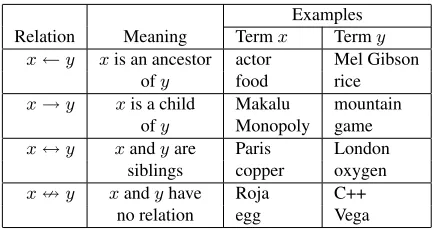
learn-ing perspective, we model it as a multi-class classi-fication problem. Table 1 defines four relations with some examples in our experiment data sets.
is-Examples Relation Meaning Termx Termy
x←y xis an ancestor actor Mel Gibson
ofy food rice
x→y xis a child Makalu mountain ofy Monopoly game x↔y xandyare Paris London
siblings copper oxygen x=y xandyhave Roja C++
no relation egg Vega
Table 1: Taxonomic relations and some examples in our data sets.
sues of how to take contexts into account and how it should be used in applications to a future work.
3.2 The Overview of TAREC
Assume that we already have a learned local clas-sifier that can classify taxonomic relations between
any two terms. Given two terms, TAREC uses
Wikipedia and the local classifier in an inference model to make a final prediction on the taxonomic relation between these two. To motivate the need for an inference model, beyond the local classifier itself, we observe that the presence of other terms in addi-tion to the two input terms, can provide some natural constraints on the possible taxonomic relations and thus can be used to make the final prediction (which we also refer as global prediction) more coherent. In practice, we first train a local classifier (Section 4), then incorporate it into an inference model (Section 5) to classify taxonomic relations between terms. The TAREC algorithm consists of three steps and is summarized in Figure 1 and explained below.
1. Normalizing input terms to Wikipedia: Al-though most commonly used terms have corre-sponding Wikipedia articles, there are still a lot of terms with no corresponding Wikipedia articles. For a non-Wikipedia term, we make an attempt to find a replacement by using Web search. We wish to find a replacement such that the taxonomic relation
is unchanged. For example, for input pair (Lojze
Kovaˇciˇc,Rudi ˇSeligo), there is no English Wikipedia
page forLojze Kovaˇciˇc, but if we can find Marjan
Roˇzancand use it as a replacement ofLojze Kovaˇciˇc
(two terms are siblings and refer to two writers), we can continue classifying the taxonomic relation of
the pair (Marjan Roˇzanc, Rudi ˇSeligo). This part
of the algorithm was motivated by (Sarmento et al.,
TAxonomic RElation Classifier (TAREC)
INPUT: A pair of terms (x,y)
A learned local classifierR(Sec. 4) WikipediaW
OUTPUT: Taxonomic relationr∗betweenxandy
1. (x, y)←NormalizeToWikipedia(x, y,W) 2. Z ←GetAddionalTerms(x, y)(Sec. 5.2)
[image:4.612.77.298.53.168.2]3. r∗=ClassifyAndInference(x, y,Z,R,W)(Sec. 5.1) RETURN:r∗;
Figure 1: The TAREC algorithm.
2007). We first make a query with the two input
terms (e.g. “Lojze Kovaˇciˇc” AND “Rudi ˇSeligo”)
to search for list-structure snippets in Web
docu-ments1 such as “... hdelimiteri ca hdelimiteri cb
hdelimitericchdelimiteri...” (the two input terms
should be among ca, cb, cc, ...). The delimiter could
be commas, periods, or asterisks2. For snippets that
contain the patterns of interest, we extractca,cb,cc
etc. as replacement candidates. To reduce noise, we empirically constrain the list to contain at least 4 terms that are no longer than 20 characters each. The candidates are ranked based on their occurrence frequency. The top candidate with Wikipedia pages is used as a replacement.
2. Getting additional terms (Section 5.2): TAREC leverage an existing knowledge base to extract addi-tional terms related to the input terms, to be used in the inference model in step 3.
3. Making global prediction with relational con-straints (Section 5.1): TAREC performs several
lo-cal predictions using the lolo-cal classifierR(Section
4) on the two input terms and these terms with the additional ones. The global prediction is then in-ferred by enforcing relational constraints among the terms’ relations.
4 Learning Taxonomic Relations
The local classifier of TAREC is trained on the pairs of terms with correct taxonomic relation labels (some examples are showed in Table 1). The trained classifier when applied on a new input pair of terms will return a real valued number which can be inter-preted as the probability of the predicted label. In this section, we describe the learning features used
1
We use http://developer.yahoo.com/search/web/ 2
Title/Term Text Categories
President of the United States
The President of the United States is the head of state and head of government of the United States and is the highest political official in the United States by influence and recognition. The President leads the executive branch of the federal government and is one of only two elected members of the executive branch...
Presidents of the United States, Presidency of the United States
George W. Bush
George Walker Bush; born July 6, 1946) served as the 43rd President of the United States from 2001 to 2009. He was the 46th Governor of Texas from 1995 to 2000 before being sworn in as President on January 20, 2001...
Children of Presidents of the United States, Gov-ernors of Texas, Presidents of the United States, Texas Republicans...
Gerald Ford Gerald Rudolff Ford (born Leslie Lynch King, Jr.) (July 14, 1913 December 26, 2006) was the 38th President of the United States, serving from 1974 to 1977, and the 40th Vice President of the United States serving from 1973 to 1974.
[image:5.612.79.534.52.131.2]Presidents of the United States, Vice Presidents of the United States, Republican Party (United States) presidential nominees...
Table 2: Examples of texts and categories of Wikipedia articles.
by our local taxonomic relation classifier.
Given two input terms, we first build a semantic representation for each term by using a local search
engine3to retrieve a list of top articles in Wikipedia
that are relevant to the term. To do this, we use the following procedure: (1) Using both terms to make a
query (e.g.“George W. Bush”AND“Bill Clinton”)
to search in Wikipedia ; (2) Extracting important keywords in the titles and categories of the retrieved
articles using TF-IDF (e.g.president,politician); (3)
Combining each input term with the extracted
key-words (e.g. “George W. Bush” AND “president”
AND “politician”) to create a final query used to search for the term’s relevant articles in Wikipedia. This is motivated by the assumption that the real world applications calling TAREC typically does so with two terms that are related in some sense, so our procedure is designed to exploit that. For example,
it’s more likely that term Ford in the pair (George
W. Bush,Ford) refers to the former president of the
United States,Gerald Ford, than the founder of Ford
Motor Company,Henry Ford.
Once we have a semantic representation of each term, in the form of the extracted articles, we extract from it features that we use as the representation of the two input terms in our learning algorithm. It is worth noting that a Wikipedia page usually consists of a title (i.e. the term), a body text, and a list of categories to which the page belongs. Table 2 shows
some Wikipedia articles. From now on, we usethe
titles ofx,the texts of x, andthe categories ofxto refer to the titles, texts, and categories of the
asso-ciated articles in the representation ofx. Below are
the learning features extracted for input pair (x,y).
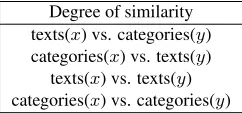
Bags-of-words Similarity: We use cosine simi-larity metric to measure the degree of simisimi-larity be-tween bags of words. We define four bags-of-words features as the degree of similarity between the texts
3
E.g. http://lucene.apache.org/
Degree of similarity texts(x) vs. categories(y) categories(x) vs. texts(y)
texts(x) vs. texts(y) categories(x) vs. categories(y)
Table 3: Bag-of-word features of the pair of terms (x,y); texts(.) and categories(.) are two functions that extract associated texts and categories from the semantic repre-sentation ofxandy.
and categories associated with two input termsxand
yin Table 3. To collect categories of a term, we take
the categories of its associated articles and go upK
levels in the Wikipedia category system. In our ex-periments, we use abstracts of Wikipedia articles in-stead of whole texts.
Association Information: This features repre-sents a measure of association between the terms by considering their information overlap. We cap-ture this feacap-ture by the pointwise mutual informa-tion (pmi) which quantifies the discrepancy between the probability of two terms appearing together ver-sus the probability of each term appearing
indepen-dently4. The pmi of two termsxandyis estimated
as follows:
pmi(x, y) =log p(x, y)
p(x)p(y) =log
N f(x, y)
f(x)f(y),
whereN is the total number of Wikipedia articles,
andf(.)is the function which counts the number of
appearances of its argument.
Overlap Ratios: The overlap ratio features cap-ture the fact that the titles of a term usually overlap with the categories of its descendants. We measure this overlap as the ratio of the number of common phrases used in the titles of one term and the cate-gories of the other term. In our context, a phrase is
4
[image:5.612.366.487.168.225.2]considered to be a common phrase if it appears in the titles of one term and the categories of the other term and it is also of the following types: (1) the whole string of a category, or (2) the head in the root form of a category, or (3) the post-modifier of a category. We use the Noun Group Parser from (Suchanek et al., 2007) to extract the head and post-modifier from a category. For example, one of the categories of an
article aboutChicagoisCities in Illinois. This
cate-gory can be parsed into a head in its root formCity,
and a post-modifierIllinois. Given term pair(City,
Chicago), we observe thatCitymatches the head of
the categoryCities in Illinoisof termChicago. This
is a strong indication thatChicagois a child ofCity.
We also use a feature that captures the overlap
ratio ofcommon phrasesbetween the categories of
two input terms. For this feature, we do not use the
post-modifierof the categories. We use Jaccard sim-ilarity coefficient to measure these overlaps ratios.
5 Inference with Relational Constraints
Once we have a local multi-class classifier that maps a given pair of terms to one of the four possible rela-tions, we use a constraint-based optimization algo-rithm to improve this prediction. The key insight behind the way we model the inference model is that if we consider more than two terms, there are logical constraints that restrict the possible relations
among them. For instance, George W. Bush
can-not be an ancestor or sibling ofpresident if we are
confident thatpresident is an ancestor ofBill
Clin-ton, andBill Clintonis a sibling ofGeorge W. Bush.
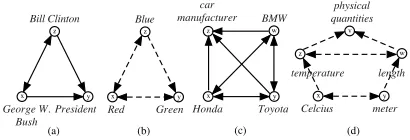
We call the combination of terms and their relations a term network. Figure 2 shows some n-term
net-works consisting of two input terms (x, y), and
ad-ditional termsz,w,v.
The aforementioned observations show that if we can obtain additional terms that are related to the two target terms, we can enforce such coherency relational constraints and make a global prediction that would improve the prediction of the taxonomic relation between the two given terms. Our infer-ence model follows constraint-based formulations that were introduced in the NLP community and were shown to be very effective in exploiting declar-ative background knowledge (Roth and Yih, 2004; Denis and Baldridge, 2007; Punyakanok et al., 2008; Chang et al., 2008).
George W. Bush
President Bill Clinton
x y
z
Red Green Blue
x y
z
(a) (b)
Honda Toyota car
manufacturer
x y
z w
BMW
Celcius meter temperature
x y
z w
length
(d) (c)
v
[image:6.612.325.530.56.126.2]physical quantities
Figure 2: Examples ofn-term networks with two input term xand y. (a) and (c) show valid combinations of edges, whereas (b) and (d) are two relational constraints. For simplicity, we do not drawno relationedges in (d).
5.1 Enforcing Coherency through Inference
Let x, y be two input terms, and Z =
{z1, z2, ..., zm} be a set of additional terms. For a
subsetZ ∈ Z, we construct a set of term networks
whose nodes arex,yand all elements inZ, and the
edge,e, between every two nodes is one of four
tax-onomic relations whose weight, w(e), is given by
a local classifier (Section 4). If l = |Z|, there are
n = 2 + l nodes in each network, and4[12n(n−1)] term networks can be constructed. In our
experi-ments we only use 3-term networks (i.e. l = 1).
For example, for the input pair (red, green) and
Z ={blue, yellow}, we can construct 64 networks
for the triplehred, green, Z ={blue}iand 64
net-works forhred, green, Z ={yellow}iby trying all
possible relations between the terms.
A relational constraintis defined as a term net-work consisting of only its “illegitimate” edge set-tings, those that belongs to a pre-defined list of in-valid edge combinations. For example, Figure 2b
shows an invalid network where redis a sibling of
bothgreenandblue, andgreenis an ancestor ofblue.
In Figure 2d,Celcius andmetercannot be siblings
because they are children of two sibling terms
tem-peratureandlength. The relational constraints used in our experiments are manually constructed.
LetCbe a list of relational constraints. Equation
(1) defines the network scoring function, which is a
linear combination of the edge weights, w(e), and
the penalties, ρk, of term networks matching
con-straintCk ∈ C.
score(t) =X e∈t
w(e)−
|C|
X
k=1
ρkdCk(t) (1)
function dCk(t) indicates if t matches Ck. In our
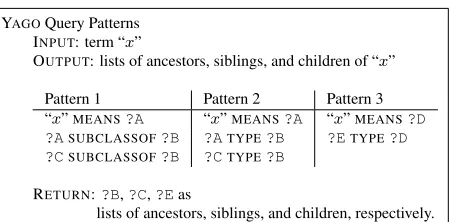
con-YAGOQuery Patterns INPUT: term “x”
OUTPUT: lists of ancestors, siblings, and children of “x”
Pattern 1 Pattern 2 Pattern 3 “x”MEANS?A “x”MEANS?A “x”MEANS?D ?ASUBCLASSOF?B ?ATYPE?B ?ETYPE?D ?CSUBCLASSOF?B ?CTYPE?B
RETURN:?B,?C,?Eas
[image:7.612.77.302.51.162.2]lists of ancestors, siblings, and children, respectively.
Figure 3: Our YAGOquery patterns used to obtain related terms for “x”.
straints and set their penaltyρk to∞. For a set of
term networks formed byhx, y, Ziand all possible
relations between the terms, we select the best net-work,t∗=argmaxtscore(t).
After picking the best term network t∗ for every
Z ∈ Z, we make the final decision on the taxonomic
relation betweenx andy. Letr denote the relation
betweenxandyin a particulart∗(e.g. r=x↔y.)
The set of allt∗is divided into 4 groups with respect
tor (e.g. a group of all t∗ having r = x ↔ y, a
group of all t∗ havingr = x ← y.) We denote a
group with term networks holdingr as the relation
between x and y by Tr. To choose the best
taxo-nomic relation,r∗, ofxandy, we solve the objective
function defined in Equation 2.
r∗=argmaxr 1
|Tr|
X
t∗∈T
r
λt∗score(t∗) (2)
whereλtis the weight of term networkt, defined
as the occurrence probability oft(regarding only its
edges’ setting) in the training data, which is aug-mented with additional terms. Equation (2) finds the best taxonomic relation of two input terms by com-puting the average score of every group of the best term networks representing a particular relation of two input terms.
5.2 Extracting Related Terms
In the inference model, we need to obtain other terms that are related to the two input terms.
Here-after, we refer to additional terms as related terms.
The related term space is a space of direct ancestors, siblings and children in a particular resource.
We propose an approach that uses the YAGO
on-tology (Suchanek et al., 2007) to provide related
terms. It is worth noting that YAGO is chosen over
the Wikipedia category system used in our work
be-cause YAGO is a clean ontology built by carefully
combining Wikipedia and WordNet.5
In YAGO model, all objects (e.g. cities, people,
etc.) are represented asentities. To map our input
terms to entities in YAGO, we use the MEANS
re-lation defined in the YAGO ontology. Furthermore,
similar entities are grouped intoclasses. This allows
us to obtain direct ancestors of an entity by using
the TYPE relation which gives the entity’s classes.
Furthermore, we can get ancestors of a class with theSUBCLASSOFrelation6. By using three relations
MEANS, TYPE and SUBCLASSOF in YAGO model, we can obtain Proposals for direct ancestors, sib-lings, and children, if any, for any input term. We then evaluate our classifier on all pairs, and run the inference to improve the prediction using the co-herency constraints. Figure 3 presents three patterns
that we used to query related terms from YAGO.
6 Experimental Study
In this section, we evaluate TAREC against several systems built upon existing well-known knowledge sources. The resources are either hierarchical struc-tures or extracted by using distributional semantic models. We also perform several experimental anal-yses to understand TAREC’s behavior in details.
6.1 Comparison to Hierarchical Structures
We create and use two main data sets in our
ex-periments. Dataset-Iis generated from 40
seman-tic classes of about 11,000 instances. The
orig-inal semantic classes and instances were manu-ally constructed with a limited amount of manual post-filtering and were used to evaluate informa-tion extracinforma-tion tasks in (Pas¸ca, 2007; Pas¸ca and Van Durme, 2008) (we refer to this original data as
OrgData-I). This dataset contains both terms with
Wikipedia pages (e.g. George W. Bush) and
non-Wikipedia terms (e.g. hindu mysticism). Pairs of
terms are generated by randomly pairing
seman-tic class names and instances. We generate
dis-joint training and test sets of 8,000 and 12,000 pairs of terms, respectively. We call the test set of this
5However, Y
AGO by itself is weaker than our approach in identifying taxonomic relations (see Section 6.)
6
dataset Test-I. Dataset-IIis generated from 44 se-mantic classes of more than 10,000 instances used
in (Vyas and Pantel, 2009)7. The original semantic
classes and instances were extracted from Wikipedia lists. This data, therefore, only contains terms with corresponding Wikipedia pages. We also generate disjoint training and test sets of 8,000 and 12,000 pairs of terms, respectively, and call the test set of this datasetTest-II.8
Several semantic class names in the original data
are written in short forms (e.g. chemicalelem,
proglanguage). We expand these names to some meaningful names which are used by all systems in
our experiments. For example,terroristgroupis
ex-panded toterrorist group,terrorism. Table 1 shows
some pairs of terms which are generated. Four types of taxonomic relations are covered with balanced numbers of examples in all data sets. To evaluate our systems, we use a snapshot of Wikipedia from July, 2008. After cleaning and removing articles without categories (except redirect pages), 5,503,763 articles
remain. We index these articles using Lucene9. As
a learning algorithm, we use a regularized averaged Perceptron (Freund and Schapire, 1999).
We compare TAREC with three systems that we built using recently developed large-scale
hierarchi-cal structures. Strube07 is built on the latest
ver-sion of a taxonomy,TStrube, which was derived from
Wikipedia (Ponzetto and Strube, 2007). It is worth
noting that the structure ofTStrube is similar to the
page structure of Wikipedia. For a fair comparison, we first generate a semantic representation for each input term by following the same procedure used in TAREC described in Section 4. The titles and cat-egories of the articles in the representation of each input term are then extracted. Only titles and their
corresponding categories that are inTStrubeare
con-sidered. A term is an ancestor of the other if at least one of its titles is in the categories of the other term. If two terms share a common category, they are considered siblings; and no relation, otherwise. The ancestor relation is checked first, then sibling,
and finally no relation. Snow06 uses theextended
7There were 50 semantic classes in the original dataset. We grouped some semantically similar classes for the purpose of classifying taxonomic relations.
8
Published at http://cogcomp.cs.illinois.edu/page/software 9
http://lucene.apache.org, version 2.3.2
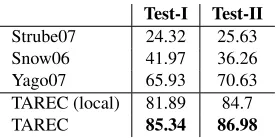
Test-I Test-II
Strube07 24.32 25.63
Snow06 41.97 36.26
Yago07 65.93 70.63
TAREC (local) 81.89 84.7
[image:8.612.358.498.53.122.2]TAREC 85.34 86.98
Table 4: Evaluating and comparing performances, in ac-curacy, of the systems onTest-IandTest-II. TAREC (lo-cal) uses only our local classifier to identify taxonomic re-lations by choosing the relation with highest confidence.
WordNet(Snow et al., 2006). Words in the extended WordNet can be common nouns or proper nouns. Given two input terms, we first map them onto the hierarchical structure of the extended WordNet by exact string matching. A term is an ancestor of the other if it can be found as an hypernym after going
upKlevels in the hierarchy from the other term. If
two terms share a common subsumer within some levels, then they are considered as siblings. Oth-erwise, there is no relation between the two input terms. Similar to Strube07, we first check ancestor,
then sibling, and finally no relation. Yago07 uses
the YAGO ontology (Suchanek et al., 2007) as its
main source of background knowledge. Because the
YAGO ontology is a combination of Wikipedia and
WordNet, this system is expected to perform well at recognizing taxonomic relations. To access a term’s ancestors and siblings, we use patterns 1 and 2 in Figure 3 to map a term to the ontology and move up on the ontology. The relation identification process is then similar to those of Snow06 and Strube07. If an input term is not recognized by these systems,
they returnno relation.
Our overall algorithm, TAREC, is described in
Figure 1. We manually construct a pre-defined list of 35 relational constraints to use in the inference model. We also evaluate our local classifier (Section
4), which is referred as TAREC (local). To make
classification decision with TAREC (local), for a pair of terms, we choose the predicted relation with highest confidence returned by the classifier.
In all systems compared, we vary the value ofK10
from 1 to 4. The best result of each system is re-ported. Table 4 shows the comparison of all tems evaluated on both Test-I and Test-II. Our sys-tems, as shown, significantly outperform the other
10
systems. In Table 4, the improvement of TAREC over TAREC (local) on Test-I shows the contribu-tion of both the normalizacontribu-tion procedure (that is, go-ing outside Wikipedia terms) and the global infer-ence model to the classification decisions, whereas the improvement on Test-II shows only the contribu-tion of the inference model, because Test-II contains only terms with corresponding Wikipedia articles.
Observing the results we see that our algorithms is doing significantly better that fixed taxonomies based algorithms. This is true both for TAREC (lo-cal) and for TAREC. We believe that our machine learning based classifier is very flexible in extract-ing features of the two input terms and thus in pre-dicting their taxonomic Relation. On the other hand, other system rely heavily on string matching tech-niques to map input terms to their respective ontolo-gies, and these are very inflexible and brittle. This clearly shows one limitation of using existing struc-tured resources to classify taxonomic relations.
We do not use special tactics to handle polymous terms. However, our procedure of building se-mantic representations for input terms described in Section 4 ties the senses of the two input terms and thus, implicitly, may get some sense information. We do not use this procedure in Snow06 because WordNet and Wikipedia are two different knowl-edge bases. We also do not use this procedure in
Yago07 because in YAGO, a term is mapped onto the
ontology by using theMEANSoperator (in Pattern 1,
Figure 3). This cannot follow our procedure.
6.2 Comparison to Harvested Knowledge
As we discussed in Section 2, the output of bootstrapping-based algorithms is usually limited to a small number of high-quality terms while sacri-ficing coverage (or vice versa). For example, the full Espresso algorithm in (Pantel and Pennacchiotti,
2006) extracted 69,156 instances of is-a relation
with 36.2% precision. Similarly, (Kozareva et al., 2008) evaluated only a small number (a few
hun-dreds) of harvested instances. Recently, (Baroni
and Lenci, 2010) proposed a general framework to
extract properties of input terms. Their TypeDM
model harvested 5,000 significant properties for each term out of 20,410 noun terms. For
exam-ple, the properties of marineinclude hown, bombi,
huse, guni. Using vector space models we could
measure the similarity between terms using their property vectors. However, since the information available in TypeDM does not support predicting the ancestor relation between terms, we only evaluate TypeDM in classifying sibling vs. no relation. We do this by giving a list of semantic classes using the following procedure: (1) For each semantic class, use some seeds to compute a centroid vector from the seeds’ vectors in TypeDM, (2) each term in an input pair is classified into its best semantic class based on the cosine similarity between its vector and the centroid vector of the category, (3) two terms are siblings if they are classified into the same category; and have no relation, otherwise. Out of 20,410 noun terms in TypeDM, there are only 345 terms overlap-ping with the instances in OrgData-I and belonging to 10 significant semantic classes. For each seman-tic class, we randomly pick 5 instances as its seeds to make a centroid vector. The rest of the overlapping instances are randomly paired to make a dataset of 4,000 pairs of terms balanced in the number of sib-ling and no relation pairs. On this dataset, TypeDM achieves the accuracy of 79.75%. TAREC (local), with the local classifier trained on the training set (with 4 relation classes) of Dataset-I, gives 78.35% of accuracy. The full TAREC system with relational constraints achieves 82.65%. We also re-train and evaluate the local classifier of TAREC on the same training set but without ancestor relation pairs. This local classifier has an accuracy of 81.08%.
These results show that although the full TAREC system gives better performance, TypeDM is very competitive in recognizing sibling vs. no relation. However, TypeDM can only work in a limited set-ting where semantic classes are given in advance, which is not practical in real-world applications; and of course, TypeDM does not help to recognize an-cestor relations between two terms.
6.3 Experimental Analysis
In this section, we discuss some experimental anal-yses to better understand our systems.
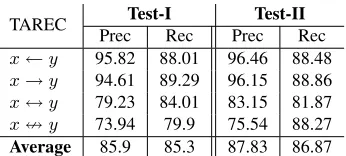
TAREC Test-I Test-II
Prec Rec Prec Rec
x←y 95.82 88.01 96.46 88.48 x→y 94.61 89.29 96.15 88.86 x↔y 79.23 84.01 83.15 81.87 x=y 73.94 79.9 75.54 88.27
[image:10.612.100.273.53.131.2]Average 85.9 85.3 87.83 86.87
Table 5: Performance of TAREC on individual taxo-nomic relation.
Wiki WordNet non-Wiki
Strube07 24.59 24.13 21.18
Snow06 41.23 46.91 34.46
Yago07 69.95 70.42 34.26
TAREC (local) 89.37 89.72 31.22
TAREC 91.03 91.2 45.21
Table 6: Performance of the systems on special data sets, in accuracy. On the non-Wikipedia test set, TAREC (lo-cal) simply returns sibling relation.
achieves 79.34% and 66.03% of average Precision and Recall, respectively. These numbers on Test-II are 81.33% and 70.44%.
Special Data Sets: We evaluate all systems that use hierarchical structures as background knowl-edge on three special data sets derived from Test-I. From 12,000 pairs in Test-I, we created a test set,
Wiki, consisting of 10,456pairs with all terms in
Wikipedia. We use the rest of1,544pairs with at
least one non-Wikipedia term to build a non-Wiki
test set. The third dataset,WordNet, contains8,625
pairs with all terms in WordNet and Wikipedia. Ta-ble 6 shows the performance of the systems on these data sets. Unsurprisingly, Yago07 gets better results on Wiki than on Test-I. Snow06, as expected, gives better performance on the WordNet test set. TAREC still significantly outperforms these systems. The improvement of TAREC over TAREC (local) on the Wiki and WordNet test sets shows the contribution of the inference model, whereas the improvement on the non-Wikipedia test set shows the contribution of normalizing input terms to Wikipedia.
Contribution of Related Terms in Inference:
We evaluate TAREC when the inference procedure is fed by related terms that are generated using a
“gold standard” source instead of YAGO. To do this,
we use the original data which was used to generate Test-I. For each term in the examples of Test-I, we get its ancestors, siblings, and children, if any, from
K=1 K=2 K=3 K=4
TAREC 82.93 85.34 85.23 83.95
[image:10.612.316.537.53.88.2]TAREC (Gold Infer.) 83.46 86.18 85.9 84.93
Table 7: Evaluating TAREC with different sources pro-viding related terms to do inference.
the original data and use them as related terms in the
inference model. This system is referred asTAREC
(Gold Infer.). Table 7 shows the results of the two
systems on different K as the number of levels to
go up on the Wikipedia category system. We see that TAREC gets better results when doing inference with better related terms. In this experiment, the two systems use the same number of related terms.
7 Conclusions
We studied an important component of many com-putational linguistics tasks: given two target terms, determine that taxonomic relation between them. We have argued that static structured knowledge bases cannot support this task well enough, and pro-vided empirical support for this claim. We have de-veloped TAREC, a novel algorithm that leverages in-formation from existing knowledge sources and uses machine learning and a constraint-based inference model to mitigate the noise and the level of uncer-tainty inherent in these resources. Our evaluations show that TAREC significantly outperforms other systems built upon existing well-known knowledge sources. Our approach generalizes and handles non-Wikipedia term well across semantic classes. Our future work will include an evaluation of TAREC in the context of textual inference applications.
Acknowledgments
[image:10.612.91.282.179.246.2]References
A. Abad, L. Bentivogli, I. Dagan, D. Giampiccolo, S. Mirkin, E. Pianta, and A. Stern. 2010. A resource for investigating the impact of anaphora and corefer-ence on infercorefer-ence. InLREC.
M. Banko and O. Etzioni. 2008. The tradeoffs between open and traditional relation extraction. InACL-HLT. M. Baroni and A. Lenci. 2010. Distributional
mem-ory: A general framework for corpus-based semantics. Computational Linguistics, 36.
S. Chakrabarti, B. Dom, R. Agrawal, and P. Raghavan. 1997. Using taxonomy, discriminants, and signatures for navigating in text databases. InVLDB.
M. Chang, L. Ratinov, and D. Roth. 2008. Constraints as prior knowledge. InICML Workshop on Prior Knowl-edge for Text and Language Processing.
D. Davidov and A. Rappoport. 2008. Unsupervised dis-covery of generic relationships using pattern clusters and its evaluation by automatically generated sat anal-ogy questions. InACL.
P. Denis and J. Baldridge. 2007. Joint determination of anaphoricity and coreference resolution using integer programming. InNAACL.
C. Fellbaum. 1998. WordNet: An Electronic Lexical Database. MIT Press.
Y. Freund and R. E. Schapire. 1999. Large margin clas-sification using the perceptron algorithm. Machine Learning.
M. A. Hearst. 1992. Acquisition of hyponyms from large text corpora. InCOLING.
A. Hotho, S. Staab, and G. Stumme. 2003. Ontologies improve text document clustering. InICDM.
Z. Kozareva, E. Riloff, and E. Hovy. 2008. Seman-tic class learning from the web with hyponym pattern linkage graphs. InACL-HLT.
B. MacCartney and C. D. Manning. 2008. Modeling se-mantic containment and exclusion in natural language inference. InCOLING.
B. MacCartney and C. D. Manning. 2009. An extended model of natural logic. InIWCS-8.
M. Pas¸ca and B. Van Durme. 2008. Weakly-supervised acquisition of open-domain classes and class attributes from web documents and query logs. InACL-HLT. M. Pas¸ca. 2007. Organizing and searching the world
wide web of facts step two: Harnessing the wisdom of the crowds. InWWW.
P. Pantel and M. Pennacchiotti. 2006. Espresso: Lever-aging generic patterns for automatically harvesting se-mantic relations. InACL, pages 113–120.
S. P. Ponzetto and M. Strube. 2007. Deriving a large scale taxonomy from wikipedia.AAAI.
V. Punyakanok, D. Roth, and W. Yih. 2008. The impor-tance of syntactic parsing and inference in semantic role labeling.Computational Linguistics, 34(2). D. Roth and W. Yih. 2004. A linear programming
formu-lation for global inference in natural language tasks. In CoNLL.
D. Roth and W. Yih. 2007. Global inference for en-tity and relation identification via a linear program-ming formulation. In Lise Getoor and Ben Taskar, ed-itors, Introduction to Statistical Relational Learning. MIT Press.
M. Sammons, V.G. Vydiswaran, and D. Roth. 2010. Ask not what textual entailment can do for you... InACL. L. Sarmento, V. Jijkuon, M. de Rijke, and E. Oliveira.
2007. ”more like these”: growing entity classes from seeds. InCIKM.
A. K. Saxena, G. V. Sambhu, S. Kaushik, and L. V. Sub-ramaniam. 2007. Iitd-ibmirl system for question an-swering using pattern matching, semantic type and se-mantic category recognition. InTREC.
R. Snow, D. Jurafsky, and A. Y. Ng. 2005. Learning syntactic patterns for automatic hypernym discovery. InNIPS.
R. Snow, D. Jurafsky, and A. Y. Ng. 2006. Semantic taxonomy induction from heterogenous evidence. In ACL.
F. M. Suchanek, G. Kasneci, and G. Weikum. 2007. Yago: A Core of Semantic Knowledge. InWWW. O. Vikas, A. K. Meshram, G. Meena, and A. Gupta.
2008. Multiple document summarization using princi-pal component analysis incorporating semantic vector space model. InComputational Linguistics and Chi-nese Language Processing.
V. Vyas and P. Pantel. 2009. Semi-automatic entity set refinement. InNAACL-HLT.