3708
CAL
CS: Continuously Approximating Longest Common Subsequence forSequence Level Optimization
Semih Yavuz∗
University of California, Santa Barbara [email protected]
Chung-Cheng Chiu
Google Brain
Patrick Nguyen
Google Brain [email protected]
Yonghui Wu
Google Brain [email protected]
Abstract
Maximum-likelihood estimation (MLE) is one of the most widely used approaches for train-ing structured prediction models for text-generation based natural language process-ing applications. However, besides expo-sure bias, models trained with MLE suffer from wrong objective problem where they are trained to maximize the word-level cor-rect next step prediction, but are evaluated with respect to sequence-level discrete met-rics such as ROUGE and BLEU. Several variants of policy-gradient methods address some of these problems by optimizing for fi-nal discrete evaluation metrics and showing improvements over MLE training for down-stream tasks like text summarization and ma-chine translation. However, policy-gradient methods suffers from high sample variance, making the training process very difficult and unstable. In this paper, we present an alterna-tive direction towards mitigating this problem by introducing a new objective (CALCS) based on a differentiable surrogate of longest com-mon subsequence (LCS) measure that captures sequence-level structure similarity. Experi-mental results on abstractive summarization and machine translation validate the effective-ness of the proposed approach.
1 Introduction
Recently, deep neural networks have achieved state-of-the-art results in various tasks including computer vision, natural language processing, and speech processing. Specifically, neural text gen-eration models, central focus of this work, have led to great progress in central downstream NLP tasks like text summarization, machine transla-tion, and image captioning. For example, the abstractive summarization task, which has previ-ously not been the popular choice for text
sum-∗
Work done while interning at Google Brain.
BLEU (Papineni et al., 2002) for translation, and word error rate for speech recognition, not log-likelihood. On the other hand, training models that directly optimize for such discrete metrics as objective is hard due to non-differentiable nature of the corresponding loss functions (Rosti et al., 2011). To address these issues, Ranzato et al. (2016) introduces an incremental learning recipe that uses a hybrid loss function combining REIN-FORCE (Williams,1992) and cross-entropy. Re-cently, Paulus et al. (2018) also explored com-bining maximum-likelihood and policy gradient training for text summarization.
Towards sequence level optimization, previous works (Ranzato et al., 2016; Wu et al., 2016; Paulus et al., 2018) employ reinforcement learn-ing (RL) with a policy-gradient approach which works around the difficulty of differentiating the reward function by using it as a weight. How-ever, REINFORCE is known to suffer from high sample variance and credit assignment problems which makes the training process difficult and un-stable besides resulting in models that are hard to reproduce (Henderson et al.,2018).
In this paper, we propose an alternative ap-proach for sequence-level training with longest common subsequence (LCS) metric that measures the sequence-level structure similarity between two sequences. We essentially introduce a con-tinuous approximation to the discrete LCS met-ric which can be directly optimized against using standard gradient-based methods. Our proposed approach has the advantage of being able to di-rectly optimize for a surrogate reward as opposed to using the exact reward only as a weight as in RL-inspired works. Hence, it provides a viable alternative perspective to policy-gradient methods for side stepping the non-differentiability with re-spect to the exact reward. In addition, it simultenu-ously combats theexposure biasproblem through exposing the model to its own predictions while computing our approximation to LCS metric.
To this end, we introduce a new learning recipe that incorporates the aformentioned continuous approximation to LCS metric (CALCS) as an ad-ditional objective on top of maximum-likelihood loss in existing neural text generation models. We evaluate the proposed approach on abstrac-tive text summarization and machine translation tasks. To this end, we use recently introduced pointer-generator network (See et al., 2017) and
transformer (Vaswani et al.,2017) as underlying baselines for summarization and machine transla-tion, respectively. More precisely, we start from a pre-trained baseline model with cross-entropy loss, and continue training the model to optimize for the proposed differentiable objective based on CALCS. Using this recipe, we conduct various experiments onCNN/Daily Mail(Hermann et al., 2015; Nallapati et al., 2016) summarization and WMT 2014 English-to-German machine transla-tion tasks. Experimental results validate the effec-tiveness of the proposed approach on both tasks.
2 Continuously Approximating Longest Common Subsequence Metric
In this work, we explore the potential use of longest common subsequence (LCS) metric from an algorithmic point of view to address the afore-mentioned wrong objective and exposure bias problems. LCS metric measures a sequence-level structure similarity between discrete sequences by identifying longest co-occurring in sequence n-grams and it has been shown to correlate well with human judgments for downstream text generation tasks (Lin and Och, 2004). To this end, we pro-pose a way to continuously approximate LCS met-ric and use this differentiable approximation as the objective to train text generation models rather than the exact LCS measure, which is hard to op-timize for due to non-differentiability of the cor-responding loss function. Although such differ-entiable approximation provides a unique advan-tage from modeling and optimization perspective, the difficulty of controlling its tightness might be a potential drawback in terms of its applicability. In this section, we will first introduce our proposed approximation to LCS metric, and then provide a natural way to control its tightness.
Consider a sequence generation problem condi-tioned on an input sequencex= (x1, x2, . . . , xn)
and let y = (y1, y2, . . . , ym) denote its
corre-sponding ground-truth output sequence. Let
f(x,Θ) =z= (z1, z2, . . . , zk)
denote hypothesis sequence obtained by greedy decoding from a generic encoder-decoder archi-tecture for input sequencex, whereΘrepresents model parameters. Also, letp1, p2, . . . , pk be the
probability distributions over vocabularyV at de-coding time steps from which z1, z2, . . . , zk are
2.1 CALCS
In this section, we define our approach to con-tinuously approximate the longest common sub-sequence measure (LCS), which is an unnormal-ized version of ROUGE-L metric (Lin and Och, 2004) (See Appendix B) that is commonly used for performance evaluation of text summarization models. The main intuition behind our approach is to relax the common necessity for hard inferences while computing discrete metrics by instead com-paring discrete tokens in a soft way. Towards this end, we start by defining LCS metric.
Definition 1. Given two sequencesyandzof to-kens, longest common subsequenceLCS(y,z)is defined as the longest sequence of tokens that ap-pear left-to-right (but not necessarily in a contigu-ous block) in both sequences.
The most common and intuitive solution for computing longest common subsequence is via dynamic programming. We will briefly revisit this here as it will be useful in terms of both recall and notational convenience while describing our sur-rogate LCS measure. Let ri,j denote the longest
common subsequence between prefix sequences
y[:i]= (y1, y2, . . . , yi)andz[:j]= (z1, z2, . . . , zj)
ofyandz, respectively. A dynamic programming solution is given by
ri,j =
0 ifi= 0orj= 0
ri−1,j−1+ 1 ifyi=zj max(ri−1,j, ri,j−1) o/w.
(1)
ri,j for all i = 1,2, . . . , m andj = 1,2, . . . , k.
It can be computed inmkiterations using the for-mula in Eqn1. After computing 2D dynamic pro-gramming matrixr, we obtain LCS(y,z) =rm,k.
Towards removing the dependence on hard in-ference for computing LCS, we now define our approximation to longest common subsequence, which we call CALCS. At high-level, the idea is to continuously relax the original LCS mea-sure. To this end, we leverage output probabil-ity distributions p1, p2, . . . , pk as soft predictions
to refine the dynamic programming formulation for original LCS. More precisely, we recursively define soft longest common subsequencesi,j
be-tween prefixesy[:i]andz[:j]in analogous tori,j as
follows:
si,j =p(jyi)(si−1,j−1+ 1) + (2)
(1−p(yi)
j ) max(si−1,j, si,j−1) (3)
fori, j > 0andsi,0 = s0,j = 0, where p(jyi)
de-note the probability of generatingyiatj-th
decod-ing step. Intuitively, CALCSreplaces the hard to-ken comparison1[yi=zj]in Eq.1with the
prob-ability p(yi)
j as in Eq. 2. Interpreting the
proba-bilityp(yi)
j as a continuous relaxation of discrete
comparison operator1[yi =zj],si,j establishes a
natural continuous approximation tori,j. Similar
to LCS, after iteratively filling upsi,j matrix, we
define
CALCS(y,z) =sm,k (4)
Although the proposed approximation is a natu-ral way of relaxing/extending the hard binary com-parison of discrete tokens, it is not clear how tight the approximation is, which is established in the next section.
2.2 On the Tightness of Approximation
In this section, we first discuss the tightness of the proposed approximation, and then provide a natu-ral way of controlling it.
2.2.1 Bounding the Approximation Error
We now present a bound on the approximation error of the proposed CALCS compared to the original LCS measure. Characterization of this bound will enable us to theoretically argue about the feasibilty of using the proposed surrogate re-ward function for our objective as well as control-ling its tightness.
LCS measure is intrinsically monotonic by defi-nition. We start by a lemma that establishes a sim-ilar monotonicity property for CALCS.
Lemma 1. [Monotonicity] The following two in-equalities
si,j ≤si,j+1≤si,j+ 1
si,j ≤si+1,j≤si,j+ 1
hold for all0≤i < mand0≤j < k.
Proof. See Appendix A for the proof.
Having established a certain monotonicity prop-erty for CALCS, we will discuss its approximation error to the original LCS measure. Let
denote theapproximation errorof CALCSto LCS measure between generated prefix sequence y[:i] and the ground-truth prefixz[:j].
Lemma 2. Let Pi,j = {(0,0),(i1, j1), . . . ,(iq−1, jq−1),(iq, jq)}
de-note the path of dynamic programming algorithm for LCS ending at(i, j) = (iq, jq) cell ofm×k
grid. Then,
|δi,j|<
δiq−1,jq−1
+ (1−max(pj)) (6)
wheremax(pj) = max{p(1)j , p
(2)
j , . . . , p
(|V|)
j }.
Proof. We will establish the proof by investigating two cases and combining them.
CASE 1: zj =yi.
In this case, we have
ri,j = 1 +ri−1,j−1 (7)
and
(iq−1, jq−1) = (i−1, j−1) (8)
by1. Using Eq.7, we get
δi,j =si,j−ri,j
=1−p(yi)
j
max (si−1,j, si,j−1)
+ p(yi)
j (si−1,j−1+ 1)−(1 +ri−1,j−1) = (si−1,j−1−ri−1,j−1)
+ 1−p(yi)
j
h
max(si−1,j, si,j−1)
− (1 +si−1,j−1) i
Using the definition of δ and triangle inequality, we get
|δi,j| ≤ |δi−1,j−1|+
1−p(yi)
j (1 +si−1,j−1)
− max (si−1,j, si,j−1)
≤ |δi−1,j−1|+
1−p(yi)
j
(9)
where inequality9follows from the monotonicity established by Lemma1.
Moreover,zj =yiimpliespj(yi)= max(pj)
be-causezis generated by greedy decoding. Plugging this in Eq.9and using Eq.8, we can immediately conclude that
|δi,j|<δiq−1,jq−1
+ (1−max(pj)) (10)
CASE 2: zj 6=yi.
By definition1, we have
ri,j = max (ri−1,j, ri,j−1).
Using this identity, we obtain
δi,j =si,j−ri,j
=
1−p(yi)
j
max (si−1,j, si,j−1)
+p(yi)
j (si−1,j−1+ 1)−max (ri−1,j, ri,j−1)
=p(yi)
j [(1 +si−1,j−1)−max (si−1,j, si,j−1)]
+ [max (si−1,j, si,j−1)−max (ri−1,j, ri,j−1)]
Applying triangle inequality on the last equation above, we get
|δi,j| ≤
p(yi)
j |(1 +si−1,j−1)−max (si−1,j, si,j−1)| +|max (si−1,j, si,j−1)−max (ri−1,j, ri,j−1)|
≤
p(yi)
j |(1 +si−1,j−1)−max (si−1,j, si,j−1)| + max (|si−1,j−ri−1,j|,|si,j−1−ri,j−1|) (11)
=
p(yi)
j |(1 +si−1,j−1)−max (si−1,j, si,j−1)| + max (|δi−1,j|,|δi,j−1|)
≤p(yi)
j + max (|δi−1,j|,|δi,j−1|) (12)
where inequality12follows from again the mono-tonicity of s[·,·], and inequality 11 follows from the following identity that holds true for all real numbersa, b, c, d≥0
|max(a, b)−max(c, d)| ≤max(|a−c|,|b−d|)
Moreover, sincezj 6=yi, we know thatp(jyi) 6=
max(pj), which implies
p(yi)
j ≤1−max(pi). (13)
Combining11and13completes the proof for this case. Finally, two cases investigated above to-gether establish the proof of Lemma2.
Lemma 2 leads to the following important corollary.
Corollary 1. Let Pi,j = {(0,0),(i1, j1), . . . ,(iq, jq)} be the path of
dynamic programming algorithm for LCS ending at(i, j) = (iq, jq)cell ofm×kgrid. Then,
|δi,j| ≤ q
X
w=1
Proof. Applying Lemma 2 iteratively and using
δ0,0 = 0, we get
|δi,j| ≤
δiq−1,jq−1
+ (1−max(pjq))
δiq−1,jq−1 ≤
δiq−2,jq−2
+ (1−max(pjq−1))
δiq−2,jq−2 ≤
δiq−3,jq−3
+ (1−max(pjq−2))
.. .
|δi1,j1| ≤ |δ0,0|+ (1−max(pj1))
|δ0,0| ≤0
Summing(q+ 1)-many inequalities above side by side and cancelling out the same terms appearing on both sides of the resulting inequality establishes the proof of corollary.
2.2.2 Controlling the Tightness of Approximation
Corollary 1 hints for a natural way of control-ling the tightness of approximation CALCSby ex-ploiting the peakedness of model’s softmax output probability distributions. More precisely, upper bound on the approximation error is represented as a sum of1−max(pj)’s, hence the more peaked
the model’s output probability distributions on av-erage, the smaller the approximation error we are guaranteed by the established bounds.
We exploit this property to control the tight-ness of approximation by making a modification to computation of the proposed CALCSmeasure. Formally, let l1, l2, . . . , lk denote the
unnormal-ized logits of the model output before applying softmax to obtain probabilities p1, p2, . . . , pk at
decoding time steps, respectively. Hence,
p(ji) = exp(l (i)
j )
P
iexp(l
(i)
j )
(15)
Recall that CALCSis computed usingpj’s. Using
peaked softmax, we can obtain more peaked prob-ability distributions without causing any change in the actual generated sequencezvia greedy decod-ing. This is simply because the order of probabil-ities for corresponding vocabulary words will not change, only the probability disributionpjwill get
more peaked. So, we definepeaked softmax oper-ator with hyperparameterαas
p(ji)(α) = exp(l (i)
j /α)
P
iexp(l
(i)
j /α)
(16)
By Corollary1,|δi,j| → 0asα → 0for CALCS
measure computed with pj(α). One can further
attempt to use Corollary1as a guide to pinpoint a range ofαvalues to force the approximation error within certain desired limits. We will useα as a hyperparameter in this work.
Corollary 1 is also useful for alternative ways of controlling the tightness of approximation such as incurring penalty for high-entropy output prob-ability distributions or simply penalizing the max-imum output probability values less than a desired threshold (that explicitly controls the tightness of the approximation). We leave such options of con-trolling the approximation error for future work.
With the guidance of Corollary 1 and peaked softmaxin Eq. 16, we conclude that CALCS es-tablishes a promising approximation for LCS mea-sure. In the next section, we introduce a new ob-jective function using CALCS as a continuously differentiable reward to be directly maximized.
2.3 Sequence Level Optimization via CALCS
In this section, we describe how to leverage CALCSto define a loss function for sequence level optimization. For notational consistency, we will usef(x,Θ) to denote an encoder-decoder archi-tecture that takes an input sequence x and out-puts a sequence of tokens z = (z1, z2, . . . , zm)
via greedy decoding from corresponding probabil-ity distributionsp1, p2, . . . , pmat each step.
For a pair of input sequence x and its corre-sponding ground-truth output sequencey, we de-fine
JCALCS(x,y;Θ) =−log
CALCS(y, f(x,Θ))
|y|
(17)
as the loss function for a sample(x,y)based on the CALCS, where |y| denote the length of se-quence y. It is important to note here that while computing probability distributionptat decoding
stept, we feed model’s own predictionzt−1at the previous time step to fightexposure bias.
It is important to observe here that
JCALCS(x,y;Θ)is differentiable inp1, p2, . . . , pk
by definition and eachpiis differentiable in model
parametersΘ. Hence,JCALCS(x,y;Θ) is
differ-entiable in model parametersΘ, which allows us to directly optimize the network parameters with respect to LCS metric. The bound we established on the approximation error and our proposed strategy to control it theoretically ensures the feasibility of using the introduced loss function
3 Model
In this section, we first briefly revisit the pointer-generator (See et al., 2017) and transformer (Vaswani et al., 2017) networks that are used as the underlying baselines in our experiments. Sub-sequently, we describe how the proposed objective function and its variants are used to train new sum-marization and machine translation models.
3.1 Baseline Models
Pointer-Generator Network. We use pointer-generator network (See et al.,2017) as our base-line sequence-to-sequence model for text sum-marization. It is essentially a hybrid between sequence-to-sequence model with attention ( Bah-danau et al.,2015) and a pointer network (Vinyals et al., 2015) that supports two decoding modes, copying and generating, via a soft switch mecha-nism. This enables the model to copy a word from the input sequence based on the attention distribu-tion. On each decoding time step t, the decoder LSTM is fed the word embedding of the previous word, and computes a decoder statest, an
atten-tion distribuatten-tionatover the words of input article, and a probabilityPvocab(w)of generating wordw
for summary from output vocabularyV, which is then softly combined with thecopymode’s proba-bility distributionPcopy(w)via soft switch
proba-bilitypgen∈[0,1]by
p(tw)=pgenPvocab(w) + (1−pgen)Pcopy(w)
and
Pcopy(w) =
X
{i:wi=w}
ati
where at
i indicates the attention probability oni
-th word of -the input article. The whole network is then trained end-to-end with the negative log-likelihood loss function of
JPG(x,y;Θ) =−
1
|y|
|y|
X
t=1
log(p(yt)
t )
for a sample article-summary pair(x,y)whereΘ
denote the learnable model parameters. It is im-portant to note here that we do not use the cov-erage mechanism introduced by the original work (See et al.,2017) to prevent the potential repetition problem in the summaries generated by the model.
Transformer Network. For machine translation, we use the transformer network (Vaswani et al., 2017), which is a recently published model that achieved state-of-the-art results on WMT 2014 English-to-German MT task with less computa-tional time owing to its highly parallelizable ar-chitecture. The core idea behind this model is to use stacked self-attention mechanisms along with point-wise, fully connected layers for both en-coder and deen-coder to represent its input and out-put. For the sake of brevity, we refer the reader to (Vaswani et al.,2017) for further details regard-ing the architecture. Similar to previously defined loss functions, let JTF(x,y;Θ) denote the
per-example loss function of transformer networks for an input-output translation pair(x,y)whereΘis again indicating the learnable model parameters.
3.2 Model Variants and Training
Let{(x(l),y(l))}N
l=1 denote the set of training ex-amples, where x(l)’s are input sequences, and
y(l)’s are their corresponding ground-truth output sequences. Before optimizing for the introduced objectiveJCALCS, we first train the corresponding
baseline network by minimizing
J{PG,TF}(Θ) =
1
N N
X
l=1
J{PG,TF}(x,y;Θ).
Unlike JCALCS, loss functions J{PG,TF} for
base-line models are computed by teacher forcing, feed-ing the previous ground-truth word at each de-coding step. We will denote the baseline models by POINTGEN for pointer-generator network and TRANSFORMERfor transformer network.
To optimize for the proposed objectiveJCALCS,
we initialize the model parametersΘfrom the pre-trained baseline network and continue training the model by minimizing the joint loss
J(Θ) =λJCALCS(Θ) + (1−λ)J{PG,TF}(Θ)
(18)
JCALCS(Θ) =
1
N N
X
l=1
JCALCS(x,y;Θ) (19)
where λis a hyperparameter controlling the bal-ance between the two losses. During the training with the joint loss, we computeJCALCS(x,y;Θ),
objec-Model ROUGE-1 ROUGE-L
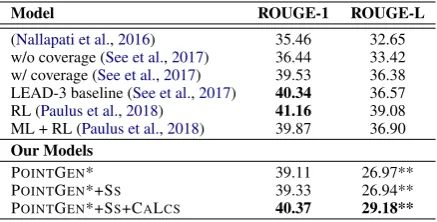
(Nallapati et al.,2016) 35.46 32.65 w/o coverage (See et al.,2017) 36.44 33.42 w/ coverage (See et al.,2017) 39.53 36.38 LEAD-3 baseline (See et al.,2017) 40.34 36.57 RL (Paulus et al.,2018) 41.16 39.08 ML + RL (Paulus et al.,2018) 39.87 36.90
Our Models
POINTGEN* 39.11 26.97**
POINTGEN*+SS 39.33 26.94**
[image:7.595.72.291.62.173.2]POINTGEN*+SS+CALCS 40.37 29.18**
Table 1: ROUGE F1 results onCNN/Daily Mail summa-rization dataset. Our reimplementation of POINTGEN* cor-responds to w/o coverage (See et al.,2017). ** sign near ROUGE-L results reported for our models indicates a differ-ence in our ROUGE-L evaluation as explained below.
tive by generating longer and longer hypothe-ses instead of incurring an additional length penalty. We will refer to the resulting model trained with the loss function in Eq. 18 as
{POINTGEN,TRANSFORMER}+CALCS depend-ing on the baseline model.
4 Experiments
We numerically evaluate the proposed method on two sequence generation benchmarks: abstrac-tive document-summarization and machine trans-lation. We compare the results of the proposed method against the recently proposed strong base-line models (See et al.,2017) for summarization and and (Vaswani et al.,2017) for machine trans-lation tasks.
4.1 Abstractive Summarization
We use a modified version of the CNN/Daily Mail dataset (Hermann et al.,2015) that is first used for summarization by (Nallapati et al., 2016). How-ever, we follow the processing script provided by (See et al., 2017) to obtainnon-anonymized ver-sion of the data that contains 287,226 training pairs, 13,368 validation pairs, and 11,490 test pairs of news articles (781 tokens on average) and their corresponding ground-truth summaries (56 tokens on average). We refer the reader to (See et al., 2017) for further details of the difference of their version from (Nallapati et al.,2016).
For training our baseline model, we use single layer LSTM encoder (bi-directional) and decoder with hidden dimensions of 512 and 1024, respec-tively. We use a vocabulary of 50k words for both source and target. Following the original paper, we also do not pre-train word embeddings, which are learned with the rest of model parameters during
training. We use the Adam (Kingma and Ba,2015) optimizer with a learning rate of 0.00001 for train-ing. We pre-train the baseline model for 20k steps by applying greedy scheduled sampling (Bengio et al.,2015) with fixed ground-truth feeding prob-ability of75%. Once the baseline model training is complete, we start optimizing for CALCS objec-tive as described in the previous section. Also, we setλ= 1.0andα = 1.0, which are tuned on the development set.
In Table 1, we report our main results on the summarization task. POINTGEN+SSrefers to the baseline model trained with scheduled sampling. POINTGEN+SS+CALCS corresponds our model trained with CALCSstarting from POINTGEN+SS model. Experimental results demonstrate that training with our proposed objective provides an improvement of 2.2 points in ROUGE-L score. This also provides empirical evidence to justify that our approximate CALCSeffectively captures what the original LCS metric is supposed to mea-sure, recalling ROUGE-L is a normalized LCS. The reason why ROUGE-L scores of our models are lower than previously reported is that we eval-uate ROUGE-L score by taking the entire sum-mary as a single sequence instead of splitting it into sentences, which is also the way we compute CALCS objective during the model training pro-cess. The main motivation behind this approach is to encourage the model to preserve the sentence order within a summary, and evaluate its perfor-mance in the same way. We consider the capability of preserving the order across produced sentences as an important attribute a multi-sentence sum-marization model should have in terms of read-ability and fluency of its generated summaries as
a whole. When POINTGEN*+SS and
Model BLEU
GNMT(Wu et al.,2016) 24.61
GNMT+RL (Wu et al.,2016) 24.60
TRANSFORMER(Vaswani et al.,2017) 27.3 WEIGHTEDTRANSFORMER(Ahmed et al.,2018) 28.4
TRANSFORMER* 27.6
[image:8.595.67.293.60.141.2]TRANSFORMER*+CALCS 27.8
Table 2: Machine translation results onWMT 2014 English-to-Germantask. TRANSFORMER* corresponds to our train-ing of the original model in (Vaswani et al.,2017).
4.2 Machine Translation
We also evaluate our sequence-level training ap-proach on theWMT 2014 English-to-German ma-chine translation task, which contains 4.5M pairs of sentences.
To train our baseline transformer model, we closely follow the small model in the original transformer paper (Vaswani et al.,2017). We use a vocabulary of size 32k. Our encoder and decoder consist ofN = 6identical layers each. Following the notation in the original paper, we set the other parameters asdmodel = 512, dff = 2048, h = 8, Pdrop = 0.1. We setλ= 0.3andα = 1.0, which
are tuned on the development set.
In Table 2, we show our empirical results on machine translation task. Our first observation is that our trained baseline transformer network achieves a better performance than the one re-ported in the original paper (Vaswani et al.,2017) by 0.3 BLEU score, which might be solely due to hyperparameter tuning. More importantly, we observe that training with our proposed CALCS objective leads to noticeable 0.2 BLEU point im-provements over the baseline, which further rein-forces our confidence in effectiveness of our pro-posed sequence-level training approach and its ap-plicability to other sequence prediction tasks. It is also interesting to note that optimizing for LCS metric via its continuous approximation leads to improvements in evaluation with another discrete metric BLEU. On the other had, optimizing for the exact discrete metric BLEU via reinforcement learning strategy may not improve the evaluation performance in BLEU as reported by (Wu et al., 2016). As a final remark, we would like to note that our proposed approach is orthogonal to ad-vancements in more expressive and powerful ar-chitecture designs. Hence it has the potential to provide further improvements over the recently proposed models such as WEIGHTED TRANS -FORMER(Ahmed et al.,2018).
5 Related Work
Text Summarization. Before the successful ap-plication of neural generative models, most of the existing works on text summarization (Dorr et al., 2003; Durrett et al., 2016) have focused on ex-tractive methods. While some of the early ap-proaches have used a rich set of heuristic rules or sparse features to select textual units to include in the summary, more recent works (Cheng and La-pata, 2016; Nallapati et al., 2017) leverage neu-ral models to select words and sentences from the original text. With the emergence of sequence-to-sequence models (Sutskever et al., 2014) and large-scale datasets like CNN/Daily Mail ( Her-mann et al., 2015; Nallapati et al., 2016) and NYT (Paulus et al.,2018), abstractive summariza-tion of longer text have become a more feasi-ble and popular task. Several recent approaches have been proposed to tackle abstractive summa-rization problem, where Nallapati et al. (2016) exploits hierarchical encoders, See et al. (2017) proposes pointer-generator network and cover-age mechanism to overcome OOV and repetition problems, Tan et al. (2017) introduces a graph-based attention mechanism and hierarchical beam search strategy, and (Paulus et al., 2018) pro-poses to optimize for ROUGE metric via rein-forcement learning. Although impressive progress has been achieved for sentence-level summariza-tion, attempts on abstractive document summa-rization task are still in early stages where the sim-ple LEAD-3 baseline performance is only very re-cently matched (Paulus et al.,2018).
Norouzi et al.,2016;Shen et al.,2016;Bahdanau et al., 2017; Zhukov and Kretov, 2017; Casas et al.,2018) have investigated sequence-level op-timization by training to maximize BLEU score.
Neural Sequence Generation with RL. Most neural sequence generation models are trained with the objective of maximizing the probability of the next correct word. However, this results in a major discrepancy between training and test settings of these models because they are trained with cross-entropy loss at word-level, but evalu-ated based on sequence-level discrete metrics such as ROUGE (Lin and Och, 2004) or BLEU ( Pap-ineni et al.,2002). On the other hand, directly op-timizing for such evaluation metrics is hard due to non-differentiable nature of the exact objec-tive (Rosti et al., 2011). Recent works (Ranzato et al., 2016; Wu et al., 2016; Bahdanau et al., 2017; Paulus et al., 2018) address the difficulty of differentiating with respect to rewards based on such discrete metrics using variants of reinforce-ment learning. These methods essentially pro-pose to mitigate the problem by optimizing the reward weighted log-likelihood of the hypothesis sequences generated by the model distribution. In this paper, we propose an alternative solution to tackle this problem by introducing a differentiable approximation to exact LCS metric that can be di-rectly optimized by standard gradient-based meth-ods without RL, while still addressing the expo-sure biasproblem.
6 Conclusion and Future Work
In this work we explored an alternative approach for training text generation models with sequence-level optimization to combatwrong objectiveand exposure biasproblems. We introduced a new ob-jective function based on a continuous approxima-tion of LCS metric that measures sequence-level structure similarity between sentences. We ap-plied our proposed approach to CNN/Daily Mail dataset for long document summarization and WMT 2014 English-to-German machine transla-tion task. By extending the objectives of strong neural baseline models with our proposed objec-tive, we empirically demonstrated its effective-ness on these two tasks. Our proposed approach suggests a promising alternative to policy-gradient methods to side step the difficulty of differentiat-ing w.r.t reward function while directly optimizdifferentiat-ing for sequence-level discrete metrics.
References
Karim Ahmed, Nitish Shirish Keskar, and Richard Socher. 2018. Weighted transformer network for machine translation. InInternational Conference on Learning Representations (ICLR).
Dzmitry Bahdanau, Philemon Brakel, Kelvin Xu, Anirudh Goyal, Ryan Lowe, Joelle Pineau, Aaron C. Courville, and Yoshua Bengi. 2017. An Actor-Critic algorithm for sequence prediction. InInternational Conference on Learning Representations (ICLR).
Dzmitry Bahdanau, Kyunghyun Cho, and Yoshua Ben-gio. 2015. Neural machine translation by jointly learning to align and translate. InInternational Con-ference on Learning Representations (ICLR).
Samy Bengio, Oriol Vinyals, Navdeep Jaitly, and Noam Shazeer. 2015. Scheduled sampling for se-quence prediction with recurrent neural networks. InAdvances in Neural Information Processing Sys-tems (NIPS).
N. Casas, M R. Costa-juss, and J.A. R. Fonollosa. 2018. A differentiable bleu loss. analysis and first results. Workshop of the 6th International Confer-ence on Learning Representations.
Jianpeng Cheng and Mirella Lapata. 2016. Neural summarization by extracting sentences and words. InAnnual Meeting of the Association for Computa-tional Linguistics (ACL).
Kyunghyun Cho, Bart Van Merrienboer, Caglar Gul-cehre, Dzmitry Bahdanau, Fethi Bougares, Hol-ger Schwenk, and Yoshua Bengi. 2014. Learning phrase representations using rnn encoder-decoder for statistical machine translation. arXiv preprint arXiv:1406.1078.
Sumit Chopra, Michael Auli, and M. Alexander Rush. 2016. Abstractive sentence summarization with at-tentive recurrent neural networks. In The North American Chapter of the Association for Computa-tional Linguistics (NAACL).
J. Chung, K. Cho, , and Yoshua Bengio. 2016. A character-level decoder without explicit segmenta-tion for neural machine translasegmenta-tion. arXiv preprint arXiv:1603.06147.
Bonnie Dorr, David Zajic, and Richard Schwartz. 2003. Hedge trimmer: A parse-and-trim approach to head-line generation. InProceedings of the HLT-NAACL 03 on Text Summarization Workshop - Volume 5.
Greg Durrett, Taylor Berg-Kirkpatrick, and Dan Klein. 2016. Learning-based single-document summariza-tion with compression and anaphoricity constraints. InAnnual Meeting of the Association for Computa-tional Linguistics (ACL).
Karl Moritz Hermann, Tomas Kocisky, Edward Grefenstette, Lasse Espeholt, Will Kay, Mustafa Su-leyman, and Phil Blunsom. 2015. Teaching ma-chines to read and comprehend. InAdvances in Neu-ral Information Processing Systems (NIPS).
Diederik P. Kingma and Jimmy Ba. 2015. Adam: A method for stochastic optimization. InInternational Conference on Learning Representations (ICLR).
Philipp Koehn, Franz Josef Och, and Daniel Marcu. 2003. Statistical phrase-based translation. In An-nual Meeting of the Association for Computational Linguistics (ACL).
C.Y. Lin and Franz Josef Och. 2004. Automatic eval-uation of machine translation quality using longest common subsequence and skip-bigram statistics. In
Annual Meeting of the Association for Computa-tional Linguistics (ACL).
Minh-Thang Luong and Christopher D. Manning. 2016. A hybrid Word-Character approach to open vocabulary neural machine translation. In Annual Meeting of the Association for Computational Lin-guistics (ACL).
Minh-Thang Luong, Hieu Pham, and Christopher D. Manning. 2015. Effective approaches to attention-based neural machine translation. In Empir-ical Methods on Natural Language Processing (EMNLP).
Yishu Miao and Phil Blunsom. 2016. Discrete gen-erative models for sentence compression. In Em-pirical Methods on Natural Language Processing (EMNLP).
Ramesh Nallapati, Feifei Zhai, and Bowen Zhou. 2017. Summarunner: A recurrent neural network based se-quence model for extractive summarization of docu-ments. InAAAI Conference on Artificial Intelligence (AAAI).
Ramesh Nallapati, Bowen Zhou, Cicero dos Santos, Caglar Gulcehre, and Bing Xiang. 2016. Abstrac-tive text summarization using sequence-to-sequence rnns and beyond. In Computational Natural Lan-guage Learning (CoNLL).
Mohammad Norouzi, Samy Bengio, Zhifeng Chen, Navdeep Jaitly, Mike Schuster, Yonghui Wu, and Dale Schuurmans. 2016. Reward augmented max-imum likelihood for neural structured prediction. In
Advances in Neural Information Processing Systems (NIPS).
Kishore Papineni, Salim Roukos, Todd Ward, and Wei-Jing Zhu. 2002. Bleu: A method for automatic evaluation of machine translation. InAnnual Meet-ing of the Association for Computational LMeet-inguistics (ACL).
Romain Paulus, Caiming Xiong, and Richard Socher. 2018. A deep reinforced model for abstractive sum-marization. InInternational Conference on Learn-ing Representations (ICLR).
Marc’Aurelio Ranzato, Sumit Chopra, Michael Auli, and Wojciech Zaremba. 2016. Sequence level train-ing with recurrent neural networks. InInternational Conference on Learning Representations (ICLR).
Antti-Veikko I. Rosti, Bing Zhang, Spyros Matsoukas, and Richard Schwartz. 2011. Expected bleu training for graphs: Bbn system description for wmt11 sys-tem combination task. InProceedings of the Sixth Workshop on Statistical Machine Translation.
M. Alexander Rush, Sumit Chopra, and Jason Weston. 2015. A neural attention model for abstractive sen-tence summarization. InEmpirical Methods on Nat-ural Language Processing (EMNLP).
Abigail See, Peter J. Liu, and Christopher D. Manning. 2017. Get to the point: Summarization with pointer-generator networks. InAnnual Meeting of the Asso-ciation for Computational Linguistics (ACL).
Shiqi Shen, Yong Cheng, Zhongjun He, Wei He, Hua Wu, Maosong Sun, and Yang Liu. 2016. Minimum risk training for neural machine translation. In An-nual Meeting of the Association for Computational Linguistics (ACL).
Ilya Sutskever, Oriol Vinyals, and Quoc V Le. 2014. Sequence to sequence learning with neural net-works. InAdvances in Neural Information Process-ing Systems (NIPS).
Jiwei Tan, Xiaojun Wan, and Jianguo Xiao. 2017. Abstractive document summarization with a graph-based attentional neural model. In Annual Meet-ing of the Association for Computational LMeet-inguistics (ACL).
Z. Tu, Z. Lu, Y. Liu, X. Liu, and H Li. 2016. Coverage-based neural machine translation. InAnnual Meet-ing of the Association for Computational LMeet-inguistics (ACL).
Ashish Vaswani, Shazeer Noam, Niki Parmar, Jakob Uszkoreit, Llion Jones, Aidan N Gomez, Lukasz Kaiser, and Illia Polosukhin. 2017. Attention is all you need. InAdvances in Neural Information Pro-cessing Systems (NIPS).
Oriol Vinyals, Meire Fortunato, and Navdeep Jaitly. 2015. Pointer networks. InAdvances in Neural In-formation Processing Systems (NIPS).
R. J Williams. 1992. Simple statistical gradient-following algorithms for connectionist reinforce-ment learning. Machine Learning.
Qingyu Zhou, Na Yang, Fur Wei, and Ming Zhou. 2017. Selective encoding for abstractive sentence summarization. InAnnual Meeting of the Associa-tion for ComputaAssocia-tional Linguistics (ACL).
Vlad Zhukov and Maksim Kretov. 2017. Differentiable lower bound for expected BLEU score. In NIPS Workshop on Conversational AI.
A Proof of Lemma 1
[Monotonicity] The following two inequalities
si,j ≤si,j+1≤si,j+ 1
si,j ≤si+1,j≤si,j+ 1
hold for all0≤i < mand0≤j < k.
Proof. We will prove this lemma by induction on
i+j.
Base Case: i+j = 0. In this case, we have
i = j = 0. Since s0,0 = s1,0 = s0,1 = 0 by definition, both s0,0 ≤ s0,1 ≤ s0,0 + 1 and
s0,0≤s1,0 ≤s0,0+ 1hold.
Inductive Step: Assume fori+j=lthat
si,j ≤si,j+1≤si,j+ 1 (20)
si,j ≤si+1,j≤si,j+ 1 (21)
hold.
We will now prove that the inequalities of in-ductive hypothesis hold fori+j=l+ 1.
We will start by showingsi,j+1 ≥si,j. By
defi-nition, we have
si,j+1=pj(y+1i)(si−1,j+ 1)+ (22)
(1−p(yi)
j+1) max(si−1,j+1, si,j) (23)
≥p(yi)
j+1(si−1,j+ 1) + (1−p(jy+1i))si,j
(24)
≥p(yi)
j+1si,j+ (1−pj+1,yi)si,j (25)
≥si,j (26)
where inequality24follows from the definition of maxoperator, and inequality 25follows from in-duction assumption20 because(i−1) +j = l. Hence, final inequality26establishes the proof of
si,j+1 ≥si,j.
Now, we will show thatsi,j+1 ≤si,j+ 1holds.
Again by definition, we have
si,j+1=pj(y+1i)(si−1,j+ 1)+ (27)
(1−p(yi)
j+1) max(si−1,j+1, si,j) (28)
≤p(yi)
j+1(si−1,j+ 1)+ (29)
(1−p(yi)
j+1)(si−1,j+ 1) (30)
≤si−1,j+ 1 (31)
≤si,j+ 1 (32)
where inequalities30and32follow from inequal-ities20and21of inductive step as(i−1) +j=l. Note that 26 and 32 completes the proof of
si,j ≤ si,j+1 ≤ si,j + 1for i+j = l+ 1.
Fol-lowing similar arguments, one can easily establish the correctness of si,j ≤ si+1,j ≤ si,j + 1 for i+j=l+1, which completes the proof of Lemma by induction.
B Definition of Rouge-L