APRIL: Interactively Learning to Summarise by Combining
Active Preference Learning and Reinforcement Learning
Yang Gao, Christian M. Meyer, Iryna Gurevych
Ubiquitous Knowledge Processing Lab (UKP-TUDA)
Department of Computer Science, Technische Universit¨at Darmstadt
https://www.ukp.tu-darmstadt.de/
Abstract
We propose a method to perform automatic document summarisation without using refer-ence summaries. Instead, our method inter-actively learns from users’ preferences. The merit of preference-based interactive sum-marisation is that preferences are easier for users to provide than reference summaries. Existing preference-based interactive learning methods suffer from high sample complex-ity, i.e. they need to interact with the ora-cle for many rounds in order to converge. In this work, we propose a new objective function, which enables us to leverage ac-tive learning, preference learning and rein-forcement learning techniques in order to re-duce the sample complexity. Both simula-tion and real-user experiments suggest that our method significantly advances the state of the art. Our source code is freely avail-able athttps://github.com/UKPLab/ emnlp2018-april.
1 Introduction
With the rapid growth of text-based information on the Internet, automatic document summarisa-tionattracts increasing research attention from the Natural Language Processing (NLP) community (Nenkova and McKeown, 2012). Most existing document summarisation techniques require ac-cess to reference summaries to train their systems. However, obtaining reference summaries is very expensive: Lin (2004) reported that 3,000 hours of human effort were required for a simple evalu-ation of the summaries for the Document Under-standing Conferences (DUC). Although previous work has proposed heuristics-based methods to summarise without reference summaries (Ryang and Abekawa, 2012; Rioux et al., 2014), the gap between their performance and the upper bound is still large: the ROUGE-2 upper bound of .212 on
DUC’04 (P.V.S. and Meyer, 2017) is, for example, twice as high as Rioux et al.’s (2014) .114.
The Structured Prediction from Partial Infor-mation (SPPI) framework has been proposed to learn to make structured predictions without ac-cess to gold standard data (Sokolov et al., 2016b). SPPI is an interactive NLP paradigm: It inter-acts with a user for multiple rounds and learns from the user’s feedback. SPPI can learn from two forms of feedback:point-basedfeedback, i.e. a numeric score for the presented prediction, or
preference-based feedback, i.e. a preference over a pair of predictions. Providing preference-based feedback yields a lower cognitive burden for hu-mans than providing ratings or categorical labels (Thurstone, 1927; Kendall, 1948; Kingsley and Brown, 2010; Zopf, 2018). Preference-based SPPI has been applied to multiple NLP applications, in-cluding text classification, chunking and machine translation (Sokolov et al., 2016a; Kreutzer et al., 2017). However, SPPI has prohibitively high sam-ple comsam-plexities in the aforementioned NLP tasks, as it needs at least hundreds of thousands rounds of interaction to make near-optimal predictions, even with simulated “perfect” users. Figure 1a illus-trates the workflow of the preference-based SPPI.
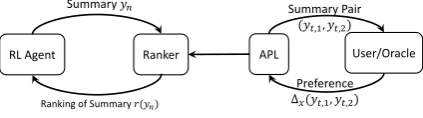
To reduce the sample complexity, in this work, we propose a novel preference-based interactive learning framework, calledAPRIL(Active Prefer-ence ReInforcement Learning). APRIL goes be-yond SPPI by proposing a new objective func-tion, which divides the preference-based interac-tive learning problem into two phases (illustrated in Figure 1b): an Active Preference Learning
Agent User/Oracle Summary Pair
("#,%, "#,&)
Preference Δ)("#,%, "#,&)
(a) Workflow of preference-based SPPI
RL Agent User/Oracle Summary Pair
("#,%, "#,&)
Preference
Δ)("#,%, "#,&)
APL Ranker
Summary "*
Ranking of Summary +("*)
[image:2.595.79.291.157.216.2](b) Workflow of APRIL
Figure 1: A comparison of workflows of SPPI (a) and APRIL (b) in the EMDS use case. Notation details, e.g.,∆xandr(yn), are discussed in§3.
We apply APRIL toExtractive Multi-Document Summarisation(EMDS). The task of EMDS is to extract sentences from the original documents to build a summary under a length constraint. We accommodate multiple APL and RL techniques in APRIL and compare their performance under different simulation settings. We also compare APRIL to a state-of-the-art SPPI implementation using both automatic metrics and human evalua-tion. Our results suggest that APRIL significantly outperforms SPPI.
2 Related Work
RL has been previously used to perform EMDS without using reference summaries. Ryang and Abekawa (2012) formulated EMDS as a Markov Decision Process (MDP), designed a heuristics-based reward function considering both informa-tion coverage rate and redundancy level, and used the Temporal Difference(TD) algorithm (Sutton, 1984) to solve the MDP. In a follow-up work, Ri-oux et al. (2014) proposed a different reward func-tion, which also did not require reference sum-maries; their experiments suggested that using their new reward function improved the summary quality. Henß et al. (2015) proposed a different RL formulation of EMDS and jointly used super-vised learning and RL to perform the task. How-ever, their method requires the access to reference summaries. More recent works applied encoder-decoder-based RL to document summarisation (Ranzato et al., 2015; Narayan et al., 2018; Paulus et al., 2017; Pasunuru and Bansal, 2018). These works outperformed standard encoder-decoder as
RL can directly optimise the ROUGE scores and can tackle theexposure biasproblems. However, these neural RL methods all used ROUGE scores as their rewards, which in turn relied on reference summaries. APRIL can accommodate these neu-ral RL techniques in its RL phase by using a rank-ing of summaries instead of the ROUGE scores as rewards. We leave neural APRIL for future study.
P.V.S. and Meyer (2017) proposed a bigram-based interactive EMDS framework. They asked users to label important bigrams in candidate sum-maries and usedinteger linear programming(ILP) to extract sentences covering as many important bigrams as possible. Their method requires no ac-cess to reference summaries, but it requires con-siderable human effort during the interaction: in simulation experiments, their system needed to collect up to 350 bigram annotations from a (simu-lated) user. In addition, they did not consider noise in users’ annotations but simulated perfect oracles.
Preference learningaims at obtaining the rank-ing (i.e. total orderrank-ing) of objects from pairwise preferences (F¨urnkranz and H¨ullermeier, 2010). Simpson and Gurevych (2018) proposed to use an improved Gaussian process preference learning
(Chu and Ghahramani, 2005) for learning to rank arguments in terms of convincingness from crowd-sourced annotations. However, such Bayesian methods can hardly scale and suffer from high computation time. Zopf (2018) recently proposed to learn a sentence ranker from preferences. The resulting ranker can be used to identify the impor-tant sentences and thus to evaluate the quality of the summaries. His study also suggests that pro-viding sentence preferences takes less time than writing reference summaries. APRIL not only learns a ranking over summaries from pairwise preferences, but also uses the ranking to “guide” our RL agent to generate good summaries.
is able to directly use a ranking of predictions to guide the RL agent without making assump-tions about the underlying structure of the utility functions. This also enables APRIL to use non-utility-based preference learning techniques (e.g., Maystre and Grossglauser, 2017).
3 Background
In this section, we recap necessary details of SPPI, RL and preference learning, and adapt them to the EMDS use case, laying the foundation for APRIL.
3.1 The SPPI Framework
LetX be the input space and let Y(x)be the set of possible outputs for inputx ∈ X. In EMDS,
x ∈ X is a cluster of documents andY(x)is the set of all possible summaries for cluster x. The function∆x:Y(x)×Y(x)→ {0,1}is the
prefer-ence functionsuch that∆x(yi, yj) = 1if the user believesyjis better thanyi(denoted byyj yior equivalentlyyi ≺yj), and 0 otherwise. Through-out this paper we assume that users do not equally prefer two different items. For a givenx, the ex-pected loss is:
LSPPI(w|x) =Epw(yi,yj|x)[∆x(yi, yj)]
= X
yi,yj∈Y(x)
∆x(yi, yj)pw(yi, yj|x), (1)
wherepw(yi, yj|x) is the probability of querying the pair(yi, yj). Formally,
pw(yi, yj|x)
= exp[w
|(φ(y
i|x)−φ(yj|x))] P
yp,yq∈Y(x)
exp[w|(φ(yp|x)−φ(yq|x))], (2)
where φ(y|x) is the vector representation of y
givenx, andw is the weight vector to be learnt. Eq. (2) is a Gibbs sampling strategy:w|(φ(yi|x)− φ(yj|x)) can be viewed as the “utility gap” be-tween yi and yj. The sampling strategy pw en-courages querying pairs with large utility gaps.
To minimiseLSPPI, SPPI uses gradient descent
to update w incrementally. Alg. 1 presents the pseudo code of our adaptation of SPPI to EMDS. In the supplementary material, we provide a de-tailed derivation of∇wLSPPI(w|x).
3.2 Reinforcement Learning
RL amounts to efficient algorithms for searching optimal solutions in MDPs. MDPs are widely
Input :sequence of learning ratesγt; query
budgetT; document clusterx
initialisew0;
whilet= 0. . . T do
sample(yi, yj)according to Eq. (2); obtain feedback∆x(yi, yj);
wt+1:=wt−γt∇wLSPPI(w|x)
end
Output:y∗ = arg maxy∈Y(x)w|T+1φ(y, x)
Algorithm 1: SPPI for preference-based
in-teractive document summarisation (adjusted from Alg. 2 in (Sokolov et al., 2016a)).
used to formulate sequential decision making
problems, which EMDS falls into: in EMDS, the summariser has to sequentially select sentences from the original documents and add them to the draft summary. An (episodic) MDP is a tuple
(S, A, P, R, T). Sis the set ofstates,Ais the set ofactions,P:S×A×S → Ris thetransition functionwithP(s0|s, a)yielding the probability of performing actionain statesand being transited to a new states0. R: S×A → Ris thereward functionwithR(s, a)giving the immediate reward for performing actionain states.T ⊆Sis the set ofterminal states; visiting a terminal state termi-nates the current episode.
In EMDS, we follow the same MDP formu-lation as Ryang and Abekawa (2012) and Rioux et al. (2014). Given a document cluster, a states
is a draft summary, A includes two types of ac-tions, concatenate a new sentence to the current draft summary, or terminate the draft summary construction. The transition functionP in EMDS is trivial because given the current draft summary and an action, the next state can be easily inferred. The reward functionRreturns an evaluation score of the summary once the actionterminateis per-formed; otherwise it returns 0 because the sum-mary is still under construction and thus not ready to be evaluated. Providing non-zero rewards be-fore the action terminatecan lead to even worse result, as reported by Rioux et al. (2014).
probabil-ity of policyπ generating a summaryyin cluster
x. Then the expected reward of a policy is:
RRL(π|x) =Ey∈Yπ(x)R(y|x)
= X
y∈Yπ(x)
π(y|x)R(y|x), (3)
whereR(y|x)is the reward for summaryyin doc-ument clusterx. The goal of an MDP is to find the optimal policyπ∗that has the highest expected re-ward:π∗ = arg maxπRRL(π).
Note that the loss function in SPPI (Eq. (1)) and the expected reward function in RL (Eq. (3)) are in similar forms: if we view the pair selection proba-bilitypw in Eq. (2) as a policy, and view the pref-erence function∆xin Eq. (1) as a negative reward function, we can view SPPI as an RL problem. The major difference between SPPI and RL is that SPPI selects and evaluates pairs of outputs, while RL selects and evaluates single outputs. We will exploit their connection to propose our new objec-tive function and the APRIL framework.
3.3 Preference Learning
The linear Bradley-Terry (BT) model (Bradley and Terry, 1952) is one of the most widely used methods in preference learning. Given a set of itemsY, suppose we have observedTpreferences:
Q = {q1(y1,1, y1,2),· · · , qT(yT ,1, yT,2)}, where
yi,1, yi,2 ∈ Y, and qi ∈ {≺,} is the oracle’s preference in theith round. The BT model min-imises the following cross-entropy loss:
LBT(w) =− X
qi(yi,1,yi,2)∈Q
[µi,1 logPw(yi,1yi,2)
+ µi,2 logPw(yi,2 yi,1) ], (4)
where Pw(yi yj) = (1 + exp[w|(φ(yj) − φ(yi))])−1, and µi,1 and µi,2 indicate the
direc-tion of preferences: if yi,1 yi,2 then µi,1 = 1
and µi,2 = 0. Let w∗ = arg minwLBT(w), then w∗ can be used to rank all items inY: for any yi, yj ∈ Y, the ranker prefers yi overyj if w∗|φ(y
i)> w∗|φ(yj).
4 APRIL: Decomposing SPPI into Active Preference Learning and RL
A major problem of SPPI is its high sample com-plexity. We believe this is due to two reasons. First, SPPI’s sampling strategy is inefficient: From Eq. (2) we can see that SPPI tends to select pairs with large quality gaps for querying the user. This
strategy can quickly identify the relatively good and relatively bad summaries, but needs many rounds of interaction to find the top summaries. Second, SPPI uses the collected preferences inef-fectively: In Alg. 1, each preference is used only once for performing the gradient descent update and is forgotten afterwards. SPPI does not gener-alise or re-use collected preferences, wasting the useful and expensive information.
These two weaknesses of SPPI motivate us to propose a new learning paradigm that can query and generalise preferences more efficiently. Re-call that in EMDS, the goal is to find the optimal summary for a given document clusterx, namely the summary that is preferred over all other pos-sible summaries in Y(x). Based on this under-standing, we define a new expected reward func-tionRAPRILfor policyπas follows:
RAPRIL(π|x) =Eyj∼π[ 1 |Y(x)|
X
yi∈Y(x)
∆x(yi, yj)]
= 1
|Y(x)|
X
yj∈Yπ(x)
π(yj|x) X
yi∈Y(x)
∆x(yi, yj)
= X
y∈Yπ(x)
π(y|x)r(y|x), (5)
where r(y|x) = P
yi∈Y(x)∆x(yi, yj)/|Y(x)|.
Note that ∆x(yi, yj) equals 1 if yj is preferred overyi and equals 0 otherwise (see§3.1). Thus, r(y|x)is the relative position ofyin the (ascend-ing) sorted Y(x), and it can be approximated by preference learning. The use of preference learn-ing enables us to generalise the observed prefer-ences to a ranker (see §3.3), allowing more ef-fective use of the collected preferences. Also, we can use active learning to select summary pairs for querying more effectively. In addition, the resem-blance ofRAPRILand RL’s reward functionRRL
(in Eq. (3)) enables us to use a wide range of RL algorithms to maximiseRAPRIL(see§2).
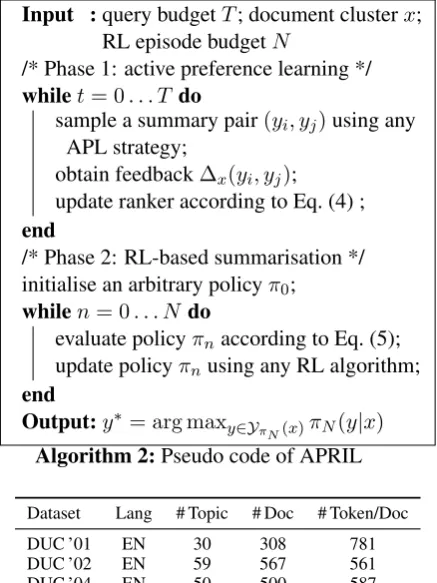
in-Input :query budgetT; document clusterx; RL episode budgetN
/* Phase 1: active preference learning */
whilet= 0. . . T do
sample a summary pair(yi, yj)using any APL strategy;
obtain feedback∆x(yi, yj);
update ranker according to Eq. (4) ;
end
/* Phase 2: RL-based summarisation */ initialise an arbitrary policyπ0;
whilen= 0. . . N do
evaluate policyπnaccording to Eq. (5); update policyπnusing any RL algorithm;
end
Output:y∗ = arg maxy∈YπN(x)πN(y|x)
Algorithm 2:Pseudo code of APRIL
Dataset Lang # Topic # Doc # Token/Doc
DUC ’01 EN 30 308 781
DUC ’02 EN 59 567 561
[image:5.595.72.291.66.358.2]DUC ’04 EN 50 500 587
Table 1: Statistics of the datasets. The target sum-mary length is 100 tokens in all three datasets.
volving humans in the loop) while the RL phase can be performed offline, helping to improve the real-time responsiveness. Also, the learned ranker can provide an unlimited number of rewards (i.e.
r(y|x)in Eq. (5)) to the RL agent, enabling us to perform many episodes of RL training with a small number of collected preferences – unlike in SPPI where each collected preference is used to train the system for one round and is forgotten afterwards. Alg. 2 shows APRIL in pseudo code.
5 Experimental Setup
Datasets. We perform experiments on DUC ’04
to find the best performing APL and RL tech-niques. Then we combine the best-performing APL and RL to complete APRIL and compare it against SPPI on the DUC ’01, DUC ’02 and DUC ’04 datasets.1 Some statistics of these datasets are summarised in Table 1.
Simulated Users. Existing preference-based
in-teractive learning techniques assume that the or-acle has an intrinsic evaluation function U∗ and provides preferences consistent withU∗by prefer-ring higher valued candidates. We term this a
Per-1http://duc.nist.gov/
fect Oracle(PO). We believe that assuming a PO is unrealistic for real-world applications, because sometimes real users tend to misjudge the prefer-ence direction, especially when the presented can-didates have similar quality. In this work, besides PO, we additionally consider two types of noisy oracles based on the user-response models pro-posed by Viappiani and Boutilier (2010):
• Constant noisy oracle (CNO): with
prob-ability c ∈ [0,1], this oracle randomly se-lects which summary is preferred; otherwise it provides preferences consistent with U∗. We consider CNOs withc= 0.1andc= 0.3.
• Logistic noisy oracle (LNO): for two
sum-maries yi and yj in cluster x, the or-acle prefers yi over yj with probability pU∗(yi yj|x;m) = (1 + exp[(U∗(yj|x)−
U∗(yi|x))/m])−1. This oracle reflects the in-tuition that users are more likely to misjudge the preference direction when two summaries have similar quality. Note that the parame-ter m ∈ R+ controls the “noisiness” of the user’s responses: higher values of m result in a less steep sigmoid curve, and the result-ing oracle is more likely to misjudge. We use LNOs withm= 0.3andm= 1.
As for the intrinsic evaluation function U∗, re-cent work has suggested that human preferences over summaries have high correlations to ROUGE scores (Zopf, 2018). Therefore, we define:
U∗(y|x) =R1(y|x) 0.47 +
R2(y|x)
0.22 +
RS(y|x)
0.18 (6)
where R1, R2 and RS stand for ROUGE-1, ROUGE-2 and ROUGE-SU4, respectively. The real values (0.47, 0.22 and 0.18) are used to bal-ance the weights of the three ROUGE scores. We choose them to be around the EMDS upper-bound ROUGE scores reported by P.V.S. and Meyer (2017). As such, an optimal summary’sU∗value should be around 3.
Implementation. All code is written in Python
and runs on a desktop PC with 8 GB RAM and an i7-2600 CPU. We use NLTK (Bird et al., 2009) to perform sentence tokenisation. Our source code is freely available at https://github.com/ UKPLab/emnlp2018-april.
6 Simulation Results
perfor-mance of multiple APL and RL algorithms in each phase. Then, in §6.3, we combine the best per-forming APL and RL algorithm to complete Alg. 2 and compare APRIL against SPPI.
6.1 APL Phase Performance
Recall that the task of APL is to output a ranking of all summaries in a cluster. In this subsection, we test multiple APL techniques and compare the quality of their resulting rankings. Two metrics are used: Kendall’sτ (Kendall, 1948) and Spearman’s
ρ(Spearman, 1904). Both metrics are valued be-tween −1 and 1, with higher values suggesting higher rank correlation. Because the number of possible summaries in a cluster is huge, instead of evaluating the ranking quality on all possible sum-maries, we evaluate rankings on 10,000 randomly sampled summaries, denotedY(ˆ x). During query-ing, all candidate summaries presented to the ora-cle are also selected fromY(ˆ x). SamplingY(ˆ x)a priori helps us to reduce the response time to un-der 500 ms for all APL techniques we test. We compare four active learning strategies under two query budgets,T = 10andT = 100:
• Random Sampling (RND): Randomly
se-lect two summaries fromY(ˆ x)to query.
• SPPI Sampling (SBT): Select summary
pairs fromY(ˆ x)according to the SPPI strat-egy in Eq. (2). After each round, the weight vectorwis updated according to Eq. (4).
• Uncertainty Sampling (Unc): Query the
mostuncertainsummary pairs. In line with P.V.S. and Meyer (2017), the uncertainty of a summary is evaluated as follows: first, we estimate the probability of a summary
y being the optimal summary in cluster x
aspopt(y|x) = (1 + exp(−wt∗|φ(x, y)))−1, where wt∗ is the weights learned by the BT model (see§3.3) in roundt. Givenpopt(y|x),
we let the uncertainty scoreunc(y|x) = 1− popt(y|x)ifpopt(y|x)≥0.5andunc(y|x) =
popt(y|x)otherwise.
• J&Nis therobust query selection algorithm
proposed by Jamieson and Nowak (2011). It assumes that the items’ preferences are de-pendent on their distances to an unknown ref-erence point in the embedding space: the far-ther an item to the reference point, the more preferred the item is. After each round of interaction, the algorithm uses all collected
preferences to locate the area where the ref-erence point may fall into, and identify the query pairs which can reduce the size of this area, termedambiguous query pairs. To com-bat noise in preferences, the algorithm se-lects the most-likely-correct ambiguous pair to query the oracle in each round.
After all preferences are collected, we obtain the ranker as follows: for anyyi, yj ∈ Y(x), the ranker prefersyioveryj if
αw∗|φ(yi|x) + (1−α)HU(yi|x)>
αw∗|φ(yj|x) + (1−α)HU(yj|x), (7)
wherew∗is the weights vector learned by the BT model (see Eq. (4)), HU is the heuristics-based summary evaluation function proposed by Ryang and Abekawa (2012), andα ∈ [0,1]is a param-eter. The aim of using HU andα is to trade off between theprior knowledge(i.e. heuristics-based
HU) and the posterior observation (i.e. the BT-learntw∗), so as to combat thecold-startproblem. Based on some preliminary experiments, we set
α= 0.3when the query budget is 10, andα= 0.7
when the query budget is 100. The intuition is to put more weight to the posterior with increasing rounds of interaction. More systematic research ofαcan yield better results; we leave it for future work. For the vectorφ(y|x), we use the same bag-of-bigram embeddings as Rioux et al. (2014), and we let its length be 200.
In Table 2, we compare the performance of the four APL methods on the DUC’04 dataset. The baseline we compared against is the prior rank-ing. We find that Unc significantly2 outperforms all other APL methods, except when the oracle is LNO-1, where the advantage of Unc to SBT is not significant. Also, both Unc and SBT are able to significantly outperform the baseline un-der all settings. The competitive performance of SBT, especially with LNO-1, is due to its unique sampling strategy: LNO-1 is more likely to mis-judge the preference direction when the presented summaries have similar quality, but SBT has high probability to present summaries with large qual-ity gaps (see Eq. (2)), effectively reducing the chance that LNOs misjudge preference directions. However, SBT is more “conservative” compared to Unc because it tends to exploit the existing
2In this paper we use double-tailed student t-test to
RND SBT Unc J&N
Oracle τ ρ τ ρ τ ρ τ ρ
Query budgetT =10,α= 0.3:
PO .211 .310 .241 .353 .253∗ .370∗ .217 .319 CNO-0.1 .208 .307 .231 .339 .240∗ .351∗ .211 .311 CNO-0.3 .210 .309 .218 .320 .229∗ .337∗ .205 .302 LNO-0.3 .210 .309 .216 .318 .231∗ .339∗ .209 .307 LNO-1 .206 .303 .210 .308 .211 .310 .207 .305
Query budgetT =100,α= 0.7:
PO .258 .377 .340 .490 .418∗ .587∗ .255 .372 CNO-0.1 .248 .363 .317 .459 .386∗ .549∗ .247 .362 CNO-0.3 .212 .312 .271 .396 .330∗ .476∗ .232 .340 LNO-0.3 .231 .339 .277 .404 .324∗ .467∗ .229 .336 LNO-1 .210 .309 .225 .330 .225 .331 .213 .313
[image:7.595.72.292.62.233.2]Baseline,α= 0,T = 0:τ =.206,ρ=.304
Table 2: Performance of multiple APL algorithms (columns) using different oracles and query bud-gets (rows). The baseline is the purely prior rank-ing. All results except the baseline are averaged over 50 document clusters in DUC’04. Aster-isk: significant advantage over other active learn-ing strategies given the same oracle and budgetT.
ranking to select one good and one bad summary to query, while Unc performs more exploration by querying the summaries that are least confident ac-cording to the current ranking. We believe this ex-plains the strong overall performance of Unc.
Additional experiments suggest that when we only use the posterior ranking (i.e. lettingα= 1), no APL we test can surpass the baseline when
T = 10. Detailed results are presented in the sup-plementary material. This observation reflects the severity of the cold-start problem, confirms the ef-fectiveness of our prior-posterior trade-off mecha-nism in combating cold-start, and indicates the im-portance of tuning theαvalue (see Eq. (7)). This opens up exciting avenues for future work.
6.2 RL Phase Performance
We compare two RL algorithms: TD(λ) (Sut-ton, 1984) and LSTD(λ) (Boyan, 1999). TD(λ) has been used in previous RL-based EMDS work (Ryang and Abekawa, 2012; Rioux et al., 2014). LSTD(λ) is chosen, because it is an improved TD algorithm and has been used in the state-of-the-art PbRL algorithm by Wirth et al. (2016). We let the learning round (see Alg. 2)N = 5,000, which we found to yield good results in reasonable time (less than 1 minute to generate a summary for one doc-ument cluster). LettingN = 3,000will result in a significant performance drop, while increasingN
to 10,000 will only bring marginal improvement at the cost of doubling the runtime. The
learn-Method R1 R2 RL RSU4
TD(λ) .484 .184 .388 .199
LSTD(λ) .458 .159 .366 .185 ILP .470 .212 N/A .185
Table 3: Upper-bound performance comparison. Results are averaged over all clusters in DUC’04.
ing parameters we use for TD(λ) are the same as those by Rioux et al. (2014). For LSTD(λ), we let
λ = 1and initialise its square matrix as a diag-onal matrix with random numbers between 0 and 1, as suggested by Lagoudakis and Parr (2003). The rewards we use are theU∗function introduced in §5. Note that this serves as the upper-bound performance, because U∗ relies on the reference summaries (see Eq. (6)), which are not available in the interactive setting. As a baseline, we also present the upper-bound performance of integer linear programming (ILP) reported by P.V.S. and Meyer (2017), optimised for bigram coverage.
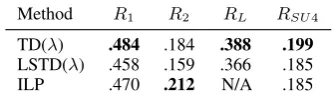
Table 3 shows the performance of RL and ILP on the DUC’04 dataset. TD(λ) significantly out-performs LSTD(λ) in terms of all ROUGE scores we consider. Although the least-square RL algo-rithms (which LSTD belongs to) have been proved to achieve better performance than standard TD methods in large-scale problems (see Lagoudakis and Parr, 2003), their performance is sensitive to many factors, e.g., initialisation values in the di-agonal matrix, regularisation parameters, etc. We note that a similar observation about the inferior performance of least-square RL in EMDS is re-ported by Rioux et al. (2014).
TD(λ) also significantly outperforms ILP in terms of all metrics except ROUGE-2. This is not surprising, because the bigram-based ILP is opti-mised for ROUGE-2, whereas our reward function
U∗ considers other metrics as well (see Eq. (6)). Since ILP is widely used as a strong baseline for EMDS, these results confirm the advantage of us-ing RL for EMDS problems.
6.3 Complete Pipeline Performance
[image:7.595.332.499.64.113.2]DUC ’01 DUC ’02 DUC ’04 Oracle Method T R1 R2 RL RSU4 R1 R2 RL RSU4 R1 R2 RL RSU4
PO
SPPI 10 .332 .075 .264 .104 .357 .083 .280† .116 .378 .098 .299 .129 APRIL 10 .357 .087 .283 .119 .390 .108 .306 .133 .410 .116 .325 .149
SPPI 100 .353 .091 .284 .119 .391 .104 .306 .136 .392 .106 .312 .140 APRIL 100 .363 .091 .283 .118 .393 .107 .310 .137 .415 .118 .325 .151
CNO-0.1
SPPI 10 .331 .081 .265 .103 .358 .081 .279† .114† .372† .093† .295† .125† APRIL 10 .351 .081 .276 .112 .376 .102 .296 .126 .403 .111 .320 .145
SPPI 100 .350 .089 .279 .117 .377 .100 .294 .129 .390 .107 .309 .138 APRIL 100 .353 .084 .280 .115 .385 .103 .302 .134 .411 .117 .325 .151
CNO-0.3
SPPI 10 .320† .063† .253† .096† .354† .080 .278† .113† .370† .093† .295† 125† APRIL 10 .339 .076 .266 .108 .370 .091 .290 .124 .394 .104 .312 .138
SPPI 100 .345 .079 .270 .111 .373 .094 .295 .125 .386 .104 .307 .136 APRIL 100 .349 .081 .275 .109 .376 .097 .296 .127 .404 .114 .320 .146
LNO-0.3
SPPI 10 .319† .067† .253† .096† .354† .083 .280† .113† .375† .095† .294† .127† APRIL 10 .347 .084 .275 .109 .370 .095 .289 .125 .398 .108 .311 .141
SPPI 100 .321† .068† .252† .097† .352† .080 .278† .112† .387 .104 .309 .136 APRIL 100 .350 .086 .277 .123 .380 .079 .296 .129 .407 .112 .321 .147
LNO-1
SPPI 10 .314† .058† .250† .092† .348† .076† .273† .110† .373† .096† .297† .126† APRIL 10 .337 .072 .266 .104 .362 .085 .286 .119 .388 .102 .307 .134
SPPI 100 .320† .064† .255† .097† .351† .078† .273† .113† .381 .099 .301 .132 APRIL 100 .347 .080 .274 .109 .369 .089 .286 .123 .391 .101 .308 .136
[image:8.595.76.528.73.348.2]Baselines SPPI 0 .323 .068 .259 .098 .350 .077 .278 .112 .372 .093 .293 .125 TD(λ) 0 .324 .069 .256 .099 .350 .081 .276 .113 .372 .086 .292 .122
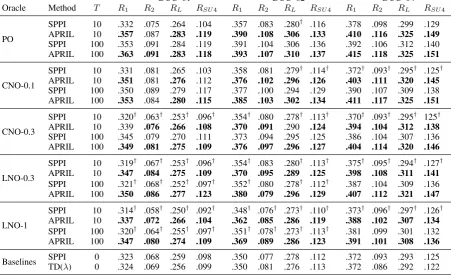
Table 4: Comparison of APRIL and SPPI. All results are averaged over all clusters in each dataset. Baselines: HU-trained SPPI and TD(λ), without any interaction (i.e. T = 0). Boldface: Comparable (i.e. no significant gaps exist) or significantly better than SPPI with 100 rounds of interaction, under the same oracle. Superscript†: Comparable or significantly worse than the corresponding baseline.
DUC’01 DUC’02 DUC’04 Overall
APRIL 3.57±.30 4.14±.14 3.86±.40 3.86±.17
SPPI 2.29±.29 2.14±.14 3.14±.34 2.52±.18
Table 5: Human ratings for the summaries gener-ated by APRIL and SPPI (mean±standard error).
SPPI) for up to 5,000 episodes. The baseline re-sults are presented in the bottom rows of Table 4.
We make the following observations from Ta-ble 4. (i)Given the same oracle, the performance of APRIL with 10 rounds of interaction is com-parable or even superior than that of SPPI after 100 rounds of interaction (see boldface in Table 4), suggesting the strong advantage of APRIL to reduce sample complexity. (ii) APRIL can sig-nificantly improve the baseline with either 10 or 100 rounds of interaction, but SPPI’s performance can be even worse than the baseline (marked by† in Table 4), especially under the high-noise low-budget settings (i.e., CNO-0.3, LNO-0.3, and LNO-1 withT = 10). This is because SPPI lacks a mechanism to balance between prior and poste-rior ranking, while APRIL can adjust this trade-off
by tuningα (Eq. (7)). This endows APRIL with better noise robustness and lower sample com-plexity in high-noise low-budget settings. Note that the above observations also hold for the other two datasets, indicating the consistently strong performance of APRIL across different datasets.
As for the overall runtime, when budget T = 100, APRIL on average takes 2 minutes to interact with an oracle and output a summary, while SPPI takes around 15 minutes due to its expensive gra-dient descent computation (see§3.1).
7 Human Evaluation
Topic d30042 (DUC’04), SPPI: After meeting Libyan leader Moammar Gad-hafi in a desert tent, U.N. Secretary-General Kofi Annan said he thinks an ar-rangement for bringing two suspects to trial in the bombing of a Pan Am air-liner could be secured in the “not too distant future.” TRIPOLI, Libya (AP) U.N. Secretary-General Kofi Annan arrived in Libya Saturday for talks aimed at bringing to trial two Libyan suspects in the 1988 Pan Am bombing over Lockerbie, Scotland. Secretary General Kofi Annan said Wednesday he was extending his North African tour to include talks with Libyan authorities. An-nan’s one-day, 2nd graf pvs During his Algerian stay,
Topic d30042 (DUC’04), APRIL: TRIPOLI, Libya (AP) U.N. Secretary-General Kofi Annan arrived in Libya Saturday for talks aimed at bringing to trial two Libyan suspects in the 1988 Pan Am bombing over Lockerbie, Scot-land. Annan’s one-day visit to meet with Libyan leader Col. Moammar Gadhafi followed reports in the Libyan media that Gadhafi had no authority to hand over the suspects. The 60-year-old Annan is trying to get Libya to go along with a U.S.-British plan to try the two suspects before a panel of Scottish judges in the Netherlands for the Dec. 21, 1988, bombing over Lockerbie, Scotland. Sirte is 400 kilometers (250 miles) east of the Libyan capital Tripoli. During his Algerian stay,
Topic d117i (DUC’02), SPPI: The Booker Prize is sponsored by Booker, an international food and agriculture business. The novel, a story of Scottish low-life narrated largely in Glaswegian dialect, is unlikely to prove a popular choice with booksellers, who have damned all six books shortlisted for the prize as boring, elitist and- worst of all- unsaleable. The shortlist of six for the Pounds 20,000 Booker Prize for fiction, announced yesterday, immediately prompted the question ’Who ? ’ Japanese writer Kazuo Ishiguro won the 1989 Booker Prize, Britain’s top literary award, for his novel “The Remains of the Day,” judges announced Thursday. He didn’t win.
Topic d117i (DUC’02), APRIL: Australian novelist Peter Carey was awarded the coveted Booker Prize for fiction Tuesday night for his love story, “Oscar and Lucinda.” The Booker Prize is sponsored by Booker, an international food and agriculture business, and administered by The Book Trust. British publish-ers can submit three new novels by British and Commonwealth writpublish-ers. Six novels have been nominated for the Booker Prize, Britain’s most prestigious fiction award, and bookmakers say the favorite is “The Remains of the Day” by Japanese author Kazuo Ishiguro. On the day of the Big Event, Ladbroke, the large British betting agency, posted the final odds.
Topic d19 (DUC’01), SPPI: The issue cuts across partisan lines in the Senate, with Minority Leader Bob Dole (R-Kan.) arguing against the White House po-sition on grounds that including illegal aliens in the census is unfair to Amer-ican citizens.. Loss of Seats Cited. Shelby’s amendment says only that the secretary is to “make such adjustments in total population figures as may be necessary, using such methods and procedures as the secretary determines fea-sible and appropriate” to keep illegal aliens from being counted in congres-sional reapportionment. “Some states will lose congrescongres-sional seats because of illegal aliens,” Dole argued. But there’s nothing simple about it.
Topic d19 (DUC’01), APRIL: In a blow to California and other states with large immigrant populations, the Senate voted Friday to bar the Census Bu-reau from counting illegal aliens in the 1990 population count. But the Senate already has voted to force the Census Bureau to exclude illegal immigrants in preparing tallies for congressional reapportionment. said that Georgia and Indi-ana both lost House seats after the 1980 Census, and California and New York-centers of illegal immigration- each gained seats. A majority of the members of the House of Representatives has signaled support. The national head count will be taken April 1, 1990.
Figure 2: Summaries generated by SPPI and APRIL used in the human evaluation experiments.
summary pairs and rate the summaries on a 5-point Likert scale with higher scores for better summaries. All users are fluent in English.
In all three topics, all users prefer the APRIL-generated summaries over the SPPI-APRIL-generated summaries. Table 5 shows the users’ ratings. The APRIL-generated summaries consistently receive higher ratings. These results are consistent with our simulation experiments and confirm the sig-nificant advantage of APRIL over SPPI.
8 Conclusion
We propose a novel preference-based interactive learning formulation named APRIL (Active Pref-erence ReInforcement Learning), which is able to make structured predictions without referring to the gold standard data. Instead, APRIL learns from preference-based feedback. We designed a novel objective function for APRIL, which natu-rally splits APRIL into anactive preference learn-ing (APL) phase and a reinforcement learning
(RL) phase, enabling us to leverage a wide spec-trum of active learning, preference learning and RL algorithms to maximise the output quality with a limited number of interaction rounds. We ap-plied APRIL to the Extractive Multi-Document Summarisation (EMDS) problem, simulated the users’ preference-giving behaviour using multiple user-response models, and compared the perfor-mance of multiple APL and RL techniques. Sim-ulation experiments indicated that APRIL
signif-icantly improved the summary quality with just 10 rounds of interaction (even with high-noise oracles), and significantly outperformed SPPI in terms of both sample complexity and noise robust-ness. Human evaluation results suggested that real users preferred the APRIL-generated summaries over the SPPI-generated ones.
We identify two major lines of future work. On the technical side, we plan to employ more ad-vanced APL and RL algorithms in APRIL, such as sample-efficient Bayesian-based APL algorithms (e.g., Simpson and Gurevych, 2018) and neural RL algorithms (e.g. Mnih et al., 2015) to further reduce the sample complexity of APRIL. On the experimental side, a logical next step is to imple-ment an interactive user interface for APRIL and conduct a larger evaluation study comparing the summary quality before and after the interaction. We also plan to apply APRIL to more NLP appli-cations, including machine translation, informa-tion explorainforma-tion and semantic parsing.
Acknowledgements
References
Steven Bird, Ewan Klein, and Edward Loper. 2009. Natural Language Processing with Python. O’Reilly.
Justin A. Boyan. 1999. Least-squares temporal differ-ence learning. InProceedings of the Sixteenth Inter-national Conference on Machine Learning (ICML 1999), June 27–30, 1999, Bled, Slovenia, pages 49– 56.
Ralph Allan Bradley and Milton E Terry. 1952. Rank analysis of incomplete block designs: I. The method of paired comparisons. Biometrika, 39(3/4):324– 345.
Paul F. Christiano, Jan Leike, Tom Brown, Miljan Mar-tic, Shane Legg, and Dario Amodei. 2017. Deep Reinforcement Learning from Human Preferences. InAdvances in Neural Information Processing Sys-tems 30: 31st Annual Conference on Neural Infor-mation Processing Systems, December 4–9, 2017, Long Beach, CA, USA, pages 4302–4310.
Wei Chu and Zoubin Ghahramani. 2005. Prefer-ence learning with Gaussian processes. In Ma-chine Learning, Proceedings of the Twenty-Second International Conference (ICML 2005), August 7– 11, 2005, Bonn, Germany, pages 137–144.
Johannes F¨urnkranz and Eyke H¨ullermeier. 2010. Pref-erence learning: An introduction. In Preference Learning, pages 1–17. Berlin/Heidelberg: Springer.
Stefan Henß, Margot Mieskes, and Iryna Gurevych. 2015. A reinforcement learning approach for adap-tive single- and multi-document summarization. In Proceedings of the International Conference of the German Society for Computational Linguistics and Language Technology (GSCL 2015), September 30– October 2, 2015, University of Duisburg-Essen, Germany, pages 3–12.
Kevin G. Jamieson and Robert D. Nowak. 2011. Ac-tive ranking using pairwise comparisons. In Ad-vances in Neural Information Processing Systems 24: 25th Annual Conference on Neural Informa-tion Processing Systems, December 12–14, 2011, Granada, Spain, pages 2240–2248.
M.G. Kendall. 1948. Rank correlation methods. C. Griffin.
David C Kingsley and Thomas C Brown. 2010. Prefer-ence uncertainty, preferPrefer-ence refinement and paired comparison choice experiments. Land Economics, 86(3):530–544.
Julia Kreutzer, Artem Sokolov, and Stefan Riezler. 2017. Bandit structured prediction for neural sequence-to-sequence learning. In Proceedings of the 55th Annual Meeting of the Association for Computational Linguistics (ACL 2017), Volume 1: Long Papers, July 30–August 4, 2017, Vancouver, Canada, pages 1503–1513.
Michail G Lagoudakis and Ronald Parr. 2003. Least-squares policy iteration. Journal of Machine Learn-ing Research, 4:1107–1149.
Chin-Yew Lin. 2004. ROUGE: A package for auto-matic evaluation of summaries. In Workshop on Text Summarization Branches Out, Post-Conference Workshop of ACL, July 21–26, 2004, Barcelona, Spain, pages 74–81.
Lucas Maystre and Matthias Grossglauser. 2017. Just sort it! A simple and effective approach to ac-tive preference learning. In Proceedings of the 34th International Conference on Machine Learning (ICML 2017), August 6–11, 2017, Sydney, Australia, pages 2344–2353.
Volodymyr Mnih, Koray Kavukcuoglu, David Silver, Andrei A Rusu, Joel Veness, Marc G Bellemare, Alex Graves, Martin Riedmiller, Andreas K Fidje-land, Georg Ostrovski, et al. 2015. Human-level control through deep reinforcement learning. Na-ture, 518(7540):529–533.
Shashi Narayan, Shay B. Cohen, and Mirella Lapata. 2018. Ranking sentences for extractive summariza-tion with reinforcement learning. InProceedings of the 2018 Conference of the North American Chap-ter of the Association for Computational Linguis-tics: Human Language Technologies (NAACL-HLT 2018),Volume 1 (Long Papers), June 1-6, 2018, New Orleans, LA, USA, pages 1747–1759.
Ani Nenkova and Kathleen McKeown. 2012. A survey of text summarization techniques. In Charu C. Ag-garwal and ChengXiang Zhai, editors, Mining Text Data, pages 43–76. Boston: Springer.
Ramakanth Pasunuru and Mohit Bansal. 2018. Multi-reward reinforced summarization with saliency and entailment. InProceedings of the 2018 Conference of the North American Chapter of the Association for Computational Linguistics: Human Language Technologies (NAACL-HLT 2018), Volume 2 (Short Papers), June 1-6, 2018, New Orleans, LA, USA, pages 646–653.
Romain Paulus, Caiming Xiong, and Richard Socher. 2017. A deep reinforced model for abstractive sum-marization.CoRR, abs/1705.04304.
Avinesh P.V.S. and Christian M. Meyer. 2017. Joint optimization of user-desired content in multi-document summaries by learning from user feed-back. InProceedings of the 55th Annual Meeting of the Association for Computational Linguistics (ACL 2017): Volume 1: Long Paper, July 30–August 4, 2017, Vancouver, Canada, pages 1353–1363.
Cody Rioux, Sadid A. Hasan, and Yllias Chali. 2014. Fear the REAPER: A system for automatic multi-document summarization with reinforcement learn-ing. In Proceedings of the 2014 Conference on Empirical Methods in Natural Language Processing (EMNLP 2014), October 25–29, 2014, Doha, Qatar, pages 681–690.
Seonggi Ryang and Takeshi Abekawa. 2012. Frame-work of automatic text summarization using rein-forcement learning. In Proceedings of the 2012 Joint Conference on Empirical Methods in Natural Language Processing and Computational Natural Language Learning (EMNLP-CoNLL 2012), July 12–14, 2012, Jeju Island, Korea, pages 256–265.
Edwin D. Simpson and Iryna Gurevych. 2018. Finding convincing arguments using scalable bayesian pref-erence learning. Transactions of the Association for Computational Linguistics, 6:357–371.
Artem Sokolov, Julia Kreutzer, Christopher Lo, and Stefan Riezler. 2016a. Learning structured predic-tors from bandit feedback for interactive NLP. In Proceedings of the 54th Annual Meeting of the Asso-ciation for Computational Linguistics (ACL 2016): Volume 1: Long Papers, August 7–12, 2016, Berlin, Germany, pages 1610–1620.
Artem Sokolov, Julia Kreutzer, Stefan Riezler, and Christopher Lo. 2016b. Stochastic structured pre-diction under bandit feedback. InAdvances in Neu-ral Information Processing Systems 29: 30th An-nual Conference on Neural Information Processing Systems, December 5–10, 2016, Barcelona, Spain, pages 1489–1497.
Charles Spearman. 1904. The proof and measurement of association between two things. The American Journal of Psychology, 15(1):72–101.
R. S. Sutton. 1984.Temporal Credit Assignment in Re-inforcement Learning. Ph.D. thesis, University of Massachusetts, Amherst.
Louis Leon Thurstone. 1927. A Law of Comparative Judgement. Psychological Review, 34:278–286. Paolo Viappiani and Craig Boutilier. 2010. Optimal
Bayesian recommendation sets and myopically op-timal choice query sets. In Advances in Neural Information Processing Systems 23: 24th Annual Conference on Neural Information Processing Sys-tems, December 6-9 , Vancouver, British Columbia, Canada, pages 2352–2360.
Christian Wirth, Riad Akrour, Gerhard Neumann, and Johannes F¨urnkranz. 2017. A survey of preference-based reinforcement learning methods. Journal of Machine Learning Research, 18:4945–4990.
Christian Wirth, Johannes F¨urnkranz, and Gerhard Neumann. 2016. Model-free preference-based rein-forcement learning. InProceedings of the Thirtieth AAAI Conference on Artificial Intelligence, Febru-ary 12–17, 2016, Phoenix, AZ, USA, pages 2222– 2228.