1
Neural Character-based Composition Models for Abuse Detection
Pushkar Mishra Dept. of CS & Technology
University of Cambridge United Kingdom
Helen Yannakoudakis The ALTA Institute University of Cambridge
United Kingdom
Ekaterina Shutova ILLC
University of Amsterdam The Netherlands
Abstract
The advent of social media in recent years has fed into some highly undesirable phenomena such as proliferation of offensive language, hate speech, sexist remarks, etc. on the Inter-net. In light of this, there have been several efforts to automate the detection and modera-tion of such abusive content. However, delib-erate obfuscation of words by users to evade detection poses a serious challenge to the ef-fectiveness of these efforts. The current state of the art approaches to abusive language de-tection, based on recurrent neural networks, do not explicitly address this problem and resort to a genericOOV (out of vocabulary) embed-ding for unseen words. However, in using a single embedding for all unseen words we lose the ability to distinguish between obfuscated and non-obfuscated or rare words. In this pa-per, we address this problem by designing a model that can compose embeddings for un-seen words. We experimentally demonstrate that our approach significantly advances the current state of the art in abuse detection on datasets from two different domains, namely Twitter and Wikipedia talk page.
1 Introduction
Pew Research Centerhas recently uncovered sev-eral disturbing trends in communications on the Internet. As per their report (Duggan,2014), 40% of adult Internet users have personally experienced harassment online, and 60% have witnessed the use of offensive names and expletives. Expect-edly, the majority (66%) of those who have per-sonally faced harassment have had their most re-cent incident occur on a social networking website or app. While most of these websites and apps pro-vide ways of flagging offensive and hateful tent, only 8.8% of the victims have actually con-sidered using such provisions.
Two conclusions can be drawn from these statis-tics: (i)abuse(a term we use henceforth to collec-tively refer to toxic language, hate speech, etc.) is prevalent in social media, and (ii) passive and/or manual techniques for curbing its propagation (such as flagging) are neither effective nor easily scalable (Pavlopoulos et al.,2017). Consequently, the efforts to automate the detection and modera-tion of such content have been gaining popularity (Waseem and Hovy,2016;Wulczyn et al.,2017).
In their work, Nobata et al. (2016) describe the task of achieving effective automation as an inher-ently difficult one due to several ingrained com-plexities; a prominent one they highlight is the deliberate structural obfuscation of words (for ex-ample, fcukk,w0m3n,banislam, etc.) by users to evade detection. Simple spelling correction tech-niques and edit-distance procedures fail to provide information about such obfuscations because: (i) words may be excessively fudged (e.g., a55h0le, n1gg3r) or concatenated (e.g., stupidbitch, femi-nismishate), and (ii) they fail to take into account the fact that some character sequences like musl andwomare more frequent and more indicative of abuse than others (Waseem and Hovy,2016).
noisy input is not explicitly accounted for, these approaches resort to the use of a generic OOV (out of vocabulary) embedding for words not seen in the training phase. However, in using a sin-gle embedding for all unseen words, such ap-proaches lose the ability to distinguish obfuscated words from non-obfuscated or rare ones. Recently, Mishra et al. (2018) and Qian et al. (2018), working with the same Twitter dataset as we do, reported that many of the misclassifications by their RNN-based methods happen due to inten-tional misspellings and/or rare words.
Our contributions are two-fold: first, we exper-imentally demonstrate that character n-gram fea-tures are complementary to the current state of the artRNNapproaches to abusive language detection and can strengthen their performance. We then ex-plicitly address the problem of deliberately noisy input by constructing a model that operates at the character level and learns to predict embeddings for unseen words. We show that the integration of this model with the character-enhancedRNN meth-ods further advances the state of the art in abuse detection on three datasets from two different do-mains, namely Twitter and Wikipedia talk page. To the best of our knowledge, this is the first work to use character-based word composition models for abuse detection.
2 Related Work
Yin et al. (2009) were among the first ones to ap-ply supervised learning to the task of abuse detec-tion. They worked with a linear support vector ma-chine trained on local (e.g., n-grams), contextual (e.g., similarity of a post to its neighboring posts), and sentiment-based (e.g., presence of expletives) features to recognize posts involving harassment.
Djuric et al. (2015) worked with comments taken from the Yahoo Finance portal and demon-strated that distributional representations of com-ments learned using the paragraph2vec frame-work (Le and Mikolov,2014) can outperform sim-pler bag-of-wordsBOWfeatures under supervised classification settings for hate speech detection. Nobata et al. (2016) improved upon the results of Djuric et al. by training their classifier on an amal-gamation of features derived from four different categories: linguistic (e.g., count of insult words), syntactic (e.g. part-of-speechPOStags), distribu-tional semantic (e.g., word and comment embed-dings) and n-gram based (e.g., word bi-grams).
They noted that while the best results were ob-tained with all features combined, character n-grams had the highest impact on performance.
Waseem and Hovy (2016) utilized a logistic regression (LR) classifier to distinguish amongst racist, sexist, and clean tweets in a dataset of ap-proximately 16kof them. They found that char-acter n-grams coupled with gender information of users formed the optimal feature set for the task. On the other hand, geographic and word-length distribution features provided little to no improve-ment. Experimenting with the same dataset, Bad-jatiya et al. (2017) improved on their results by training a gradient-boosted decision tree (GBDT) classifier on averaged word embeddings learnt us-ing a long short-term memory (LSTM) models ini-tialized with random embeddings. Mishra et al. (2018) went on to incorporate community-based profiling features of users in their classification methods, which led to the state of the art perfor-mance on this dataset.
Waseem (2016) studied the influence of anno-tators’ knowledge on the task of hate speech de-tection. For this, they sampled 7k tweets from the same corpus as Waseem and Hovy (2016) and recruited expert and amateur annotators to anno-tate the tweets asracism,sexism,bothorneither. Combining this dataset with that of Waseem and Hovy (2016), Park et al. (2017) evaluated the ef-ficacy of a 2-step classification process: they first used anLRclassifier to separate abusive and non-abusive tweets, and then used anotherLRclassifier to distinguish between the racist and sexist ones. They showed that this setup had comparable per-formance to a 1-step classification approach based on convolutional neural networks (CNNs) operat-ing on word and character embeddoperat-ings.
about25kracist, offensiveorclean tweets. They evaluated several multi-class classifiers with the aim of discerning clean tweets from racist and of-fensive tweets, while simultaneously being able to distinguish between the racist and offensive ones. Their best model was anLRclassifier trained using TF–IDFandPOSn-gram features coupled with fea-tures like count of hash tags and number of words.
3 Datasets
Following the proceedings of the1stWorkshop on Abusive Language Online(Waseem et al., 2017), we use three datasets from two different domains.
3.1 Twitter
Waseem and Hovy (2016) prepared a dataset of
16,914 tweets from a corpus of approximately
136ktweets retrieved over a period of two months. They bootstrapped their collection process with a search for commonly used slurs and expletives re-lated to religious, sexual, gender and ethnic mi-norities. After having manually annotated16,914
of the tweets as racism, sexism or neither, they asked an expert to review their annotations in order to mitigate against any biases. The inter-annotator agreement was reported atκ = 0.84, with further insight that85%of all the disagreements occurred in thesexismclass alone.
The authors released the dataset as a list of
16,907 tweet IDs and their corresponding anno-tations. We could only retrieve 16,202 of the tweets with python’s Tweepy library since some of them have been deleted or their visibility has been limited. Of the ones retrieved, 1,939 (12%) areracism, 3,148 (19.4%) aresexism, and the re-maining 11,115 (68.6%) are neither; the origi-nal dataset has a similar distribution, i.e., 11.7% racism, 20.0%sexism, and 68.3%neither.
3.2 Wikipedia talk page
Wulczyn et al. (2017) extracted approximately
63M talk page comments from a public dump of the full history of English Wikipedia released in January 2016. From this corpus, they ran-domly sampled comments to form three datasets on personal attack, toxicity and aggression, and engaged workers from CrowdFlower to annotate them. Noting that the datasets were highly skewed towards the non-abusive classes, the authors over-sampled comments from banned users to attain a more uniform distribution.
In this work, we utilize the toxicity and per-sonal attack datasets, henceforth referred to as W -TOX and W-ATT respectively. Each comment in both of these datasets was annotated by at least 10 workers. We use the majority annotation of each comment to resolve its gold label: if a comment is deemed toxic (alternatively, attacking) by more than half of the annotators, we label it asabusive; otherwise, asnon-abusive. 13,590 (11.7%) of the 115,864 comments in W-ATT and 15,362 (9.6%) of the 159,686 comments in W-TOX are abusive. Wikipedia comments, with an average length of 25 tokens, are considerably longer than the tweets which have an average length of 8.
4 Methods
We experiment with ten different methods, eight of which have an RNNoperating on word embed-dings. Six of these eight also include character n-gram features, and four further integrate our word composition model. The remaining two comprise anRNNthat works directly on character inputs.
Hidden-state (HS).As our first baseline, we adopt the “RNN” method of Pavlopoulos et al. (2017) since it produces state of the art results on the Wikipedia datasets. Given a text formed of a se-quence w1, . . ., wn of words (represented by d
-dimensional word embeddings), the method uti-lizes a 1-layer GRUto encode the words into hid-den statesh1,. . .,hn. This is followed by anLR
layer that classifies the text based on the last hid-den state hn. We modify the authors’ original
ar-chitecture in two minor ways: we extend the 1-layerGRUto a 2-layerGRUand use softmax as the activation in theLRlayer instead of sigmoid.1
Following Pavlopoulos et al., we initialize the word embeddings to GLoVe vectors (Pennington et al.,2014). In all our methods, words not present in the GLoVe set are randomly initialized in the range ±0.05, indicating the lack of semantic in-formation. By not mapping these words to a single random embedding, we mitigate against the errors that may arise due to their conflation (Madhyastha et al.,2015). A special OOV (out of vocabulary) token is also initialized in the same range. All the embeddings are updated during training, allowing for some of the randomly-initialized ones to get
1
task-tuned (Kim, 2014); the ones that do not get tuned lie closely clustered around the OOV token to which unseen words in the test set are mapped. Word-sum (WS). The “LSTM+GLoVe+GBDT” method of Badjatiya et al. (2017) constitutes our second baseline. The authors first employ anLSTMto task-tuneGLoVe-initialized word em-beddings by propagating error back from an LR layer. They then train a gradient-boosted decision tree (GBDT) classifier to classify texts based on the average of the constituent word embeddings.2 We make two minor modifications to the original method: we utilize a 2-layerGRU3 instead of the LSTM to tune the embeddings, and we train the GBDT classifier on the L2-normalized sum of the
embeddings instead of their average.4
Hidden-state + char n-grams (HS+CNG).Here we extend the hidden-state baseline: we train the 2-layer GRU architecture as before, but now concatenate its last hidden state hn with L2
-normalized character n-gram counts to train a GBDTclassifier.
Augmented hidden-state + char n-grams (AUGMENTED HS+CNG).In the above methods, unseen words in the test set are simply mapped to the OOV token since we do not have a way of obtaining any semantic information about them. However, this is undesirable since racial slurs and expletives are often deliberately fudged by users to prevent detection. In using a single embedding for all unseen words, we lose the ability to distinguish such obfuscations from other non-obfuscated or rare words. Taking inspiration from the effectiveness of character-level features in abuse detection, we address this issue by having a character-based word composition model that can compose embeddings for unseen words in the test set (Pinter et al.,2017). We then augment the hidden-state + char n-gramsmethod with it.
2
In their work, the authors report that initializing embed-dings randomly rather than withGLoVe yields state of the art performance on the Twitter dataset that we are using. How-ever, we found the opposite when performing 10-fold strat-ified cross-validation (CV). A possible explanation of this lies in the authors’ decision to not use stratification, which for such a highly imbalanced dataset can lead to unexpected outcomes (Forman and Scholz,2010). Furthermore, the au-thors train theirLSTMon the entire dataset including the test part without any early stopping criterion; this facilitates over-fitting of the randomly-initialized embeddings.
3
The deeper 2-layerGRUslightly improves performance.
4
L2-normalized sum ensures uniformity of range across the feature set in all our methods;GBDT, being a tree based model, is not affected by the choice of monotonic function.
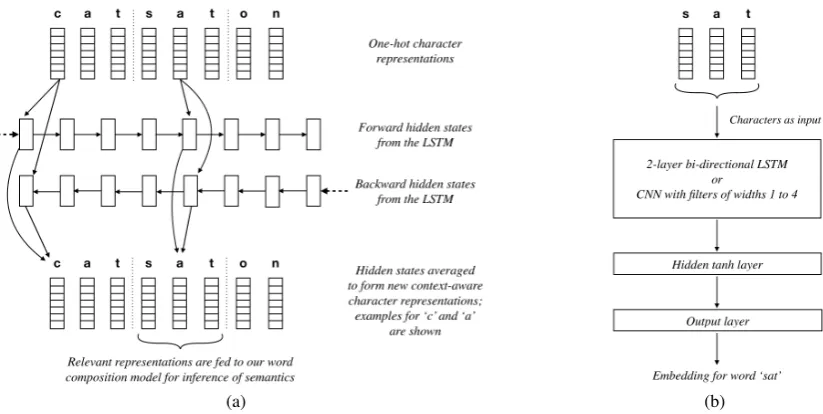
Specifically, our model (Figure 1b) comprises a 2-layer bi-directional LSTM, followed by a hid-den layer with tanh non-linearity and an output layer at the end. The model takes as input a se-quence c1, . . ., ck of characters, represented as
one-hot vectors, from a fixed vocabulary (i.e., low-ercase English alphabet and digits) and outputs a
d-dimensional embedding for the word ‘c1. . . ck’.
Bi-directionality of the LSTM allows for the se-mantics of both the prefix and the suffix (last hid-den forward and backward state) of the input word to be captured, which are then combined to form the hidden state for the input word. The model is trained by minimizing the mean squared er-ror (MSE) between the embeddings that it pro-duces and the task-tuned embeddings of words in the training set. This ensures that newly com-posed embeddings are endowed with characteris-tics from both theGLoVe space as well as the task-tuning process. While approaches like that of Bo-janowski et al. (2017) can also compose embed-dings for unseen words, they cannot endow the newly composed embeddings with characteristics from the task-tuning process; this may constitute a significant drawback (Kim,2014).
During the training of our character-based word composition model, to emphasize frequent words, we feed a word as many times as it appears in the training corpus. We note that a 1-layer CNN with global max-pooling in place of the 2-layer LSTM provides comparable performance while requiring significantly less time to train. This is expected since words are not very long sequences, and the filters of the CNNare able to capture the different character n-grams within them.
(a) (b)
Figure 1: Context-aware approach to word composition. The figure on the left shows how the encoder extracts context-aware representations of characters in the phrase “cat sat on” from their one-hot repre-sentations. The dotted lines denote the space charactert which demarcates word boundaries. Semantics
of an unseen word, e.g.,sat, can then be inferred by our word composition model shown on the right.
To address this, we develop context-aware representations for characters as inputs to our character-based word composition model instead of one-hot representations.5 We introduce an en-coder architecture to produce the context-aware representations. Specifically, given a text formed of a sequencew1, . . ., wn of words, the encoder
takes as input one-hot representations of the char-actersc1,. . .,ckwithin the concatenated sequence
‘w1t. . .twn’, wheret denotes the space
charac-ter. This input is passed through a bi-directional LSTMthat produces hidden statesh1,. . .,hk, one
for every character. Each hidden state, referred to as context-aware character representation, is the average of its designated forward and backward states; hence, it captures both the preceding as well as the following contexts of the character it corresponds to. Figure 1 illustrates how the context-aware representations are extracted and used for inference by our character-based word composition model. The model is trained in the same manner as done in the augmented hidden-state + char n-grams method, i.e., by minimiz-ing the MSEbetween the embeddings that it pro-duces and the task-tuned embeddings of words in the training set (initialized withGLoVe). However,
5
We also experimented with word-level context but did not get any significant improvements. We believe this is due to higher variance at word level than at the character level.
the inputs now are context-aware representations of characters instead of one-hot representations.
Word-sum + char n-grams (WS + CNG), Augmented word-sum + char n-grams (AUGMENTED WS + CNG), and Context word-sum + char n-grams (CONTEXT WS + CNG).These methods are identical to the(context/ augmented) hidden-state + char n-gramsmethods except that here we include the character n-grams and our character-based word composition model on top of theword-sumbaseline.
Char hidden-state (CHAR HS) andChar word-sum (CHAR WS).In all the methods described up till now, the input to the core RNN is word em-beddings. To gauge whether character-level inputs are themselves sufficient or not, we construct two methods based on thecharacter to word(C2W) ap-proach of Ling et al. (2015). For thechar hidden-statemethod, the input is one-hot representations of characters from a fixed vocabulary. These rep-resentations are encoded into a sequencew1,. . .,
wnof intermediate word embeddings by a 2-layer
bi-directional LSTM. The word embeddings are then fed into a 2-layer GRUthat transforms them into hidden states h1, . . ., hn. Finally, as in the
hidden-state baseline, an LR layer with softmax activation uses the last hidden statehnto perform
is similar except that once the network has been trained, we use the intermediate word embeddings produced by it to train a GBDT classifier in the same manner as done in theword-sumbaseline.
5 Experiments and Results
5.1 Experimental setup
We normalize the input by lowercasing all words and removing stop words. For theGRU architec-ture, we use exactly the same hyper-parameters as Pavlopoulos et al. (2017),6 i.e., 128 hidden units, Glorot initialization, cross-entropy loss, and Adam optimizer (Kingma and Ba, 2015). Bad-jatiya et al. (2017) also use the same settings except they have fewer hidden units. The LSTM in our character-based word composition model has 256 hidden units while that in our encoder has 64; the CNN has filters of widths varying from 1 to 4. The results we report are with an LSTM-based word composition model. In all the models, besides dropout regularization (Srivastava et al.,2014), we hold out a small part of the train-ing set as validation data to prevent over-fitttrain-ing. We use 300d embeddings and 1 to 5 character n-grams for Wikipedia and 200d embeddings and 1 to 4 character n-grams for Twitter. We imple-ment the models in Keras (Chollet et al., 2015) withTheanoback-end. We employLightgbm(Ke et al., 2017) as our GDBT classifier and tune its hyper-parameters using 5-fold grid search.
5.2 Twitter results
For the Twitter dataset, unlike previous research (Badjatiya et al.,2017;Park and Fung,2017), we report the macro precision, recall, andF1averaged
over 10 folds of stratified CV (Table 1). For a classification problem withN classes, macro pre-cision (similarly, macro recall and macro F1) is
given by:
M acro P = 1 N
N
X
i=1
Pi
wherePidenotes precision on classi. Macro
met-rics provide a better sense of effectiveness on the minority classes (Van Asch,2013).
We observe that character n-grams (CNG) con-sistently enhance performance, while our aug-mented approach (AUGMENTED) further improves
6
The authors have not released their models; we replicate their method based on the details in their paper.
upon the results obtained with character n-grams. All the improvements are statistically significant withp <0.05under 10-foldCVpaired t-test.
As Ling et al. (2015) noted in theirPOStagging experiments, we observe that the CHAR HS and CHAR WSmethods perform worse than their coun-terparts that use pre-trained word embeddings, i.e., theHSandWSbaselines respectively.
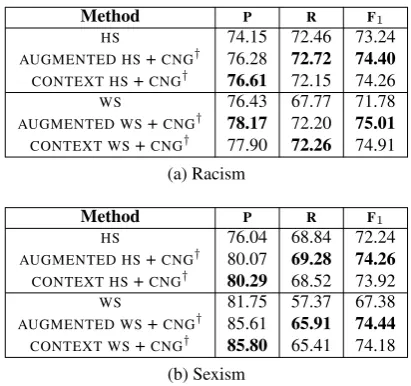
To further analyze the performance of our best methods (CONTEXT/AUGMENTED WS/HS + CNG), we also examine the results on the racism and sexism classes individually (Table2). As be-fore, we see that our approach consistently im-proves over the baselines, and the improvements are statistically significant under paired t-tests.
Method P R F1
HS 79.14 77.06 78.01
CHAR HS 79.48 69.00 72.36
HS+CNG† 80.36 78.20 79.19
AUGMENTED HS+CNG† 81.28 77.84 79.37
CONTEXT HS+CNG† 81.39 77.47 79.21
WS 80.78 72.83 75.93
CHAR WS 80.04 68.17 71.94
WS+CNG† 83.16 76.60 79.31
AUGMENTED WS+CNG† 83.50 77.20 79.80
[image:6.595.327.532.277.395.2]CONTEXT WS+CNG† 83.44 77.06 79.67
Table 1: Results on the Twitter dataset. The meth-ods we propose are denoted by†. Our best method (AUGMENTED WS + CNG) significantly outper-forms all other methods.
Method P R F1
HS 74.15 72.46 73.24
AUGMENTED HS+CNG† 76.28 72.72 74.40
CONTEXT HS+CNG† 76.61 72.15 74.26
WS 76.43 67.77 71.78
AUGMENTED WS+CNG† 78.17 72.20 75.01
CONTEXT WS+CNG† 77.90 72.26 74.91 (a) Racism
Method P R F1
HS 76.04 68.84 72.24
AUGMENTED HS+CNG† 80.07 69.28 74.26
CONTEXT HS+CNG† 80.29 68.52 73.92
WS 81.75 57.37 67.38
AUGMENTED WS+CNG† 85.61 65.91 74.44
CONTEXT WS+CNG† 85.80 65.41 74.18 (b) Sexism
Table 2: The baselines (WS, HS) vs. our best ap-proaches (†) on the racism and sexism classes.
[image:6.595.326.532.482.675.2]+CNGmethod from 74.12 to 75.01 for the racism class, and from 74.03 to 74.44 for the sexism class. TheAUGMENTED HS+CNGmethod similarly im-proves theF1score of theHS+CNGmethod from
74.00 to 74.40 on the racism class while making no notable difference on the sexism class.
We see that theCONTEXT HS/WS +CNG meth-ods do not perform as well as the AUGMENTED HS/WS + CNG methods. One reason for this is that the Twitter dataset is not able to expose the methods to enough contexts due to its small size. Moreover, because the collection of this dataset was bootstrapped with a search for certain commonly-used abusive words, many such words are shared across multiple tweets belonging to dif-ferent classes. Given the above, context-aware character representations perhaps do not provide substantial distinctive information.
5.3 Wikipedia results
Following previous work (Pavlopoulos et al., 2017; Wulczyn et al., 2017), we conduct a stan-dard 60:40 train–test split experiment on the two Wikipedia datasets. Specifically, from W-TOX,
95,692 comments (10.0% abusive) are used for training and 63,994 (9.1% abusive) for testing; fromW-ATT,70,000(11.8%abusive) are used for training and 45,854 (11.7% abusive) for testing. Table3 reports the macro F1 scores. We do not
report scores from the CHAR HS and CHAR WS methods since they showed poor preliminary re-sults compared to theHSandWSbaselines.
Method W-TOX W-ATT
HS 88.65 86.28
HS+CNG† 89.29 87.32
AUGMENTED HS+CNG† 89.31 87.33
CONTEXT HS+CNG† 89.35 87.44
WS 85.49 84.35
WS+CNG† 87.12 85.80
AUGMENTED WS+CNG† 87.02 85.75
[image:7.595.326.532.100.225.2]CONTEXT WS+CNG† 87.16 85.81
Table 3: Macro F1 scores on the two Wikipedia
datasets. The current state of the art method for these datasets is HS. † denotes the methods we propose. Our best method (CONTEXT HS+ CNG) outperforms all the other methods.
Mirroring the analysis carried out for the Twit-ter dataset, Table 4 further compares the per-formance of our best methods for Wikipedia (CONTEXT/AUGMENTED HS+ CNG) with that of
the state of the art baseline (HS) on specifically the abusive classes ofW-TOXandW-ATT.
Method P R F1
HS 84.48 74.60 79.24
AUGMENTED HS+CNG† 85.43 76.02 80.45
CONTEXT HS+CNG† 85.42 76.17 80.53 (a)W-TOX
Method P R F1
HS 78.61 72.88 75.64
AUGMENTED HS+CNG† 81.23 74.06 77.48
CONTEXT HS+CNG† 81.39 74.28 77.67 (b)W-ATT
Table 4: The current state of the art baseline (HS) vs. our best methods (†) on the abusive classes of W-TOXandW-ATT.
We observe that the augmented approach sub-stantially improves over the state of the art base-line. Unlike in the case of Twitter, our context-aware setup for word composition is now able to further enhance performance courtesy of the larger size of the datasets which increases the availability of contexts. All improvements are significant (p < 0.05) under paired t-tests. We note, however, that the gains we get here with the word composition model are relatively small compared to those we get for Twitter. This difference can be explained by the fact that: (i) Wikipedia comments are less noisy than the tweets and contain fewer obfusca-tions, and (ii) the Wikipedia datasets, being much larger, expose the methods to more words dur-ing traindur-ing, hence reducdur-ing the likelihood of un-seen words being important to the semantics of the comments they belong to (Kim et al.,2016).
[image:7.595.99.289.506.606.2]Abusive sample Predicted class
WS WS+CNG AUGMENTED WS+CNG
@mention I love how the Islamofascists recruit 14 and 15 year old jihadis and then talk about minors in reference to 17 year olds.
neither racism racism
@mention @mention @mention As a certified inmate of the Is-lamasylum, you don’t have the ability to judge.
neither racism racism
@mention “I’ll be ready in 5 minutes” from a girl usually means “I’ll be ready in 20+ minutes.” #notsexist #knownfrom-experience
neither sexism sexism
RT @mention: #isis #muslim #Islamophobia? I think the word you’re searching for is #Islamorealism http://t.co/NyihT8Bqyu http://t.c...
neither neither racism
@mention @mention And looking at your page, I can see that you are in the business of photoshopping images, Islamist cock-sucker.
neither neither racism
I think Kat is on the wrong show. #mkr is for people who can cook. #stupidbitch #hopeyouareeliminated
neither neither sexism
[image:8.595.96.531.57.256.2]@mention because w0m3n are a5sh0les #feminismishate neither neither sexism
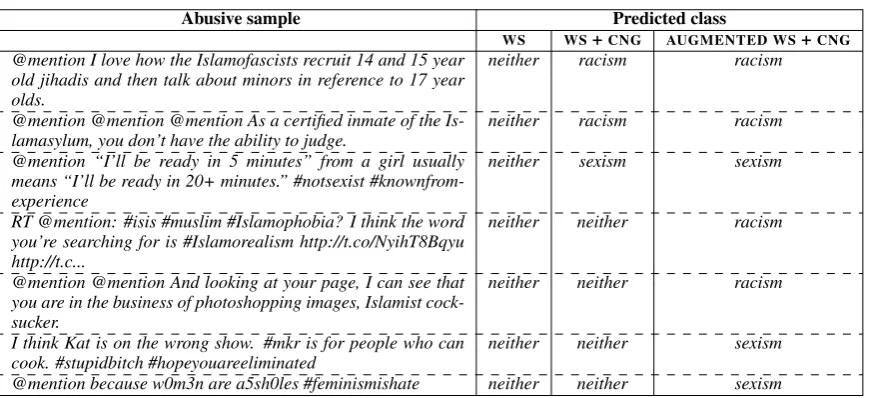
Table 5: Improved classification upon the addition of character n-grams (CNG) and our word composition model (AUGMENTED). Names of users have been replaced withmentionfor anonymity.
6 Discussion
To investigate the extent to which obfuscated words can be a problem, we extract a number of statistics. Specifically, we notice that out of the approximately 16k unique tokens present in the Twitter dataset, there are about 5.2k tokens that we cannot find in the English dictionary.7 Around 600 of these 5.2k tokens are present in the racist tweets, 1.6k in the sexist tweets, and the rest in tweets that are neither. Examples from the racist tweets includefuckbag, ezidiz, islamo-fascists,islamistheproblem,islamasylumand isis-aremuslims, while those from the sexist tweets in-cludec*nt,bbbbitch,feminismisawful, and stupid-bitch. Given that the racist and sexist tweets come from a small number of unique users, 5 and 527 respectively, we believe that the presence of ob-fuscated words would be even more pronounced if tweets were procured from more unique users.
In the case of the Wikipedia datasets, around
15k unique tokens in the abusive comments of bothW-TOXandW-ATTare not attested in the En-glish dictionary. Examples of such tokens from W-TOXincludefuggin,n*gga,fuycker, and1d10t; and fromW-ATTincludef**king,beeeitch, musul-mans, and motherfucken. In comparison to the tweets, the Wikipedia comments use more “stan-dard” language. This is validated by the fact that only 14% of the tokens present inW-TOXandW -ATTare absent from the English dictionary as
op-7
We use theUS English spell-checking utility provided by thePyEnchantlibrary of python.
posed to 32% of the tokens in the Twitter dataset even though the Wikipedia ones are almost ten times larger.
Across the three datasets, we note that the ad-dition of character n-gram features enhances the performance of RNN-based methods, corroborat-ing the previous findcorroborat-ings that they capture com-plementary structural and lexical information of words. The inclusion of our character-based word composition model yields state of the art results on all the datasets, demonstrating the benefits of inferring the semantics of unseen words. Table 5 shows some abusive samples from Twitter that are misclassified by the WS baseline method but are correctly classified upon the addition of char-acter n-grams (WS+CNG) and the further addition of our character-based word composition model (AUGMENTED WS+CNG).
Many of the abusive tweets that remain mis-classified by theAUGMENTED WS+ CNGmethod are those that are part of some abusive dis-course (e.g., @Mich McConnell Just “her body” right?) or contain URLs to abusive content (e.g., @salmonfarmer1: Logic in the world of Islam http://t.co/6nALv2HPc3).
Word Similar words in training set women girls,woman,females,chicks,ladies w0m3n† woman,women,girls,ladies,chicks
cunt twat,prick,faggot,slut,asshole a5sh0les† assholes,stupid,cunts,twats,faggots stupidbitch† idiotic,stupid,dumb,ugly,women
jihad islam,muslims,sharia,terrorist,jihadi jihaaadi† terrorists,islamist,jihadists,muslims terroristislam† terrorists,muslims,attacks,extremists
[image:9.595.84.303.60.170.2]fuckyouass† fuck,shit,fucking,damn,hell
Table 6: Words in the training set that exhibit high cosine similarity to the given word. The ones marked with † are not seen during training; em-beddings for them are composed using our word composition model.
To ascertain the effectiveness of our task-tuning process for embeddings, we conducted a quali-tative analysis, validating that semantically simi-lar words cluster together in the embedding space. Analogously, we assessed the merits of our word composition model by verifying the neighbors of embeddings formed by it for obfuscated words not seen during training. Table6provides some exam-ples. We see that our model correctly infers the se-mantics of obfuscated words, even in cases where obfuscation is by concatenation of words.
7 Conclusions
In this paper, we considered the problem of obfus-cated words in the field of automated abuse detec-tion. Working with three datasets from two differ-ent domains, namely Twitter and Wikipedia talk page, we first comprehensively replicated the pre-vious state of the artRNNmethods for the datasets. We then showed that character n-grams capture complementary information, and hence, are able to enhance the performance of theRNNs. Finally, we constructed a character-based word composi-tion model in order to infer semantics for unseen words and further extended it with context-aware character representations. The integration of our composition model with the enhancedRNN meth-ods yielded the best results on all three datasets. We have experimentally demonstrated that our ap-proach to modeling obfuscated words significantly advances the state of the art in abuse detection. In the future, we wish to explore its efficacy in tasks such as grammatical error detection and correc-tion. We will make our models and logs of experi-ments publicly available athttps://github. com/pushkarmishra/AbuseDetection.
Acknowledgements
Special thanks to the anonymous reviewers for their valuable comments and suggestions.
References
Pinkesh Badjatiya, Shashank Gupta, Manish Gupta, and Vasudeva Varma. 2017. Deep learning for hate speech detection in tweets. In Proceedings of the 26th International Conference on World Wide Web Companion, WWW ’17 Companion, pages 759– 760, Republic and Canton of Geneva, Switzerland. International World Wide Web Conferences Steer-ing Committee.
Piotr Bojanowski, Edouard Grave, Armand Joulin, and Tomas Mikolov. 2017. Enriching word vectors with subword information. Transactions of the Associa-tion for ComputaAssocia-tional Linguistics, 5:135–146.
Franc¸ois Chollet et al. 2015. Keras.
Thomas Davidson, Dana Warmsley, Michael Macy, and Ingmar Weber. 2017. Automated hate speech detection and the problem of offensive language. In
Proceedings of the 11th International AAAI Confer-ence on Web and Social Media, ICWSM ’17.
Nemanja Djuric, Jing Zhou, Robin Morris, Mihajlo Gr-bovic, Vladan Radosavljevic, and Narayan Bhamidi-pati. 2015. Hate speech detection with comment embeddings. In Proceedings of the 24th Interna-tional Conference on World Wide Web, WWW ’15 Companion, pages 29–30, New York, NY, USA. ACM.
Maeve Duggan. 2014. Online harassment.
George Forman and Martin Scholz. 2010. Apples-to-apples in cross-validation studies: Pitfalls in clas-sifier performance measurement. SIGKDD Explor. Newsl., 12(1):49–57.
Guolin Ke, Qi Meng, Thomas Finley, Taifeng Wang, Wei Chen, Weidong Ma, Qiwei Ye, and Tie-Yan Liu. 2017. Lightgbm: A highly efficient gradient boosting decision tree. In I. Guyon, U. V. Luxburg, S. Bengio, H. Wallach, R. Fergus, S. Vishwanathan, and R. Garnett, editors,Advances in Neural Infor-mation Processing Systems 30, pages 3149–3157. Curran Associates, Inc.
Yoon Kim. 2014. Convolutional neural networks for sentence classification. InProceedings of the 2014 Conference on Empirical Methods in Natural Lan-guage Processing (EMNLP), pages 1746–1751. As-sociation for Computational Linguistics.
Diederik P. Kingma and Jimmy Ba. 2015. Adam: A method for stochastic optimization. In Proceed-ings of the 3rd International Conference on Learn-ing Representations, ICLR ’15.
Quoc Le and Tomas Mikolov. 2014. Distributed repre-sentations of sentences and documents. In Proceed-ings of the 31st International Conference on Inter-national Conference on Machine Learning, ICML ’14.
Wang Ling, Chris Dyer, Alan W Black, Isabel Tran-coso, Ramon Fermandez, Silvio Amir, Luis Marujo, and Tiago Luis. 2015. Finding function in form: Compositional character models for open vocabu-lary word representation. InProceedings of the 2015 Conference on Empirical Methods in Natural Lan-guage Processing, pages 1520–1530. Association for Computational Linguistics.
Pranava Swaroop Madhyastha, Mohit Bansal, Kevin Gimpel, and Karen Livescu. 2015. Mapping unseen words to task-trained embedding spaces. CoRR, abs/1510.02387.
Pushkar Mishra, Marco Del Tredici, Helen Yan-nakoudakis, and Ekaterina Shutova. 2018. Author profiling for abuse detection. In Proceedings of the 27th International Conference on Computational Linguistics, pages 1088–1098. Association for Com-putational Linguistics.
Chikashi Nobata, Joel Tetreault, Achint Thomas, Yashar Mehdad, and Yi Chang. 2016. Abusive lan-guage detection in online user content. In Proceed-ings of the 25th International Conference on World Wide Web, WWW ’16, pages 145–153, Republic and Canton of Geneva, Switzerland. International World Wide Web Conferences Steering Committee.
Ji Ho Park and Pascale Fung. 2017. One-step and two-step classification for abusive language detection on twitter. In Proceedings of the First Workshop on Abusive Language Online, pages 41–45. Association for Computational Linguistics.
John Pavlopoulos, Prodromos Malakasiotis, and Ion Androutsopoulos. 2017. Deep learning for user comment moderation. InProceedings of the First Workshop on Abusive Language Online, pages 25– 35. Association for Computational Linguistics.
Jeffrey Pennington, Richard Socher, and Christo-pher D. Manning. 2014. Glove: Global vectors for word representation. InEmpirical Methods in Nat-ural Language Processing (EMNLP), pages 1532– 1543.
Yuval Pinter, Robert Guthrie, and Jacob Eisenstein. 2017. Mimicking word embeddings using subword rnns. In Proceedings of the 2017 Conference on Empirical Methods in Natural Language Process-ing, pages 102–112. Association for Computational Linguistics.
J. Qian, M. ElSherief, E. Belding, and W. Wang. 2018. Leveraging intra-user and inter-user represen-tation learning for automated hate speech detection.
NAACL HLT, New Orleans, LA, June 2018., pageto appear.
Nitish Srivastava, Geoffrey Hinton, Alex Krizhevsky, Ilya Sutskever, and Ruslan Salakhutdinov. 2014. Dropout: A simple way to prevent neural networks from overfitting. Journal of Machine Learning Re-search, 15:1929–1958.
Vincent Van Asch. 2013. Macro-and micro-averaged evaluation measures [[basic draft]]. Computa-tional Linguistics & Psycholinguistics, University of Antwerp, Belgium.
Zeerak Waseem. 2016. Are you a racist or am I seeing things? annotator influence on hate speech detection on twitter. InProceedings of the First Workshop on NLP and Computational Social Science, pages 138– 142. Association for Computational Linguistics.
Zeerak Waseem, Wendy Hui Kyong Chung, Dirk Hovy, and Joel Tetreault. 2017. Proceedings of the first workshop on abusive language online. In Proceed-ings of the First Workshop on Abusive Language On-line. Association for Computational Linguistics.
Zeerak Waseem and Dirk Hovy. 2016. Hateful sym-bols or hateful people? predictive features for hate speech detection on twitter. InProceedings of the NAACL Student Research Workshop, pages 88–93, San Diego, California. Association for Computa-tional Linguistics.
Ellery Wulczyn, Nithum Thain, and Lucas Dixon. 2017. Ex machina: Personal attacks seen at scale. InProceedings of the 26th International Conference on World Wide Web, WWW ’17, pages 1391–1399, Republic and Canton of Geneva, Switzerland. In-ternational World Wide Web Conferences Steering Committee.