HedgeHunter: A System for Hedge Detection and Uncertainty
Classification
David Clausen
Department of Linguistics Stanford University Stanford, CA 94305, USA. [email protected]
Abstract
With the dramatic growth of scientific publishing, Information Extraction (IE) systems are becoming an increasingly im-portant tool for large scale data analy-sis. Hedge detection and uncertainty clas-sification are important components of a high precision IE system. This paper describes a two part supervised system which classifies words as hedge or non-hedged and sentences as certain or uncer-tain in biomedical and Wikipedia data. In the first stage, our system trains a logistic regression classifier to detect hedges based on lexical and Part-of-Speech collocation features. In the second stage, we use the output of the hedge classifier to generate sentence level features based on the num-ber of hedge cues, the identity of hedge cues, and a Bag-of-Words feature vector to train a logistic regression classifier for sentence level uncertainty. With the result-ing classification, an IE system can then discard facts and relations extracted from these sentences or treat them as appropri-ately doubtful. We present results for in domain training and testing and cross do-main training and testing based on a sim-ple union of training sets.
1 Introduction
With the rapid increase in domain specific (bio-medical) and domain general (WWW) text collec-tions information extraction is an increasingly im-portant tool for making use of these data sets. In order to maximize the usefulness of extracted rela-tions an Information Extraction (IE) system needs the ability to separate the factual and reliable re-lationships from the uncertain and unreliable rela-tionships. Most work on this problem has focused
on the task of hedge detection where the goal is to classify a span of text as hedged or as non-hedged with the goal of facilitating sentence level classification of certain or uncertain. Much of the work was conducted within the framework of the BioNLP 2009 shared task sub task on uncertainty detection focusing on biomedical datasets (Kim et al., 2009) motivating further work in the biomedi-cal NLP field (Aramaki et al., 2009; Conway et al., 2009). Other work has focused on creating anno-tated datasets from both a linguistically sophisti-cated perspective (Saur´ı and Pustejovsky, 2009) or from a language engineering perspective (Vincze et al., 2008).
Early work by Light et al. (2004) framed the task as determining the degree of speculation or uncertainty at the sentence level. The presence of a hedge cue, a phrase indicating that authors cannot back up their opinions or statements with facts, is a high precision feature of sentence level uncertainty. Other early work focused on semi-supervised learning due to a lack of annotated datasets (Medlock and Briscoe, 2007). Linguis-tically motivated approaches achieved a robust baseline on the sentence classification task (Kil-icoglu and Bergler, 2008) although their training methods are hand tuned. Morante and Daele-mans (2009) cast the problem as a sequence label-ing task and show that performance is highly do-main dependent and requires high precision hedge detection in order to perform the complex task of hedge scope labeling. Szarvas (2008) demon-strates that semi-supervised learning is even more effective with more labeled training data and so-phisticated feature selection.
HedgeHunter is built to perform the CoNLL-2010 sentence uncertainty classification task. The task is a supervised learning task with training data drawn from Wikipedia and biomolecular ar-ticles and abstracts. Each training sentence is
beled as certain or uncertain and every hedge cue is also labeled. HedgeHunter separates the task into two stages: hedge detection and uncertainty classification, with the goal of producing an in-dependent high precision hedge detection system for use in other tasks such as hedge scope detec-tion. The system is designed to be expanded using semi-supervised learning although this is not im-plemented at this time. This paper will describe the hedge detection stage in Section 2 and the sen-tence classification stage in Section 3. Section 4 describes the evaluation of the system and Section 5 discusses the results. Section 6 discusses the re-sults in a larger context and suggest future areas for improvement. Section 7 summarizes the con-clusions.
2 Hedge Detection
Hedge detection is largely based on the identi-fication of lexical items like suggest and might
which indicate sentence level uncertainty. As a result, reasonable hedge detection in English can be accomplished by collecting a list of all lexical items that convey hedging. These include epis-temic verbs (may, might, could, should, can, ought to), psychological verbs of perception, knowing or concluding (seems, guess, suppose, hope, assume, speculate, estimate), adverbs (possibly, unlikely, probably, approximately), adjectives (quite, rare, apparent) and many nouns. While some of these, especially the epistemic verbs, are often applied across domains to indicate hedge cues, many are unique to a particular domain. Further complicat-ing hedge detection in English is the fact that the same word types occasionally have different, non-hedging uses.
The form of a hedge cue often acts as a high pre-cision feature, whenever one is present in a sen-tence it is highly likely to be labeled as a hedge cue in the training set. Lexical hedge cues often vary from domain to domain and contain multi-ple words so non-lexical features are required for recognizing hedge cues robustly across domains although they are unlikely to provide a large bene-fit due to the largely lexical nature of hedges. As a result HedgeHunter uses both lexical and POS fea-tures for classification. Some hedges likeought to
span multiple words so we also use positional fea-tures in order to capture multi-word hedges.
The hedge detection stage labels each word in a sentence independently. Labeling is done by
lo-gistic regression using Quasi-Newton minimiza-tion to set feature weights. This is a classifica-tion method that is both fast and robust for binary classification tasks like the one at hand. Features are drawn from the target word to be labeled and its context, the three words to the left and right of the target word. For the target word we extract features based on the word form, the word lemma and its POS as determined by a maximum entropy POS tagger trained on the PennTreebank imple-mented in Stanford JavaNLP. For the 6 words in the context window we also extract features based on the word, its lemma and its POS.
3 Uncertainty Classification
Uncertainty classification involves partitioning the set of sentences in a dataset into certain and uncer-tain classes. In most scientific writing sentences are generally certain so uncertain sentences are the minority class. This holds even more so for the Wikipedia dataset due to the method by which an-notations were obtained and the encyclopedic na-ture of the dataset. Wikipedia hedge cues were identified by the presence of theweasel wordtag which editors are allowed to append to spans of text in a Wikipedia article. These are often applied in a manner similar to hedge cues in the annotated biomedical datasets but they also focus on identi-fying non universal statements like those quanti-fied by some or few. Due to the collaborative na-ture of Wikipedia, what qualifies as aweasel word
varies greatly contributing to the increased varia-tion in hedge cues in this dataset. Weasel words often get edited quickly so there are not many ex-amples in the training set creating further difficul-ties.
vocab-ulary.
Classification is again performed by a logis-tic regression using Quasi-Newton minimization. It should be stressed that all hedge related fea-tures used by the uncertainty classification stage are taken from the results of the hedge detection stage and not from the gold standard annotation data. This was done to allow the system to fold new unannotated sentences into the training set to perform semi-supervised learning. Time con-straints and implementation difficulties prevented fully implementing this system component. Fu-ture work plans to extract high class conditional likelihood features from unannotated sentences, annotate the sentences based on treating these fea-tures as hedges, and retrain the hedge detection stage and uncertainty classification stage in an it-erative manner to improve coverage.
4 Evaluation
The dataset provided for the CoNLL-2010 shared task consists of documents drawn from three sepa-rate domains. Two domains, biomedical abstracts and full articles, are relatively similar while the third, selected Wikipedia articles, differs consider-ably in both content and hedge cues for the reasons previously discussed. Overall the dataset contains 11,871 sentences from abstracts, 2,670 from full articles, and 11,111 from Wikipedia articles.
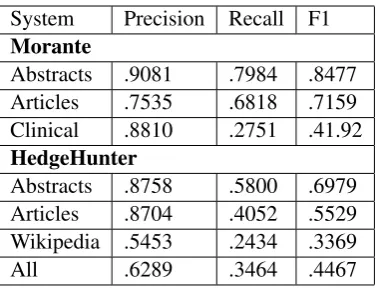
Performance for the hedge detection system was calculated at the word level while perfor-mance for the uncertainty classification stage was calculated at the sentence level using the classes of hedged and uncertain as the positive class for pre-cision, recall and F1 statistics. We compare our hedge detection system to a state of the art sys-tem presented in Morante and Daelemans (2009) and trained on a dataset of 20,924 sentences drawn from clinical reports and biomedical abstracts and articles. The Morante system used 10 fold cross validation while our system randomly withholds 10 percent of the dataset for testing so our results may be viewed as less reliable. We do provide the first evaluation of one system on both domain specific and domain general datasets. Table 1 pro-vides a breakdown of performance by system and dataset.
We evaluated the performance of the Hedge-Hunter system on the withheld training data including 5003 evaluation sentences from the biomedical domain and 9634 sentences from
System Precision Recall F1
Morante
Abstracts .9081 .7984 .8477 Articles .7535 .6818 .7159 Clinical .8810 .2751 .41.92
HedgeHunter
[image:3.595.323.512.60.205.2]Abstracts .8758 .5800 .6979 Articles .8704 .4052 .5529 Wikipedia .5453 .2434 .3369 All .6289 .3464 .4467
Table 1: Hedge detection performance
Wikipedia. For uncertainty classification we com-pare our system to the results from the CoNLL-2010 shared task comparing to the state of the art systems. For more details see the task description paper (Farkas et al., 2010). Table 2 summarizes the results for the closed domain training subtask. Table 3 summarizes the best performing systems in the Wikipedia and biomedical domain on the cross domain training subtask and compares to the HedgeHunter system.
System Precision Recall F1
Tang
Biomedical .8503 .8777 .8636
Georgescul
Wikipedia .7204 .5166 .6017
HedgeHunter
[image:3.595.316.515.412.525.2]Biomedical .7933 .8063 .7997 Wikipedia .7512 .4203 .5390
Table 2: Uncertainty classification performance closed
System Precision Recall F1
Li
Biomedical .9040 .8101 .8545
Ji
Wikipedia .6266 .5528 .5874
HedgeHunter
[image:3.595.318.514.596.710.2]Biomedical .7323 .6405 .6833 Wikipedia .7173 .4168 .5272
5 Results
The Hedge Detection stage performed slightly worse than the state of the art system. Although precision was comparable for biomedical articles and abstracts our system suffered from very low recall compared to the Morante system. The Morante system included chunk tagging as an ap-proximation of syntactic constituency. Since many multi word hedge cues are constituents of high precision words and very frequent words (ought to) this constituency information likely boosts re-call. Like the Morante system, HedgeHunter suf-fered a significant performance drop when tested across domains, although our system suffered more due to the greater difference in domains tween biomedical and Wikipedia articles than be-tween biomedical and clinical reports and due to the annotation standards for each dataset. Hedge-Hunter achieved better results on biomedical ab-stracts than the full articles due to higher recall based on the significantly larger dataset. Our system produced the worst performance on the Wikipedia data although this was mostly due to a drop in precision compared to the biomedical domain. This is in line with the drop in perfor-mance experienced by other systems outside of the biomedical domain and indicates that Wikipedia data is noisier than the peer reviewed articles that appear in the biomedical literature confirming our informal observations. Since the dataset has an overwhelming number of certain sentences and unhedged words, there is already a large bias to-wards those classes as evidenced by high over-all classification accuracy (87% for certainty de-tection and 97% for hedge dede-tection on all data) despite sometimes poor F1 scores for the minor-ity classes. During development we experimented with SVMs for training but abandoned them due to longer training times and it is possible that we could improve the recall of our system by using a different classifier, a weaker prior or different pa-rameters that allowed for more recall by paying less attention to class priors. We plan to expand our system using semi-supervised learning so it is not necessarily a bad thing to have high precision and low recall as this will allow us to expand our dataset with high quality sentences and by lever-aging the vast amounts of unannotated data we should be able to overcome our low recall.
The uncertainty classification system performed robustly despite the relatively poor performance of
the hedge detection classifier. The use of BOW features supplemented the low recall of the hedge detection stage while still relying on the hedge tures when they were available as shown by fea-ture analysis. We did not implement bi or tri-gram features although this would likely give a further boost in recall. Wikipedia data was still the worst performing domain although our cross domain system performed near the state of the art system with higher precision.
Overall our system produced a high precision hedge detection system for biomedical domain data which fed a high precision uncertainty classi-fier. Recall for the hedge detection stage was low overall but the use of BOW features for the uncer-tainty classification stage overcame this to a small degree. The amount of annotated training data has a significant impact on performance of the Hedge-Hunter system with more data increasing recall for the hedge detection task. For the sentence uncer-tainty task the system still performed acceptably on the Wikipedia data.
6 Discussion
HedgeHunter confirmed many of the findings of previous research. The most significant finding is that domain adaptation in the task of hedge detec-tion is difficult. Most new domains contain differ-ent vocabulary and hedges tend to be highly lex-icalized and subject to variation across domains. This is reinforced by feature analysis where the top weighted features for our hedge detection clas-sifier were based on the word or its lemma and not on its POS. Once our system learns that a partic-ular lexical item is a hedge it is easy enough to apply it precisely, the difficulty is getting the nec-essary training examples covering all the possible lexical hedge cues the system may encounter. The lexicon of hedge cues used in biomedical articles tends to be smaller so it is easier to get higher re-call in this domain because the chance of seeing a particular hedge cue in training is increased. With the Wikipedia data, however, the set of hedge cues is more varied due to the informal nature of the articles. This makes it less likely that the hedge detection system will be exposed to a particular hedge in training.
un-seen lexical items. This would increase the recall of the system despite the limited nature of anno-tated training sets by leveraging the lexical nature of hedges and their relatively closed class status.
We also found that the size of the training set matters significantly. Each domain employs a cer-tain number of domain specific hedge cues along with domain general cues. While it is easy enough to learn the domain general cues, domain specific cues are difficult and can only be learned by see-ing the specific lexical items to be learned. It is important that the training dataset include enough examples of all the lexical hedge cues for a spe-cific domain if the system is to have decent re-call. Even with thousands of sentences to train on, HedgeHunter had low recall presumably because there were still unseen lexical hedge cues in the test set. Future work should concentrate on meth-ods of expanding the size of the training sets in or-der to cover a larger portion of the domain specific hedging vocabulary because it does not appear that there are good non-lexical features that are robust at detecting hedges across domains. This may in-clude using lexical resources as described previ-ously or by leveraging the high precision nature of hedge cues and the tendency for multiple cues to appear in the same sentence to perform semi-supervised learning.
This work also confirmed that hedge cues pro-vide a very high precision feature for uncertainty classification. The highest weighed features for the classifier trained in the uncertainty classifi-cation stage were those that indicated the pres-ence and number of lexical hedge cues. Contrary to some previous work which found that features counting the number of hedge cues did not im-prove performance, HedgeHunter found that the number of hedge cues was a strong feature with more hedge cues indicating an increased likeli-hood of being uncertain (Szarvas, 2008). It is largely a limitation of the task that we treat all un-certain sentences as equally unun-certain. From a lin-guistic perspective a speaker uses multiple hedge cues to reinforce their uncertainty and our system seems to confirm that in terms of the likelihood of class membership even if the datasets do not encode the degree of uncertainty directly. Future work should focus on creating more sophisticated models of uncertainty that recognize the fact that it is at least a scalar phenomena and not a binary classification. Ideally a hedge detection and
uncer-tainty quantification system would function to at-tach a probability to every fact or relation extracted from a sentence in an IE system determined in part by the hedging vocabulary used to express that fact or relation. This would yield a more nuanced view of how language conveys certainty and allow for interesting inference possibilities for systems leveraging the resulting IE system output.
One surprising finding was that uncertain sen-tences often contained multiple hedge cues, some-times up to 4 or more. This is useful because it allows us to hypothesize that a sentence that is unannotated and has a high chance of being un-certain due to containing a hedge cue that we have seen in training, possibly contains other hedge cues that we have not seen. We can then use the large amounts of unannotated sentences that are available to extract n-gram features that have high uncertainty class conditional probability and add them to our training set with those features labeled as hedges as described in Medlock and Briscoe (2007). Because hedges are high precision fea-tures for uncertainty this should not hurt precision greatly. This allows us to increase the size of our training set substantially in order to expose our system to a greater variety of hedge cues in a semi-supervised manner. As with most semi-semi-supervised systems we run the risk of drift resulting in a drop in precision. Future work will have to determine the correct balance between precision and recall, ideally by embedding this task within the larger IE framework to provide extrinsic evaluation
scope finding system.
This work also failed to integrate constituency or dependency features into either stage of the system. Dependencies encode important informa-tion and we plan to include features based on de-pendency relationships into future versions of the system. At the hedge detection stage it should improve recall by allowing the system to detect which multi word hedge cues are part of the same cue. At the uncertainty classification stage it should allow the extraction of multiword features not just based on n-gram frequency. For semi-supervised learning it should allow the system to more accurately annotated multi word features that have a high class conditional probability. This should be even more important when performing the task of hedge scope detection where scope is often delimitated at the phrase level and determin-ing the dependency relations between words can capture this observation.
7 Conclusion
This work described HedgeHunter, a two stage hedge detection and uncertainty classification sys-tem. It confirmed the lexical nature of the hedge detection task, the importance of hedge cues to un-certainty classification and sharpened the need for large amounts of training data in order to achieve broad coverage. It highlights the issues involved in developing an open domain system by evaluating across very disparate datasets. It provides a frame-work that can be extended to semi-supervised learning in order to leverage large amounts of unannotated data to improve both in domain and cross domain performance.
References
Eiji Aramaki, Yasuhide Miura, Masatsugu Tonoike, Tomoko Ohkuma, Hiroshi Mashuichi, and Kazuhiko Ohe. 2009. TEXT2TABLE: Medical Text Summa-rization System Based on Named Entity Recogni-tion and Modality IdentificaRecogni-tion. InProceedings of the BioNLP 2009 Workshop, pages 185–192, Boul-der, Colorado, June. Association for Computational Linguistics.
Mike Conway, Son Doan, and Nigel Collier. 2009. Us-ing Hedges to Enhance a Disease Outbreak Report Text Mining System. InProceedings of the BioNLP 2009 Workshop, pages 142–143, Boulder, Colorado, June. Association for Computational Linguistics. Rich´ard Farkas, Veronika Vincze, Gy¨orgy M´ora, J´anos
Csirik, and Gy¨orgy Szarvas. 2010. The
CoNLL-2010 Shared Task: Learning to Detect Hedges and their Scope in Natural Language Text. In Proceed-ings of the Fourteenth Conference on Computational Natural Language Learning (CoNLL-2010): Shared Task, pages 1–12, Uppsala, Sweden, July. Associa-tion for ComputaAssocia-tional Linguistics.
Halil Kilicoglu and Sabine Bergler. 2008. Recogniz-ing Speculative Language in Biomedical Research Articles: A Linguistically Motivated Perspective. In Proceedings of the Workshop on Current Trends in Biomedical Natural Language Processing, pages 46–53, Columbus, Ohio, June. Association for Com-putational Linguistics.
Jin-Dong Kim, Tomoko Ohta, Sampo Pyysalo, Yoshi-nobu Kano, and Jun’ichi Tsujii. 2009. Overview of BioNLP’09 Shared Task on Event Extraction. In
Proceedings of the BioNLP 2009 Workshop Com-panion Volume for Shared Task, pages 1–9, Boulder, Colorado, June. Association for Computational Lin-guistics.
Marc Light, Xin Ying Qiu, and Padmini Srinivasan. 2004. The Language of Bioscience: Facts, Specu-lations, and Statements in Between. InProc. of the HLT-NAACL 2004 Workshop: Biolink 2004, Linking Biological Literature, Ontologies and Databases, pages 17–24.
Ben Medlock and Ted Briscoe. 2007. Weakly Super-vised Learning for Hedge Classification in Scientific Literature. InProceedings of the ACL, pages 992– 999, Prague, Czech Republic, June.
Roser Morante and Walter Daelemans. 2009. Learning the Scope of Hedge Cues in Biomedical Texts. In
Proceedings of the BioNLP 2009 Workshop, pages 28–36, Boulder, Colorado, June. Association for Computational Linguistics.
Roser Saur´ı and James Pustejovsky. 2009. FactBank: a corpus annotated with event factuality. Language Resources and Evaluation, 43(3):227–268.
Gy¨orgy Szarvas. 2008. Hedge Classification in Biomedical Texts with a Weakly Supervised Selec-tion of Keywords. InProceedings of ACL-08: HLT, pages 281–289, Columbus, Ohio, June. Association for Computational Linguistics.