Learning from Post-Editing:
Online Model Adaptation for Statistical Machine Translation
Michael Denkowski Chris Dyer Alon Lavie Language Technologies Institute
Carnegie Mellon University Pittsburgh, PA 15213 USA
{mdenkows,cdyer,alavie}@cs.cmu.edu
Abstract
Using machine translation output as a starting point for human translation has become an increasingly common applica-tion of MT. We propose and evaluate three computationally efficient online methods for updating statistical MT systems in a scenario where post-edited MT output is constantly being returned to the system: (1) adding new rules to the translation model from the post-edited content, (2) updating a Bayesian language model of the target language that is used by the MT system, and (3) updating the MT system’s discriminative parameters with a MIRA step. Individually, these tech-niques can substantially improve MT qual-ity, even over strong baselines. Moreover, we see super-additive improvements when all three techniques are used in tandem. 1 Introduction
Using machine translation outputs as a starting point for human translators is becoming increas-ingly common and is now arguably one of the most commercially important applications of MT. Con-siderable evidence has accumulated showing that human translators are more productive and accu-rate whenpost-editingMT output than when trans-lating from scratch (Guerberof, 2009; Carl et al., 2011; Koehn, 2012; Zhechev, 2012, inter alia). An important (if unsurprising) insight from prior research in this area is that translators become more productive as MT quality improves (Tat-sumi, 2009). While general improvements to MT continue to lead to further productivity gains, we explore how MT quality can be improved specifi-cally in an online post-editing scenario in which sentence-level MT outputs are constantly being presented to human experts, edited, and then re-turned to the system for immediate learning. This
task is challenging in two regards. First, from a technical perspective, post-edited outputs must be processed rapidly: a productive post-editor cannot wait for a standard batch MT training pipeline to be rerun after each sentence is corrected! Sec-ond, from a methodological perspective, it is ex-pensive to run many human subject experiments, in particular when the human subjects must have translation expertise. We therefore use a sim-ulated post-editing paradigm in which either non-post-edited reference translations or manually post-edited translations from a similar MT system are used in lieu of human post-editors (§2). This paradigm allows us to efficiently develop and eval-uate systems that can go on to function in real-time post-editing scenarios without modification.
We present and evaluate three online methods for improving translation models using feedback from editors: adding new translations rules to the translation grammar (§3), updating a Bayesian language model with observations of the post-edited output (§4), and using an online discrimi-native parameter update to minimize model error (§5). These techniques are computationally effi-cient and make minimal use of approximation or heuristics, handling initial and incremental data in a uniform way. We evaluate these techniques in a variety of language and data scenarios that mimic the demands of real-world translation tasks. Com-pared to a competitive baseline, we show substan-tial improvement from updating the translation grammar or language model independently and super-additive gains from combining these tech-niques with a MIRA update (§6). We then discuss how our techniques relate to prior work (§7) and conclude (§8).
2 Simulated Post-Editing Paradigm
In post-editing scenarios, humans continuously edit machine translation outputs into production-quality translations, providing an additional,
stant stream of data absent in batch translation. This data consists of highly domain-relevant ref-erence translations that are minimally different from MT outputs, making them ideal for learn-ing. However, true post-editing data is infeasi-ble to collect during system development and in-ternal testing as standard MT pipelines require tens of thousands of sentences to be translated with low latency. To address this problem, Hardt and Elming (2010) formulate the task of sim-ulated post-editing, wherein pre-generated refer-ence translations are used as a stand-in for actual post-editing. This approximation is equivalent to the case where humans edit each translation hy-pothesis to be identical to the reference rather than simply correcting the MT output to be grammat-ical and meaning-equivalent to the source. Our work uses this approximation for tuning and eval-uation. We also introduce a more accurate approx-imation wherein MT output from the target sys-tem (or a similar syssys-tem) is post-edited in advance, creating “offline” post-edited data that is similar to expected system outputs and should thus min-imize unnecessary edits. An experiment in §6.4 compares the two approximations.
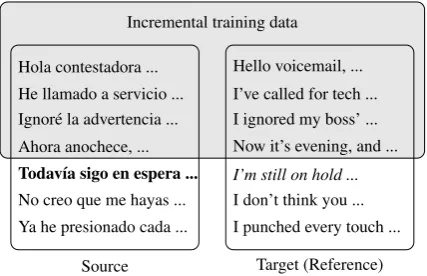
In our simulated post-editing tasks, decoding (for both the test corpus and each pass over the development corpus during optimization) begins with baseline models trained on standard bilin-gual and monolinbilin-gual data. After each sentence is translated, the following take place in order: First, MIRA uses the new source–reference pair to update weights for the current models. Second, the source is aligned to the reference and used to update the translation grammar. Third, the refer-ence is added to the Bayesian language model. As sentences are translated, the models gain valuable context information, allowing them to zero in on the target document and translator. Context is re-set at the start of each development or test corpus.1 This setup, which allows a uniform approach to tuning and decoding, is visualized in Figure1.
3 Translation Grammar Adaptation Translation models (either phrase tables or syn-chronous grammars) are typically generated of-fline from large bilingual text. This is reasonable in scenarios where available training data is fixed over long periods of time. However, this approach
1Initial experiments show this to outperform resetting models on more fine-grained document boundaries, although further investigation is warranted.
Hola contestadora ... Hello voicemail, ... He llamado a servicio ... I’ve called for tech ... Ignor´e la advertencia ... I ignored my boss’ ... Ahora anochece, ... Now it’s evening, and ... Todav´ıa sigo en espera ... I’m still on hold ...
No creo que me hayas ... I don’t think you ... Ya he presionado cada ... I punched every touch ...
Incremental training data
[image:2.595.310.524.63.201.2]Source Target (Reference)
Figure 1: Context when translating an input sen-tence (bold) with simulated post-editing. Previ-ous sentences and references (shaded) are added to the training data. After the current sentence is translated, it is aligned to the reference (italic) and added to the context for the next sentence.
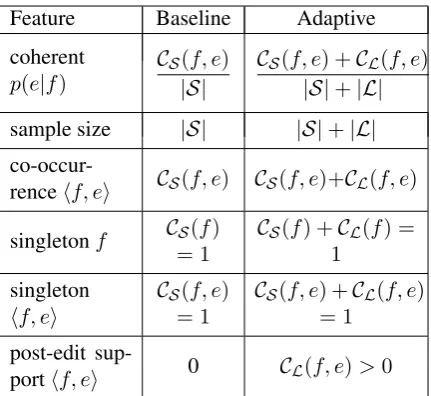
does not allow adding new data without repeating model estimation in its entirety, which may take hours or days. In this section, we describe a simple technique for incorporating new bilingual training data as soon as it is available. Our approach is an extension of the on-demand grammar extractor described byLopez (2008a). We extend the work initially designed for on-the-fly grammar extrac-tion from static data (to mitigate the expense of storing large translation grammars), to specifically handle incremental data from post-editing. 3.1 Suffix Array Grammar Extraction Lopez (2008a) introduces an alternative to tradi-tional model estimation for hierarchical phrase-based statistical machine translation (Chiang, 2007). Rather than estimating a single grammar from all training data, the aligned bitext is indexed using a source-side suffix array (Manber and My-ers, 1993). When an input sentence is to be trans-lated, a grammar extraction program samples in-stances of aligned phrase pairs from the suffix ar-ray that match the source side of the sentence. Using statistics from these samples rather than the entire bitext, a sentence-specific grammar is rapidly generated. In addition to speed gains from sampling, indexing the source side of the bitext fa-cilitates a more powerful feature set. Rules in on-demand grammars are generated using a sampleS
Feature Baseline Adaptive coherent
p(e|f) CS|S|(f, e) CS(f, e|S|) ++C|L|L(f, e)
sample size |S| |S|+|L|
co-occur-rencehf, ei CS(f, e) CS(f, e)+CL(f, e)
singletonf C= 1S(f) CS(f) +1CL(f) =
singleton
hf, ei CS= 1(f, e) CS(f, e) += 1CL(f, e)
post-edit
sup-porthf, ei 0 CL(f, e)>0
Table 1: Phrase feature definitions for baseline and adaptive translation models.
• CS(f, e): count of instances in S where f
aligns toe(phrase co-occurrence count).
• CS(f): count of instances inSwherefaligns
[image:3.595.74.290.60.258.2]to any target phrase.
• |S|: total number of instances inS, equal to number of occurrences off in training data, capped by the sample size limit.
These statistics are used to instantiate translation rulesX→hf, eiand calculate scores for the phrase feature set shown in the “Baseline” column of Ta-ble 1. Notably, the coherent phrase translation probability that conditions on f occurring in the data(|S|)rather thanfbeing extracted as part of a phrase pair(CS(f))is shown by Lopez (2008b) to
yield significant improvement over the traditional translation probability.
3.2 Online Grammar Extraction
When a human translator post-edits MT output, a new bilingual sentence pair is created. However, in typical settings, it can be weeks or months be-fore these training instances are incorporated into bilingual data and models retrained. Our exten-sion to on-demand grammar extraction incorpo-rates these new training instances into the model immediately. In addition to a static suffix array that indexes initial data, our system maintains a dynamic lookup table. Each new sentence pair is word-aligned with the model estimated from the initial data (a process often called forced align-ment). This makes a generally insignificant ap-proximation with respect to the original alignment model. Extractable phrase pairs are stored in the
lookup table and phrase occurrences are counted on the source side. When subsequent grammars are extracted, the suffix array sample S for each f is accompanied by an exhaustive lookupLfrom the lookup table. Matching statistics are calculated fromL:
• CL(f, e): count of instances in L where f
aligns toe.
• CL(f): count of instances inLwherefaligns
to any target phrase.
• |L|: total number of instances of f in post-editing data (no size limit).
We use combined statistics fromSandLto calcu-late scores for the “Adaptive” feature set defined in Table1. In addition to updating existing features, we introduce a new indicator feature that identi-fies rules supported by post-editor feedback. Fur-ther, our approach allows us to extract rules that encode translations (phrase mappings and reorder-ings)onlyobserved in the incremental post-editing data. This process, which can be seen as influ-encing the distribution from which grammars are sampled over time, produces comparable results to the infeasible process of rebuilding the transla-tion model after every sentence is translated with the added benefit of allowing an optimizer to learn a weight for the post-edited data via the post-edit support feature. The simple aggregation of statis-tics allows our model to handle initial and incre-mental data in a formally consistent way. Further, any additional features that can be calculated on a suffix array sample can be matched by an incre-mental data lookup, making our translation model a viable platform for further exploration in online learning for MT.
4 Language Model Adaptation
Adapting language models in an online manner based on the content they are generating has long been seen as a promising technique for improving automatic speech recognition and machine transla-tion (Kuhn and de Mori, 1990;Zhao et al., 2004; Sanchis-Trilles, 2012,inter alia). The post-editing scenario we are considering simplifies this process somewhat since rather than only having a poste-rior distribution over machine-generated outputs (any of which may be ungrammatical), the out-puts, once edited by human translators, may be presumed to be grammatical.
inferred as the posterior predictive distribution of a Bayesian language model with hierarchi-cal Pitman-Yor process priors, conditioned on the training corpus (Teh, 2006). The Bayesian formu-lation provides a natural way to incorporate pro-gressively more data: by updating the posterior distribution given subsequent observations. Fur-thermore, the nonparametric nature of the model means that the model is well suited to poten-tially unbounded growth of vocabulary. Unfortu-nately, in general, Bayesian techniques are com-putationally difficult to work with. However, hi-erarchical Pitman-Yor process language models (HPYPLMs) are convenient in this regard since (1) inference can be carried out efficiently in a convenient collapsed representation (the “Chinese restaurant franchise”) and (2) the posterior predic-tive distribution from a single sample provides a high quality language model.
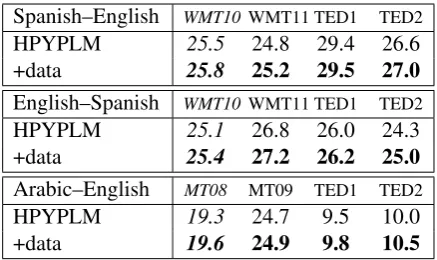
We thus use the following procedure. Using the target side of the bitext as observations, we run the Gibbs sampling procedure described by Teh (2006) for 100 iterations in a 3-gram HPY-PLM. The inferred “seating configuration” defines a posterior predictive distribution over words in 2-gram contexts (as with any 3-2-gram LM) as well as a posterior distribution over how the model will generate subsequent observations. We use the for-mer as a language model component of a transla-tion model. And, as post-edited sentences become available, we add theirn-grams to the model us-ing the later. We do not run any Gibbs samplus-ing. Just updating the language model in this way, we obtain the results shown in Table2for the experi-mental conditions described in§6.
5 Learning Feature Weights
MT system parameter optimization (learning fea-ture weights for the decoder) is also typically con-ducted as a batch process. Discriminative learn-ing techniques such as minimum error rate train-ing (Och, 2003) are used to find feature weights that maximize automatic metric score on a small development corpus. The resulting weight vector is then used to decode given input sentences. Us-ing this approach with post-editUs-ing tasks presents two major issues. First, reference translation are only considered after all sentences are translated, a mismatch with post-editing where references are available incrementally. Second, despite the fact that adaptive feature sets become more powerful as post-editing data increases, an optimizer must
Spanish–English WMT10 WMT11 TED1 TED2
HPYPLM 25.5 24.8 29.4 26.6
+data 25.8 25.2 29.5 27.0
English–Spanish WMT10 WMT11 TED1 TED2
HPYPLM 25.1 26.8 26.0 24.3
+data 25.4 27.2 26.2 25.0
Arabic–English MT08 MT09 TED1 TED2
HPYPLM 19.3 24.7 9.5 10.0
[image:4.595.307.526.61.191.2]+data 19.6 24.9 9.8 10.5
Table 2: BLEU scores for systems with trigram HPYPLM (no large language model), with and without incremental updates from simulated post-editing data. Scores are averages over 3 optimizer runs. Bold scores indicate statistically significant improvement. Tuning set scores are italicized.
learn a single corpus-level weight for each fea-ture. This forces an averaging effect that can lead to decoding individual sentences with suboptimal weights. We address the first issue by using ref-erence translations to simulate post-editing (Hardt and Elming, 2010) at tuning time and the second by using a version of the margin-infused relaxed algorithm (Crammer et al., 2006;Eidelman, 2012) to make online parameter updates during decod-ing. The result is a consistent approach to tuning and decoding that brings out the potential of adap-tive models.
5.1 Parameter Optimization
to MT system optimization on a development cor-pus, MIRA proceeds as follows. The MT system generates a list of thekbest translations for a sin-gle input sentence. From the list, a “hope” hy-pothesis is selected as a translation with both high model score and high automatic metric score. A “fear” hypothesis is selected as a translation with high model score but low metric score. Parameters are updated away from the fear hypothesis, toward the hope hypothesis, and the system processes the next input sentence. This process continues for a set number of passes over the development corpus. All adaptive systems used in our work are opti-mized with this variant of MIRA using the param-eter settings described by Eidelman (2012). For each pass over the data, translation and language models have incremental access to reference trans-lations (simulated post-editing data) as input sen-tences are translated. Translation and language models reset to using background data only at the beginning of each MIRA iteration.2
5.2 Online Parameter Updates
Our optimization strategy allows us to treat de-coding as if it were simply the next iteration of MIRA (or alternatively that MIRA makes a single pass over an input corpus that consists of the de-velopment data concatenatedntimes followed by unseen input data). After each sentence is trans-lated, a reference translation (resulting from ac-tual human post-editing in production or simulated post-editing for our experiments) is provided to the models and MIRA makes a parameter update. In the only departure from our optimization setup, we decrease the maximum step size for MIRA (de-scribed in§6.2), effectively increasing regulariza-tion strength. This allows us to prefer small ad-justments to already optimized decoding parame-ters over the large changes needed during tuning. It is also important to note that by using MIRA for updating weights during both tuning and de-coding, we avoid scaling issues between multiple optimizers (such as when tuning with MERT and updating with a passive-aggressive algorithm).
6 Experiments
We evaluate our online extensions to standard machine translation systems in a series of
sim-2Resetting translation and language models prevents con-tamination. If models retained state from previous passes over the development set, they would include data for input sentences before they were translated, rather than after as in post-editing.
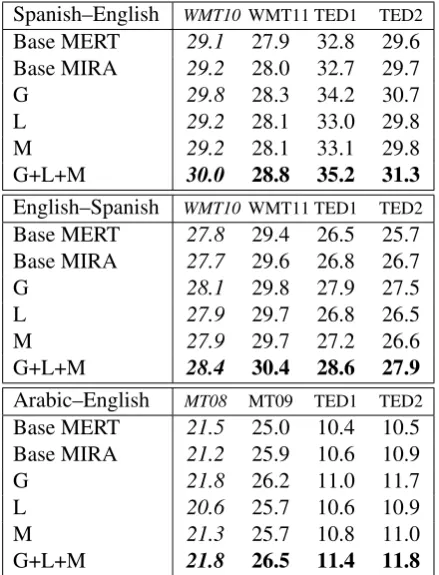
Spanish–English WMT10 WMT11 TED1 TED2 Base MERT 29.1 27.9 32.8 29.6 Base MIRA 29.2 28.0 32.7 29.7
G 29.8 28.3 34.2 30.7
L 29.2 28.1 33.0 29.8
M 29.2 28.1 33.1 29.8
G+L+M 30.0 28.8 35.2 31.3
English–Spanish WMT10 WMT11 TED1 TED2 Base MERT 27.8 29.4 26.5 25.7 Base MIRA 27.7 29.6 26.8 26.7
G 28.1 29.8 27.9 27.5
L 27.9 29.7 26.8 26.5
M 27.9 29.7 27.2 26.6
G+L+M 28.4 30.4 28.6 27.9
Arabic–English MT08 MT09 TED1 TED2 Base MERT 21.5 25.0 10.4 10.5 Base MIRA 21.2 25.9 10.6 10.9
G 21.8 26.2 11.0 11.7
L 20.6 25.7 10.6 10.9
M 21.3 25.7 10.8 11.0
G+L+M 21.8 26.5 11.4 11.8
Table 3: BLEU scores for baseline and adap-tive systems. Scores are averages over three opti-mizer runs. Highest scores are bold and tuning set scores are italicized. All fully adaptive systems (G+L+M) show statistically significant improve-ment over both MERT and MIRA baselines.
ulated post-editing experiments that cover high-traffic languages and challenging domains. We show incremental improvement from our adaptive models and significantly larger gains when pair-ing our models with an online parameter update. We finally validate our adaptive system on actual post-edited data.
6.1 Data
[image:5.595.307.527.62.350.2]En-glish). We tune and evaluate on standard news sets: WMT10 and WMT11 for Spanish–English and English–Spanish, and MT08 and MT09 for Arabic–English. To simulate real-world post edit-ing where one translator works on a document at a time, we use only one of the four available refer-ence translation sets for MT08 and MT09.
We also evaluate on a blind domain adapta-tion scenario that mimics the demands placed on MT systems in real-world translation tasks. The Web Inventory of Transcribed and Translated Talks (WIT3) corpus (Cettolo et al., 2012) makes transcriptions of TED talks3 available in several languages, including English, Spanish, and Ara-bic. For each language pair, we select two sets of 10 talk transcripts each (2000-3000 sentences) as blind evaluation sets. These sets consist of spoken language covering a broad range of topics. Sys-tems have no access to any training or develop-ment data in this domain prior to translation. 6.2 Translation Systems
For each language scenario, we first construct a competitive baseline system. Bilingual data is word aligned using the model described by Dyer et al. (2013) and suffix array-backed transla-tion grammars are extracted using the method described by Lopez (2008a). We add the stan-dard lexical and derivation features4 from Lopez (2008b) and Dyer et al. (2010). An unpruned, modified Kneser-Ney-smoothed 4-gram language model is estimated using the KenLM toolkit (Heafield et al., 2013). Feature weights are op-timized using the lattice-based variant of MERT (Macherey et al., 2008; Och, 2003) on either WMT10 or MT08. Evaluation sets are translated using the cdec decoder (Dyer et al., 2010) and evaluated with the BLEU metric (Papineni et al., 2002). These results are listed as “Base MERT” in Table 3. To establish a baseline for our adap-tive systems, we tune the same baseline system using cutting-plane MIRA with 500-best lists, the pseudo-document approximation described by Ei-delman (2012), and a maximum update size of 0.01. We begin with uniform weights and make 20 passes over the development corpus. Results for this system are listed as “Base MIRA”.
To evaluate the impact of each online model adaptation technique, we report the results for the
3http://www.ted.com/talks
4Derivation features consist of word count, discretized rule-level non-terminal count (0, 1, or 2), glue rule count, and out-of-vocabulary pass-through count.
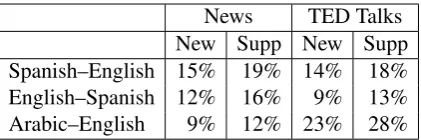
[image:6.595.312.523.61.131.2]News TED Talks New Supp New Supp Spanish–English 15% 19% 14% 18% English–Spanish 12% 16% 9% 13% Arabic–English 9% 12% 23% 28%
Table 5: Percentages of new rules (only seen in incremental data) and post-edit supported rules (Rules from all data for which the “post-edit sup-porthf, ei” feature fires) in grammars by domain.
following systems in Table3:
• G: Baseline MIRA system with online gram-mar extraction, including incrementally up-dating existing phrase features plus an addi-tional indicator feature for post-edit support.
• L: Baseline MIRA with a trigram hierarchi-cal Pitman-Yor process language model that is incrementally updated, including a sepa-rate out-of-vocabulary feature.
• M: Baseline MIRA with online feature weight updates from cutting-plane MIRA. Finally, we report results for a fully adaptive system that includes online grammar, language model, and feature weight updates. This system is reported as “G+L+M”. To account for optimizer instability, all systems are tuned (consisting of running either MERT or MIRA) and evaluated 3 times. We report average scores over optimizer runs and conduct statistical significance tests us-ing the methods described by Clark et al. (2011).
6.3 Results
Our simulated translation post-editing experi-ments are summarized in Table 3. Simply mov-ing from MERT to cuttmov-ing-plane MIRA for pa-rameter optimization yields improvement in most cases, corroborating existing work (Eidelman, 2012). Using incremental post-editing data to up-date translation grammars (G) yields further im-provement in all cases evaluated. Gains are signif-icantly larger for TED talks where translator feed-back can bridge the gap between domains. Table5 shows the aggregate percentages of rules in online grammars that are entirely new (extracted from post-editing instances only) or post-edit supported (superset of new rules). While percentages vary by data set, the overall trend is a combination of
learning new vocabulary and reordering and dis-ambiguatingexisting translation choices.
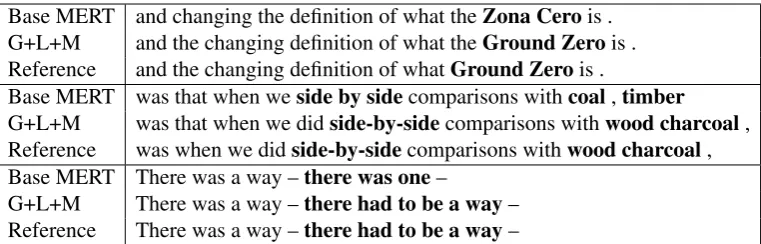
Base MERT and changing the definition of what theZona Cerois . G+L+M and the changing definition of what theGround Zerois . Reference and the changing definition of whatGround Zerois .
Base MERT was that when weside by sidecomparisons withcoal,timber G+L+M was that when we didside-by-sidecomparisons withwood charcoal, Reference was when we didside-by-sidecomparisons withwood charcoal, Base MERT There was a way –there was one–
[image:7.595.109.490.61.183.2]G+L+M There was a way –there had to be a way– Reference There was a way –there had to be a way–
Table 4: Translation examples from baseline and fully adaptive systems of Spanish TED talks into En-glish. Examples illustrate (from top to bottom) learning translations for new vocabulary items, selecting correct translation candidates for the domain, and learning domain-appropriate phrasing.
cases it leads to slight improvement and in oth-ers, degradation. It appears that a static but large 4-gram language model often outperforms an in-crementally updated but smaller trigram model. Further, learning a single weight for the Bayesian model can lead to a harmful mismatch. As a tun-ing pass over the development corpus proceeds, the model incorporates additional data and MIRA learns a weight corresponding to its predictive ability at the end of the corpus. During decod-ing,allsentences are translated with this language model weight, even before the model can ade-quately adapt itself to the target domain. This problem is alleviated in our fully adaptive system. Using cutting-plane MIRA to incrementally up-date weights during decoding (M) also leads to mixed results, frequently resulting in both small increases and decreases in score. This could be due to the noise incurred when making small ad-justments to static features after each sentence: depending on the similarity between the previous and current sentence and the limit of the step size (regularization strength), a parameter update may slightly improve or degrade translation.
Finally, we see significantly larger gains for our fully adaptive system (G+L+M) that com-bines adaptive translation grammars and language models with online parameter updates. In many cases, the difference between the baseline sys-tems and our adaptive system isgreater than the sum of the differences from our individual tech-niques, demonstrating the effectiveness of com-bining online learning methods. Our final sys-tem has two key advantages over any individual extension. First, incremental updates from MIRA canrescaleweights for features thatchangeover time, keeping the model consistent. Second, the Bayesian language model’s out-of-vocabulary
fea-ture can discriminate between true OOV items and vocabulary items in the post-editing data not present in the monolingual data. By contrast, the only OOVs in the baseline system are untranslated items, as the target side of the bitext is included in the language model training data. This interplay between the adaptive components in our transla-tion system leads to significant gains over MERT and MIRA baselines. Table4 contains examples from our system’s output that exemplify key im-provements in translation quality. With respect to performance, our fully adaptive system translates an average of 1.5 sentences per second per CPU core. The additional cost incurred updating trans-lation grammars and language models is less than one second per sentence (though the baseline cost of on-demand grammar extraction can be up to a few seconds). In total, the system is well within the acceptable speed range needed to function in real-time human translation scenarios.
system on both types of references. Using inde-pendent references for tuning and evaluation (as before), our system yields an improvement of 0.6 BLEU (23.3 to 23.9). With post-edited references, our system yields an improvement of 1.3 BLEU (43.0 to 44.3). This provides strong evidence that our adaptive systems would provide better trans-lations (both in terms of absolute quality and im-provement over a standard baseline) for real-world post-editing scenarios.
7 Related Work
Prior work has led to the extension of standard phrase-based translation systems to make use of incrementally available data.5 Approaches gen-erally fall into categories of adding new data to translation models and of using incremental data to adjust model parameters (feature weights). In the first case,Nepveu et al. (2004) use cache-based translation and language models to incorporate data from the current document into a computer-aided translation scenario. Ortiz-Mart´ınez et al. (2010) augment a standard translation model by storing sufficient statistics in addition to feature scores for phrase pairs, allowing feature values to be incrementally updated as new sentence pairs are available for phrase extraction.Hardt and Elm-ing (2010) demonstrate the benefit of maintain-ing a distinction between background and post-editing data in an adaptive model with simulated post-editing. Though not targeted at post-editing applications, the most similar work to our online grammar adaptation is the stream-based transla-tion model described byLevenberg et al. (2010). The authors introduce a dynamic suffix array that can incorporate new training text as it becomes available. Sanchis-Trilles (2012) proposes a strat-egy for online language model adaptation wherein several smaller domain-specific models are built and their scores interpolated for each sentence translated based on the target domain.
Focusing on incrementally updating model pa-rameters with post-editing data, Mart´ınez-G´omez et al. (2012) and L´opez-Salcedo et al. (2012) show improvement under some conditions when using techniques including passive-aggressive al-gorithms, perceptron, and discriminative ridge re-gression to adapt feature weights for systems ini-tially tuned using MERT. This work also uses ref-erence translations to simulate post-editing.Saluja
5Prior to phrase-based systems, NISHIDA et al. (1988) use post-editing data to correct errors in transfer-based MT.
et al. (2012) introduce a support vector machine-based algorithm capable of learning from binary-labeled examples. This learning algorithm is used to incrementally adjust feature weights given user feedback on whether a translation is “good” or “bad”. As with our work, this strategy can be used during both optimization and decoding.
Finally, Simard and Foster (2013) apply a pipeline solution to the post-editing task wherein a second stage automatic post-editor (APE) sys-tem learns to replicate the corrections made to ini-tial MT output by human translators. As incre-mental data accumulates, the APE (itself a statisti-cal phrase-based system) attempts to “correct” the MT output before it is shown to humans.
8 Conclusion
Casting machine translation for post-editing as an online learning task, we have presented three methods for incremental model adaptation: adding data to the indexed bitext from which gram-mars are extracted, updating a Bayesian language model with incremental data, and using an on-line discriminative parameter update during de-coding. These methods, which allow the sys-tem to handle all data in a uniform way, are ap-plied to a strong baseline system optimized using MIRA in conjunction with simulated post-editing. In addition to showing gains for individual meth-ods under various circumstances, we report super-additive improvement from combining our tech-niques to produce a fully adaptive system. Im-provements generalize over language and data sce-narios, with the greatest gains realized in blind out-of-domain tasks where the system must rely heavily on post-editor feedback to improve qual-ity. Gains are also more significant when using of-fline post-edited references, showing promise for applying our techniques to real-world post-editing tasks. All software used for our online model adaptation experiments is freely available under an open source license as part of thecdectoolkit.6 Acknowledgements
This work is supported in part by the National Sci-ence Foundation under grant IIS-0915327, by the Qatar National Research Fund (a member of the Qatar Foundation) under grant NPRP 09-1140-1-177, and by the NSF-sponsored XSEDE program under grant TG-CCR110017.
References
[Callison-Burch et al.2012] Chris Callison-Burch, Philipp Koehn, Christof Monz, Matt Post, Radu Soricut, and Lucia Specia. 2012. Findings of the 2012 workshop on statistical machine translation. In Proceedings of the Seventh Workshop on Statis-tical Machine Translation, pages 10–51, Montr´eal, Canada, June. Association for Computational Linguistics.
[Carl et al.2011] Michael Carl, Barbara Dragsted, Jakob Elming, Daniel Hardt, and Arnt Lykke Jakobsen. 2011. The process of post-editing: A pilot study. Copenhagen Studies in Language, 41:131–142.
[Cettolo et al.2012] Mauro Cettolo, Christian Girardi, and Marcello Federico. 2012. Wit3: Web inventory of transcribed and translated talks. InProceedings of the Sixteenth Annual Conference of the European Association for Machine Translation.
[Chiang2007] David Chiang. 2007. Hierarchical phrase-based translation. Computational Linguis-tics, 33.
[Chiang2012] David Chiang. 2012. Hope and fear for discriminative training of statistical translation mod-els. Journal of Machine Learning Research, pages 1159–1187, April.
[Clark et al.2011] Jonathan H. Clark, Chris Dyer, Alon Lavie, and Noah A. Smith. 2011. Better hypothe-sis testing for statistical machine translation: Con-trolling for optimizer instability. InProceedings of the 49th Annual Meeting of the Association for Com-putational Linguistics: Human Language Technolo-gies, pages 176–181, Portland, Oregon, USA, June. Association for Computational Linguistics.
[Crammer et al.2006] Koby Crammer, Ofer Dekel, Joseph Keshet, Shai Shalev-Shwartz, and Yoram Singer. 2006. Online passive-aggressive algo-rithms. Journal of Machine Learning Research, pages 551–558, March.
[Dyer et al.2010] Chris Dyer, Adam Lopez, Juri Gan-itkevitch, Jonathan Weese, Ferhan Ture, Phil Blun-som, Hendra Setiawan, Vladimir Eidelman, and Philip Resnik. 2010. cdec: A decoder, alignment, and learning framework for finite-state and context-free translation models. InProceedings of the ACL 2010 System Demonstrations, pages 7–12, Uppsala, Sweden, July. Association for Computational Lin-guistics.
[Dyer et al.2013] Chris Dyer, Victor Chahuneau, and Noah A. Smith. 2013. A simple, fast, and effective reparameterization of IBM model 2. InThe 2013 Conference of the North American Chapter of the Association for Computational Linguistics: Human Language Technologies.
[Eidelman2012] Vladimir Eidelman. 2012. Optimiza-tion strategies for online large-margin learning in
machine translation. InProceedings of the Seventh Workshop on Statistical Machine Translation, pages 480–489, Montr´eal, Canada, June. Association for Computational Linguistics.
[Guerberof2009] Ana Guerberof. 2009. Productivity and quality in mt post-editing. InProceedings of MT Summit XII - Workshop: Beyond Translation Memo-ries: New Tools for Translators MT.
[Hardt and Elming2010] Daniel Hardt and Jakob Elm-ing. 2010. Incremental re-training for post-editing smt. InProceedings of the Ninth Conference of the Association for Machine Translation in the Ameri-cas.
[Heafield et al.2013] Kenneth Heafield, Ivan Pouzyrevsky, Jonathan H. Clark, and Philipp Koehn. 2013. Scalable modified Kneser-Ney language model estimation. In Proceedings of the 51st Annual Meeting of the Association for Computational Linguistics, Sofia, Bulgaria, August. [Hopkins and May2011] Mark Hopkins and Jonathan May. 2011. Tuning as ranking. InProceedings of the 2011 Conference on Empirical Methods in Nat-ural Language Processing, pages 1352–1362, Edin-burgh, Scotland, UK., July. Association for Compu-tational Linguistics.
[Koehn2012] Philipp Koehn. 2012. Computer-aided translation. Machine Translation Marathon. [Kuhn and de Mori1990] Roland Kuhn and Renato
de Mori. 1990. A cache-based natural language model for speech recognition. IEEE Transac-tions on Pattern Analysis and Machine Intelligence, 12(6).
[Levenberg et al.2010] Abby Levenberg, Chris Callison-Burch, and Miles Osborne. 2010. Stream-based translation models for statistical machine translation. In Human Language Tech-nologies: The 2010 Annual Conference of the North American Chapter of the Association for Compu-tational Linguistics, pages 394–402, Los Angeles, California, June. Association for Computational Linguistics.
[Lopez2008a] Adam Lopez. 2008a. Machine transla-tion by pattern matching. InDissertation, Univer-sity of Maryland, March.
[Lopez2008b] Adam Lopez. 2008b. Tera-scale transla-tion models via pattern matching. In Proceedings of the 22nd International Conference on Compu-tational Linguistics (Coling 2008), pages 505–512, Manchester, UK, August. Coling 2008 Organizing Committee.
[Macherey et al.2008] Wolfgang Macherey, Franz Och, Ignacio Thayer, and Jakob Uszkoreit. 2008. Lattice-based minimum error rate training for statistical ma-chine translation. InProceedings of the 2008 Con-ference on Empirical Methods in Natural Language Processing, pages 725–734, Honolulu, Hawaii, Oc-tober. Association for Computational Linguistics. [Manber and Myers1993] Udi Manber and Gene
My-ers. 1993. Suffix arrays: A new method for on-line string searches. SIAM Journal of Computing, 22:935–948.
[Mart´ınez-G´omez et al.2012] Pascual Mart´ınez-G´omez, Germ´an Sanchis-Trilles, and Francisco Casacuberta. 2012. Online adaptation strategies for statistical machine translation in post-editing scenarios. Pattern Recognition, 45:3193–3203. [Nepveu et al.2004] Laurent Nepveu, Guy Lapalme,
Philippe Langlais, and George Foster. 2004. Adap-tive language and translation models for interacAdap-tive machine translation. In Dekang Lin and Dekai Wu, editors, Proceedings of EMNLP 2004, pages 190– 197, Barcelona, Spain, July. Association for Com-putational Linguistics.
[NISHIDA et al.1988] Fujio NISHIDA, Shinobu TAKAMATSU, Tadaaki TANI, and Tsunehisa DOI. 1988. Feedback of correcting information in postediting to a machine translation system. In Proc. of COLING.
[Och2003] Franz Josef Och. 2003. Minimum error rate training in statistical machine translation. In Pro-ceedings of the 41st Annual Meeting of the Associa-tion for ComputaAssocia-tional Linguistics, pages 160–167, Sapporo, Japan, July. Association for Computational Linguistics.
[Ortiz-Mart´ınez et al.2010] Daniel Ortiz-Mart´ınez, Is-mael Garc´ıa-Varea, and Francisco Casacuberta. 2010. Online learning for interactive statistical ma-chine translation. In Human Language Technolo-gies: The 2010 Annual Conference of the North American Chapter of the Association for Compu-tational Linguistics, pages 546–554, Los Ange-les, California, June. Association for Computational Linguistics.
[Papineni et al.2002] Kishore Papineni, Salim Roukos, Todd Ward, and Wei-Jing Zhu. 2002. Bleu: a method for automatic evaluation of machine trans-lation. In Proceedings of 40th Annual Meeting of the Association for Computational Linguistics, pages 311–318, Philadelphia, Pennsylvania, USA, July. Association for Computational Linguistics. [Parker et al.2011] Robert Parker, David Graff, Junbo
Kong, Ke Chen, and Kazuaki Maeda. 2011. En-glish Gigaword Fifth Edition, June. Linguistic Data Consortium, LDC2011T07.
[Przybocki2012] Mark Przybocki. 2012. Nist open machine translation 2012 evaluation (openmt12). http://www.nist.gov/itl/iad/mig/openmt12.cfm.
[Saluja et al.2012] Avneesh Saluja, Ian Lane, and Ying Zhang. 2012. Machine translation with binary feed-back: a large-margin approach. InProceedings of the Tenth Biennial Conference of the Association for Machine Translation in the Americas.
[Sanchis-Trilles2012] Germ´an Sanchis-Trilles. 2012. Building task-oriented machine translation systems. InPh.D. Thesis, Universitat Politcnica de Valncia. [Simard and Foster2013] Michel Simard and George
Foster. 2013. PEPr: Post-edit propagation using phrase-based statistical machine translation. In Pro-ceedings of the XIV Machine Translation Summit, pages 191–198,, September.
[Tatsumi2009] Midori Tatsumi. 2009. Correlation between automatic evaluation metric scores, post-editing speed, and some other factors. In Proceed-ings of the Twelfth Machine Translation Summit. [Teh2006] Yee Whye Teh. 2006. A hierarchical
Bayesian language model based on Pitman-Yor pro-cesses. InProc. of ACL.
[Zhao et al.2004] Bing Zhao, Matthias Eck, and Stephan Vogel. 2004. Language model adaptation for statistical machine translation with structured query models. InProc. of COLING.