Accommodating Multiple Learning Styles and Abilities in a
Large-Scale Online Learning Resource
Authors: Liz Falconer
Manuel Frutos-Perez
Address for correspondence: Dr Liz Falconer, E-learning Development Co-ordinator, University of the West of England, Bristol BS16 1QY, U.K. Email: [email protected]
Accommodating Multiple Learning Styles and Abilities in a
Large-Scale Online Learning Resource
Abstract
Background
Introduction
This paper describes, discusses and evaluates the research and development of a large-scale, online teaching and learning resource. The project is a blend of instructional design, pedagogy, and IT systems development. Whilst the project grew from the support needs of distant students undertaking Masters level dissertations, this resource (the Research Observatory {RO}) now supports students in their research and project studies on attended, part-time and distance-learning modes of delivery across a university with a population of approximately 27,000 students. The resource consists of learning materials to support students through their research methods studies, both at undergraduate and postgraduate level. It is important to stress that it is a resource, not a course. It is most frequently used via the university‟s VLE to support research methods modules across the university, with tutors providing links to materials they feel are most important to their students‟ study. However, the resource is also openly available within and outside the university to facilitate easy access for students undertaking placements, or distant or part-time study.
The project is fundamentally about researching and developing online learning environments which offer learning support in a variety of contexts that can accommodate varying cognitive abilities and learning styles, with the minimum of material duplication. This is a particular issue when providing large-scale learning support across an institution, and beyond. Considerations of online accessibility often concentrate upon visual and auditory impairments and dyslexia. These are very important issues and it is entirely right that they should be addressed. However, taking account of the cognitive abilities and learning preferences of students can represent a greater challenge as these styles and abilities affect every student, can be difficult to define, and can be even harder to accommodate without replicating materials. This paper discusses the initial design of the RO, the evaluation of its metaphorical context, the research question that arose from that evaluation, the methods by which that question has been approached and the results of the research so far. We also discuss the opportunities for future work.
The design of RO version 1
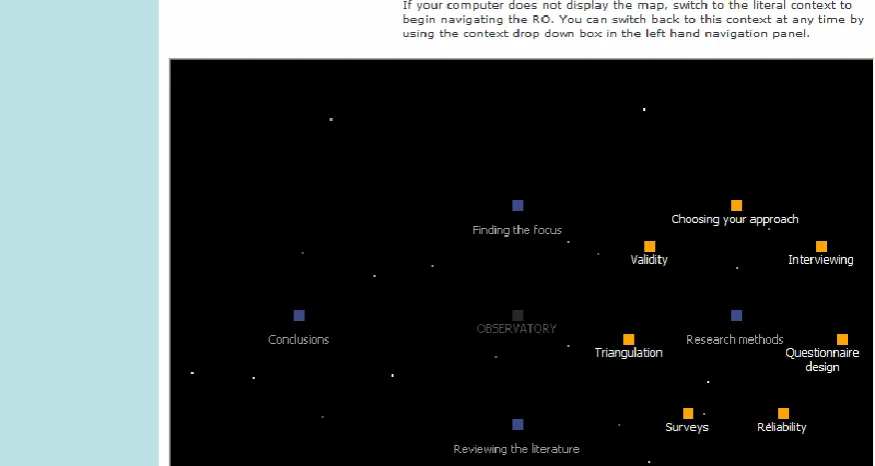
The RO version 1 design applies a cartographic metaphor, i.e. a star map and stellar observatory, to assist students and teachers to locate and understand learning resources. The resources in the RO “universe” are grouped into “constellations” of inter-related materials. These materials are in the form of electronic learning objects utilising a variety of formats, including text, graphics, drag and drop and audio materials. Grouping materials into constellations acknowledges that, just as star constellations are human-defined groupings that make familiar patterns, so the connections between learning materials can be visualised as forming navigable associations.
The learning resources
All constellations comprise learning objects in three categories, although the exact mix varies depending upon the subject. The three categories are:
Exploration – these comprise information about the topic in a variety of formats, e.g. text or narrated graphics presentations.
Application – these prompt students to consider how the knowledge they have gained can be applied to their own cognate discipline.
The learning content for the RO is provided by academic colleagues in the university who are keen to find a method of sharing their materials in electronic form. The e-learning team then converts the provided content into learning objects and adds appropriate interaction. Authors are consulted throughout this process, and if they are happy with the final rendition of their content in the test environment, it is added to the live site.
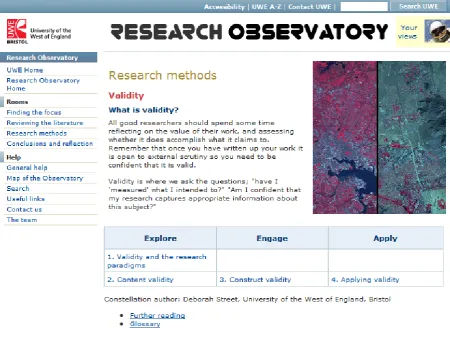
[image:4.595.72.523.297.646.2]The structure of RO version 1 has been developed as a traditional, linear website that renders HTML (HyperText Markup Language) pages and interactive media to the learner. The learner has some control over the way in which this material is rendered, but only relating to text size and contrast colour via cascading style sheets. The observatory metaphor drives the context and appearance of the site, although the individual learning objects are written independent of any context. The site can be navigated in a more linear format by using the left hand navigation panel, but the terminology of the site is only expressed using the observatory metaphor; see Figure 1 below.
Figure 1: Example of the RO version 1
systemized learning styles and world views. These issues are much further expanded later in this paper.
The research question
The RO project is intended to begin answering the following research question.
What are the technological and pedagogical implications for designing online learning resources that can be offered to accommodate a variety of learning styles and abilities?
Therefore, we next discuss the theory of content/context differentiation in online learning design, some of the underpinning theory regarding metaphoric approaches and the concomitant issues of learning impairment and learning preferences.
Theory
E-learning materials can be described in two categories, viz:
non-specific, reusable learning objects that can be repurposed, and
contextual materials that relate to the precise meaning for groups or individual students.
The concept of the distinction between content and context in learning environment design has been recognised for some time (see, for example, Choi & Hannafin, 1995). Weller et al (2003) describe this distinction using the terms “learning objects”, which contain the core learning material or content, and “narrative objects”, which deliver the contextual, sense-making narrative. This distinction was a founding principle for the design of RO version 1 which consists of both learning and narrative objects. The term “learning object” is now widely and commonly used, but it is helpful to discuss briefly at this point what we mean by the term. It has been variously defined, with Polsani (2003) commenting that there are as many definitions of learning objects as there are users. Whilst Wiley (2002) states that a learning object is “…any digital resource that can be reused to support learning”, Polsani (op cit.) argues that “A media asset or a digital object can become a LO only when it is incorporated into a form and provides a relation to itself as LO (sic) in order to facilitate the understanding of that object.” Also, a learning object should fulfil the three functional requirements of accessibility, reusability and interoperability. However, this field is moving rapidly, and more recent work is beginning to stress more holistic approaches to learning object design that give the learner more context, narrative and rationale incorporated in the learning object, to counter the criticism that learning objects create overly “chunked” courses that may cause the learner to lose focus (see, for example, Mason 2006). Indeed, the new term of “learning component” is beginning to appear in the literature (Kaczmarek & Landowska 2007), which refers to the addition of an interface to learning objects to create unified and platform independent access.
The RO was initially developed using a map metaphor as the contextual environment, as there is significant evidence of the power of metaphor in discovering and engaging with information. In particular, there is evidence that spatial and cartographic metaphors may be especially effective. For example, Skupin (2000) argues that
“By virtue of their spacio-cognitive abilities, humans are able to navigate through geographical space …… those cognitive skills also have value in the exploration and analysis of non-geographic information.”
This navigational ability can also help us to see connections between apparently unrelated cognate disciplines; an important feature of high-level learning. Although disciplines may not be related by topic, they could be represented as being related spatially. For instance, fuzzy logic is a branch of mathematics, but the concepts that it includes are drawn from, and can likewise inform, human decision-making. In a spatial sense, the cognate disciplines of fuzzy logic and human decision-making occupy closely related space (Falconer, 2001), whereas in topic terms the relationship between those disciplines would not be close; fuzzy logic would be part of a mathematics discipline and decision-making would be part of a sociological discipline.
Whilst it therefore appears that metaphors may have significant promise in the design of e-learning resources, we must recognize that navigating electronic environments can pose significant difficulties for some people who suffer from cognitive impairments. In the case of online learning environments, this can result in exclusion from learning for certain communities of users where the environment does not accommodate their learning capabilities. Specifically, the understanding of metaphor is severely impaired in individuals with certain cognitive disorders such as autism, Asperger syndrome and high functioning autism. These impairments are collectively referred to as Autism Spectrum Disorder (ASD), recognizing that sufferers can exhibit a range of symptoms depending upon the severity of the disability, i.e. the characteristic “triad of impairments” to their social interaction, communication and imagination (National Autistic Society, 2005). As such, individuals with ASD face particular issues in navigating online environments that require the synthesis of ideas and concepts together with the physical manifestation of the environment.
Evidence from studies such as that carried out by Baron-Cohen et al (2001) demonstrates that a significant proportion of neurotypical adults may have characteristics associated with the autistic spectrum, such as an accentuated tendency to categorize and systemize, together with reduced empathy. In that study, researchers developed and tested an instrument to test this in the general population; the Autism Spectrum Quotient (AQ). The AQ was applied to a group of eight hundred and forty Cambridge University students and a number of control groups. Their findings showed, inter alia, that amongst the Cambridge students, scientists and mathematicians scored significantly higher (i.e. further towards the autistic end of the neurotypical spectrum) than the humanities and social sciences students, supporting earlier studies that appear to correlate autistic conditions with scientific skills. So, it appears that autistic propensities are not confined to those people with diagnosed ASD. This is an important but under-recognized issue in the design of technology enhanced learning, as autistic tendencies are not recognized as a learning style or preference.
Method
This project combines the research and development disciplines of pedagogy and IT systems design, as reflected in the research question. The methods used therefore draw on both educational and systems design methodologies.
evaluating the metaphorical approach and general design features of RO version 1, researching and evaluating appropriate technological solutions to the issues raised
from that evaluation, and
developing version 2 of the RO in a revised format. These three parts of the method are expanded below.
Initial evaluation of RO version 1 Version 1 of the RO was piloted with
A group of forty-one distance learning MSc students in Construction Management, four individuals studying for PhDs in mathematics and physics, and
a cohort of one hundred and seventy-two Computing and IT MSc dissertation students who used the RO as a resource to support a compulsory, core module in research methods.
Evaluation of the most appropriate technology to deliver the required design,
This part of the project was undertaken by a Software Engineering MSc student as the research element of his studies, leading to the completion of a dissertation. The study method consisted of an initial qualitative phase, gathering the requirements and aspirations from the RO project team. Also, understanding the nature of the project in the wider ICT and learning perspective was vital, and this was partly achieved by literature review and partly by interview. The second phase was a familiarisation and assessment of the current technologies supported by IT Services in the university, as any solution must be sustainable in the current IT environment. This was achieved by interview and observation. Thirdly, a comparative assessment was carried out by coding trials, to identify the most appropriate solution.
Development of RO version 2 prototype.
To accommodate the fact that the precise shape of the RO version 2 could not be totally foreseen by the project team, a method was needed that would enable fluid and active collaboration. We applied the Dynamic Systems Design Method (DSDM Consortium, 2002) as the project perfectly fitted the description below.
“A commonly recurring problem in IT systems development is the inability of both user and developer to envision a full set of requirements at the outset of a project. DSDM is predicated on the belief that nothing is built perfectly first time, and that development must proceed both iteratively and incrementally, enabling stakeholders’ views to convergence [sic] towards a solution that is fit for business purpose.” (ibid p.2)
Contribution
The findings of the project are discussed in this section.
Evaluation of RO version 1
The first pilot with students on the Construction Management MSc research methods module began with an attended session at their research methods study school. The RO design and the method of navigation were explained to the participants, who then had a one hour session using the RO and recording their views on its usability, content and relevance. These views were qualitative under the three headings and did not use any scaling system. The responses were collected during the session and analysed using a qualitative techniques. Generally the RO was well-received and the metaphoric design and navigation was appreciated and felt to be helpful by the majority of students. However, whilst there were no reported problems in navigating the RO, in a minority of responses there were some reservations about the usefulness of metaphor generally, in so far as it was not felt to be relevant to the study of research methods. These reservations were amplified by the PhD students discussed next. The mathematics and physics PhD students‟ response to the RO was generally positive as a resource to support their research, but they did not see the significance of the metaphor, preferring to be “… given the files.” One of the respondents felt that metaphor could be patronising, as it gave the impression that the user could not follow the learning materials without them being “simplified” by the metaphor. However, this group of students did not have any face to face introduction or explanation of the RO and as such their responses are not necessarily directly comparable with the Construction Management students. But, it is clear that the metaphorical navigation of the RO did not appear relevant to them and was considered somewhat of a distraction.
The Computing and IT MSc students completed monitoring and evaluation questionnaires at the end of their research methods module, and were asked to comment specifically on online support. The responses were generally favourable, with no negative remarks about the navigation or metaphoric elements of the RO. For example, one student commented that they would like to see
“…continued development of the Research Observatory as it gives a different perspective.” The tutor for the module, who had contributed material for the RO, was surprised by this observation, as the subject of the material she had contributed was the same as that which she taught in class to the same group of students. However, although the subject is the same, the arrangement and context are different when presented in the RO environment, and it is interesting to see that this is recognised by the students.
The following quotation was unsolicited on our behalf, but came to our attention during web research exercises. It comes from “A Learner‟s Blog” (2006) which is from a secondary school ICT teacher in the UK undertaking a PhD in the potential impact of the signs, symbols and actions of technology on learning.
gave us the insight that students may like to switch between contexts, depending upon how they are studying at the time.
Results of research into comparative evaluation of technological solutions
This part of the project resulted in an MSc Software Engineering dissertation that made two main IT systems recommendations for the design of RO version 2.
Firstly, it was recommended that HTML would be the most appropriate native format for both the learning and narrative objects. Using XML (eXtensible Markup Language) and stylesheet transformation languages such as XSLT (eXtensible Stylesheet Language Transformations) as the format for the objects was considered and evaluated. However, using XML for objects that incorporate interactive activities such as drag and drop quizzes, embedded video and self-diagnostic exercises was found to be likely to be prohibitively complex and time-consuming. As interactivity is a feature of RO version 1 that we wish to amplify in version 2, this is an important consideration.
Secondly, it was recommended that the most appropriate structure would consist of a three-tier architecture, i.e.,
a file store to contain the individual learning and narrative objects,
a database to control the relationships between learning and narrative objects, constellations, rooms and overlying contexts, and
an application layer to control the interface with the learner.
This would give us the greatest flexibility in design and functionality. Again, building a structure in XML had been considered as a possible solution, but the study showed that this would be inappropriate as it would duplicate existing technologies that offer “out of the box” database and application functionality. Also, the IT Services department of the university already supports this three-tier architecture in a number of university systems and so the RO version 2 would fit into existing support structures.
Results from development and early testing of RO version 2
A specialist software designer was recruited to the team and undertook an evaluation of the recommendation that a three-tier architecture would be most appropriate. Working closely with the instructional design team members, a more detailed architecture was developed which demonstrated that the design would able to support the dynamic nature of the RO version 2 and also provide the robustness and security necessary for a resource that could be accessible to all members of the university, both on and off campus.
Support for the dynamic nature of RO version 2
naming it and then configuring it by assigning objects from the file store. These may be new or existing objects which may or may not be members of other constellations. Finally, the constellation is made visible from one of the rooms, or a new room is created and the constellation made visible from there. New contexts are added in a similar way, by naming them and then defining which narrative objects apply to them.
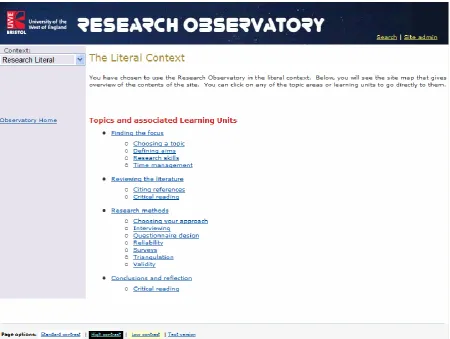
[image:10.595.66.520.215.665.2]Figures 2 and 3 below show the home pages of the two currently available contexts; the metaphoric and the literal. If users wish to change the context at any point in the site, they can do this by choosing the context from the drop-down box in the left hand navigation panel. They do not have to return to these front pages. The high and low contrast controls for accessibility are also available in both contexts.
[image:10.595.79.517.430.663.2]Figure 2. Example of the literal context
Security and robustness
The application front layer resides on a web server in the perimeter network or DMZ (DeMilitarized Zone) i.e. it is directly accessible from the Internet. The application drives the rendition of the RO based on the choices made by the user accessing it. The relational database resides on a consolidation database server behind the university‟s firewall, i.e. it is not directly accessible from the Internet. The database stores information about all the learning and narrative objects and their relationships. The file store resides on the university‟s Storage Area Network behind the firewall. All learning and narrative objects are physically stored there. When a user views the RO, for example a particular constellation, the application queries the database to gather the information relating to that constellation. It then accesses the related files in the file store and presents them to the user according to their chosen visual and cognitive rendition. Early testing has revealed that the architecture is both robust and secure, as at no time does any user have direct access to the database or file store.
Evaluation
In the creation of RO version 2, we employed the DSDM approach. This has proved to be a highly effective method of design and construction, as it stresses the iterative processes of design. It fitted us as a small team, took account of the pedagogical and technical expertise of the team members and it is certainly a method we would use again in the future.
Now that we have a proven architecture, the RO version 2 forms the seed bed for further large-scale cross-curricula projects in the university. There is interest in similar resources being created in mathematics support and careers education, for example. The implemented three-tier architecture has revealed itself to be a very flexible and robust solution that could be further developed to serve an expanding set of requirements, be it new conceptual realisations of learning environments or new rendering aids. Furthermore, the team has reflected on the possibility of applying web 2.0 architecture principles to a future version 3 of the RO, with a view to devolving rendering design to the user, and thus creating a dynamic architecture that could grow organically to serve the user community‟s needs.
Conclusion
The project so far has clearly shown that there is a need for learning resources to be flexible enough to adapt to different learning contexts, and that current learning management systems, portals and information systems tend not to offer that degree of choice to the user. Current accessibility standards have a tendency to focus on dyslexia, hearing and vision impairments. However, it is likely that cognitive aptitudes affect a larger proportion of the student body, but of course these differences are harder to identify and harder to accommodate, particularly when presenting the same basic information or learning opportunities.
There is an interesting echo of the Baron-Cohen et al (2001) study on autistic tendencies in maths and science students and the RO version 1 evaluation relating to the views of some of the students on the irrelevance of metaphor. Our study investigated a small sample of students but the resonance suggests that future study might further explore relationships between learning styles and subjects of study. The current phase of the research work that underpins further development of the RO is engaging with students with diagnosed ASD to collaboratively design and create further contexts that can be accommodated by the RO structure.
The development of the RO version 2 is currently ongoing. The nature of a project such as this is that there is no point at which it can be considered as „completed‟. However, the team feels that this is a good point at which to report on our findings as the development work has revealed some fundamental pedagogical issues and some technological solutions that can be used to address them.
Acknowledgements
We would like to acknowledge the members of the RO project team, Dr Olivia Billingham, Faisal Liaqatullah and John Bailey for their inspired input into the project. We would also like to acknowledge the many members of IT Services and academic colleagues at the University of the West of England, Bristol, who have given their continuing support. Special thanks go to Steve Grive, Head of IT Services, for his constant belief in this project.
References
A Learner‟s Blog, (2006). A Learner’s Space – into the semiosphere at
http://www.itbubble.com/?m=20060801 . Posted 1st August 2006. Accessed 8th September 2006
Males and Females, Scientists and Mathematicians. Journal of Autism and Developmental Disorders, 31, (1) pp 5 – 17
Choi J and Hannafin M. (1995). Situated cognition and learning environments: Roles, structures and implications for design. Educational Technology Research and Development, 43, 2, pp.53-69.
DSDM Consortium (2002). Business Driven Systems Development: the DSDM approach. The DSDM Consortium, National Computing Centre; Manchester UK.
Falconer L. (2001). Fuzzy Decisions and Occupational Risks. PhD thesis, University of Salford.
Kaczmarek J & Landowska A (2007) Model of a Distributed Learning Objects Repository for a Heterogenic Internet Environment. Interactive Learning Environments, 14, 1, pp.1 – 15. Mason R (2006) Holistic Course Design Using Learning Objects. International Journal of Learning Technology, 2, issue 2/3, pp 203 - 215.
Mottron L & Belleville S. (1993). A Study of Perceptual Analysis in a High-Level Autistic Subject with Exceptional Graphic Abilities. Brain and Cognition, 23, pp.279 – 309. National Autistic Society. (2005). About Autistic Spectrum Disorders. At
http://www.nas.org.uk/nas/jsp/polopoly.jsp?d=114 . Accessed 1st February 2007.
Plaisted K, Swettenham J & Rees L. (1999). Children with Autism Show Local Precedence in a Divided Attention Task and Global Precedence in a Selective Attention Task. Journal of Child Psychology and Psychiatry, 40, pp.733 – 742.
Polsani PR (2003) Use and Abuse of Reusable Learning Objects. Journal of Digital Information, 3, 4, Article No. 164, 2003-02-19. At
http://jodi.ecs.soton.ac.uk/Articles/v03/i04/Polsani . Accessed on 22nd May 2007.
Skupin A. (2000). From Metaphor to Method: Cartographic Perspectives on Information Visualization at
http://geography.sdsu.edu/People/Pages/skupin/research/pubs/InfoVis2000.pdf Accessed 31st January 2007.