© 2019, IRJET | Impact Factor value: 7.211 | ISO 9001:2008 Certified Journal
| Page 2812
DESIGN AID TO IS 800-2007: SAFE LOAD FOR ANGLE STRUTS
Vidhi Chopra
1, Dr. Mohan Gupta
21
Student, M-tech (Structural Engineering), Dept. of Civil Engineering, B.I.T. Durg, Chhattisgarh, India
2Ph.D (Steel Structures), Professor and Head, Dept. of Civil Engineering, B.I.T. Durg, Chhattisgarh, India
---***---Abstract -
Steel Structures had been widely preferred by theengineers, designers and architects across the whole world as steel is considered as the material par excellence when we consider modern as well as advanced construction practices. Steel Structures permit better design, detailing, quality, economy and safety. The Revision of IS 1984 to IS 800-2007 has shifted the design practice of Steel structures from Working Stress Design (WSD) to Limit State Design (LSD). This Design Aid to IS 800-2007 will contribute to provide all the necessary information regarding the Safe Load for Angle Struts, based on the LSD specifications, emphasizing on the fact that promoting the application of IS 800-2007 in designing will help in better and efficient adoption of LSD methodology . It contains the Compressive Resistance of various Rolled Steel Equal and Unequal Angle Sections served in a comprehensible table configuration. It is prepared to facilitate the LSD of Steel Structures for students as well as practicing engineers. Comparative study of Safe Loads for Angle Struts based on both the codes IS 1984 and IS 800-2007 is also presented to provide the contrasts between the two methods.
Key Words: Steel Structures, IS: 800, LSD, WSD, LSM, WSM, BIS.
1. INTRODUCTION
Generally the construction materials are decided on the basis of the budget of the project, required weight of the structure, availability of the materials and required resistance against the fire, earthquake, floods etc. In India, concrete has been widely used as a construction material because it provides better economy during construction as it is cheap and does not requires much skilled labors. But they are not very much preferred when it comes to construction of commercial buildings like high rise buildings, long span bridges, Railway Bridges, Footbridges and other advanced structures due to its lack of strength, versatility, quality and durability and therefore they are replaced by steel.
The use of steel as a building material has rocketed immensely during the last few decades and the popularity of Steel Structures in modern construction practices is crystal clear worldwide. Steel Structures enables integrated design,
high strength, great workability, high elasticity, accurate detailing, efficient and cost effective erection as well as complete health and safety in the construction industry. From the environmental point of view, it has also been proven that steel liberates less Greenhouse gases as compared to concrete and cause minimum energy burden to the eco-system. The production of waste during the manufacturing of steel elements as well as during the construction stage is also less. The steel can also be recycled and reused, thus overall they are considered as a better sustainable material for construction.
2. STEEL AS AN ANGLE SECTION
Structural Steel are available in a number of different shapes uniquely prepared by Hot or Cold Rolling each sections individually like I-Sections, Channel sections, Tee-Sections, Angle Sections etc. or by combining two or more such sections or by forming built-up sections with or without cover plates by the help of welding or bolting.
The use of Single angle section as a compression member is considered quite difficult due to their eccentric end conditions which leads to perplexity in the calculation and makes the analysis quite cumbersome. However this design-aid will ease the calculation by providing the value of design compressive stress for the respective slenderness ratio of the different angle sections.
2.1 Application of Angle Sections
The Angle sections can be used in different stages during construction of a steel structure, in the form of a number of different structural elements. Some of their applications are mentioned below:
Angle Sections are more resistant to buckling and hence are used in the construction of Trusses (generally as Purlin), Towers (generally Lattice profiled Steel Tower), Steel Bridges etc.
© 2019, IRJET | Impact Factor value: 7.211 | ISO 9001:2008 Certified Journal
| Page 2813
For resisting heavy loads, angles are used as aConnecting Member to form built-up sections. Angle sections are used as Lacing or battening
elements and also as Cleat Angles to connect two columns, a column to a beam, purlins to the chord etc. to prevent buckling as well as to transfer forces among the connected members.
3. INDIAN STANDARD CODES FOR CIVIL ENGINEERS
To get the desired strength, uniformity and economy in the construction it is very important to design the structures according to the Standard Specifications that are verified by the government of the country and are known as the Code of Practices.
Code of Practices, provides standard details, procedures essential data as well as all the important information to the designers and the contractors to work according to the designated guidelines in order to obtain safe and economical construction. Thus they can be defined as the virtual collection of the technical knowledge of the expertise within the building and the construction industry.
A large number of Indian Standard (IS) codes prepared by Bureau of Indian Standards (BIS) are available that virtually provide all the technical terms, specification and guidelines. They very much acts as a government approved regulations which specifies the preferable options of designing and construction works in order to meet the operational requirements and objectives.
IS 800 is assigned for the “Code of practice for general construction in steel”. IS 800 was first published in 1956 with revisions in 1962, 1968, 1984 till publication of IS 800-2007.The Limit State concept of design (LSD) also known as Load and Resistance Factor design (LRFD) has been introduced on the latest IS code of practice for general construction using hot-rolled steel sections (IS 800-2007), published by Bureau of Indian Standards, New Delhi released in February 2008; this 3rd revision of the code is based on LSM of design while the earlier versions of the codes were based on WSM or Allowable Stress Method.
4. DESIGN-AID TO IS 800-2007
Until the BIS introduced the LSD specifications in IS 800-2007, the design of steel structures were based solely on WSD methodologies. The shift to LSD has not been readily embraced by the engineering or designing profession, even
though almost all the engineering institute of India had been shifted to teaching the LSD specifications five years of its introduction. It seems that there was no apprehended need for the engineers to change the methodologies, even though there was adequate evidence that LSD produced structures with a more consistent factor of safety.
As compared to the world, the LSD concept was introduced much later on India and that is why the structural engineers of India are still unfamiliar with the concept of LSM. The young engineering graduates when enter the construction industry are often advised by the senior to design the structure with traditional WSM as per IS 800-1984. The overall idea of WSM is to be safe and to keep the stress up to the Elastic limit, by increasing the size of the member which automatically increases the budget as well as the duration of the project. Thus this method is preferred when the life of the structure is more important as compared to the cost and time involved in the project. In LSM, the designing is based upon improving the performance and bringing economy in the construction project thus it is extended up to the Ultimate strength of the materials and comparatively smaller size of members are constructed. After designing, checks for safety (shearing, flexural, torsional etc.) and serviceability (creep, deflection, durability etc.) are performed for increased load and if the checks are satisfied against the permissible value it is assumed to be satisfied for the actual loads acting on the structure Therefore for the acceptance of LSD in all the levels of construction, better study, evaluation and understanding of IS 800:2007 is necessary. This design-aid for angle struts based on LSD is prepared for better application of IS 800:2007.
4.1 This Design-Aid will provide guidelines for
Convenient design of compression members as per LSD methodology.
Determining the compressive resistance of various rolled steel equal and unequal angle sections. Direct design implementation of LSD concept. Minimizing the cumbersome effort of step-by-step
designing of compression members.
© 2019, IRJET | Impact Factor value: 7.211 | ISO 9001:2008 Certified Journal
| Page 2814
Necessary information about the safe compressiveload for angle sections considering both hinged and fixed gusset plate connectivity provided in an easy to understand table configuration.
4.2 Safe load for Single Angle Struts
Struts are the Vertical or inclined Compression members generally used in the Trusses or Bracings. They are generally used for short spans.
Using C programming we developed a program to determine the safe loads for single angle struts and by accumulating those values we develop a table which serves as our design-aid.
The program embeds pre-stored data containing the angle properties such as rvv (Radius of Gyration about the Minor Axis) which we obtained from the steel tables, and constants K1, K2, K3 according to the different combinations of number of bolts at the end connection and the connecting member fixity obtained from the Table 12 of IS 800:2007.
The program further proceeds by obtaining the input values for ‘b1’ and ‘b2’ i.e. Width of two legs of the angles, ‘t’ being the thickness of the leg and ‘l’ i.e. the center to center length of the supporting member and ‘Ae’ being the effective area of the angles obtained from the user.
Now providing the equation for the determination of λvv and λØ using the data already provided as an input by the user where the value of constants E (Modulus of Elasticity of Steel) is prescribed as 2 X 10⁵ and ɛ (yield stress ratio) as 1 by considering the value of yield stress fy = 250MPa. The obtained results for λvv and λØ are thus stored in the instance of program as well as simultaneously being used to evaluate the value of λe which is further used to evaluate the design compressive stress fcd considering the value of imperfection factor α as 0.49 for the buckling class ‘c’ for single angles.
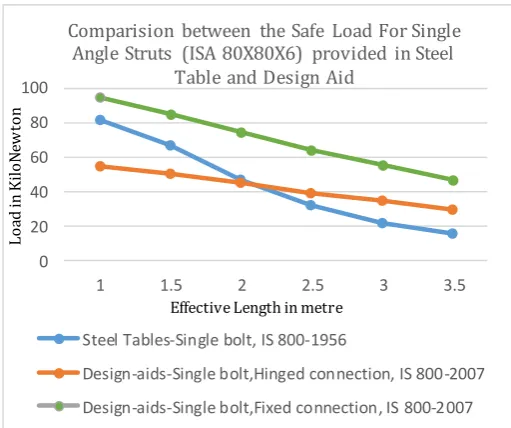
Chart below shows the Contrast between the Safe Loads for Angle Struts obtained th
rough the WSM (IS 800-1956)
and
LSM(IS 800-2007) method as provided in the Steel Table by S. Ramamrutham and the Design-aids to IS 800-20070 20 40 60 80 100
1 1.5 2 2.5 3 3.5
Lo
ad
in
K
ilo
N
ew
to
n
Effective Length in metre
[image:3.595.311.567.101.315.2]Comparision between the Safe Load For Single Angle Struts (ISA 80X80X6) provided in Steel
Table and Design Aid
Steel Tables-Single bolt, IS 800-1956
Design-aids-Single bolt,Hinged connection, IS 800-2007
Design-aids-Single bolt,Fixed connection, IS 800-2007
Chart -1: Safe load for single angle strut, ISA 80X80X6 Some important points to be considered in the use of design-aids are:
The design units are entirely in SI units as per the provisions of IS 800-2007.
It is assumed that the user is familiar with the provisions of IS 800-2007 before using these design-aids.
These design-aids are also based on Steel Tables by S. RAMAMRUTHAM.
Notations used in it are as per IS 800-2007 and Steel Tables as far as possible.
The term ‘Code’ in here refers to IS 800 ‘General Construction in Steel- Code of Practice’ published in 1956 and revised in 1984 and 2007.
It is based on Limit State of Design concepts or specifications for Steel Structures.
The design-aids are presented in a comprehensive table format for better accuracy and understanding.
5. RESULT AND DISCUSSION
© 2019, IRJET | Impact Factor value: 7.211 | ISO 9001:2008 Certified Journal
| Page 2815
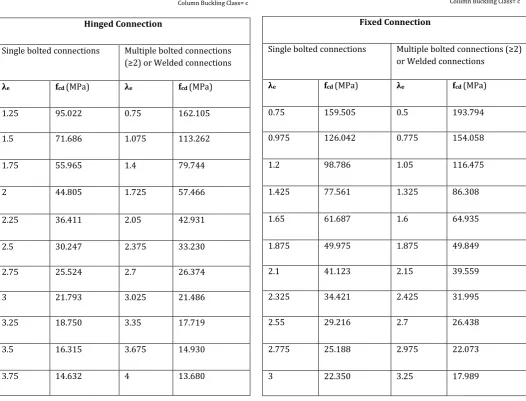
Table -1: Design Compressive Stress, fcd (MPa)corresponding to Equivalent Slenderness Ratio, λe (For single angle struts based on the number of bolts at
each end connection and hinged connection)
fy= 250 N/mm2
E=2.0 X10⁵ N/mm2
Column Buckling Class= c
Hinged Connection
Single bolted connections Multiple bolted connections
(≥2) or Welded connections
λe fcd (MPa) λe fcd (MPa)
1.25 95.022 0.75 162.105
1.5 71.686 1.075 113.262
1.75 55.965 1.4 79.744
2 44.805 1.725 57.466
2.25 36.411 2.05 42.931
2.5 30.247 2.375 33.230
2.75 25.524 2.7 26.374
3 21.793 3.025 21.486
3.25 18.750 3.35 17.719
3.5 16.315 3.675 14.930
3.75 14.632 4 13.680
Table -2: Design Compressive Stress, fcd (MPa) corresponding to Equivalent Slenderness Ratio, λe (For single angle struts based on the number of bolts at
each end connection and Fixed connection)
fy= 250 N/mm2
E=2.0 X10⁵ N/mm2
Column Buckling Class= c
Fixed Connection
Single bolted connections Multiple bolted connections (≥2)
or Welded connections
λe fcd (MPa) λe fcd (MPa)
0.75 159.505 0.5 193.794
0.975 126.042 0.775 154.058
1.2 98.786 1.05 116.475
1.425 77.561 1.325 86.308
1.65 61.687 1.6 64.935
1.875 49.975 1.875 49.849
2.1 41.123 2.15 39.559
2.325 34.421 2.425 31.995
2.55 29.216 2.7 26.438
2.775 25.188 2.975 22.073
3 22.350 3.25 17.989
5.1 Discussion
The obtained value of fcd was determined by the means of linear interpolation method. The accuracy and precision of which can be increased by using polynomial interpolation or other advanced interpolation methods but this will also increase the complexity as well as the time taken for the overall process.
© 2019, IRJET | Impact Factor value: 7.211 | ISO 9001:2008 Certified Journal
| Page 2816
marginal difference in the value of fcd for the same value of λebut different angles and effective lengths. This can occur due to rounding-off of the results (λe and fcd) up to 3 decimal places performed for the convenience and ease in the further computational work.
6. CONCLUSIONS
It can be concluded that LSD concept is accepted all over the world replacing WSD, but in India we had still not completely switched to this methodology. Practicing Engineers are still indecisive over using IS 800-2007 and till date prefer IS 800-1984 based on traditional WSD specifications.
Structures like long span steel bridges and tall steel structures are frequently constructed in the developed countries of the world using LSD concepts but unfortunately in India these structures are not very popular as in the case of implementing LSD. The rate of steel consumption in India is alarmingly low when compared with the other developing and developed countries of the world which is a very concerning matter because we are one of the top manufacturer of steel. All these ignorance and lack of application of IS 800-2007 have brought great losses from the development point of view in our country and to overcome this loss we have to promote the use IS 800-2007 among the young structural engineers as well as upgrade the knowledge of both professionals and students towards the LSD methodology.
This Design-Aids is prepared to act as one such helping hand for the better understanding of IS 800-2007. It provides the compressive resistance of various rolled steel equal and unequal angle sections in tabular form for a convenient learning process, high rate of accuracy in the evaluation process and saves a lot of time and efforts during the designing phase.
ACKNOWLEDGEMENT
I would like to express my deep gratitude to Dr. M. K. Gupta for giving his time so generously and providing me with all information regarding the various IS specifications and design procedure.
REFERENCES
[1] Som Biswajit, Maiti Sovanlal, Mondal Gokul (January 2015), Limit State Design: IS: 800 2007 a New Challenge for Structural Engineers in India. Int. Journal of Engineering Research and Applications. ISSN: 2248-9622, Vol. 5, Issue 1 (Part 3), pp. 11-19. [2] M. Krishnamoorthy, D. Tensing (October 2012), Design of Compression Members Based on IS 800-2007 and IS 800-1984- Comparison. Journal of Information, Knowledge and Research in Civil Engineering. ISSN: 0975- 6744, Vol. 2, Issue 1. [3] Subramanian N., Steel Structures: Design and
Practice (2013), 6th ed. India: Oxford University Press 2010. ISBN-13: 978-0-19-806881-5, ISBN-10: 0-19-806881-6.
[4] Duggal S. K., Limit State Design of Steel Structures (2015), 2nd ed. India: McGraw Hill Education Private Limited 2014. 13: 978-93-5134-349-3, ISBN-10: 93-5134-349-9.
[5] Guha Arijit and Dr. Bandyopandhya T.K., Structural Member Design Based on Draft IS: 800 (Limit State Method), Insdag’s Steel Journal, Institute for Steel Development and Growth, Jan 2004, Vol.5.
[6] Indian Standard General Construction in Steel- Code of Practice “IS 800-2007”, 3rd Revision, Published by Bureau of Indian Standards 2007. ICS 77.140.01. [7] Indian Standard Code of Practice for General
Construction in Steel “IS 800-1984”, 1st Revision, Published by Bureau of Indian Standards 1995. UDC 693-814: 006-76.
[8] Ramamrutham S., Steel Tables (February 2010), Dhanpat Rai Publishing Company Private Limited. ISBN 978-93-84378-11-0
BIOGRAPHIES
Vidhi Chopra