International Research Journal of Engineering and Technology (IRJET)
e-ISSN: 2395-0056 p-ISSN: 2395-0072 Volume: 06 Issue: 05 | Apr 2019 www.irjet.netPARAMETRIC OPTIMIZATION OF TIG WELDING ON SS 304 AND MS
USING TAGUCHI APPROACH
Vishal Chaudhari
1, Vaibhav Bodkhe
2, Shubham Deokate
3, Bhupendra Mali⁴, Rayappa Mahale⁵
1234
UG Student, Dept of Mechanical Engineering, D Y Patil Technical Campus, Ambi , Maharashtra , India.
5Assistant Professor, Dept of Mechanical Engineering, D Y Patil Technical Campus, Ambi , Maharashtra , India.
---***---
Abstract –
In this research paper we used stainless steel304 and mild steel material. In which stainless steel 304 material has good inter-granular corrosion resistance which increase the life span of pressure vessels and automobile components. TIG welding is most vital and common operation used for joining of two similar or dissimilar parts with heating the material or applying the pressure by using the filler material for increasing productivity with less time and cost constrain. We have used Taguchi’s method of optimization to optimize the various process parameters such as Current, Voltage, and Gas Flow Rate (GFR) which has influence on tensile strength and hardness of the joint. A Taguchi Orthogonal array, signal to noise (S/N) ratio and analysis of variance (ANOVA) are employed to investigate the welding characteristics of dissimilar joint and optimize the welding parameters.
Key Words: TIG Welding, Taguchi Orthogonal Array, Tensile Strength, Hardness, S/N Ratio, ANOVA
1.
INTRODUCTION
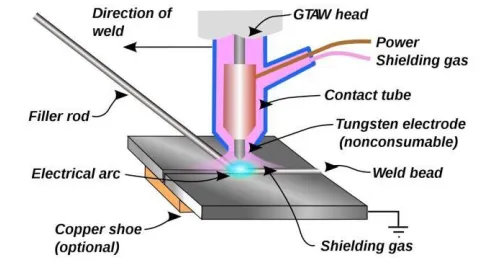
[image:1.596.36.285.625.758.2]Welding is a process in which we join two similar or dissimilar metals or non metals by applying pressure or non pressure. Gas tungsten arc welding, GTAW, also known as tungsten inert gas welding, is an arc welding process that uses a non consumable tungsten electrode for establishing an electric arc. Weld area is protected by shielding gases like argon or helium. It is generally used for welding hard-to- weld metals such as Stainless Steels, Magnesium, Aluminium, and Titanium. TIG welding is most commonly used to weld thin sections. For welding stainless steel we use direct current with negative electrode. Direct current with positive electrode is very less common and used rarely.
Fig :-1 Principle Of TIG Welding
Ramesh Rudrapati [6] who carried out experiment on Parametric Optimization of TIG Welding Process in Butt Joining of Mild Steel and Stainless Steel. In this paper welding parameters are analyzed and optimized in TIG welding of dissimilar materials (mild steel and stainless steel) to maximize the ultimate load and breaking load simultaneously by using grey relational analysis combined with Taguchi method. Kumar Rahul Anand [4] who carried out experiment on parametric optimization of CO2 welding
which is done on stainless steel the process parameter where current, voltage and gas flow rate (GFR) statistical technique, analysis of variance (ANOVA), signal to noise ratio and graphically main effect plot have been used to study the effect of welding parameters on which ultimate load of weld specimen optimum parametric condition obtained by the Taguchi method. Ajit Khatter [11] in this paper, the use of the L9 orthogonal array, with three control parameters allowed this study to be conducted with a sample of 18 work pieces.
The study found that the control factors had varying effects on the Tensile strength, welding voltage having the highest effects. Ravinder & S.K.Jarial [9] studied the Parametric Optimization of TIG welding on stainless steel (202) and mild steel by using Taguchi method and found the control factor which had varying effect on the tensile strength, arc voltage having the highest effect and also found the optimum parameter for tensile strength current 80 A, Arc voltage 30 V and GFR 6 lt/min.
2.
Taguchi Method
International Research Journal of Engineering and Technology (IRJET)
e-ISSN: 2395-0056 p-ISSN: 2395-0072 Volume: 06 Issue: 05 | Apr 2019 www.irjet.netany process using Taguchi concept by conducting few experiments.
2.
METHODOLOGY
a)Selection of material (SS 304 and Mild Steel (Low Carbon). b) Process Parameter Selection (Welding Current, Arc Voltage, & Gas Flow).
c)Sample Preparation (Cutting, Welding etc.).
d)Specimen for Tensile Test and Rockwell Hardness Test. e)Analysis of results.
Material Selection
Stainless Steel
Stainless steels are most notable for the corrosion resistance, which increases with increasing chromium content. Additions of molybdenum increase corrosion resistance in reducing acids and against pitting attack in chloride solutions. Thus, there are numerous grades of stainless steel with varying chromium and molybdenum contents to suit the environment the alloy must endure. Stainless steels resistance to corrosion and staining, low maintenance, and familiar luster make it an ideal material for many applications where both the strength of steel and corrosion resistance are required.
Chemical Composition
Element Cr Ni Mn N S C Si P % 18 8 2 0.10 0.03 0.08 0.75 0.045
Mild steel
Mild steel is a type of carbon steel with a low amount of carbon – it is actually also known as “low carbon steel.” Although ranges vary depending on the source, the amount of carbon typically found in mild steel is 0.05% to 0.25% by weight, whereas higher carbon steels are typically described as having carbon content from 0.30% to 2.0%. If any more carbon than that is added, the steel would be classified as cast iron.
Element C Si Mn S P
% 0.16-
0.18 0.40 0.70- 0.90 0.040 0.040
Signal to Noise (S/N) Ratio
Taguchi method stresses the necessity of studying the response variation using the signal-to-noise ratio, resulting to decrease the effect of quality characteristic variation due to uncontrollable parameter. The S/N ratio can be used in three types:
Where,
n = Number of trials or measurement yi = measured value
ȳ = mean of measured value s = standard deviation
ANOVA (Analysis Of Variance)
The purpose of the analysis of variance (ANOVA) is to investigate which design parameters significantly affect the quality characteristic. This is accomplished by separating the total variability of the S/N ratios, which is measured by the sum of the squared deviations from the total mean S/N ratio, into contributions by each of the design parameters and the error. First, the total sum of squared deviations SST from the total mean S/N ratio nm can be calculated as, SST
= Σ (ni - nm)2
Where,
ni = S/N ratio experiment.
nm = total mean of S/N
ratio.
3.
Experimentation and work
The plan has been made and work-piece materials (i.e. mild steel and stainless steel304) have been cut into desired dimensions (150*150*6mm). The welding parameters to this project are taken as current, voltage and gas flow rate. The S/N ratio for each level of process parameters is computed based on S/N analysis. Further, statistical ANOVA was performed to indicate which process parameters are significant. Welds are made under varied conditions of welding as given L9 orthogonal array of Taguchi method.
Table-1: Process Parameters
1.
Larger the better2.Smaller the better
3.Nominal the best
Where, n= Number of trials or measurement, Y =
Sr. No.
Process
Parameter Unit s 1 level 2 3
International Research Journal of Engineering and Technology (IRJET)
e-ISSN: 2395-0056 p-ISSN: 2395-0072 Volume: 06 Issue: 05 | Apr 2019 www.irjet.netTable-2: Universal Testing Machine Results
Run Current Voltage Gas Flow
Rate Tensile Hardness
1 150 22 10 368.38 82.3
2 150 24 12 403.333 82.1
3 150 26 14 504.94 88.8
4 200 22 10 403.76 83.33
5 200 24 12 375.57 78.5
6 200 26 14 314.30 78.4
7 250 22 10 340.77 62.6
8 250 24 12 343.61 70.9
9 250 26 14 319.72 80.4
4.
Result & Discussion
Tensile Test
Tensile testing has been done on the welded specimens. It was done on Universal Testing Machine (UTM). The value of tensile strength has been observed and then S/N ratio has been calculated manually as well as using software called MINITAB. The effect of each parameter on welding has been calculated and with the help of ANOVA, their percentage contribution is also evaluated.
Table-3: Reading of Tensile Strength and S/N ratio
Calculation for S/N Ratio:
We know S/N ratio for larger is better is: For 1st run: n = 1 because we get the result in single trial y = 368.38 (observed value) So, S/N = -10 log (1/ 368.38) = 51.32 Similarly we have calculated S/N Ratio for every run.
Fig-3: Graph for S/N Ratio of Different parameters For Tensile Strength.
Table-4: Mean Response Table for Signal to Noise Ratio for Tensile Strength Larger is better
Level Current Voltage Gas Flow Rate
1 52.50 51.37 50.66
2 51.19 51.44 51.44
3 50.49 51.37 52.07
Delta 2.01 0.08 1.40
Rank 1 3 2
In Taguchi experiments, we always want to Maximize the S/N ratios and the means were maximized. when the Current was 150, the Gas Flow Rate was 10 and the arc voltage was 24. Based on these results, we should set the factor at the calculated value.
Run current
(amp) (volt) GFR
n) strength (mpa)
S/N ratio
150 22 10 368.38 51.32
150 24 12 403.333 52.11
150 26 14 504.94 54.06
200 22 10 403.76 52.12
200 24 12 375.57 51.19
200 26 14 314.30 49.94
250 22 10 340.77 50.64
250 24 12 343.61 50.72
International Research Journal of Engineering and Technology (IRJET)
e-ISSN: 2395-0056 p-ISSN: 2395-0072 Volume: 06 Issue: 05 | Apr 2019 www.irjet.netTable No:-5Analysis of Variance for Transformed Response
Hardness Test
[image:4.596.28.294.137.425.2]The Rockwell hardness test method, as defined in ASTM E- 18, is the most commonly used hardness test method. The micro-structure of each zone has also been observed and captured for better understanding. The samples were prepared accordingly and all 9 samples are tested for hardness. The 9 samples for hardness test are prepared on a mould of Bakelite Powder.
Table-6: Response of Hardness with S/N ratio:
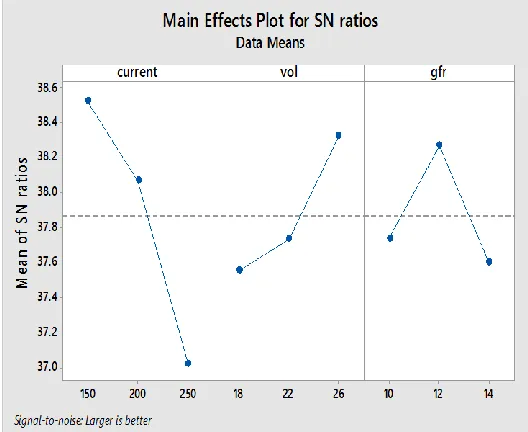
Fig-3: Graph for S/N Ratio of Different parameters For Hardness Test
Table-:7 Mean Response Table for Signal to Noise Ratio For Tensile Strength Larger is Better
Level Current Voltage Gas Flow Rate
1 38.52 37.55 37.74
2 38.07 37.73 38.27
3 37.02 38.32 37.60
Delta 1.50 0.77 0.67
Rank 1 2 3
From the above table we have observed that the Hardness of taken specimen will be higher when the arc current is maintained at 150 A, arc voltage at 22V and gas flow rate at 12 L/min thus we find these parameters are optimum for this experiment and we have the ANOVA result in below table.
ce DO F
Seq ss Contri Adj
SS Adj MS F- Valu e
p- Valu e
CUR REN T
9693.
4 48.55 9693 .4 4846. 1.89 0.34
VOL 817.
0 4.09% 817. 408.5 0.16 0.86
GFR 4331.
9 21.70 4331 .9 2165. 0.85 0.54
ERR
OR 5124.9 25.67 5124 .9 2562.
Total 19967. 100.00
Run Current Voltage Gas Flow Rate
Hardness S/N ratio
150 22 10 82.3 38.30
150 24 12 82.1 38.28
150 26 14 88.8 38.96
200 22 10 83.33 38.41
200 24 12 78.5 37.89
200 26 14 78.4 37.88
250 22 10 62.6 35.93
250 24 12 70.9 37.01
[image:4.596.28.295.140.424.2]International Research Journal of Engineering and Technology (IRJET)
e-ISSN: 2395-0056 p-ISSN: 2395-0072 Volume: 06 Issue: 05 | Apr 2019 www.irjet.net4.
Mathematical Model
A mathematical model can be developed for above experiment. Using multiple linear regression and correlation analysis, mathematical models for Ra is obtained as follows: As Ra is a function of more than one independent variable; the matrix equations that express the relationships among the variables can be expanded to accommodate the additional data.
Ra = a0 + a1 x1 + a2 x2 + a3 x3 + a4 x4
Where, a0, a1, a2, a3 and a4 are the constant coefficient and
x1= Welding current (I) x2= Welding voltage (V) x3= Gas flow Rate (G)
A multivariate model of the data is multiple regressions solves for unknown coefficients by performing a least squares fit. Construct and solve the set of simultaneous equations by forming the regression matrix, X, and solving for the coefficients using the backslash operator. X
= [ones (size(x1)) x1 x2 x3]; the least squares fit model of the data is to validate the model, find the maximum of the absolute value of the deviation of the data from the model. Y = X*a;
The regression equation is
Tensile=338 - 0908CURRENT + 1.09VOL + 16.25GFR
5.
Conclusions
1. The use of the L9 orthogonal array, with three control parameters allowed this study to be conducted with a sample of 18 work pieces (9workpiece of SS304 and 9workpiece of Mild Steel).
2.The study found that the control factors had varying effects on the Tensile strength, welding current having the highest effects.
3.Optimum parameter setting for weld strength is obtained at current of 150 amps, 24 volt, and 10-litre/min-gas flow. 4. Formulation of equation for tensile strength- Tensile Strength =338-0.908CURRENT+1.09VOL16.25GFR
5.Optimum parameter setting for Hardness is obtained at current of 150 amps, 22 volt, and 12-litre/min-gas flow. 6.Formulation of equation for hardness, Hardness=88.7 - 0.1310CURRENT + 0.808VOL - 0.14GFR
6. References
1.Bhushan P Jain, Darshan V Sanghavi, Rayappa S Mahale “Parametric Optimization Of Co2 Welding On Fe410 Using Taguchi Technique” Volume: 06 Issue: 04 Apr 2019, e- ISSN: 2395-0056, p-ISSN: 2395-0072.
2.Devesh Goyal, Pavan Agrawal “Optimization of Welding Parameters of TIG Welding on Welding Strength using Taguchi and ANOVA” Volume 6 Issue III, March 2018, ISSN: 2321-9653.
3. Shahin Ansari ,Quazi T.Z “Optimisation of Tig Welding Parameters by using Taguchi’s Approach” Volume 8, Issue 2, February-2017, ISSN 2229-5518.
4. Kumar Rahul Anand, Vijay Mittal “Parameteric Optimization Of Tig Welding On Joint Of Stainless Steel(316) & Mild Steel Using Taguchi Technique” Volume: 04 Issue: 05 May -2017, e-ISSN: 2395 -0056, p-ISSN: 2395-0072.
5.Sanjay Kumar, Pravin Kumar Singh, Dharmendra Patel, S. B. Prasad “Optimization Of Tig Welding Process Parameters Using Taguchi’s Analysis And Response Surface Methodology” Volume 8, Issue 11, November 2017, ISSN: 0976-6340 and ISSN: 0976-6359.
6.. Ramesh Rudrapati , Nirmalendhu Chowdhury , Aasish Bandyopadhyay “Parametric Optimization of TIG Welding Process in Butt Joining of Mild Steel and Stainless Steel” Oct 2016 ,E-ISSN 2277 – 4106, P-ISSN 2347 – 5161. 7. M.Prabhandha, Prasad Rayala “Parametric Optimization Of Tig Welding Using Taguchi Method” Volume 1, Issue 1 (2016, Sept/Oct), (Issn-Xxxx-Xxxx) Anveshana’s International Journal Of Recent Advances In ce D F Seq ss Contri Adj SS Adj MS F- Valu
e
p- Valu e
CUR REN T
228.13 58.09 228.
13 114.0 3.43 0.22
VOL 65.89 16.78 65.8 32.94 0.99 0.50
GFR 32.19 8.20% 32.1 16.10 0.48 0.67
ERR
OR 66.51 16.94 66.5 33.26
Total 392.72 100.00
International Research Journal of Engineering and Technology (IRJET)
e-ISSN: 2395-0056 p-ISSN: 2395-0072 Volume: 06 Issue: 05 | Apr 2019 www.irjet.netManufacturing, Quality And Operation Management Research.
8.Prashant Kumar Singh, Pankaj Kumar, Baljeet Singh, Rahul Kumar Singh “A review on TIG welding for optimizing process parameters on dissimilar joints” ISSN : 2248-9622, Vol. 5, Issue 2, February 2015.
9.Ravinder, S. K. Jarial “Parametric Optimization of TIG Welding on Stainless Steel (202) & Mild Steel by using Taguchi Method” Vol. 4 Issue 6, June-2015, ISSN: 2319- 7463.
10. . Nirmalendhu Choudhury, Ramesh Rudrapati and Asish Bandyopadhyay “Design optimization of Process Parameters for TIG Welding based on Taguchi Method” Special Issue-2, (February 2014), E-ISSN 2277 – 4106, P- ISSN 2347 – 5161.
11. Ajit Khatter, Pawan Kumar, Manish Kumar “Optimization of Process Parameter in TIG Welding Using Taguchi of Stainless Steel-304” IJRMET Vol. 4, IssuE 1, NoV 2013 - ApRIl 2014, ISSN : 2249-5762 ISSN : 2249- 5770.
12.J.Pasupathy, V.Ravisankar “Parametric Optimization Of Tig Welding Parameters Using Taguchi Method For Dissimilar Joint” Volume 4, Issue 1, Novmber-2013 ISSN 2229-5518.
BIOGRAPHIES:
Shubham Tatyaso Deokate is now
pursuing his Bachelor of Engineering in Mechanical Engineering at D. Y. Patil School of Engineering Academy, Ambi, Pune. He is presently working on the project of Parametric Optimization of TIG Welding On SS304 and MS Using Taguchi Technique.
Vishal Jayant Chaudhari is now pursing
his Bachelor of Engineering in
Mechanical Engineering at D.Y.Patil School of Engineering Academy, Ambi, Pune. He is presently working on the project of Parametric Optimization of TIG Welding on SS304 and MS Using Taguchi Technique.
Vaibhav Dilip Bodkhe is now pursing his
Bachelor of Engineering in Mechanical Engineering at D.Y.Patil School of Engineering Academy, Ambi, Pune. He is presently working on the project of Parametric Optimization of TIG Welding On SS304 and MS Using Taguchi Technique.
Bhupendra Mali is now pursing his Bachelor
of Engineering in Mechanical Engineering at D.Y.Patil School of Engineering Academy, Ambi, Pune. He is presently working on the project of Parametric Optimization of TIG Welding on SS304 and MS Using Taguchi Technique.
Rayappa S Mahale received Bachelor’s degree
in Industrial and Production Engineering and Master’s degree in Production Mechanical Engineering at D. Y. Patil School of Engineering Academy, Ambi, Pune, India. His areas of interests are Lean Manufacturing, Industrial Robotics, Advanced Ergonomics,
Process Metallurgy, Mechatronics,
Micro Fabrication and MEMS.