Attack Tree Design and Analysis of Offshore Oil and Gas
Process Complex SCADA System
M. V. V. Siva Prasad
Research Scholar, Department of Computer Science & Systems Engineering,
AU College of Engineering (A), Andhra University, Visakhapatnam
P. S. Avadhani
Professor, Department of Computer Science & Systems Engineering,
AU College of Engineering (A), Andhra University, Visakhapatnam
ABSTRACT
Attack Trees are very important in the effort to secure Industrial Process Control Systems ( I C S ) , because they aid directly in indicating the presence of vulnerabilities in network and how attackers use the vulnerabilities to implement an effective attack. Attack Tree design and analysis provide clues for the network security professionals on how an attacker exploits the vulnerability on the network to achieve goals. In this paper it will be illustrated for designing attack tree in Offshore Oil and Gas Process Complex SCADA System to identify various vulnerabilities. Using the vulnerabilities it presents how an attacker can take control of the SCADA system network and eventually affect hydrocarbons production.
Keywords
ICS, SCADA, MTU, TDMA, RTU
1 .
INTRODUCTION
SCADA system network instrumentation and control are critical for offshore oil and gas process complex as they support the operational state of the process complex via interaction with remote platform physical transducers and equipment. They are also responsible for oil and gas process control at remote platforms. SCADA systems are operated in environments different from those of conventional IT systems. In the past, SCADA systems were based on analog technologies; however, since the introduction of digital technologies in the 2000s, the proportion of digital technologies has been steadily increasing. The Present study SCADA system implemented in Tier structure is on corporate LAN. Since corporate LAN is not isolated the SCADA system exposed to network attacks. To access the impact of various threats faced by networks utilizing vulnerabilities Attack Tree analysis is proposed and developed by Schneier [1]. Phillips and Swiler in 1998 outlined a method that used graph to evaluate network security risk [2]. Meadows in his paper proposed using a graph representation to model stages of attacks on cryptographic protocols [3]. There is one approach of building security scenario on graph theory based graph assessment. According to Ramakrishman etal [4] graph theory based model checking was initially used to analyze whether a given goal state is reachable from the initial state and model based attack graph assessment used to enumerate all possible sequences of attacks between the two states. Ammann etal [5] in their paper proposed more compact representation of attack graph was proposed based on the graph theory in 2005. The attack tree analysis developed to assess the vulnerability of systems to a specific attack and security test. In general, the root nodes of attack trees and attack graphs represent the goal of an attack, other nodes represent the vulnerability that is exploited by the attack, and edges represent the relationship between nodes. In calculating
2.
METHODOLOGY TO CONSTRUCT
OFFSHORE OIL AND GAS PROCESS
COMPLEX SCADA ATTACK TREE
Attack trees constitute a powerful security tool aimed at modeling the many ways in which an attacker may compromise different assets in a network. An attack tree provides a method for representing attacks (and similar vulnerabilities) on a system in the structure of a tree. The goal of the tree is the root node. The leaf nodes represent different paths to achieve the goal. In the proposed attack tree for SCADA system identifies the threats that might affect Offshore Oil and Gas Process Complex process control system network and potentially compromise its assets. This includes SCADA system Tier-1 network, host, and applications. Network vulnerabilities or threats can be assessed by investigating how the data passes through Tier-1network routers, firewalls, switches, and other network devices. SCADA system Engineer needs to understand the logic and syntax of these device’s configuration files. In addition, system engineer needs to be able to determine what it takes to get past or compromise each device. Host investigations should include common configuration categories applicable to all server and operating systemresources (patches, files/directories, ACLs).
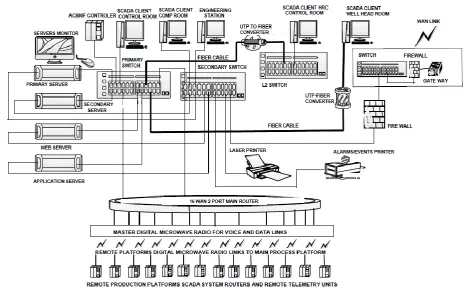
[image:2.595.59.526.361.651.2]To evaluate security of SCADA network, hosts security analyst must take into account the effects of local vulnerabilities and determine global security flaws. Scanning tools associated with Tier-1 SCADA system determine individual vulnerabilities of hosts. Using this information along with other information about network attack tree has been designed. The process for designing an attack tree for a SCADA system starts with important four servers Application Server, Web Server, Primary Server and Secondary Server’s vulnerabilities. Each path in an attack tree is a series of exploits they may be called as actions. Actions lead to undesired state. An undesired state is a state where intruder has gained administrative control over the critical host. Each branch in the attack tree implies lone intruder action. A path from root node to any other leaf node down below action corresponds to action scenario. Modeling the attack tree involves associating a logical AND & a logical OR with each node. In essence, a node of an attack tree can be decomposed into an AND or an OR node. An AND node or an OR node decomposition can be represented in graphical or textual formats. Let us consider Tier-1 SCADA system implemented at process complex level and analyze the same with attack tree. Figure 1 is SCADA network diagram at Tier-1.
Fig 1: Tier-1 SCADA System at Heera Offshore Oil and Gas Process Complex
The above figure 1 depicts SCADA system implemented at process complex level. It comprises of four Servers primary, secondary, WEB, and Application respectively. The Networking part includes with 16 WAN 2 Port main router and three numbers network switches. Main Telemetry Unit comprises of AC 800F main controller and Master Time Division Multiple Access (TDMA) Radio and Main Router. Master radio establishes communication links with remote platforms for field level data and parameters
for necessary monitoring and control. Once Attack Tree is designed it’s traversal along it’ path gives access over different nodes. Which represent the vulnerabilities in attacker’s way to gain control over the network.
node queue not null, the host pointed to by the pointer will be considered as a host attacker to exploit this. From the host that is directly connected to the host of attacker, one can find the host which can be attacked by an attacker. If they are found, and they are not in node_queue, put each of them in the node_queue. That means an attack has occurred from the attacker’s host to a new host. At the same time, the
[image:3.595.96.502.127.370.2]pointer will point to other elements in the next node_queue next to attacker’s host. The third point is continuing step (2), until node_queue pointer is null, which means no more elements in the node_queue. At this point, the flow chart will end. A detailed explanation of the flow chart is shown in Figure below.
Fig 2: Attack Tree Generation Flow Chart
3.
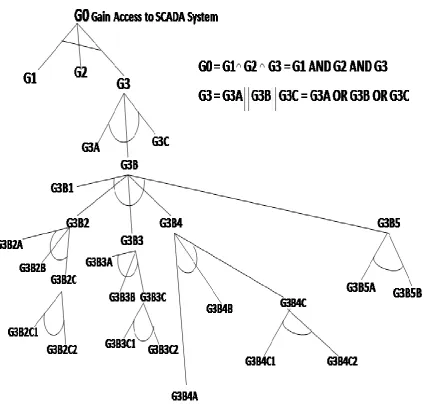
ATTACK TREE DESIGN FOR GAIN ACCESS TO SCADA SYSTEM
[image:3.595.81.516.431.752.2]4.
ATTACK TREE TOTAL NODES FOR GAIN ACCESS TO SCADA SYSTEM
5.
OFFSHORE OIL AND GAS PROCESS COMPLEX ATTACK TREE MODELING
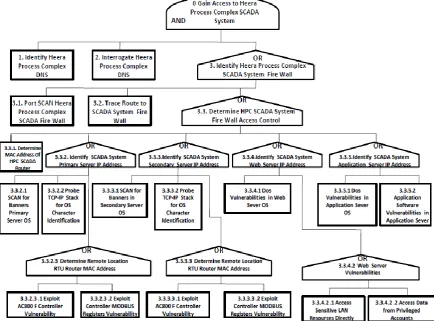
Fig 4: Offshore Oil and Gas Process Complex SCADA System Attack Tree
Total Nodes in Heera Oil and Gas Process Complex SCADA System Attack Tree
G0 = <AND> Gain Access to Heera Oil and Gas Process Complex (HPC) SCADA SystemG1 = Identify Heera Process Complex Domain Name Service (DNS)
G2 = Interrogate Heera Process Complex DNS
G3 = <OR> Identify Heera Process Complex SCADA System Fire Wall
G3A = Port SCAN HPC SCADA System Fire Wall
G3B = Trace Route to HPC SCADA System Fire Wall
G3C = <OR> Determine SCADA System Fire Wall Access Control
G3B1 = Determine MAC Address of HPC SCADA Router
G3B2 = <OR> Identify SCADA System Primary Server IP-Address
G3B2A = SCAN for Banners in Primary Server Operating System
G3B2B = Probe TCP-IP Stack for Operating System Character Identification
G3B2C1 = Exploit AC800F Controller Vulnerabilities
G3B2C2 = Exploit Controller MODBUS Vulnerabilities
G3B3 = <OR> Identify SCADA System Secondary Server IP-Address
G3B3A = SCAN for banners in Secondary Server Operating System
G3B3B = Probe TCP-IP Stack for Operating System Character Identification
G3B3C = <OR> Determine Remote location RTU Router MAC Address
G3B3C1 = Exploit AC800F Controller Vulnerabilities
G3B3C2 = Exploit Controller MODBUS Vulnerabilities
G3B4 = <OR> Identify SCADA System WEB Server IP-Address
G3B4A = DoS Vulnerabilities of WEB Server
G3B4B = <OR> WEB Server Vulnerabilities
G3B4C1 = Access Sensitive LAN Resources
G3B4C2 = Access Data from Privileged Accounts
G3B5 = <OR> Identify SCADA System Application Server IP-Address
G3B5A = DoS Vulnerabilities in SCADA System Application Server
G3B5B = Application Server Application Software Vulnerabilities
6.
RESULTS AND DISCUSSION
Tier-1 SCADA System at Offshore Oil and Gas Process Complex Attack Tree Generation Flow Chart developed and also Attack Trees designed and constructed. Detailed list of label, name, node type, node attack and node details are tabulated in a tabular form in table 1. The node gain access to Heera Process complex SCADA system is denoted by label ‘0’ and it is represented by AND-gate. Any able person can carry this attack. Labels 1and 2 denote - Identify and Interrogate Heera Process Complex DNS represented by leafy nodes. They are subjected to single threaded attacks and requires a PC with internet connection. Label 3 denotes Identify Heera Process complex Fire wall represented by OR-gate. Port SCAN and Trace Route to Heera Process complex SCADA system Fire walls are leafy nodes. Attacks are multi threaded. In this particular case entering SCADA network requires tunnel and break through the hardware fire wall. SCADA system fire wall access control node is represented by OR-gate. The SCADA system routers MAC address determination represented by leafy node. Identifying IP-address of Primary Server represented by OR-gate. Scanning Primary server for banners is denoted by leafy node. Node attack is single threaded attack. Probing TCP-IP stack for OS character identification is also leaf node but it requires multi threaded attacks. Determination of remote oil and gas platform router MAC address is denoted by OR-gate. Replicating worm to find router MAC address necessarily requires skilled network engineer. Exploiting AC 800F RTU Controller and RTU Modbus registers are leaf nodes. Only known persons about SCADA system can mount this type of attack. These attacks are single threaded. As the SCADA system is provided with redundancy, Secondary Server also follows same attacks routine in attack tree model. Web-Server in SCADA network is meant for Tier-2 connectivity. Web-Server IP-Address determination is denoted by OR-gate. Exploitation of DoS vulnerabilities of Web Server OS is a leaf node. Node attack type is multi threaded and there should be separate sub trees for each protocol riding on top of IP (TCP, MDP). Web-Server vulnerabilities is node denoted by OR-gate. Access
sensitive LAN resources directly and access data from privileged accounts are two leaf nodes under this OR-gate. The Identification SCADA system Application Server IP-Address is depicted by OR-gate. Exploiting DoS vulnerabilities in application server OS and application software vulnerabilities are leaf nodes under above OR-gate. To gain control over application server and effecting its functions are multi threaded attacks. Total number of nodes in process complex SCADA system attack tree determined to be 28. It means there are twenty seven vulnerabilities will aid for intruder in taking complete control over the SCADA system at process complex.
7.
REFERENCES
[1] B. Schneier, “Modeling security threats,” Dr. Dobb’s Journal, 1999.
[2] Phillps C, Swiler L P, “A Graph-based System for Network Vulnerability Analysis”, Proceedings of the 1998 workshop on new security paradigms, VA, USA: ACM Press, pp. 71-79, 1998.
[3] Meadows C, “ A Representation of protocol attacks for risk assessment”, Network Threats, DIMACS series in Discrete Mathematics and Theoretical Computer Science, Vol 38, R.N. Wright and P.G. Neumann editors, American Mathematical Society, PP 1-10.
[4] J, Ramakrishman C, Skar R, “Model-based Vulnerability Analysis of Computer Systems”, Proceedings of the 2nd International Workshop on Verification, Pisa, Italy: Model Checking and Abstract Interpretation Press, pp. 1-81, 1998.
[5] Ammann P, Pamuls J, Ritchev R, “A Host Based Approach to Network Attack Chaining Analysis”, Proceedings of the 21st Annual Computer Security Applications Conference, Tucson, Arizona, USA: IEEE Computer Society Press, pp. 72-84, 2005
[6] N. Poolsappasit, R. Dewri, and I. Ray, “Dynamic security risk management using Bayesian attack graphs,” IEEE Transactions on Dependable and Secure Computing, vol. 9, no. 1, pp. 61–74, 2012.
[7] B. Ivanc and T. Klobucar, “Critical infrastructure attack modeling,” Elektrotehniski Vestnik, vol. 79, no. 4, pp. 193–196, 2012.re
[8] SecurI Tree, Amaneza Tech Limited, A Quick Tour of Attack Tree Based Risk Analysis using SecurI Tree, Technical report, 2002.
[9] Alexander Opel, “Design and Implementation of a Support Tool for Attack Trees, 2005.
[10] TANAT Threat ANd Attack Tree Modeling Plus Simulation, 2004, http://www13.informatik.tu-muenchen.de:8080/tanat.
[11] Stefan Einarsson and Marvin Rausand “An Approach to Vulnerability Analysis of complex industrial systems, Risk Analysis, 18(5): 535-545, 1998.
[12] Jan Stefan and Markus Schumacher, “Collaborative attack modeling in Proc.SAC 2002, pages 253-259, ACM 2002.
[13] J.P.Mcdermott, “Attack net penetration testing in Proc.2000, workshop on security paradigm, pages 15-20, ACM 2001.