©2019 The AuthorsTopics in Cognitive Sciencepublished by Wiley Periodicals, Inc. on behalf of Cognitive Science Society
ISSN:1756-8765 online DOI: 10.1111/tops.12439
This article is part of the topic “Aligning Implicit Learning and Statistical Learning: Two Approaches, One Phenomenon,” Padraic Monaghan and Patrick Rebuschat (Topic Editor). For a full listing of topic papers, see http://onlinelibrary.wiley.com/journal/10.1111/(ISSN) 1756-8765/earlyview
A Single Paradigm for Implicit and Statistical Learning
Padraic Monaghan,
a,bChristine Schoetensack,
cPatrick Rebuschat
d,ea
Department of English, University of Amsterdam
b
Department of Psychology, Lancaster University
c
School of Philosophy, Psychology, and Language Sciences, Edinburgh University
d
Department of Linguistics and English Language, Lancaster University
e
LEAD Graduate School and Research Network, University of Tubingen€
Received 10 October 2018; received in revised form 4 May 2019; accepted 27 May 2019
Abstract
Implicit learning generally refers to the acquisition of structures that, like knowledge of natural language grammar, are not available to awareness. In contrast, statistical learning has frequently been related to learning language structures that are explicitly available, such as vocabulary. In this paper, we report an experimental paradigm that enables testing of both classic implicit and statistical learning in language. The paradigm employs an artificial language comprising sentences that accompany visual scenes that they represent, thus combining artificial grammar learning with cross-situational statistical learning of vocabulary. We show that this methodology enables a comparison between acquisition of grammar and vocabulary, and the influences on their learning. We show that both grammar and vocabu-lary are promoted by explicit information about the language structure, that awareness of structure affects acquisition during learning, and awareness precedes learning, but is not distinctive at the endpoint of learning. The two traditions of learning—implicit and statistical—can be conjoined in a single para-digm to explore both the phenomenological and learning consequences of statistical structural knowledge.
Keywords: Implicit learning; Statistical learning; Cross-situational learning; Awareness; Language; Acquisition; Explicit instruction
Correspondence should be sent to Professor Padraic Monaghan, Department of English, University of Amsterdam, Spuistraat 134, 1012 VB Amsterdam, E-mail: [email protected]
1. Introduction
There has been a traditional distinction between implicit and statistical learning approaches to language research, not only in the theory, but also in the methods used and the types of language structures assessed in these fields. Implicit learning studies have tended to address unconscious compared to conscious knowledge of grammatical structures of sequences, whereas statistical learning studies have focused more on acquisition of words or simple local constraints in grammatical sequences ( this issue; Gomez & Gerken, 1999; Perruchet & Pacton, 2006; Romberg & Saffran, 2010). Indeed, such a distinction between learning associated with grammar and learn-ing associated with words has been underwritten by theories that assume only the lat-ter process is related to statistical learning (e.g., Pe~na et al., 2002). Furthermore, learning words and grammar have been related to distinct memory systems ( this issue; Schacter, 1987; Shanks & St. John, 1994), with vocabulary requiring the opera-tion of explicit, or declarative, memory whereas syntax is acquired through implicit, or procedural, memory (Ullman, 2004, 2016), consistent with views of acquisition of sequencing constraints being acquired without awareness (e.g., Reber, 1967; Reber & Squire, 1994). Thus, the language learner can report what the words are in the lan-guage, but struggles to describe the grammatical structures inherent within the language.
Yet the distinction between acquisition of grammar and acquisition of vocabulary has been challenged by studies that suggest instead that similar statistical processes can apply to acquisition of both types of language structure (Bates & Goodman, 1997; Frost & Monaghan, 2016), though the order of acquisition of grammar and vocabulary remains an open question (Rebuschat, Monaghan, & Schoetensack, submitted).
Despite the implicit representation of grammar, explicit knowledge about grammatical structure has been found to promote language learning in adults (see Goo et al., 2015; Norris & Ortega, 2000; Spada & Tomita, 2010). A key question arises, then, about how knowledge of grammar can influence learning, both of the grammar itself, but also whether this knowledge can also promote learning of the vocabulary that the grammar contains. If so, then this certainly melds fields of implicit and statistical learning still more coherently. The paradigm that we describe in this paper illustrates the means by which both grammar and vocabulary learning can be explored, by simultaneously manip-ulating statistical learning processes associated with learning vocabulary but also implicit learning processes associated with grammar acquisition, with the possibility to introduce explicit information about grammatical structure into the learning paradigm and investi-gate the extent to which this knowledge penetrates acquisition of grammar as well as vocabulary learning.
sentences in the grammar are accompanied by two scenes each indicating an object undertaking an action, with the sentence referring to one scene. Participants, exposed to multiple instances, could learn through determining associations between certain objects and actions and certain nouns and verbs in the language. So, learning could proceed only if participants are sensitive to cross-situational statistics, a hallmark of natural language learning situations (Monaghan, Mattock, Davies, & Smith, 2015; Scott & Fisher, 2012; Yu & Smith, 2007).
In addition to the cross-situational statistical learning, participants can respond to learn-ing about structure contained within the language—thus, learning that has been previously considered under the remit of implicit learning studies can also be determined and detected in this paradigm. Furthermore, information about the grammatical structure of the language can be manipulated to investigate how explicit knowledge can affect acqui-sition of grammar, as is often investigated in implicit and explicit learning studies, but its effect on vocabulary can also be examined—a methodological alignment of statistical with implicit learning approaches.
We next report two experimental studies exploring this paradigm providing insight into how the interface between explicit knowledge of language structure affects acquisition of vocabulary and grammar during learning. In Experiment 1, we investigated acquisition of vocabulary and grammar when explicit information about the grammar was or was not provided to participants prior to exposure to the artificial language. We predicted that par-ticipants who received explicit knowledge about the artificial language would be able to apply this knowledge of the syntactic structure of the language to acquire the relations between particular nouns and objects and verbs and actions. However, we were also inter-ested in the trajectory of learning for when this knowledge provided an advantage. It could be that learning was promoted from the beginning of the learning, or it could be that the advantage of syntactic knowledge only occurred later in training when partici-pants had also acquired some knowledge of potential associations between individual words and referents in the scenes. Thus, the study enabled us to address the issue of whether, for a language where both vocabulary and syntax are unknown in advance of learning, the learner’s derivation of syntactic knowledge preceded their vocabulary knowledge, thereby promoting acquisition of individual words, or whether syntax and vocabulary learning were instead mutually dependent (Abend, Kwiatkowski, Smith, Gold-water, & Steedman, 2017; Fisher et al., 2010; Landau & Gleitman, 1985).
discovering language structure results in distinct patterns of behavior, with implications for the effectiveness of language instruction (N. C. Ellis, 2005a R. Ellis,2005b, 2015).
In the second experiment, we investigated in greater depth the point at which partici-pants derived explicit knowledge of the syntactic structure of the language and their use of this knowledge in order to guide their acquisition of learning the word–referent map-pings in the language. Experiment 1 tested how explicit knowledge of structure could affect learning, and whether awareness, as measured by retrospective verbal reports, affected performance during the acquisition of the language structure. In Experiment 2, we determined more precisely when explicit knowledge of structure emerged during train-ing, and how this affected learning. In Experiment 2, we asked participants to report, on a trial by trial basis, what each classification decision was based on, with response options ranging from implicit to explicit sources of knowledge. Determining whether explicit knowledge preceded or followed an enhanced ability to acquire the language addresses the relation between vocabulary and syntax acquisition, and, more broadly, the relation between implicit and statistical learning.
2. Experiment 1: The effect of explicit instruction on learning grammar and vocabulary
2.1. Method
2.1.1. Participants
Thirty-one native speakers of English (19 female) were randomly assigned to either incidental (n = 15) or instructed (n = 16) exposure conditions. The majority of partici-pants (30) were university students, and the mean age was 21.9 (SD = 2.5). Three partici-pants reported speaking an additional native language other than English (Dutch, Punjabi, and Yoruba). Twenty-nine participants indicated that they also had acquired one or more foreign languages, namely French (22), German (16), Spanish (9), Mandarin, Polish, and Urdu (each 1). One participant in the instructed group did not follow task instructions (taking phone calls during training), and data for this participant were excluded from the analyses. Participants received £15 for participating. Our target for the number of partici-pants was 15 per condition, in accordance with other studies tested in our laboratory using cross-situational language learning sufficient to reveal between-condition differ-ences in learning (Monaghan & Mattock, 2012,N = 15; Monaghan et al., 2015,N = 16).
2.1.2. Materials
that these objects could perform. The two monosyllabic pseudowords served as “function words” that indicated if the following content word referred to a shape or to a motion.
Eight of the bisyllabic words were paired with a shape each and the remaining eight bisyllabic words were paired with a motion. Pairings were randomized in six different versions to avoid biases linking particular words to shapes or motions.
2.1.2.2. Questionnaires: A debriefing questionnaire was used to determine whether par-ticipants became aware of any patterns. Parpar-ticipants were first asked if they had noticed any rules or patterns in general. They were then asked if they noticed what type of word always followed the monosyllabic words (tha and noo). Participants were encouraged to write down their best guesses if they did not notice anything in particular. A background questionnaire asked for age, gender, educational background, native language(s), and any foreign languages studied by the participants.
2.1.3. Procedure
Participants were tested individually in a quiet laboratory. They were randomly assigned to either an incidental or an instructed condition. Participants first completed the cross-situational learning task, then the debriefing questionnaire (retrospective verbal reports), followed by the background questionnaire.
For the cross-situational learning task, participants were told that they would see two scenes and hear a sentence and that their task was to choose which scene the sentence refers to. Both groups were then presented with an example where a rectangular shape performed a circling movement while the sentence “Tha trepier noo vinnoy” was played. The incidental group was informed that “trepier” referred to the shape and “vinnoy” to the circling movement. The instructed group was provided with explicit information about the function words: “Each sentence contains the name of an object and the name of its motion. The object name is always preceded by the word tha, and the motion name is always preceded by the word noo.” After seeing the example, they were informed that “tha trepier” referred to the shape and “noo vinnoy” to the circling movement. Partici-pants in the instructed condition were reminded of the role of the function words halfway through the exposure task (during the break after block 6).
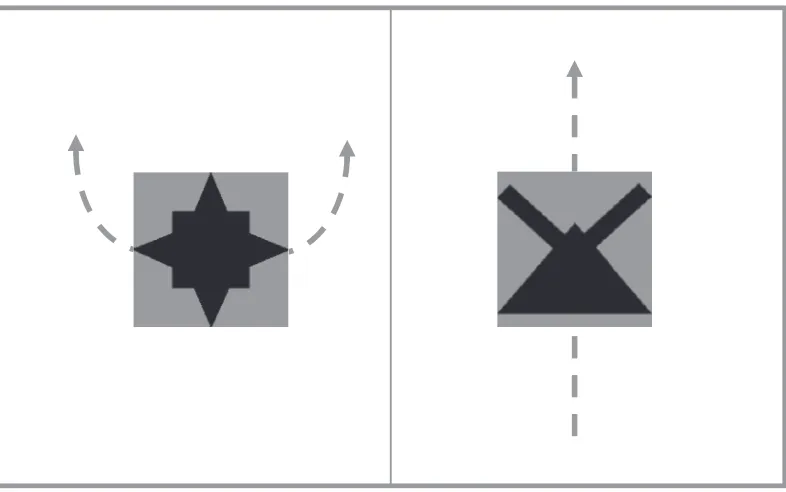
For each trial, participants observed two scenes each comprising an object undergoing a motion. After 3 seconds, participants heard a sentence composed of two phrases (func-tion word plus content word) with order of noun and verb phrases balanced across trials, so that the function words provided distributional information to indicate the content words’ roles (see Fig. 1 for example). Then, participants selected, as quickly and accu-rately as possible, whether the scene on the left or the right of the screen was described by the sentence with a keyboard press. After a pause of 500 ms, the next trial began. No feedback was provided on the accuracy of the response.
Participants could solve the task by responding only to the noun–object or the verb– ob-ject pairing, and so two testing blocks were added after training. To test verb learning, participants were presented with two scenes containing a previously unseen object per-forming different motions. They then heard a single motion referring word and were required to select the scene described by the word. To test noun learning, participants viewed two stationary objects and heard a single object–referring word. There were 16 trials in total (one for each verb and noun), and no feedback was given on performance. The tests were administered twice in order to increase power for analysis. Since the task remained the same (choosing which scene matched the auditory stimulus), the test phase followed without a break from the training.
2.2. Results
Data and statistical analysis scripts in R are available at https://osf.io/2xzye/?view_ only=24b19067006948a19ed03726290e8a63
2.2.1. Performance on training blocks
[image:6.486.45.438.81.327.2]For proportion correct across all training blocks, the incidental group judged 0.72 (SD = 0.15) of trials correctly, which was significantly above chance, t(14) = 5.791,
p < .001, d = 1.467, and the instructed group judged 0.83 (SD = 0.08) of items correctly, again above chance, t(14) = 15.641, p < .001, d = 4.125. In order to investigate individ-ual variation in terms of learning, we used binomial tests to determine when participants first scored above chance (17 out of 24 correct) within each block, and remained above chance subsequently. Participants in the incidental group tended to perform above chance by block mean = 6.64, SD = 3.54, and the instructed group tended to perform above chance by block mean = 3.67, SD = 1.76. The difference between groups was significant,
t(27) = 2.896,p = .007, Hedges’g = 1.034 (Fig. 2).
In order to determine whether learning was different according to the incidental or instructed condition, we constructed a series of generalized linear mixed effects (GLME) models to test accuracy on each trial throughout training. GLME models enable variance associated with individual participants’ responses and with individual items to be taken into account in the analysis (random effects), and then the contribution of fixed effects of experimental manipulations in explaining variance can be observed over both participants and items. First, we constructed a model to predict whether a trial was correct or not with random effects of the participant, the object, and the action present in the target scene. Then, we added in variables to determine if these improved model fit using log-likelihood tests. Random slopes for fixed effects were included for all random effects, except when the model failed to converge, in which case the model with the maximal random effects structure that converged was constructed (Barr, Levy, Scheepers, & Tily, 2013). To deter-mine the effect size of the fit of each model, we calculated R2, using the method reported in Nakagawa and Schielzeth (2013). There are two R2 calculations that can be performed on GLME models: marginal R2 is the proportion of variance in the data set explained by the fixed effects in the model, and conditional R2 is the proportion of variance explained by both fixed and random effects. Nakagawa and Schielzeth’s (2013) method applies to models with random intercepts, and so we computed the R2 values from models without random slopes.
[image:7.486.43.451.521.588.2]Compared to the model containing only random effects, the effect of training block significantly improved model fit, v2(1) = 35.489, p < .001, marginal R2 = 0.289, condi-tional R2 = 0.585, adding incidental versus instructed condition did not significantly
Table 1
Best-fitting model of proportion correct for Experiment 1, showing fixed effects
Fixed Effects Estimate SEEstimate Z p
(Intercept) 0.541 0.146 3.695 <.001
Block 0.495 0.064 7.708 <.001
Condition 0.189 0.172 1.099 .272
Block9Condition 0.203 0.089 2.281 .023
Number of observations: 8,640, Participants: 30, Actions: 8, Objects: 8. AIC=7322.6, BIC=7400.3, log-likelihood= 3650.3.
improve fit, v2(1) = 0.155, p = .694, marginal R2 = 0.346, conditional R2 = 0.585. The interaction between block and incidental versus instructed condition did improve model fit, v2(1) = 4.727, p < .001, marginal R2 = 0.449, conditional R2 = .651. In Table 1, we report the final best-fitting model.
We next tested for which of the training blocks the difference between incidental and instructed conditions was evident. We tested GLME models for single blocks, comparing the model fit for just the random effects to a model also containing incidental versus instructed condition. The results are summarized in Table 2. Instruction condition had a significant effect on accuracy in blocks 5–10 and block 12.
We additionally tested whether language background—the number or the maximum proficiency of second languages spoken by participants (from 0 for no second languages, 1 for the beginner level, 2 for intermediate, and 3 for advanced)—improved model fit over the final model shown in Table 1. It did not: for number of languages spoken,
v2(1) = 0.440,p = .507, with marginalR2 = 0.452, conditionalR2 = 0.651; for maximum
proficiency level, v2(1) = 0.145, p = .703, marginal R2 = 0.450, conditional R2 = 0.651. The marginal and conditional R2 values accounted for very small increases in vari-ance compared to the model in Table 1.
2.2.2. Performance on test blocks
For the test trials that determined whether learning was based on nouns or verbs, or both, in the incidental group, participants scored 0.84 (SD = 0.19) in the noun test and 0.84 (SD = 0.20) in the verb test, both significantly better than chance, t(14) = 6.931,
d = 1.789, t(14) = 6.584, d = 1.700, respectively, both p < .001. In the instructed group, participants scored .95 (SD = 0.08) in the noun test and 0.97 (SD = 0.06) in the verb test, significantly above chance for both word types,t(14) = 21.786,d = 5.625,t(14) = 30.338,
[image:8.486.39.444.478.632.2]d = 7.833, respectively, bothp < .001.
Table 2
Effect of condition for each block, with improvement in fit over random effects model tested with log-likeli-hood comparison, and marginal and conditionalR2of the model fit
Block v2(1) p MarginalR2 ConditionalR2
1 0.684 .408 0.004 0.027
2 0.382 .536 0.003 0.079
3 0.738 .391 0.012 0.409
4 1.961 .161 0.034 0.404
5 3.965 .047 0.095 0.645
6 5.557 .018 0.142 0.668
7 10.021 .002 0.283 0.814
8 4.835 .028 0.153 0.842
9 5.327 .021 0.150 0.721
10 5.949 .015 0.213 0.883
11 2.598 .107 0.096 0.791
GLME models indicated that whether the testing was the first or the second block had no significant effect, v2(1) = 0.228, p = .633, marginal R2 = 0.001, conditional
R2 = 0.762; nor was there a significant effect of nouns or verbs, v2(1) = 0.001, p = .975, marginal R2 < 0.001, conditional R2 = 0.761. There was a significant effect of instructed or incidental group, v2(1) = 5.840, p = 0.016, marginal R2 = 0.167, conditional
R2 = 0.749. There were no significant interactions. Language background did not signifi-cantly improve model fit: For number of languages spoken, v2(1) = 0.089, p = .765, with marginal R2 = 0.169, conditional R2 = 0.750; for maximum proficiency level,
v2(1) = 0.243, p = .622, marginal R2 = 0.172, conditional R2 = 0.750. Language
back-ground did not significantly improve model fit for any of the other tests Experiments 1 or 2, so we do not mention them further. The final model including the effect of group is shown in Table 3.
2.2.3. Retrospective verbal reports
We coded the verbal reports to determine whether participants became aware of any patterns in the language. As predicted, all participants in the instructed group were aware of the function words and of the role they played. Seven subjects in the incidental condi-tion also became fully aware of both funccondi-tion words and of the types of words with which they were associated. No participant reported trying to intentionally learn the func-tion words as a strategy; thus, this grammatical knowledge was acquired incidentally, as a side-effect of completing the exposure task. In order to determine whether awareness of the structure in the incidental group related to performance during training, we compared the performance of aware and unaware participants of the incidental group on the cross-situational learning task. The online response design of our study also enabled us to determine at what point during training such awareness might have first had an influence on performance.
In terms of overall accuracy, the unaware participants (n = 7) judged 0.66 (SD = 0.11) of trials correctly, which was significantly above chance, t(6) = 3.848, p = .009,
d = 1.455, while the aware participants (n = 7) judged 0.80 (SD = 0.15) of items cor-rectly, t(6) = 5.292, p = .001, d = 2.000. Binomial tests of when participants first scored above chance and remained above chance until the end of training demonstrated that the unaware participants consistently performed above chance from block 8 (M = 7.50,
[image:9.486.45.447.543.587.2]SD = 2.43) and the aware participants from block 5 (M = 5.14, SD = 3.76). However,
Table 3
Final model for testing performance for Experiment 1, showing fixed effects
Fixed Effects Estimate SEEstimate Z p
(Intercept) 3.968 0.562 7.056 <.001
Condition 1.628 0.642 2.535 .011
Number of observations: 960, Participants: 30, Objects: 9 (including novel unnamed object). AIC =531.3, BIC =550.8, log-likelihood= 261.7.
the difference between groups was not significant, t(10.326) = 1.314, p > .05, Hedge’s g = 0.698.
We tested whether awareness affected learning by comparing GLME models. For per-formance in the incidental condition, there was a significant improvement in fit by adding block to the model, v2(1) = 229.49, p < .001, marginal R2 = 0.107, conditional
R2 = 0.511. There was also a significant improvement in fit by distinguishing aware and unaware participants, v2(1) = 3.947, p = .047, marginal R2 = 0.264, conditional
R2 = 0.512. The interaction between block and awareness was not significant,
v2(1) = 2.786, p = .095, marginal R2 = 0.277, conditional R2 = 0.523, and awareness
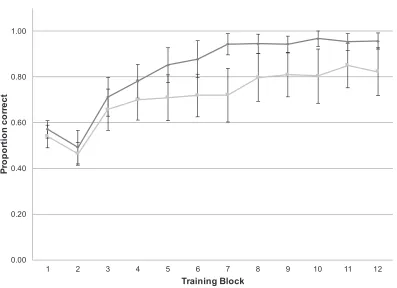
was not related to better performance at the end of training, with no significant improve-ment in fit by adding the awareness group to a random effects model at the final training block, v2(1) = 1.082, p = .298, marginal R2 = 0.077, conditional R2 = 0.761. Fig. 3 shows the results for aware and unaware participants during training.
For the test of noun and verb learning after training, awareness did not significantly improve model fit, v2(1) = 0.615, p = .433, marginal R2 = 0.037, conditional R2 = 0.739,
0.00 0.20 0.40 0.60 0.80 1.00
1 2 3 4 5 6 7 8 9 10 11 12
P
ropor
ti
on c
o
rr
ec
t
[image:10.486.43.440.318.606.2]Training Block Intentional Incidental
indicating that by the end of training, word learning was similar across aware and una-ware participants.
2.3. Discussion
Experiment 1 demonstrated that classic implicit learning and statistical learning approaches can be combined in a single methodology. We showed that the effectiveness of cross-situational learning—a task that has been used to test statistical learning in acquisition of language—can be modulated by explicit knowledge of the language structure to be acquired, consistent with many other studies of the benefit of syntactic information for language learning (Goo et al., 2015; Spada & Tomita, 2010). This alignment of approaches enables links between theories of statistical learning with theo-ries of effects of explicit structural knowledge. For instance, the advantage of explicit knowledge about syntactic structure appeared only to able to promote learning once a proportion of the words had been acquired in the language, in accord with Gleitman’s (1990) view of syntactic knowledge applying to learning only once sufficient vocabu-lary had been acquired in the language. However, tracking the trajectory of learning
0.00 0.20 0.40 0.60 0.80 1.00
1 2 3 4 5 6 7 8 9 10 11 12
P
ropor
ti
on C
o
rr
ec
t
Training Block
[image:11.486.50.445.78.359.2]Incidental-Unaware Incidental-Aware
through training of the participants in the incidental group that independently learned about the structure of the syntax at the end of training indicates a slightly different pic-ture. As shown in Fig. 3, participants who later became aware of the syntactic structure were outperforming those that remained unaware in learning the cross-situational statis-tics early in training. Interestingly, emerging awareness did not distinguish performance at the end of the task (as indicated in the final block of training and the vocabulary testing), but it did show a distinction in performance during the acquisition of the cross-situational statistics task.
Awareness of the acquired knowledge was only measured at the end of training (by means of retrospective verbal reports). Hence, we have no direct evidence of the point at which explicit knowledge of the language structure was first derived. The steep increase in vocabulary acquisition, as shown in Fig. 3 for the incidental group that gained explicit knowledge, may have precipitated understanding of the syntactic struc-ture, or alternatively emerging explicit knowledge may have resulted in the increase. We do not yet know the causative direction of this effect. Experiment 2 addresses this issue.
3. Experiment 2: The emergence of explicit knowledge during cross-situational learning
This study was similar to the incidental exposure condition of Experiment 1, except that for each trial during training, participants were asked about their awareness of the language, responding according to whether their decision was based on a guess, intu-ition, recollection of previous trials, or knowledge based on a rule (Subjective mea-sures of awareness; Dienes & Scott, 2005; Rebuschat & Williams, 2012; see Rebuschat, 2013, for review of this approach). We predicted that initially most responses would be based on the more implicit categories (guess and intuition), but that during training the proportion of responses based on the more explicit categories (recollection and rule knowledge) would increase. In addition to these subjective mea-sures of awareness, we also measured awareness by means of retrospective verbal reports, as in Experiment 1.
If awareness precedes learning, we predicted that there would be a correspondence between accuracy of responses for each type of explicit knowledge category, such that rule knowledge responses would be most accurate, then recollection, intuition, and then guesses. If awareness follows learning, then we predicted increasing rates of rule knowl-edge responses without these relating directly to accuracy.
3.1. Method
3.1.1. Participants
3.1.2. Materials
The scenes and language were identical to those used in Experiment 1.
3.1.3. Procedure
The procedure was identical to the incidental exposure condition of Experiment 1 except for two details. First, the description of the trial prior to training (present in Experiment 1) was not given. Second, after making a decision about the scene described by the sentence in each training trial, participants were then asked to make an additional judgment in order to report the basis of their decision by selecting one of four adjacent keys (labeled “G” for guess, “I” for intuition, “R” for recollection, “K” for rule knowledge) on a keyboard. Participants were asked to select the guess category if their decision was based on a true guess; that is, they might as well have flipped a coin. Participants were instructed to select the intuition category if they felt their deci-sion was correct but they could not explain why; that is, they just followed a hunch. In contrast, participants were asked to select the recollection category if the decision was based on conscious recollection of specific sequences (or parts of sequences) that they have heard before, while they should select the rule knowledge category if they fol-lowed a conscious (verbalizable) rule when making the decision. The actual wording of the instructions can be found in the Supplementary Materials online. Following Dienes and Scott (2005), decisions based on guessing and intuition were linked to implicit knowledge, while decisions based on conscious recollection and rule knowledge were associated with explicit knowledge; full instructions and scale description are described in the Supporting Information.
3.2. Results and discussion
3.2.1. Performance during training and testing blocks
Over all blocks, participants judged 0.79 (SD = 0.07) of trials correctly, which was significantly above chance, t(18) = 17.287, p < .001, d = 4.143. Participants performed above chance in all blocks, t(21) > 2.756, p < .012, d > 1.175, except for block 2, t
(21) = 0.344, p = .734, d = 0.147.
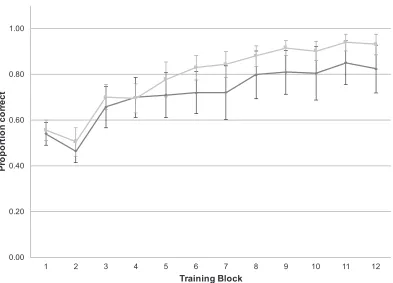
We next tested whether performance improved with training block using GLME mod-els. Adding block to a model containing only random effects significantly improved model fit, v2(1) = 27.881, p < .001, marginal R2 = 0.299, conditional R2 = 0.502. Fig. 4 shows the performance by block, in comparison to the incidental exposure condition of Experiment 1.
For the tests of noun and verb learning, participants judged 0.86 (SD = 0.20) of trials correctly in the noun test and 0.82 (SD = 0.18) of trials in the verb test. Again, perfor-mance was significantly above chance (noun test: t(21) = 8.452, d = 1.800, verb test: t
(21) = 8.170, d = 1.778, both p < .001). There was no significant improvement in fit including first or second test in a GLME model, v2(1) = .773, p = .379, marginal
p = .187, marginal R2 = 0.008, conditional R2 = 0.601; thus, participants acquired both nouns and verbs to a similar degree of accuracy.
3.2.2. Subjective measures of awareness
For the different categories of knowledge, participants were correct for 0.53 (SD = 0.11) of trials when they believed they were guessing, not significantly different than chance, t(16) = 1.125, p = .277, d = 0.273. Accuracy was greater than chance for other response types: for intuition, mean = 0.67 (SD = 0.16), t(16) = 5.002, p < .001,
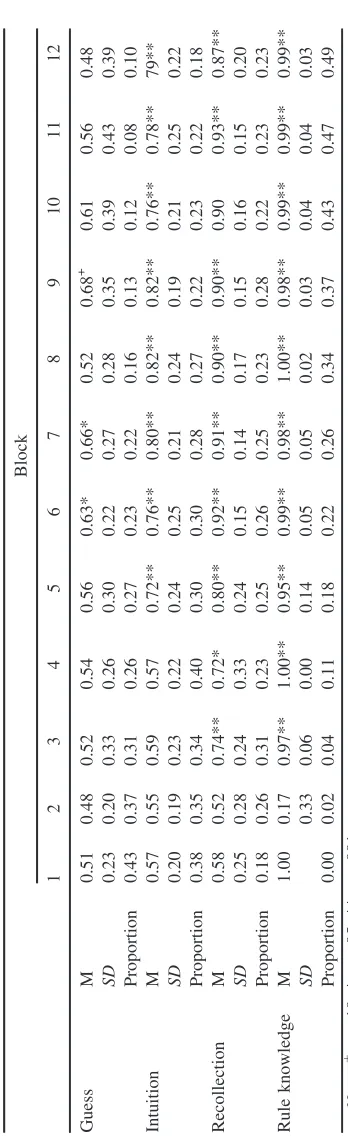
d = 1.063, for recollection, mean= 0.79 (SD = 0.15), t(15) = 9.259, p < .001, d = 1.933, and for rule knowledge, mean = 0.93 (SD = 0.23), t(17) = 8.187, p < .001, d = 1.870. Across the 12 training blocks, Table 4 shows proportion of responses by response cate-gory, which indicated a gradual shift from implicit responses (guess and intuition) to explicit responses (recollection and rule knowledge). A GLME model on accuracy with block as fixed effect was improved significantly in fit by adding whether the response was implicit or explicit, v2(1) = 164.28, p < .001, marginal R2 = 0.446, conditional
R2 = 0.561.
0.00 0.20 0.40 0.60 0.80 1.00
1 2 3 4 5 6 7 8 9 10 11 12
P
ro
p
o
rt
io
n
co
rr
ect
[image:14.486.45.438.96.379.2]Training Block Incidental-Expt 1 Incidental-Expt 2
In order to determine whether responses were predicted not only by current implicit or explicit response, we determined whether the most recent previous training trial that con-tained the same object had an implicit or an explicit response and if that response could predict current accuracy in addition to current response type. We also determined whether the most recent previous training trial containing the same action had an implicit or expli-cit response. As there was a relation between expliexpli-cit judgments and accuracy, we con-structed a GLME model with block, implicit/explicit response on the current trial, and accuracy of the previous trial containing the same object and accuracy of the previous trial containing the same action. We then determined whether adding implicit/explicit judgment to this model predicted additional variance. We found that it did,
v2
(2) = 9.250, p = .009, marginal R2 = 0.298, conditional R2 = 0.502. Thus, participants were able to generate explicit knowledge about the structure prior to accuracy on the next trial containing similar information.
3.2.3. Retrospective verbal reports
The analysis indicated that 17 out of 19 participants were aware of the function words and of the role they played by the end of Experiment 2. This was significantly differently distributed than for the incidental condition of Experiment 1, v2(1) = 6.332,
p = .012, Cramer’s V = 0.035, suggesting that the requirement to make a decision about the source of knowledge during training resulted in greater explicit awareness by the end of the study, but that this was only a small effect size. Such a result is consis-tent with observations of a learning advantage for an attribution decision about knowl-edge at each trial found in a Reber-style artificial grammar learning task (Ivanchei & Moroshkina, 2018).
4. General discussion
In this paper, we have adapted the cross-situational learning paradigm, which has been widely used to investigate the statistical mechanisms available to learners in acquiring language, to bridge the distinct traditions of implicit and statistical (language) learning. In adapting the paradigm, we have carefully manipulated exposure conditions (incidental vs. instructed) and included measures of awareness (verbal reports and subject measures), which is typically gathered in implicit learning research but not in statistical learning research (see Arciuli et al., 2014; Batterink et al., 2015; Franco, Cleeremans, & Destre-becqz, 2016; Hamrick & Rebuschat, 2012; Kachergis et al., 2010, for exceptions). By incorporating syntactic structure, in addition to word to object (Yu & Smith, 2007) and word to action (Scott & Fisher, 2012) mappings, this enabled us to determine the extent to which knowledge of the syntactic structure emerged, and could be manipulated during language development. Experiment 1 showed that instruction about the structure of the language could influence the statistical processing by improving acquisition of word to referent mappings across situations. However, this effect exerted itself during acquisition
explicit knowledge compared to those that were not given this information in advance. Experiment 1 also demonstrated that this paradigm could reveal differences during learn-ing that related to whether participants had determined the language structure themselves as a consequence of performing the task, compared to those that had not. Intriguingly, once again those that developed emerging explicit knowledge performed differently dur-ing the task. However, this difference in their ability to solve the task was not detectable anymore by the end of the task, highlighting the importance of learning tasks that permit the online tracking of performance.
Experiment 2 addressed a key question in language acquisition research about when syntactic knowledge can be used in concert with vocabulary information. Experiment 2 asked participants to give information on the source of their decision at each cross-situa-tional learning training trial. We found that explicit knowledge about the language struc-ture was able to predict accuracy of the participants learning the next time a similar word to object or word to action mapping was experienced. Thus, explicit knowledge preceded application of that knowledge for the task.
In terms of future directions, we have shown how statistical learning—beyond acquisi-tion of adjacent or non-adjacent dependencies in sequences—can be extended effectively to studies that investigate statistical correspondences across situations that are separate instances of learning. Furthermore, we have shown how classic tools in implicit learning research (e.g., measures of awareness and manipulation of exposure condition) can address foundational questions in the study of statistical learning of language. For instance, we have demonstrated how provision of explicit information about the structure of the language can affect statistical learning—during the process, if not the endpoint, of acquisition of the language. We have also shown how the individual’s determination of the source of their knowledge of the language structure—implicit or explicit—can pre-cede accurate learning of mappings between the language and objects and actions in the world. Further work in this area should address the types of syntactic structures that can be acquired prior to, or simultaneously with, development of vocabulary knowledge. In the current study, we have only investigated learning of nouns and verbs in a simple intransitive sentence. Whether participants can align knowledge of more complex syntac-tic structures—such as hierarchical dependencies—with acquisition of vocabulary across learning situations would enable us to address how implicit and explicit knowledge about structure can scale up to support learning of complex, more realistic phrase structure grammars that occur in natural language.
Acknowledgments
References
Abend, O., Kwiatkowski, T., Smith, N. J., Goldwater, S., & Steedman, M. (2017). Bootstrapping language acquisition.Cognition,164, 116–143.
Arciuli, J., von Torkildsen, J. K., Stevens, D. J., & Simpson, I. C., (2014). Statistical learning under incidental versus intentional conditions.Frontiers in Psychology,5, 747.
Barr, D. J., Levy, R., Scheepers, C., & Tily, H. J. (2013). Random effects structure for confirmatory hypothesis testing: Keep it maximal.Journal of Memory and Language,68, 255–278.
Bates, E., & Goodman, J. (1997). On the inseparability of grammar and the lexicon: Evidence from acquisition, aphasia, and real-time processing.Language and Cognitive Processes,12, 507–584.
Batterink, L. J., Paller, K. A., & Reber, P. J. (this issue). A memory-systems perspective on implicit and statistical learning.Topics in Cognitive Science, in press.
Batterink, L., Reber, P. J., Neville, H., & Paller, K. A. (2015). Implicit and explicit contributions to statistical learning.Journal of Memory and Language,83, 62–78.
Christiansen, M. H. (this issue). Implicit statistical learning: A tale of two literaturesChristiansen, M.H. (in press). Implicit-statistical learning: A tale of two literatures.Topics in Cognitive Science, in press. Dienes, Z., & Scott, R. (2005). Measuring unconscious knowledge: Distinguishing structural knowledge and
judgment knowledge.Psychological Research Psychologische Forschung,69(5–6), 338–351.
Ellis, N. C. (2005a). At the interface: Dynamic interactions of explicit and implicit language knowledge.
Studies in Second Language Acquisition,27(2), 305–352.
Ellis, R. (2005b). Measuring implicit and explicit knowledge of a second language: A psychometric study.
Studies in Second Language Acquisition,27(2), 141–172.
Ellis, R. (2015).Understanding second language acquisition(2nd ed). Oxford, UK: Oxford University Press. Fiser, J., & Aslin, R. N. (2002). Statistical learning of higher-order temporal structure from visual
shape-sequences.Journal of Experimental Psychology: Learning, Memory, and Cognition,28, 458–467.
Fisher, C., Gertner, Y., Scott, R. M., & Yuan, S. (2010). Syntactic bootstrapping. Wiley Interdisciplinary Reviews: Cognitive Science,1(2), 143–149.
Franco, A., Cleeremans, A., & Destrebecqz, A. (2016). Objective and subjective measures of cross-situational learning.Acta Psychologica,165, 16–23.
Frost, R. L. A., & Monaghan, P. (2016). Simultaneous segmentation and generalisation of non-adjacent dependencies from continuous speech.Cognition,147, 70–74.
Gleitman, L. (1990). The structural sources of verb meanings.Language Acquisition,1(1), 3–55.
Gomez, R. L., & Gerken, L. A. (1999). Artificial grammar learning by 1-year-olds leads to specific and abstract knowledge.Cognition,70(2), 109–135.
Goo, J., Granena, G., Yilmaz, Y., & Novella, M. (2015). Implicit and explicit instruction in L2 learning. In P. Rebuschat (Ed.), Implicit and explicit learning of languages (pp. 443–482). Amsterdam: John
Benjamins.
Hamrick, P., & Rebuschat, P. (2012). How implicit is statistical learning. In P. Rebuschat & J. N. Williams (Eds.),Statistical learning and language acquisition(pp. 365–382). Boston: de Gruyter.
Ivanchei, I. I., & Moroshkina, N. V. (2018). The effect of subjective awareness measures on performance in artificial grammar learning task.Consciousness and Cognition,57, 116–133.
Kachergis, G., Yu, C., & Shiffrin, R. M. (2010). Cross-situational word learning is both implicit and strategic.Frontiers in Psychology,5, 588.
Landau, B., & Gleitman, L. (1985).Language and experience. Cambridge, MA: Harvard University Press. Monaghan, P., & Mattock, K. (2012). Integrating constraints for learning word-referent mappings.Cognition,
123, 133–143.
Nakagawa, S., & Schielzeth, H. (2013). A general and simple method for obtaining R2 from generalized linear mixed-effects models.Methods in Ecology and Evolution,4, 133–142.
Norris, J. M., & Ortega, L. (2000). Effectiveness of L2 instruction: A research synthesis and quantitative meta-analysis.Language Learning,50(3), 417–528.
Pe~na, M., Bonatti, L. L., Nespor, M., & Mehler, J. (2002). Signal-driven computations in speech processing.
Science,298(5593), 604–607.
Perruchet, P., & Pacton, S. (2006). Implicit learning and statistical learning: One phenomenon, two approaches.Trends in Cognitive Sciences,10(5), 233–238.
Reber, A. S. (1967). Implicit learning of artificial grammars. Journal of Verbal Learning and Verbal Behavior,6, 855–863.
Reber, P. J., & Squire, L. R. (1994). Parallel brain systems for learning with and without awareness.
Learning and Memory,1, 217–229.
Rebuschat, P. (2013). Measuring implicit and explicit knowledge in second language research. Language Learning,63(3), 595–626.
Rebuschat, P., & Williams, J. (2012).Statistical learning and language acquisition. Amsterdam: de Gruyter. Romberg, A. R., & Saffran, J. R. (2010). Statistical learning and language acquisition.Wiley Interdisciplinary
Reviews: Cognitive Science,1(6), 906–914.
Schacter, D. L. (1987). Implicit memory: History and current status. Journal of Experimental Psychology: Learning, Memory, and Cognition,13(3), 501–518.
Scott, R. M., & Fisher, C. (2012). 2.5-year-olds use cross- situational consistency to learn verbs under referential uncertainty.Cognition,122(2), 163–180.
Shanks, D. R., & St. John, M. F., (1994). Characteristics of dissociable human learning systems.Behavioral and Brain Sciences,17, 376–447.
Spada, N., & Tomita, Y. (2010). Interactions between type of instruction and type of language feature: A meta-analysis.Language Learning,60(2), 263–308.
Ullman, M. T. (2004). Contributions of memory circuits to language: The declarative/procedural model.
Cognition,92(1), 231–270.
Ullman, M. T. (2016). The declarative/procedural model: A neurobiological model of language learning, knowledge and use. In G. Hickok & S. A. Small (Eds.), The Neurobiology of Language (pp. 953–68).
Amsterdam: Elsevier.
Yu, C., & Smith, L. B. (2007). Rapid word learning under uncertainty via cross-situational statistics.
Psychological Science,18(5), 414–420.
Supporting Information
Additional Supporting Information may be found online in the supporting information tab for this article: