Abstract— This study presents a closed-loop model which combine manufacture chain with reverse chain that includes the collection of used products as well as distribution of the new products, considering inspection cost and reworking cost. The objective of this research is to discuss maximizing the profit of the supply chain and minimizing the total cost and shortages of products. The result shows that subsidy can affect profit to increase, and the new model can reduce a little bit of the profit in the supply chain.
Index Terms—Closed-loop Supply Chain, Green Supply Chain Management, Imperfect Environment
I. INTRODUCTION
R
ecently, we concern about the issue of environmental pollution, because the pollution are more extremely awful over the past decade. As environmental degradation and global warming, the strategy of Green supply chain management (GSCM) play an important role in the whole world, because GSCM is a critical to let a firm sustainable [1] .The European Union and many governments have enacted legislations. For example, used products and manufacturing-induced wastes [2][3].When people have the concept of environmental protection, researcher started to focus on the Green supply chain ,owing to the successful implementation of the green supply chain managenent,whole enterprise can continuously development.Hamed [4] used genetic algorithm to build their model in different situation. The goal is optimize total profit, and reduce lost working days due to occupational accidents. And the results demonstrate the feasibility of the proposed model and the applicability of the developed solution. Rui Zhao [5] propose a model which apply a big data, to improve the green supply chain management. In their paper, the purpose is to optimize the model of a green supply chain, and reduce the inherent risk occurred by hazardous materials, associated carbon emission and economic cost. Ashkan Memari [6] present the develop a novel multi-objective mathematical model which apply multi-objective and genetic algorithm, and considering costs of production, distribution, holding and shortage cost and environmental impact of logistic network. The result is compared the gained Pareto fronts from Moga
Ming-Cheng Lo (Corresponding Author) is with Department of Business Administration, Chien Hsin University of Science and Technology, No.229, Jianxing Rd., Zhongli City, Taoyuan County 32097, Taiwan, R.O.C. (e-mail: [email protected])
Ming-Feng Yang is with Department of Transportation Science, National Taiwan Ocean University, No.2, Beining Rd., Jhongjheng District, Keelung City 202, Taiwan, R.O.C. (phone: +886-2-24622192#7011; fax:+886-2-24633745; e-mail: [email protected])
Yu-Chen Chang is with Department of Transportation Science, National Taiwan Ocean University, No.2, Beining Rd., Jhongjheng District, Keelung City 202, Taiwan, R.O.C. (e-mail: [email protected])
Jing-Wei Liu is with Department of Information Management, National Taiwan University of sport, No. 16,Section1, Shuang-shi Rd., North District, Taichung404, Taiwan, R.O.C. (e-mail: [email protected])
and purpose attainment programing solver. Alice Tognetti [7]considered that green supply chain is most important in the company. According to their German automotive industry, they find optimize system can be reduced by 30% at almost zero variable cost increase in the supply chain. In this paper, we apply the closed loop to build a green-supply chain in imperfect environment. The Closed-loop supply chain refers to the completely supply chain of the enterprise from purchasing to final sale, including product which need to recovery and life cycle of reverse logistics. The good example is the Japanese Ministry of the Environment for the automotive industry. [8] Its purpose is to close the flow of materials, reduce environmental pollution, and residual waste, and while lower the cost to provide customers. Govindan and Darbari [9] proposed integrated CLSC network model, and research in Indian market. They find that use closed loop model can let the firm in gaining sustainably from the numerous electronic product reuse opportunities And the imperfect environment means the imperfect production process, the produce defective product.Chiu[10] [11] note that recovery the defective product or inspect the product cannot avoid in the imperfect environment, consequently effective to reduce the cost for reworking the defective product. And he thought the machine malfunction affect the size of economics lot, the defective product do not reworking, if not to deal with the scrap.
We want to build the model, which material can continue to be use; no matter directly product or the used product can be recovery. According to the above situation, we can waste less resources and less cost. In all the research, our research is different from other papers. Because we combing the reverse chain and the manufacture chain to be one supply chain. Detail item like, manufacturers and secondary material to be a unit, and the wholesalers and the disassembly plants to be a unit; the last but the least is retailers and the collecting plants. We use the less recourses and the cost, to maximizing the profit.
This paper is organized as follows. Section II defined the notation and assumptions. Next, Section III develops the integrated inventory model which combine the manufacturing chain and the reverse chain. And then, we showed numerical examples and analysis in Section IV. Finally, having the conclusion and discussing future research opportunities.
II. NOTATIONSANDASSUMPTIONS A. Notations
In order to develop a closed-loop green supply chain model, we use the profit formula to solve this problem, and we consider the cost of each item in this research.
The following notations and assumptions below are used to build the model:
Notation Definition SP-Supply chain of profit
A Closed-loop Green Supply Chain Model in
Imperfect Environment
STR-total revenue of supply chain STC-total cost
Cp-procurement cost of physical flow i Cin-inspection cost of production process Cre-reworking cost of defective products Cir-inventory cost for storing raw materials Ci-inventory cost for storing products
Cit-Inventory cost for storing used product that has been treated by a reverse logistics chin member
Cint-Inventory cost for storing used product that has not been treated by a reverse logistics chin member
Ct-transportation cost Cb-sales return cost
α- Defective ratio
β-Return ratio S -Unit Subsidy
F-recycling fees charged by the corresponding EPA for manufacturing products
θ-predetermined products sale return ratio δ-predetermined production defective ratio Cl-hourly labor cost
Cf-unit cost final disposal Ctr-transitional treatment cost
Cc-collecting cost of used product returned from end-customer
Qi- Quantity of Inventory---decision variable Qir- Quantity of raw materials inventory
Qit- Quantity of inventory of used product that has been treated
Qint- Quantity of inventory of used product that has not been treated invent
Qf- Quantity of final disposal---decision variable Ql- Quantity of labor
Qm- Manufacturing quantity---decision variable Qr- Raw materials quantity---decision variable Qtr- Transitional treatment quantity---decision variable Qi,j- The generalized form of a decision variable referring to the physical flow quantity transported from layer i in manufacturing/reverse chain to layer j in manufacturing/reverse chain
Qre-Quantity of used-product that has been returned by end customers
Si- Facility capacity for inventory
Sir- Facility capacity for raw-material inventory
Sint- Facility capacity for inventory that has not been treated Sit- Facility capacity for inventory that has already been treated
B. Assumptions
(1) Only the single-product condition is considered in the proposed model.
(2)Shortages are not allowed.
(3) The time-varying quantity of product demands from end-customers in any given time interval
is given.
(4) There is a given return ratio, referring to the proportion of the quantity of used products returned from end-customers, and through the reverse logistics chain.
(5) Facility capacities associated with chain members of the proposed integrated logistics system are known.
(6) The lead-time associated with each chain member either in the general supply chain or in the reverse supply chain is given.
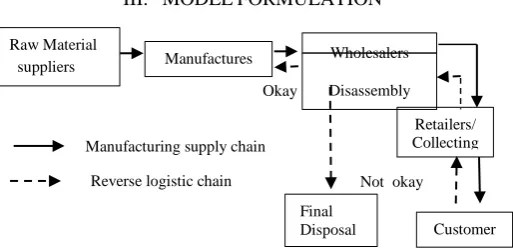
[image:2.595.300.557.57.183.2]III. MODELFORMULATION
Figure I the concept of the green supply chain model
A. Objective formula
In the figure, there are six unit in this model, and the solid represents manufacturing supply chain, the dotted line represents the reverse logistic chain. If the used-material can be recycle, it will go to the manufactures step, but if not, it will go to the final disposal.
Max SP=STR-STC
Max=(MTR+RR+RS)-(SPC+SMC+SIC+STRC+SBC+SCC +SRC+SLC+SFC+STTC+STCC)
According to our assumption, we integrated the supply chain and the reverse chain to optimize the model, and the objective of our model is maximum net profit in the supply chain. And the SP is measure by subtracting the corresponding aggregate costs from the respective aggregate revenues and costs. The profit mines the cost that we are consider: Procurement, Manufacturing, Inventory, Transportation, Recycling fees, Collection, Transition treatment, Final disposal.
1 .STR- total revenue from the profit of the supply chain +the subsidies which are oriented from the supply flows of the returned used product transported to the layer of disassembly plants for government subsidies.
∑{[∑ ∑ 𝑅𝑠𝑖, 𝑠𝑗 5
𝑗=𝑖+1 4
𝑖=1 ∀𝑡
(𝑡) ∗ 𝑄𝑠𝑖, 𝑠𝑗(𝑡)]
+ [∑ ∑ 𝑅24(𝑡) ∗ ∀𝑆4
∀𝑆2
𝑄24(𝑡)]
+ [∑ ∑ 𝑅25(𝑡) ∗ 𝑄25(𝑡)] ∀𝑠5
∀𝑠2
+ [∑ ∑ 𝑅35(𝑡) ∀𝑠5
∗ ∀𝑠3
𝑄35(𝑡)]
+ [∑ ∑ 𝑅𝑠𝑖, 𝑠𝑗(𝑡) ∗ 𝑄𝑠𝑖, 𝑠𝑗(𝑡)] 4
𝑗=𝑖−1 5
𝑖=3
+ [∑ ∑ 𝑅53(𝑡) ∗ 𝑄53(𝑡)] ∀𝑠3
∀𝑠5
+ [∑ ∑ 𝑆 ∗ 𝑄43 ∀𝑠3
] ∀𝑠4
}
(1) 2. SPC –total raw-material procurement cost, the first formula is initialized cost of raw material, and the second one is from raw material suppliers and the used material.
Retailers/ Collecting Raw Material
suppliersWe i Liu
Manufactures URES
Final Disposal
Wholesalers
Disassembly
Customer s Okay
NONot okay Reverse logistic chain
∑{[∑ 𝐶𝑟(𝑡) ∀𝑆1
∗ 𝑄 ∀𝑡
𝑟(𝑡)]
+ ∑[∑ ∑ 𝐶𝑝𝑠𝑖, 𝑠𝑗(𝑡) ∗ 𝑄𝑠𝑖, 𝑠𝑗(𝑡)] 4
𝑗=𝑖+1 3
𝑖=1 ∀𝑡
+ [∑ ∑ 𝐶𝑝24 ∗ 𝑄24]} ∀𝑠4
∀𝑠2
(2) 3. SMC-total manufacturing cost, including manufacturing cost, inspection cost and reworking cost.
∑{[∑ 𝐶𝑠(𝑡) ∀𝑠2
∗ 𝑄𝑠(𝑡)] + [∑ 𝐶𝑖𝑛(𝑡) ∀𝑠2
∗ 𝑄𝑠(𝑡)] ∀t
+ [∑ 𝐶𝑟𝑒(𝑡) ∗ 𝑄(𝑡) ∗ 𝛼 ∀𝑠2
]}
(3) 4. SIC-inventory cost
∑{[ ∀𝑡
∑ ∑ 𝐶𝑖𝑟(𝑡) ∗ 𝑄𝑖𝑟(𝑡)] ∀𝑠𝑖
2
𝑖=1
+ [∑ ∑ 𝐶𝑖(𝑡) ∗ 𝑄𝑖(𝑡)] ∀𝑠𝑖
4
𝑖=2
+ [ ∑ ∑ 𝐶𝑖𝑛𝑡(𝑡) ∗ 𝑄𝑖𝑛𝑡(𝑡)] ∀𝑠𝑖
6
𝑖=2,𝑖≠3,𝑖≠5
+ [ ∑ ∑ 𝐶𝑖𝑡(𝑡) ∗ 𝑄𝑖𝑡(𝑡) ∀𝑠𝑖
4
𝑖=2,𝑖≠3
]}
+ ∑[𝐶𝑖34(𝑡) ∗ 𝑄𝑖34(𝑡) + 𝐶𝑖36(𝑡) ∗ 𝑄 𝑖36(𝑡)]}
𝑠3
(4) 5. STRC-total transportation cost in any chain member of the supply chain
∑{[∑ ∑ 𝐶𝑡 𝑠3, 𝑠𝑗 ∗ 𝑄𝑠3, 𝑠𝑗 6
𝑗=5
] ∀𝑠3
∀𝑡
+ [∑ ∑ ∑ ∑ 𝐶𝑡 𝑠𝑖, 𝑠𝑗(𝑡) ∀𝑠𝑗
∀𝑠𝑖 5
𝑗=𝑖+1 4
𝑖=1 ∗ 𝑄𝑠𝑖, 𝑠𝑗(𝑡)]
+ [∑ ∑ ∑ ∑ 𝐶𝑡 𝑠𝑖, 𝑠𝑗(𝑡) ∀𝑠𝑗
∀𝑠𝑖 3
𝑗=𝑖−1 4
𝑖=3 ∗ 𝑄𝑠𝑖, 𝑠𝑗(𝑡)]
+ [∑ ∑ 𝐶𝑡𝑠2, 𝑠𝑗(𝑡) ∗ 𝑄𝑠2, 𝑠𝑗(𝑡)] 5
𝑗=4 ∀𝑠2
(5) 6. SCC-total sales return cost
∑ {[∑ 𝐶𝑟𝑒(𝑡) ∗ 𝑄(𝑡) ∗ 𝛿] ∀𝑠2
∀𝑡
+ [∑ ∑ ∑ ∑ 𝐶𝑡𝑠𝑖, 𝑠𝑗(𝑡) ∗ 𝑄𝑠𝑖, 𝑠𝑗(𝑡) ∀𝑠𝑗
∀𝑠𝑖 5
𝑗=𝑖 +1 4
𝑖=2
∗ 𝛿] + [ ∑ ∑ 𝐶𝑡25(𝑡) ∗ 𝑄25(𝑡) ∗ ∀𝑠5
∀𝑠2
𝛿]
+ [∑ ∑ 𝐶𝑡35(𝑡) ∗ 𝑄35(𝑡) ∗ ∀𝑠5
∀𝑠3
𝛿]
+ [∑ ∑ 𝐶𝑡24(𝑡) ∗ 𝑄25(𝑡) ∗ ∀𝑠5
∀𝑠2
𝛿]}
(6) 7. SLC-labor cost
∑ {∑ ∑ 𝐶𝑙1𝑖 ∗ 𝑄𝑙1𝑖(𝑡) + ∑ ∑ 𝐶𝑙2𝑖 ∗ 𝑄𝑙2𝑖(𝑡) ∀𝑠𝑖
6
𝑖=2,𝑖≠5 ∀𝑠𝑖
5
𝑖=1
} ∀𝑡
(7) 8. SFC-the final dispose fee
∑ {∑ 𝐶𝑓(𝑡) ∗ 𝑄𝑓(𝑡) ∀𝑠3
} ∀𝑡
(8) 9. STTC-the transitional treatment procedures executed potentially in all the supply chain, expect the final disposal
∑{∑ ∑ 𝐶𝑡𝑟(𝑡) ∗ 𝑄𝑡𝑟(𝑡)} ∀𝑠𝑗
4
𝑗=2 ∀𝑡
(9) 10. STCC-the amount of returned used product collected from the end-customer layer to the members of supply chain.
∑ {∑ ∑ ∑ 𝐶𝑐𝑠5, 𝑠𝑗(𝑡) ∗ 𝑄𝑠5, 𝑠𝑗(𝑡) ∀𝑆𝑗
∀𝑆5 4
𝑗=3
} ∀𝑡
(10) B. Constraint
Demand constraints-
𝐷(𝑡) ≥ ∑ ∑ ∑ 𝑄𝑠𝑖, 𝑠5(𝑡) ≥ 0, ∀𝑡 ∀𝑠5
∀𝑠𝑖 4
𝑖=2
(11) Inventory constraints-
1.For raw-material suppliers:
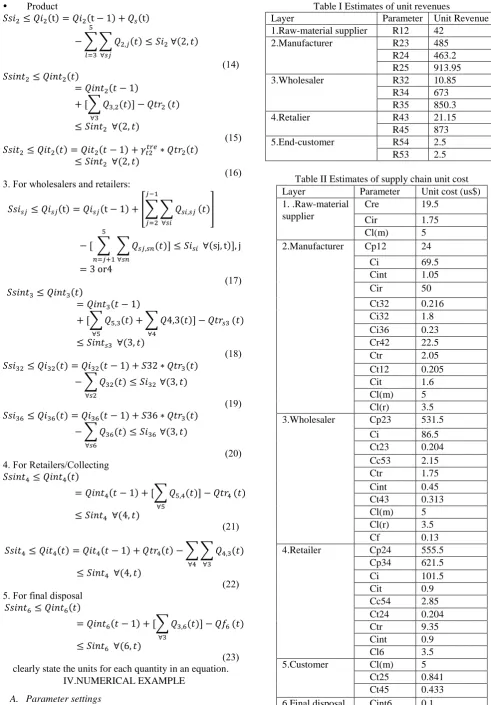
Ssir1≤ Qir(t) = Qir(t − 1) + Qr(t) − ∑∀𝑠2𝑄𝑠1, 𝑠2(𝑡) ≤ 𝑆𝑖𝑟𝑠1 ∀(𝑆1, 𝑡)
(12) 2.For product manufacturers:
Material
𝑆𝑠𝑖𝑟2≤ 𝑄𝑖𝑟2(t) = 𝑄𝑖𝑟2(t − 1) + ∑ 𝑄1,2(𝑡) − 𝑟2 2 𝑚
∀𝑠1 ∗ 𝑄𝑠(𝑡) ∀(2, 𝑡)
Product
𝑆𝑠𝑖2≤ 𝑄𝑖2(t) = 𝑄𝑖2(t − 1) + 𝑄𝑠(t)
− ∑ ∑ 𝑄2,𝑗(𝑡) ≤ 𝑆𝑖2 ∀(2, 𝑡) ∀𝑠𝑗
5
𝑙=3
(14) 𝑆𝑠𝑖𝑛𝑡2≤ 𝑄𝑖𝑛𝑡2(𝑡)
= 𝑄𝑖𝑛𝑡2(𝑡 − 1)
+ [∑ 𝑄3,2(𝑡)] − 𝑄𝑡𝑟2 ∀3
(𝑡)
≤ 𝑆𝑖𝑛𝑡2 ∀(2, 𝑡)
(15) 𝑆𝑠𝑖𝑡2≤ 𝑄𝑖𝑡2(𝑡) = 𝑄𝑖𝑡2(𝑡 − 1) + 𝛾𝑡2𝑡𝑟𝑒∗ 𝑄𝑡𝑟2(𝑡)
≤ 𝑆𝑖𝑛𝑡2 ∀(2, 𝑡)
(16) 3. For wholesalers and retailers:
𝑆𝑠𝑖𝑠𝑗≤ 𝑄𝑖𝑠𝑗(t) = 𝑄𝑖𝑠𝑗(t − 1) + [∑ ∑ 𝑄𝑠𝑖,𝑠𝑗 ∀𝑠𝑖 𝑗−1
𝑗=2
(𝑡)]
− [ ∑ ∑ 𝑄𝑠𝑗,𝑠𝑛(𝑡)] ≤ 𝑆𝑖𝑠𝑖 ∀𝑠𝑛
5
𝑛=𝑗+1
∀(sj, t)], j
= 3 or4
(17) 𝑆𝑠𝑖𝑛𝑡3≤ 𝑄𝑖𝑛𝑡3(𝑡)
= 𝑄𝑖𝑛𝑡3(𝑡 − 1)
+ [∑ 𝑄5,3(𝑡) + ∑ 𝑄4,3(𝑡) ∀4
] − 𝑄𝑡𝑟𝑠3 ∀5
(𝑡)
≤ 𝑆𝑖𝑛𝑡𝑠3 ∀(3, 𝑡)
(18) 𝑆𝑠𝑖32≤ 𝑄𝑖32(𝑡) = 𝑄𝑖32(𝑡 − 1) + 𝑆32 ∗ 𝑄𝑡𝑟3(𝑡)
− ∑ 𝑄32(𝑡) ≤ 𝑆𝑖32 ∀(3, 𝑡) ∀𝑠2
(19) 𝑆𝑠𝑖36≤ 𝑄𝑖36(𝑡) = 𝑄𝑖36(𝑡 − 1) + 𝑆36 ∗ 𝑄𝑡𝑟3(𝑡)
− ∑ 𝑄36(𝑡) ≤ 𝑆𝑖36 ∀(3, 𝑡) ∀𝑠6
(20) 4. For Retailers/Collecting
𝑆𝑠𝑖𝑛𝑡4≤ 𝑄𝑖𝑛𝑡4(𝑡)
= 𝑄𝑖𝑛𝑡4(𝑡 − 1) + [∑ 𝑄5,4(𝑡)] − 𝑄𝑡𝑟4 ∀5
(𝑡)
≤ 𝑆𝑖𝑛𝑡4 ∀(4, 𝑡)
(21) 𝑆𝑠𝑖𝑡4≤ 𝑄𝑖𝑡4(𝑡) = 𝑄𝑖𝑡4(𝑡 − 1) + 𝑄𝑡𝑟4(𝑡) − ∑ ∑ 𝑄4,3(𝑡)
∀3 ∀4 ≤ 𝑆𝑖𝑛𝑡4 ∀(4, 𝑡)
(22) 5. For final disposal
𝑆𝑠𝑖𝑛𝑡6≤ 𝑄𝑖𝑛𝑡6(𝑡)
= 𝑄𝑖𝑛𝑡6(𝑡 − 1) + [∑ 𝑄3,6(𝑡)] − 𝑄𝑓6 ∀3
(𝑡)
≤ 𝑆𝑖𝑛𝑡6 ∀(6, 𝑡)
(23) clearly state the units for each quantity in an equation.
IV.NUMERICAL EXAMPLE A. Parameter settings
[image:4.595.44.536.50.756.2]Our data is from Sheu et al (2005) [10].The case of a well-known Taiwan notebook manufacturer.
Table I Estimates of unit revenues
Layer Parameter Unit Revenue
1.Raw-material supplier R12 42
2.Manufacturer R23 485
R24 463.2
R25 913.95
3.Wholesaler R32 10.85
R34 673
R35 850.3
4.Retalier R43 21.15
R45 873
5.End-customer R54 2.5
R53 2.5
Table II Estimates of supply chain unit cost Layer Parameter Unit cost (us$) 1. .Raw-material
supplier
Cre 19.5
Cir 1.75
Cl(m) 5
2.Manufacturer Cp12 24
Ci 69.5
Cint 1.05
Cir 50
Ct32 0.216
Ci32 1.8
Ci36 0.23
Cr42 22.5
Ctr 2.05
Ct12 0.205
Cit 1.6
Cl(m) 5
Cl(r) 3.5
3.Wholesaler Cp23 531.5
Ci 86.5
Ct23 0.204
Cc53 2.15
Ctr 1.75
Cint 0.45
Ct43 0.313
Cl(m) 5
Cl(r) 3.5
Cf 0.13
4.Retailer Cp24 555.5
Cp34 621.5
Ci 101.5
Cit 0.9
Cc54 2.85
Ct24 0.204
Ctr 9.35
Cint 0.9
Cl6 3.5
5.Customer Cl(m) 5
Ct25 0.841
Ct45 0.433
6.Final disposal Cint6 0.1
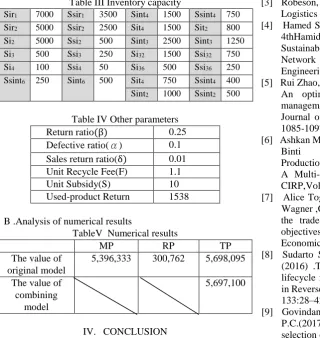
Table III Inventory capacity
Sir1 7000 Ssir1 3500 Sint4 1500 Ssint4 750
Sir2 5000 Ssir2 2500 Sit4 1500 Sit2 800
Si2 5000 Ssi2 500 Sint3 2500 Sint3 1250
Si3 500 Ssi3 250 Si32 1500 Ssi32 750
Si4 100 Ssi4 50 Si36 500 Ssi36 250
Ssint6 250 Sint6 500 Sit4 750 Ssint4 400
Sint2 1000 Ssint2 500 Table IV Other parameters
Return ratio(β) 0.25
Defective ratio(α) 0.1 Sales return ratio(δ) 0.01 Unit Recycle Fee(F) 1.1
Unit Subsidy(S) 10
Used-product Return 1538 B .Analysis of numerical results
TableV Numerical results
MP RP TP
The value of original model
5,396,333 300,762 5,698,095 The value of
combining model
5,697,100
IV. CONCLUSION
In recent years, we are concern about our issue of environmental pollution. Green supply chain has been becoming a trend of supply chain management. In this paper, we integrated manufacturing chain and reverse chain into our inventory model; there are some features in this paper, first, we considering the governmental regulations, second, this model in the imperfect environmental, which more closed to the reality. Third, we combine the manufactory chain and the reverse chain into the one formula.
The numerical results present that combining the supply chain can reduce recourse and cost, and it isn’t waste more used-product. The value comes up, the maximum profit of manufacturing chain is $5396333 and the maximum profit of reverse chain is $300762. When we aggregate the two value, the maximum profit is $5698095, due to there will be some factors influence each other. And another value which we combine the model is $5697100.
In this paper, we use the subsidy into the investigation, when the subsidy increase, the profit of the reverse chain will be increase, this indicated subsidy can affect the reverse chain, and we found that combining the model can let some recourses to be recycle, and some cost can be merge. The combined value will be lower than the value without merge ring the supply chain.
REFERENCE
[1] Shuai Yang , Yujie Xiao , Yan Zheng and Yan Liu(2017). The Green Supply Chain Design and Marketing Strategy for Perishable Food Based on Temperature Control, Sustainability (Switzerland) 9(9), 1511 [2] Fleischmann, M., Krikke, H.R., Dekker, R., Flapper,
S.D.P., 2000. A characterization of logistics networks for product recovery. Omega 28, 653–666.
[3] Robeson, J.F., Copacino, W.C., Howe, R.E., 1992. The Logistics Handbook. Macmillan, Inc., New York [4] Hamed Soleimani, Kannan Govindan, Hamid Saghafi,
4thHamid Jafari(2017) .Fuzzy Multi-Objective Sustainable and Green Closed-Loop Supply Chain Network Design. Computers & Industrial Engineering,Vol 109, Pages 191-203
[5] Rui Zhao, Yiyun Liu , Ning Zhang , Tao Huang(2017). An optimization model for green supply chain management by using a big data analytic approach. Journal of Cleaner Production,Vol 142, Part 2, Pages 1085-1097
[6] Ashkan Memari , Abdul Rahman Abdul Rahim , Robiah
Binti Ahmad .(2015) An Integrated
Production-distribution Planning in Green Supply Chain: A Multi-objective Evolutionary Approach. Procedia CIRP,Vol 26, Pages 700-705
[7] Alice Tognetti, Pan Theo Grosse-Ruyken, Stephan M. Wagner ,Green supply chain network optimization and the trade-off between environmental and economic objectives. International Journal of Production Economics.(2015)Vol170, Part B, Pages 385-392 [8] Sudarto S, Takahashi K, Morikawa K, Nagasawa K
(2016) .The impact of capacity planning on product lifecycle for performance on sustainability dimensions in Reverse Logistics Social Responsibility. J Clean Prod 133:28–42.
[9] Govindan, K., Darbari, J.D., Agarwal, V., Jha, P.C.(2017) .Fuzzy multi-objective approach for optimal selection of suppliers and transportation decisions in an eco-efficient closed loop supply chain network. Journal of Cleaner Production 165, pp. 1598-1619
[10] Chiu, C.Y., Meng, C.L., and Yang, M.F., (2002). Comprehensive High School Learning Group Selection Model Using Fuzzy Set Theory, Educational Research & Information, Vol. 10, No. 4, .67-84.
[11] Chiu, S.W., Yang, J.C., and Kuo, S.Y.C., (2008). Manufacturing Lot Sizing with Backordering, Scrap,
and Random Breakdown Occurring in
Inventory-Stacking Period, WSEAS Transactions on Mathematics, 7(4), pp. 183-194.
[12] Sheu, J.-B., Chou, Y.-H., Hu, C.-C.(2005) .An integrated logistics operational model for green-supply chain .management. Transportation Research Part E: Logistics and Transportation Review 41(4), p 287-313 [13] Yang, M.F., and Huang, T.S., Lin, Y., (2010). Variable