Towards a Knowledge-based Approach to Semantic
Service Composition
Chen L.1, Shadbolt N.R.1, Goble C.2, Tao F.1, Cox S.J.3, Puleston C.2, Smart P.R4
1 Department of Electronics and Computer Science
University of Southampton, Highfield, Southampton, SO17 1BJ, U.K.
{lc, nrs, ft}@ecs.soton.ac.uk
2 Department of Computer Science
University of Manchester, Oxford Road, Manchester, M13 9PL, U.K.
{carole, colin.puleston}@cs.man.ac.uk
3 School of Engineering Sciences
University of Southampton, Highfield, Southampton, SO17 1BJ, U.K.
4 Epistemics Ltd., Strelley Hall, Nottingham NG8 6PE, U.K.
Abstract. The successful application of Grid and Web Service technologies to
real-world problems, such as e-Science [1], requires not only the development of a common vocabulary and meta-data framework as the basis for inter-agent communication and service integration but also the access and use of a rich re-pository of domain-specific knowledge for problem solving. Both requirements are met by the respective outcomes of ontological and knowledge engineering initiatives. In this paper we discuss a novel, knowledge-based approach to re-source synthesis (service composition), which draws on the functionality of semantic web services to represent and expose available resources. The ap-proach we use exploits domain knowledge to guide the service composition process and provide advice on service selection and instantiation. The approach has been implemented in a prototype workflow construction environment that supports the runtime recommendation of a service solution, service discovery via semantic service descriptions, and knowledge-based configuration of se-lected services. The use of knowledge provides a basis for full automation of service composition via conventional planning algorithms. Workflows pro-duced by this system can be executed through a domain-specific direct map-ping mechanism or via a more fluid approach such as WSDL-based service grounding. The approach and prototype have been used to demonstrate practi-cal benefits in the context of the Geodise initiative [2].
1 Introduction
of these technologies has seen Grid technologies evolving towards an Open Grid Services Architecture (OGSA) [5] (a service-oriented distributed computing para-digm), which sees the Grid as providing an extensible set of services that virtual or-ganizations can aggregate in various ways to solve domain specific problems.
Scientific computing in e-Science usually involves very complicated processes. A process is normally composed of many steps of computation. Each scientific compu-tation is a resource that may come from different organizations and most probably is represented in different models and terminologies. Apart from this, other features of scientific computing include: (1) different disciplines have different problems, each dependent on different aspects of domain-specific knowledge; (2) the nature of the problem being dealt with often changes as the computation process proceeds, a fixed workflow is therefore nearly impossible for all but the most simple cases; and (3) both the underlying computing resources and the information input for the process are dynamic. Obviously an effective realization of the Grid computing paradigm, namely to promote the seamless integration of highly flexible and distributed coalitions of service-oriented components, requires not only an explicit description of resources so that they can be discovered, shared, understood and processed by both humans and machines, but also domain specific knowledge about how these resources should be composed, configured and executed to achieve some problem-solving goals.
Service discovery, description and messaging have been tackled in the web ser-vices community with introduction of a set of ‘industry-standard’ protocols (e.g. UDDI [6], WSDL [4] and SOAP [7]). However, none of these standards defines the meaning of services and their parameters in a way that transcends the tendency of agents to use their own terms and frame of reference. Furthermore, these protocols do not address the need to coordinate the sequencing and execution of services as part of some larger information processing tasks. Some industry initiatives have been devel-oped to address this issue, such as WSFL [8], XLANG [9] and BPEL4WS [10]; how-ever, such initiatives generally focus on representing service compositions where the flow of the process and the bindings between the services are known a priori. For scientific computations the knowledge required to select and coordinate the activity of available services is usually specific to the application domain. It is often the case that resource selection cannot be specified in advance of the execution of individual components of the more global workflow specification. As such it is apparent that pre-defined service sequencing and binding is not sufficient in scientific computing contexts.
configura-tion. At this point IBROW concentrates on component discovery and configuration rather than component composition for problem solving.
Recently the Semantic Web technologies [14] have been used to provide more ex-plicit and expressive descriptions for web services [18]. The purpose of semantic service descriptions is to facilitate service discovery based on underlying semantics that is enriched by means of ontologies using ontology description languages such as DAML+OIL [15], DAML-S [16] and OWL [17]. Obviously semantic service de-scriptions are not intended to provide the knowledge about when and how such ser-vices should be used to solve a problem, for example in the case of service composi-tion. Some research [19] has exploited semantic matching via ontology-driven rea-soning to conduct service composition. However, for some domains there is not al-ways a well-structured high-level ontology that can be used to characterize the do-main activities. Furthermore, for complex computations there may be multiple choices for the next step of a workflow sequence. The selection and configuration of a service for a specific problem are usually dependent on rich nexuses of domain knowledge.
We argue that both semantic service descriptions and domain-specific knowledgbased decision support services are essential ingredients for resource synthesis in e-Science. Semantic service descriptions support effective service discovery, seamless resource integration and reuse on the Grid. Knowledge-based decision-making sup-port systems can suggest what should be done next during a service composition process and which service should be chosen once a number of services are discov-ered. All decisions can be made dynamically by taking into consideration the problem characteristics, service performances and previous computation results. Furthermore, once a service is selected, knowledge support can be further provided for the configuration of that service. As such we contend that web-based service–oriented applications, both e-Science and e-Business, ought to exploit semantic service descriptions and domain knowledge in order to solve complex problems through automatic, seamless resource synthesis on the Web/Grid.
This paper introduces a knowledge-based approach and framework for semantic service composition. In section 2 we briefly discuss semantic resource description using the DAML-S service ontology. Section 3 describes the knowledge-based advice system, in particular, its recommendation strategy and implementation architecture. Section 4 presents the semantic service composition framework for the knowledge-based approach. An implementation prototype is given in section 5 to demonstrate the approach with respect to an example problem taken from the GEODISE initiative. We conclude in section 6 with some initial findings and possible future work.
2 Modeling Resources with Semantics
of WSDL during service design is usually more concerned with the signature of a service, i.e. the identifiers of the service and its parameters. Based on this description, it is usually impossible for software agents to figure out the precise meaning of the service identifiers and functionality provided by the service. The lack of semantics in the abstract functionality description of the service, i.e. the capabilities of the service, makes it difficult for machines to discover and use the service at the right time.
Ontological engineering plays a central role in incorporating semantics into service descriptions. An ontology is an explicit, shared specification of the various conceptu-alization in a problem domain. It not only provides a common language for interoperability but also adds meaning and relations to service descriptions. Ontology representation languages, such as RDF Schema [21], DAML+OIL or the ontology web language OWL, can be used to characterise the service-portfolio offered by a web service in a more expressive manner than the existing WSDL, thereby opening up the possibilty of automatic service discovery and use.
Semantically-enriched service descriptions can also be provided by the DAML Service ontology language DAML-S – a service description language that is itself written in RDF. DAML-S partitions a semantic description of a web service into three components: the service profile, process model and grounding. The Service Profile describes what a service does by specifying its inputs, outputs, preconditions, effects and other properties. The Process Model describes how a service works; each service is either an Atomic Process that is executed directly or a Composite Process that is a combination of other sub-processes. The Grounding contains the details of how an agent can access a service by specifying the details of the communication protocol, i.e. the parameters to be used in the protocol and the serialization techniques to be employed for the communication.
DAML-S allows the definition of classes of related services and can establish links to other concepts that describe specific service types and their properties. This makes service discovery much easier in terms of the built-in links, thus facilitating resource reuse. For example, in the engineering design domain a mesh generation service has a geometry file as its input, which is linked to a geometry generation service, and a mesh file as its output, which leads to the code analysis service. The mesh generation service itself uses the Gambit meshing tool as its process model.
3 A Knowledge-based Advice System for Service Composition
performances of the services available. As a result, it is not practical to specify, a priori, the precise sequence of steps for a problem goal. The successful orchestration of component services into a valid workflow specification is heavily dependent on bodies of domain knowledge as well as semantically enriched service descriptions. A knowledge-based advice system aims to support automatic or semi-automatic ser-vice composition by providing adser-vice constrained by bodies of domain-specific knowledge. It is described in detail below.
3.1 Strategies for knowledge-based advice
There are two approaches to providing service composition advice. One is based on the semantic service descriptions, i.e. the conceptual links between services and their properties [18] [22]. It makes use of available information about service profiles such as the preconditions, constraints and outputs of the service in order to assess the po-tential fit of each service to a particular role in the workflow specification. The ex-pressive description logic of DAML+OIL enables a suitable reasoning engine, such as FaCT [29], to automatically retrieve a service that matches the semantic descrip-tion. External agents can use the outcome of such reasoning engines to select a ser-vice commensurate with their information processing goals. Often, however, such systems are limited with respect to the appropriate selection of services suited for a specific task or with the appropriate configuration of service parameters.
The knowledge-based approach to the provision of service composition advice can often succeed in situations where ontology-driven reasoning proves inadequate. For example, in the domain of engineering design search and optimization there are over a hundred different optimization methods, each of which is geared to solving a spe-cific type of engineering problem. Even with a single method, different configura-tions of control parameters may produce very different results. Knowledge about the correct method to choose in a particular situation as well as the appropriate configura-tion of method parameters is an important feature of expert-level performance and a vital ingredient of problem-solving success. Any system concerned with the appropri-ate selection of optimization methods, therefore requires access to an exquisitely detailed representation of the knowledge contingencies relating problem characteris-tics and design goals with the appropriate selection and configuration of available methods.
knowledge and knowledge-based systems. One feature of the latest knowledge engi-neering methodologies, such as CommonKADS [23], and knowledge engiengi-neering tools, is that they place special emphasis on the way in which knowledge is modeled so as to promote knowledge re-use across diverse problem-solving contexts.
Knowledge-based advice systems for service composition have the advantage of providing specific advice at multiple levels of granularity during the service composi-tion process. At the highest level, the system can help determine what kind of service is required against a contextual backdrop that includes problem-solving goals and procedural knowledge. Once all the services that can fulfill the required function are discovered, the advice system can recommend an appropriate service, taking into account both problem characteristics and performance considerations. More special-ized, in-depth advice can also be given, for example, how to initialize and configure the control parameters of a service. Such knowledge is usually only available from experienced users or domain experts.
In order to deploy, share and re-use knowledge-based advice systems in the Grid computing paradigm, the system has been developed with three important innova-tions. Firstly, ontologies are used as knowledge models for representing knowledge. Second, ontologies are exploited to conceptualize knowledge systems with commonly accepted vocabulary, thus facilitating knowledge sharing and re-use. Third, knowl-edge systems themselves are exposed as services within the service-oriented frame-work of the Grid.
3.2 A service-oriented architecture for knowledge-based advice systems
Traditionally, knowledge intensive systems are constructed anew for each knowledge project. There is often little reuse of existing knowledge structures and problem-solving elements. The reasons for this are legion, including the diversity of domain knowledge, the close coupling of domain knowledge with reasoning processes and the different terminologies and modeling views adopted by different users for a single domain. It is obvious that the exploitation of knowledge technologies on the Web/Grid requires that these obstacles be successfully surmounted, an insight that has led to a variety of new tools, techniques and research agendas [14] [24] [25] [26].
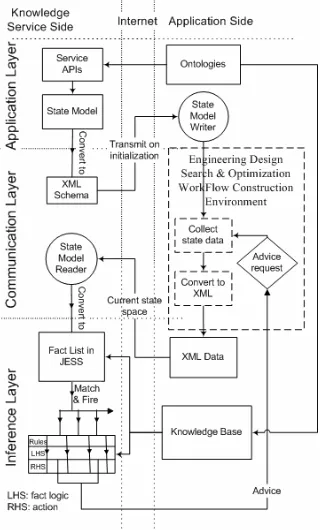
A second feature of the architecture is its use of multiple layers. These layers enable the effective separation of reasoning, communication and representation com-ponents into the Inference, Communication and the Application Layers. The Applica-tion Layer uses domain ontologies from the ApplicaApplica-tion Side to define an applicaApplica-tion- application-dependent state model that is then converted to a frame-like XML schema used as a placeholder for state variables. A state model contains the description of all possible factors that can potentially affect the advice delivered by the knowledge service. It holds the state space of an application on the Application Side and uses the state in-formation as the input to the reasoning engine in the Inference Layer. The Communi-cation Layer deals with the transmission protocols and serialization of messages be-tween the Application Side and the Knowledge Service Side, i.e. transmission of the XML schema of the state model and the state information requests. The Inference Layer provides a domain-independent inference capability via a reasoning engine. The availability of a domain-specific knowledge base enables the reasoning engine to drive inferential processes that operate on the state information.
A third feature of the architecture regards its use of ontologies – the web-oriented knowledge models. Not only are the state variables of an application denoted using ontology vocabularies, as discussed above, but also the axi-oms, facts and rules of the knowledge base are formalized with respect to the shared repository of common terms. The use of ontology enables different users and machines to share and reuse domain-specific knowledge. These features make the proposed advice system different from traditional stand-alone knowledge-based systems, and contribute to its acceptability in a Grid computing environment.
The generic knowledge-based ad-vice system is actually a web serad-vice, which operates as follows. The service user in the Application Side supplies domain knowledge, i.e. ontologies and knowledge bases. The knowledge service in the Knowledge Service Side creates the state model and corre-sponding XML schema. The state
[image:7.595.313.473.332.597.2]XML schema is passed onto the Application Side during knowledge service initializa-tion. The State Model Writer in the Application Side monitors the progress of the application and collects relevant states to fill in the state XML schema. Whenever the application requests advice, the state information in the state model, i.e. an instanti-ated XML schema, will be sent to the knowledge service. Once the state information
Fig. 1. The Architecture of Knowledge-
of the application reaches the Knowledge Service Side, it will be parsed and con-verted to facts. The reasoning engine in the Inference Layer will reason against these facts to provide domain-specific, context-sensitive decision support.
Figure 1 illustrates the implementation of the proposed architecture in the context of engineering design search and optimization. In this implementation, the Applica-tion Side (the user) is concerned with advice on EDSO workflow construcApplica-tion. Do-main knowledge in this example application assumes the form of EDSO ontologies and knowledge-rich contingencies represented in a production rule-like format. The reasoning of the Inference Layer is based on JESS [28], a Java-based implementation of the CLIPS expert system shell. Outside of this domain, the aforementioned system architecture is applicable to any area of domain expertise, providing that a suitable characterization of the domain-specific knowledge is available.
4 Knowledge-based Service Composition Framework
[image:8.595.137.474.458.642.2]We have developed and partially implemented a knowledge-based service composi-tion framework (see Figure 2) to provide a practical demonstracomposi-tion of our approach. This framework uses domain knowledge and advice services to provide advice and guidance with respect to the selection, sequencing and correct configuration of ser-vices as part of constructing a workflow specification. It additionally uses semanti-cally-enriched service descriptions to assist in the process of discovering available services for workflow specification. This ability to exploit service descriptions facili-tates the workflow specification process with respect to existing descriptions of Web/Grid resources.
Fig. 2. The Knowledge-based Semantic Service Composition Framework
Ontology component contains domain-related ontologies that provide an explicit shared conceptualization of the target domain, i.e. concepts, terms and relations. They serve as a conceptual backbone to underpin the service composition framework by supplying a common vocabulary and establishing semantic links among service prop-erties. The ontologies were developed through ontological engineering and are ex-posed through the Ontology Services component. The Ontology Services provide complete access to any DAML+OIL ontology available over the Internet. Users can perform common ontological operations, such as subsumption checking, class and/or property retrieval and navigation of concept hierarchies through a set of ontology service APIs in conjunction with the FaCT reasoner [29]. Ontology Services are im-plemented as standard SOAP-based web services and can be accessed, shared and re-used through the WSDL standard.
The cornerstone of the service composition framework lies in the exploitation of domain-specific knowledge contained in the knowledge bases. These knowledge bases consist of concepts, axioms and rules acquired through KAs, which conceptual-ize the target domain. The availability of knowledge bases is a prerequisite for advice provision during the workflow construction process.
Advice services are actually knowledge-based systems that are implemented as web services [27] such as the Process and Component-related Advice Services. They provide advice based on service requests. Users can obtain advice in two ways. First, a user may request advice according to his/her epistemic needs and requirements during the workflow construction process. Secondly, a software agent can be used to monitor the service composition process as it unfolds, and provide advice and/or recommendations along the way. Both approaches need to monitor the progress of the composition process and collect snapshots of states when advice is requested. These states are then fed into the reasoning engine to retrieve context-sensitive advice as with traditional knowledge-based systems. Advice can be provided at multiple levels of granularity, for example the process level and/or the component level, dependent on the availability of knowledge in the underlying knowledge bases.
At the core of the framework is Workflow Construction Environment (WCE) It consists of a set of WCE GUIs and tools to facilitate workflow construction. Seman-tic service description is undertaken using ontologies accessed via the ontology ser-vices. As the DAML-S service ontology only provides the basic schema for describ-ing a web service, it does not provide the vocabulary with which to describe specific services in different scientific domains. Therefore, domain specific ontologies are used to incorporate domain specific functions and terminology in creating semantic service descriptions. The process of specifying semantic service descriptions is car-ried out in two steps. Firstly, domain ontologies, such as the task ontology and the function ontology, are created. Then, the domain specific service ontology is built using concepts from the domain ontologies. The semantic descriptions of domain-specific services are actually instances of concepts from the service ontology. Seman-tic service descriptions are stored in the SemanSeman-tic Service Description component.
The WCE GUI consists of five graphical tools to assist workflow construction. Each of them presents relevant structures and information via a control panel. The Component (Service) Editor is a frame-like data-storage structure. It can be used to specify a service description for service discovery or to define a service directly by filling in the required data fields. The structure of the Component Editor is dynami-cally generated in accordance with the service ontology. The Discovered Service Browser displays services returned by the search engine. Users can choose a service from the panel based on the advice given for a particular workflow composition. The State Monitor monitors the workflow construction process, and collects and maintains a workflow state space. During the workflow construction process, whenever a re-quest for advice is made, the state space can be fed into the underlying knowledge-based advice services. Advice as to what to do next and which service should be used is then provided as output by these services. The results are shown in the Knowledge-based Advice panel. Workflows are built in the Workflow Editor where different services are connected together. Details of the workflow construction process will be described in the next section in the context of a real application.
5 Example Application: Workflow Construction in Geodise
Engineering design search and optimization (EDSO) is the process whereby engineer-ing modelengineer-ing and analysis are exploited to yield improved designs. An EDSO process usually comprises many different tasks. Consider the design optimization of a typical aero-engine or wing. It is necessary (1) to specify the wing geometry in a parametric form which specifies the permitted operations and constraints for the optimisation process, (2) to generate a mesh for the problem, (3) decide which analysis code to use and carry out the analysis, (4) decide the optimisation schedule, and finally (5) exe-cute the optimisation run coupled to the analysis code. Apparently a problem solving process in EDSO is a process of constructing and executing a workflow.
Grid enabled engineering design search and optimization (Geodise) aims to aid engineers in the EDSO process by providing a range of internet-accessible web ser-vices comprising a suite of design optimization and search tools, computation pack-ages, data, analysis and knowledge resources. A desirable feature of Geodise is that it should allow for users to compose a suite of EDSO algorithms (web services) into a workflow, i.e. to create a design solution to a specific EDSO problem. To provide such a capability we have applied our approach and the corresponding framework in Geodise. The detailed work is described below.
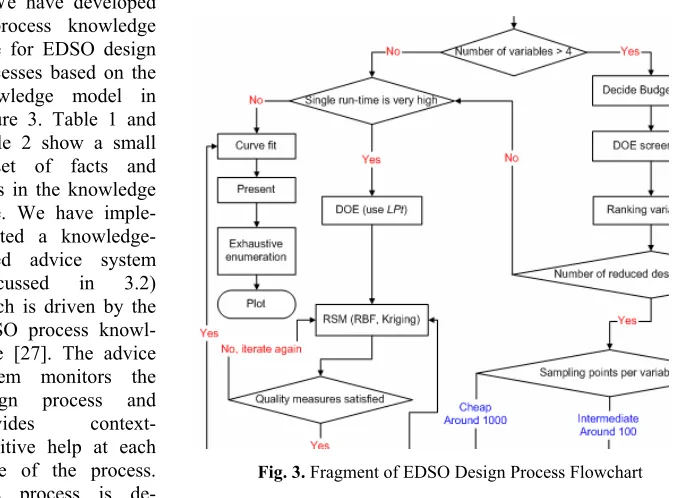
We have undertaken extensive knowledge and ontological engineering using CommonKADS methodology in the domain of EDSO. A substantial amount of do-main knowledge has been acquired and modelled [30], for example the EDSO proc-ess knowledge in Figure 3. A number of ontologies have also been developed using OilEd [31] including the EDSO basic domain ontology, the optimization function ontology and the DAML-S-based task service ontology.
as a standard SOAP-based web service in Java and deployed using Apache Tomcat & Axis technologies.
[image:11.595.142.479.176.425.2]We have developed a process knowledge base for EDSO design processes based on the knowledge model in Figure 3. Table 1 and Table 2 show a small subset of facts and rules in the knowledge base. We have imple-mented a knowledge-based advice system (discussed in 3.2) which is driven by the EDSO process knowl-edge [27]. The advice system monitors the design process and provides context-sensitive help at each stage of the process. This process is de-scribed in more detail below.
Table 1. Fragment of the facts in the process knowledge base
… …
f-6 (MAIN::resource (name "step_file") (location "d:/geodise/res/airFoilStepFile")) f-7 (MAIN::resource (name "gambit_jou_file") (location "d:/geodise/res/gambit.jou"))
f-8 (MAIN::workflow_task (name "geometry") (input nil) (output "step_file") (relevant_commands nil) (finished? nil) (constrains nil) (dependance )) f-9 (MAIN::workflow_task (name "mesh") (input "step_file" "gambit_jou_file") (output "mesh_file") (relevant_commands nil) (finished? nil) (constrains nil) (dependance ))
… …
Table 2. Fragment of the rules in the process knowledge base
… … (defrule rule1
(not (state_panel (available_resources $?x "step_file" $?y))) ?taskID<-(workflow_task(input $?a "step_file" $?b)) => (retract ?taskID)
(printout t ?taskID " Retract this workflow task because it needs step_file as input, which is not available according to the state model. " crlf)) (defrule rule2
(not (state_panel (available_resources $?x "gambit_jou_file" $?y))) ?taskID<-(workflow_task(input $?a "gambit_jou_file" $?b)) => (retract ?taskID)
(printout t ?taskID " Retract this workflow task because it needs gambit_jou_file as input, which is not available according to the state model. " crlf)) … …
(defrule workflow-answer-1
(declare (salience -10)) (workflow_task (name ?n))
=> (printout t "In term of the work flow, next step you can do: " ?n crlf))
As there are currently no semantically described EDSO task services available on the Grid, it makes no sense to search the Internet for any required task services. Therefore, we have not implemented the Semantics-based Search Engine of the ser-vice composition framework. In Geodise, the process of serser-vice discovery amounts to
loading the EDSO task service ontology into the workflow construction environment. Users can then browse the service hierarchy and define appropriate services.
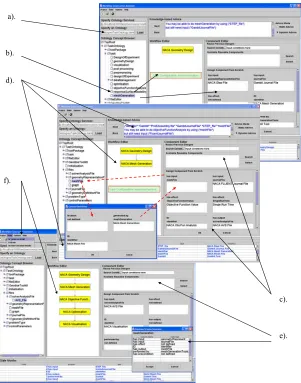
We have developed a workflow construction environment prototype for the framework as shown in Figure 4. The left panel is used to specify ontology services and the task service ontology. It presents the task service hierarchy through the On-tology Concept Browser. The right panel is the Component Editor. Its lower part is used to specify the properties of a task service and its upper part is used to search for task services that match the semantic description defined in the lower part. As we have not implemented the search mechanisms, the Component Editor is actually used to define a service directly. The middle panel is the Workflow Editor where services are composed and edited. The bottom panel is the State Monitor while the right top panel is used to display knowledge-based advice on service composition. The knowl-edge-based advice system has not yet been wrapped up as a set of web services. It currently runs as a standalone knowledge-based system, which is directly integrated with the workflow construction environment. Despite this difference from the archi-tectural specification detailed above, the decision support provided for service com-position is the same.
A workflow specification represents a design solution to a specific EDSO problem. The general procedure for composing services as a workflow using the workflow construction environment is described step by step below. This process is also illus-trated in Figure 4.
a). Specify and load the Geodise task service ontology via ontology services in the left panel. The Geodise task services will be presented in a hierarchy in the Ontology Concept Browser.
To start a workflow construction process, users need to provide an initial descrip-tion of the problem at hand, e.g. the problem type and its characteristics. The knowl-edge-based advice system can then give advice on what to do first to solve the prob-lem via the advice panel. Alternatively a static knowledge support system will sug-gest to users what should be done first.
b). Select a suitable primitive task service by navigating the service hierarchy util-izing the initial advice, and drag and drop it into the Workflow Editor. A task service description form will appear in the Component Editor for defining the service.
c). Define a task service by filling in the property values of the task service de-scription form. Users can follow the ontological concept links from the semantic task service description to define each property. For example, to define a mesh file for the objective function analysis task, the semantic link of the property “meshFile” will bring you to the “MeshFile” concept in the Geodise task service ontology. Dragging and dropping the concept into the property’s input area will in turn open a concept definition dialog box for users to input relevant values. This process is demonstrated by the red dashed arrows in Figure 4.
Alternatively users can partially describe the properties of a service using the ser-vice description form. The semantic-based search engine (at the top of the Compo-nent Editor) will enable users to discover similar task services on the Grid. This fea-ture has not been implemented at present.
embed-ded semantics will be adembed-ded to the Workflow Editor. It will form a step of the work-flow specified for the current problem. This is shown as a yellow box in Figure 4. Second some property information of the task service, in particular, the input, effect and output parameters, will be added to the state memory of the Workflow Construc-tion Environment. These states are, in turn, passed on to the underlying advice system and displayed in the State Monitor. The recommendation on what one should/can do next is subsequently displayed in the knowledge advice panel. This advice guides users to select a suitable service from the service hierarchy.
Fig. 4. Screenshots of Workflow Construction Environment
e). A database schema for any task service can be generated automatically by dragging and dropping the service from the task service ontology. The instantiated
a).
b).
d).
f).
c).
service can then be archived in the database. By collecting all the services created for different problems a semantically-enriched knowledge base can be built over a period of time. This provides semantic content for the search engine to work on for future service discovery.
f). After an arbitrary number of loops, i.e. advice on required services, service dis-covery/configuration, and service composition, the user can construct a workflow that solves the specific problem. The generated workflow can be submitted to the underly-ing enactment engine where various resources will be bound together to form an executable. The executable will run in a domain specific execution environment. In Geodise, the executable is a Matlab .m script and the execution environment is the Matlab environment [32]. A full discussion of workflow enactment and execution issues is beyond the scope of this paper.
Each time a workflow is constructed for a particular design problem, it can be ar-chived to form a semantically enriched problem/solution within a knowledge reposi-tory. This facilitates the re-use of previous designs, while avoiding the overhead of manually annotating the solution with respect to semantic content.
6 Conclusions
This paper has described an approach, a framework and its implementation towards the delivery of knowledge-based service composition, or more generally, resource synthesis, in a web-enabled or Grid computing environment. A central feature of the approach discussed herein is the exploitation of domain-specific knowledge to com-pose web/Grid services into a workflow specification specifically geared to a core set of problem-solving objectives based on best practice knowledge and expertise. In developing this approach we have emphasized the importance of DAML-S, and re-lated technologies, in providing semantically-enriched characterizations of available services as the basis for dynamic service discovery and appropriate resource utiliza-tion. We have further outlined a service-oriented architecture for knowledge-based systems operating in the context of the technological infrastructure provided by Grid-computing platforms and the semantic web. Our approach co-opts traditional knowl-edge-based systems engineering with the current state-of-the-art in ontology specifi-cation and XML web services. The prototype system, developed to provide a concrete demonstration of our approach, exemplifies this close merger of previously disparate technologies, availing itself of both a knowledge-based decision support facility and exploitation of semantically-enriched service descriptions in a single unitary envi-ronment. Such systems empower problem-solving agents by enabling maximal ex-ploitation of available resources to meet a diverse set of complex problem-solving goals.
The importance of domain knowledge and expertise to problem-solving success is nowhere more apparent than in the field of scientific computation and scientific dis-covery. We have demonstrated the importance of domain knowledge with respect to one aspect of expertise, namely the selection and configuration of services as part of a workflow specification. While this system is as yet only partially automated – users still need to manually construct workflows based on knowledge-system output – we firmly believe the current results are an important milestone on the way to providing a fully automatic means of intelligent service discovery and resource utilization in the context of Grid computing and the Semantic Web.
7 Acknowledgements
This work is supported by the UK EPSRC Geodise e-Science pilot (GR/R67705/01). The authors gratefully acknowledge the contributions from and discussion with EPSRC projects MyGrid (GR/R67743/01) [33] and AKT (GR/N15764/01(P)).
References
1. Hey, T. and Trefethen, A. E.: The Data Deluge: An e-Science Perspective. To appear in “Grid Computing – Making the Global Infrastructure a Reality”, Wiley, January 2003 2. Geodise project: http://www.geodise.org/
3. Foster, I. and Kesselman, C.: The Grid: Blueprint for a New Computing Infrastructure. Morgan Kaufmann (1999)
4. Chinnici, R., Gudgin, M., Moreau, J. and Weerawarana, S.: Web Services Description
Lan-guage (WSDL) 1.2, W3C Working Draft. http://www.w3.org/TR/wsdl12/ (2002)
5. Foster, I., Kesselman, C., Nick, J. and Tucke S.: The Physiology of the Grid: An Open Grid Service Architecture for Distributed Systems Integration. http://www.globus.org/ogsa/ (2002)
6. UDDI. The UDDI technical white paper. 2000. http://www.uddi.org/
7. SOAP 1.2 Working draft, http://www.w3c.org/TR/2001/WD-soap12-part0-20011217/ 8. WSFL 1.0 http://www-3.ibm.com/software/solutions/webservices/pdf/WSFL.pdf 9. XLANG http://www.gotdotnet.com/team/xml_wsspecs/xlang-c/default.htm
10. Curbera, F., Goland, Y., Klein, J., Leymann, F., Roller, D., Thatte, S. and Weerawarana, S. Business Process Execution Language for Web Services, Version 1.0. http://www-106.ibm.com/developerworks/webservices/library/ws-bpel/
11. IBROW project: http://www.swi.psy.uva.nl/projects/ibrow/home.html
12. Fensel, D., Benjamins, V.R., Motta, E. and Wielinga, B.: UPML: A Framework for knowl-edge system reuse. In Proceedings of the International Joint Conference on AI (IJCAI-99) 13. Benjamins, V.R., Plaza, E., Motta, E., Fensel, D., Studer, R., Wielinga, B., Schreiber, G.
and Zdrahal, Z: IBROW3 - An Intelligent Brokering Service for Knowledge-Component Reuse on the World Wide Web. In proceedings of KAW'98 (1998)
14. Berners-Lee, T., Hendler, J. and Lassila, O.: The Semantic Web, Scientific American, May 2001
15. DAML+OIL http://www.daml.org.
17. OWL Web Ontology Language 1.0 Reference, http://www.w3.org/TR/owl-ref/
18. Sirin, E., Hendler, J. and Parsia, B.: Semi-automatic Composition of Web Services Using Semantic Descriptions. "Web Services: Modeling, Architecture and Infrastructure" work-shop in conjunction with ICEIS2003 (2002)
19. Paolucci, M. Kawmura, T., Payne, T. and Sycara, K.: Semantic Matching of Web Services Capabilities. In The First International Semantic Web Conference (2002)
20. Extensible Markup Language, http://www.w3.org/XML/
21. Resource Description Framework (RDF) Model and Syntax Specification. W3C Recom-mendation Standard, http://www.w3.org/TR/1999/REC-rdf-syntax-19990222/
22. Wroe, C., Stevens, R., Goble, C., Roberts, A. and Greenwood, M.: A Suite of DAML+OIL
Ontologies to Describe Bioinformatics Web Services and Data. International Journal of Co-operative Information Systems, Editor(s): Prof. Bukhres, O. ISSN: 0218-8430 (2003) 23. Schreiber S., Akkermans H., Anjewierden A., Hoog R., and Shadbolt N.: Knowledge
Engi-neering and Management. The MIT Press, London (1999)
24. Advanced Knowledge Technologies (AKT) project: http://www.aktors.org/
25. Cannataro, M. and Talia, D.: The Knowledge Grid. Communication of the ACM, Vol.46 No.1, pp89-93 (2003)
26. Chen, L., Cox, S.J., Goble, C., Keane, A.J, Roberts, A., Shadbolt, N.R., Smart, P. and Tao,
F.: Knowledge Services for Distributed Service Integration. In Proceedings of UK
e-Science all hands meeting (2002)
27.Tao, F., Chen, L., Shadbolt, N.R., Pound, G. and Cox, S.J.: Towards the Semantic Grid:
Putting Knowledge to Work in Design Optimization. In Proceedings of the 3rd International Conference on Knowledge Management, Industry meets Science, pp555-566. (2003) 28. Jess, the rule engine for the Java platform, http://herzberg.ca.sandia.gov/jess/
29. Horrocks, I., Sattler, U. and Tobies, S.: Practical reasoning for expressive description lo-gics. Lecture Notes in Artificial Intelligence, No.1705 pp.161-180. Springer-Verlag (1999) 30. Chen, L., Cox, S.J., Goble, C., Keane, A.J., Roberts, A., Shadbolt, N.R., Smart, P., Tao, F.:
Engineering Knowledge for Engineering Grid Applications. In Proceedings of Euroweb 2002 Conference, The Web and the GRID: from e-science to e-business, pp12-25 (2002) 31. Bechhofer, S., Horrocks, I., Goble, C. and Stevens, R.: OilEd: a Reason-able Ontology
Editor for the Semantic Web DL2001, 14th International Workshop on Description Logics (2001)
32. Pound, G., Eres, H., Wason, J., Jiao, Z., Keane, A.J., and Cox, S.J.: A Grid-enabled Prob-lem Solving Environment (PSE) for Design Optimization within Matlab. International Par-allel and distributed Processing Symposium IPDPS-2003 (2003)