Physics and Astronomy Publications
Physics and Astronomy
5-2018
Phase field study of surface-induced melting and
solidification from a nanovoid: Effect of
dimensionless width of void surface and void size
Anup Basak
Iowa State University, [email protected]
Valery I. Levitas
Iowa State University, [email protected]
Follow this and additional works at:
https://lib.dr.iastate.edu/physastro_pubs
Part of the
Engineering Physics Commons
, and the
Structures and Materials Commons
The complete bibliographic information for this item can be found athttps://lib.dr.iastate.edu/physastro_pubs/475. For information on how to cite this item, please visithttp://lib.dr.iastate.edu/howtocite.html.
Phase field study of surface-induced melting and solidification from a
nanovoid: Effect of dimensionless width of void surface and void size
Abstract
The size effect and the effects of a finite-width surface on barrierless transformations between the solid (S),
surface melt (SM), and melt (M) from a spherical nanovoid are studied using a phase field approach. Melting
(SM → M and S → M) from the nanovoid occurs at temperatures which are significantly greater than the
solid-melt equilibrium temperature θe but well below the critical temperature for solid instability. The relationships
between the SM and M temperatures and the ratio of the void surface width and width of the solid-melt
interface, Δ
⎯⎯⎯
, are found for the nanovoids of different sizes. Below a critical ratio Δ
⎯⎯⎯∗
, the melting occurs
via SM and the melting temperature slightly reduces with an increase in Δ
⎯⎯⎯
. Both S → SM and SM → M
transformations have a jump-like character (excluding the case with the sharp void surface), causing small
temperature hysteresis. However, the solid melts without SM for Δ
⎯⎯⎯
>Δ
⎯⎯⎯∗
, and the melting temperature
significantly increases with increasing Δ
⎯⎯⎯
. The results for a nanovoid are compared with the melting/
solidification of a nanoparticle, for which the melting temperatures, in contrast, are much lower than θe. A
linear dependency of the melting temperatures with the inverse of the void radius is shown. The present study
shows an unexplored way to control the melting from nanovoids by controlling the void size and the width
and energy of the surface.
Keywords
phase transitions
Disciplines
Aerospace Engineering | Engineering Physics | Structures and Materials
Comments
This is the Accepted Manuscript of the article published as Basak, Anup, and Valery I. Levitas. "Phase field
study of surface-induced melting and solidification from a nanovoid: Effect of dimensionless width of void
surface and void size."
Applied Physics Letters
112, no. 20 (2018): 201602. DOI:
10.1063/1.5029911
. Posted
with permission.
Phase field study of surface-induced melting and solidification from a
nanovoid: effect of dimensionless width of void surface and void size
Anup Basak1,a) and Valery I. Levitas2,b)
1)
Department of Aerospace Engineering, Iowa State University, Ames, IA 50011, USA.
2)Departments of Aerospace Engineering, Mechanical Engineering, and Material Science and Engineering,
Iowa State University, Ames, IA 50011, USA.
Division of Materials Science and Engineering, Ames Laboratory, Ames, IA 50011, USA.
The size effect and the effects of finite-width surface on barrierless transformations between solid (S), surface melt (SM), and melt (M) from a spherical nanovoid are studied using a phase field (PF) approach. Melting (SM→M and S→M) from nanovoid occurs at temperatures which are significantly greater than the solid-melt equilibrium temperature θe but well below the critical temperature for solid instability. The relationships between the SM and M temperatures and the ratio of the void surface width and width of solid-melt interface,
¯
∆, are found for the nanovoids of different sizes. Below a critical ratio ¯∆∗, the melting occurs via SM and the melting temperature slightly reduces with an increase in ¯∆. Both S→SM and SM→M transformations have a jump-like character (excluding the case with the sharp void surface), causing small temperature hysteresis. However, the solid melts without SM for ¯∆>∆¯∗, and the melting temperature significantly increases with increasing ¯∆. The results for a nanovoid are compared with the melting/solidification of a nanoparticle, for which the melting temperatures, in contrast, are much lower than θe. A linear dependency of the melting temperatures with the inverse of the void radius is shown. The present study shows an unexplored way to control the melting from nanovoids by controlling the void size and the width and energy of the surface.
External and internal surfaces play an important role in the nucleation and kinetics of melting and so-lidification in materials1. Surface-induced surface melt-ing, meltmelt-ing, and solidification are widely observed in nature and have great practical importance. For ex-ample, melting and surface melting are important in the combustion of nanoparticles2; surface melting in-creases the reactivity of explosives3; surface melting yields transformation of one solid into another, which would otherwise be impossible4; and melting tempera-tures in nanoparticles5–15 and nanovoids16 significantly differ from the thermodynamic equilibrium temperature between solid and melt, θe. The finite curvature of the surfaces plays an important role15–18. The surfaces re-duce the melting temperature,θm, from the surface melt (SM) or solid to melt in nanoparticles well belowθe (see e.g.7,9–13,15) and increaseθ
m from nanovoids well above
θe, allowing superheating of the solids (see e.g.16,17). No-tably,θm is significantly lower than the instability tem-perature for solid at which barrierless transformation to melt occurs. For the particles embedded in the matrix,
θmis smaller thanθe18.
Surface-induced melting in nanoparticles is well-understood based on the model with a sharp external surface7–11,13,14. Recently, however, multiple strong ef-fects of finite-width of the surface were observed by uti-lizing the PF approach to lead to various counterintu-itive phenomena15. It was shown that when the ratio
¯
∆ = δξ/δ, where δξ and δ are the widths of the sur-face and the solid-melt intersur-face, respectively, is smaller
a)Electronic mail: [email protected] b)Electronic mail: [email protected]
2
be modeled as diffused regions with prescribed widths. Thus, thegoal of this letter is to present the first PF study of melting at a nanovoid with focus on the effect of finite-width void surface and void radius. A melting tem-perature versus ¯∆ diagram is determined and analyzed in details. We show that with increasing ¯∆, below a critical
¯
∆∗ the SM→M transformation temperature slightly de-creases, but above ¯∆∗ the solid melts barrierlessly with-out surface melting and the melting temperature strongly increases. The SM→S and S→SM curves are also plot-ted. Within 0<∆¯ ≤∆¯∗, the S→SM temperatures are slightly higher than the SM→S temperatures with a max-imum difference of 2−3 K, implying that these trans-formations yield hysteresis. The hysteresis is caused by discontinuous (jump-like) change in the stationary distri-bution of the order parameter during S→SM and SM→S transformations, excluding the case with ¯∆ = 0. A sim-ilar jump exists for SM→M transformation. The effects of void size on melting, surface melting, and solidification are also analyzed. The melting temperatures and surface melting temperatures decrease with increase in the void size. The simulation result for melting of a nanoparticle is also presented and compared with the results for voids. In both the cases, the melting temperatures are well below the solid-to-melt instability temperature. While melting occurs significantly belowθefor nanoparticles, it takes place significantly aboveθefor nanovoids.
Model. We have used a PF approach of the Ginzburg-Landau type15, which considers an order parameter η for describing the solid↔melt transformations. An ad-ditional order parameter ξis introduced to describe the transition between the material (solid or melt) and the surrounding (vacuum or gas), and thus introduce a finite width of the void surface S0. The order parameter η is taken to be 0 in melt and 1 in solid, and ξ = 0 in the material andξ= 1 in the surrounding.
The Helmholtz free energy per unit volume of the body is taken in the following form15
ψ(η, ξ, θ,∇η,∇ξ) = ˘ψθ(η, θ) + ˜ψθ(η, θ) +ψ∇(∇η) +
ψξ(η, ξ,∇ξ), (1)
where ˘ψθ is the barrier energy and ˜ψθ is the thermal (or chemical) energy related to S↔M transformations,ψ∇is the solid-melt gradient energy (∇ denotes the gradient operator), andψξ is the free energy related toS015:
˘
ψθ= 3H(1−θcM S/θe)η2(1−η)2, ψ˜θ=H(θ/θe−1)ϕ(η),
ψ∇= 0.5β|∇η|2, ψ
ξ =Aξ(η)ξ2(1−ξ)2+ 0.5βξ(η)|∇ξ|2,
whereβξ(η) = 1.084δξγξ(η), Aξ(η) =
16.62γξ(η)
δξ
, (2)
His the heat of fusion,θ >0 is the absolute temperature,
θM S
c and θSMc are the critical temperatures for barrier-less melt-to-solid and solid-to-melt transformations, re-spectively (i.e., when energy minimum for melt or solid disappears),β >0 is the coefficient of gradient energy for
S-M interface,Aξ(η) andβξ(η), respectively, are the bar-rier energy coefficient and gradient energy coefficient of
S0, and the width of the void surfaceδξ is defined as the distance between the points whereξ= 0.05 andξ= 0.95. The interpolation function is ϕ(η) = η2(3−2η) which satisfiesϕ(0) = 0,ϕ(1) = 1,∂ϕ(0)/∂η=∂ϕ(1)/∂η= 0. The surface energyγξ(η) is taken as14,15
γξ(η) =γl+ (γs−γl)ϕ(η), (3)
whereγlandγsare the surface energies of the melt and solid, respectively. The Ginzburg-Landau equations de-scribing the evolution of the order parameters are (also see15)
˙
η L =−
∂ψ ∂η +∇ ·
∂ψ
∂∇η
=−6H θ
θe
−1
(η−η2)−
6H
1−θ
M S c
θe
(η−3η2+ 2η3)−∂ψξ ∂η +β∇
2η, and
˙
ξ Lξ
=−∂ψ ∂ξ +∇ ·
∂ψ
∂∇ξ
=−2Aξ(ξ−3ξ2+ 2ξ3) +
βξ∇2ξ, (4)
whereL > 0 and Lξ >0 are the kinetic coefficients for solid-melt interface and the surfaceS0, respectively, and
∂ψξ
∂η =
∂γξ(η)
∂η
16.62
δξ
ξ2(1−ξ)2+ 0.542δξ|∇ξ|2
.(5)
When we consider the problem in a spherically-symmetric domain, the order parameters are functions of the radial coordinate r and independent of the az-imuthal and zenith angles, and the problem can be solved in an one-dimensional domain R ≤ r < ∞, where R
is the initial void radius. Hence using the relations
∇2(·) = 1
r2 ∂ ∂r(r
2∂(·)
∂r) and |∇(·)|
2 = (∂(·)/∂r)2, the
Ginzburg-Landau equations (4)1,2 are simplified to
˙
η L−β
∂2η
∂r2 =−6H θ
θe
−1
(η−η2)−6H
1−θ
M S c
θe
×
(η−3η2+ 2η3)−∂ψξ ∂η +
2β r
∂η ∂r, and
˙
ξ Lξ
−βξ
∂2ξ
∂r2 =−2Aξ(ξ−3ξ
2+ 2ξ3) +2βξ
r ∂ξ
∂r, where (6)
∂ψξ
∂η =
∂γξ(η)
∂η "
16.62
δξ
ξ2(1−ξ)2+ 0.542δξ ∂ξ
∂r 2#
.
(7)
The last terms in Eqs. (6)1 and (6)2 contribute to the evolution of the order parameters when the curvature 1/ris finite, as it is for particles or voids. Obviously, this term vanishes in a domain with a flat surface.
To study the effect of surfaceS0one should first solve Eq. (6)2 to obtain the stationary distribution of ξ and then proceed to solve Eq. (6)1forη. Instead, we use the analytical stationary solution of Eq. (6)215
3
0 0.2 0.4 0.6
7 "
900 920 940 960 980 1000 1020
3
(K
) SM ! M
S ! M
S ! SM
SM
! S
"*=0.153
3e= 933:67 K R= 5 nm
0.1 0.12 0.14 0.16 950
955 960 965
(a)
5 5.5 6 6.5 7 7.5
r(nm)
0 0.2 0.4 0.6 0.8 1
2
935.4 K
935.5
936
940
950 K
963.8 K
963.9 K 7 "= 0:0667
R= 5 nm
(b)
5 5.5 6 6.5 7 7.5
r(nm)
0 0.2 0.4 0.6 0.8 1
2
957.7 K
957.8 K !
960 K !
A 963 K
A 963.2 K
963.3 K 7 "= 0:133
R= 5 nm
(c)
FIG. 1. (a) Temperature for barrierless transformations between SM, M, and S versus ratio ¯∆ of the width of the void surface to the width of S-M interface for a spherical void with 5 nm radius. (b) and (c) The stationary order parameterηprofile for various temperatures betweenθS→SM andθmfor (b) ¯∆ = 0.0667 and (c) ¯∆ = 0.133.
in Eq. (6)1 and then solve it, where R is the position where ξ= 0.5. We recall that ξ= 1 in the vacuum and
ξ = 0 in the particle, and the stationary solution for ξ
given by Eq. (8) is used such that half of the vacuum-particle interface is withinr < R and the other half lies in r ≥ R such that ξ = 0.5 at r = R. Here, we solve the Ginzburg-Landau equation Eq. (6)1 in the compu-tational domain R ≤ r ≤ R∞ using the finite element
method30 in the deal.ii31, where R
∞ δξ is the exter-nal particle radius. Obviously, within our computatioexter-nal domain half ofδξ is present, within which we prescribe twice the surface energy and apply the Neumann bound-ary condition∂η/∂r= 0 atr=R. This is equivalent to considering the full surface width15. Atr=R
∞, we also
take ∂η/∂r = 0. The following material parameters for aluminum are used14,15: H = 933.57 MJ/m3,θe= 933.67 K,θM S
c = 746.9 K, θSMc = 1120.4 K,β = 3.21×10⁻¹⁰ N,δ= 3 nm,L= 400 m2/Ns,γ
s= 1.05 N/m,γl= 0.931 N/m, and the solid-melt interfacial energyγsl= 0.1 N/m. The condition for surface melting at a sharp flat surface requires γs−γl−γsl > 0, and it is satisfied with the accepted energies. The results for ¯∆ = 0 are obtained by using the PF model for a sharp interface14 with cor-responding boundary conditions.
Note that the solid-melt interface widthδ= 3 nm pro-vides a good correspondence with the experiments on width of molten layer versus temperature for a planer Al surface; see14. The experimental results on size-dependence of the melting temperatures in Al nanopar-ticles were well-described by the present model with δξ within the range 0.8-1.2 nm, i.e. for 0.27≤∆¯ ≤0.4 15. Because the width of the external and internal surfaces can be varied by changing the gaseous medium surround-ing the surface, by surface alloysurround-ing, or by a chemical re-action such as oxidation on the surface, we will vary ¯∆ between 0 and 0.6 to understand a general trend of the transformations. Then maximum δξ considered here is thus 1.8 nm. As the lattice parameter of Al is 0.4 nm,
0 0.2 0.4 0.6
7 "
800 850 900 950 1000
3
(K
)
SM ! M
S ! SM
3e= 933:67 K R= 5 nm (particle)
S ! M
"*=0.103 SM
! S
[image:5.612.63.542.71.226.2]0.08 0.1 860 870 880
FIG. 2. θfor barrierless transformations between SM, M, and S versus ¯∆ for a sphericalparticlewith 5 nm radius.
the surface layer hence contains up to 4.5 atomic layers, which is reasonable (see e.g. Chapter 3 of1) and the range of ¯∆ is justified.
Numerical results and discussion. The transformation curves between SM, melt, and solid versus width ratio
¯
∆ in a void with radius R = 5 nm is shown in Fig. 1(a), where we have taken R∞ = 40 nm. To simulate
solid to SM and to melt transformations, the initial con-dition forη is taken between 0.98 and 0.99, distributed randomly. There are two different melting regimes. For
¯
[image:5.612.350.513.289.417.2]4
0 0.2 0.4 0.6
7 "
920 940 960 980 1000 1020 1040
3
(K
) SM ! M
S ! M
S ! SM
"*=0.133 SM
! S
3e= 933:67 K
R= 3 nm
0.1 0.12 0.14 970
975 980
(a)
0 0.2 0.4 0.6
7 "
900 920 940 960 980 1000 1020
3
(K
) SM ! M
S ! M
S ! SM
SM
! S
"*=0.153
3e= 933:67 K R= 5 nm
0.1 0.12 0.14 0.16 950
955 960 965
(b)
0 0.2 0.4 0.6
7 "
880 900 920 940 960 980 1000
3
(K
) SM ! M
S ! M
S ! SM
SM
! S
"*=0.16
3e= 933:67 K R= 15 nm
0.1 0.12 0.14 0.16 925
930 935 940 945
(c)
FIG. 3. (a)θ for barrierless transformations between SM, M, and S for voids with radius (a) 3 nm, (b) 5 nm, and (c) 15 nm.
melt without the appearance of any SM along the curve S→M. The melting temperature increases drastically for this range of ¯∆. Also, note that the melting points for all ¯∆ ≥0 are well above the bulk melting temperature
θe = 933.67 K, which confirms that the void allows su-perheating of the solid. The temperatures correspond-ing to SM→S and S→SM transformations coincide for the sharp interface ( ¯∆ = 0), but the SM→S transfor-mation temperatures are slightly lower than the S→SM transformation temperatures for ¯∆ >0. The maximum difference in those temperatures is 1.6 K at ¯∆ = 0.153, implying that there is a small hysteresis in S↔SM trans-formations. For ¯∆ > ∆¯∗, the surface-melt is unstable
and does not exist, and the entire particle is either in the solid phase or in the molten phase. That is why we have plotted the SM→S transformation curve within the range 0≤∆¯ ≤∆¯∗ only (see inset for a magnified view). We have also calculated the melt→solid transformation temperatures for 0 ≤ ∆¯ ≤ 0.6 by considering the melt in a spherical region of radius 5 nm. The solidification temperature varies almost linearly according to 735.5−
4.83 ¯∆ K, i.e. the temperature slightly decreases as ¯∆ increases.
The stationary profiles of the order parameters with varying temperatures betweenθS→SM andθmare shown in Figs. 1(b) and 1(c) for ¯∆ = 0.0667 and ¯∆ = 0.133, respectively. For ¯∆ = 0.0667, at θ = 935.4 K the solu-tion shows complete solid, but at θ = 935.5 K there is a jump-like appearance of the surface melt within a nar-row region. Such a jump like transformation is the reason for the small temperature hysteresis between the appear-ance and disappearappear-ance of the SM. As the temperature increases, the region over which the surface melt exists increases. There is a jump like transformation from SM to complete melt betweenθ= 963.8 K and 963.9 K. Ob-viously, the range of temperatures over which the surface melt can exist decreases as the ratio ¯∆ increases, and the jump in the order parameter during S→SM transforma-tion increases (Fig. 1(c)).
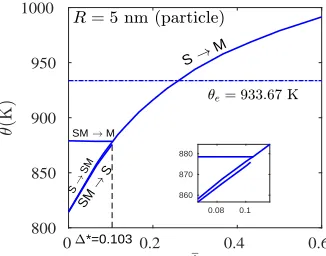
A comparative study between surface melting and
melting in a nanovoid and a nanoparticle (Fig. 2), each having a radius of 5 nm, is now presented. Although the temperature plots in Figs. 1(a) and 2 possess similar qualitative features, including that all melting tempera-tures being well below the solid to melt instability tem-perature θSM
c = 1120.4 K, there are subtle differences. The S→SM, SM→S, and S→M (for ¯∆ <0.25) temper-atures are significantly lower thanθein the particle (see also15) in contrast to the void, for which the melting tem-peratures (SM→M and S→M) are much higher than θe over the entire range of ¯∆. This is in agreement with the results obtained earlier in15,16,18,23,24,27. Notably, the critical width ratio for the particle ( ¯∆∗ = 0.103) is
smaller than that for the void ( ¯∆∗= 0.153).
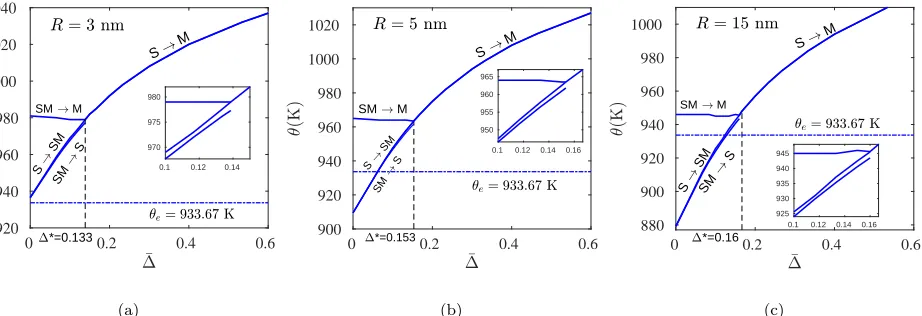
Let us discuss the effect of the void size on all the trans-formations. The melting temperatures versus ¯∆ plots for the voids with 3 nm, 5 nm, and 15 nm radius are shown in Fig. 3. Clearly, all the melting temperatures decrease towardsθeas the void size increases. The difference be-tween SM→M and S→SM transformation temperatures increases with increasingR over the entire 0≤∆¯ ≤∆¯∗ range. For instance, for 3 nm, 5 nm, and 15 nm voids the differences are 44.5 K, 55.5 K, and 63.4 K, respectively, for ¯∆ = 0. The critical thickness ratio ¯∆∗ increases in
larger voids.
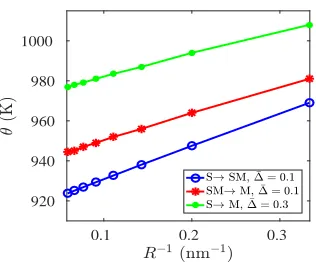
In Fig. 4 the plots are shown for S→SM and SM→M transformation temperatures for ¯∆ = 0.1 and S→M transformation temperatures for ¯∆ = 0.3 for voids with varying size. Obviously, all of the transformation tem-peratures increase with decreasing R and vary linearly with 1/R.
[image:6.612.81.542.69.227.2]5
0.1 0.2 0.3
R!1(nm!1)
920 940 960 980 1000
3
(K
)
[image:7.612.90.248.57.188.2]S!SM,"7= 0:1 SM!M,"7= 0:1 S!M,"7= 0:3
FIG. 4. Variation of S→SM and SM→M transformation tem-peratures for ¯∆ = 0.1 and S→M transformation temperatures for ¯∆ = 0.3 with 1/R. Obviously,θis linear inR−1.
of melting in a nanoparticle were reproduced. However, we are not aware of any suitable experimental/atomistic simulation data which can be directly used here for a quantitative comparison with the current results for a nanovoid. We hope that our predictions will encour-age a systematic experimental and/or atomistic study to understand the role of surface width in the solid↔melt transformations in nanovoids.
In summary, we have presented the first PF study of the barrierless transformations between solid, surface melt, and melt in the nanovoids. The key effects are caused by the ratio ¯∆ of the width of the void surface and solid-melt interface and by the void size. There are two different melting regimes. During heating for ¯∆ ≤∆¯∗, surface melt appears in a jump-like process, grows, loses its stability, and undergoes a jump-like transformation to complete melt. For ¯∆ > ∆¯∗, surface melt does not appear and the solid melts directly. The melting tem-peratures for voids are much higher thanθe, in contrast to the particles for which the melting temperatures are much smaller than θe. A jump-like process explains the hysteresis between the appearance and disappearance of the surface melt, but it is only a few degrees. For the void with a sharp surface, the jump and hysteresis are absent. With increasing ¯∆, the melting temperature slightly de-creases for ¯∆ ≤∆¯∗ and strongly increases for ¯∆ >∆¯∗. With increasing void radius, all of the melting tempera-tures decrease towardθe; the difference between SM→M and S→SM transformation temperatures and the criti-cal thickness ratio ¯∆∗ both increase. Our study demon-strates a direction to control the melting of solids by controlling the size of voids and the energy and width of the void surfaces. For example, (i) one can change the gaseous medium surrounding a particle or the gaseous medium within an open system of voids. (ii) Alloying the void surfaces by different elements would changes their widths and energy. (iii) The void surfaces can be deformed plastically by generating defects therein. The generated stresses can modify the surface width in some materials32. (iv) A surface reaction, such as oxidation, is another way to engineer the surface energy and width.
Note that the ratio of two nanoscale parame-ters strongly affects material behavior in martensitic transformations33, interaction between phase transfor-mation and dislocations34, and solid-solid phase trans-formation via intermediate melt35,36; see37for a review.
Acknowledgments. Support from ONR (N00014-16-1-2079), NSF (CMMI-1536925 and DMR-1434613), and Iowa State University (Vance Coffman Faculty Chair Professorship) is gratefully acknowledged.
1D.A. Porter, K.E. Easterling, M.Y. Sherif, Phase
Transforma-tions in Metals and Alloys. (CRC Press, Boca Raton, 2009).
2V.I. Levitas, Phil. Trans. Royal Society A 371 (2013) 20120215. 3B. F. Henson, L. Smilowitz, 14th International
Detonation Symposium, Coeur dAlene, Idaho
(https://getinfo.de/app/The-Surface-Quasiliquid-Melt-Acceleration-and-the/id/BLCP%3ACN080849513, 2010).
4V.I. Levitas, Z. Ren, Y. Zeng, Z. Zhang, G. Han, Phys. Rev. B
85 (2012) 220104.
5C.R.M. Wronski, Brit. J. Appl. Phys. 18 (1967) 1731-1737. 6C.J. Coombes, J. Phys. F: Metal Phys. 2 (1972) 441-449. 7R.P. Berman, A.E. Curzon, Canad. J. Phys. 52 (1974) 923-929. 8P.R. Couchman, W.A. Jesser, Nature 269 (1977) 481-483. 9R. Lipowsky, Phys. Rev. Lett. 323 (1982) 1575-1578. 10R.W. Cahn, Nature 323 (1986) 668-669.
11G.L. Allen, R.A. Bayles, W.W. Gile, W.A. Jesser, Thin Solid
Films 144 (1986) 297-308.
12H. L¨owen, R. Lipowsky, Phys. Rev. B 43 (1991) 3507-3513. 13F. Ercolessi, W. Andreoni, E. Tosatti, Phys. Rev. Lett. 66 (1991)
911-914.
14V.I. Levitas, K. Samani, Nat. Commun. 2, 284 (2011). 15V.I. Levitas, K. Samani, Phys. Rev. B 89 (2014) 075427. 16X.M. Bai, M. Li, Nano Lett. 6 (2006) 2284-2289.
17H.M. Lu, D.N. Ding, Z.H. Cao, S.C. Tang, X.K. Meng, J. Phys.
Chem. C 111 (2007) 12914-12917.
18R. Kofman, P. Cheyssac, A. Aouaj, Y. Lereah, G. Deutscher,
T. Ben-Davida, J.M. Penissonc, A.Bourret, Surf. Sci. 303 (1994) 231-246.
19Z.H. Liu, H. Li, L.S. Yang, Physica B 405 (2010) 4863-4865. 20H. Li, Z. Wen, Q. Jiang, Solid State Comm. 147 (2008) 250-253. 21S. Xiong, W. Qi, Y. Cheng, B. Huang, M. Wang, Y. Li, Phys.
Chem. Chem. Phys. 13 (2011) 10648-10651.
22G. Ouyang, X.L. Li, G.W. Yang, Appl. Phys. Lett. 92 (2008)
051902.
23G. Ouyang, C.X. Wang, G.W. Yang, Chem. Rev. 109 (2009)
4221-4247.
24H. Li, X.H. Liang, M. Li Mater. Chem. Phys. 144 (2014) 390-395. 25S. Li, W. Qi, J. Phys. Chem. C 119 (2015) 6843-6851.
26He, A. M., Duan, S., Shao, J. L. J. Appl. Phys. 112 (2012) 074116. 27P.M. Agrawal, B.M. Rice, D.L. Thompson, J. Chem. Phys. 118
(2003) 9680-9688.
28A. Basak, A. Gupta, Model. Simul. Mater. Sci. Eng. 22 (2014)
055022.
29A.V. Idesman, V.I. Levitas, D.L. Preston, J.Y. Cho, J. Mech.
Phys. Solids 53 (2005) 495-523.
30O.C. Zienkiewicz, R.L. Taylor, The Finite Element Method:
Vol-ume 1- The Basis, (Butterworth-Heinemann, Woburn, 2000).
31W. Bangerth, D. Davydov, T. Heister, L. Heltai, G. Kanschat, M.
Kronbichler, M. Maier, B. Turcksin, D. Wells, J. Numer. Math. 24 (2016).
32V.I. Levitas, H. Chen, L. Xiong, Phys. Rev. Lett. 118 (2017)
025701.
33V.I. Levitas, M. Javanbakht, Phys. Rev. Lett. 107 (2011) 175701. 34V.I. Levitas, M. Javanbakht, Appl. Phys. Lett. 102 (2013)
251904.
35V.I. Levitas, K. Momeni, Acta Mater. 65 (2014) 125-132. 36V.I. Levitas, A.M. Roy, Acta Mater. 105 (2016) 244-257. 37V.I. Levitas, Scripta Mater. 149C (2018) 155-162.