Feature Derivation for Exploitation of Distant Annotation via Pattern
Induction against Dependency Parses
Dayne Freitag and John Niekrasz
SRI International 9988 Hibert Street, Suite 203
San Diego, CA 92130
{freitag,niekrasz}@ai.sri.com
Abstract
We consider the use of distant supervi-sion for biological information extraction, and introduce two understudied corpora of this form, the Biological Expression Lan-guage (BEL) Large Corpus and the Path-way Logic (PL) Datum Corpus. Each resource eschews annotation at the sen-tence constituent level, and the PL corpus requires synthesis of information across multiple sentences to construct compos-ite knowledge frames. Decomposing this problem into feature induction for slot-level attributes, followed by event assem-bly over this space of features, we intro-duce a novel, general-purpose pattern in-duction procedure, evaluating it against these two corpora, demonstrating its abil-ity to induce effective detection against de-pendency parses.
1 Introduction
Biological event and relation extraction have been the focus of considerable study in recent years, resulting in the availability of annotated cor-pora (Kim et al., 2003; Pyysalo et al., 2007; Kim et al., 2008; Thompson et al., 2009). In the interest of replicability and progress on critical challenges, such resources typically decompose the hard prob-lem of factual understanding into several simpler problems, such as entity recognition, binary rela-tion detecrela-tion, and co-reference resolurela-tion.
This methodology is subject to several criti-cisms. The reliance on thorough annotation im-poses overheads that prevent rapid progress. The targeting of a fixed set of simplified, typically bi-nary relations does justice neither to the complex-ity of information expressed in a typical sentence, nor to the biological processes under discussion.
And the methodology places a emphasis on pieces of information amenable to expression in individ-ual sentences, leaving untouched information that can be assembled only through traversal of para-graphs or complete documents.
Some of these limitations can be mitigated throughdistant supervision, a technique deriving noisy annotation through the heuristic alignment of structured knowledge resources to texts (Craven et al., 1999). The biological domain affords a number of high-quality knowledge resources with good coverage, making possible strongly compet-itive distantly supervised solutions (Poon et al., 2015). However, the distance between resource and text is often not great in such work, which fo-cuses on relations for which entity co-occurrence in a sentence is strong evidence that the sentence expresses the target relation.
In this paper we attempt to exploit two knowl-edge resources, neither of which has received much attention from the BioNLP community, that increase this distance in interesting and dis-tinct ways. The Biological Expression Language (BEL) is a knowledge interchange format intended to encode qualitative causal and correlative rela-tions that supports nested knowledge frames. One product of the OpenBEL initiative1 is the “Large
BEL Corpus,” which explicitly pairs a large num-ber of literature excerpts with the BEL assertions that each supports. The relation between sentence and BEL statement is many-to-many, with no pro-visions for aligning specific statement components with specific sentence constituents.
The Pathway Logic (PL) project pursues high-fidelity signaling pathway models centering on Ras (Eker et al., 2004). Part of the effort involves a manual curation of experimental results, which has resulted in approximately 40K records, each
1http://www.openbel.org/
containing a detailed formal representation of an experiment and its outcomes. Such records, called
datums, retain pointers to the papers and figures from which they were derived. In general, assem-bling the rich information contained in a datum re-quires traversing multiple sentences, both in figure captions and paper bodies.
We view the problem of extracting composite knowledge frames based on these attenuated su-pervisory signals as having two parts. First, we seek to generate a set of features highly indicative of various aspects of the target frame (its type, var-ious attributes, etc.). Second, we view the prob-lem of assembling frames from the resulting en-riched feature space as one of structured classi-fication. Recent work on structured classifica-tion lends confidence that such empirical assem-bly models are possible in principle (Daum III et al., 2009) and applicable to discourse-level event extraction (Reschke et al., 2014).
In this paper we address the first problem, the derivation of features for downstream extraction. We treat this problem as one of sentence classi-fication via pattern (or rule) set induction against dependency parses. Compared with related work involving rules in the BioNLP literature (Bunescu et al., 2005; Bui et al., 2013; Huang et al., 2004; Liu et al., 2011; Hunter et al., 2008; Valenzuela-Escarcega et al., 2015; Peng et al., 2014), our ap-proach exhibits some interesting features, partic-ularly the eschewal of domain heuristics and the nonreliance on constituent-level annotations. Our work can be viewed as complementary to man-ual rule writing, and we present evidence that our learned patterns outperform rules written by hand.
Our contributions in this paper are twofold:
• We present and evaluate a novel, general-purpose approach to the induction of classi-fication and extraction patterns from depen-dency parses.
• We evaluate this approach against two BioNLP corpora that have received little at-tention in the literature. Each corpus presents an extraction problem of greater complexity than can be addressed by current methods, providing avenues toward models of greater scope and biological fidelity.
The remainder of the paper is organized as fol-lows. In the next section, we describe these two
data sources and the problems they pose. In Sec-tion 3 we present our approach to pattern induc-tion. Then, we describe and discuss our experi-ments in Section 4. Finally, we compare our ap-proach in Section 5 to related work.
2 Data
In this section we describe the BEL Large Corpus and the PL Datum Corpus, against which we eval-uate our approach.
2.1 OpenBEL
The Biological Expression Language (BEL) is designed to capture rich qual-itative biological relationships in con-text. For example, the BEL statement
[p(HGNC:CCND1) =⇒kin(p(HGNC:CDK4))]
expresses that “increased abundance of the protein HGNC:CCND1 directly increases the kinase activity of the abundance of the protein HGNC:CDK4.” Here, the =⇒ symbol expresses a causal directly increases relationship between two BEL functions. Relationship types include causal (e.g., increases) and correlative (e.g., asso-ciation) relationships. BEL functions are defined for abundances (e.g., protein or rna abundances), modifications (e.g., phosphorylation), activities (e.g., kinase or catalytic activity), processes (e.g., angiogenesis), and transformations (e.g., translocation and cell secretion). Depending on their definition, functions can be nested, accepting entity or other functions as arguments.
The OpenBEL initiative distributes the ‘large corpus.”2, a collection of ∼80k statements,∼74k
of which are associated with natural language ev-idence passages and a PubMed article ID. The re-lationship between BEL statements and support-ing sentences is many-to-many — some sentences are used to support multiple BEL statements, and whole paragraphs can be mustered in support of a given statement. After sentence segmentation and minor cleanup (e.g., removing inline comments from curators), we obtained a total of∼40k unique supporting evidence sentences. In terms of biolog-ical content, the corpus contains independent ob-servations (in human, mouse, and rat) not selected to represent any specific biological process. Given its size, this implies a lack of comprehensive cov-erage for any specific biological domain.
2https://github.com/OpenBEL/
Figure 1: An example of a Pathway Logic datum.
2.2 Pathway Logic
Pathway Logic (PL) is an approach to model-ing biological entities and processes based on rewriting logic.3 PL models can include
spe-cific facts and general principles relating entities and processes. PL is currently being used for the analysis of signal transduction and metabolic networks, including the STM model, a network of protein interactions and modifications used by the cell to transmit signals from its environment to the nucleus. Using STM, PL is able to pre-dict and explain the effect of interventions (re-moval/inhibition/mutation of proteins) on down-stream events.
In PL, reactions are curated by expert biolo-gists from published experimental evidence (nor-mally a Pubmed article). This experimental evi-dence is captured in formal expressions called “da-tums,” encoded in a structured syntax over a con-trolled vocabulary, each representing one assay. An example datum is shown in Figure 1. Each datum captures, among other things, the protein(s) that are observed (Subject), the assay (Assay), the stimulus (Treatment), a result (Change), and the cells and culture conditions that were used in the assay (Environment).
Importantly, each datum also includes a refer-ence to the figure in its source article containing the experimental result. These references allow us to link each datum to a small set of natural lan-guage sentences, namely those in the caption of the referenced figure or citing it in the paper body. This alignment, along with any mentions of en-tities listed in key datum roles, provides our su-pervisory signal. Note that the datum corpus con-sists primarily of PDF documents, necessitating a somewhat noisy conversion and alignment. We use a version of the PL knowledge base that con-tains∼39k unique datums sourced from figures in
∼2,000 Pubmed articles.
In Section 4 we benchmark our pattern induc-3http://pl.csl.sri.com/
tion procedure against rule sets written by hand us-ing the ODIN framework (Valenzuela-Escarcega et al., 2015). We created these rules over a pe-riod of several weeks while implementing a datum extraction system evaluated under DARPA Big Mechanism. This activity took place before the work described here had begun. Rule authors had full access to the datum corpus and possessed tools that exploited the same sentence-to-datum align-ment heuristics used in this paper’s experialign-ments. Thus, although we cannot claim to have produced optimal manual rule sets, these sets can be viewed as characteristic of what can be achieved with rea-sonable effort. Of course, the two rule sources are not mutually exclusive. We are currently extend-ing the datum extraction system to useboth man-ual and automatically induced rules, and expect to see improvements in both precision and recall.
3 Approach
3.1 The Setting
We frame our approach as a problem of Boolean classification over dependency parses (more gen-erally, graphs with multiply labeled nodes and edges), where the positive class typically reflects that a sentence communicates some information we seek to detect. For conciseness, in the remain-der of the paper we will refer simply to “parses”, leaving the “dependency” modifier implied.
Formally, we are given dataas a set of exam-ples from(X, Y), withY ={0,1}reflecting class membership. Each member ofXis a parse taking the form(Vd, Ed), withVda set of vertices andEd a set of directed edges(vi, vj). In addition, we are given two feature spaces,FV : Vd 7→ {0,1} and
FE : Ed 7→ {0,1}, that range over vertices and edges, respectively, which represent things such as a vertex word or the dependency label of an edge. We seek to classify such parses using patterns, which take the form(r, Vp, Ep, TV, TE, DE). As with parses, the components Vp andEp define a tree, which in this case is rooted in the distin-guished vertexr. DE denotes thedirectionof an edge, taking the formDE :Ep 7→ {↑,↓}. As this implies, we allow pattern edges to traverse up or down a parse.
TV and TE represent thetypesof vertices and edges, respectively. The vertex type,TV : Vp 7→
(call itCV) with parse vertices:
CV(vd, vp, TV) =
1 : TV(vp) =λ∨
(TV(vp))(vd) = 1
0 : otherwise
In other words, a null pattern vertex is compati-ble with any parse vertex, while afeaturepattern vertex is compatible only with parse vertices for which the feature tests true, i.e., thathavethat fea-ture. Thus, a feature pattern vertex with typefthe will match only parse vertices that correspond to the word “the”,fNN only to nouns, etc.
Edge types, TE : Ep 7→ {λ,∗} ∪ FE, are analogous to vertex types. A pattern edge with typefamodwill match only parse edges having the “amod” dependency label. Edges with type “*”, which we callKleene edges, are explained in the next section.
3.2 Matching
We say that a pattern matches a parse if we can find a one-to-one alignment between pattern ver-tices and a subset of parse verver-tices proceeding re-cursively from the root node. This matching pro-cedure is most easily described by means of a hy-pothetical Boolean function MATCH that returns true if a specified pattern vertex matches a speci-fied parse vertex.
Algorithm 1 Procedure for matching patterns to parses.
1: functionMATCH(X, vd, P, vp) 2: (Vd, Ed)←X
3: (r, Vp, Ep, TV, TE, DE)←P
4: ifnotCV(vd, vp, TV)then returnfalse 5: forepinEps.t.ep= (vp, vp0)do 6: Found = false
7: fored, vd0 in CandEdges(ep, Ed, vd)do 8: ifTE(ep) =∗then
9: ifKleeneMatch(X, ed, v0d, P, vp0)then
10: Found = true
11: else ifTE(ep) =λ∨TE(ep)(ed) = 1then 12: ifMatch(X, v0
d, P, vp0)then
13: Found = true
14: ifnot Foundthen returnfalse 15: returntrue
MATCH, shown in Algorithm 1, can be broken into three parts: a check for vertex compatibility (Line 4); a check for edge (or edge-to-path) com-patibility (Line 5–13); and a recursive call to align unmatched pattern vertices (Lines 9 and 12). For brevity, we assume the existence of two helper functions. CANDEDGES (Line 7) merely selects
and returns all edges (with destination vertex) at-tached to vd that are compatible with the direc-tional restriction ofep. KLEENEMATCH(Line 9) enumerates all nodes on any path in the direction selected byep, internally calling MATCHon each until a match is found.
3.3 Induction
Linguistic variation usually ensures that no sin-gle pattern can adequately account for the ways in which target information is expressed. Therefore, our objective is to learn a set of patterns covering the forms observed in the training data. In pursuit of this objective we follow a top-down set covering procedure. At each step in this procedure, a single pattern is learned from the training data, all posi-tive parses matching the new pattern are removed from the training set, and the process repeats. If no positive parses remain, or if the algorithm fails to induce a pattern, the process terminates.
Algorithm 2Pattern induction procedure. 1: functionINDUCE(T, V, α)
2: P← {} 3: p←null vertex
4: whilep0←Specialize(T, p, α)do
5: p←p0
6: s←Score(p, V) 7: P ←P∪ {(p, s)}
8: T ←T− {(x, y)|y= 1∧Match(p, x)} 9: return(p, s)∈Pwith maxs
10:
11: functionSPECIALIZE(T, p, α) 12: E← {}
13: for(x, y)∈Ts.t.y= 1do
14: M ←Matches(p, x)
15: foro1· · ·ok∈Extensions(M, x, α)do 16: E←E∪ {o1· · ·ok7→(0,0)} 17: for(x, y)∈Tdo
18: M ←Matches(p, x)
19: foro1· · ·ok∈Extensions(M, x, α)do 20: ifo1· · ·ok∈Ethen
21: E[o1· · ·ok][y]+=1 22: o1· · ·ok←BestExtention(E) 23: ifno best extension foundthen
24: returnfalse
25: returnpextended witho1
of matching positive parses,nthe number of neg-ative, andm >0a smoothing parameter.
SPECIALIZE (Line 11) takes the training set T, the pattern p in its current form, and an integer “look-ahead” parameter α. The proce-dure involves two passes over the training data, one collecting a set of candidate extensions to p
(Lines 13–16), the other accumulating statistics for those extensions (Lines 17–21), which, as im-plied by Lines 16 and 21, are simple counts of the number of positive and negative parses matching each extension. These two steps assume the exis-tence of two procedures: MATCHES(a straightfor-ward variant of MATCH, Lines 14 and 18) returns all alignments betweenpandx; and EXTENSIONS (Lines 15 and 19), the behavior of which will be described in the next section.
Extensions are sequences of specialization op-erations o1· · ·ok, 1 ≤ k ≤ α. Once statistics have been collected, the extension that best favors positive examples at the expense of negative ones is selected (Line 22). We use the “FOIL gain” in making this determination (Quinlan, 1990):
y0·(log(y0y+0n0)−log(y+y n)) (1)
where y and n (respectively, y0 and n0) are the
number of positive and negative parses matched by p(respectively, p0 formed by extendingp). 4.
Importantly, once the best extension is identified, only the first specialization operation in the se-quence is applied (Line 25) In this way, some of the greediness of the extension search is mitigated.
3.4 Specialization Operations
When considering specializations of a pattern, we have as reference its alignment to some parse, each vertex to some parse vertex, and each non-Kleene edge to some parse edge. We generate extensions by iterating over this alignment and collecting all possible specialization operations supported by it. Let us usevp (pattern) andvd (data) to represent two vertices in an alignment (similarly ep anded for edges). We consider the following specializa-tion operaspecializa-tions (theoiin Algorithm 2):
• Specialize a null vertex. Ifvpis null, change it to require a feature of vd. Because parse 4We experimented with several comparable objective functions, including mutual information and kappa, and found results to be largely insensitive to this choice
nodes may have multiple features, this opera-tion in general generates multiple specializa-tions.
• Specialize a null edge. Analogous to the pre-vious item, but defined on edges. We cur-rently only consider features based on depen-dency labels, but others are possible in prin-ciple.
• Add a null edge. Ifvdhas edges to unaligned parse vertices, add a null edge in the appro-priate direction fromvpto a new null vertex.
• Add a Kleene edge. Except for the type, the conditions and effects of this operation are identical to the previous item.
Because these operations are typically considered in the context of a multi-step extension search, we can align any newly introduced vertices and edges to the parse, and consider further specializations either to the current element or to any newly in-troduced elements, up to the limit specified byα. Being a hyperparameter that inversely affects ac-curacy and running time, we set α manually to maximize accuracy given practical constraints on compute resources (α = 3for experiments in this paper).
Feature Description
Word Word associated with a vertex POS Part-of-speech tag
NER The named entity type, if any Cluster Cluster of a word derived
[image:5.595.314.519.440.528.2]through distributional clustering
Table 1: Vertex feature types.
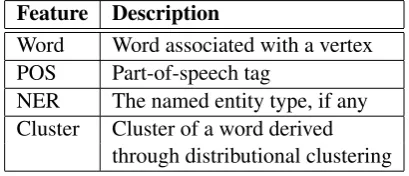
The specialization operations are defined in part by the feature spaces available, particularly by the vertex (word) feature space FV. Conceptually, these features belong to an extensible set of types at the lexical level. The types used in our experi-ments are presented in Table 1.
Figure 2: An example of an automatically induced pattern matching a sentence.
IL-2 IL-7 and IL-15 induced phosphorylation of Stat5
PRO PRO PRO PRO
NNP NNP CC NNP VBD NN IN NNP
λ PRO VBD phosphorylation PRO
ROOT
dobj nmod case cc
conj conjnsubj
* *
*
λ
another matching POS=VBD, and another match-ing any word.
3.5 Pattern Application
The output of the induction process is a set of pat-terns scored for precision against hold-out data. Our primary interest in these patterns is as feature detectors used by some downstream process that assembles composite events, but the set of patterns can be used and evaluated as a stand-alone classi-fication model. In this mode, the scores attached to the rules enable us to estimate the precision of matches against novel parses, and therefore to con-trol precision and recall.
Multiple patterns may and often do match an individual parse. In such cases we estimate the precision of the ensemble matchM as:
1− Y
p∈M
(1−sp) (2)
wherepis a pattern andsp is its estimated preci-sion. This estimate essentially treats the individual estimates as mutually independent.
4 Experiments
We evaluated our pattern induction procedure on the BEL and PL corpora for its effectiveness in de-tecting sentences expressing information needed for composite knowledge frames.
4.1 BEL evaluation
We converted BEL statements into a set of overlapping binary distinctions, calledfragments, each a possible abstraction of the statement. Our objective is to convert each BEL extraction into a large set of redundant simpler problems, from which the original statement might be reconstituted. For example, the BEL statement
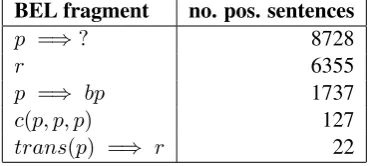
[image:6.595.324.509.334.417.2]“p(HGNC:CCND1) =⇒kin(p(HGNC:CDK4))” yields (among other fragments) “kin” (describes kinase activity), “kin(p)” (kinase activity of a protein), and “=⇒kin(p)” (kinase activity of a protein resulting from unspecified cause). Generating BEL fragments from fully specified BEL statements proceeds by first abstracting away any entity or numeric function arguments. Then, fragments are generated for every subtree in the abstract syntax tree of the statement. (We distinguish between functions occurring in the statement’s subject and object position, in other words treating “subject” and “object” as a named element of the syntax tree.) Additionally, a fragment is generated for the relationship type and all functions occurring anywhere in the statement. Table 2 lists examples of BEL fragments with the number of positive training set sentences associated with each of them in the corpus.
BEL fragment no. pos. sentences
p =⇒? 8728
r 6355
p =⇒ bp 1737
c(p, p, p) 127
trans(p) =⇒ r 22
Table 2: Example BEL statement fragments (p = proteinAbundance;r = rnaAbundance;bp = biologicalP rocess;trans=translocation;c= complexAbundance).
From the ∼74,000 BEL statements associated with validated evidence, this process generates
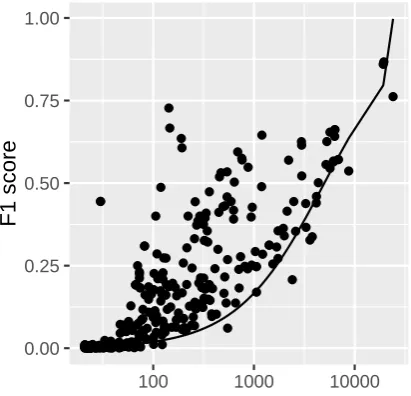
Figure 3: Scatterplot showing results of the∼400 sentence classification experiments run on the BEL corpus. ● ● ● ● ●●● ●●●●● ● ● ● ● ● ● ● ● ● ● ● ● ● ● ● ● ● ● ● ● ● ● ● ● ● ●● ● ● ● ● ● ● ● ● ● ● ● ● ● ● ● ● ● ● ● ● ● ● ● ● ● ● ● ● ● ● ● ● ● ● ● ● ● ● ● ● ● ● ● ● ● ● ● ● ● ● ● ● ● ● ● ● ● ● ● ● ● ● ● ● ● ●●● ● ● ● ● ● ● ● ● ● ● ● ● ●● ● ● ● ● ● ● ● ● ●● ● ● ● ● ● ● ● ● ● ● ● ● ● ● ● ● ● ● ● ● ● ● ● ● ● ● ● ● ● ● ● ● ● ● ● ● ● ● ● ● ● ● ● ● ● ●●●● ● ● ● ● ● ● ● ● ● ● ● ●●● ● ● ● ● ● ● ● ● ● ● ● ● ● ● ● ● ● ● ● ● ● ● ● ● ● ● ● ● ● ● ● ● ● ● ● ● ● ● ● ● ● ● ● ● ● ● ● ● ● ● ● ● ● ● ● ● ● ● ● ● ● ● ● ● ● ● ● ● ● ● ● ● ● ● ● ● ● ● ● ● ● ● ● ● ● ●● ● ● ● ● ● ● ●● ● ● ● ● ● ● ● ● ● ● ● ● ● ● ● ● ● ● ● ● ● ● ● ● ● ● ● ● ● ● ● ● ● ● ● ● ● ● ● ● ● 0.00 0.25 0.50 0.75 1.00
100 1000 10000
no. positive training examples
F1 score
We evaluate the induced rule ensembles by calculating an idealized F1 score, identifying a threshold for classification based upon the vali-dation estimated precision of the ensemble match (Eq. 2) that maximizes F1 on the test set. We acknowledge that finding this threshold using test data produces an overly-optimistic result, but do-ing so provides us with an informative upper bound. In practice, the threshld would be tuned using an alternative validation set to prevent over-fitting. The mean cardinality of the induced rule ensembles was 7, with a total of 2991 rules (2402
unique) induced across the∼400 fragments. Results are plotted in Figure 3, with one dot per classification experiment, each being an applica-tion of the rule inducapplica-tion approach against a single unique BEL statement fragment. For each experi-ment, the F1 classification result is plotted against the size of the positive training set. The plot also contains a line showing the F1 results of a random chance baseline. To calculate the baseline, we as-sume a classifier that randomly labels sentences as positive or negative with the same marginal prob-abilities as observed in the training set.
4.2 Pathway Logic evaluation
We next conducted a set of experiments target-ing classification of sentences associated with var-ious PL datum fragments. In this case, we em-ployed named entity resolution for proteins,
label-PL datum fragment Learned Written
phos & subject 0.54 0.37 ubiq & subject 0.53 0.41 GTP-assoc & subject 0.60 0.20 phos & treatment 0.48 0.35 ubiq & treatment 0.29 0.17 GTP-assoc & treatment 0.32 0.05
Table 3: F1 performance in the extraction of da-tum fields by learned and hand-written rules.
ing parse nodes as to whether they refer to the value of associated Subject or Treatment fields, and restricting rules to necessarily include nodes that match the protein mention. Results are shown in Table 3. These experiments targeted the two da-tum fields (subjectandtreatment) that correspond to extractible entities, and focus on the three im-portant assay types (phos, ubiq, and GTP-assoc) for which we had written ODIN rules while im-plementing our heuristic datum extractor.
4.3 Discussion
The results presented in Figure 3 clearly estab-lish the effectiveness of the induced rule ensem-bles at detecting the information conveyed in the BEL statements. Not surprisingly, this effective-ness increases with increased training data, though there is considerable variation. We attribute this variation to the indiscriminate way in which frag-ments were generated. Presumably, some kinds of information correspond more strongly to de-tectible linguistic regularities than others. A brief investigation informally confirmed our intuitions. For example, a common but difficult fragment is “complex(p, p) =⇒ ?” (about 0.17 F1), or, roughly, “a complex between two proteins in-creases some effect.” A key insight is that “ =⇒
?” corresponds to a large range of effects, and these effects govern the form a sentence takes. In contrast, the fact that a complex is the agent is often expressed subtly, often requiring infer-ence over multiple sentinfer-ences. Note that the set of classes we target deliberatelyoverdeterminethe typical BEL statement, making it possible in prin-ciple to reassemble many statements.
[image:7.595.80.286.115.313.2]to show in an official evaluation that the extrac-tions could be used to corroborate mechanistic assertions extracted by other systems, increasing baseline precisions of 50% to 80% at the strictest corroboration levels. Based on these results, we intend to supplement or replace the hand-written rules with learned ones.
In the slightly longer term, it remains to vali-date the second part of our hypothesis: that as-sembly of information captured by these induced patterns into composite frames (BEL statements or PL datums) similarly can be realized. To this end, we plan to explore the selection and use of learned patterns as features, as well as alter-native approaches to induction, such as boost-ing. Experience has shown that contextualiz-ing symbolic learncontextualiz-ing methods in this way yields performance as strong as other leading learning paradigm (Caruana and Niculescu-Mizil, 2006).
5 Related Work
Progress in biological information extraction (BioIE) is measured against shared annotated cor-pora that decompose the problem into entity ex-traction and sentence-level relation detection (Kim et al., 2003; Pyysalo et al., 2007; Kim et al., 2008; Thompson et al., 2009). The BEL corpus has re-cently joined the ranks of these shared corpora as part of BioCreative, where early F1 scores on the task of assembling complete BEL statements average about 0.2, reflecting the difficulty of the task (Fluck et al., 2015).
Corpora annotated for entities and pairwise re-lations enable the application of machine learn-ing, which has been shown to be as effective for such problems (Bunescu et al., 2005). Perhaps because of a relative wealth of structured knowl-edge resources, there are several competitive rule-based approaches to BioIE, involving both hand-written rules (Hunter et al., 2008; Valenzuela-Escarcega et al., 2015; Peng et al., 2014) and rules induced or tuned from data. For the most part, these rule learning approaches introduce domain-specific heuristics that limit their generality. Bui et al (2013) begin with a pre-specified library of syntactic patterns, which are instantiated from training data through a domain-specific procedure. Huang et al (2004) heuristically simplify training sentences, align them in pairs using a specialized edit distance, derive a pattern from the alignment, applying a series of heuristic checks to discard
problematic patterns. Liu et al (2011) presents what is in some ways a generalization of this pro-cedure, deriving a graph structure that is the union of individual simplified parses. It is unclear how the resulting extractor controls for overgeneration. In contrast to these rather specific solutions, Bunescu et al (2005) evaluate a number of ma-chine learning approaches to BioIE problems, finding them generally viable and noting that the rule-based learners yield high precision. These rule learners, which were drawn from a tradition of general-purpose rule induction for IE (Ciravegna and others, 2001; Soderland, 1997; Califf and Mooney, 1999; Freitag, 2000; Freitag and Kush-merick, 2000), notably make no or relatively mod-est assumptions about syntax. We are aware of no prior work applying such techniques to full depen-dency or constituent parses.
The relaxations of the annotation requirement that we explore in this paper (absence of phrase-level annotations, distant supervision) have been thoroughly studied in other contexts. An early instance of the IE-as-classification idea was the AutoSlog system (Riloff, 1996), which gave birth to bootstrapping techniques commonly used for many NLP problems (Riloff et al., 1999). Sim-ilarly, distant supervision, pioneered in the bio-logical domain (Craven et al., 1999), has matured toward yielding performance comparable to com-plete supervision on certain problems (Poon et al., 2015). In contrast with such work, which focuses on sentence-local targets, relatively little work has been done ondiscourse-leveldistant supervision. A counter-example is Reschke et al (2014), which addresses event extraction at the document level, showing promising results but leaving many unan-swered questions.
6 Conclusion
References
Quoc-Chinh Bui, David Campos, Erik van Mulligen, and Jan Kors. 2013. A fast rule-based approach for biomedical event extraction. InProceedings of the BioNLP Shared Task 2013 Workshop, pages 104– 108. Association for Computational Linguistics.
Razvan Bunescu, Ruifang Ge, Rohit J. Kate, Ed-ward M. Marcotte, Raymond J. Mooney, Arun K. Ramani, and Yuk Wah Wong. 2005. Compara-tive Experiments on Learning Information Extrac-tors for Proteins and their Interactions. Artificial In-telligence in Medicine: Special Issue on Summariza-tion and InformaSummariza-tion ExtracSummariza-tion from Medical Doc-uments.
M.E. Califf and R.J. Mooney. 1999. Relational learn-ing of pattern-match rules for information extrac-tion. InProceedings of the Sixteenth National Con-ference on Artificial Intelligence, volume 334.
Rich Caruana and Alexandru Niculescu-Mizil. 2006. An empirical comparison of supervised learning al-gorithms. InProceedings of the 23rd international conference on Machine learning, pages 161–168. ACM.
Fabio Ciravegna and others. 2001. Adaptive infor-mation extraction from text by rule induction and generalisation. InInternational joint conference on artificial intelligence, volume 17, pages 1251–1256. LAWRENCE ERLBAUM ASSOCIATES LTD.
Mark Craven, Johan Kumlien, and others. 1999. Con-structing biological knowledge bases by extracting information from text sources. In ISMB, volume 1999, pages 77–86.
Hal Daum III, John Langford, and Daniel Marcu. 2009. Search-based structured prediction. Machine learning, 75(3):297–325.
Steven Eker, Merrill Knapp, Keith Laderoute, Patrick Lincoln, and Carolyn Talcott. 2004. Pathway logic: Executable models of biological networks. Electronic Notes in Theoretical Computer Science, 71:144–161.
Juliane Fluck, Sumit Madan, Tilia Renate Ellendorff, Theo Mevissen, Simon Clematide, Adrian van der Lek, and Fabio Rinaldi. 2015. Track 4 Overview: Extraction of causal network information in biolog-ical expression language (bel). InFifth BioCreative Challenge Evaluation Workshop, pages 333–346.
Dayne Freitag and Nicholas Kushmerick. 2000. Boosted wrapper induction. In AAAI/IAAI, pages 577–583.
Dayne Freitag. 2000. Machine learning for informa-tion extracinforma-tion in informal domains.Machine learn-ing, 39(2-3):169–202.
Minlie Huang, Xiaoyan Zhu, Yu Hao, Donald G. Payan, Kunbin Qu, and Ming Li. 2004. Discov-ering patterns to extract proteinprotein interactions from full texts. Bioinformatics, 20(18):3604–3612. Lawrence Hunter, Zhiyong Lu, James Firby,
William A. Baumgartner, Helen L. Johnson, Philip V. Ogren, and K. Bretonnel Cohen. 2008. OpenDMAP: an open source, ontology-driven con-cept analysis engine, with applications to capturing knowledge regarding protein transport, protein interactions and cell-type-specific gene expression. BMC bioinformatics, 9(1):78.
J.-D. Kim, Tomoko Ohta, Yuka Tateisi, and Junichi Tsujii. 2003. GENIA corpusa semantically an-notated corpus for bio-textmining. Bioinformatics, 19(suppl 1):i180–i182.
Jin-Dong Kim, Tomoko Ohta, and Jun’ichi Tsujii. 2008. Corpus annotation for mining biomedical events from literature.BMC bioinformatics, 9(1):1. Haibin Liu, Ravikumar Komandur, and Karin
Ver-spoor. 2011. From graphs to events: A subgraph matching approach for information extraction from biomedical text. In Proceedings of the BioNLP Shared Task 2011 Workshop, pages 164–172. Asso-ciation for Computational Linguistics.
Yifan Peng, Manabu Torii, Cathy H. Wu, and K. Vijay-Shanker. 2014. A generalizable NLP framework for fast development of pattern-based biomedical relation extraction systems. BMC bioinformatics, 15(1):1.
Hoifung Poon, Kristina Toutanova, and Chris Quirk. 2015. Distant supervision for cancer pathway ex-traction from text. InPac. Symp. Biocomput., pages 120–131.
Sampo Pyysalo, Filip Ginter, Juho Heimonen, Jari Bjrne, Jorma Boberg, Jouni Jrvinen, and Tapio Salakoski. 2007. BioInfer: a corpus for information extraction in the biomedical domain. BMC bioinfor-matics, 8(1):50.
J. Ross Quinlan. 1990. Learning logical definitions from relations. Machine learning, 5(3):239–266. Kevin Reschke, Martin Jankowiak, Mihai Surdeanu,
Christopher D. Manning, and Daniel Jurafsky. 2014. Event Extraction Using Distant Supervision. In LREC, pages 4527–4531.
Ellen Riloff, Rosie Jones, and others. 1999. Learn-ing dictionaries for information extraction by multi-level bootstrapping. InAAAI/IAAI, pages 474–479. Ellen Riloff. 1996. Automatically generating
extrac-tion patterns from untagged text. In Proceedings of the national conference on artificial intelligence, pages 1044–1049.
Paul Thompson, Syed A. Iqbal, John McNaught, and Sophia Ananiadou. 2009. Construction of an anno-tated corpus to support biomedical information ex-traction. BMC bioinformatics, 10(1):1.