Towards a semantics for distributional representations
Katrin Erk
University of Texas at Austin
Abstract
Distributional representations have recently been proposed as a general-purpose representation of natural language meaning, to replace logical form. There is, however, one important difference between logical and distributional representations: Logical languages have a clear semantics, while distributional representations do not. In this paper, we propose a semantics for distributional repre-sentations that links points in vector space to mental concepts. We extend this framework to a joint semantics of logic and distributions by linking intensions of logical expressions to mental concepts.
1
Introduction
Distributional similarity can model a surprising range of phenomena (e.g., Lund et al. (1995); Landauer and Dumais (1997)) and is useful in many NLP tasks (Turney and Pantel, 2010). Recently, it has been suggested that a general-purpose framework for representing natural language semantics should be dis-tributional, such that it could represent word similarity and phrase similarity (Coecke et al., 2010; Baroni and Zamparelli, 2010; Grefenstette and Sadrzadeh, 2011; Clarke, 2012). Another suggestion has been to combine distributional representations and logical form, with the argument that the strengths of the two frameworks are in complementary areas (Garrette et al., 2011).
One important difference between logic and distributional representations is that logics have a seman-tics. For example, a model1in model-theoretic semantics provides a truth assignment to each sentence of a logical language. More generally, it associates expressions of a logic with set-theoretic structures, for example the constantcat0could be interpreted as the set of all cats in a given world. But what is the interpretation of a distributional representation? What does a point in vector space, where the dimensions are typically uninterpretable symbols, stand for? 2 In this paper, we propose a semantics in which dis-tributional representations stand for mental concepts, and are linked to intensions of logical expressions. This gives us a joint semantics for distributional and logical representations.
Distributional representations stand for mental concepts.One central function of models is that they evaluate sentences of a logic as being either true or false. Distributional representations have been eval-uated on a variety of phenomena connected to human concept representation (e.g., Lund et al. (1995); Landauer and Dumais (1997); Burgess and Lund (1997)). Here, evaluation means that predictions based on distributional similarity are compared to experimental results from human subjects. So we will inter-pret distributional representations over a conceptual structure.
Distributional representations stand for intensions. G¨ardenfors (2004) suggests that the intensions of logical expressions should be mental concepts. By adopting this view, we can link distributional representations and logic through a common semantics: Both the intensions of logical expressions and the interpretations of distributional representations are mental concepts. However, there is a technical
1
In the context of logical languages, “models” are structures that provide interpretations. In the context of distributional approaches, “distributional models” are particular choices of parameters. To avoid confusion, this paper will reserve the term “model” for the model-of-a-logic sense.
2
∃x woodchuck(x)∧see(John, x) sim(woodchuck, groundhog)> θ
∃x groundhog(x)∧see(John, x)
Figure 1: Sketch of an example interaction of distributional and logical representations
problem: If intensions are mental concepts, they cannot be mappings from possible worlds to extensions, which is the prevalent way of defining intensions. We address this problem throughhyper-intensional semantics. Hyper-intensional approaches in formal semantics (Fox and Lappin, 2001, 2005; Muskens, 2007) were originally introduced to address problems in the granularity of intensions. Crucially, some hyper-intensional approaches have intensions that are abstract objects, with minimal requirements on the nature of these objects. So we can build on them to link some intensions to conceptual structure.
Why design a semantics for distributional representations? Our aim is not to explicitly construct conceptual models; that would be at least as hard as constructing an ontology. Rather, our aim is to support inferences. Distributional representations induce synonyms and paraphrases automatically based on distributional similarity (Lin, 1998; Lin and Pantel, 2001). As Garrette et al. (2011) point out, and as illustrated in Figure 1, these can be used as inference rules within logical form. But when is such inference projection valid? Our main aim for constructing a joint semantics is to provide a principled basis for answering this question.
In the current paper, we construct a first semantics along the lines sketched above. In order to be able to take this first step, we simplify distributional predictions greatly by discretizing them. We want to stress, however, that this is a temporary restriction; our eventual aim is to make use of the ability of distributional models to handle graded and uncertain information as well as ambiguity.
2
Related work
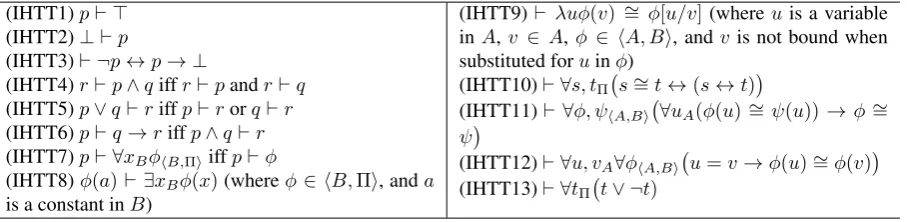
(IHTT1)p` >
(IHTT2)⊥ `p
(IHTT3)` ¬p↔p→ ⊥
(IHTT4)r`p∧qiffr`pandr`q
(IHTT5)p∨q`riffp`rorq`r
(IHTT6)p`q→riffp∧q`r
(IHTT7)p` ∀xBφhB,Πiiffp`φ
(IHTT8)φ(a)` ∃xBφ(x)(whereφ∈ hB,Πi, anda
is a constant inB)
(IHTT9)` λuφ(v) ∼= φ[u/v] (whereuis a variable inA,v ∈ A,φ ∈ hA, Bi, andv is not bound when substituted foruinφ)
(IHTT10)` ∀s, tΠ s∼=t↔(s↔t)
(IHTT11)` ∀φ, ψhA,Bi ∀uA(φ(u)∼=ψ(u))→φ∼=
ψ
(IHTT12)` ∀u, vA∀φhA,Bi u=v→φ(u)∼=φ(v)
(IHTT13)` ∀tΠ t∨ ¬t)
Table 1: Axioms of the intensional higher-order type theory IHTT of Fox and Lappin (2001)
•IfαAis a non-logical constant, then||α||M,g =
F(I(α))
•IfαAis a variable, then||α||M,g =g(α)
• ||αhA,Bi(βA)||M,g=||α||M,g ||β||M,g
• If α is in A and u is a variable in B, then
||λuα||M,g is a functionh : D
A → DB such
[image:3.595.74.528.70.181.2]that for anya∈DA,h(a) =||α||M,g[u/a]
• ||¬φΠ||M,g=tiff||φ||M,g=f
• ||φΠ∧ψΠ||M,g =tiff||φ||M,g=
||ψ||M,g =t
• ||φΠ∨ψΠ||M,g =tiff||φ||M,g=tor||ψ||M,g =t
• ||φΠ→ψΠ||M,g=tiff||φ||M,g =for||ψ||M,g =t
• ||φΠ↔ψΠ||M,g=tiff||φ||M,g =||ψ||M,g
• ||αA∼=βA||M,g =tiff||α||M,g =||β||M,g
• ||αA=βA||M,g =tiffI(α) =I(β)
• ||∀uAφΠ||M,g=tiff for alla∈DA ||φ||M,g[u/a]=t
• ||∃uAφΠ||M,g =tiff for somea∈DA ||φ||M,g[u/a] =t
•φΠis true inM (false inM) iff||φ||M,g =t(f) for allg.
•φΠis logically true (false) iffφis true (false) in everyM
•φΠ |=ψΠiff for everyM such thatφis true inM,ψis
true inM
Table 2: Interpretation of IHTT expressions
correspond to logic formulas. A word or phrase xis linked to formulas for sequencesuxvin which it occurs, and each formulaF is generalized to other formulasGthat entailF. But it is not clear yet how this representation could be used for inferences.
Distributions, extensions, and intensions Like the current paper, Copestake and Herbelot (2012) con-sider the connection between distributional representations and the semantics of logical languages. How-ever, they reach a very different conclusion. They propose using distributional representations as inten-sions of logical expresinten-sions. In addition, they link distributions to exteninten-sions by noting that each sentence that contributes to the distributional representation for the word “woodchuck” is about some member of the extension ofwoodchuck. They define theideal distributionfor a concept, for example “woodchuck”, as the collection of all true statements about all members of the category, in this case all woodchucks in the world.
In our view, distributions describe general, intensional knowledge, and do not provide reference to extensions, so we will link distributional representations to intensions and not extensions. Concerning the Copestake and Herbelot proposal of distributions as intensions, we consider distributions as represen-tations in need of an interpretation or intension, rather than represenrepresen-tations that constitute the intension.3 Also it is a somewhat unclear how the intension would be defined in practice in the Copestake and Her-belot framework, as it is based on the hypothetical ideal distribution with its potentially infinite number of sentences.
Hyper-intensional semantics The axiom of Extensionality states that if two expressions have the same extension, then they share all their properties. Together with the standard formulation of intensions as functions from possible worlds to extensions, this generates the problem that logically equivalent state-ments like “John sleeps” and “John sleeps, and Mary runs or does not run” become intersubstitutable in
3
all contexts, even in contexts like “Sue believes that. . . ” where they should not be exchangeable. Hyper-intensional semantics addresses this problem. In particular, some approaches (Fox and Lappin, 2001, 2005; Muskens, 2007) address the problem by (1) dropping the axiom of Extensionality, (2) mapping ex-pressions of the logic first to intensions and then mapping the intensions to extensions, and (3) adopting a notion of intensions as abstract objects with minimal restrictions. This makes these approaches relevant for our purposes, as we can add the axioms that we need for a joint semantics of logical and distributional representations. Muskens (2007) has one constraint on intensions that makes the approach unusable for our purposes in its current form: It has intensions and extensions be objects from the same collections of domains – but we would not want to force extensions to be mental objects. Instead we build on the in-tensional higher-order type theory IHTT from Fox and Lappin (2001). The set of types of IHTT contains the basic typese(for entity) and Π(proposition), and ifA, B are types, then so is hA, Bi. The logic contains all the usual connectives, plus “∼=” for extensional equality and “=” for intensional equality. Fox and Lappin adopt the axioms shown in Table 1, which do not include the axiom of Extensionality.4 A model for IHTT is a tupleM =hD, S, L, I, Fi, whereDis a family of non-empty sets such thatDAis
the set of possible extensions for expressions of typeA. S is the set of possible intensions, andL⊆ S is the set of possible intensions for non-logical constants of the logic. I is a function that maps arbitrary expressions of IHTT to the setSof intensions. Ifαis a non-logical constant, thenI(α)is inL, otherwise I(α)is inS−L. The functionF is a mapping fromL(intensions of non-logical constants) to members ofD(extensions). A valuationgis a function from the variables of IHTT to members ofDsuch that for allvAit holds thatg(v)∈DA. A model of IHTT has to satisfy the following constraints:5
(M1) Ifvis a variable, thenI(v) =v.
(M2) For a modelM, ifI(α) =I(β), then for allg,||α||M,g =||β||M,g.
Table 2 shows the definition of extensions||.||M,gof expressions of IHTT.
3
A joint semantics for distributional and logical representations
In this section we construct a first implementation of the semantics for distributional representations sketched in the introduction. In this semantics, distributional interpretations are interpreted over mental concepts and are linked to the intensions of some logical expressions. We use as a basis the hyper-intensional logic IHTT of Fox and Lappin (2001) (Section 2), which does not require intensions to be mappings from possible worlds to extensions, such that we are free to link intensions to mental concepts. The central result of this section will be that the interpretation of sentences of the logic is invariant to rewriting steps such as the one in Figure 1, which replace a non-logical constant by another based on distributional similarity. The semantics that we present in this paper constitutes a first step. It leaves some important questions open, such as paraphrasing beyond the word level, or graded concept membership.
3.1 Distributional representations
Typically, the distributional representation for a target word t is computed from the occurrences, or usages, oftin a given corpus. Minimally, a usage is a sequence of words in which the target appears at least once. We will allow for two additional pieces of information in a usage, namely larger discourse context, and non-linguistic context. (Recently, there have been distributional approaches that make use of non-linguistic context, in particular image data (Feng and Lapata, 2010; Bruni et al., 2012).)
LetW be a set of words (the lexicon), and letSeq(W)be the set of finite sequences overW. Then a usage overW is a tuple hs, t, δ, ωi, wheres ∈ Seq(W) is a sequence of words such that a word form of t ∈W occurs insat least once,δ ∈ ∆∪ {N A}is a (possibly empty) discourse context, and
4
We writeαAto indicate that expressionαis of typeA.
5
Fox and Lappin mention that one could add the constraint that ifα, α0differ only in the names of bound variables, then
ω ∈ Ω∪ {N A} is a (possibly empty) non-linguistic context. We write U(W,∆,Ω) for the set of all usages overW (and ∆andΩ). For any usageu = hs, t, δ, ωi, we writetarget(u) = t. Given a set U ⊆ U(W,∆,Ω)of usages, we writeUt ={u∈U |target(u) =t}for the usages of a target wordt.
Furthermore, we writeWU ={t∈W |Ut6=∅}for the set of words that have usages inU.
In distributional approaches, the vector space representation for a target wordtis computed from such a set U of usages, typically by mappingU to a single point in vector space (Lund et al., 1995; Landauer and Dumais, 1997) or a set of points (Sch¨utze, 1998; Reisinger and Mooney, 2010). This makes it possible to use linear algebra in modeling semantics. However, for our current purposes, we do not need to specify any particular mapping to a vector space, and can simply work with the underlying setU of usages: A finite setU of usages overW constitutes adistributional representationforWU. The
distributional representation for a wordt∈W isUt.
3.2 A semantics for distributional representations
We want to interpret distributional representations over conceptual structure. But what is conceptual structure? We know that concepts are linked by different semantic relations, including is-a, and part-of (Fellbaum, 1998), they can overlap, and they are associated with definitional features (Murphy, 2002). Eventually, all of these properties may be useful to include in the semantics of distributional representa-tions. But for this first step we work with a much simpler definition. We define a conceptual structure simply as a set of (atomic, unconnected) concepts.
An individual usage of a wordt can refer to a single mental concept. For example, the usage of “bank” in (1) clearly refers to a “financial institution” concept, not the land at the side of a river. But an individual usage can also refer to multiple mental concepts when there is ambiguity as in (2), or when there is too little information to determine the intended meaning as in (3).67
(1) hThe bank engaged in risky stock trades, bank,δ,ωi
(2) hWhy fix dinner when it isn’t broken, fix,δ,ωi8
(3) hbank,bank,NA,NAi
From this link between individual usages and concepts, we can derive a link between distributional representations and concepts: The representationUtof a wordtis connected to all concepts to which the
usages inUtlink. Formally, aconceptual modelforU(W,∆,Ω)is a tupleC=hIu, Ci, whereCis a set
of concepts, and the functionIu :U(W,∆,Ω)→ 2C is an interpretation function for usages that maps
each usage to a set of concepts.9 A conceptual modelCtogether with a finite setU ⊆ U(W,∆,Ω)of usages define a conceptual mapping for words. We writeIC,U(w) =Su∈UwIu(u)for the set of concepts
associated withw.
Distributional approaches centrally use some similarity measure, for example cosine similarity, on pairs of distributional representations, usually pairs of points in vector space. Since we represent a word t directly by its setUt of usages rather than a point in vector space derived fromUt, we instead have
a similarity measure sim(U1, U2) on sets of usages. We assume a range of [0,1] for this similarity
measure. A conceptual model can be used to evaluate the appropriateness of similarity predictions: A prediction is appropriate if it is high for two usage sets that refer to the same concepts, or low for two usage sets that refer to different concepts. Formally, a similarity predictionsim(U1, U2)isappropriate
for a conceptual modelC=hIu, Ciand thresholdθiff
• eithersim(U1, U2)≥θandSu∈U1Iu(u) =Su∈U2Iu(u),
6
For the purpose of this paper we make the simplifying assumption that concepts have “strict boundaries”: A usage either does or does not refer to a concept. We do not model cases where a usage is related to a concept, but is not a clear match.
7
Another possible reason for one usage mapping to multiple mental concepts is concept overlap (Murphy, 2002).
8Advertisement for a supermarket in Austin, Texas.. 9We write2S
9
x woodchuck(x)
^
see(John, x)
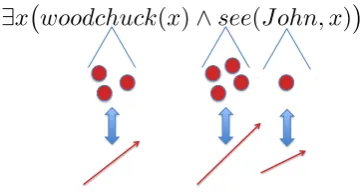
Figure 2: Enriching the information about non-logical constants: Constants are associated with sets of concepts (circles) and, through them, with distributional representations
• orsim(U1, U2)< θand
S
u∈U1Iu(u)6=
S
u∈U2Iu(u).
This formulation of appropriateness is simplistic in that it discretizes similarity predictions into two classes: above or below threshold θ. This is due to our current impoverished view of concepts as dis-joint atoms. When we introduce a conceptual similarity measure within conceptual models, a more fine-grained evaluation of distributional similarity ratings becomes available. Such a conceptual sim-ilarity measure would be justified, as humans can judge simsim-ilarity between concepts (Rubenstein and Goodenough, 1965), but we do not do it here in order to keep our models maximally simple.
3.3 A joint semantics for logical form and distributional representations
We now link the intensions of some logical expressions to mental concepts, using the logic IHTT as a basis. We will need to constrain the behavior of intensions more than Fox and Lappin do. In particular, we add the following two requirements to modelsM =hD, S, L, I, Fiof IHTT.
(M3) If the expressionα∈Ais the result of beta-reducing the expressionβ ∈A, thenI(α) =I(β).
(M4) IfI(uA) =I(vA), then for allφ∈ hA, Bi,I(φ(u)) =I(φ(v)).
(M4) allows for the exchange of an intensionally equal expression without changing the intension of the overall expression.
We now define models that join an intensional model of IHTT with a conceptual model for a dis-tributional representation. In particular, we link constants of the logic to sets of concepts, and through them, to distributional representations, as sketched in Figure 2. If the word “woodchuck” is associated with the concept setCwoodchuck =IC,U(woodchuck), then the intension of the constantwoodchuckwill
also beCwoodchuck. We proceed in two steps: In the definition of joint models, we require the existence of a mapping from words to non-logical constants that share the same interpretation. In a second step, we require semantic constructions to respect this mapping, such that the logical expression associated with “woodchuck” will beλx woodchuck(x)rather thanλx guppy(x). Note that only words inWU
have distributional representations associated with them; for words inW −WU, neither their translation
to logical expressions nor the intensions of those expressions are constrained in any way.
LetM =hD, S, L, I, Fibe a model for IHTT, letC=hIu, Cibe a conceptual model forU(W,∆,Ω),
and letU be a finite subset ofU(W,∆,Ω). ThenMC=hD,S,L,I,F,Iu,Ciis anintensional
concep-tual modelfor IHTT andU(W,∆,Ω)based onU if
(M5) There exists a functionhfromWUto the non-logical constants of IHTT such that for allw∈WU,
IC,U(w) =I(h(w))
(M6) For allw1, w2∈WU, ifIC,U(w1) =IC,U(w2)thenh(w1)andh(w2)have the same type.
We say that the modelMCcontainsM andC.
distributional interpretation, their associated constants have the same type. We next define semantic constructionssemin general, and semantic constructions that connect the translationsem(w)of a word wto its associated constanth(w). Asemantic construction functionfor a setW of words and a logical language L is a partial function sem : Seq(W) → L such that sem(w) is defined for all w ∈ W. sem(.) maps sequences of words overW to expressions fromL. A sequence s ∈ Seq(W) is called grammatical ifsem(s)is defined. A semantic constructionsemis anintended semantic construction for an intensional conceptual modelM =hD,S,L,I,F,Iu,Cibased onU if the following constraint
holds for the functionhfrom (M5):
(M7) For each typeAthere exists some expressionφAsuch that for allw∈W
U,sem(w)is equivalent
(modulo beta-reduction) toφA(h(w)).
(M7) states that the construction of translationssem(w) from non-logical constantsh(w)must be uniform for all words of the same semantic type. For example, if for the word “woodchuck” we have h(woodchuck) =woodchuck, an expression of typehe,Πi, then the expressionφhe,Πi=λP λx(P(x)) will mapwoodchucktoλx(woodchuck(x)) =sem(woodchuck).
3.4 Synonym replacement
In Section 2 we have sketched a framework for the interaction of logic and distributional representations based on Bar-Haim et al. (2007). Distributional representations can be used to predict semantic similarity between pairs of words and in particular to predict synonymy between words (Lin, 1998). Distribution-ally induced synonym pairs can be used as rewriting rules that transform sentence representations. In our case, the representations to be transformed are expressions of the logic. Two sentences count as synonymous if it is possible to transform the representation of one sentence into the representation of the other, using both distributional rewriting rules and the axioms of the logic.
We start out by showing that the application of a rewriting rule that exchanges one non-logical con-stant of IHTT for another concon-stant with the same intension leaves both the intension and the extension of the overall logical expression unchanged. Given a logical expressionφ, we writeφ[someb/a]for the set of expressions obtained fromφby replacing zero or more occurrences ofabyb.
Proposition 1: Soundness of non-logical constant rewriting. LetM =hD, S, L, I, Fibe an inten-sional model for IHTT, and leta, bbe non-logical constants of IHTT of typeAsuch thatI(a) =I(b). Then for any expressionφof IHTT and anyφ0 ∈ φ[someb/a],I(φ) =I(φ0), and for any valuationg,
||φ||M,g =||φ0||M,g.
Proof. LetxAbe a variable that does not occur inφ. Then for eachφ0 ∈φ[someb/a]there exists an
expressionψ∈φ[somex/a]such that(λxψ)(a)beta-reduces toφand(λxψ)(b)beta-reduces toφ0. As I(a) = I(b), we haveI((λxψ)(a)) = I((λxψ)(b))by (M4). So by (M3),I(φ) =I(φ0). From this it follows that for any valuationg,||φ||M,g =||φ0||M,g by (M2).
We call two words synonyms if they refer to the same set of concepts. Formally, letU be a finite subset ofU(W,∆,Ω) that is a distributional representation forWU, andC = hIu, Cia conceptual model for
U(W,∆,Ω). A wordp∈WU is asynonymfort∈WU byCandU ifIC,U(t) =IC,U(p).
We would like to show that iftandp are synonyms, then exchanging tfor p changes neither the intension nor the extension of the logical translation for the sentence. To do so, we first show that exchangingtforpcorresponds to applying constant rewriting on the sentence representation.
sequences∈Seq(W)of words overW, we writeT(s)for the set of constituent structure analyses fors. Forτ ∈T(s), we writeτ[p/t]for the syntactic graph that is exactly likeτ except that all leaves labeled tare replaced by leaves labeledp. We writesem(τ)for the logical translation ofsthat is based on the syntactic structure ofτ. We assume that there exists exactly one translationsem(τ) for each syntactic structureτ.
Lemma 2. LetMC be be an intensional conceptual model for IHTT andU(W,∆,Ω) based onU ⊆
U(W,∆,Ω)that containsM =hD, S, L, I, FiandC =hIu, Ci. Lett, p ∈WU be synonyms byCand
U, and lets ∈ Seq(W)be a sequence with syntactic analysisτ ∈ T(s)such that τ[p/t] ∈ T(s[p/t]). Then for any intended semantic construction semfor MC and U, sem(τ[p/t]) is equivalent modulo beta-reduction to some member ofsem(τ)[someh(p)/h(t)].
Proof. We proceed by induction over the structure ofτ. Ifsconsists of a single word, thenτ =s, and either s = tors = wfor a wordw 6= t. Ifs = wfor somew 6= t, thensem(τ[p/t]) = sem(τ) ∈
sem(τ)[someh(p)/h(t)].
Ifs = t, thensem(τ) = sem(t)andsem(τ[p/t]) = sem(p). By (M5) and becausetandp are synonyms, we have I(h(t)) = IC,U(t) = IC,U(p) = I(h(p)). From this it follows by (M6) that the
non-logical constantsh(t)andh(p)have the same semantic typeA. Then by (M7) there exists a logical expression φA such that sem(τ) = sem(t) is equivalent modulo beta-reduction to φA(h(t)). At the
same time,sem(τ[p/t]) =sem(p)is equivalent modulo beta-reduction toφA(h(p)), which is equivalent
modulo beta-reduction to a member of φA(h(t))[someh(p)/h(t)], which in turn is equivalent modulo
beta-reduction so a member ofsem(τ)[someh(p)/h(t)].
Now assume thatscomprises more than one word. Let the root ofτ havenchildren that are the roots of subtrees τ1. . . τn. There is some semantic construction rule associated with the root of τ
that can be written as an expression φ of IHTT such that φ(sem(τ1)). . .(sem(τn)) beta-reduces to
sem(τ). By the inductive hypothesis,sem(τi[p/t])is equivalent modulo beta-reduction to someψi ∈
sem(τi)[someh(p)/h(t)]for 1 ≤ i ≤ n. The expression φremains unchanged betweensem(τ) and
sem(τ[p/t])because only leaves of the tree were changed and the overall constituent structure remained the same. So the expression sem(τ[p/t]) is equivalent modulo beta-reduction to φ(ψ1). . .(ψn) ∈
φ(sem(τ1)). . .(sem(τn))
[someh(p)/h(t)], which in turn is equivalent modulo beta-reduction to sem(τ)[someh(p)/h(t)].
The reason why we have usedφ[someb/a]rather than replacement of all occurrences is that there is no guarantee that the corresponding non-logical constanth(t)for a wordtis used only in the lexical entry oft. For example, the expression φhe,Πi of (M7) could beλP λx woodchuck(x)
∧P(x), making the lexical entry for “guppy”λx woodchuck(x)∧guppy(x). Or the semantic construction expressionφ for NPs could contain the constant woodchuck. However, now we are in a position to show that this does not matter, and that a constant rewriting rule can be applied to all occurrences ofh(t), whether in the lexical entry fortor elsewhere. At the same time, we show that replacement of a word by a synonym does not change the interpretation of the sentence.
Proposition 3: Synonym replacement as constant replacement. LetMC be be an intensional con-ceptual model for IHTT andU(W,∆,Ω)based onU ⊆ U(W,∆,Ω)that containsM =hD, S, L, I, Fi andC = hIu, Ci. Lett, p ∈ WU be synonyms by CandU, and lets ∈ Seq(W)be a sequence with
syntactic analysisτ ∈ T(s)such that τ[p/t]∈ T(s[p/t]). Then for any valuationg, and any intended semantic constructionsemforMCandU,I(sem(τ)) =I(sem(τ[p/t])) =I(sem(τ)[h(p)/h(t)]), and
||sem(τ)||M,g =||sem(τ[p/t])||M,g =||sem(τ)[h(p)/h(t)]||M,g.
I(sem(τ)), and by (M3),I(sem(τ)[p/t]) =I(ψ). Thus, I(sem(τ)) = I(sem(τ[p/t])). By Proposi-tion 1, the intension is the same for all members ofsem(τ)[someh(p)/h(t)], so we haveI(sem(τ)) =
I(sem(τ)[h(p)/h(t)]. And by (M2), if sem(τ), sem(τ[p/t]) andsem(τ)[h(p)/h(t)] have the same intension, they also have the same extension.
3.5 Inference
We extend the list of axioms for IHTT from Table 1 by two additional axioms that correspond to the constraints (M3) and (M4).
(IHTT14) ` λuφ(v) = φ[u/v](whereu is a variable inA, v ∈ A, φ ∈ hA, Bi, and vis not bound when substituted foruinφ)
(IHTT15) ` ∀u, vA∀φhA,Bi u=v→φ(u) =φ(v)
These axioms parallel (IHTT9) and (IHTT12) but state intensional rather than extensional equality. Synonymy predictions from the distributional representation can be transformed into rewriting rules: If the wordstandpare synonyms by the distributional representationU, then we generate the rewriting ruleh(t)7→h(p). As Proposition 3 shows, this rewriting rule can be applied indiscriminately to a logical expression, and is not restricted to the lexical entry fort. But since the logic is equipped with inference capability and is not a passive representation like the syntactic graphs that Bar-Haim et al. (2007) used, we can alternatively just inject an expression h(t) = h(p), which states intensional equality, into the logical representation for the parsed sentenceτ. The logical representation forτ[p/t]can then be inferred using (IHTT14) and (IHTT15).
4
Conclusion and outlook
In this paper we have proposed a semantics for distributional representations, namely that each point in vector space stands for a set of mental concepts. We have provided a coarse-grained evaluation for dis-tributional representations in which their similarity predictions are evaluated against conceptual equality or inequality. We have extended this approach to a joint semantics of distributional and logical rep-resentations by linking the intensions of some logical expressions to mental concepts as well: If the distributional representation for a word w is interpreted as a set C of concepts, then the non-logical constant linked to the lexical entry forwwill have as its intension the same setC. We have used hyper-intensional semantics as a basis for this joint semantics. We have been able to show that distributional rewriting rules that exchange non-logical constants with the same intension do not change the intension or extension of the overall logical expression. These rewriting rules can be used to compute the logical representation of a sentence after exchanging a word for its synonym.
The current joint semantics is, however, only a first step, and leaves many important questions open. We consider the following three to be especially important.(1) Polysemy.Many synonym pairs can only be substituted for one another in particular sentence contexts. For example “correct” is a synonym for “fix” that can be substituted in the context of “The programmer fixed the error”, but not in “The cook fixed dinner.” This means that the words “fix” and “correct” do not map to the same set of concepts, but they are exchangeable in particular contexts. So we would want to say that “fix” and “correct” are synonyms with respect to a usageu = hs,fix, δ, ωi ifIu(u) = Iu(hs[correct/fix],correct, δ, ωi). The
question is whether all logical expressions should be associated with conceptual structures: Should the intension of a variable be something conceptual?
(3) Gradience. In this paper we have assumed that the link from usage to concept is binary – either present or not –, and also that there are no relations between concepts. Both assumptions are simpli-fications: Concepts have “fuzzy boundaries” (Hampton, 2007), and cognizers can distinguish degrees of similarity between concepts (Rubenstein and Goodenough, 1965). By modeling this gradience, we could then talk about degrees of similarity between words and phrases, not just a binary choice of either synonymy or non-synonymy. But this will require dealing with probabilities or weights in the model and also in the logic.
Acknowledgements. This research was supported in part by the NSF CAREER grant IIS 0845925 and by the DARPA DEFT program under AFRL grant FA8750-13-2-0026. Any opinions, findings, and conclusions or recommendations expressed in this material are those of the author and do not neces-sarily reflect the view of DARPA, AFRL or the US government. Warmest thanks to John Beavers and Gemma Boleda, as well as the members of the Austin Computational Linguistics Tea and the anonymous reviewers, for very helpful discussions.
References
Andrews, M., G. Vigliocco, and D. Vinson (2009). Integrating experiential and distributional data to learn semantic representations. Psychological Review 116(3), 463–498.
Bar-Haim, R., I. Dagan, I. Greental, and E. Shnarch (2007). Semantic inference at the lexical-syntactic level. InProceedings of AAAI, Vancouver, Canada.
Baroni, M. and R. Zamparelli (2010). Nouns are vectors, adjectives are matrices: Representing adjective-noun constructions in semantic space. InProceedings of EMNLP, Cambridge, MA.
Barsalou, L. W. (2008). Grounded Cognition. Annual Review of Psychology 59(1), 617–645.
Berant, J., I. Dagan, and J. Goldberger (2011). Global learning of typed entailment rules. InProceedings of ACL, Portland, OR.
Blei, D. M., A. Ng, and M. I. Jordan (2003). Latent Dirichlet allocation. Journal of Machine Learning Research 3, 993–1022.
Bruni, E., G. Boleda, M. Baroni, and N. Tran (2012). Distributional semantics in technicolor. In Pro-ceedings of ACL, Jeju Island, Korea.
Burgess, C. and K. Lund (1997). Modelling parsing constraints with high-dimensional context space. Language and Cognitive Processes 12, 177–210.
Clark, S., B. Coecke, and M. Sadrzadeh (2008). A compositional distributional model of meaning. In Proceedings of QI, Oxford, UK, pp. 133–140.
Clarke, D. (2007). Context-theoretic Semantics for Natural Language: an Algebraic Framework. Ph. D. thesis, University of Sussex.
Clarke, D. (2012). A context-theoretic framework for compositionality in distributional semantics. Com-putational Linguistics 38(1).
Coecke, B., M. Sadrzadeh, and S. Clark (2010). Mathematical foundations for a compositional dis-tributed model of meaning.Lambek Festschrift, Linguistic Analysis 36.
Copestake, A. and A. Herbelot (2012, July). Lexicalised compositionality. Unpublished draft.
Feng, Y. and M. Lapata (2010). Visual information in semantic representation. InProceedings of HLT-NAACL, Los Angeles, California.
Fox, C. and S. Lappin (2001). A framework for the hyperintensional semantics of natural language with two implementations. In P. de Groote, G. Morrill, and C. Retore (Eds.),Proceedings of LACL, Le Croisic, France.
Fox, C. and S. Lappin (2005). Foundations of Intensional Semantics. Wiley-Blackwell.
G¨ardenfors, P. (2004). Conceptual spaces. Cambridge, MA: MIT press.
Garrette, D., K. Erk, and R. Mooney (2011). Integrating logical representations with probabilistic infor-mation using markov logic. InProceedings of IWCS, Oxford, UK.
Grefenstette, E. and M. Sadrzadeh (2011). Experimental support for a categorical compositional distri-butional model of meaning. InProceedings of EMNLP, Edinburgh, Scotland, UK.
Hampton, J. A. (2007). Typicality, graded membership, and vagueness. Cognitive Science 31, 355–384.
Landauer, T. and S. Dumais (1997). A solution to Platos problem: the latent semantic analysis theory of acquisition, induction, and representation of knowledge.Psychological Review 104(2), 211–240.
Lin, D. (1998). Automatic retrieval and clustering of similar words. InProceedings of COLING-ACL, Montreal, Canada.
Lin, D. and P. Pantel (2001). Discovery of inference rules for question answering. Natural Language Engineering 7(4), 343–360.
Lund, K., C. Burgess, and R. Atchley (1995). Semantic and associative priming in high-dimensional semantic space. InProceedings of the Cognitive Science Society, pp. 660–665.
Murphy, G. L. (2002). The Big Book of Concepts. MIT Press.
Muskens, R. (2007). Intensional Models for the Theory of Types. The Journal of Symbolic Logic 72(1), 98–118.
Reisinger, J. and R. Mooney (2010). Multi-prototype vector-space models of word meaning. In Pro-ceeding of NAACL.
Rubenstein, H. and J. Goodenough (1965). Contextual correlates of synonymy. Computational Linguis-tics 8, 627–633.
Sch¨utze, H. (1998). Automatic word sense discrimination. Computational Linguistics 24(1).
Socher, R., E. Huang, J. Pennin, A. Ng, and C. Manning (2011). Dynamic pooling and unfolding recursive autoencoders for paraphrase detection. In J. Shawe-Taylor, R. Zemel, P. Bartlett, F. Pereira, and K. Weinberger (Eds.),Proceedings of NIPS.
Szpektor, I. and I. Dagan (2008). Learning entailment rules for unary templates. In Proceedings of COLING.
Turney, P. and P. Pantel (2010). From frequency to meaning: Vector space models of semantics. Journal of Artificial Intelligence Research 37, 141–188.