A Framework for the Classification and Annotation of Multiword
Expressions in Dialectal Arabic
Abdelati Hawwari, Mohammed Attia, Mona Diab
Department of Computer Science
The George Washington University
{Abhawwari,mohattia,mtdiab}@gwu.edu
Abstract
In this paper we describe a framework for classifying and annotating Egyptian Ara-bic Multiword Expressions (EMWE) in a specialized computational lexical re-source. The framework intends to en-compass comprehensive linguistic infor-mation for each MWE including: a. pho-nological and orthographic information; b. POS tags; c. structural information for the phrase structure of the expression; d. lexicographic classification; e. semantic classification covering semantic fields and semantic relations; f. degree of idio-maticity where we adopt a three-level rat-ing scale; g. pragmatic information in the form of usage labels; h. Modern Standard Arabic equivalents and English transla-tions, thereby rendering our resource a three-way – Egyptian Arabic, Modern Standard Arabic and English – repository for MWEs.
1
Introduction
Multiword expressions (MWEs) comprise a wide range of diverse, arbitrary and yet linguistically related phenomena that share the characteristic of crossing word boundaries (Sag et al., 2002). MWEs are computationally challenging because the exact interpretation of an MWE is not direct-ly obtained from its component parts. MWEs are intrinsically single units on the deep conceptual and semantic levels, but on the surface (lexical and syntactic) levels they are expressed as multi-ple units. MWEs vary in their syntactic category, morphological behavior, and degree of semantic opaqueness. MWEs are pervasively present in natural texts, which makes it imperative to tackle them explicitly if we aspire to make large-scale,
linguistically-motivated, and precise processing of a human language.
Integrating MWEs in NLP applications has evidently and consistently shown to improve the performance in tasks such as Information Re-trieval (Acosta et al. 2011; da Silva and Souza, 2012), Text Mining (SanJuan and Ibekwe-SanJuan, 2006), Syntactic Parsing (Eryiğit et al., 2011; Nivre and Nilsson, 2004; Attia, 2006; Korkontzelos and Manandhar, 2010), Machine Translation (Deksne, 2008; Carpuat and Diab, 2010; Ghoneim and Diab 2013; Bouamor et al., 2011), Question Answering, and Named-Entity extraction (Bu et al., 2011).
In the current work, we propose guidelines for detailed linguistic annotation of an MWE lexicon for dialectal (Egyptian) Arabic that covers, among other types, expressions that are tradi-tionally classified as idioms (e.g. ﻖﯾﻳﺮﻟاﺍﻰﻠﻋEalaY Alriyq1 ‘on an empty stomach’), prepositional verbs (e.g. ﻰﻠﻋ ﻞﻛﻮﺗ tawak~al EalaY ‘rely on’), compound nouns (e.g. رﺭوﻭﺮﻣةﺓرﺭﺎﺷإﺇ<i$Arap muruwr ‘traffic light’), and collocations (e.g. شﺵدﺩ ﺪﺧأﺃ >axad du$~ ‘to take a shower’).
Creating a repository of annotated MWEs that is focused on dialects is essential for computa-tional linguistics research as it provides a crucial resource that is conducive to better analysis and understanding of the user-generated content rife in the social media (such as Facebook, Twitter, blogs, and forums). Moreover, it helps in under-standing he correspondences between different languages and their representation of the seman-tic space. We hope that the multilingual data in this repository will lead to a significant en-hancement in the processing of comparable and parallel corpora. We believe that our proposed framework will contribute to the sustainability of
1
In this paper, we use the Buckwalter Transliteration Scheme for rendering Romanized Arabic as described in www.qamus.com.
MWE research in general, and provide a blue print for research on MWEs in dialects, informal vernaculars, as well as morphologically rich lan-guages.
MWE are not only interesting from an NLP perspective but also from a linguistic perspec-tive, as MWE can help in understanding the link between lexicon, syntax and semantics. Until now, this is hampered by the lack of comprehen-sive resources for MWEs with fine-grained clas-sification on different dimensions related to se-mantic roles and syntactic functions. Arabic comprises numerous divergent dialects, and hav-ing an annotated MWE lexical resource in dia-lects and Modern Standard Arabic (MSA) will allow for studying transformation, change and development in this language.
From a theoretical linguistic point of view, our work will be interesting particularly in studies related to Diglossia. Diglossia (Walters, 1996) is where two languages or dialects exist side by side within a community, where typically one is used in formal contexts while the other is used in informal communications and interactions. Stud-ying the MWE space for dialects and MSA as a continuum will lead to deeper insights into varia-tions as we note intersection and overlap be-tween the two. In many instances, we see that MSA MWEs and their dialectal equivalents are not necessarily shared as they occupy comple-mentary linguistic spaces. However, the nature of this complementarity and its cultural and social implications will need more exploration and in-vestigation, which will be possible once a com-plete resource becomes available.
In the current work, we give detailed descrip-tion of our methodology and guidelines for anno-tating phonological, morphological, syntactic, semantic and pragmatic information of an Egyp-tian Multiword Expressions (EMWE) lexical resource. Our annotation scheme covers the fol-lowing areas.
a) Phonological and orthographic information; b) POS tag, based on the observation of how an
MWE functions as a whole lexical unit; c) Syntactic variability and structural
composi-tion;
d) Lexicographic types, which includes the classifications followed in the dictionary-writing domain (idioms, support verbs, com-pound nouns, etc.);
e) Semantic information, where we cover se-mantic fields and relations;
f) Idiomaticity Degree; we adopt a three level rating scale (Mel’čuk, 1998) to measure the degree of semantic opaqueness;
g) Degree of morphological, lexical and syntac-tic flexibility (Sag et al., 2002);
h) Pragmatic information, which includes add-ing usage labels to MWEs where applicable; i) Translation, which includes the MSA and
English equivalents, either as an MWE in MSA and English if available or as a para-phrase otherwise.
2
Previous Work
There are four main areas of research on MWEs: extraction from structured and unstructured data, construction of lexicons for specific languages, integration in NLP applications, and the con-struction of guidelines and best practices. A sig-nificant amount of research has focused on the identification and extraction of MWEs (Ramisch et al., 2010; Dubremetz and Nivre, 2014; Attia et al., 2010; Weller and Heid, 2010; Schneider et al., 2014). Description and specifications of MWE lexical resources have been presented for Japanese (Shudo et al. 2011), Italian (Zaninello and Nissim, 2010), Dutch (Grégoire, 2010; Odijk, 2013), and Modern Standard Arabic (Hawwari et al., 2012). Moreover, Calzolari et al. (2002) presented a project that attempted to in-troduce best practice recommendations for the treatment of MWE in mono- and multi-lingual computational lexicons that incorporate both syntactic and semantic information, but the limi-tation of their work is that they focus on only two types of MWEs, namely, support verbs and noun compounds.
Apart from Schneider et al. (2014), who fo-cused on the language of the social web, none of these projects dealt with informal or dialectal languages, which are rampant in user-generated content (UGC). With the explosion of social me-dia, the language of Web 2.0 is undergoing fun-damental changes: English is no longer dominat-ing the web, and UGC is outpacdominat-ing professional-ly edited content.
voice their opinions on events and products and exert powerful influence on the behavior and opinion of others. Yet, the current overflow of UGC poses significant challenges in data gather-ing, annotation and presentation.
3
MWE Taxonomy
Although the importance of the MWEs has been acknowledged by many researchers in the field of NLP as evident by the large number of research papers and dedicated workshops in the past decade, the theory of MWEs is still underdeveloped (Sag et al., 2002). There is critical need for studying MWEs both from the theoretical and practical point of views. MWEs have diverse categories, varying degrees of idiomaticity, different syntactic compositions, and different morphological, lexical and syntactic behavior, and dealing with them is complicated even further by the fact that there is no “watertight criteria” for distinguishing them them (Atkins and Rundell, 2008).
Moreover, there is no universally-agreed tax-onomy of MWEs (Ramisch, 2012), and different researchers proposed different typology for this phenomena. Fillmore et al. (1988) proposed three types based on lexical and syntactic familiarity: a) unfamiliar pieces familiarly combined, b) miliar pieces unfamiliarly combined, and c) fa-miliar pieces fafa-miliarly combined. Mel'čuk (1989), on the other hand, introduced three different classes: a) complete phraseme, b) semi-phraseme, c) and quasi-phraseme. Sag et al. introduced two classes: institutionalized phrases and lexicalized phrases, with lexicalized phrases subdivided into fixed, semi-fixed and syntactically flexible expressions. Ramisch (2012) introduced yet another set of classes: nominal, verbal and adverbial expressions.
From the lexicographic point of view, the leg-acy three-way division of MWEs proved to be too coarse-grained to cater for the needs of lexi-cographers who need to identify the large array of sub-types that fall under the umbrella of ‘MWEs’. Atkins and Rundell (2008) empha-sized the need for lexicographers to be able to recognize MWE types such as fixed phrases, transparent collocations, similes, catch phrases, proverbs, quotations, greetings, phatic expres-sions, compounds, phrasal verbs, and support verbs.
When we look deeply into the different classi-fications, we notice that each approach has
looked at the phenomenon from a different angle, either focusing on its syntactic regularity, seman-tic and pragmaseman-tic properties, meaning composi-tionality, surface flexibility, POS (part of speech) category, or lexicographic relevance. What we propose is that it is not possible to come up with a hard and fast classification that cuts through all levels of representation. All afore-mentioned classifications are valid and can work parallel to each other, instead of substituting for each other. The assumption that we follow in this paper is that MWEs have different classifications at dif-ferent levels of representation from the very deep level of semantics and pragmatics to the very shallow level of morphology and phonetics. The details of our annotation scheme are ex-plained in the following section.
It is worth noting that in our current work, we move the focus away from edited text to the challenging and creative language found in UGC and by trying to close the language resource gap between edited and unedited text. We handle this gap by focusing on dialects, the language used in informal communications such as emails, chat rooms, and in social media in general. We cover the full range of MWEs (nominal, verbal, adver-bial, adjectival and prepositional expressions) in Egyptian Arabic, covering 7,331 MWEs (col-lected from corpora and paper dictionaries).
4
Annotation of Linguistic Features in
MWE
In this section, we provide a comprehensive specification of MWE types and the detailed lin-guistic information, including the phonological, orthographical, syntactic, semantic and pragmat-ic features.
4.1 Phonological
Each MWE is provided in full diacritization to indicate its common pronunciation in Cairene Arabic accent, such as ﺖﯾﻳِﺮْﻔَﻋ ّﻒَﻛ ﻰَﻠَﻋ EalaY kaf~ Eaforiyt ‘at high risk’, ‘lit. on the palm of a de-mon’. We also list other phonological variants when available.
4.2 Orthography
facts into consideration. For example, the Egyp-tian expression ﮫﻪﻟﺎﺑ ﺪﺧأﺃ >axad bAluh ‘to pay atten-tion’ is rendered in CODA as ﮫﻪﻟﺎﺑ ﺬﺧأﺃ >axa* bAluh.
4.3 POS
At this level of annotation we consider the POS of the entire MWE when regarded as one unit from a functional perspective. We annotate each MWE with a POS tag from a predefined tagset. We define the POS tag based on the headword POS in the MWE. Our POS tagset includes verb, noun, adjective, adverb, interjection, proper noun, and preposition. The list of POS tags used along with examples is shown in Table 1.
POS Example
1 verb بﺏﺎﺴ ِﺤﻟاﺍ ﻰﻠﻋ ّﺮَﺟ jar~ EalaY AlHisAb ‘pay later’
2 noun ﺶْﯿﻴِﻌْﻟاﺍ ﻞْﻛَأﺃ >akol AlEay$ ‘making ends meet’ [lit. eating bread]
3 adjective نﻥاﺍﻮﻟأﺃوﻭ لﻝﺎﻜﺷأﺃ
>a$okAl wa->alowAn ‘various shapes and colors’
4 adverb ﺔﻤﺘﻤﻟاﺍ ةﺓﺮﺧأﺃ >axorip Al-matam~ap ‘at the end’
5 interjection هﻩﻮھﮪﮬﻫﺎﯾﻳ سﺱﺎﻧ ﺎﯾﻳ yA nAs yAhuwh ‘anybody there’
6 proper nouns
ﺪﻟاﺍ ةﺓﺮﺠﺷ
رﺭ $ajarip Aldur~ ‘Shajar al-Durr’
7 preposition ﻦﻋ ﺮﻈﻨﻟاﺍ ﺾﻐﺑ
[image:4.595.70.530.70.538.2]bi-gaD~ AlnaZar Eano ‘irrespective of’
Table 1: MWE Examples with their POS Tags
4.4 Syntactic Annotation
A syntactic variable is a slot that intervenes be-tween the component parts of an MWE, without being itself a part of it, but fills a syntactic gap. Syntactic variables are added, when needed, to MWEs to represent the syntactic behavior of an MWE and they exemplify how the MWE inter-acts with other elements within its scope. We create a tagset of syntactic variables reflecting the argument structure of an MWE. Examples are shown in Table 2.
No Syntactic Variable
Example
1 ُنﻥﻼﻓ somebody (masc_ nominative)
ﺾﺒﻨﻟاﺍ (ٌنﻥﻼﻓ) ّﺲﺟ jas~ (fulAn) AlnaboD ‘ (somebody) tested the waters’
2 ًﺔﻧﻼﻓ
somebody (fem_ accusative)
ﻞﻛأﺃ ) ﮫﻪﯿﻴﻨﯿﻴﻌﺑ (ﺔﻧﻼﻓ >akal (fulAnap) bi-Eaynayh ‘he devoured (some woman/girl) with his eyes’
3 ِمﻡﻮﻘﻟاﺍ people (genitive)
ﻦﯿﻴﻔﺳإﺇ (مﻡﻮﻘﻟاﺍ) ﻦﯿﻴﺑ قﻕدﺩ daq~ bayn (Alqawom) <isofiyn ‘he drove a wedge between (some people)’
4 َﺮﻣﻷاﺍ
some matter (accusative)
ﮫﻪﺑﺎﺴﺣﻲﻓ (ﺮﻣﻷاﺍ) ﻂﺣ Hat~ (Al>amora) fiy
HisAbihi
‘he took (some matter) into consideration’
5 ُءﻲﺸﻟاﺍ something (nominative)
ﮫﻪﯿﻴﻠﻋﻞﺼﻔﺘﻣ (ءﻲﺸﻟاﺍ) (Al$ayo') mitofaS~al Ealayh ‘(something) fits him perfectly’
Table 2: Syntactic variables and example usages
4.5 Lexicographic Annotation
In the dictionary market there are specialized dictionaries for idioms, phrasal verbs, proverbs and quotations. However, general domain dic-tionaries try to avoid the use of too technical terms in the description of MWEs and use for the sake of simplicity a general term like ‘phrase’ to denote them to users. Yet, in the meta language of the dictionary compiling profession, lexicog-raphers make a more fine-grained distinction be-tween the various types of MWEs. Our lexico-graphic classification of MWEs is adapted from Atkins and Rundell (2008) and includes the fol-lowing tags. Examples are listed in Table 3.
1. Idiom: An idiom is an MWE whose mean-ing is fully or partially unpredictable from the meanings of its components (Nunberg et al., 1994);
[image:4.595.69.300.257.580.2]3. Prepositional verb: These are verbs fol-lowed by prepositions with impact on the meaning;
4. Compound noun: A compound noun is a lexeme that consists of more than one noun; 5. Compound term: This is a technical com-pound noun used in a specific technical field;
6. Compound named entity: This is a multi-word proper name;
7. Phatic expression: an expression that is in-tended for performing a social function (such as greeting or well-wishing) rather than conveying information;
8. Proverb: We consider proverbs as multi-word expression if they are used as lexical units;
9. Quotation: We list only quotations that have gained currency in the language and have become familiar to the majority of the community.
10.
Classification Example 1 Idiom ﺔﺒﻗﺔﺒﺤﻟاﺍ ﻦﻣ ﻞﻤﻌﯿﻴﺑ
biyiEomil min AlHab~ap qub~ap
‘to make a mountain out of a molehill’
2 Support verb رﺭﺎﺗ ﺪَﺧَأﺃ >axad tAr ‘to take revenge’ 3 Prepositional
verb
ﮫﻪﯿﻴﻠﻋ ﻚﺤﺿ DiHik Ealayh ‘to play a joke on’ [lit. laugh on him]’ 4 Compound
noun
نﻥاﺍدﺩﺮﻗ ﻮﺑأﺃ >abuw qirodAn ‘Cattle egret’
5 Compound
term ﺎﺴﻨﻟاﺍ قﻕﺮﻋ
Eiroq AlnisA ‘Sciatica’
6 Compound named entity
لﻝﻮﮭﻬﻟاﺍ ﻮُﺑَأﺃ >abuw Alhuwl ‘the Sphinx’
7 Phatic expres-sion
ﺮﯿﻴﺨﺑ ﻚﺷوﻭ فﻑﻮﺷأﺃ
>a$uwf wu$~ak bi-xayr ‘see you later’
8 Quotation ﻲﻨﺘﻘﻠﺧ ﺎﻤﻛ يﻱﻻﻮﻣ ﺎﯾﻳ yA mawolAyA kamA xa-laqotiniy ‘penniless’ 9 Proverb ﺔﻨﯾﻳزﺯ ﻞﻘﻌﻟاﺍ AlEaqol ziynap
[image:5.595.303.523.114.620.2]‘wisdom is a blessing’ Table 3: Examples of Lexical Types
4.6 Structural Classification
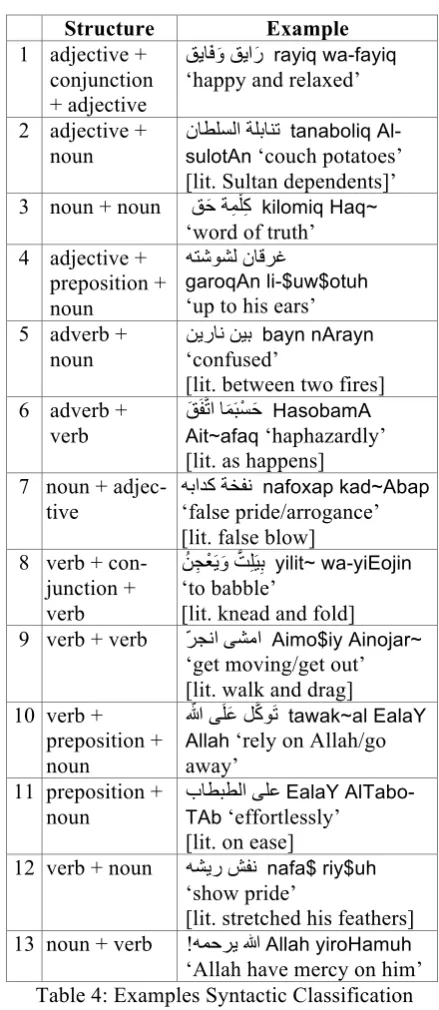
We provide the syntactic phrase structure com-position of the expressions, giving the MWE pat-tern or the POS of its component elements. The purpose is to show the normal productive
syntac-tic patterns underlying the expressions. Table 4 shows the list of possible structural pattern in Egyptian MWEs.
Structure Example
1 adjective + conjunction + adjective
اﺍَرﺭ ﻖِﯾﻳ َوﻭ
ﻖِﯾﻳﺎَﻓ rayiq wa-fayiq ‘happy and relaxed’
2 adjective + noun
نﻥﺎﻄﻠﺴﻟاﺍ ﺔﻠﺑﺎﻨﺗ tanaboliq
Al-sulotAn ‘couch potatoes’ [lit. Sultan dependents]’ 3 noun + noun ﻖَﺣ ﺔِﻤْﻠِﻛ kilomiq Haq~
‘word of truth’ 4 adjective +
preposition + noun
ﮫﻪﺘﺷﻮﺸﻟ نﻥﺎﻗﺮﻏ
garoqAn li-$uw$otuh ‘up to his ears’ 5 adverb +
noun
ﻦﯾﻳرﺭﺎﻧ ﻦﯿﻴﺑ bayn nArayn ‘confused’
[lit. between two fires] 6 adverb +
verb َﻖَﻔﱠﺗاﺍﺎَﻤَﺒْﺴَﺣ
HasobamA Ait~afaq ‘haphazardly’ [lit. as happens] 7 noun +
adjec-tive
ﮫﻪﺑاﺍﺪﻛ ﺔﺨﻔﻧ nafoxap kad~Abap ‘false pride/arrogance’ [lit. false blow] 8 verb +
con-junction + verb
ُﻦِﺠْﻌَﯾﻳَوﻭ ﱡﺖِﻠَﯿﻴِﺑ yilit~ wa-yiEojin
‘to babble’
[lit. knead and fold]
9 verb + verb ّﺮﺠﻧاﺍ ﻰﺸﻣاﺍ Aimo$iy Ainojar~ ‘get moving/get out’ [lit. walk and drag] 10 verb +
preposition + noun
ﱠﷲ ﻰَﻠَﻋ ﻞﱠﻛﻮَﺗ tawak~al EalaY Allah ‘rely on Allah/go away’
11 preposition + noun
بﺏﺎﻄﺒﻄﻟاﺍ ﻰﻠﻋ EalaY AlTabo-TAb ‘effortlessly’
[lit. on ease]
12 verb + noun ﮫﻪﺸﯾﻳرﺭ ﺶﻔﻧ nafa$ riy$uh ‘show pride’
[lit. stretched his feathers] 13 noun + verb !ﮫﻪﻤﺣﺮﯾﻳﷲAllah yiroHamuh ‘Allah have mercy on him’ Table 4: Examples Syntactic Classification
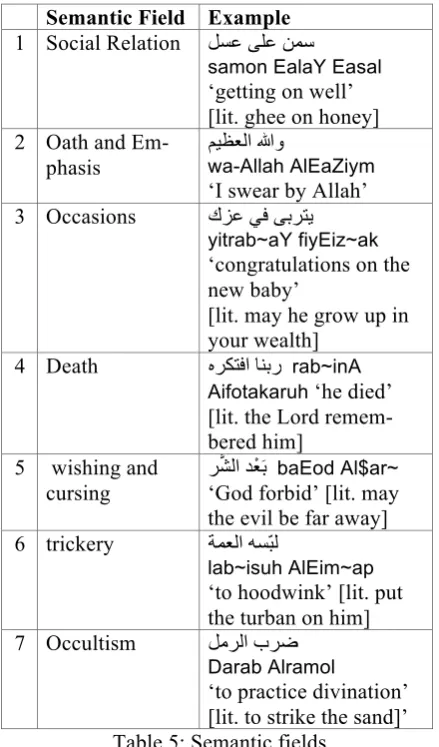
4.7 Semantic Fields
[image:5.595.74.288.329.686.2]thesau-rus. In Table 5 we show a sample of our seman-tic field classification.
Semantic Field Example 1 Social Relation ﻞﺴﻋ ﻰﻠﻋ ﻦﻤﺳ
samon EalaY Easal ‘getting on well’ [lit. ghee on honey] 2 Oath and
Em-phasis
ﻢﯿﻴﻈﻌﻟاﺍﷲوﻭ
wa-Allah AlEaZiym ‘I swear by Allah’ 3 Occasions كﻙﺰﻋ ﻲﻓ ﻰﺑﺮﺘﯾﻳ
yitrab~aY fiyEiz~ak ‘congratulations on the new baby’
[lit. may he grow up in your wealth]
4 Death هﻩﺮﻜﺘﻓاﺍ ﺎﻨﺑرﺭ rab~inA Aifotakaruh ‘he died’ [lit. the Lord remem-bered him]
5 wishing and cursing
ﺮﱠﺸﻟاﺍ ﺪْﻌ َﺑ baEod Al$ar~ ‘God forbid’ [lit. may the evil be far away] 6 trickery ﺔﻤﻌﻟاﺍ ﮫﻪﺴّﺒﻟ
lab~isuh AlEim~ap ‘to hoodwink’ [lit. put the turban on him] 7 Occultism ﻞﻣﺮﻟاﺍ بﺏﺮﺿ
Darab Alramol
[image:6.595.70.290.107.481.2]‘to practice divination’ [lit. to strike the sand]’ Table 5: Semantic fields
4.8 Semantic Relations
Aiming at presenting detailed lexical semantic information, we further classify our entries based on semantic relations like synonymy, antonymy and polysemy.
• Synonymy: MWE synonyms are grouped together; as the following expressions which all mean ‘to practice divination’ نﻥﺎﺠﻨﻔﻟاﺍ اﺍﺮﻗ qarA AlfinojAn [lit. read the cup], عﻉدﺩﻮﻟاﺍ بﺏﺮﺿ Darab AlwadaE [lit. hit the shells], ﻒﻜﻟاﺍ اﺍَﺮﻗ qarA Alkaf~ [lit. read the hand palm].
• Antonymy: MWE antonyms are two MWE having the opposite meaning to each other. For examples, ﺔﻔﺷﺎﻧ هﻩﺪﯾﻳإﺇ <iyduh nA$ofap ‘ava-ricious’ [lit. his hand is dry] is the antonym of ﺔﻣوﻭﺮﺨﻣ هﻩﺪﯾﻳإﺇ <iyduh maxoruwmap ‘wasteful’ [lit. his hand has a hole in it].
• Polysemy. This is when an MWE has more than one meaning. For example, ﺔﻠﯾﻳﻮطﻁ هﻩﺪﯾﻳِإﺇ <iyduh Tawiylap [lit. his hand is long] can mean either a ‘powerful person’ or a ‘thief’.
4.9 Idiomaticity Degree
Mel’čuk (1998) classified MWEs with regards to idiomaticity into three types: full phrasemes, quasi-phrasemes and semi-phrasemes.
• Full phrasemes are when the meaning of the expression does not match the meaning of the component words, such as اﺍﺮﺟ ﻢﻠھﮪﮬﻫوﻭ Wa-halum~ jar~A ‘and so on’.
• Quasi-phrasemes are when the meaning of the expression matches the meaning of the component words in addition to an extra piece of meaning that is not directly derived from either components, such as ﺐﻌﺸﻟاﺍ ﺲﻠﺠﻣ majolis Al$aEob ‘people's assembly’.
• Semi-phrasemes are when the meaning of the MWE is partially directly derived from one component and partially indirectly indi-cated by the other component, such as تﺕﺎﺳاﺍرﺭدﺩ ﺎﯿﻴﻠﻋ dirAsAt EuloyA ‘higher studies’.
4.10 Morpho-lexico-grammatical flexibility A scale of three levels is used to measure the de-gree of morphological, lexical and grammatical flexibility of a MWE, adopted from Sag et al. (2002). The three levels are as follows:
• Fixed MWE: An MWE is considered as a fixed expression if it does not have any de-gree of syntactic, morphological or lexical flexibility, and its meaning cannot be pre-dicted from its component elements, for ex-ample, حﺡاﺍﺪﻣحﺡاﺍﺪﺳ sadAH madAH ‘slapdash’. • Semi-Fixed MWE: Semi-fixed expressions
allow for a certain degree of morphological and lexical variation, but they are fixed in terms of the syntactic word order, for ex-ample, ﻢھﮪﮬﻫﺮﻌﺷ\ﺎھﮪﮬﻫﺮﻌﺷ ﻞﺣ ﻰﻠﻋ ﻦﯿﻴﯿﻴﺷﺎﻣ\ﺔﯿﻴﺷﺎﻣ mA$oyap/mA$oyiyn EalaY Hal~ $aEo-rahA/$aEoruhum [lit. living by letting down her/their hair] ‘whore/whores’ or ‘loose women’.
(fulAn) du$~ ‘to scold someone harshly’ [lit. give someone a shower].
[image:7.595.70.293.260.450.2]4.11 Pragmatic Annotation (Usage Labels) The reason we provide usage labels is inspired by the CALLHOME Egyptian Arabic corpus (Gadalla et al., 1997)), which is a collection of data gathered from spoken colloquial language. The usage labels present specifications on who uses an MWE and how it is used. The usage label tagset in our lexicon includes labels such vulgar, youth, aggressive or taboo, as exemplified in Table 6.
Who or how Example
youth لﻝﺒﺠﻟاﺍ ﻲِﻓ ﻞﺒﮭﻬﻟاﺍ قﻕﻮﺴﯾﻳ
yisuwq Alhabal fiy Aljabal ‘to act foolishly’ [lit. to act madly in the mountain]’
women / girls رﺭﺎﻤﺣ ﻞﺟﺮﺑ لﻝﺰﻐﺗ ةﺓﺮطﻁﺎﺸﻟاﺍ Al$ATrap tigozil birijol HumAr ‘make do with what you have’ [lit. a clever girl will knit with a donkey’s leg]’
Aggressive ﻚﺷوﻭ ﻲﻓ ﻚﯾﻳدﺩأﺃ >ad~iyk fiy wi$~ak ‘I shall slap you in the face’ Table 6: Pragmatic annotation
5
Status of the current resource
The Egyptian MWE lexical resource at the cur-rent stage contains 7,331 entries, and work is still on going in the linguistic annotation of the dic-tionary. Table 7 presents the current annotation progress statistics regarding the various classifi-cations and features.
Feature Completion
1 Diacritization 34.10% 2 Syntactic Variables 25.92% 3 MSA Equivalent 27.28%
4 POS 34.10%
5 Syntactic Classification 23.58% 6 English Equivalent 27.28% 7 Lexical Type 98.94% 8 Pragmatics Usage 4.09%
9 Synonymous 0.14%
[image:7.595.71.287.591.757.2]10 Idiomaticity Degree 12.82% 11 Semantic-Field 2.29%
Table 7: Annotation work progress
6
Conclusion
We have described the annotation guidelines for a lexical database of MWE for dialectal Arabic. We provide descriptive specifications of MWE at the phonological, orthographical, syntactic and semantic levels. The main contribution of this paper is that it is the first description of a classi-fication and annotation scheme of a lexical data-base for dialects, which can be extended for in-formal languages and with direct applicability on user-generated content.
Acknowledgement
This work was supported by the Defense Ad-vanced Research Projects Agency (DARPA) Contract No. HR0011-12-C-0014, BOLT pro-gram with subcontract from Raytheon BBN.
References
Acosta, Otavio Costa, Aline Villavicencio, Viviane P. Moreira. (2011) Identification and Treatment of Multiword Expressions applied to Information Re-trieval. Proceedings of the Workshop on Multi-word Expressions: from Parsing and Generation to the Real World (MWE 2011), pages 101–109, Portland, Oregon, USA, 23 June 2011.
Atkins, B. T. S. and M. Rundell. 2008. The Oxford Guide to Practical Lexicography. Oxford University Press.
Attia, Mohammed, Antonio Toral, Lamia Tounsi, Pavel Pecina and Josef van Genabith. 2010. Auto-matic Extraction of Arabic Multiword Expressions. COLING 2010 Workshop on Multiword Expres-sions: from Theory to Applications. Beijing, China Attia, Mohammed. (2006) Accommodating
Multi-word Expressions in an Arabic LFG Grammar. In T. Salakoski et al. (Eds.): Advances in Natural Language Processing. FinTAL 2006, Lecture Notes in Computer Science. Vol. 4139, pp. 87 - 98, 2006. Springer-Verlag Berlin Heidelberg.
Baldwin, T. (2005a). The deep lexical acquisition of English verb-particles. Computer Speech and Lan-guage, Special Issue on Multiword Expressions 19 (4), 398–414.
Baldwin, T. (2005b). Looking for prepositional verbs in corpus data. In Proceedings of the 2nd ACL-SIGSEM Workshop on the Linguistic Dimensions of Prepositions and their Use in Computational Linguistics Formalisms and Applications, Colches-ter, UK, pp. 115–126.
Processing, pages 267–292. CRC Press, Boca Ra-ton, USA, 2nd edition.
Bannard, C. 2007. A Measure of Syntactic Flexibil-ity for Automatically Identifying Multi Word Ex-pressions in Corpora. Proceedings of A Broader Perspective on Multiword Expressions, Workshop at the ACL 2007 Conference: 1–8.
Benson, M. 1990. Collocations and general-purpose dictionaries. International Journal of Lexicogra-phy, 3(1):23--35.
Bouamor, Dhouha, Nasredine Semmar and Pierre Zweigenbaum. (2011) Improved Statistical Ma-chine Translation Using MultiWord Expressions. International Workshop on Using Linguistic In-formation for Hybrid Machine Translation LIHMT. Barcelona, November 2011
Bu, Fan, Xiao-Yan Zhu, and Ming Li. (2011) A New Multiword Expression Metric and Its Applications. In Journal of Computer Science and Technology. 26(1): 3-13, Jan. 2011.
Calzolari, Nicoletta, Charles J. Fillmore, Ralph Grishman, Nancy Ide, Alessandro Lenci, Catherine MacLeod, Antonio Zampolli. (2002) Towards Best Practice for Multiword Expressions in Computa-tional Lexicons. In Proceedings of the Third Inter-national Conference on Language Resources and Evaluation (LREC 2002), Las Palmas, Canary Is-lands, pp. 1934-1940
Carpuat, Marine and Mona Diab. (2010) Task-based evaluation of multiword expressions: a pilot study in statistical machine translation. Human Language Technologies: The 2010 Annual Conference of the North American Chapter of the Association for Computational Linguistics. Los Angeles, CA. Pp. 242-245.
Chafe, Wallace1968. Idiomaticity as an Anomaly in the Chomskyan Paradigm. Foundations of Lan-guage 4.109-127.
da Silva, Edson Marchetti and Renato Rocha Souza. (2012) Information retrieval system using Multi-words Expressions (MWE) as descriptors. JISTEM - Journal of Information Systems and Technology Management. Vol.9 no.2 São Paulo May/Aug. 2012.
Deksne, Daiga, Raivis Skadiņš, and Inguna Skadiņa. a. 2008. Dictionary of Multiword Expressions for Translation into Highly Infliected Languages. In the 6th International Conference on Language Re-sources and Evaluation (LREC 2008), Marrakech, Morocco.
Dubremetz, Marie and Joakim Nivre. (2014) Extrac-tion of Nominal Multiword Expressions in French. In proceedings of the 10thWorkshop on Multiword Expressions (MWE 2014), the 14th Conference of the European Chapter of the Association for
Com-putational Linguistics. 26-27 April 2014. Gothen-burg, Sweden
Eryiğit, Gülşen, Tugay ˙Ilbay Ozan and Arkan Can. (2011) Multiword Expressions in Statistical De-pendency Parsing. Proceedings of the Second Workshop on Statistical Parsing of Morphological-ly Rich Languages.
Fillmore, C.J., P. Kay, M. O’Connor. (1988) Regu-larity and idiomaticity in grammatical construc-tions: the case of let alone. Language, 64, 3, 501– 538.
Gadalla, Hassan, Hanaa Kilany, Howaida Arram, Ashraf Yacoub, Alaa El-Habashi, Amr Shalaby, Krisjanis Karins, Everett Rowson, Robert Mac-Intyre, Paul Kingsbury, David Graff, Cynthia McLemore. (1997) CALLHOME Egyptian Arabic Transcripts. LDC catalog number LDC97T19, ISBN 1-58563-115-9.
Ghoneim, Mahmoud and Mona Diab. (2013) Multi-word Expressions in the context of Statistical Ma-chine Translation. In the Proceedings of IJCNLP 2013, October, Nagoya, Japan.
Gibbs, R. W. (1980). Spilling the beans on under-standing and memory for idioms. Memory & Cog-nition, 8, 449–456.
Grégoire, Nicole. (2010) DuELME: a Dutch electron-ic lexelectron-icon of multiword expressions. In Language Resources and Evaluation, 44(1-2):23-39 (2010)
Gross, Maurice, 1986. Lexicon-Grammar. The Repre-sentation of Compound Words. In COLING-1986 Proceedings, Bonn, pp. 1-6.
Habash, Nizar, Mona Diab, Owen Rambow (2012). CODA: A Conventional Orthography for Dialectal Arabic. Proceedings of LREC, Istanbul Turkey, May 2012.
Hawwari, Abdelati, Kfir Bar, and Mona Diab (2012). Building an Arabic Multiword Expressions Reposi-tory. Proceedings of the NAACL-HLT 2012 Workshop on Computational Linguistics for Lit-erature, Montreal, Canada, June 2012.
Jackendoff, R. (1973). The base rules for preposition-al phrases. In A Festschrift for Morris Halle, pp. 345–356. New York, USA: Rinehart and Winston.
Korkontzelos, Ioannis, and Suresh Manandhar. (2010) Can Recognising Multiword Expressions Improve Shallow Parsing? In proceedings of Human Lan-guage Technologies: The 2010 Annual Conference of the North American Chapter of the ACL, pages 636–644, Los Angeles, California, June 2010. Mel’čuk, I. (1998) Collocations and Lexical
Mel’čuk, Igor (2004) Verbes supports sans peine. Lingvisticæ Investigationes 27: 2, 203-217.
Nivre, Joakim and Jens Nilsson. 2004. Multiword Units in Syntactic Parsing. InWorkshop on Meth-odologies and Evaluation of Multiword Units in Real-World Applications, the 4th International Conference on Language Resources and Evaluation (LREC 2004), pp. 39-46. Lisbon, Portugal.
Odijk, Jan. (2013) Identification and Lexical Repre-sentation of Multiword Expressions. In P. Spyns and J. Odijk (eds.), Essential Speech and Language Technology for Dutch, Theory and Applications of Natural Language Processing
Palmer, Martha, Dan Gildea, Paul Kingsbury. (2005) The Proposition Bank: An Annotated Corpus of Semantic Roles. Computational Linguistics, 31:1., pp. 71-105.
Ramisch, Carlos, Aline Villavicencio, Christian Boi-tet, "mwetoolkit: a Framework for Multiword Ex-pression Identification", Proceedings of the Sev-enth International Conference on Language Re-sources and Evaluation (LREC 2010), Valetta, Malta, May, 2010.
Sag, I. A., Baldwin, T., Bond, F., Copestake, A., and Flickinger, D. 2002. Multiword Expressions: A Pain in the Neck for NLP. Proceedings of the 3rd International Conference on Intelligent Text Pro-cessing and Computational Linguistics, CI-CLING2002: 1–15.
SanJuan, Eric and Fidelia Ibekwe-SanJuan. 2006. Text mining without document context. In Infor-mation Processing and Management. Volume 42, Issue 6, pp. 1532-1552.
Schneider, Nathan, Spencer Onuffer, Nora Kazour, Emily Danchik, Michael T. Mordowanec, Henriet-ta Conrad, and Noah A. Smith. (2014) Comprehen-sive Annotation of Multiword Expressions in a So-cial Web Corpus. In Proceedings of the Language Resources and Evaluation Conference (LREC 2014), Reykjavik, Iceland, May 2014.
Shudo, Kosho, Akira Kurahone, and Toshifumi Tana-be. (2011) A Comprehensive Dictionary of Multi-word Expressions. Proceedings of HLT '11 Pro-ceedings of the 49th Annual Meeting of the Asso-ciation for Computational Linguistics: Human Language Technologies, Portland, Oregon. Volume 1, pp. 161-170
Walters, Keith. Diglossia, linguistic variation, and language change in Arabic. 1996. In Eid, Mushira, Perspectives on Arabic Linguistics VIII. John Ben-jamins. 1996
Weller, Marion, Ulrich Heid. (2010) Extraction of German Multiword Expressions from Parsed Cor-pora Using Context Features. In proceedings of the
seventh international conference on Language Re-sources and Evaluation (LREC), Val-letta, Malta. Zaninello, Andrea, Malvina Nissim. (2010) Creation