Is Unlabeled Data Suitable for Multiclass SVM-based Web Page
Classification?
Arkaitz Zubiaga, V´ıctor Fresno, Raquel Mart´ınez
NLP & IR Group at UNED Lenguajes y Sistemas Inform´aticos
E.T.S.I. Inform´atica, UNED
{azubiaga, vfresno, raquel}@lsi.uned.es
Abstract
Support Vector Machines present an interest-ing and effective approach to solve automated classification tasks. Although it only han-dles binary and supervised problems by na-ture, it has been transformed into multiclass and semi-supervised approaches in several works. A previous study on supervised and semi-supervised SVM classification over bi-nary taxonomies showed how the latter clearly outperforms the former, proving the suitability of unlabeled data for the learning phase in this kind of tasks. However, the suitability of un-labeled data for multiclass tasks using SVM has never been tested before. In this work, we present a study on whether unlabeled data could improve results for multiclass web page classification tasks using Support Vector Ma-chines. As a conclusion, we encourage to rely only on labeled data, both for improving (or at least equaling) performance and for reducing the computational cost.
1 Introduction
The amount of web documents is increasing in a very fast way in the last years, what makes more and more complicated its organization. For this rea-son, web page classification has gained importance as a task to ease and improve information access. Web page classification can be defined as the task of labeling and organizing web documents within a set of predefined categories. In this work, we focus on web page classification based on Support Vec-tor Machines (SVM, (Joachims, 1998)). This kind of classification tasks rely on a previously labeled
training set of documents, with which the classi-fier acquires the required ability to classify new un-known documents.
Different settings can be distinguished for web page classification problems. On the one hand, at-tending to the learning technique the system bases on, it may besupervised, with all the training docu-ments previously labeled, orsemi-supervised, where unlabeled documents are also taken into account during the learning phase. On the other hand, attend-ing to the number of classes, the classification may be binary, where only two possible categories can be assigned to each document, ormulticlass, where three or more categories can be set. The former is commonly used for filtering systems, whereas the latter is necessary for bigger taxonomies, e.g. topi-cal classification.
Although multiple studies have been made for text classification, its application to the web page classification area remains without enough attention (Qi and Davison, 2007). Analyzing the nature of a web page classification task, we can consider it to be, generally, multiclass problems, where it is usual to find numerous classes. In the same way, if we take into account that the number of available labeled documents is tiny compared to the size of the Web, this task becomes semi-supervised besides multiclass.
However, the original SVM algorithm supports neither semi-supervised learning nor multiclass tax-onomies, due to its dichotomic and supervised na-ture. To solve this issue, different studies for both multiclass SVM and semi-supervised SVM ap-proaches have been proposed, but a little effort has
been invested in the combination of them.
(Joachims, 1999) compares supervised and semi-supervised approaches for binary tasks using SVM. It shows encouraging results for the transductive semi-supervised approach, clearly improving the su-pervised, and so he proved unlabeled data to be suitable to optimize binary SVM classifiers’ results. On the other hand, the few works presented for semi-supervised multiclass SVM classification do not provide clear information on whether the unla-beled data improves the classification results in com-parison with the only use of labeled data.
In this work, we performed an experiment among different SVM-based multiclass approaches, both supervised and semi-supervised. The experiments were focused on web page classification, and were carried out over three benchmark datasets:
BankSearch, WebKB and Yahoo! Science. Using the results of the comparison, we analyze and study the suitability of unlabeled data for multiclass SVM classification tasks. We discuss these results and evaluate whether it is worthy to rely on a semi-supervised SVM approach to conduct this kind of tasks.
The remainder of this document is organized as follows. Next, in section 2, we briefly explain how SVM classifiers work for binary classifications, both for a supervised and a semi-supervised view. In sec-tion 3, we continue with the adaptasec-tion of SVM to multiclass environments, and show what has been done in the literature. Section 4 presents the details of the experiments carried out in this work, aim at evaluating the suitability of unlabeled data for mul-ticlass SVM classification. In section 5 we show and discuss the results of the experiments. Finally, in section 6, we conclude with our thoughts and future work.
2 Binary SVM
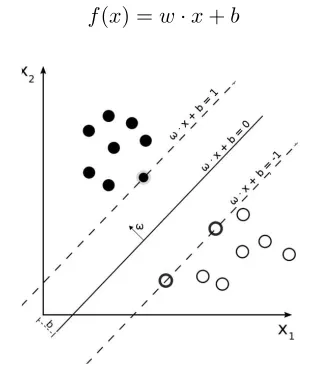
In the last decade, SVM has become one of the most studied techniques for text classification, due to the positive results it has shown. This technique uses the vector space model for the documents’ representa-tion, and assumes that documents in the same class should fall into separable spaces of the representa-tion. Upon this, it looks for a hyperplane that sepa-rates the classes; therefore, this hyperplane should
maximize the distance between it and the nearest documents, what is called the margin. The following function is used to define the hyperplane (see Figure 1):
[image:2.612.342.497.126.311.2]f(x) =w·x+b
Figure 1: An example of binary SVM classification, sep-arating two classes (black dots from white dots)
In order to resolve this function, all the possible values should be considered and, after that, the val-ues ofwandbthat maximize the margin should be
selected. This would be computationally expensive, so the following equivalent function is used to relax it (Boser et al. , 1992) (Cortes and Vapnik, 1995):
min
"
1
2||w||2+C
l X
i=1 ξid
#
Subject to: yi(w·xi+b)≥1−ξi, ξi ≥0
where C is the penalty parameter, ξi is an stack
variable for theithdocument, andlis the number of
labeled documents.
Note that the function above can only resolve bi-nary and supervised problems, so different variants are necessary to perform semi-supervised or multi-class tasks.
2.1 Semi-supervised Learning for SVM (S3VM)
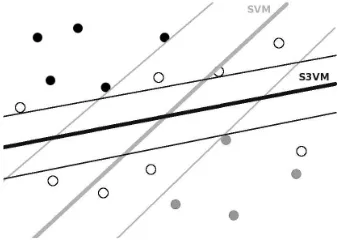
Semi-supervised learning approaches differ in the learning phase. As opposed to supervised ap-proaches, unlabeled data is used during the learn-ing phase, and so classifier’s predictions over them is also included as labeled data to learn. The fact of taking into account unlabeled data to learn can im-prove the classification done by supervised methods, specially when its predictions provide new useful in-formation, as shown in figure 2. However, the noise added by erroneus predictions can make worse the learning phase and, therefore, its final performance. This makes interesting the study on whether relying on semi-supervised approaches is suitable for each kind of task.
Semi-supervised learning for SVM, also known as S3VM, was first introduced by (Joachims, 1999)
in a transductive way, by modifying the original SVM function. To do that, he proposed to add an additional term to the optimization function:
min
1
2· ||ω||2+C·
l X
i=1
ξdi +C∗· u X
j=1 ξj∗d
whereuis the number of unlabeled data.
Nevertheless, the adaptation of SVM to semi-supervised learning significantly increases its com-putational cost, due to the non-convex nature of the resulting function, and so obtaining the minimum value is even more complicated. In order to relax the function, convex optimization techniques such as semi-definite programming are commonly used (Xu et al. , 2007), where minimizing the function gets much easier.
[image:3.612.337.506.61.181.2]By means of this approach, (Joachims, 1999) demonstrated a large performance gap between the original supervised SVM and his semi-supervised proposal, in favour of the latter one. He showed that for binary classification tasks, the smaller is the training set size, the larger gets the difference among these two approaches. Although he worked
Figure 2: SVM vs S3VM, where white balls are
unla-beled documents
with multiclass datasets, he splitted the problems into smaller binary ones, and so he did not demon-strate whether the same performance gap occurs for multiclass classification. This paper tries to cover this issue. (Chapelle et al., 2008) present a compre-hensive study on S3VM approaches.
3 Multiclass SVM
Due to the dichotomic nature of SVM, it came up the need to implement new methods to solve multi-class problems, where more than two multi-classes must be considered. Different approaches have been pro-posed to achieve this. On the one hand, as a direct approach, (Weston, 1999) proposed modifying the optimization function getting into account all thek
classes at once:
min
1
2
k X
m=1
||wm||2+C l X
i=1 X
m6=yi
ξim
Subject to:
wyi·xi+byi ≥wm·xi+bm+ 2−ξ
m
i , ξim≥0
On the other hand, the original binary SVM clas-sifier has usually been combined to obtain a multi-class solution. As combinations of binary SVM clas-sifiers, two different approaches tok-classclassifiers can be emphasized (Hsu and Lin, 2002):
• one-against-allconstructskclassifiers defining
be created. New documents will be categorized in the class of the classifier that maximizes the margin: Cˆi = arg maxi=1,...,k(wix+bi). As
the number of classes increases, the amount of classifiers will increase linearly.
• one-against-one constructs k(k−1)
2 classifiers,
one for each possible category pair. For in-stance, for a problem with 4 classes, 1 vs 2,
1 vs 3, 1 vs 4, 2 vs 3, 2 vs 4 and3 vs 4 clas-sifiers would be created. After that, it classi-fies each new document by using all the clas-sifiers, where a vote is added for the winning class over each classifier; the method will pro-pose the class with more votes as the result. As the number of classes increases, the amount of classifiers will increase in an exponential way, and so the problem could became very expen-sive for large taxonomies.
Both (Weston, 1999) and (Hsu and Lin, 2002) compare the direct multiclass approach to the one-against-one and one-against-all binary classifier combining approaches. They agree concluding that the direct approach does not outperform the results by one-against-one nor one-against-all, although it considerably reduces the computational cost be-cause the number of support vector machines it constructs is lower. Among the binary combin-ing approaches, they show the performance of one-against-oneto be superior toone-against-all.
Although these approaches have been widely used in supervised learning environments, they have scarcely been applied to semi-supervised learning. Because of this, we believe the study on its appli-cability and performance for this type of problems could be interesting.
3.1 Multiclass S3VM
When the taxonomy is defined by more than two classes and the number of previously labeled doc-uments is very small, the combination of both mul-ticlass and semi-supervised approaches could be re-quired. That is, a multiclass S3VM approach. The
usual web page classification problem meets with these characteristics, since more than two classes are usually needed, and the tiny amount of labeled documents requires the use of unlabeled data for the learning phase.
Actually, there are a few works focused on trans-forming SVM into a semi-supervised and multiclass approach. As a direct approach, a proposal by (Ya-jima and Kuo, 2006) can be found. They modify the function for multiclass SVM classification and get it usable for semi-supervised tasks. The resulting op-timization function is as follows:
min1 2
h X
i=1
βiTK−1βi
+C l X
j=1 X
i6=yj
max{0,1−(βyj
j −βji)}2
whereβrepresents the product of a vector of
vari-ables and a kernel matrix defined by the author. On the other hand, some other works are based on different approaches to achieve a multiclass S3VM
classifier.
(Qi et al., 2004) use Fuzzy C-Means (FCM) to predict labels for unlabeled documents. After that, multiclass SVM is used to learn with the augmented training set, classifying the test set. (Xu y Schu-urmans, 2005) rely on a clustering-based approach to label the unlabeled data. Afterwards, they ap-ply a multiclass SVM classifier to the fully labeled training set. (Chapelle et al., 2006) present a direct multiclass S3VM approach by using the
Continua-tion Method. On the other hand, this is the only work, to the best of our knowledge, that has tested theone-against-allandone-against-oneapproaches in a semi-supervised environment. They apply these methods to some news datasets, for which they get low performance. Additionally, they show that one-against-one is not sufficient for real-world multi-class semi-supervised learning, since the unlabeled data cannot be restricted to the two classes under consideration.
It is noteworthy that most of the above works only presented their approaches and compared them to other semi-supervised classifying methods, such as Expectation-Maximization (EM) or Naive Bayes. As an exception, (Chapelle et al., 2006) compared a semi-supervised and a supervised SVM approach, but only over image datasets. Against this, we felt the need to evaluate and compare multiclass SVM and multiclass S3VM approaches, for the sake of
documents is helpful for multiclass problems when using SVM as a classifier.
4 Multiclass SVM versus Multiclass S3VM
The main goal of this work is to evaluate the real contribution of unlabeled data for multiclass SVM-based web page classification tasks. There are a few works using semi-supervised multiclass SVM clas-sifiers, but nobody has demonstrated it improves su-pervised SVM classifier’s performance. Next, we detail the experiments we carried out to clear up any doubts and to ensure which is better for multiclass SVM-based web page classifications.
4.1 Approaches
In order to evaluate and compare multiclass SVM and multiclass S3VM, we decided to use three
differ-ent but equivaldiffer-ent approaches for each view, super-vised and semi-supersuper-vised. For further information on these approaches, see section 3. We add a suffix,
-SVMor-S3VM, to the names of the approaches, to
differentiate whether they are based in a supervised or a semi-supervised algorithm.
On the part of the semi-supervised view, the fol-lowing three approaches were selected:
• 2-steps-SVM: we called 2-steps-SVM to the technique based on the direct multiclass su-pervised approach exposed in section 3. This method works, on its first step, with the train-ing collection, learntrain-ing with the labeled docu-ments and predicting the unlabeled ones; after that, the latter documents are labeled based on the generated predictions. On the second step, now with a fully labeled training set, the usual supervised classification process is done, learn-ing with the trainlearn-ing documents and predictlearn-ing the documents in the test set.
This approach is somehow similar to those pro-posed by (Qi et al., 2004) and (Xu y Schu-urmans, 2005). Nonetheless, the2-steps-SVM
approach uses the same method for both the first and second steps. A supervised multiclass SVM is used to increase the labeled set and, af-ter that, to classify the test set.
• one-against-all-S3VM: the one-against-all
ap-proach has not sufficiently been tested for
semi-supervised environments, and seems interest-ing to evaluate its performance.
• one-against-one-S3VM: the one-against-one
does not seem to be suitable for semi-supervised environments, since the classifier is not able to ignore the inadecuate unlabeled doc-uments for each 1-vs-1 binary task, as stated by (Chapelle et al., 2006). Anyway, since it has scarcely been tested, we also consider this ap-proach.
On the other hand, the approaches selected for the supervised view were these: (1) 1-step-SVM; (2) one-against-all-SVM, and (3) one-against-one-SVM.
The three approaches mentioned above are anal-ogous to the semi-supervised approaches, 2-steps-SVM, one-against-all-S3VM and
one-against-one-S3VM, respectively. They differ in the learning
phase: unlike the semi-supervised approaches, these three supervised approaches only rely on the labeled documents for the learning task, but after that they classify the same test documents. These approaches allow to evaluate whether the unlabeled documents are contributing in a positive or negative way in the learning phase.
4.2 Datasets
For these experiments we have used three web page benchmark datasets previously used for classifica-tion tasks:
• BankSearch (Sinka and Corne, 2002), a col-lection of 11,000 web pages over 11 classes, with very different topics: commercial banks, building societies, insurance agencies, java, c, visual basic, astronomy, biology, soccer, mo-torsports and sports. We removed the category sports, since it includes both soccer and motor-sports in it, as a parent category. This results 10,000 web pages over 10 categories. 4,000 in-stances were assigned to the training set, while the other 6,000 were left on the test set.
• WebKB1, with a total of 4,518 documents of
4 universities, and classified into 7 classes
1
(student, faculty, personal, department, course, project and other). The class namedotherwas removed due to its ambiguity, and so we finally got 6 classes. 2,000 instances fell into the train-ing set, and 2,518 to the test set.
• Yahoo! Science (Tan, 2002), with 788
scien-tific documents, classified into 6 classes (agri-culture, biology, earth science, math, chemistry and others). We selected 200 documents for the training set, and 588 for the test set.
Within the training set, for each dataset, multiple versions were created, modifying the number of la-beled documents, while the rest were left unlala-beled. Thus, the size of labeled subset within the training set changes, ranging from 50 web documents to the whole training set.
4.3 Document Representation
SVM requires a vectorial representation of the docu-ments as an input for the classifier, both for train and test phases. To obtain this vectorial representation, we first converted the original html files into plain text files, removing all the html tags. After that, we removed the noisy tokens, such as URLs, email ad-dresses or some stopwords. For these edited docu-ments, thetf-idf term weighting function was used to define the values for the uniterms found on the texts. As the term dimensionality became too large, we then removed the least-frequent terms by its doc-ument frequency; terms appearing in less than 0.5% of the documents were removed for the representa-tion. The remaining uniterms define the vector space dimensions. That derived term vectors with 8285 di-mensions forBankSearchdataset, 3115 forWebKB
and 8437 forYahoo! Science.
4.4 Implementation
To carry out our experiments, we based on freely available and already tested and experimented soft-ware. Different SVM classifiers were needed to im-plement the methods described in section 4.1.
SVMlight2 was used to work with binary
semi-supervised classifiers for the one-against-all-S3VM
andone-against-one-S3VMapproaches. In the same
way, we implemented their supervised versions,
2http://svmlight.joachims.org
one-against-all-SVM and one-against-one-SVM, in order to evaluate the contribution of unlabeled data. To achieve the supervised approaches, we ignored the unlabeled data during the training phase and, af-ter that, tested with the same test set used for semi-supervised approaches. The default settings using a polynomial kernel were selected for the experi-ments.
SVMmulticlass3 was used to implement the
2-steps-SVMapproach, by using it two times. Firstly, to train the labeled data and classify unlabeled data. After that, to train with the whole training set labeled with classifier’s predictions, and to test with the test set. In the same way, the1-step-SVM method was implemented by ignoring unlabeled data and train-ing only the labeled data. This method allows to evaluate the contribution of unlabeled data for the
2-steps-SVMmethod.
4.5 Evaluation Measures
For the evaluation of the experiments we used the
accuracyto measure the performance, since it has been frequently used for text classification prob-lems, specially for multiclass tasks. The accuracy offers the percent of the correct predictions for the whole test set. We have considered the same weight for all the correct guesses for any class. A correct prediction in any of the classes has the same value, thus no weighting exists.
On the other hand, an averaged accuracy evalu-ation is also possible for the binary combining ap-proaches. An averaged accuracy makes possible to evaluate the results by each binary classifier, and provides an averaged value for the whole binary classifier set. It is worth to note that these values do not provide any information for the evaluation of the combined multiclass results, but only for evaluating each binary classifier before combining them.
5 Results and Discussion
Next, we show and discuss the results of our experi-ments. It is remarkable that both one-against-one-SVM and one-against-one-S3VM approaches were
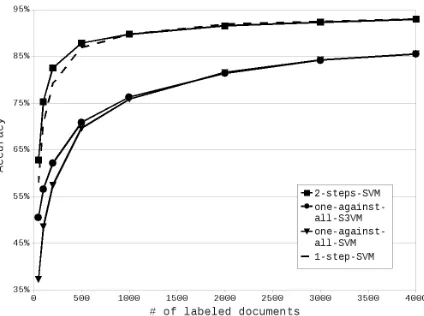
very inferior to the rest, and so we decided not to plot them in order to maintain graphs’ clarity. Hence, figures 3, 4 and 5 show the results in accordance
with the labeled subset size for the2-steps-SVM, 1-step-SVM, one-against-all-S3VM and
one-against-all-SVM approaches within our experiments. For the results to be more representative, nine execu-tions were done for each subset, obtaining the mean value. These nine executions vary on the labeled subset within the training set.
The fact thatone-against-one-S3VMhas been the
worst approach for our experiments confirms that the noise added by the unlabeled documents within each 1-vs-1 binary classification task is harmful to the learning phase, and it is not corrected when merging all the binary tasks.
The averaged accuracy for the combined bi-nary classifiers allows to compare the one-against-one and one-against-all views. The averaged ac-curacy for one-against-one-S3VM shows very low
performance (about 60% in most cases), whereas the same value for one-against-all-S3VM is much
higher (about 90% in most cases). This is obvi-ous to happen for the one-against-all view, since it is much easier to predict documents not pertain-ing to the class under consideration for each 1-vs-allbinary classifier. Although each binary classifier gets about 90% accuracy for the one-against-one-S3VMapproach, this value falls considerably when
[image:7.612.313.529.70.223.2]combining them to get the multiclass result. This shows the additional difficulty for multiclass prob-lems compared to binary ones. Hence, the difficulty to correctly predict unlabeled data increases for mul-ticlass tasks, and it is more likely to add noise during the learning phase.
[image:7.612.315.534.298.447.2]Figure 3: Results for BankSearch dataset
Figure 4: Results for WebKB dataset
Figure 5: Results for Yahoo! Science dataset
For all the datasets we worked with, there is a noticeable performance gap between direct multi-class and binary combining approaches. Both 2-steps-SVM and 1-step-SVM are always on the top of the graphs, and one-against-all-S3VM and
one-against-all-SVM approaches are so far from catch-ing up with their results, except forWebKBdataset, where the gap is not so noticeable. This seems en-couraging, since considering less support vectors in a direct multiclass approach reduces the computa-tional cost and improves the final results.
Comparing the two analogous approaches among them, different conclusions could be extracted. On the one hand, one-against-all-S3VM shows
[image:7.612.75.287.516.674.2]favourable for theone-against-allview. On the other hand, the direct multiclass view shows varying re-sults. Both2-steps-SVMand1-step-SVMshow very similar results forBankSearch andYahoo! Science
datasets, but superior for 1-step-SVM over the We-bKBdataset. As a conclusion of this, ignoring un-labeled documents by means of the1-step-SVM ap-proach seems to be advisable, since it reduces the computation cost, obtaining at least the same results than the semi-supervised2-steps-SVM.
Although their results are so poor, as we said above, the supervised approach wins for the one-against-oneview; this confirms, again, that the one-against-oneview is not an adecuate view to be ap-plied in a semi-supervised environment, due to the noise existing during the learning phase.
When analyzing the performance gaps between the analogous approaches, a general conclusion can be extracted: the smaller is the labeled subset the bigger is the performance gap, except for the Ya-hoo! Science dataset. Comparing the two best approaches,1-step-SVM and2-steps-SVM, the per-formance gap increases when the number of la-beled documents decrease forBankSearch; for this dataset, the accuracy by 1-step-SVM is 0.92 times the one by2-steps-SVMwhen the number of labeled documents is only 50, but this proportion goes to 0.99 with 500 labeled documents. This reflects how the contribution of unlabeled data decreases while the labeled set increases. For WebKB, the perfor-mance gap is in favour of 1-step-SVM, and varies between 1.01 and 1.05 times2-steps-SVMmethod’s accuracy, even with only 50 labeled documents. Again, increasing the labeled set negatively affects semi-supervised algorithm’s performance. Last, for
Yahoo! Science, the performance gap among these two approaches is not considerable, since their re-sults are very similar.
Our conjecture for the performance difference be-tween 1-step-SVM and 2-steps-SVM for the three datasets is the nature of the classes. The accuracy by semi-supervised 2-steps-SVM is slightly higher for BankSearch and Yahoo! Science, where the classes are quite heterogeneous. On the other hand, the accuracy by supervised 1-step-SVM is clearly higher forWebKB, where all the classes are an aca-demic topic, and so more homogeneous. The semi-supervised classifiers show a major problem for
pre-dicting the unlabeled documents when the collection is more homogeneous, and so more difficult to differ between classes.
In summary, the main idea is that unlabeled doc-uments do not seem to contribute as they would for multiclass tasks using SVM. Within the approaches we tested, the supervised 1-step-SVM approach shows the best (or very similar to the best in some cases) results in accuracy and, taking into account it is the least-expensive approach, we strongly en-courage to use this approach to solve multiclass web page classification tasks, mainly when the classes under consideration are homogeneous.
6 Conclusions and Outlook
We have studied and analyzed the contribution of considering unlabeled data during the learning phase for multiclass web page classification tasks using SVM. Our results show that ignoring unlabeled doc-ument to learn reduces computational cost and, ad-ditionaly, obtains similar or slightly worse accuracy values for heterogeneus taxonomies, but higher for homogeneous ones. Therefore we show that, unlike for binary cases, as was shown by (Joachims, 1999), a supervised view outperforms a semi-supervised one for multiclass environments. Our thought is that predicting unlabeled documents’ class is much more difficult when the number of classes increases, and so, the mistaken labeled documents are harmful for classifier’s learning phase.
As a future work, a direct semi-supervised multi-class approach, such as those proposed by (Yajima and Kuo, 2006) and (Chapelle et al., 2006), should also be considered, as well as setting the classifier with different parameters or kernels. Balancing the weight of previously and newly labeled data could also be interesting to improve semi-supervised ap-proaches’ results.
Acknowledgments
References
B. E. Boser, I. Guyon and V. Vapnik. 1992. A Training Algorithm for Optimal Margin Classifiers. Proceed-ings of the 5th Annual Workshop on computational Learning Theory.
C. Campbell. 2000. Algorithmic Approaches to Training Support Vector Machines: A Survey Proceedings of ESANN’2000, European Symposium on Artificial Neu-ral Networks.
O. Chapelle, M. Chi y A. Zien 2006. A Continuation Method for Semi-supervised SVMs. Proceedings of ICML’06, the 23rd International Conference on Ma-chine Learning.
O. Chapelle, V. Sindhwani, S. Keerthi 2008. Optimiza-tion Techniques for Semi-Supervised Support Vector Machines.J. Mach. Learn. Res..
C. Cortes and V. Vapnik. 1995. Support Vector Network.
Machine Learning.
C.-H. Hsu and C.-J. Lin. 2002. A Comparison of Meth-ods for Multiclass Support Vector Machines. IEEE Transactions on Neural Networks.
T. Joachims. 1998. Text Categorization with Support Vector Machines: Learning with many Relevant Fea-tures. Proceedings of ECML98, 10th European Con-ference on Machine Learning.
T. Joachims. 1999. Transductive Inference for Text Classification Using Support Vector Machines. Pro-ceedings of ICML99, 16th International Conference on Machine Learning.
J. Kivinen and E.J. Smola and R.C. Williamson. 2002. Learning with Kernels.
T. Mitchell. 1997.Machine Learning. McGraw Hill. H.-N. Qi, J.-G. Yang, Y.-W. Zhong y C. Deng 2004.
Multi-class SVM Based Remote Sensing Image Classification and its Semi-supervised Improvement Scheme. Proceedings of the 3rd ICMLC.
X. Qi and B.D. Davison. 2007. Web Page Classification: Features and Algorithms. Technical Report LU-CSE-07-010.
B. Sch¨olkopf and A. Smola. 1999. Advances in Kernel Methods: Support Vector Learning. MIT Press. F. Sebastiani. 2002. Machine Learning in Automated
Text Categorization. ACM Computing Surveys, pp. 1-47.
M.P. Sinka and D.W. Corne. 2002. A New Benchmark Dataset for Web Document Clustering. Soft Comput-ing Systems.
C.M. Tan, Y.F. Wang and C.D. Lee. 2002. The Use of Bigrams to Enhance Text Categorization. Information Processing and Management.
J. Weston and C. Watkins. 1999. Multi-class Support Vector Machines. Proceedings of ESAAN, the Euro-pean Symposium on Artificial Neural Networks.
L. Xu y D. Schuurmans. 2005. Unsupervised and Semi-supervised Multiclass Support Vector Machines. Pro-ceedings of AAAI’05, the 20th National Conference on Artificial Intelligence.
Z. Xu, R. Jin, J. Zhu, I. King and M. R. Lyu. 2007. Ef-ficient Convex Optimization for Transductive Support Vector Machine.Advances in Neural Information Pro-cessing Systems.